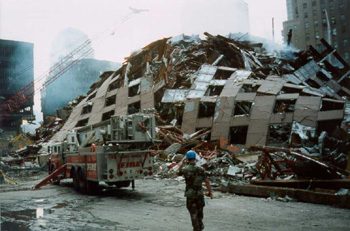
The 47-story 7 World Trade Center greatly reduced
Is Larry Silverstein a greedy man interested in power and fame? Or is he just trying to do his sad little thing again?
Mondays front page NYTimes article tells us that Larry Silverstein now has control over what happens at the site of the World Trade Center. Later in its text we are told that Silverstein annoys a lot of important people because he has a tin ear for political discourse. But his affliction is much more serious. He has a tin soul. He certainly has a tin aesthetic.
I read a lot about whats happening in New York, but I have an additional connection with Mr. Silverstein. I worked in an office high in 7 World Trade Center for about a dozen years. That building, which collapsed the afternoon of September 11, was Silversteins personal flagship before he acquired the lease to the Twin Towers 6 weeks earlier.
7 World Trade, which was across the street from the two Trade Center towers themselves, fell most likely as a consequence of the combustion of fuel stored for emergency generators designed as a backup for his friend Mayor Giulianis suspiciously ill-conceived high-tech 23rd-floor [sic] emergency command bunker. But no one talks about the fact that Silverstein, in his anxiety to attract Solomon Brothers as his prime tenant, had the entire 43rd floor removed after the building was completed in order that a trading floor could be constructed as part of their occupancy, with unknown consequences for the integrity of the building when put under severe stress. But what do I know?
What I do think I know is that Silverstein should be perhaps a building superintendent or possibly the owner of a chain of dry cleaning establishments. He should not be the arbiter of taste or design for what is arguably the most important site and the most important building project of our time.
Like his familys nemesis, Donald Trump, Silverstein is not a self-made man. He started not at the bottom, but somewhere near the upper middle, and managed to advance only to the upper reaches of the upper middle, at least until just before the disaster which destroyed all of his showy real estate.
7 World Trade was a machine, an ugly monstrosity. The building had not even opened when its lobby was chosen as stand-in for the fictional inhuman Wall Street high-rise office building in Oliver Stones film Wall Street. If you know anything about the film, you know this was a very appropriate location choice.
Everything about the environment of 7 World Trade was repellant, but somewhere along the line a curator must have persuaded Silverstein to decorate his repellant lobbies with painting and sculpture from significant, even great, contemporary American artists. Then Larry destroyed this worthy impulse by installing a number of kitschy, junky, iron-man, submissive-woman and Amerindian-racist sculptures in the same areas. I can confirm it was Silversteins doing, and that it was work by a friend of his, someone he was said to admire. I made inquiries at the time they appeared in the lobbies, I was so amazed that they were there that they could even exist in public in New York City at the end of the 20th century. These uglies were finally removed several years before September 11. The Held, Lichtenstein, Nevelson and others were destroyed along with the building.
Silverstein has been tolerated in or advanced to the importance he occupies in the redevelopment of the World Trade Center site only because for various reasons he appears to be in a position to get things started in time to satisfy the agenda of those who need something started right now. Bloomberg, Pataki, the national Republican Party and any number of commercial and political interests in New York and elsewhere are concerned not with the social, moral or aesthetic values of whatever takes shape west of lower Church Street, but with the political and financial opportunities early construction will offer them.
Silverstein is paying $120 million in rent to the Port Authority each year, but he receives no income from the 16-acre site. Silverstein wants to build now. Thats all hes concerned about. There is not one word in the Times article that suggests he has any other interest.
His motive is not patriotism or altruism, and I dont think the man is looking for power, fame or even more fortune. He and his financial backers have an investment, and they want it to pay off. That’s his job. It’s business – as usual. All right, Silverstein is 72, and Im sure hed be in a hurry for that reason alone, even if he didnt believe lots of huge, new, dreary office buildings would suitably crown a quite ordinary career. There is no time or room for beauty, vision, or greatness of any kind in this kind of deal.
If Larry Silverstein retains control of “ground zero,” New York and the entire world is a loser.
Category: Culture
probably a very good thing
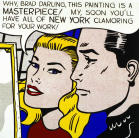
If you missed the birth of Abstract Expressionism, Op Art, Pop Art, Minimalism, the rise of Conceptual and Process Art, The New Realism, even Grafitti Art, all because you weren’t born yet (or maybe because your parents weren’t born yet!) or just because you were elsewhere engaged, don’t miss this one. Stop by John Connelly Presents tomorrow evening and be a part of your time.
It doesn’t have a name yet, and that’s probably a very good thing, but in the NYTimes on Friday Roberta Smith tried to describe the current unfolding arts phenomenon. She did alright.
Group shows are proliferating all over town, especially in Chelsea, with more opening this week and next. But the energy of this year’s explosion transcends format. New York seems to be having a Summer of Art not unlike the 1967 Summer of Love in its liberating effects. Mark my words, or those of an astute junior observer who simply termed it “our June 2003 moment.” Whatever, it’s still going strong this weekend with an array of artworks, curatorial ideas and aesthetic developments that reveal the quickening, centrifugal vitality of contemporary art, a result of several combustible collisions or collusions.
One way to put it is that the “Return of the Real,” as the critic Hal Foster noted in the late 1980’s, is being met head on by the “Return of the Formal,” most visibly in the prominence of saturated color that runs through these shows like a radiant thread (as it does through this year’s Venice Biennale).
From another angle, the counterculture and avant-garde tendencies of the late 60’s and early 70’s continue their fruitful interaction. That is, the handicrafts, scavenging, sexual openness, psychedelic palette, body decorations and druggy spirituality of the hippie era are being given backbone by the reductivist tendencies, material eccentricities and political consciousness of Conceptual Art and Process Art.
Design and architecture are part of the mix, as are continuing variations on Grafitti Art. There is a fuller embrace of the Pleasure Principle, which is perhaps the most important legacy of popular culture. Artists want to have fun, but not just fun. Call it responsible hedonism. Op Art’s revenge.
Implicit is a free-flowing equality of media, mixed or unmixed. Video has assumed the very position into which it forced painting in the late 1980’s: it is now one among many means of expression. Artists are developing so many distinctive and individual ways of working with it that often you barely see it anymore. Finally, in all mediums, collage, sampling, appropriation, bricolage, recycling call it what you will continues to mutate and expand as an artistic strategy, an ecological statement and a metaphor for inclusiveness.
John Connelly opens a very special group show tonight at 6 o’clock, called “Today’s Man.” You won’t be able to get into the gallery space itself if you’re shy about human contact, but the huge hot and happy crowd will hold down the hall as well, so you won’t be lonely.
From John’s press release:
“Today’s Man” is an exhibition of mostly small works on paper and canvas (paintings, collages, drawings etc. but no photography) and consists solely of representations of men by male artists. The relatively small scale of the works (almost all are less than 18 x 18 inches) is a purposeful inversion of what one might normally associate with the stereotype of the patriarchal grand canvas.
So maybe it’s ok if it’s just about guys this time.
“criminals in lust,”
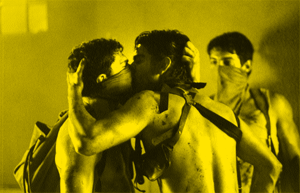
And in love.
Barry and I were totally inside the little screen yesterday afternoon, a part of the film “Burnt Money (Plata Quamada).” It was far more than either of us had expected, and all of the mainstream reviews we had seen earlier seem to have missed the point. It was sexy, hot, beautiful, political, redemptive, claustrophobic, reckless, sweaty, crudely violent, yet barely and rarely innocent and sweet, and very, very elegant.
There is a heartbreaking scene lasting only a few seconds, more than half-way into the film, where the “twins” are filmed from below a balcony in a carnival dance hall. Colorful stips of lights run across the ceiling above the two graceful figures in their suits, caught dancing a slow, elegant tango worthy of the dance’s working-class male origins.*
Another very different moment earlier in the story, when Nene calmly removes a bullet from the shoulder of the recumbent Angel, who has refused to take a narcotic (he tells his partner he wants to feel everything) is unbelievably erotic. I know, it sounds awful. You have to be there.
Jason Anderson writes in Eye Weekly:
Based on the real-life exploits of a gang of Argentinian robbers in late 1965, Burnt Money offers a stylish, pulpy combination of sweaty hunks and blazing guns. It’s the sort of film that leaves its characters soaked in blood, perspiration, spunk or — ideally — all three at once.
. . . .
[The film’s director, Marcelo] Piñeyro explains that, in the underworld of Buenos Aires, “homosexuality wasn’t — and isn’t — a cause of rejection, as it was, and probably still is, in the middle classes. Homosexuality wasn’t associated with weakness. Besides, homosexuality was part of the life in jail. Nobody in the underworld had prejudices about it.”
But the characters’ sexual identities are at once open and closeted in the film. One of the most exciting things about Burnt Money is how it inverts the standard pattern of gay relationships on film. The Twins’ relationship is transformed from one that is open and sensual into one in which their desires are frustrated and repressed — with suitably apocalyptic repercussions.
Anderson concludes his review bluntly, after quoting Piñeyro describing his cinematic influences, “his fevered Burnt Money is a real sweatbox of a movie.”
The sweat is dry, but I still feel I’m inside that box.
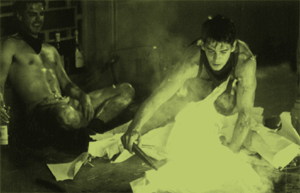
[thanks to Pagina12 for the images]
____________________
*
The dance was created by men, and men first danced together to sharpen their style, and only then [most?] went out and danced with women.
garden art
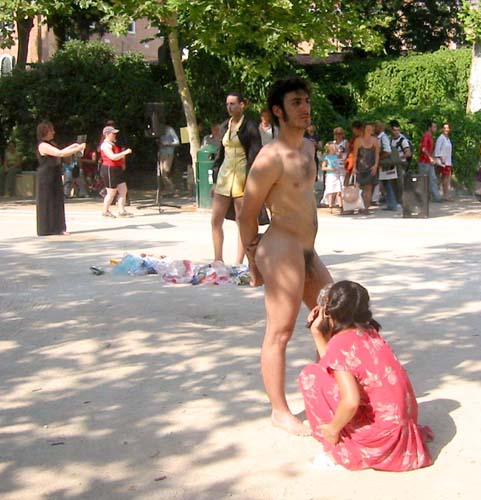
Artnet has some good images from the Venice Biennale. The photograph above, of artists in the gardini, helps to explain the seductive appeal of this event. Obviously it’s not just the venue.
Well, we did hear that the temperature was 108 on the opening days.
the D’Amelio Terras thing
Barry and I were among the teeming cultured masses in and outside of D’Amelio Terras tonight for the opening of the amazing show, “Now Playing: Daniel Reich Gallery, John Connelly Presents, K48,” which the gallery describes as a group of “three emerging artistic programs.”
In the pictures below I was behind the camera, out of its range, so everything you will see is beautiful, although what was supposed to have attracted the crowd, the art, remained inside, where I was much too busy so my camera never saw it. For 10 images of the installation, see the gallery site as a tease, but make sure you get to 22nd Street. It’s a great show. You’ll want to tell somebody’s grandchildren about it. Oh, and lots of stuff is “affordable” as we like to hear it described, beginning with artist-constructed CDs in their exotic cases, starting at $15 or so.
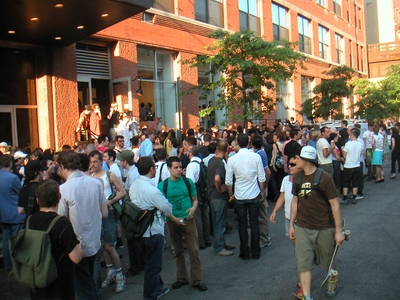
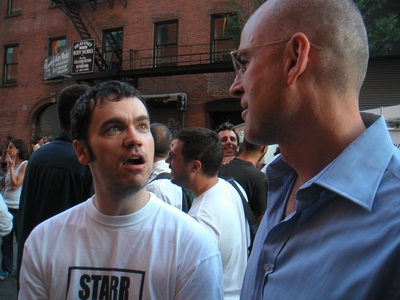
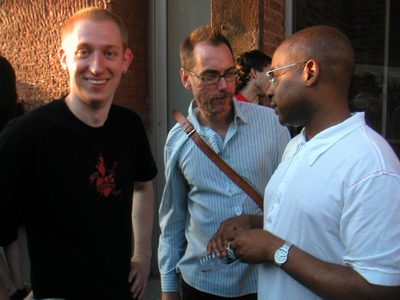
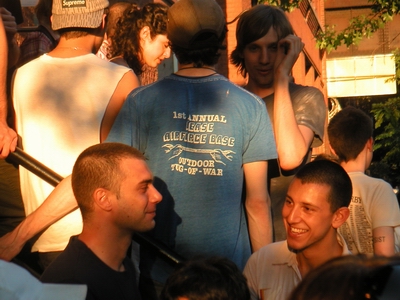
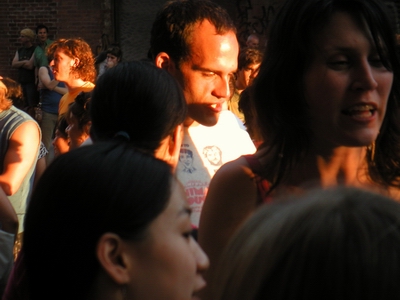
In the second picture, that’s Conyers Thompson on the right (he’s surprisingly single!), apparently shocking the Barry, and in the third, Scott Treleaven, Joe Wolin and Glenn Ligon are taking in the air – and the art fans.
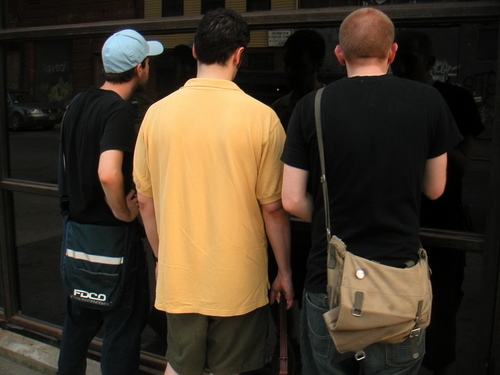
Williamsburg tourists
“Paul P. Last Flowers”
[revised June 26 with additional information]
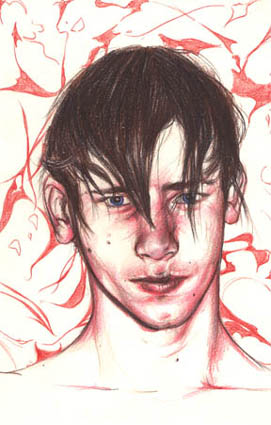
I can’t believe I hadn’t yet posted anything on a wonderful artist very new to New York, who is opening a one-man show tonight at Daniel Reich.
Disclaimer: We bought three of Paul P.‘s works from Daniel’s last, wonderfully-over-the-top show, “Karaoke Death Machine,” one painting and two images in colored pencil on paper. They are a treasure.
Even as they were effectively mounted as only a part of the magical collage-of-the-whole which composed that show, Paul’s pictures, the pink boys and vases of flowers, stood out for their purity and energy – and beauty. In fact they are together the survivors of two plagues. The boys are innocent faces drawn from pre-AIDS porn, the flower arrangements pay homage to Manet‘s last works, those in which he delighted while dying of syphilis. The title of the show at Daniel Reich is “Paul P. Last Flowers.”
The lines of the pencil images float, like delicate etchings, softly colored, on tissue. Tonight’s opening should be dynamite, and that’s without accounting for the crowd, which should be worth a run-through for its own beauty and its frisson!
Toronto-based, Paul has shown work in Toronto, Stratford, Winnipeg, Santa Monica and on the othergallery, a web-based nomadic gallery that, like its Winnipeg home gallery, focuses on Contemorary Canadian Art. [Who knew that Winnipeg was in Scotland? Listen to the delightful accents of several of the people interviewed in the CBC story.]
Daniel Reich is located at 308 West 21st Street, 2A, New York. The show continues until July.
Oh, has anyone else noticed how hot Canada is these days – at least here in New York?
“I don’t know”
Joseph Chaikin died on Sunday at his home in Greenwich Village.
The great actor and creative director had lived for years with the burden of a congenital heart disease, but this weekend he finally had to leave the boards. His sister, the actress Shami Chaikin, who was with him when he died, reports, in today’s NYTimes obituary, how he worked up to the end. He was in Philadelphia auditioning actors on thursday and friday, and he was supposed to have a meeting in his home yesterday.
“He always felt he had to work,” Shami Chaikin said. But over the weekend, she added, he felt weak and thought he might have to use a wheelchair. “Everything started to fail,” she said. He took a sleeping pill and went to bed, and awoke with distress. She said she asked him what was wrong.
“I don’t know,” he said. She said those were his last words and he spoke them questioningly, almost analytically, as if trying to understand his role.
really missing Mark Lombardi
I came late to Jerry Salz’s beautiful tribute to Mark Lombardi last month in the Village Voice, having pulled it off my reading stack only this weekend, but Saltz’s paean and his regret for our loss of this wonderful artist has probably gained even more profundity with the passage of even these few weeks. Lombardi hanged himself in his Williamsburg loft March 22, 2000.
Needless to say, our post-9-11 age would have been Lombardi’s glory days. I don’t mean this lightly. We need him. It’s heartbreaking that he isn’t here to help diagram everything that has happened lately.
Saltz’s memorial was inspired by the incredible show then hanging in Joe Amrhein’s iconic gallery, Pierogi 2000, in Williamsburg.
Lombardi is more than a conceptualist or political artist. He’s a sorcerer whose drawings are crypto-mystical talismans or visual exorcisms meant to immobilize enemies, tap secret knowledge, summon power, and expose demons. The demons Lombardi concerned himself with, however, weren’t otherworldly. He was after real people who were either hiding in plain sight or who had managed to fade into the woodwork. Lombardi was on a mission: He wanted to right wrongs by revealing them. Instead of critiquing the system, like so many contemporary conceptualists, or journeying to other psychic dimensions like shamans, Lombardi assumed the personas of the grand inquisitor, the private investigator, and the lone reporter. He followed the money.
I loved the way his mind worked. But it was his wildly suspicious imagination and his maniacal attention to and ultra-distrust of the status quo that made me think Lombardi was ill-starred. He was a rangy, whimsical, articulate guy, prone to fidgetiness and discomfiture, and if you asked him anything about his work, you’d get a way too detailed answer. But these garrulous explanations always came with a crooked smile and an expectant look that seemed to say, “I know this is strange, but it’s all true.”
Thanks Mark, Joe, and Jerry
naked for art – and much more
Spencer Tunick did his thing in Barcelona on Sunday. But Barcelona did more than Spencer’s thing.
While Mayor of New York, Rudolph Giuliani censored Tunick’s art, along with the inclination of New Yorkers to happily get naked in its service. Giuliani had managed to arrest, and sometimes jail, Tunick 5 times. Three years ago a photoshoot much smaller than Barcelona’s was proposed for a Sunday dawn in an area virtually empty of people, but there was to be no joy, no art in Gotham that morning, thanks to our prosecutorial hypocrite.
In Barcelona the authorities seem to have had no problem with 7,000 (described as up to 12,000 elsewhere) happy naked Spaniards filling a “sweeping Barcelona boulevard” in daylight, and even provided a nearby massive convention hall for an assembly area.
But the Catalonian crowd was interested in more than art or mass urban nudity. As Tunick gave them the go-ahead, speaking into a microphone,
The crowd erupted into cheers and then chants of “No War!” and “No to Bush!”
Ozan Sezen, who works with computers, said he had read with dismay of Mr. Tunick’s repeated installation-related arrests in New York City several years ago. The Supreme Court eventually ruled that Mr. Tunick had a right to stage his art outside without being jailed, but the Giuliani administration rejected his subsequent permit request; Mr. Tunick has not approached Mayor Michael R. Bloomberg for permission.
Mr. Sezen, 35, who was wearing a T-shirt that said “Rock Solid Beefcake,” prepared to take it off.
“In many of his exhibitions, there are a lot of fat guys, which makes it much easier,” he said.
The time came. There was loud cheering, and the sound of thousands of underpants hitting the floor. Everyone walked outside, naked.
The intrepid reporter joined them, with only a notepad for cover.
Then it was over. Some people jogged nude up and down the boulevard. Others re-dressed. Inside, Scott Ansell, 31, an Englishman who had already taken part in an earlier work by Mr. Tunick, involving hundreds of naked people riding the escalators in a London department store, mused on the cultural differences.
“The English seemed a bit more giggly,” he said. “I get the impression that half of the people here will be naked later today, anyway.”
His friend Jane Hyde, 44, said of the apparent Spanish tendency to spank their own naked rear ends as a form of applause, “That bottom-smacking thing is rude!”
Ahhhhh.
For a small slideshow of pictures, see Reuters.