Isabel Toledo at FIT

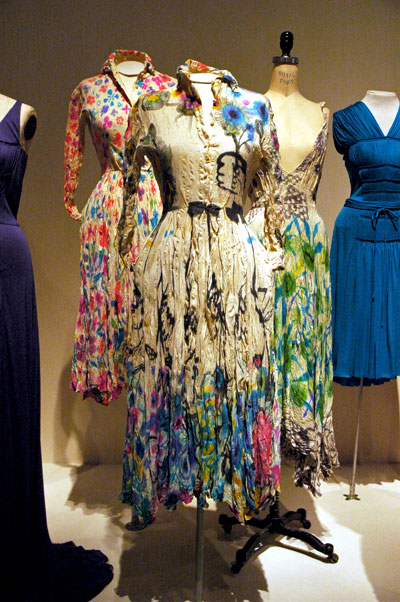
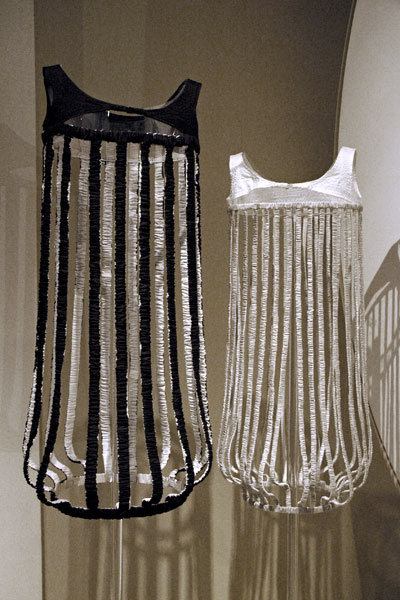
Toledo_Harness_Dresses.jpg
Harness dresses 2003
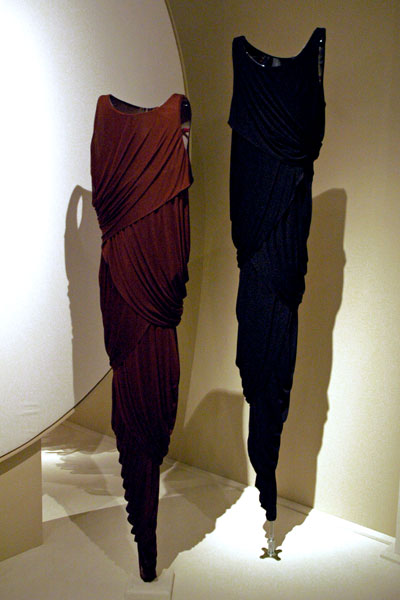
Toledo_Cornflower_Dress.jpg
Half Moons Blossom into a Cornflower dresses 1998
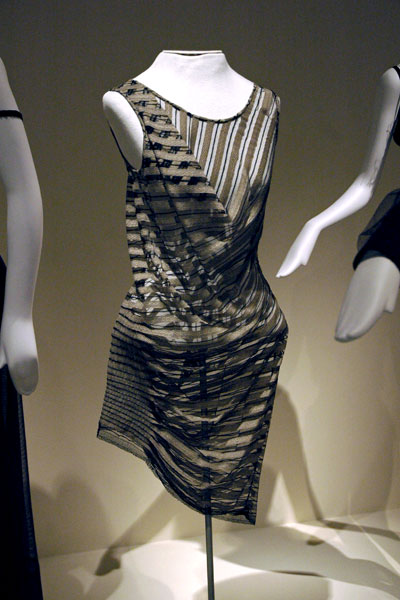
Toledo_One_Seam.jpg
One Seam lace dress 1998

Toledo_Broomstick_shirtwaist.jpg
Broomstick Librarian shirtwaist dresses (hand-painted by Ruben Toledo) 2008
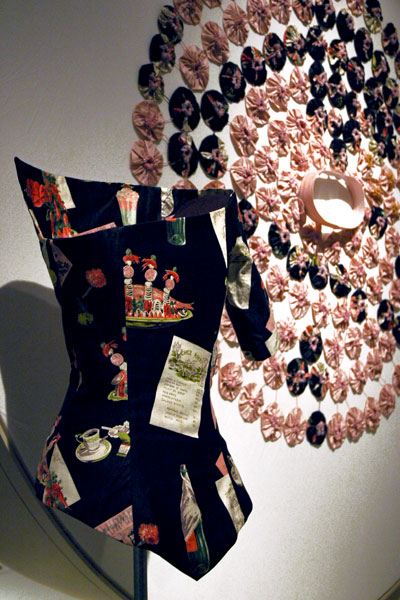
Toledo_Pouch_Skirt.jpg
Pouch skirt and one-sleeve corset top 1988

I wandered over to the Museum at the Fashion Institute of Technology [FIT] this morning at dawn (okay, 10am) for the press preview of “Isabel Toledo; Fashion from the Inside Out“. Why? Because I’ve always been interested in innovative and creative clothing of any kind, both historical and contemporary, and because I’ve been particularly enamored of Toledo’s gentle art and the independence and originality with which this beautiful woman and her equally-beautiful husband and partner, the illustrator Ruben Toledo, have gone about making New Yorkers beautiful since the early 80’s. I moved to New York in 1985, the year of Isabel’s first show.
In many ways this mid-career retrospective is about both Isabel and Ruben. Isabel refers to herself not as a designer but as a seamstress, “the one who views fashion from the inside!” She describes her creative process as beginning with a feeling and an idea in her head which she describes to Ruben who then illustrates it in drawings.
Actually, I’d describe her as an architect as well – top-notch. Maybe that’s what really brought me to the show.
“Isabel Toledo” opens to the public tomorrow. There are some wonderful moments, with great beauty and simplicity balanced by some serious humor and awesome complexity.
I was surprised to read in the press release that Toledo was “unknown to the general public” until Michelle Obama appeared in her ensemble on Inauguration Day. That “lemongrass yellow wool lace shift dress with matching overcoat ” is installed behind glass and next to a guard at FIT, and to most of the journalists present this morning it was obviously the most important piece in the show, even if it was certainly the most conservative and otherwise the least remarkable.
But should it be a surprise that the cult of personality is very much alive in the world of fashion? Still, while I’m happy for this beautiful couple that the inevitable installation of this dress and coat within the Smithsonian Museum won’t hurt their visibility, anything approaching popular hysteria still seems pretty alien to the more subtle art of the rest of the work installed inside the museum on Seventh Avenue.
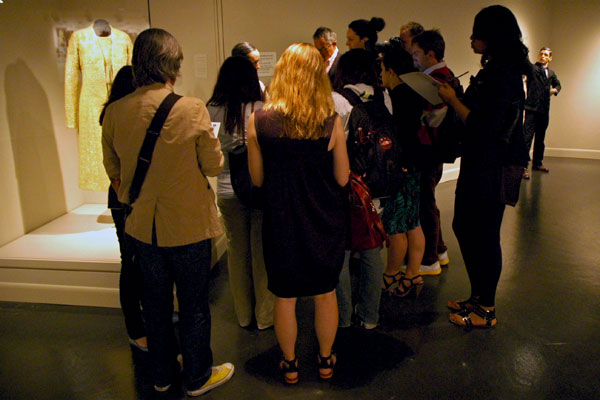
Toledo_Inaugural.jpg
Isabel meets the press in front of “the ensemble” as Ruben records the moment

Iran’s people just might win this one

Tehran-protest-Supporters-007.jpg
some of the hundreds of thousands of Mousavi supporters marching in silence today in central Tehran (green was the signature color of the opposition’s campaign)

I think they’re going to make it. There will be more demonstrations tomorrow, and the protests are likely to be more broadly-based and increasingly countrywide. A general strike has been called for the same day.
Iran’s twentieth-century political history is a complex story, and the second half especially includes a far-from-innocent involvement on the part of the U.S. [fed first by our lust for oil and Cold War hysteria – okay, it was actually pretty disgusting], but today it suddenly appears that the people who created and maintained one of the greatest civilizations in human history just may be about to emerge from the tyranny of a crude religious fanaticism which had briefly hijacked both their own best hopes and the world’s admiration for their magnificent culture.
I’d like to add that I wish that ordinary U.S. citizens had the kind of political courage being displayed on the streets of Iran today; We could certainly use it. Beginning last November I’ve been expressing my doubts about whether we were going to get what we had voted for. I should be writing more about my increasing fear and disgust, but I’ll wait for another occasion.

ADDENDUM: I just saw this Ted Rall cartoon. Although I said I wouldn’t go into Obama’s failures now, I couldn’t resist the adding this note. I do this even though Rall doesn’t address our hope-and-change President’s equally disturbing failure to address the economic meltdown (instead handing over the government to Wall Street), and his cynical reversals on gay rights issues.

[image, from the Guardian, by Abedin Taherkenareh/European Press Photo]

COV’s “Greek”: brilliantly mounted – and great fun too

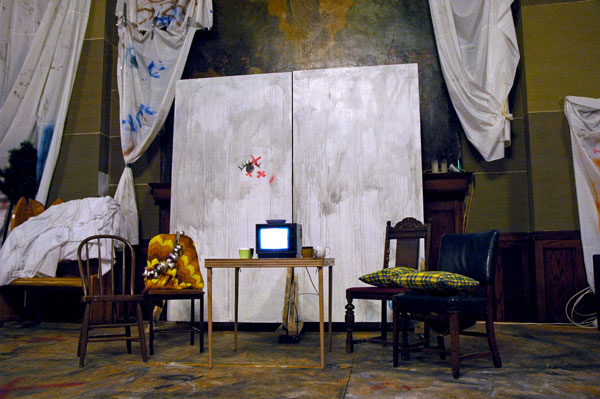
Greek_set_Chicago_Opera_Vanguard_bed-sitter.jpg
the flat

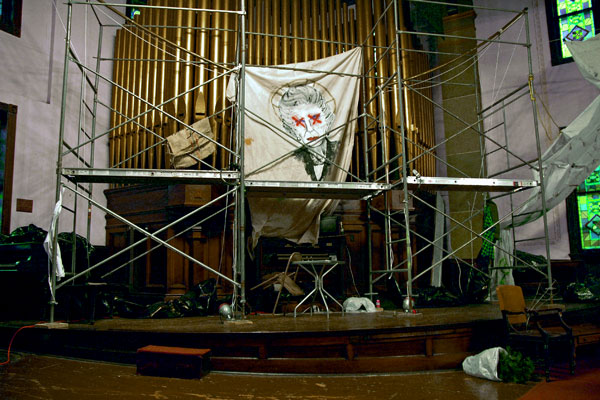
Greek_Chicago_Opera_Vanguard_caf.jpg
the caf

Barry and I both love Mark-Anthony Turnage‘s work, and we love our fifteen-year-old CD of his 1988 opera, “Greek”, in which he reinvents the Oedipus myth in London’s East End during the plague years of 1980’s Thatcherian England, using a 1984 play by Steven Berkoff as a base. I don’t think we ever expected to see a production of this exciting piece in the U.S., especially here in New York, where opera programmers and patrons haven’t even begun to acknowledge the music of the last one hundred years.
We had already made arrangements for a trip to Chicago (from which we returned late last night) when we first learned that Chicago Opera Vanguard, a spunky young opera company, was staging “Greek” somewhere on the edge of downtown while we were going to be there. We would probably have traveled west just to see this work live but it appears that the ancient gods aren’t dead yet and had secretly made the arrangements for us.
As it turns out, not only was the pleasure we got for our short trip out to Wicker Park Saturday night all out of proportion to the small effort we had expended, we would even have considered it worth the 1500 round-trip miles if we had made a special trip just for this particular “Greek”.
No, there were no supertitles, so in the planned-chaos and fantastic mix of this thrilling staging some of the dialogue may have been lost, but the extraordinary beauty, intelligence, creativity and sheer exuberance of everything and everyone involved in the production made it one of the most exciting operatic performances I’ve seen. It doesn’t hurt that the setting also summons the devils of our own contemporary plague years. And, yes, it really is opera.
The production was carved out of a somewhat eccentric late nineteenth-century “defrocked” (very appropriate, that) church, now the St. Paul Arts Center, with a wonderful and oddly-anachronistic avant-garde theater seating plan.
We arrived early to pick up our tickets and when I peeked through the doors to the theater space from the foyer where the “box office” was located I saw what appeared to be a set still in the making (scaffolding, buckets and sheets and such). Minutes later I saw instead that what I was looking at was actually a detail of the most thoroughly-broadcast set decoration operation I’d ever seen. The entire church was the stage for the opera, as we learned the moment it began, and that included the balcony above us, where music director/conductor Christopher Ramaekers and the nineteen members of the excellent orchestra were installed.
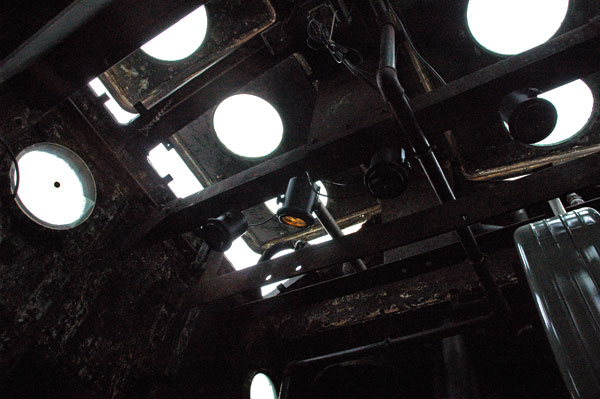
I took the images at the top, of two sections of John Sundling’s wonderful set in this theater-kind-a-in-the-round, a few minutes before the performance began.
There were four excellent singers (and real actors!), and their moves (choreographed by Erica Reid) were augmented by a fleet and nimble crew of supernumeraries/stage assistants which managed to be everywhere doing just about everything an actor, dancer, properties person or technician could be asked to do. Philip Dawkins’s costumes were spot on. I was enchanted by the kind of special effects (generally pretty low-tech) which might have intrigued a small eighteenth-century theater director, and the improvised magic lantern stuff was a terrific “stocking stuffer”.
The cast:

Justin Neal Adair (Eddy), Ashlee Hardgrave (Mum/Woman/Waitress/Sphinx), Brad Jungwirth (Dad/Police Chief/Manager), Caitlin McKechney (Doreen/Woman/Waitress/Wife/Sphinx)
Sean Eweert, Dwight Sora, Cassie Vlahos, Kelly Yacono (in various roles)

Chicago Opera Vanguard appears to be basically the creation of its amazing composer/director, Eric Reda. The COV site describes the company’s laudable mission:

Chicago Opera Vanguard is dedicated to exploring the delicate balance needed between performance, music, words, design and technology in order to make a truly immersive and transformative experience.
COV is commited to creating accessible and exciting theatrical experiences, both concretely and virtually, by producing new works, giving a second voice to important or overlooked modern pieces, and completely reimagining the standard repertoire.

There shouldn’t be an empty seat in the house for something this good. Now that the work has received some awesome reviews, tickets may be hard to find for the last three performances, this Wednesday, Friday and Saturday.
For those who can’t make it, I just found a listing for a DVD of a television production.
We definitely want to go back to Chicago, since we had such a great time and thought the people were great, but another COV production will definitely do it for us.

Target Margin’s Stein: “A Family of Perhaps Three”

Gertrude_Stein_A_Family_of_Perhaps_Three.jpg
“. . . she certainly was then quite completely interesting.” [from the dialogue]

It’s an exquisite recreation of one of her most abstract texts. Target Margin Theater‘s powerful production of Gertrude Stein’s “A Family of Perhaps Three” continues at the Chocolate Factory on June 3rd, 4th, 5th and 6th. David Herskovits, the founder and artistic director of Target Margin, directs, and the small cast is superb. It includes Chinasa Ogbuagu, Allison Schubert and Indika Senanayake. The sets and costumes (Lenore Doxsee) are minimal, beautiful and supplely evocative, and the sound design (Jim “Sneaky” Breitmeier) is brilliant and completely articulate. We love the “Sound Demon”, Caroline Kaplan, and I know I must be leaving a number of people out.
“A Family of Perhaps Three” is just one of a group of plays in the company’s current series, called “Theater of Tomorrow”, exploring the early twentieth-century roots of the American avant-garde theater with works by Stein, Zora Neale Hurston, Eugene O�Neill, Edna St. Vincent Millay and E.E. Cummings.
After exactly a century, Gertrude Stein’s most revolutionary work remains famously unread, as it always has been. For most people, her work has always been approached, and treasured, as an impression (sometimes a totem, sometimes a joke) more than an actual presence.
Of course there’s “The Autobiography of Alice B. Toklas by Gertrude Stein”, the most un-Gertrude Stein of all her works, and which has never gone out of print. I read it and Toklas’s own autobiography fairly early, but eventually I decided I needed to know what it was that made Stein’s prose seem to drive so many people crazy. More to the point, was there anything there when you got there? Was it really unreadable? I had to give it a chance, perhaps just because it was too big to ignore.
I actually made it through “Three Lives” and a good part of “The Making of Americans” while still in college and grad school in the 1960’s, so I have an answer: No, it’s not unreadable. It’s an awesome experience if you can make it through the text; the effect may be a little mind-altering (but unlike chemical stimulants, it demands some concentration if you want to get through it). My answer has to be qualified however: Stein may not be for everyone. In the interest of full disclosure, I’ve always been a big fan of confounding art forms, including cubist visual art and theater, and I’ve adored John Cage for half a century. I’ve also enjoyed my share of some of the milder stimulants closely identified with the counter-culture born in the early years of my majority, so you probably can’t take my word alone for a prediction of the pleasure of a Stein immersion.
But you won’t have to read anything to prepare for “A Family of Perhaps Three”. It will tell you a lot about the author and why she is still revolutionary, but you’ll probably want to hit one of the books after you’ve seen the play, even if only to check out what the sensation feels like in print.
I’ve just read a part of the text of the play [available here] and I now realize the miracle of what this company has accomplished in its collaboration with the author. Gertrude Stein’s language came to life last night. I’d go back again if we weren’t going to be out of the city this weekend
Don’t miss out on it. I know the idea of Queens [the borough, that is] may be scary for some, but the location, the time commitment and the cost of tickets presents absolutely no barrier to a terrific evening of theater: The little building is only steps from the #7 train’s first stop in Long Island City, it’s only one hour long, the price is $15, and once you’re there you’ll find yourself in the midst of a healthy new pub and restaurant scene for discussions with friends before or after the play.

[image of Chinasa Ogbuagu from Yi Zhao]

“Then and Now” at the LGBT Center

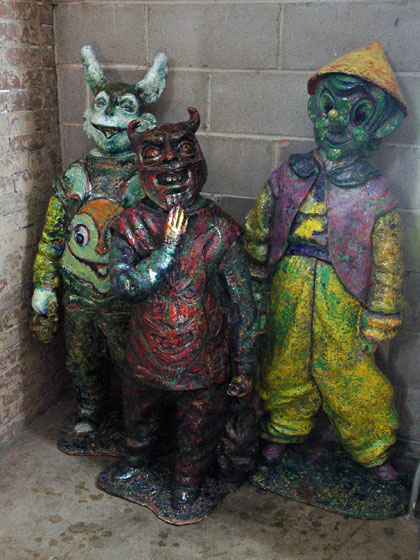
Bill_Mutter_Bunny_Devil_Pinnochio.jpg
Bill Mutter Bunny Boy, Devil Boy, Pinnochio Girl (dates unknown) ceramic sculptures, dimensions variable [installation view]

I think what you see above was the most intense image I carried home in my head from the opening of “Then and Now” at the LGBT Center last night. For the longest moment, when I spotted them just as I reached the busy stair landing where these smallish (2 1/2 to 3 1/2 feet tall) figures were installed in a corner to the left, I was still almost totally distracted by a conversation with Barry about an installation we’d just seen. I absolutely didn’t know what I was looking at for a few seconds, but I remember I was almost giddy with delight and at the same time a little unbalanced by their suggestion of some kind of horror.
They seem to be children in halloween costumes, but the members of this little band clearly represent some kind of outsiders, especially when seen in the context of the building where they’ve been assembled, although in fact, like all the undisguised queers they seem to represent, they would be outsiders virtually anywhere.
I know little more about the artist than what I learned from this link, and in the last paragraph of this 1987 New York Times review of a group show.
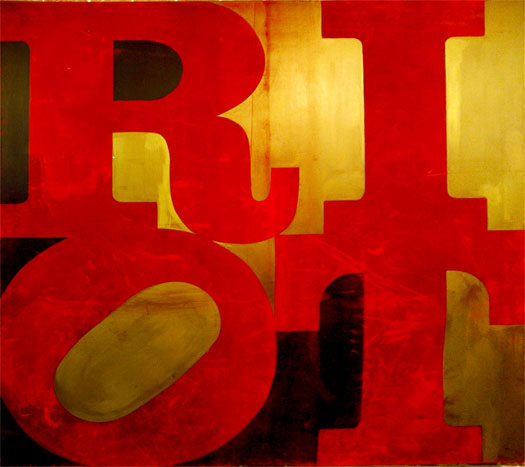
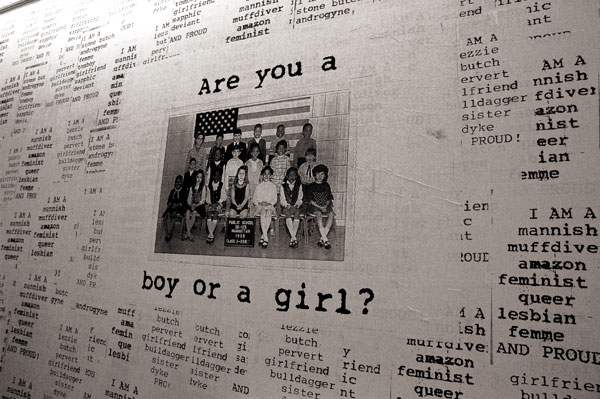
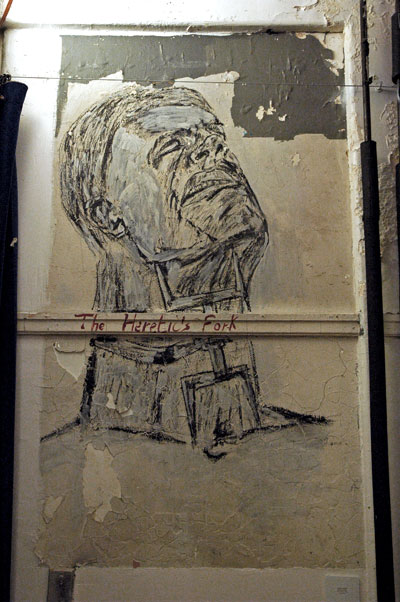
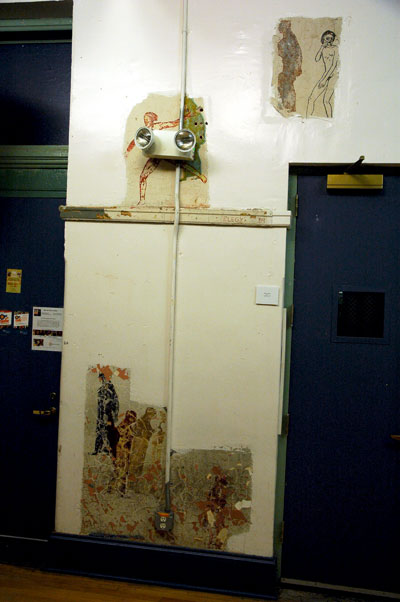
What follows are images of a few of the other works installed on 13th Street, some of it from the 1989 “The Center Show” show and some of it chosen by the artists in that show for inclusion in this one. All works dated “1989” are works installed twenty years ago.

Gran_Fury_RIOT_1989.jpg
Gran Fury RIOT 1989 acrylic on canvas

Fierce_Pussy_Center.jpg
fierce pussy [title not supplied] 2009 black and white xeroxed posters on wall, dimensions variable [large detail of installation inside a multiple-toilet room marked “ALL GENDERS” on the door]

Leon_Golub_The_Heretics_Fork.jpg
Leon Golub Heretic’s Fork 1989 oil on wall [installation view]

Nancy_Spero_Elegy.jpg
Nancy Spero Elegy 1989 acrylic on wall [installation view]

Tre_Chandler_Narrative_of-Gayzes.jpg
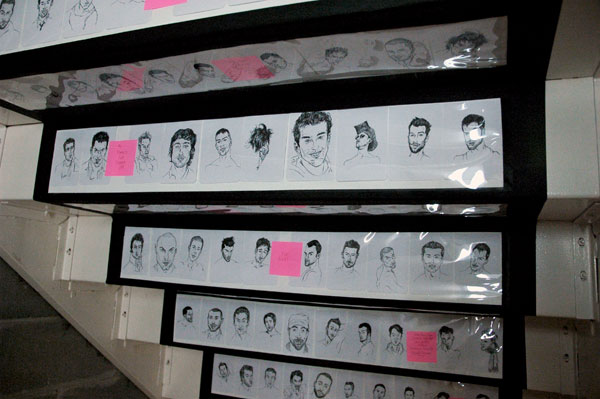
Tre Chandler A narrative of ga(y)zes 2009, 90 ink on paper drawings; 10 ink on paper post-its, dimensions variable [large detail of installation]

Stephen_Lack_Boy_On_Wall.jpg
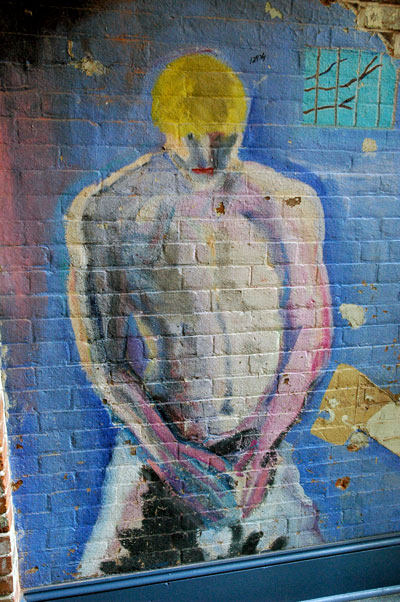
Stephen Lack Boy on Wall 1989 oil on wall [large detail of installation]

“Playing Through” in Brooklyn tomorrow

PLaying_Through_Lukowski.jpg
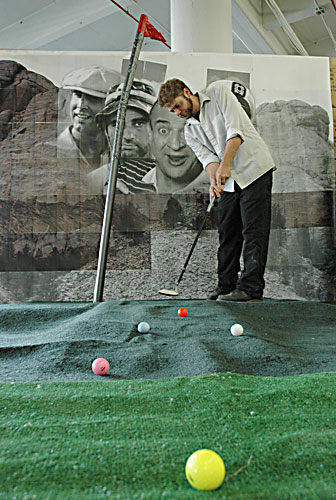
sculptor David Lukowski warming up for tomorrow’s play

For twelve hours tomorrow, beginning at noon a group of 30 or so scrappy artists will be putting on their own show, “Playing Through“, in an enormous, huge-windowed 16,000 square foot indoor space in Sunset Park, Brooklyn, just above the docks (55 33rd Street).
They describe it as an extensive mini golf course, but much more, a “carnival extravaganza”. The announcement continues:

We are eliminating greens fees and assembling a full food court featuring many local vendors. There will be a cotton candy machine and a popcorn waterfall. The course will have roaming beverage cart service. Nightfall will see the musical stage come to life, with several bands performing. In these tough economic times we’re taking care of you with an entire day of free entertainment for everyone on the Brooklyn waterfront.

As Barry writes in his blog today, we definitely hope to stop by. The concept, and the creative energy involved, would be more than enough, but the list of artists (some emerging and some quite visible), many of whose work we know and some we have written about, virtually guarantees excitement. Barry:

I was told by one of the organizers that they wanted to use an event like this to introduce the artists working there to the broader community. I particularly like the fact that they have fliers in English and Spanish!

The space is only about four blocks from the D,M,N and R (36th Street station). Here are the other details, on flyers in each language:

PlayingThrough_webvite_espanol.jpg
PlayingThrough_webinvite.jpg

[first image via The Brooklyn Paper, the other two from Playing Through]

queer marriage: California goes both ways

Hiram_Powers_Divining.jpg
with good in one hand
Hiram_Powers_thorns.jpg
and evil in the other

Barry and I happened to be visiting the Metropolitan’s newly-reworked American Wing on the same day the California Supremes announced their decision on queer marriage. There didn’t seem to be one jot of a connection between the two events when we started out, but I eventually manged to find one.
I spent much more time with the nineteenth-century sculptures in the glass court than I might normally have expected to because we were with the artist Sarah Peters, whose work has been inspired by the milieu in which these earlier American masters flourished, and by their skills, although she finds her own space in interpreting that world anew and commenting on what the artist and his/her contemporaries thought of it through her own drawings and sculpture.
I was also eager to investigate what had inspired Holland Cotter’s terrific piece on the galleries which appeared in the Times last Thursday.
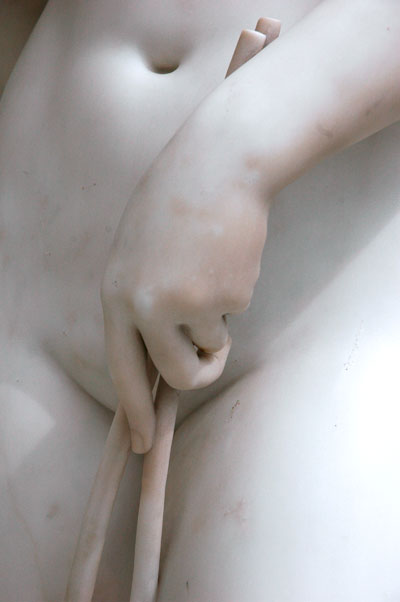
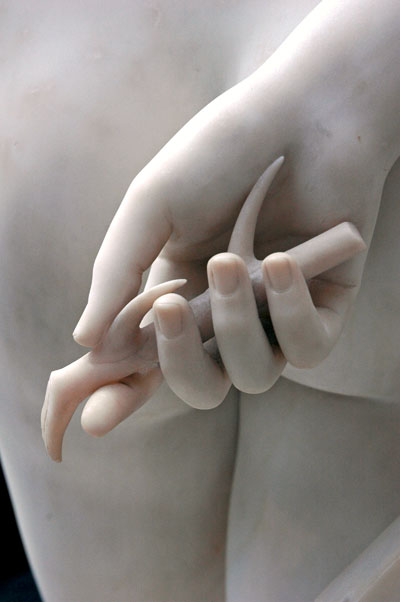
The female nude by Hiram Powers, intended as a California allegory, attracted my attention primarily for the odd props the figure was holding, especially the divining rod which she grasped so demurely before her smoothed pudendum. My mind jumped back to the news of the day when I read the note on the museum card, which reads in part:

Inspired by the California Gold Rush of 1849, Powers devised the following program for this allegorical figure: “. . . an Indian woman . . . stands in a reserved and guarded posture and with a watchful expression, holding the divining rod in her left, and pointing with it down to the earth, under a large quartz crystal, which supports the figure on the right. Quartz is the matrix of gold and the divining rod is the miner’s wand, or the sceptre of ‘California’ . . . In the right hand, which is held behind, there is a branch of thorns, to finish the allegory for she is the miner’s goddess, or ‘Fortune,’ and as it is usual to represent the Goddess ‘Fortune’ with good in one hand and evil in the other [my italics], by suitable emblems I have done so with ‘California,’ and the moral is that all is not gold that glitters. . . .”

What California gives, she also taketh away – sorta, sometimes, possibly only for a while. Maybe the queers will eventually make out, er, . . . that is, within a structure certified by the state.
BTW, it would certainly help if we could remember to call it “civil marriage” rather than “marriage”, which in this benighted land always means religion is involved. That way we might be able to get the folks over 30 to go along with the concept.

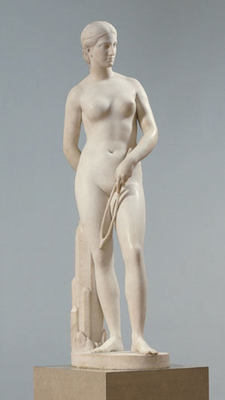
For those still interested in the allegory with which I started this post, here’s “California” in full figure:

Hiram_Powers_California.jpeg
Hiram Powers California 1850�55 (this carving, 1858) marble 71″ x 18.25″ x 24.75″

[third image from Metropolitan Museum of Art]

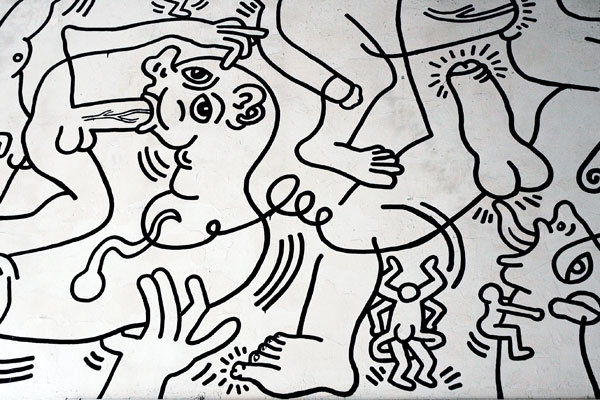
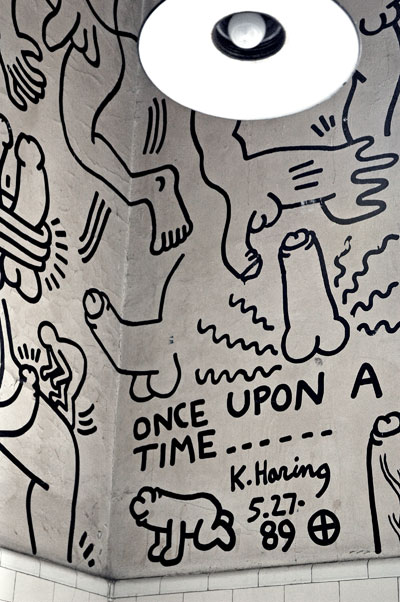
Keith Haring’s “Once Upon A Time”, 20 years old today

Keith_Haring_Center_orgy.jpg
Keith_Haring_Center_appendages.jpg
Keith_Haring_Once_Upon_A_Time.jpg

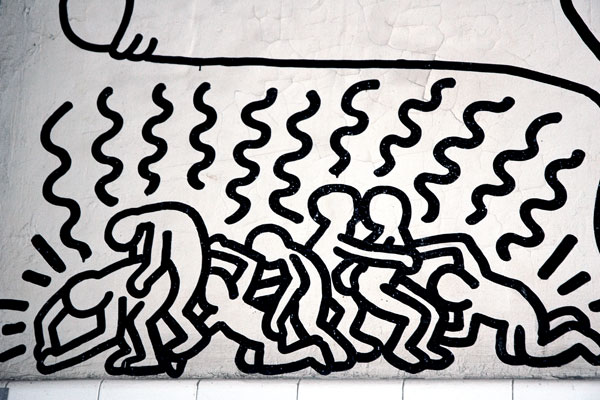
I’ve seen it described as his masterpiece; it’s almost certainly his most personal, exuberant and uninhibited expression of pure sexual jouissance.
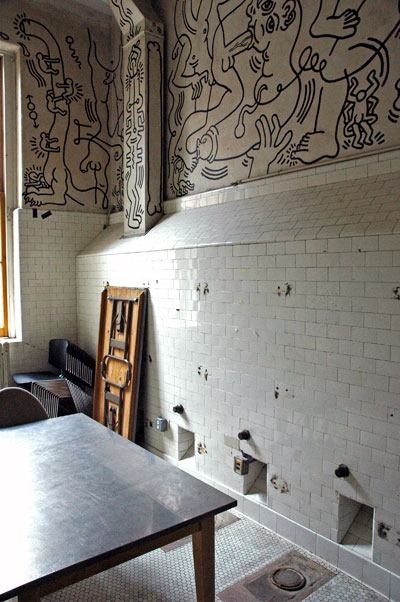
Twenty years ago today Keith Haring finished his men’s room mural, “Once Upon A Time”, on the second floor of the LGBT Community Center on West 13th Street. Then he signed and dated it. The detail shots above show that it remains there today, pretty much as he left it, with one important exception: The ancient toilet fixtures and partitions which brought both great relief and great joy to the building’s habitues over the years have long since been ripped out. Sadly, the room appears to have fallen into desuetude.
But, wait, is that actually a conference table I see in the picture below?

Keith_Haring_Center_room.jpg

While Haring’s room-size installation may have been the most extravagant, it was just one of many works included in The Center Show [see video], organized in 1989 to celebrate the 20th anniversary of Stonewall. These additional artists included, among others, Leon Golub, David LaChapelle, Barbara Sandler, Kenny Scharf, Nancy Spero, and George Whitman, and much of their work remains inside this amazing, reinvented 165-year-old school building today, continuing to enrich the dynamic energy it both encourages and shelters.
The Center is putting on a show again this year. It’s entitled “Then and Now“, and it’s intended to commemorate the 1989 events with a new installation by a new catalog of artists, although without the permanent, applied-directly-to-the-walls part of the original. It opens tomorrow, May 28, with a free reception from 6:30 to 8:30, and it will remain installed throughout the summer.
The artists invited this time around are:

Trisha Baga, The Brainstormers, Ian Campbell, Tre Chandler, Chi Peng, Abby Denson, fierce pussy, Daphne Fitzpatrick, Lola Flash, Alex Golden, Rory Golden, James Kaston, Jillian McDonald, Bill Mutter, Deirdre O’Dwyer, James Rohmberger, Jamel Shabazz, Nathaniel A. Siegel, Lori Taschler, Wu Ingrid Tsang, Forrest Williams, and Sarah Nelson Wright

Carrie Moyer at CANADA

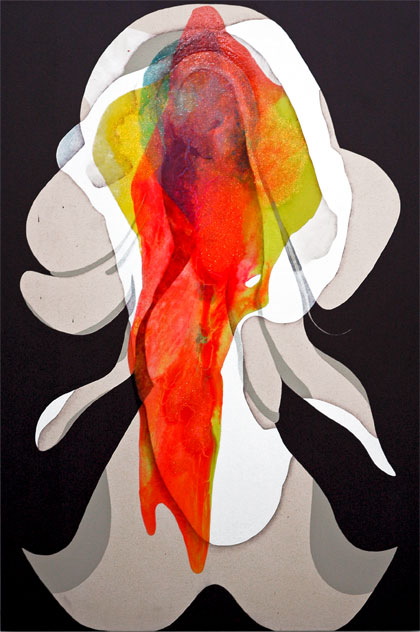
Carrie_Moyer_Ballet_Mecanique.jpg
Carrie Moyer Ballet M�canique 2008 acrylic, glitter on canvas 80″ x 60″
Carrie_Moyer_Ballet_Mecanique_detail.jpg
[detail (yeah, that’s real sparkle dust)]

Carrie_Moyer_First_Instance_2.jpg
Carrie Moyer First Instance acrylic, glitter on canvas 60″ x 40″

I thought we had gotten to the gallery pretty early in the show’s run, one week after it had opened, but when Barry and I started talking to others about the brilliant, glittering canvases in “Arcana“, Carrie Moyer‘s show at CANADA it seemed that everyone we knew had already seen it. What was also immediately clear was the fact that everyone really liked it, so this short post of images is really for those who haven’t yet been on lower Chrystie Street this month, and for those outside of the city who will miss it altogether.

Electronic Music Foundation’s “Sound in the Frying Pan”

Suzanne_Thorpe_Philip_White_Balancing_Act.jpg
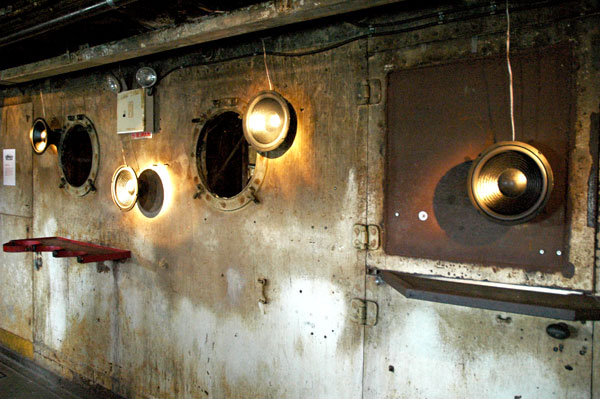
Suzanne Thorpe and Philip White created “Balancing Act”, a psychoacoustic composition which related the list of the ship to the location of the listener on the cabin deck

Richard_Garet_Inner_Outer.jpg
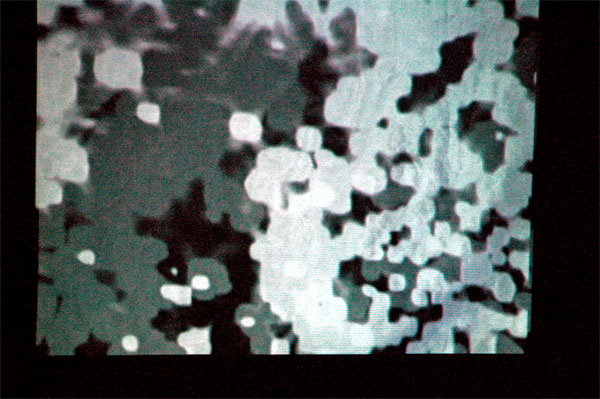
Richard Garet‘s “Inner-Outer” harmonized a video projection of the abstract, crystalline effect of light reflections bouncing on the water’s surface with a sound collage of recordings made underwater

Clarke_Owen_Takeda_Underfoot.jpg
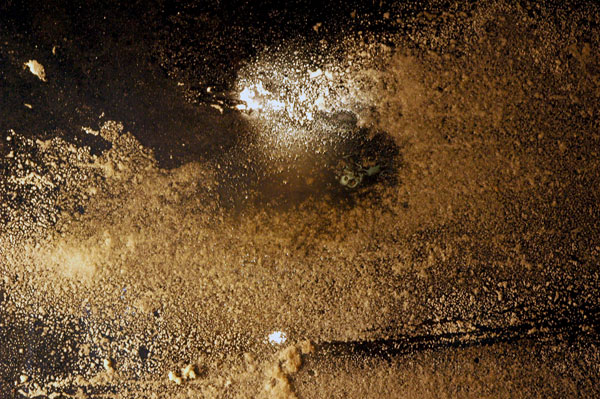
with “Underfoot”, Melissa Clarke, Ben Owen and Shimpei Takeda recreated the Hudson River bed within the ship’s bowels, using projections, sound, reflective materials composed of geographical data, and light

Bart_Bridger_Woodstrup_Gathering_Lore.jpg
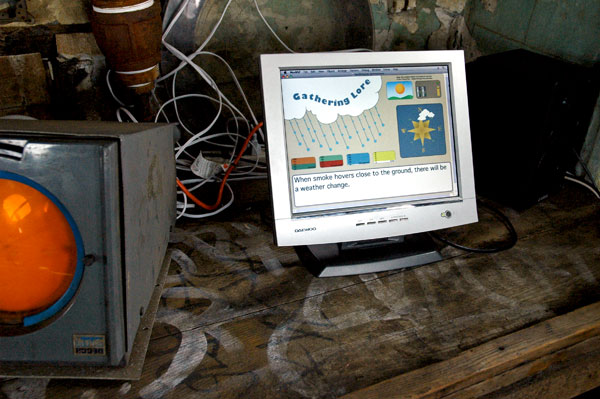
Bart Bridge Woodstrup‘s “Gathering Lore”, set up on the ship’s bridge, was a weather station which translated current meteorological conditions into sound

Jessica_Feldman_Sirens.jpg
Jessica Feldman‘s evocative piece, “Sirens”, heard throughout the ship, and beyond, reflected the ship’s original function, warning sailors, simultaneously playing with the natural seductive quality of sound

It’s not often that I get a chance to post my own images from my experience of a musical performance. Even if it might be better described as a musical “installation”, my ears and my camera both delighted in “Sound in the Frying Pan“, a remarkable project put together this past weekend by the Electronic Music Foundation in and on the “Frying Pan“, a historic decommissioned lightship moored in the Hudson River at the end of 26th Street. What you see above are a just a few bits from my collection of visual takes on the five separate site-specific compositions created by the artists or artist-collaboratives who worked on this quite literally “phenomenal” sound project, curated by Suzanne Thorpe.
This post, because of the images, may seem to be as much about the “Frying Pan” as is about the music, but I’ve been to the ship before* and yesterday it wasn’t only the squeaking of its old metal plates that I heard as it rolled gently alongside the dock, although that sound accompanied the ensemble introduced both above and below its decks; yesterday the old barnacle-encrusted veteran actually sang.

*
beginning in September 2000, in the halcyon days before Bush 2, with the appearance of Miss Kittin in the program, “BATOFAR: NEW FRENCH ELECTRONICA

[the images are mine, but the captions are partly borrowed from the press release]