“After the Deluge” at the X Initiative

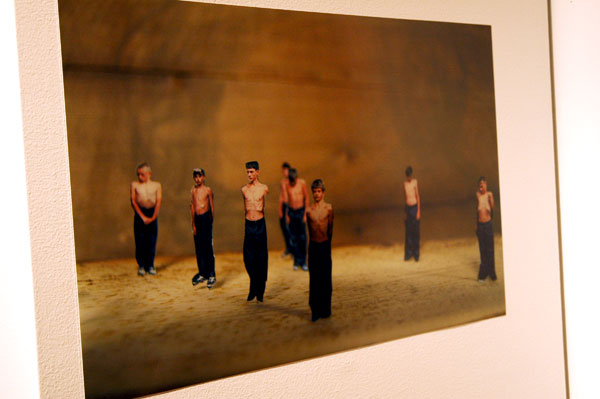
Rob_Fischer_Highway_71.jpg
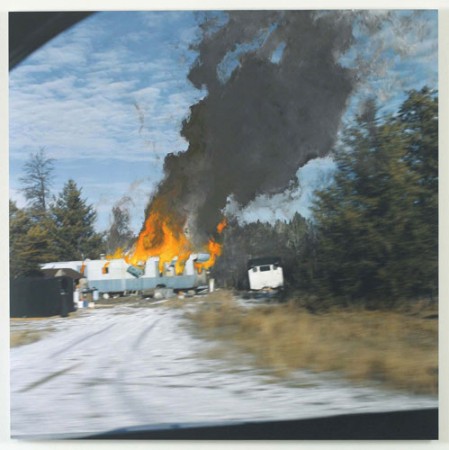
Rob Fischer Highway 71 No. 3 2004-2005 painted photograph

thoughts of living in reduced circumstances

Last night in Chelsea the X Initiative (actually, the “initiative” of Elizabeth Dee) hosted what was billed as a “town hall meeting and panel discussion”, under the somewhat compelling rubric, “After the Deluge?; Perspectives on Challenging Times in the Art World”.
It was a galvanizing evening, its importance having first been established by the economic developments of the past year, then furthered by the choice of the panel, and finally recognized by the fact that the seating was oversubscribed with art world people of every description. Virtually everyone in the audience was completely silent and apparently attentive during the discussion. It was very skillfully moderated by Lindsay Pollock, an author and a journalist with Bloomberg News. She’s a star – and a nimble one at that: During the Q&A which followed Pollock fielded queries which had arrived on her computer during the presentation in the form of both emails and twitter (a first in my experience), and later fielded questions sent by low-tech upraised hand voice (inevitably the least audible of the three media, and so presenting perhaps a foretoken for the future of settings like this).
The panel was made up of a fairly narrowly-focused selection of occupations (gallerists, or artist/gallerists, and administrators), although there was certainly diversification within this small group. It included Jeffrey Deitch of Deitch Projects; Brett Littman Executive Director of The Drawing Center; Michael Rush, Director of the Rose Art Museum; and Anya Kielar, an artist and co-founder of Guild & Greyshkul.
I don’t have most of the questions with which the moderator started the conversations on the panel. They were lost somewhere in that large, crowded room, having never made it to the small notepad balanced on my knee – in the dark. I was lucky enough to manage some more-or-less-legible scribbles which paraphrase portions of the answers, or statements. What follows are essentially my notes converted into sentences.

I think Pollock’s first question was a general one, about the state of the art world today. Jeffrey Deitch began by saying that for many people the madness of the bullish art market had resulted in more than a little confusion in distinguishing between the most expensive art and the art which is most valuable.
He noted that museum curators had stopped visiting galleries and were instead buying art from the art fairs, and that Miami Basel was only the most dramatic example. And they were buying it straight off the walls. The traditional approach had virtually disappeared, that of visiting the galleries and then returning for the artist’s next show, and sometimes visiting studios and talking to the artist, all of it to develop an understanding of and conversation with the art.
There had been what he called a “distortion” in the market, Deitch admitted, because of the extraordinary power of “the six billionaires” who in recent years actually were, the market [bear in mind that this was only at the very top end]. He quickly added that the number six was not a total exaggeration, and said that the most dramatic change within these exclusive precincts is the fact that this market has all but disappeared: He cited the collector Fran�ois Pinault, who last fall cancelled every purchase he had made, all the way back to the previous April, as only the most dramatic example of this transformation.
He responded to something someone had said about the difficulty galleries have in a depressed market with the counsel that, “like any business”, you have to live through both up and down periods. [here I thought to myself that it was easier to live through both if your ups were very up indeed].
I was actually surprised that as a hugely successful owner of three New York gallery spaces Deitch had taken the time to be a part of this discussion, and I was a little moved to hear his reply to a question Pollock asked later in the program: “What will change?” Deitch began, “We have our community”, adding with great emphasis that it is a remarkable community. “We are going to use our community as an asset.” He made analogies to the fraternity created in the last depression [my phrasing] by the WPA, which brought artists together who might never have known each other, or seen each other’s work. He added that he believed the 1980 Times Square Show* was of similar importance for New York specifically, and that it became the foundation for the 1980’s arts community.
In the Q&A part of the evening someone asked from the floor what the panel thought about calling for a new WPA. I didn’t hear everything said in response, but there appeared to be little enthusiasm. Maybe it was only because it seemed like such a preposterous an idea to present to Americans today.
Barry had tweeted during the panelists’ remarks, addressing to no one member in particular a question which he and I have both often discussed. It’s related to a concept which had first excited me before I had even moved to New York in 1985. I’m referring to Creative Time‘s exciting early programs which put art into vacant storefronts and neglected landmarks, beginning with Art on the Beach in the late 70’s. We can do it again.
Deitch took the question and sounded enthusiastic about the idea (well, sort of making it his own). He told a story about walking through streets in Soho with a friend from Beirut who, noticing all the empty stores, asked why the city didn’t do something about it, adding that in Lebanon the government arranges to have art installed in such places. He thought it should be done.
[We absolutely should be doing this already. We have experienced people in place in several institutions now who could act as administrators and curators. We’re going to have a lot of vacant stores for a while; artists never have enough spaces to show work; and most people never see enough art. It might have been a bit of a hard sell twenty-five or thirty years ago but today real estate owners and developers should jump on the idea. Art is now taken more seriously, and capitalism, well, it’s not. I worked as a liability underwriter when I moved here, and it was clear to me that the biggest obstacle for these installations would always be the difficulty and expense of getting insurance to cover property owners who might otherwise be supportive. It still is. By the way, one of my company’s biggest competitors, AIG, was always the most aggressive underwriter for this kind of odd risk arrangement. But New York City self-insures; there’s no reason why it’s not in the interest of the whole regional economy to absorb the risk for these minimal exposures. The idea is to turn the visual and performing arts, already integral to both the soul and the pocketbook of all New Yorkers, into an even more vital, attractive and economically-valuable part of New York (maybe the most successful part economically), at least until the rest of the economy can be reconstructed.]

Anya Kielar, who, with her two artist partners, closed the already-well-mourned Guild & Greyshkul space in February after five years, explained that they had done so only at the point they realized that if they were to pay the next light bill they would risk not being able to pay their artists. They had no capital, and no credit cards, and that’s how they had always wanted it. Investors were interested in helping to continue, but they knew they would inevitably lose their independence with such an arrangement. Kielar also said that the decision was made easier knowing that running a gallery was not the only thing any of them had on their own.
Later in the evening she said that although she was fortunate to have success with her own work almost from the moment she left Columbia, she appreciates her teachers advising students early on not to rely entirely on their art. In fact, like many artists, she has been able to use her MFA to earn money teaching, even if her own assignment with a Bard program, teaching at Bayview womens’ prison (in the Chelsea gallery district) might not be as financially rewarding as some. Speaking for her own relationship to the gallery system, she said that she was not currently associated with any, adding that independence had the positive aspect of enabling her to “flex and do projects”. She suggested that artists shouldn’t get too comfortable with a gallery anyway; galleries change, as artists change, and sometimes it’s good to move on.
Kielar said that while she was there the art school structure had become and remains something of a community for her, adding “You don’t realize that’s one of the most important parts of being in school”.
In the open part of the evening there was a short exchange related to her discussion of the teaching option. It started with someone’s question about what effect the economic depression might have on school art faculties. It was suggested that we can easily imagine fewer art students in the foreseeable future and that would mean fewer teachers will be needed and fewer artists will be able to realize an income teaching, or even use small appointments to supplement other income.

People seemed particularly glued to Michael Rush‘s remarks, and not just because he happens to be the beleaguered director of the the Rose Art Museum**, and so represents, personally and professionally so much of what brought all these people to 22nd Street last night. He was impressive: articulate, gentle and humane.
I don’t have a direct quote, but this is a pretty good description of how he started out: When the market was good, people said that art was all about money; now that the market stinks, people say it’s all about money. He suggested we just leave money out of it, that we should be able to rise above money. He said that the experience of the last year or so (including his own, since learning that his museum’s days were numbered) should teach us lessons of leadership and, . . . (hesitating for emphasis) humanity. He said he had learned not to let let panic determine action and how not to deal with other human beings.
He was emphatic that among the practical consequences of what Brandeis has already done will be that donors will, and should, ensure that more conditions are attached to their donations. He added that the days of “good faith” transactions are definitely over. Asking, “What is the public trust?”, Rush said he wanted to make it clear that what was happening in Waltham was not about “deaccession”, conduct in which a museum might properly engage under proper circumstances and for the right reasons. “This is about [a museum] selling art for money”, and he argued that it was an enormously harmful and destructive development in the way we regard art, and that it must not be tolerated.

Brett Littman said that he believed one of the positive sides to the market downturn would be that for students leaving the academy the pressures to produce, or to conform to others’ expectations will be lessened, that the environment for art will be “purified”.
At the end of the program and before questions from the floor Littman, who is the executive director of the Drawing Center, had the last word when the panel was asked for predictions of what “changing times in the art world” will mean. Referring to the new reality, in a depressed market, of unaffordable materials and projects, he said, “I do think that it means artists will draw more”.

The last questioner rose from the audience to ask the panelists how a constrained market was affecting the kind of art that is actually being made. She recalled that in the 70’s, with OPEC raising oil prices, dramatic inflation in the cost of living, and the Vietnam war and its aftermath, we saw the growth of body art, performance art and conceptual art. Art seemed no longer to be about “making objects that could be bought or sold”. I didn’t hear any predictions from the table.
She suggested that the question might be the topic of the next town hall meeting.

It wasn’t long into the evening’s discussions that I was thinking myself how remarkable an assembly this was, and that it should somehow continue. Perhaps it might be in a different format and perhaps where it might be easier to make it more interactive – without keeping invited the guests up too late, or driving too many people crazy. Next time I’ll even help with the chairs. Okay, I missed the GLF and the GAA, but I did ACT UP. Although real lives were at stake in that community of free spirits, it was also a swell fraternity/sorority.

NOTE: S.C. Squibb has a smoother, more concise account on the ArtCat zine.

*
Jerry Saltz, describing the show:

Young artists, critics, and curators begin their takeover of the New York art world with the “Times Square Show,” curated by artists, and held in a two-floor former bus depot and massage parlor off Times Square. It included work by unknowns Jenny Holzer, David Hammons, Jean-Michel Basquiat, Keith Haring, Kiki Smith, Walter Robinson and many others who were making a loose street-wise non-academic, non-post-minimal art. The show is a call to artists everywhere to do what they want as often and as energetically as possible.

**
It was the Rose Art Museum, part of Brandeis University, which made the news two months ago when it was learned that the university’s philistine administration had decided that the easiest way to make up their own endowment gap was to close the museum and sell all the art (in the midst of a major depression in the art market). The Rose itself is independent in its funding, has experienced no financial problems, and in fact passes on 15% of the money it raises directly to Brandeis.

[image from re-title]
PULSE New York 2009

Penelope_Umbrico_Suns_from_Flickr.jpg
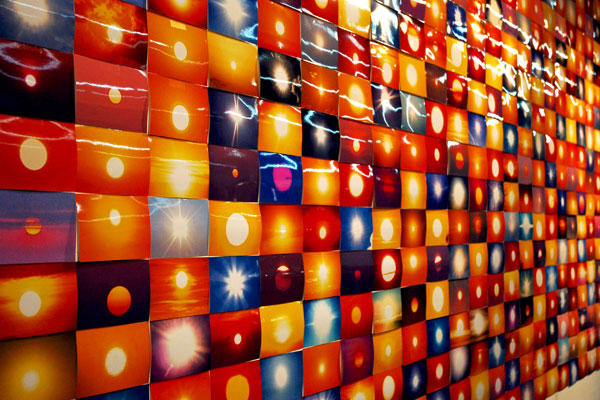
Penelope Umbrico 4,786,139 Suns from Flickr (Partial) 1/14/09 2007-2009 4″ x 6″ machine prints [detail of installation]
The 2009 New York art fairs closed ten days ago, and I wouldn’t bring them up now, since there’s so much interesting that’s been happening since, except that there are still a few images of good work knocking about in my head (and in my laptop), and they insist on getting out. This entry will describe work seen at PULSE New York; I expect to do at least one more post before I’m done.

The image at the top of this post is of Penelope Umbrico‘s Special Project installation at PULSE. It’s exactly what the title implies, a portion of the pictures of sunsets which the artist found while searching the word �sunset� on Flickr on the day she made the piece seen here. She had started the project several years ago on the day she had found (only) 541,795 pictures indicated on the site. She cropped out all but the suns alone from those some half million images and then made 4″ x 6″ machine prints.
If you have the time and you’re interested, it looks like the 541,795 cropped images are all right here. No dark glasses needed.
Brooklyn’s Randall Scott Gallery brought the piece to the fair’s site on Pier 40 at Houston Street.

Cordy_Ryman_ZigZag.jpg
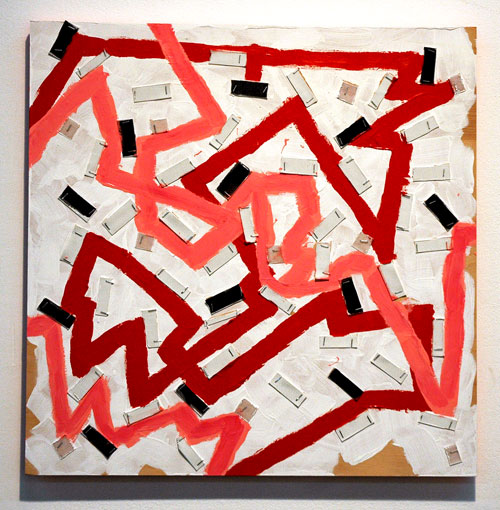
From what I’ve read and heard, the DCKT (New York) one-artist installation of work by Cordy Ryman was a favorite of almost everyone who visited the show – even people who still have money to spend. This is Ryman’s “ZigZag” (2009). It’s executed in acrylic, staples and velcro on wood.

Brion_Nuda_Rosch_Having_Felt.jpg
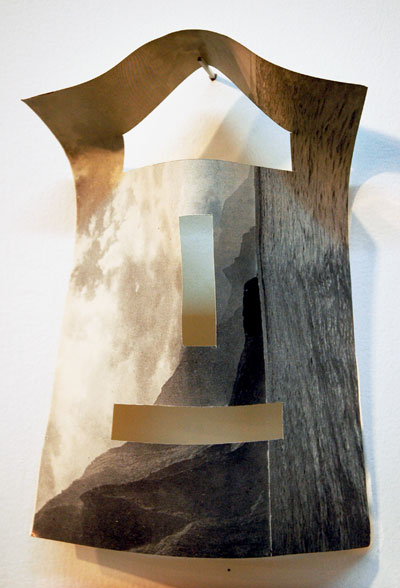
Brion Nuda Rosch was represented by this simple construction, a negative collage, “Having Felt Placed” (2009), at the booth of Baer Ridgway Exhibitions (San Francisco).

Mads_Lynnerup_Clock.jpg
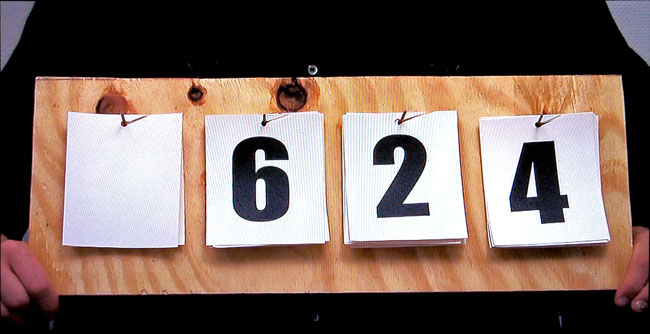
Baer Ridgway also showed Mads Lynnerup‘s delightful “Clock” (2008), a 24 hour video of the artist operating a very low-tech digital clock. The piece was done in one long take. I want it; I really, really want it.
Go here for a video excerpt.

Erik_Benson_IKEA.jpg
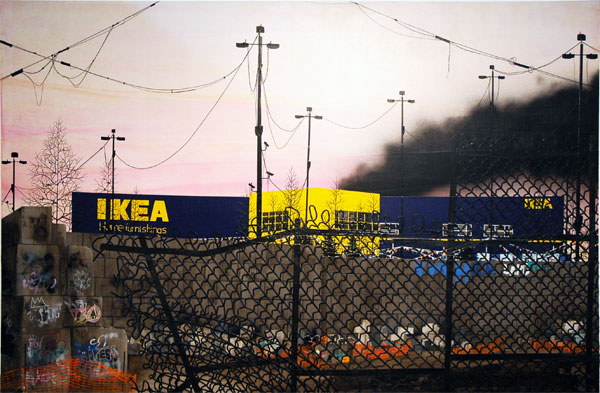
Erik Benson’s large scary/gorgeous “IKEA”, an acrylic which somehow manages to look a little like reverse-painting on glass, was hanging inside the booth of Black & White Gallery (New York), where he is part of a three-artist show up through the end of the month.

Angela_Dufresne_Pool_fellatio.jpg
This print could be found at the ACRIA booth. It’s a 2007 silkscreen by Angela Dufresne, reworked with applied pencil, titled “Westchester County Country Club pool with view of Richard Buckminster Fuller Aquatic Dome House of Victor Bloom – seen* in the foreground in the Pool receiving fellatio from an un-named woman”. It’s 13″ x 19″ (image size), in an edition of 40. The price is $300. It’s hot.
Dufresne shows at New York’s Monya Rowe Gallery.
ACRIA [AIDS Community Research Initiative of America] was one of a number of non-profits invited to participate in the fair. This is a terrific institution and I would stand by that adjective even if I weren’t personally very interested in both the organization’s fundamental mission and one of the most important methods by which it raises funds. ACRIA uses an activist approach in the study of new treatments for HIV and AIDS and in its educational activities. A sophisticated art sales program which enlists volunteers and contributions from the arts community has been a part of their funding activity for years, I think from its very beginnings.
At Pulse they had a booth displaying and selling wonderful prints created by serious established and emerging artists. Some of the work sells for as little as $100. It’s a great opportunity to feel very good about acquiring some great work for very little money. The shop is always open, and can be accessed here.

*
In both the ACRIA and Monya Rowe sites this word is spelled, “scene”, but I’m assuming that is a misprint. Of course the title might profit from a couple of commas as well, but the sense of it is there in any event.

[Dufresne image, at the bottom, from ACRIA]

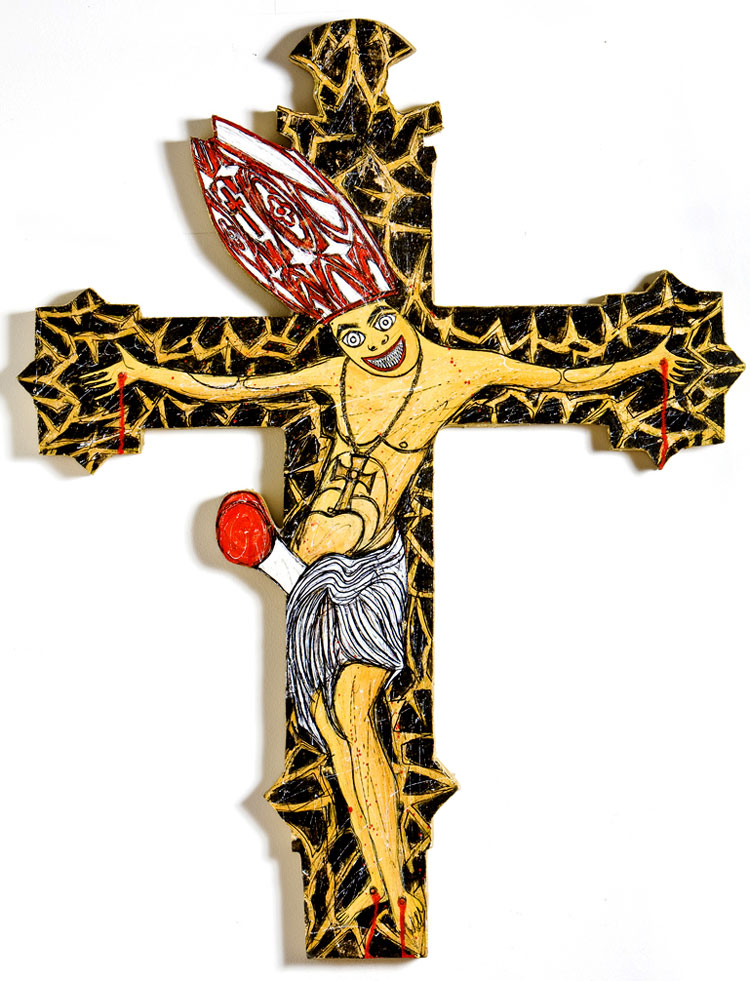
Solmi’s “il vilipendio di cose destinate al culto”

Federico_Solmi_crucifix.jpg
Federico Solmi’s “crucifix” [my punctuation], related to his 2008 hand-drawn animation video, “The Evil Empire“, a satirical look at the outrageous exploits of a fictive pope, and a part of his “ongoing desire to satirize tyrants” [as quoted in both ARTINFO and ArtNet].

I suppose this artist’s work may look to some like heady stuff, but only if you’re Catholic, unwholesomely deferential toward superstition, or just dysfunctionally prudish.
The object shown at the top is a little provocative, but it’s also very beautiful, and I think his red knob is cute. Still, Solmi’s crucifix, while being shown at Bologna’s Arte Fiera this past January, so aroused local judge Bruno Giangiacomo (Judge for the Preliminary Investigation (Giudice per le Indagini Preliminari or G.I.P) who appears to have only heard about it second hand, that he had the Carabinieri seize it from the booth occupied by Naples’ Not Gallery and the artist charged with, essentially, blasphemy (“il vilipendio di cose destinate al culto“/”contempt for an article of worship”) and obscenity (“l�esposizione di oggetti osceni“/”the display of obscene objects”). The crucifix had already been sold to a collector, and Solmi first heard about the charges after he had returned to his home in New York. The blasphemy count was later dropped, when someone realized that the statute had been rendered null by a constitutional court in 2000.
No, sadly, this wasn’t a publicity stunt, but when I was first told about the confiscation and the charges I did think that someone was pulling my leg. Actually I was almost stupefied, since the great city where this occurred has the reputation here of being Italy’s most politically and socially radical. The artist’s own home town and the capital of Emilia-Romagna, Bologna led the country�s socialist movement early in the twentieth century, was extremely active in the revolt against the fascists in 1944, and after the war, until the last decade, the city consistently voted for communist governments. I had assumed its fiery, secular, non-conformist political history would have supported an artist’s right to his creation, however provocative. Now it’s up to the lawyers to decide how much liberty is too much liberty.

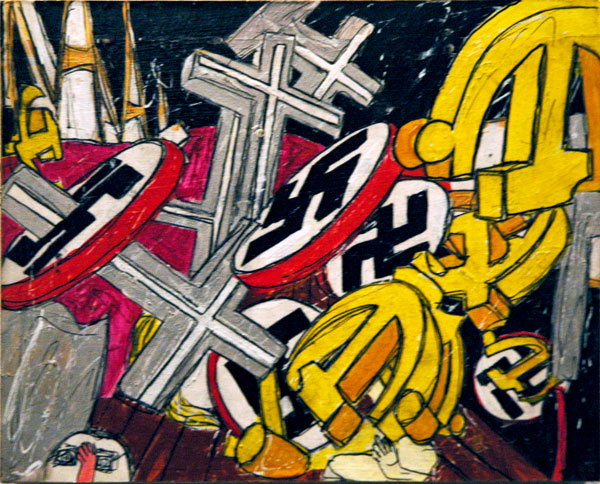
Federico_Solmi_Evil_Empire_signs.jpg
drawing used in Solmi’s “Evil Empire” video

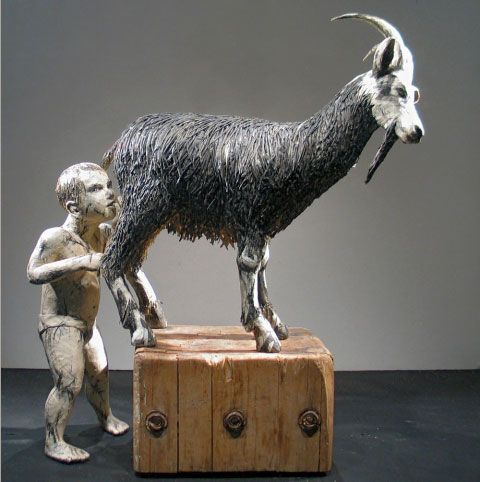
Our own art fairs last week didn’t produce anything like this kind of excitement. It almost makes me nostalgic for Rudy Giuliani’s imbecilic tantrum over the Brooklyn Museum show, “Sensation“, ten years ago. Just kidding; maybe we should think of censoring little boys and she-goats as more than enough excitement.

For more information see these ArtNet and ARTINFO articles.

[image at the top from the artist’s New York gallery, LMAK Projects, via ArtNet]

Olsen, Rishaug & Watz at M*A*S*H

Rune_Olsen_Hysterics.jpg
Rune Olsen Hysterics 2009 graphite, masking tape, blue mannequin eyes, newspaper, wire, steel and UV-resistant acrylic medium 57″ x 48″ x 53″

Alexander_Rishaug_Marius_Watz.jpg
Alexander_Rishaug_Marius_Watz_2.jpg
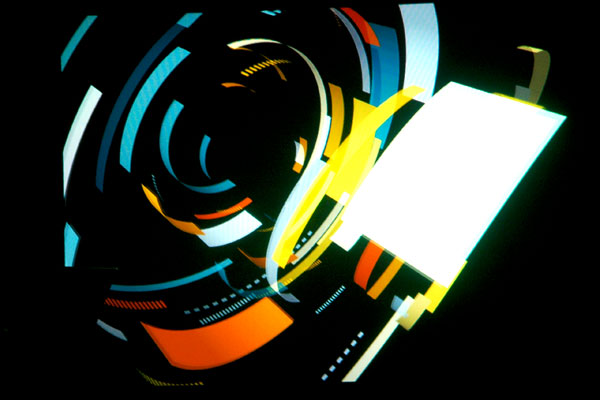
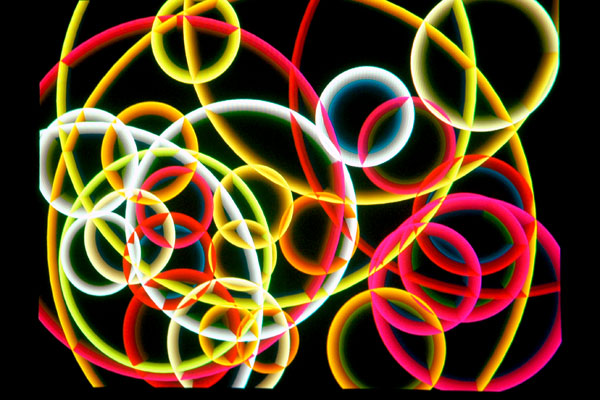
two projection stills from “Sonic Vision” by Alexander Rishaug and Marius Watz.

During the run of the much larger art fairs last week M*A*S*H New York hosted a mini-fair of Norwegian artists inside Chashama‘s West 42nd Street quarters. The multi-media show, “Darkness Descends: Norwegian Art Now“, was curated by Christina Vassallo and produced by Michael Sellinger’s Cottleston Advisors.
The organizers had planned to place Rune Olsen‘s sculpture, “Hysterics“, in the front window of the space, but soon after it was installed the building real estate manager, acting perhaps to protect the tender sensitivities of the corporate owners, decided it was objectionable and demanded that it be removed or covered up, threatening to cancel Chashama’s lease if nothing were done. Thick draperies were hung behind the window glass throughout the run of the show. The Norwegian newpsaper, Dagbladet, was amused by the landlords’ hysterics. Despite the fact that the work could only be seen from inside the space, and from an angle which distinctly obscured it, a collector had bought it by the time I had arrived at the opening reception.
During that reception Alexander Rishaug and Marius Watz collaborated on an Audio and Visual performance which produced brilliantly-colored abstract computer-created images affected by (improvised?) electronic ambient sounds, the shapes projected on a large screen. There were four “movements”, so maybe I can call it a symphony, a symphony of sound and light. The work is actually intended to be performed with four projections, and it was scheduled to be performed that way on the next day at Monkey Town, in Williamsburg.

[image of “Hysterics” from the artist]

more of The Armory Show 2009 – Contemporary

Having run out of time the night of the preview, Barry and I returned to the Armory Contemporary show on Friday. These are some more highlights from Pier 94, where the gray carpets were rolled up Sunday night. Images from some of the other fairs will appear in later posts.

Carolee_Schneeman_Parallel_Axis.jpg
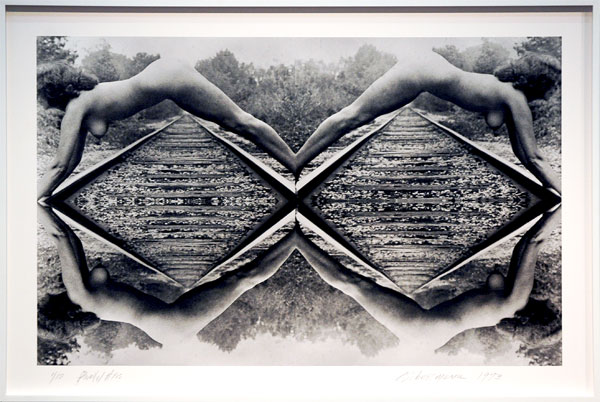
Carolee Schneeman‘s 1973 “Parallel Axis” at Carolina Nitsch Contemporary (New York)

Guyan_Panchal_installation.jpg
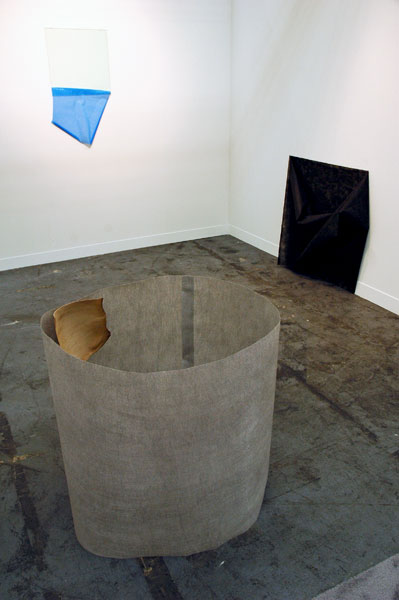
Galerie Frank Elbaz (Paris) showed the work of only one artist, Gyan Panchal, elegant sculpture which uses found, manufactured materials to evoke, or gently kiss, a more natural world.

Imi_Knoebel_red_white.jpg
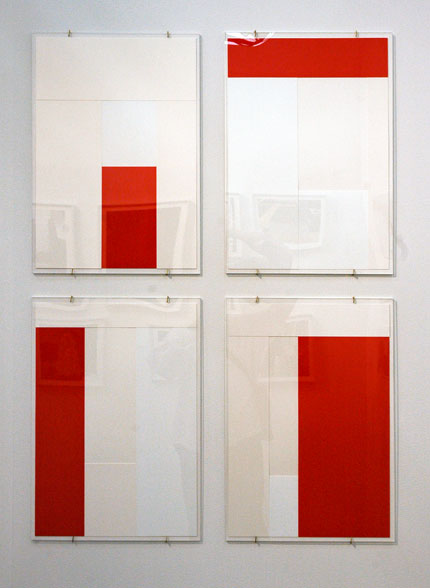
Galerie Sabine Knust (Munich) showed Imi Knoebel‘s 1990-1992 silk screen prints, “Rot-Weiss I”.

Rona_Yefman_Tanja_Schlander_Pipi_Wall.jpg
“du kan tro det virker, Pippi!”

Rona_Yefman_Martha_2.jpg
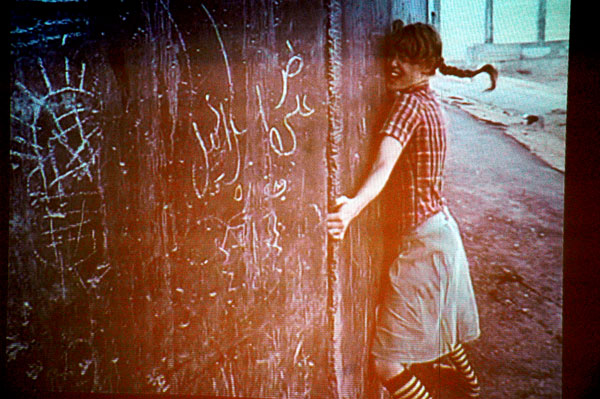
Sommer Contemporary (Tel Aviv) fitted out its booth entirely with work by Rona Yefman. The artist collaborated with Tanja Schlander, in Abu Dis, at the Dividing Wall, to create the 2008 video, “Pippi Longstocking, the Strongest Girl in the World”.
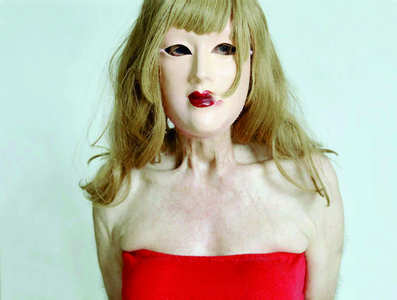
The second image is from a series, “Martha”, which Yefman did while working with an Israeli octogenarian, holocaust survivor, father, and secret cross-dresser.

John_Beech_wall_of_revolvers.jpg
Peter Blum (New York) was invited to install a number of John Beech‘s turning discs along one long wall of the show. I’m not sure whether I should have been disappointed to not see anyone trying them out.

Astrid_Svangren_Narcissism_och_Alientation.jpg
Galleri Charlotte Lund (Stockholm) showed several mixed-media, transcendent “paintings” by Astrid Svangren.

Alyson_Shotz_Armory_twist.jpg
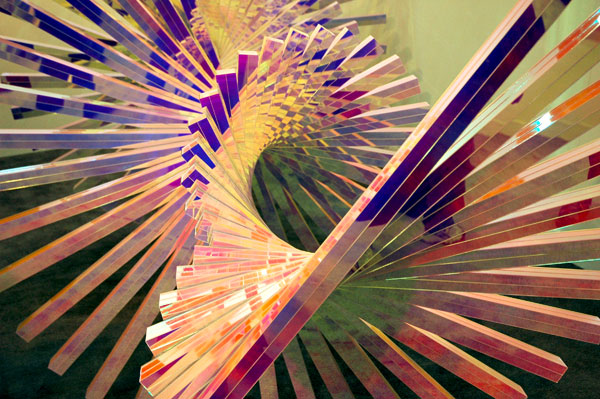
It was obvious that Alyson Shotz‘s dichroic acrylic on aluminum “Wavelength 2” at Derek Eller (New York) was catnip for every camera on the pier, including my own. That would have been no surprise to anyone familiar with her work.

Dvir_Gallery.jpg
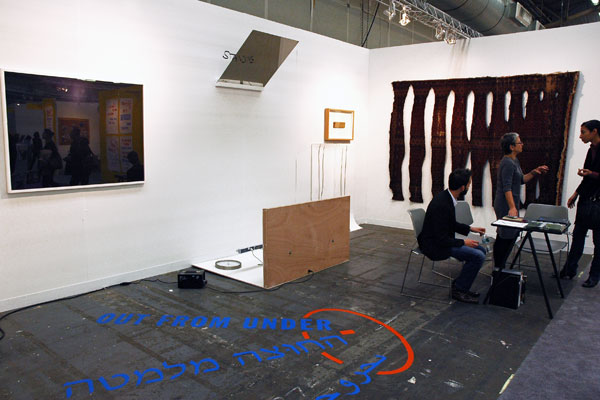
Tel Aviv’s Dvir Gallery had one of the smartest-looking and most elegant booths at the fair. They were showing work by Pierre Bismuth, Jonathan Monk, Adi Nes, Yigal Nizri, Miri Segal, Nedko Solakov and Lawrence Weiner.

Regina_Gallery_Moscow_Putin.jpg
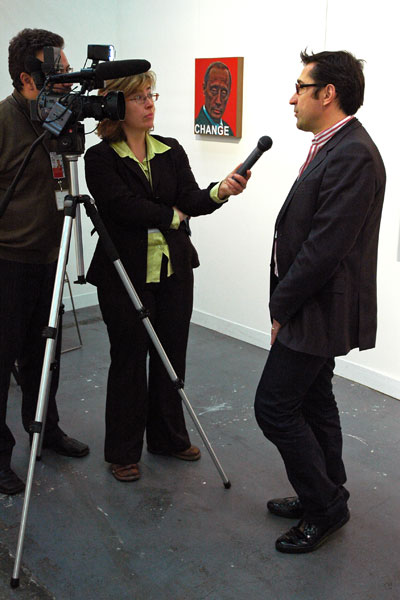
Moscow’s Regina Gallery was pretty busy when we went by. Most people were talking or writing about a neon work declaiming “Down With Capitalism”, but I found this Shepard Fairey-like painting of Putin bearing the “CHANGE” text more intriguing. I’m sorry I didn’t get the name of the artist, but after checking out the gallery’s web site today I’m sorry I didn’t really investigate the booth.

[image of Rona Yefman’s “Martha” from the The Armory Show]

VOLTA 2009

Bruce_High_Quality_Foundation_zombies_at_VOLTA.jpg
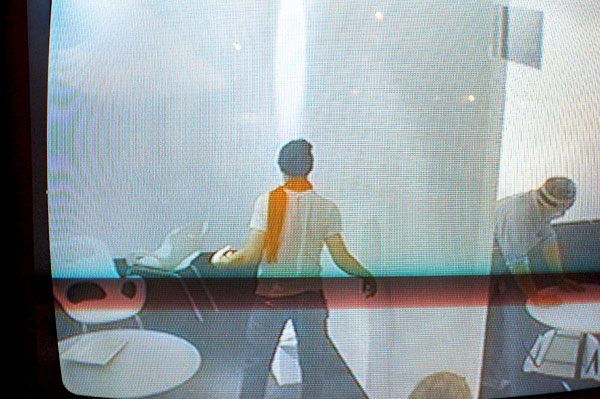
Near the entrance to VOLTA, just across from the elevators, Bruce High Quality Foundation has installed an unobtrusive old black monitor which runs a surveillance video recording a number of zombies wandering around the fair’s spaces.

Rune_Olsen_fathers_and_sons_fighting.jpg
Rune_Olsen_Bear.jpg
Rune_Olsen_Bear_Paintings.jpg
[the bear]
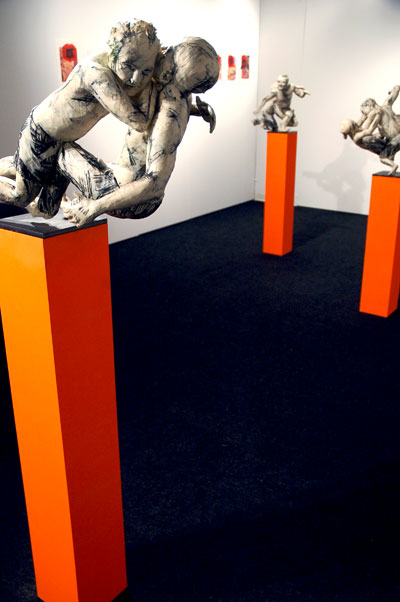
The concept which underlies Rune Olsen‘s “Too Drunk To Fuck: Father & Son”, one element of a four-part project, suggests a more ambiguous, and even more disturbing, interpretation than these apparently straightforward images of inter-generational passion might suggest.
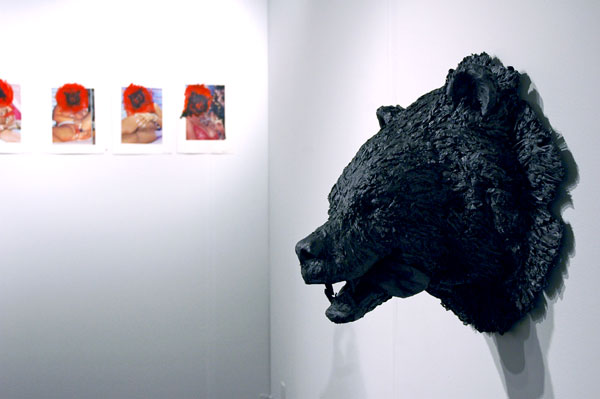
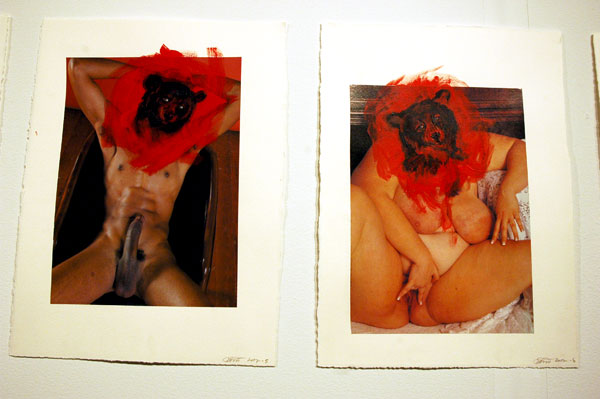
Olsen’s “Bear Paintings” replace the heads of adult magazine models with portraits of a bear, their own eyes remain as exposed as their bodies, staring at the viewer. Just as with the sculptured images used in the “Too Drunk” series, the substituted heads were inspired by an image the artist had found on line, this time that of someone’s idea of a trophy, a freshly-severed bear head lying face-up in a pool of its own blood. Olsen has re-imagined it in this same installation as the black sculpture mounted on the wall adjacent to the paintings/collages.
Samson Projects curated the installation.

Regina_Jose_Galindo_private_prison.jpg
Regina_Jose_Galinda_Prison_tablet.jpg
[wall text]
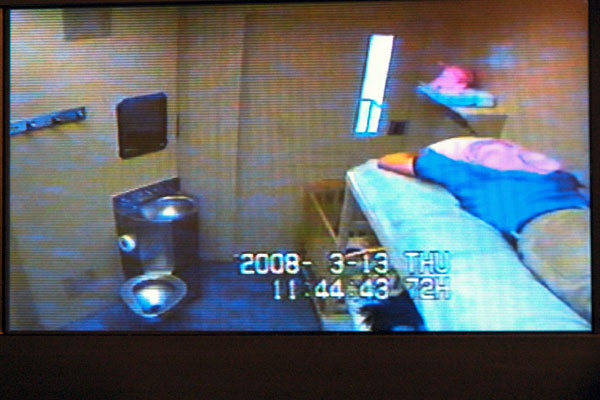
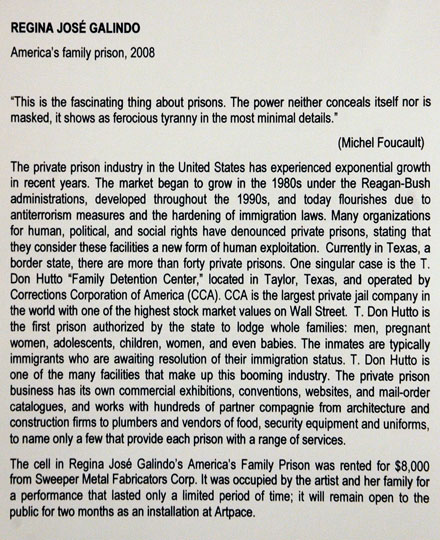
For a limited amount of time, and by their own choice, Regina Jose Galindo and her family occupied a “family cell” (intended to house whole families, typically immigrants awaiting the disposition of their cases) in one of the forty private prisons located in Texas.

Prometeo Gallery
curated the installation.

David_Kramer_Brooklyn_on_sawhorses.jpg
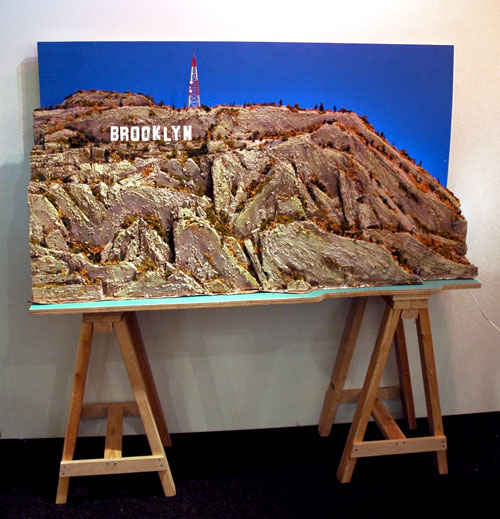
David Kramer’s heart belongs to Brooklyn.
Aeroplastics Contemporary curated the installation

Rina_Castelnuovo_grief.jpg
Rina_Castelnuovo_boys_at_dump.jpg
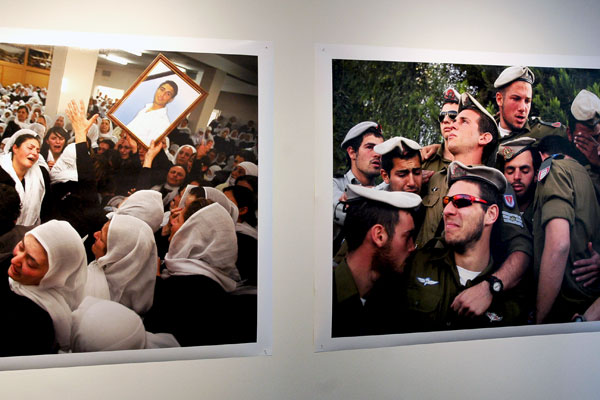
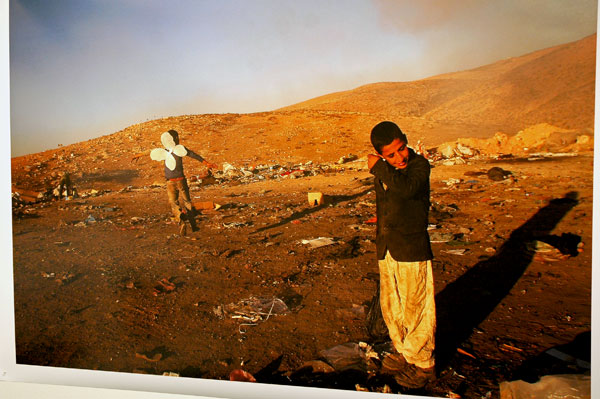
Photojournalist Rina Castelnuovo‘s images, taken within both Israel and the occupied territories, manage to convey the twisted horrors of life as it is experienced by ordinary people in communities boasting, or burdened by, virtually every kind of political status.
The first image above details a pair of photographs, that on the right showing young Israeli soldiers mourning the death of one of their number during the invasion of Gaza early this year; that on the left shows Israeli Druze women lamenting the death of a young Druze soldier who served in the very same unit. The image below these two photos is of Palestinian boys on the West Bank, playing on the dump created by Jewish West Bank settlers. The boys are part of a large colony of scavengers who live on what they can find in that trash.
Andrea Meislin Gallery curated the installation.

Maria_Nepomuceno_detail.jpg
Maria_Nepomuceno_larger.jpg
[larger view]
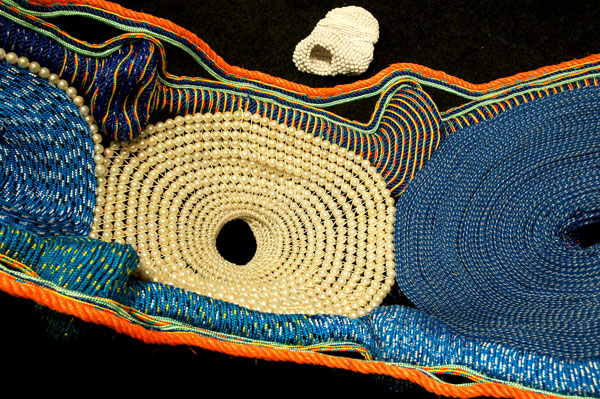
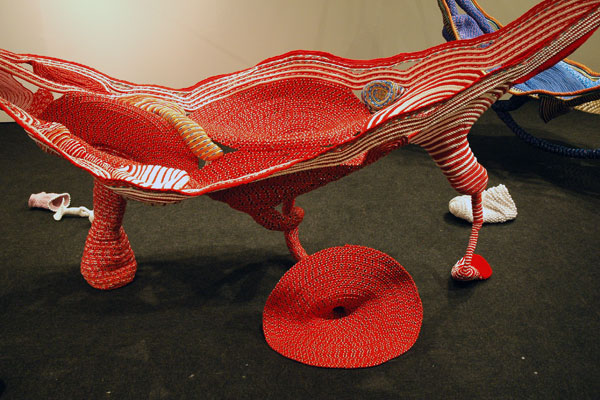
Maria Nepomuceno’s organic twists, coils, and sews fabrics and beads into fantastical organic shapes with a genius, an imagination and an industry which suggests that, given enough time, she just might be able to arrange to have them replace the world’s more conventional matter.
A Gentil Carioca curated the installation.

These are just a sample of some of the other installations at VOLTA which I thought were successful projects. Or perhaps they were only remarkable in some particular. They may also have simply moved me. They are also here because I found they responded to my camera, although it’s both frustrating and embarrassing to have to take that into consideration at all.

Alex Rose with Envoy at VOLTA

Alex_Rose_boy_under_floor.jpg

Alex_Rose_burnt_photo.jpg

Alex_Rose_Humming_Birds_boy.jpg

Alex_Rose_chained_dogs_shrine.jpg

Alex_Rose_My_Father_Murdered_Dogs.jpg

Alex_Ross_boys_waiting.jpg
Alex_Rose_by-the_bridge.jpg

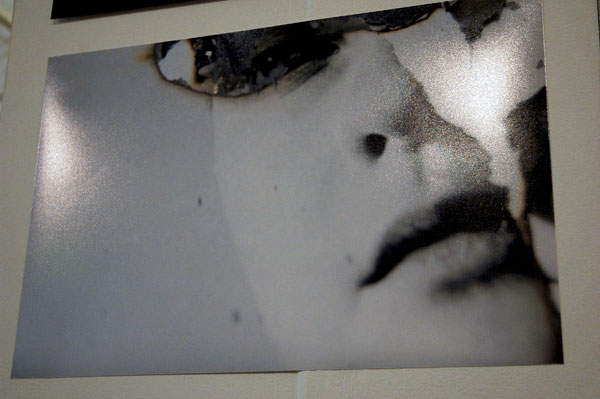
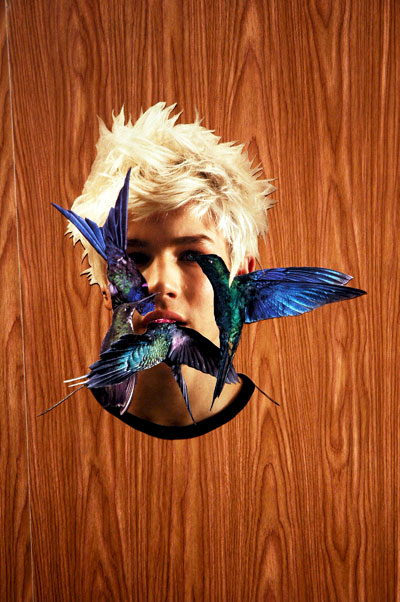
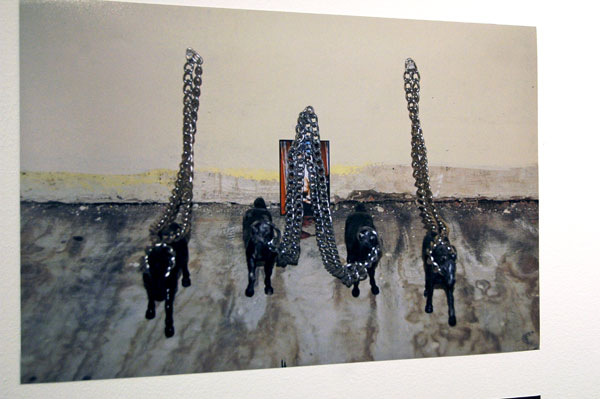
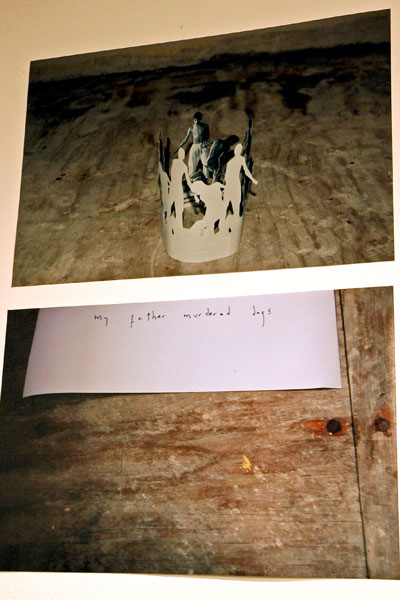
I don’t really have enough time to explain why I think the art of Alex Rose is something no one should miss seeing this week, but I thought these few poor images might do almost as well.
Envoy is showing this Irish artist’s work in their space at VOLTA, and I can’t say enough about it – on virtually every level. This is a breathtaking body of work, and it has been curated with an artistry and sensitivity worthy of both its exceptional beauty and the unique story of its creation – and destruction.
Rose, who lives in a cottage in Cork, has been and remains a shy young recluse who has created art obsessively for most of his life. He did have some experience with art school, reportedly graduating in the end at the bottom of his class, but he seems to be more of an autodidact. He works compulsively with found materials, reworking them until they are fully invested with his own soul. He burns or buries the art he has created, documenting its destruction; the documents themselves may then be reworked and turn up in other work. Images are uploaded for a brief time on his blog, but they are ultimately removed, so that nothing survives in the end.
Fortunately he was persuaded by the gallery’s director, the artist Jimi Dams, that letting go of some pieces, letting them be seen, would help other artists, and that is the only reason that we may see some of them here. But even this fragile window, a reluctant concession to visibility, was won only on the artist’s understanding that the work which survives the ordinary terms of his practice (that is, always ending with its disappearance) no longer has anything to do with him.
When Envoy began to sell work during and after a solo show last June and Dams tried to send to the artist the money he was owed, it learned that he didn’t want it. The physical objects no longer existed for him, and besides, he told them, he already had a secure, though very modest job and didn’t need the money. Dams suggested, and Rose agreed, that his share of any sales could be left in a fund which would help artists who needed it to mount their shows in the gallery.
A most peculiar and wonderful artist.

The Armory Show 2009 – Contemporary

What with everyone trying to show off their best things at once, it’s always difficult to “cover a larger art fair – even physically – and Armory 2009 was no exception. I’ll have to go back, but in the meantime what follows are images of just a few of the things that attracted my attention at the “Contemporary” section during last night’s reception.

Richard_Tuttle_Dieu_Donne_edition.jpg
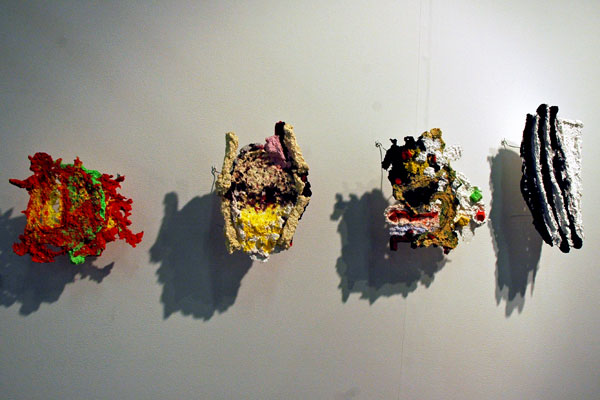
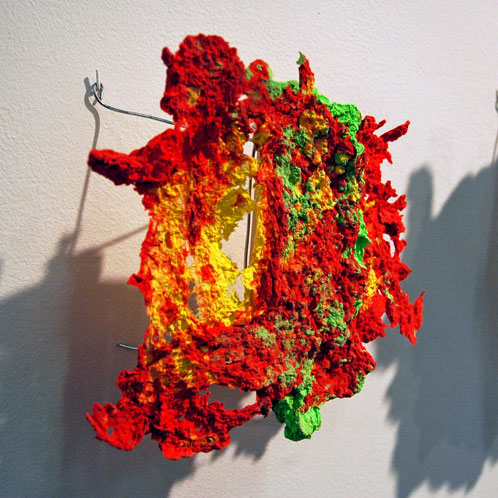
Richard Tuttle paper-pulp edition at Dieu Donne (new York)
RIchard_Tuttle_Dieu_Donne_edition_detail.jpg
[detail]

Josephine_Meckseper_Hemden.jpg
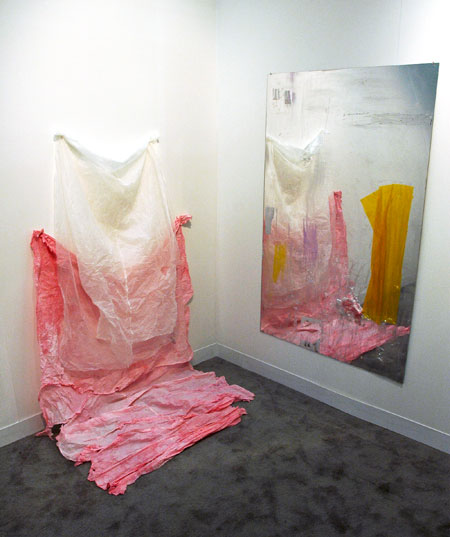
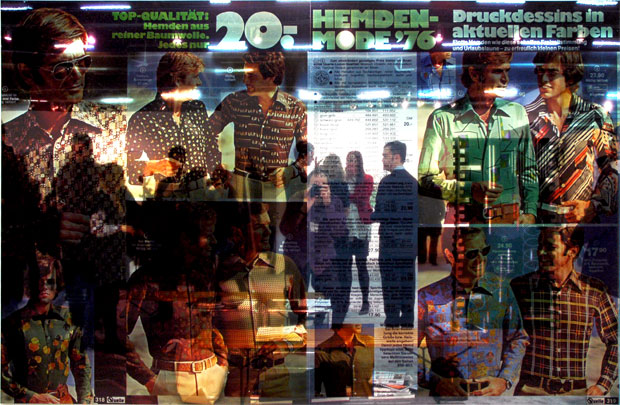
Josephine Meckseper print on reflective Mylar at Elizabeth Dee (New York)
Josephine_Meckseper_Hemden_detail.jpg
[detail]

David_Godbold_Landscape_Stump_Bird.jpg
David_Godbold_Build_House_Cards.jpg
two David Godbold paintings at Kerlin (Dublin)

Matt_Connors_two_on_Armory_wall.jpg
section of one Matt Connors wall at CANADA (New York)


Gerwald_Rockenschaub_two_sculptures.jpg
two Gerwald Rockenschaub sculptures at Georg Kargel (Vienna)

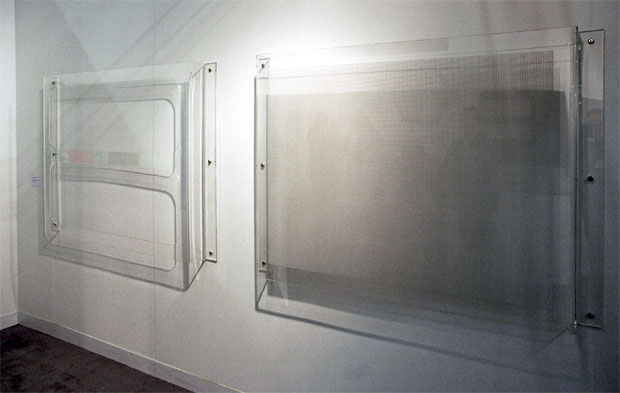
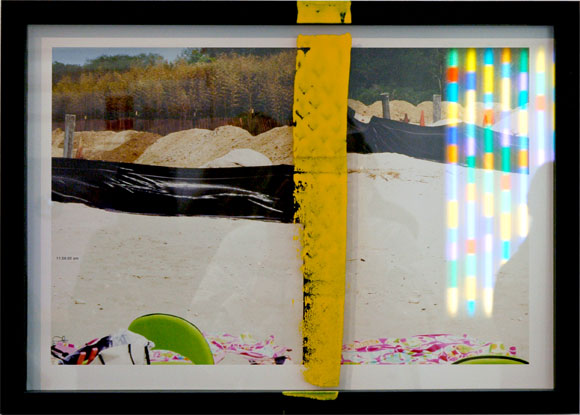
Jan_De_Cock_Module_fine.jpg
Jan De Cock architecture-related sculpture, including artist-countenanced reflections, at Stella Lohaus (Antwerp)
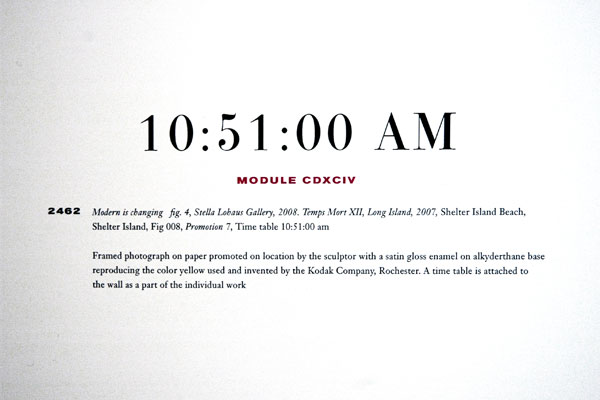
Jan_De_Cock_Module_label.jpg
[large detail of artist’s label]

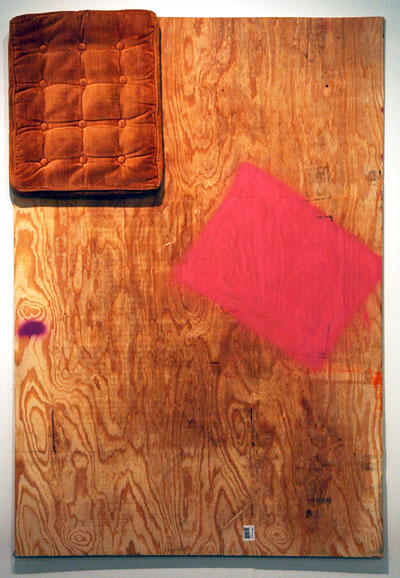
Sarah_Braman_cushion_plywood.jpg
Sarah Braman sculpture at Museum 52 (New York, London)

Fabian_Marcaccio_Just_One_Fix_2.jpg
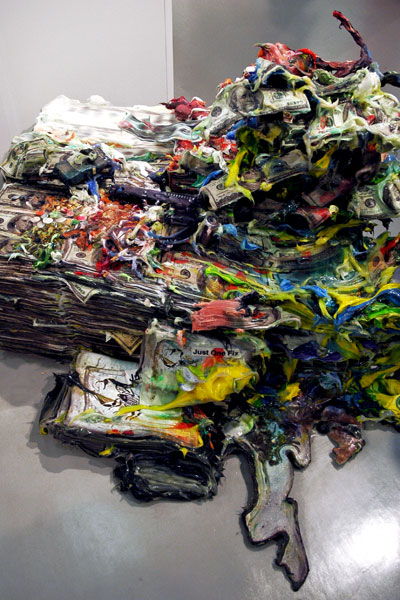
large detail of Fabian Marcaccio sculpture at Thaddeus Ropac (Salzburg, Paris)

Merlin_James_Green_Birds.jpg
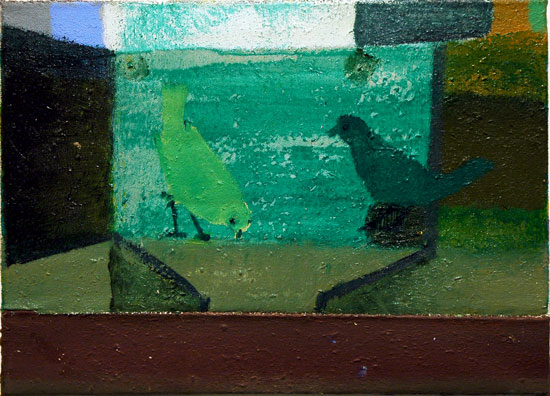
small Merlin James acrylic at Kerlin (Dublin)

champagne_on_stroller_Armory_VIP.jpg
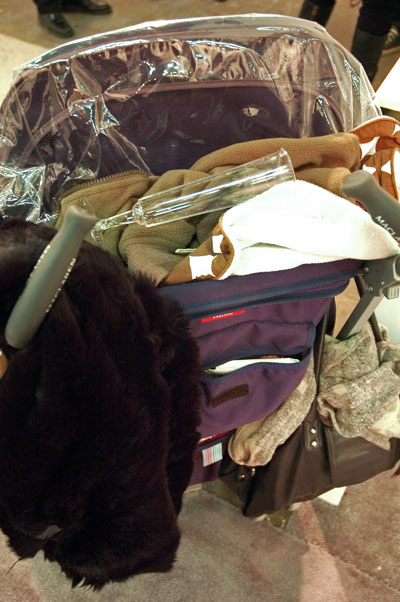
stroller spotted parked inside a booth during last night’s VIP reception

Rachel Whiteread’s Water Tower is back

Rachel_Whiteread_Water_Tower.jpg
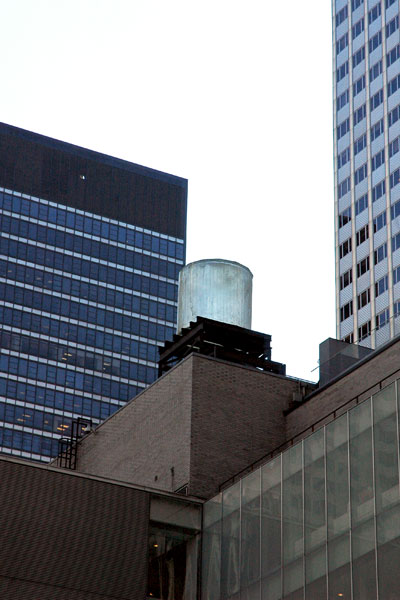
Rachel Whiteread Water Tower 1998 translucent resin and painted steel 12′ 2″ x 9′ in diameter [installation view]

I don’t know how long it’s been up there, but while at the Kippenberger press preview at MoMA last week I spotted a discreet label on the wall behind that artist’s jaw-dropping Styrofoam-to-aluminum “Santa Claus Lamp”*, which is installed where Rodin’s Balzac normally stands. I turned around and looked past the Sculpture Garden and up to the roofs where you see it here. Now owned by the museum, Rachel Whiteread‘s “Water Tower” was commissioned by the Public Art Fund. The last time I saw it was ten years ago when it was installed in its temporary home on top of a building in Soho.

*
It’s shocking to find that there’s no image of this piece on line, and perhaps even more shocking to find that MoMA has only one image of the entire Kippenberger show on its site (MOCA, where the exhibition originated last year, has only six). Especially for a museum operating in the twenty-first century, such neglect doesn’t make it look like the “educational institution” which its founders wanted MoMA to be when it began in 1929.
To be fair, MoMA is relaunching its website later this week, and that may be the reason for the lack of images on moma.org.

Tehching Hsieh at MoMA

Tehching_Hsieh_cell.jpg
the artist’s life becoming a concept [the wooden cell]

Tehching_Hsieh_photos.jpg
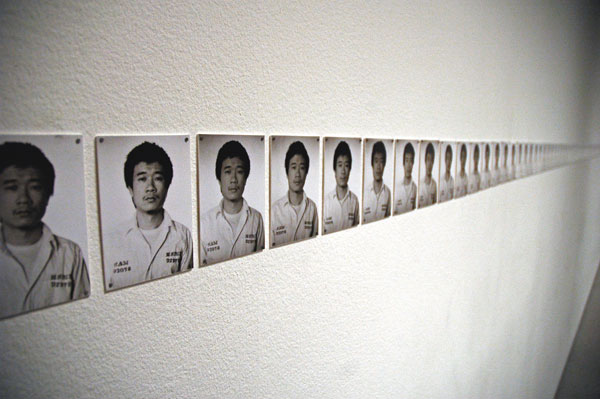
documented in time [the photographs taken daily]

I was ashamed that I hadn’t immediately recognized who Tehching Hsieh was. That is, I had not only forgotten about his 1978-1979 “Cage Piece” but I had also, for the moment at least, not remembered the “time clock piece”, “the outdoor piece” or “the rope piece”, even though just the idea of these had thrilled me at the time, as I read about them in ordinary newspapers while living in Rhode Island before moving to New York.
After having breezed through Hsieh’s exhibition at MoMA last Tuesday on our way to Klara Liden’s piece in the next room (a first priority, because her piece had not yet been opened to the public), Barry and I were returning to check out his own, more sober installation, located just off Kippenberger’s “Kafka’s ‘Amerika'” piece in the atrium. Museum Director Glenn Lowry had left the Liden room just before us, where I had heard him congratulating the curator for introducing such a terrific piece into the museum. He stopped to look at the Hsieh materials and documents and turned toward us as we entered the room apparently wanting to his clear enthusiasm for the work. [I love to see the guy at the top running around the big “shop” and sharing his excitement with visitors.] We agreed that it was an incredibly impressive and even astonishing project. I said that on registering it for the first time my second thought, and first question, had been, what does such a long experience of isolation from any outside stimulus do to your mind? I wondered aloud, what do you do after being alone with your mind for a year? I asked Lowry, do we know what he did later? He answered, “Apparently he didn’t do much”.
Which is both true and not quite so true, as I started to learn almost immediately after asking the question. Hsieh went on to commit himself to several more long-term performances equally as challenging, although not nearly so isolating as the first. But no, apparently until very recently no art was ever formally exhibited or sold. The last (latest?) two projects, the first a one-year assignment to “go in life”, not seeing, making or talking about art, and a “13-years plan” to make art but not show it publicly, would each appear to have been a relative piece of cake, but together they seem to have meant the end of his art, at least by his own account, as documented inside a long and fascinating piece. “A caged Man Breaks Out at Last“, by Deborah Sontag appearing in tomorrow’s New York Times [slide show].
Tehching Hsieh tells us he is no longer an artist, but I think we can’t take him at his word, and we must not, as I’ll try to explain.
The work haunts me as I sit here trying to express something about the inexpressible. Alexandra Munroe, the senior curator of Asian art at the Guggenheim Museum, is quoted in Sontag’s article, referring to Hsieh, “He is deeply philosophical”. It seems to me he is something else: Hsieh is not a conceptual artist; rather, he has reduced his entire life to a concept. The work he has given to us seems to have come out of nowhere. It is so pure and sublime that it doesn’t seem we could possibly deserve to be its legatees, especially since we’ve virtually ignored it for thirty years.