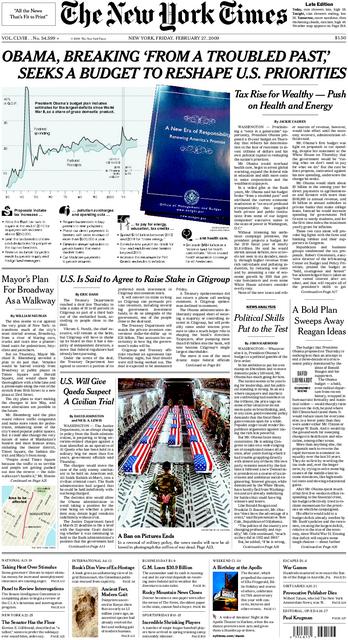
real
The front page of this morning’s real New York Times looks an awful lot like the fake New York Times published by the Yes Men with the help of many others last November 12. My own hard copy of today’s Late [City] Edition differs only slightly from the one shown above. It adds a story which suggests the feds are getting closer to nationalizing the banks.
Probably the most significant element missing from the February 27, 2009, paper is the banner headline on the July 4, 2009, edition shown below: “IRAQ WAR ENDS” – but then we still have more than four months to get that one right.
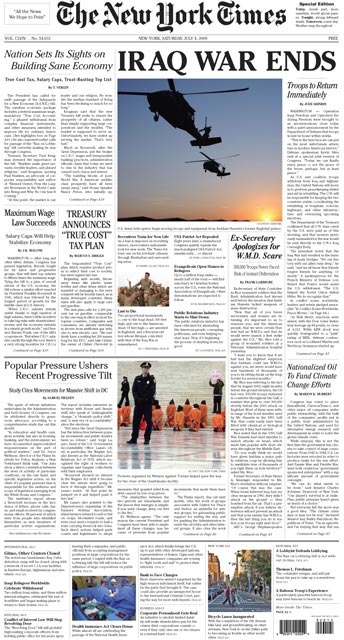
fake New York Times
[first image from the real NYT site; second from the faux NYT site]
Category: Culture
a quick return to Kippenberger(s)
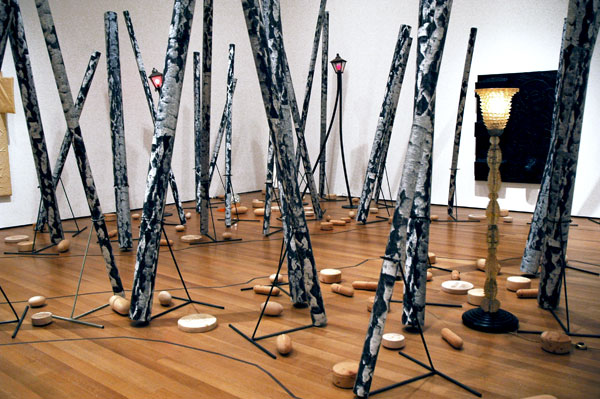
Martin Kippenberger Now I’m Going Into the Big Birch Wood, My Pills Will Soon Start Doing Me Good 1990 twenty-nine artificial birch trees (rolls of cardboard and plastic and black-and-white offset prints), metal stands and wood pills – dimension variable [large detail of installation, including “Kippenblinky”, “Street Lamp for Drunks”, “Untitled” (street lamp), “Disco Bomb”, and parts of two rubber on canvas works hanging on walls to the right and left]
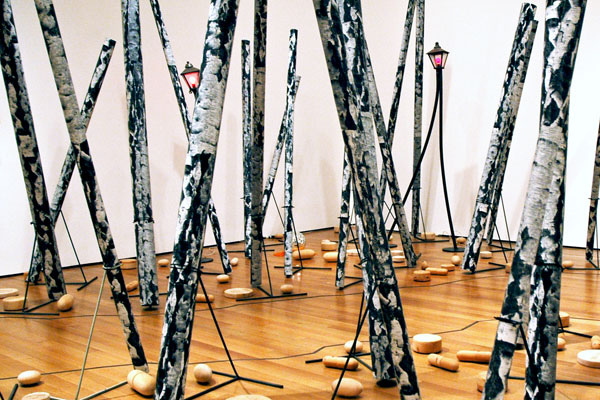
[cropped version of photo above]
I didn’t include this image in my Kippenberger show post of two days ago because it seemed to me somehow adulterated for including works that were not actually part of “Big Birch Wood” itself, but which the curator, Ann Goldstein, had intermingled with the larger piece.
And yet, since I published Tuesday’s entry, I’ve scrolled several times through the many images I took home with me, always finding myself being drawn back to the oddly-calming picture of these trees and oversize pills. I decided to try cropping the document to eliminate most traces of the other works. Then I wanted to share what I came up with, and that suggested this follow-up post.
But then something unexpected happened, barely two minutes before I started writing this paragraph. I had already decided I had to know more about why the installation had been given this shape so I did a little research on line, in the press materials, and in the George Baker’s article on the Kippenberger show in the February Artforum, “Out of Position” [unfortunately not available on line]. As a result of what I learned, I made the decision to add a thumbnail of the original image below the full-size representation of my large detail.
By this time I had apparently arrived at a sufficient degree of enlightenment to see something that has escaped me earlier, because when I took another look at the un-cropped picture I couldn’t understand why if had not satisfied me before. I reversed the arrangement I had just determined upon, so that now my preferred image is at the top. I left the cropped photo as a thumbnail mostly to show what I’ve been talking about here.
Ain’t art wonderful?
I still don’t know enough about this extraordinary artist’s life and work to critique the curator’s decision to meld several different disparate [?] pieces in this part of the gallery. I’m convinced however that Kippenberger’s “Now I’m Going Into the Big Birch Wood, My Pills Will Soon Start Doing Me Good”, largely because of its title, and its relationship to the artist’s personal circumstances, is one of the saddest, sweetest, and yet grandest poetic expressions of Kippenberger’s pain and his creative genius.
I’ve one more thing to share about Kippenberger right now, this quote from Ronal Jones, writing in Artforum in 1997 [I found it on Douglas Kelly’s site] which captures his remarkable fecundity:
Someone was always mistaking Martin’s solo exhibitions for a cattle-call group show. That pleased him no end.
Klara Liden at MoMA
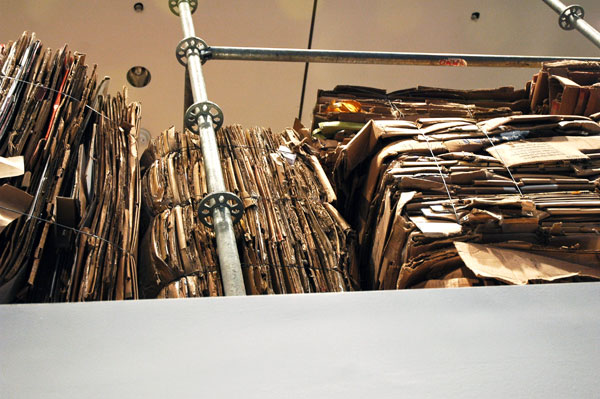
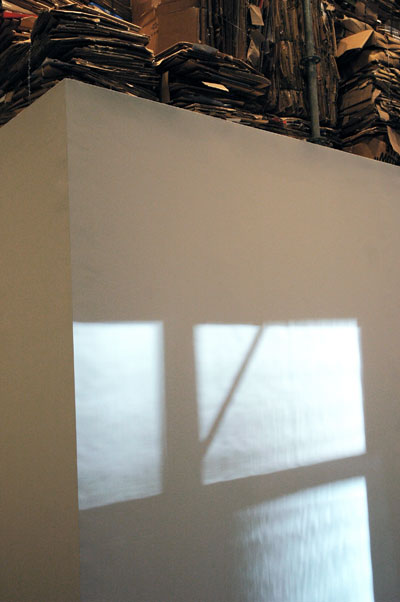
This kind of project is one of the things that we have not been seeing often enough at MoMA, and that was the case even before the opening of the new building. Since there’s now more space, there’s less of an excuse then ever to keep “emerging artists and new art“* out of our premier modern mouseion, founded and endowed as the premier “seat of the (here, visual) muses”.
Maybe some people understand “modern” in a way that does not include the “contemporary”, and MoMA’s decision not to engage in the regular deaccession of works in its collection which reach a certain age might explain what seems to be the museum’s frequent uneasiness with art being created in real time. I hope the appearance of Klara Liden on the second floor gallery signals a new openness on 53rd Street.
I’ve been one of the many champions of this artist’s work since first encountering it inside the storefront of the old Reena Spaulings four years ago, and yesterday during a press preview Barry and I were both charmed to see her working again with cardboard, this time inside a very different space.
Not everyone might agree with us, at least at first, as I learned when we were about to leave the room. A smartly-dressed woman all in black, of a certain age, who, along with several other women, also in black, had been in conversation with the curator, Eva Respini, asked us if we liked the work. I immediately volunteered, “yes”, with a little giddy enthusiasm. She asked me why, and I first described Liden’s earlier work. Turning to this installation, I mentioned the re-cycling element, the ransacking of the museum’s bowels, the white cube, the reference to consumerism (even in a museum context) and waste, the careful ordering of materials, and such. She looked up at the rows of cardboard boxes, broken down and tied, lined up high above the pure white walls, and she nodded, apparently unpersuaded of its virtues. She thanked me, and as she turned to leave, while she passed by I distinctly heard her give a very soft sigh.
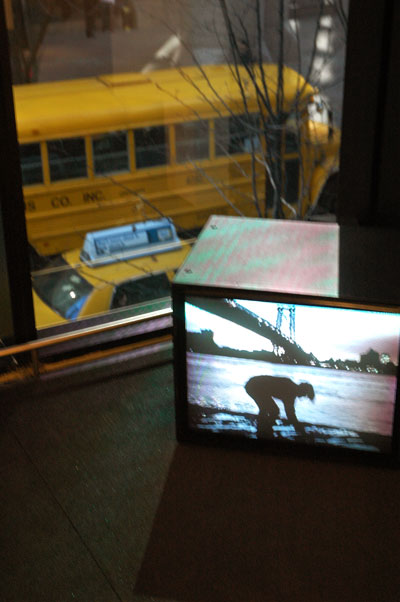
Respini told us that the accompanying video of the artist casting stones into the water had only been finished last weekend. It has a more casual air, than the structure behind it, which almost fills the room. At the time I took this picture the huge window behind the heavily-tinted glass (which turned daylight into something like the twilight East River scene on the screen, and also cast a blue light on the cube) was partly filled by a New York cab and a parked school bus, painted an identical yellow. It reminded me of the fact that MoMA routinely hosts visits of young school children on the days it is closed to the public, and we encountered one such very fortunate group, probably a kindergarden class, minutes later on our way out.
Now that’s even more than contemporary. May the gods save this kind of temple forever.
“Martin Kippenberger: The Problem Perspective”
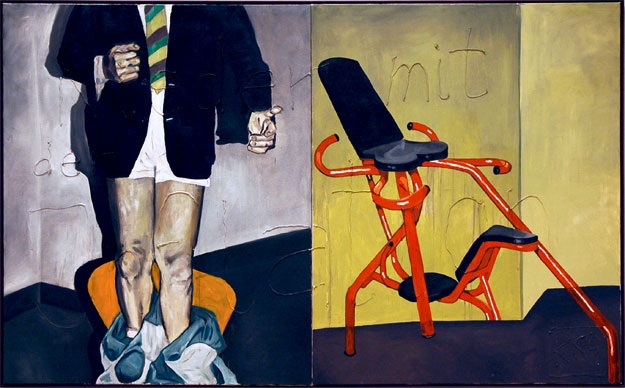
Martin Kippenberger Down with inflation 1984 oil and silicone on canvas (2 parts) 63″ x 104.75″ each
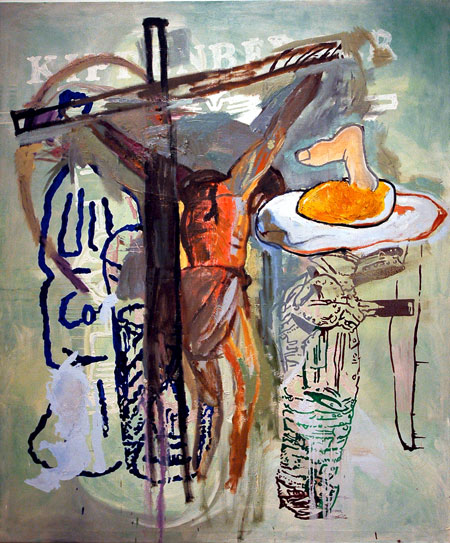
Martin Kippenberger Untitled, from the series Fred the Frog 1990 oil on canvas 94.5″ x 78.75″
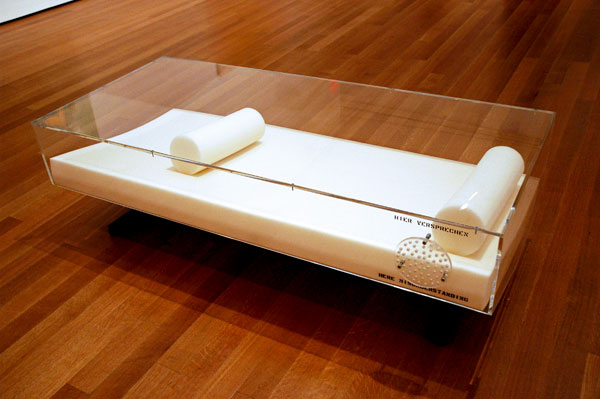
Martin Kippenberger Snow White’s Coffin* 1989 Plexiglas, synthetic foam and metal 15.75″ x 33.5″ x 71″
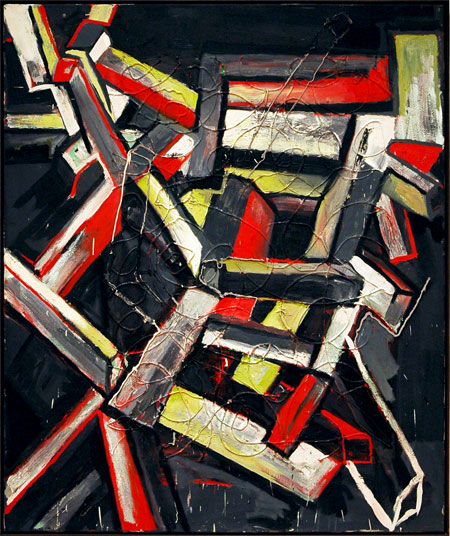
Martin Kippenberger With the Best Will in the World I Can’t see a Swastika 1984 oil and silicone on canvas 63″ x 52.75″
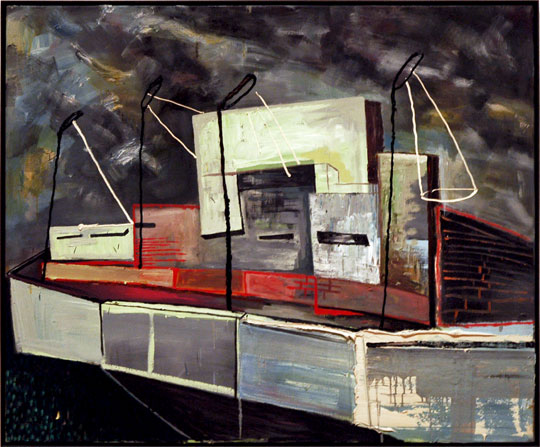
Martin Kippenberger “Stammhelm”** from Three Houses with Slits (betty Ford Clinic, Stammheim, Jewish ELementary School) 1985 oil and lacquer on canvas 49.5″ x 59″ each
This one really is for us. I mean the glorious, rich show, “Martin Kippenberger: The Problem Perspective“, which will open on Sunday (March 1) at MoMA. And I mean that it’s especially appealing to us art junkies: artists, fans and whatnots, zealots who regularly traipse through some of our meaner streets, searching out, and even haunting the more adventurous galleries and grittier rooms in this city and the incredible world beyond it, looking for the real thing, art which both reflects and challenges a world unlike that of even the most recent past. An anomalous rabble, we’re notorious (or more often ignored) for being sustained by under-known art not yet “elevated”, even made sacred, by the respectable museums we’re just not visiting so much any more (and not only because admission to the pantheon can set us back twenty bucks a pop).
But today I feel much better about the Museum of Modern Art than I have for some time.
Because of our interest in the subject of the retrospective, and our relative ignorance of it, Barry and I were eager to go to the press preview on West 53rd Street even though it was scheduled for something like our dawn this morning. I’m delighted to see that this month our local cabinet of early-modern curiosities is bringing us both Klara Liden (opening tomorrow, February 25), and the Kippenberger show, although I have to point out that the Kippenberger was put together by The Museum of Contemporary Art, Los Angeles [MOCA], Ann Goldstein, curator.
It’s a great show.
This is a collection of work which passes back and forth (sometimes doubling and tripling up) in what seems to include just about every medium. Although it all really looks like today, some of the pieces being displayed have been around for three decades. A few of the articles installed in the museum’s sixth-floor Special Exhibiton Galleries may be little more than the size of a hand, and the paintings are generally less than gigantic, but there are also room-size pieces, and one installation, “The Happy End of Franz Kafka’s ‘Amerika'”, which totally fills the bottom of the huge atrium, leaving only a modest square path lining its sides for all the visitors it will delight.
In her remarks today Ann Goldstein shed some light on the title of the retrospective (still slightly obscure to me, since I haven’t yet read all the material handed out at the presentation) when she described Kippenberger as a “profoundly productive problem maker”. I was suddenly all ears – or, in this case, all eyes.
Because of its inherent strength, its enormous influence on other artists, and the fact that, as Goldstein also said, we’ve finally begun to catch up with Kippenberger, I think by now we would probably be seeing this body of work in these major, established settings in some form even if the artist had not died so young, in 1997, of cancer. He should be turning 56 tomorrow, February 25. I can’t imagine what our world would look like if we were lucky enough to still find ourselves provoked, repeatedly, by the wisdom, the humor and the irreverence of this prolific virtuoso.
Now the work he has left us looks like it’s here for the ages, whatever that may mean, but I have to hope “the ages” will always cultivate the liberality which Kippenberger’s art seems to ask of us.
It’s a totally delightful show, great fun and without a dull note. I will be visiting it as often as I can while it’s still here in New York.
The choice of the images uploaded here [yes, they’re mine; fortunately we were allowed to take photos, since the museum seems to have virtually nothing on their site yet] was necessarily impacted by my fast run through the galleries during a far-too-brief press preview this morning, and it therefore doesn’t necessarily represent either a good overview of the installation itself or a list of my top favorites – if any arrangement of either were even possible.
*
the German text above the perforated opening translates literally as “here promise”; the English text below it reads “here misunderstanding”
**
Stammheim Prison, where the leading members of the Red Army Faction (Baader-Meinhof) were held and tried. It is also the site where four of them either committed suicide or were murdered – extrajudicially.
Lisa Kirk’s “House of Cards” at Invisible-Exports
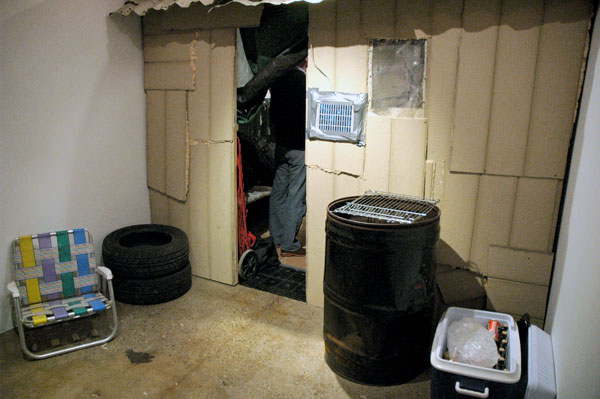
front yard
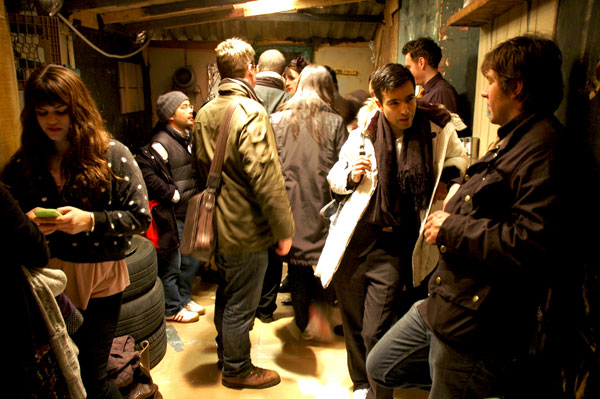
open house
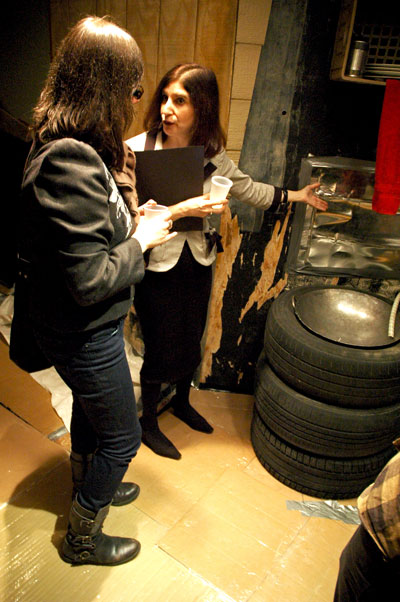
sales tour
Lisa Kirk continues her provocative body of work (what she calls her “series of social occasions”), more recently investigating capitalism, terrorism and political violence, in a dramatic installation, “House of Cards“, currently installed at the Lower East Side gallery Invisible-Exports. Although the show opened this past weekend and will continue there through most of March, after that it will take on the second life for which it was conceived.
This time Kirk has re-conceived the story of our contemporary real estate boom and bust in the form of a show model �shanty timeshare� whose structure and interior furnishings have been assembled, in classic (not “classical”) style, from discarded materials found in the neighborhood.
An experienced sales staff will be present in the rear of the gallery throughout the run of “House of Cards”, and visitors will have the opportunity to buy shares in this “private residence club” featuring all the conveniences which inhabit our current nightmares about home. Upon the show�s completion, the structure will be rebuilt inside a secure, honest-to-goodness gated community located on the edge of one of New York’s scenic waterways, where we are told “shareholders will have the opportunity to experience shanty living. After 52 weeks, maison des cartes will be disassembled and distributed to the shareholders as 52 separate and unique artworks,” thus promising a more upscale metamorphosis than that permitted most shanties when they are razed.
None of the serious satire (it’s not a burlesque) I describe here made this show any less frightening when I visited it with Barry during a preview last week, although the images I’m including here, of happy guests mingling inside these digs, would seem to belie that assertion.
It’s pretty scary; and it should be.
The press release announces a second installation, not related to the work on the main floor of the gallery:
Kirk�s shanty will be coupled with an underground installation of her updated project, Revolution (06-09). Last exhibited at P.S.1 Contemporary Art Center, Revolution appeared as a fragrance lab and terrorist headquarters suspended upside-down from the museum�s ceiling.
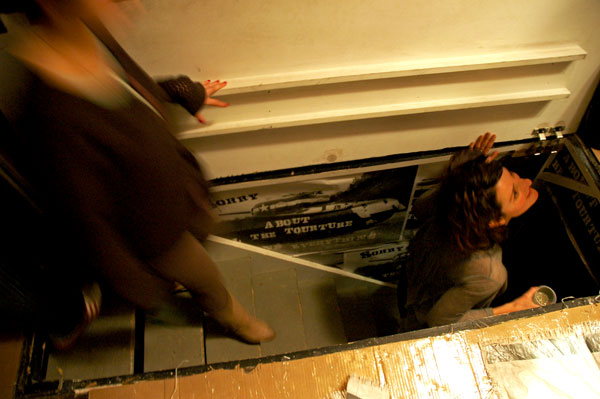
“sorry about all the torture”
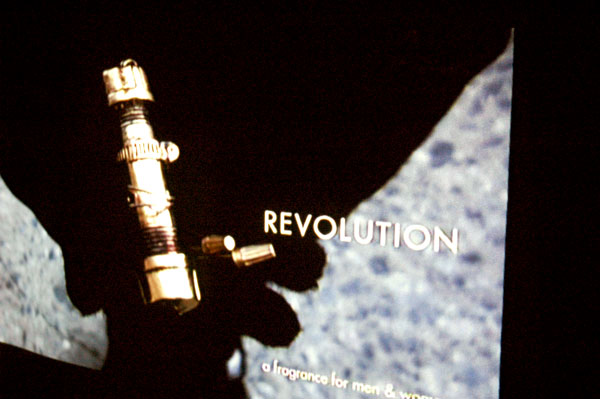
fragrance TV commercial
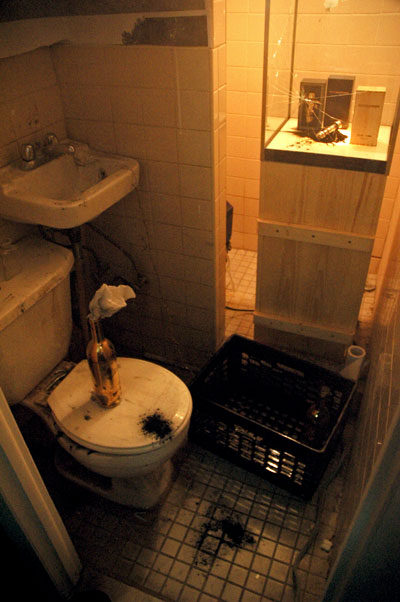
continuing “Revolution”
Bushwick L Jefferson stop drawing
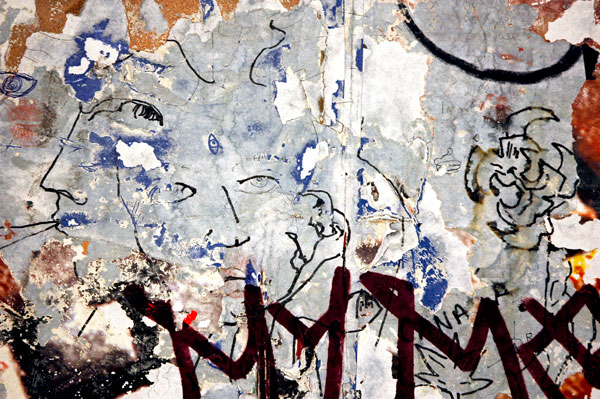
untitled (Cocteau heads) 2009
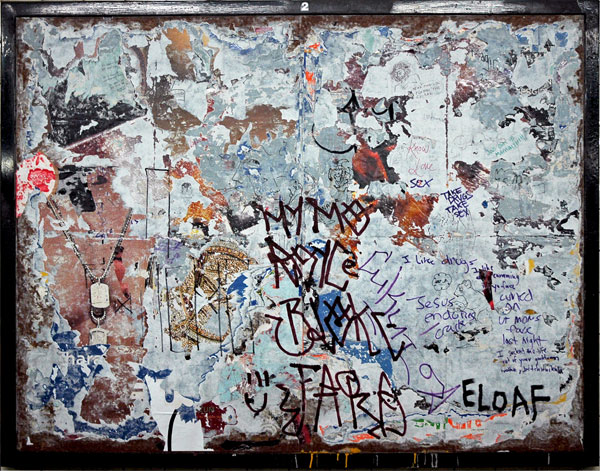
Of course I didn’t do the drawing, but I want to share it. There’s a lot going on here, most of it by chance. I saw these faces drawn on a very busy ground on an unused advertising board inside the Jefferson Avenue L stop over a week ago and the image I shot then still thrilled me when I rolled through my recent stash today.
This is what the entire board looked like:
“The Human Voice in a New World”: really new music
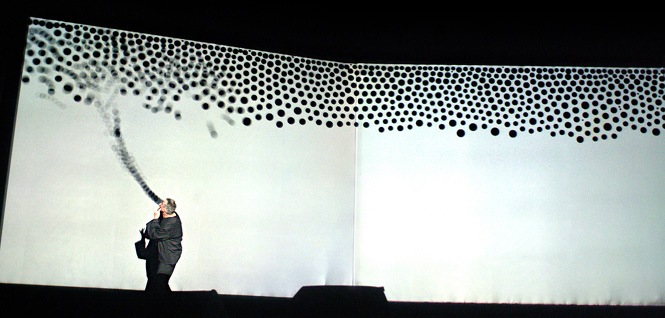
if “hearing is another form of seeing”*, then seeing is another form of hearing (Jaap Blonk and his “noise”, visualized graphically here, in a scene from “Messa di Voce”)
I know I run the risk of overplaying this description, but the folks who have put together three compelling concerts next week described under the heading, “The Human Voice in a New World“, make music as it might sound had neither language nor musical instruments yet been invented.
Actually, these masters (composers, poets, artists, performers, writers and interactive technology engineers) could hardly ignore the existence of sophisticated language or highly-evolved musical instruments; They obviously have been informed by both. It’s just that they have found a way of introducing us to musical sound in ways that make it seem we were fundamentally innocent of its pleasures until now.
They would also have us see the music, both literally and figuratively. Even without conspicuous visual elements (the most dramatic representation is included in Monday evening’s performance of “Messe di Voce“), these programs appear to be something which could be enjoyed by anyone interested in the experimentation, innovation and originality of emerging work in the visual arts – and the reverse seems equally valid. I know I’m not the only one who thrives on an immersion in the output of the freshest, most creative genius which can be found in both these arts, and I have no academic background in either.
I’m still hoping to speak with just a little authority on the subject since I’ve been listening to a number of these sound artists for decades. Most have been around for years and some of them may be as old as I am, but what they will be doing next week would be very new to almost anyone anywhere. For the tiny few who will make it to any of these performances it will look and sound like tomorrow, because almost none of us has been listening to and thinking about today as closely as Joan La Barbara, Jaap Blonk, Golan Levin, Zachery Lieberman, Trevor Wishart, Joel Chadabe, Richard Kostelanetz and David Moss.
I’ll be there each night; I wouldn’t miss one of these concerts for just about any temptation. They are being presented by the Electronic Music Foundation [EMF]. Monday’s performance, at NYU’s Frederick Lowe Theater, is produced in collaboration with the NYU Interactive Arts Series and is free. On Friday and Saturday, at Judson Church, you’ll be asked to pay all of $15 ($10 for students and seniors).
A generous amount of information, including sound samples and all the details on the performances, can be found on this page of the Electronic Music Foundation site.
The image I’m including below is a shot of the cover of one of my 25-year-old LPs of David Moss, one of the two featured artists on Saturday evening. Look at the list of his collaborators at the bottom of the cover.
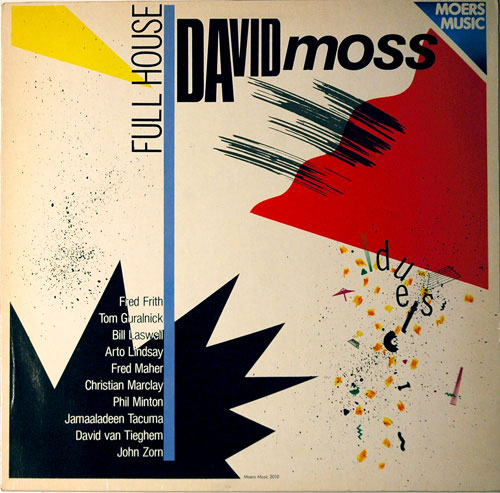
his noise is music to my ears
ADDENDUM: It’s the next morning and I’m feeling weird about not including some kind of image related to Trevor Wishart’s concert. He will be collaborating with Joel Chadabe and Richard Kostelanetz on Friday. In the middle of last night I went hunting for Wishart’s name and found an image which had been uploaded onto flickr by Sonic Arts Network. It’s of a revival at the group’s 2005 Expo festival in Scarborough, on the Isle of WIght, of the British artist and public sound activist’s 1977 piece, “Beach Singularity“. A video documenting a part of the day-long performance can be seen here.
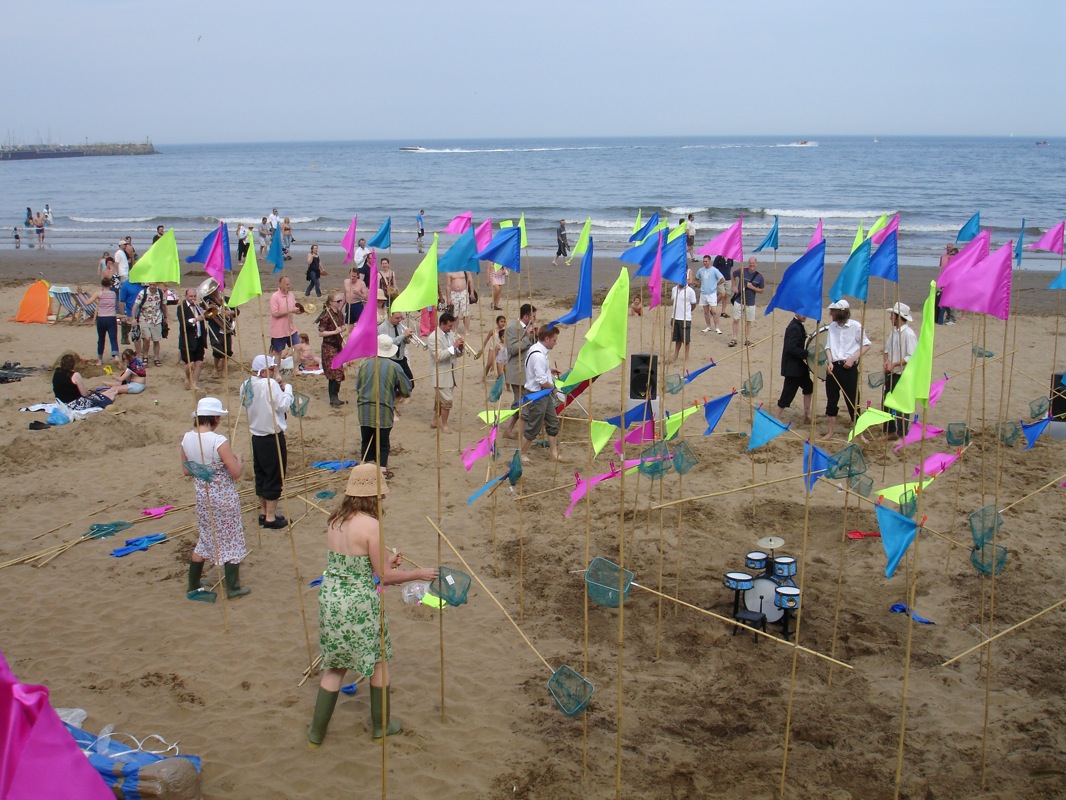
although it would have been fun, this Wishart piece is not the one coming to New York
Note: “The Human Voice in a New World” (subtitled: “A series of live performances exploring the crossroads of the human voice and technology”) is not a particularly catchy tag. Even after several days going back and forth to look at the program information I still couldn’t remember the name of the series I’m so excited about; the programs are bound to be much sexier than the billing might suggest.
*
quoted from composer William Hellermann, founder of The Sound Art Foundation in 1982
[“Messe di Voce” is produced in collaboration with the NYU Interactive Arts Series; image at the top from tmema; image at the bottom from flickr]
Paul Gabrielli at Invisible-Exports
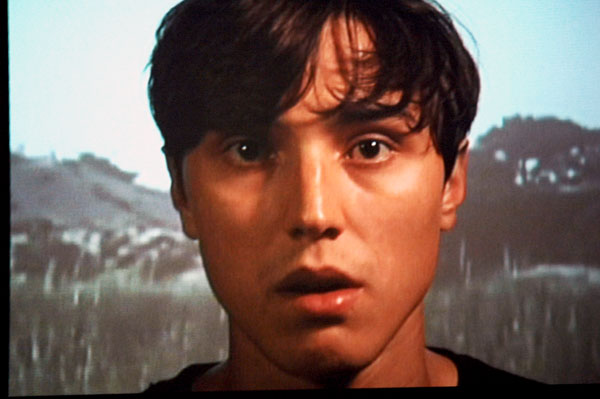
Paul Gabrielli Dark Movie 2008 single-channel video [large detail still from installation]
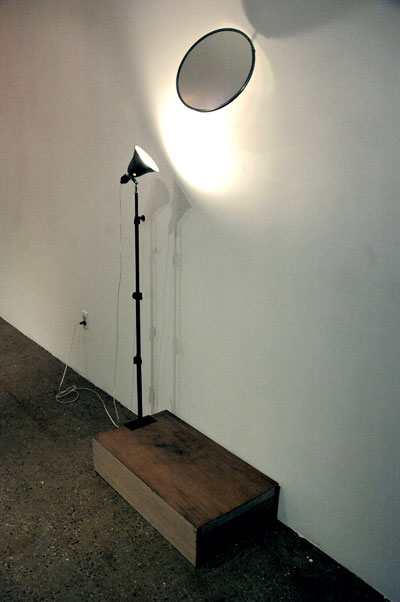
Paul Gabrielli Untitled (Stage) 2008 wood, aluminum, glass mirror, steel, light extension pole, clamp-light, light bulb, enamel 78.5″ x 32″ x 18″ [installation view]
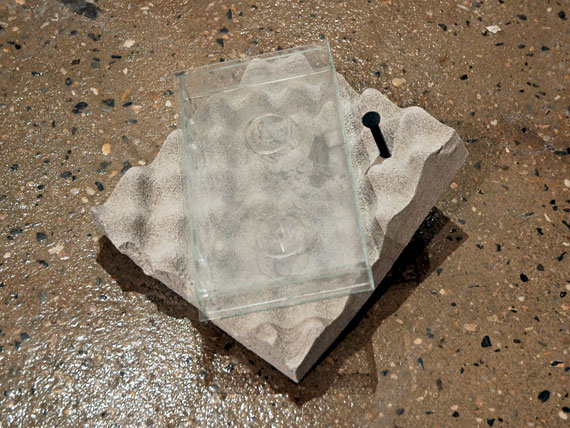
Paul Gabrielli Untitled (See Through Rental) 2008 glass, Ultra-cal, foam, acrylic paint, nail, enamel [installation view]
Barry and I weren’t able to get to Paul Gabrielli’s exhibition, “Closer Than That“, at Invisible-Exports until the last weekend of the show. It was a Top Pick on ArtCal for just two days but it would have been there throughout its run had we seen it earlier. My posting some images now of this [elegant and sexy, conceptual, posterior-minimalist, multi-media including a bunch of may-look-like-but-aren’t-readymades] installation is therefore something of an apology. It’s also meant as a head’s up, intended both for those of us who saw it and those who didn’t, to be on the lookout for his work next time he comes around.
This excerpt from the gallery press release ends with a provocative question which follows the description of Gabrielli’s work as:
. . . experiments in form designed to encapsulate the physical manifestation of a single thought, with all its lyricism and paradox. His pieces represent both interior visions and the very real destruction of the well-defined and corporeal. They stand on the anxious fulcrum of categorization; when distinctions between forms and material disappear, or are made to disappear, what is left standing?
For more information on the artist and on the program of this smart new Lower East Side space, see this interview on the newsletter ARTLURKER with Invisible-Exports owners Benjamin Tischer and Risa Needleman.
en plein air: 23rd Street studio
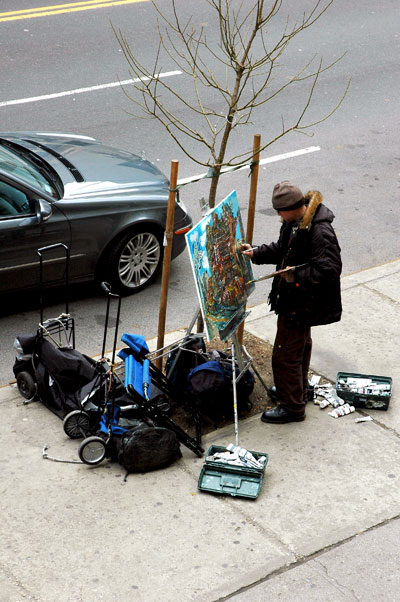
concentration
The story is that when I looked out of my window last Thursday afternoon, on the coldest, windiest day of the winter, I saw this painter and his rig. I had often seen him planted elsewhere on the block, often, as here, painting the Chelsea Hotel across the street, but on those occasions I would have been too respectful of his privacy, or maybe just to self-conscious, to intrude on his concentration with my camera.
This time it was different, since it was unlikely I could disturb him and equally unlikely I or my machine would draw anyone’s attention. I took this picture and later returned to the window (without the camera) to see if he would still be there. He was, but I now saw that a young woman was standing at the driver’s side of the car seen in this picture, looking a little puzzled, and a somewhat older man was standing in the street ahead of it pointing to something in the area of the left front fender. Then I saw a smile of recognition come to the woman’s face and she stepped forward to pull and gather up what turned out to be a large, bunched-up clear plastic bag. It had probably become stuck somewhere on the car. She thanked the helpful stranger, walked over to the curb and plopped it in the midst of the painter’s bags, each of them strapped to luggage carriers. She returned to the other side of the car, slipped into the driver’s seat and drove off.
She had apparently remained throughout totally unaware of the artist’s presence, and of his equipment as well. Probably she was only sufficiently aware of her environment to see some vaguely trash-bag shape already sitting on the curb, and that was where her own offending litter would be deposited.
I can’t end the story without allowing that the artist appeared to be no more aware of his environment than she was: He didn’t seem to notice any of what had just transpired, including his bags being mistaken for trash. In fact, he never looked away from his canvas. Ah, the singular concentration of the artist can apparently be sustained even in the open air.
UPDATE: All thanks to the folks at “Living With Legends: Hotel Chelsea Blog“, I’ve learned that the artist is David Combs, who used to live in the Chelsea, and may now have returned.
WAGMAG benefit at The Front Room tonight
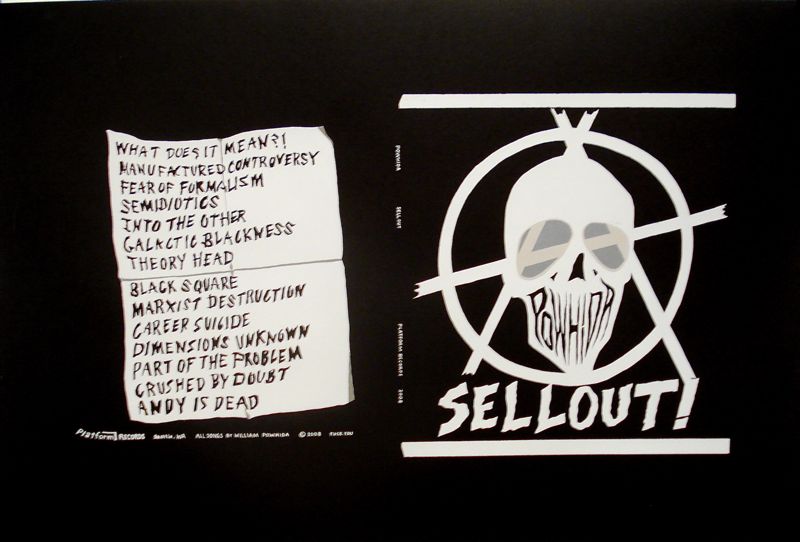
William Powhida Sellout [item #76]
One sign of the almost proximate arrival of spring is the announcement of the annual WAGMAG benefit. Once again it’s again time to help out our indispensable guide to Brooklyn galleries (it now covers all of Brooklyn!), by purchasing tickets for the artwork drawing tonight at The Front Room Gallery.
Some really great art, including the William Powhida piece shown above, have been donated by artists and galleries who know how much this publication does for the community, and want to give a bit back.
The rest of us have a chance to help by showing up and purchasing an opportunity to select from the bounty shown here. If you and your valentine are already committed elsewhere tonight, you can also buy one or more tickets on line (they are only $200 each) and indicate your choice with a WAGMAG proxy. All tickets guarantee a work of art, and entry to the party is free.
As I wrote last year, I can’t say enough about Daniel Aycock, the generous artist host.
For details, see this post on the ArtCal zine.