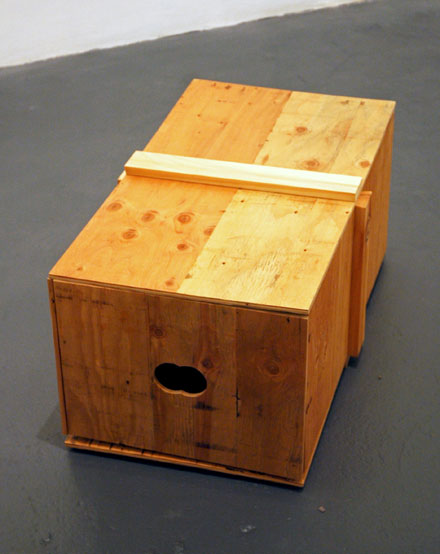
Taylor Davis Swordfight 2006 plywood and pine 16″ x 19″ x 33″ [installation view]
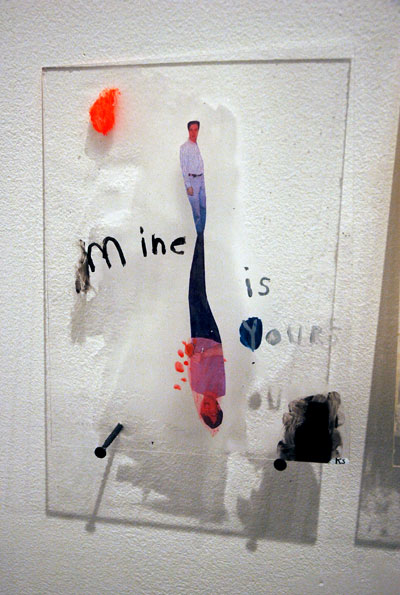
one of nine panels included, mixed media on plexiglass, 8″ x 10″ each, from a series by Katherine Streeter
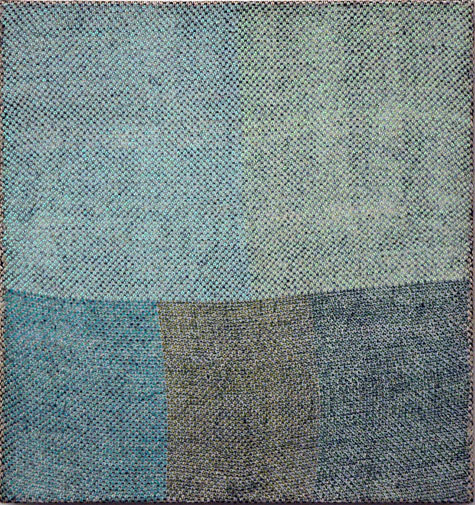
Mark Barrow Bric a Brac 2008 acrylic on hand-loomed linen textile by Sarah Parke 15″ x 14″ [one of two parts, the first part 16″ x 14″, installed to its left
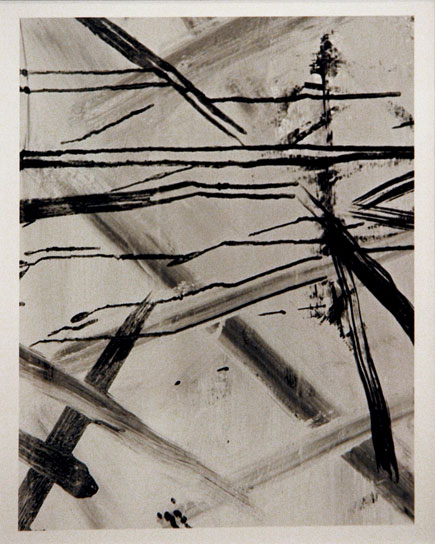
Anthony Pearson Untitled (solarization) 2008 framed solarized silver gelatin photograph 19.5″ x 16″ unique [view of installation, not including mat]
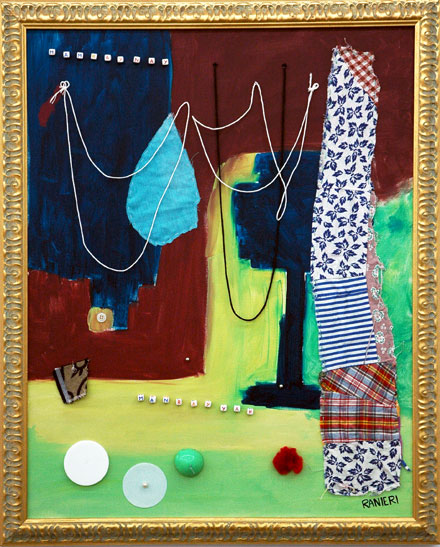
Michael Mahalchick Ham Ray Nay 2008 mixed media 33.25″ x 27″ x 2″
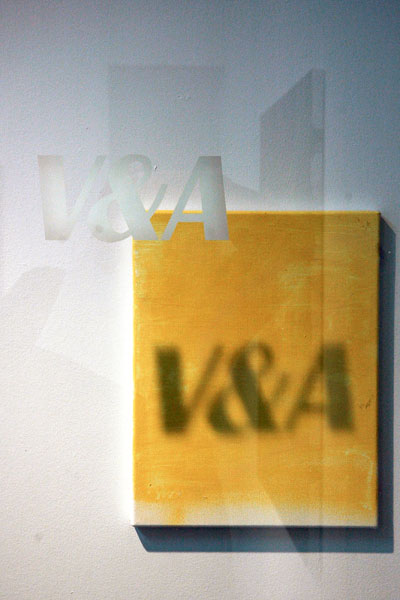
Erik Lindman Twilight 22 Electric Kingdom 2008 oil on canvas 14″ x 11″ [installation view, including site-specific shadow cast by etching on glass door]
This look at some shows on the Lower East Side is the fourth and last of the current series of visits to gallery neighborhoods.
The current show at Cuchifritos, “A Relationship Left For Dead on the Lower East Side” is my nod to tomorrow’s holiday, but the curator, Bill Previdi beat me to it, probably many months ago. It’s a compact and very smart installation about relationships inspired by a photo album given to him by a friend who had found it somewhere in the neighborhood served by/serving this gallery, a non-profit space described on its web site as having a focus “on contemporary art as it relates to community, social issues, and public space.” When we saw the show on the day it opened Previte told us that he knows nothing about the two men who appear in the pages of this album left on a curb nearby, but if they should happen to see the show and recognize the photos it would be returned. I haven’t heard if either or both have turned up, but Previdi is closing the show with a reception from 4 until 6 – on Valentine’s day.
Lisa Cooley is showing the first of a series of three-person shows, in the words of the gallery statement, “juxtaposing a canonical artist with both an established and an emerging figure”. Not surprising for this gallery, this is an exquisite installation which places Binky Palermo on the wall opposite the entrance, with works by Anthony Pearson (b. 1969) and Mark Barrow (b. 1982) trading places and dancing on walls to the right and left.
CANADA is showing Michael Mahalchick in “For What It’s Worth“, and its pleasures are definitely worth a lot, beginning with the image on the invitation and the website. How can everyday leavings be made so wacky and beautiful at the same time? My favorite line in the press release: “�For What It�s Worth� is a celebration and ritual offering to the collective ewwwwww.”
Barry and I both decided we had to get to Mott Street for the current show at V&A, if only on the basis of a piece we had seen last month in a group show at BUIA by the Chinatown gallery’s featured artist, Erik Lindman. Lindman’s piece in that show was called “Zac Efron in Highschool Musical 3 with my iPhone � Magic Johnson Theatre”. His solo show on the Lower East Side, “House Wine, House Music” includes four paintings, one shadow and a photograph, all of which are described as an attempt to make art that is anonymous. In the oils he may have to actively create what he is able to find ready-made with his camera, but when he erases pigment and representational shapes to describe negative spaces on his canvases he is seeking the same end, what the gallery notes describe as “A conscious lack of intention through attention to negative spaces.”
Category: Culture
Williamsburg: Peter Fox, Aron Namenwirth, John Bjierkle
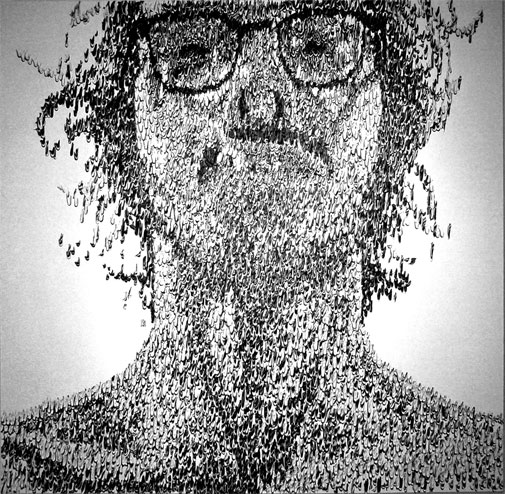
Peter Fox Big Self Portrait 2009 acrylic on canvas 73″ x 73″
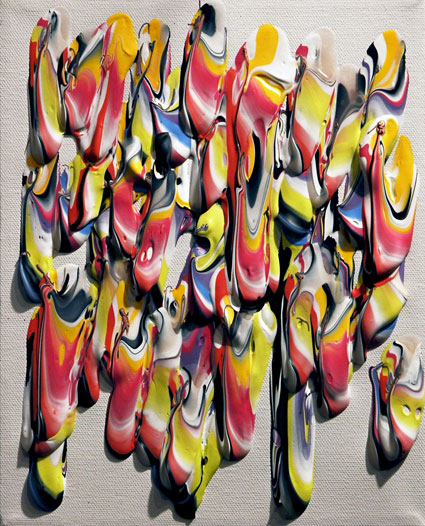
small acrylic by Fox for which I don’t have the information
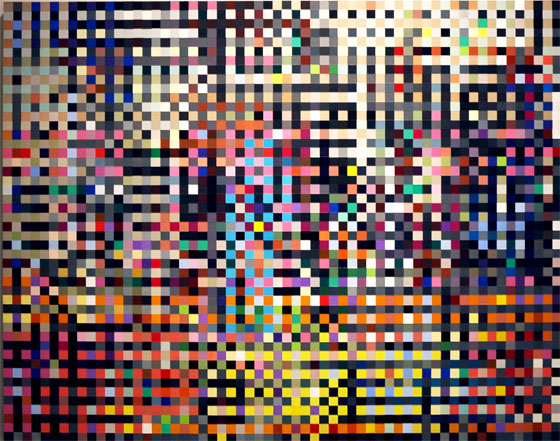
Aron Namenwirth Party City 2006-2008 48″ x 60″ x 3″
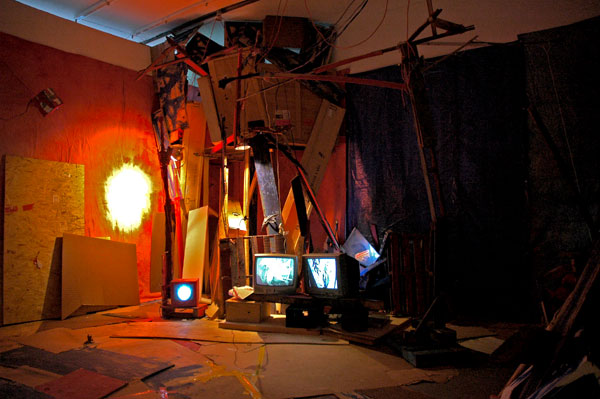
installation view of John Bjerklie’s “When A River Changes Its Course”
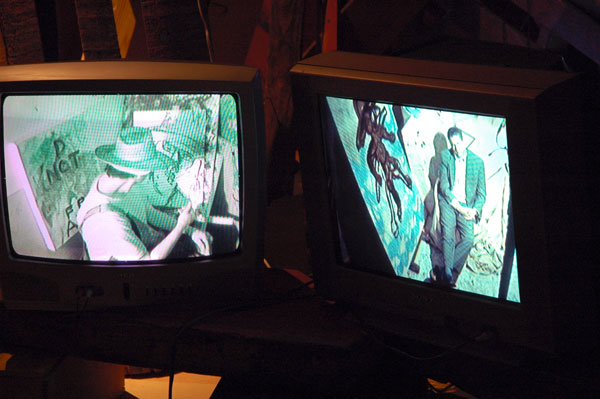
[a more detailed view]
The “tour” which began in Soho continues into a third day with a look at some shows in Williamsburg galleries.
Peter Fox has shifted from abstractions to representational and text works with the colorful and gently-risible show, “Moving Target“, currently hosted by The Hogar Collection, but his trademark relief technique, which uses countless multicolored blobs (“blobilism”?), survives unaltered. Curiously I’ve just noticed that the image I first thought would be the only one I’d use to illustrate the show happens to be the only black and white painting. Also, while I really like the new direction, I’ve now decided to add an image of a recently-completed piece I saw hanging in the gallery’s office. It’s only about ten inches high, but it shows that Fox abstractions haven’t yet run out of things to say.
Aron Namenwirth’s dynamite show at VertexList has been extended through February 28, but by appointment only. No sweat, that, and it’s definitely worth the phone call. For access to the Bayard Street space call Namenwirth at 917-301-6680 or 917-301-0306. This beautiful body of work at first suggests little more that simple blown-up pixilated photographic imagery perfectly rendered in paint, but this elegant, precisely-drawn simplicity is deceptive. The artist starts with small JPEGS which frequently depict political or spiritual figures. I don’t pretend to understand how he has done it, but some readers may get further with the help of excerpts from an interview the artist had last December with Erika Knerr. Namenwirth is describing what’s going on in the painting shown above. He had just said that another piece (which appears to be just as abstract) has four images in it, and that each one occupies a different grid, meaning there are four grids in the final work. He goes on to say that “Party City” also has four images, and that they compete with one another, in the end becoming the brilliant blur you see:
Aron Namenwirth: Basically the images all occupy one of these four pixels so there are four images sitting next to each other on four separate grids and they just obliterate each other.
�Party City� is [composed of] four images, a Chinese stockbroker, guys with suits with golden shovels breaking ground for the Chinese version of the NASDAQ, the building is designed by Rem Koolhaus, and a group of soldiers from Darfur with shovels and guns. All these images are off the internet. The fourth image is a group of people, friends of my mom, Cynthia Bloom, at her memorial service. I planted all these flowers in the sand, so all these people where around the flowers in the sand thinking about her.
I don’t know what to say here about John Bjerklie‘s installation at Parker’s Box, “When A River Changes Its Course“, especially since you’re probably going to want to visit it – and I say “visit” advisably. Most of us may have seen the inside of a gallery turned into something of a dump more than once before, but this show, with the distinction of its being littered with old TV sets, both working and clearly defunct, will probably hook you if you manage to come in while our host, Bjerklie, and [insert name here] are engaged in a quite shrewdly-mad conversation about art while inserted inside two separate screens. Meaty stuff, but lots of fun.
Chelsea: Derek Jarman, David Diao, Alyssa Phoebus, Vlatka Horvat, Sarah Greenberger Rafferty
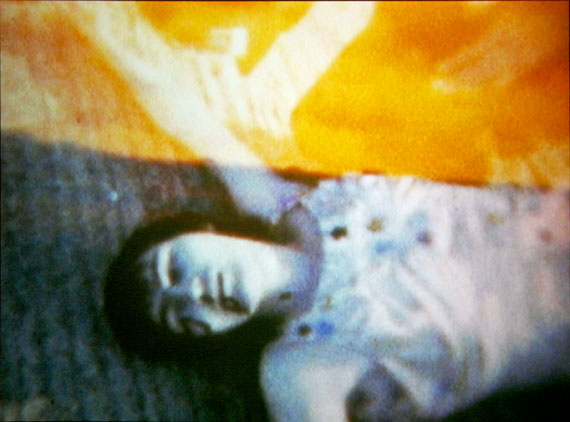
Derek Jarman In the Shadow of the Sun 1974 Super-8 (transfer to DVD) color 54 minutes [still from installation]
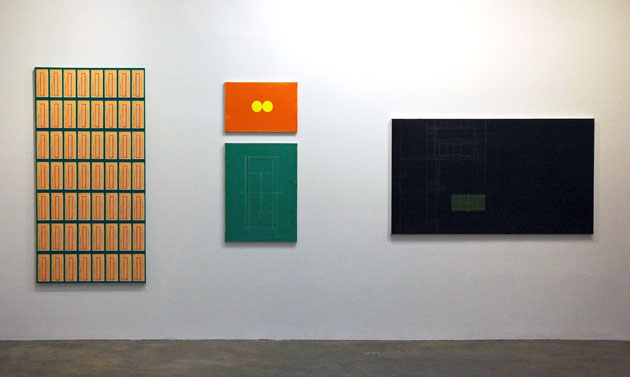
detail of David Diao’s installation, “I lived there until I was 6�”
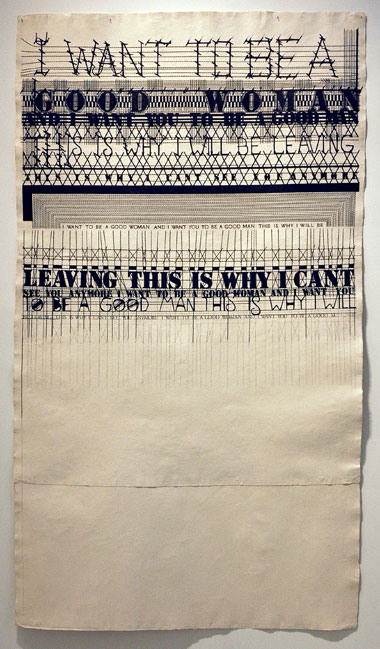
Alyssa Phoebus Good Woman 2008 graphite on cotton rag paper 96″ x 53″ [installation view]
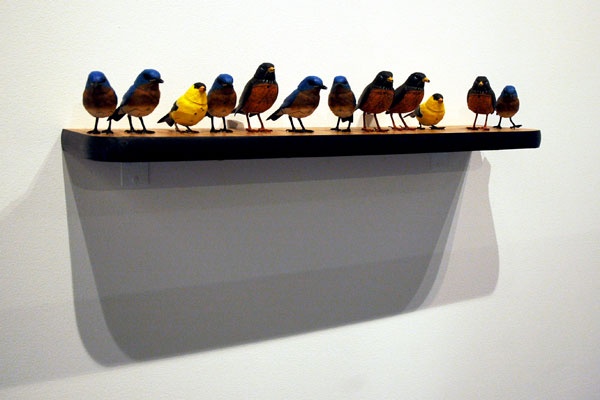
Vlatka Horvat Birds Shelf 2009 modified wood table-top, 13 photo-sensitive bird figurines [installation view]
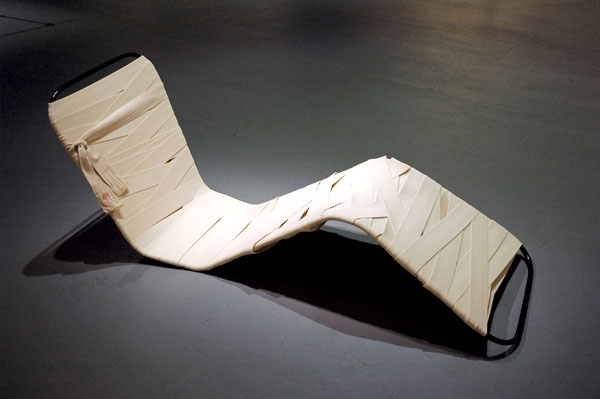
Sarah Greenberger Rafferty Strapped (Sanitorium Chair) 2009 painted galvanized steel and bandages [installation view]
Continuing the neighborhood tour started yesterday I’m uploading images, and little else, of some shows I’ve thought worth sharing.
Elizabeth Dee is showing four early, amazingly-innovative and almost painfully-beautiful Derek Jarman films. They are accompanied by an installation-specific sound design by the artist’s friend and collaborator, Simon Fisher Turner. It’s a great treat, but Jenny Moore, the gallery’s director, told me there’s more to come: Beginning March 7 and continuing for three months an exhibition of 18 rarely-screened Jarman films will be installed two blocks north of her gallery, at X, a new nonprofit space which will occupy the old Dia Art Foundation quarters on West 22nd Street. Beyond my immediate pleasure in learning about the Jarman show, the arrival of X sounds to me like very welcome news for everyone. I know I’m not the only one who misses the ambitious large-scale projects which were installed for months at a time on that building’s five spare, elegant levels. Dia’s tenure of that old garage began in 1987, the year I moved into Chelsea. The foundation moved out early in 2004 and I’m still mourning the loss of a fascinating neighbor.
I’ve learned quite a bit about David Diao in the last few days because of my visit to his solo show at Postmasters, “I lived there until I was 6�“. I had lots of catching up to do (let’s say my ignorance was embarrassing), but I’m now appreciating the strength and beauty of his art and the weight of his personal history. I’ve also learned that we share what some might call an immoderate interest in architecture, the abstraction and reality of “home”, and the urge to look back at one’s beginnings, the sort of thing which often comes with a certain maturity in years. The show, or project, at Postmasters is an aesthetic and psychological reconstruction of his family’s compound in Beijing, from which he and his parents and relatives were forced to flee in 1949 with only 24 hours notice. The paintings are inspired necessarily by very imperfect memories (the house is gone and there are no pictures), those of the 6-year-old Diao and a few surviving members of his family.
The title of Alyssa Phoebus’s show at Bellwether, “Lay in the Reins“, appears to be something of an exhortation, and the titles of individual works expand on the theme: “Rough Sex With a Big Man”, “Harder Harder”, “You Ain’t a Beauty”, and “The Cruelties That Attend the Rites of Love” among others. These dramatic graphite drawings of lines and text on gorgeous handmade ivory rag paper are pulled from popular songs and expressions, but in the artist’s hands the words take on a musical life of their own. Just don’t expect a sentimental ballad.
The Kitchen has two shows curated by Matthew Lyons, Sara Greenberger Rafferty’s “Bananas” and Vlatka Horvat’s “Or Some Other Time“, each with work in a number of very different mediums. [For a short video of Horvat’s singing “Birds” see bloggy.] I liked some of what I saw but was somewhat nonplussed about much of the work. I said “nonplussed”, not indifferent or displeased. I have to admit that I went into the space cold and I couldn’t get much out of the press release. Because The Kitchen’s web site is almost impossible to use, I see I won’t be learning any more unless I go back. Because I respect Lyons, and have enjoyed following Rachel Uffner’s program for several years now (both artists have shown in her gallery), I intend to do just that.
Soho: Davis Rhodes, Stephen Sprouse, Ben Jones
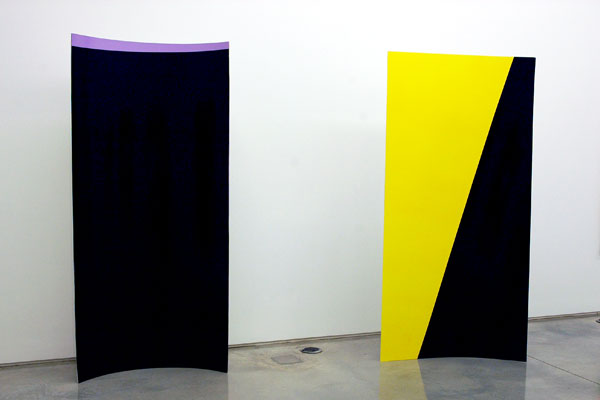
Davis Rhodes Untitled 2008 enamel on foamboard 96″ x 44″ x 8″ (each) [installation view of two separate works, each described identically]
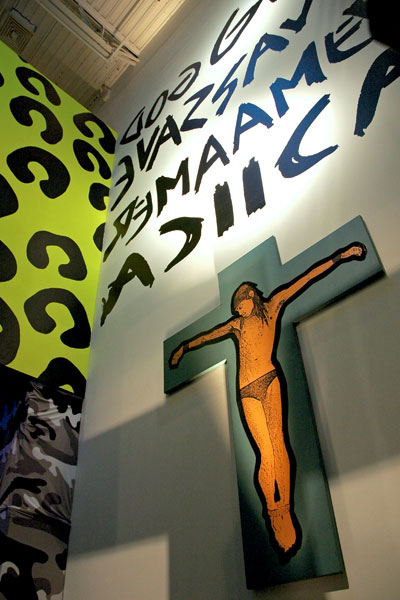
a detail of the Stephen Sprouse show [installation view including “Iggy On the Cross”]
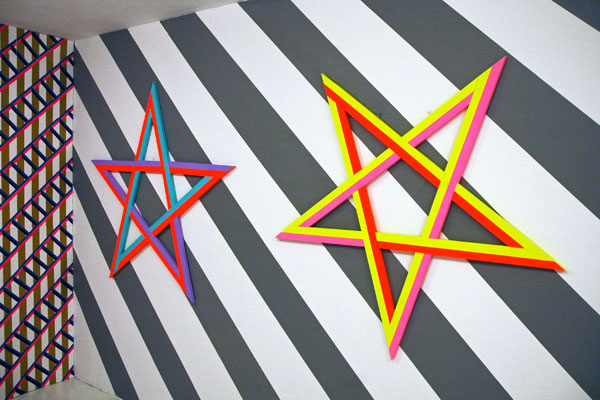
Ben Jones [detail of entrance to installation, “The New Dark Age”]
I didn’t want to lose another race with time, so I’ve decided that before they close I’d do a few posts pointing to shows I think worth a detour. I’ll be grouping them more or less by neighborhood, but including only the most abbreviated description. I hope not to make a habit of this, but lately I’ve seen so much I liked that I’d never have time to talk about it all.
The first stop is Soho.
I felt almost physically provoked by the painting/sculptures of Davis Rhodes in a three-person show at Team Gallery which also includes work by Gardar Eide Einarsson and Stanley Whitney. Rhodes’s medium is enamel on foamboard, in various thicknesses. Except for one diptych propped against a wall, painted on a thicker board than the others, they stand by themselves, with the help of the artist’s horizontal arches.
Stephen Sprouse is making another comeback. This one is being launched from Deitch Projects Wooster Street, but Sprouse isn’t here to enjoy it. Because of his early death in 2004 we have no idea what he would think about this look backward. “Rock on Mars” is a retrospective of the body of work created by the designer and artist during an erratic rocket of a career which both fired up and was fired on by a mix of and pop and punk culture which never totally disappeared; I think it just moved to Brooklyn. And now hard times are back: If he were still with us, Sprouse might feel more at home today than he had since he started out.
Ben Jones really is at home in 2009. His show at Deitch on Grand, “The New Dark Age”, is both totally of and way beyond whatever we mean by “today” – both the culture and its systems. Jones, who is part of the collective Paper Rad, is enjoying (I hope as much as we are) his first solo run at the gallery, where the work, described in the press release as “between-media video sculpture, light painting, and ‘drawing in the digital age'”, is also a mesmerizing amalgram of comedy and terror. Pay attention to that show title.
more of Nick Cave’s soundsuits at Jack Shainman
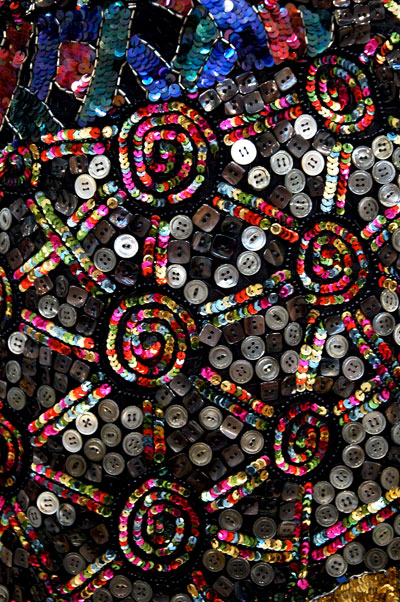
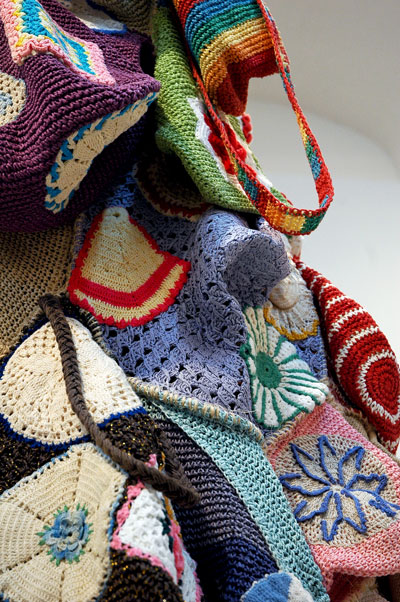
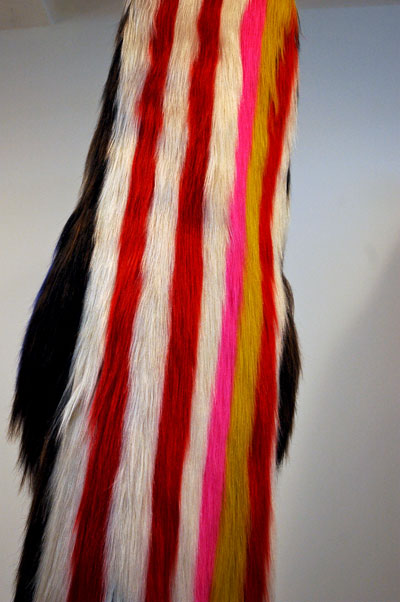
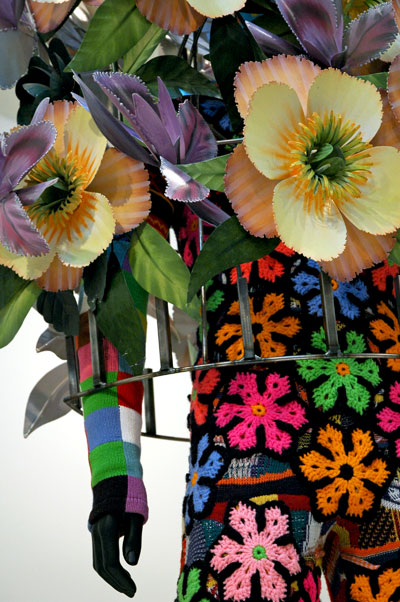
You’ve already heard it from everyone, so I’m not going to bore you with another encomium. You can and probably have seen full images in many publications and on many sites, so I’m only showing details here, plus one mid-distance shot, of some of the works in Nick Cave’s recent show at Jack Shainman, “Recent Soundsuits”.
I’ll only add that it was an incredible show. Nothing which we had seen or heard, in any medium, would have been sufficient preparation for experiencing these sculptures at first hand. My only complaint was the surprisingly static installation, but the quality of Cave’s work would have transcended any platform.
For a look at his appearance in an earlier, group show, scroll down on this link.
On Kawara’s “One Million Years” visits Zwirner
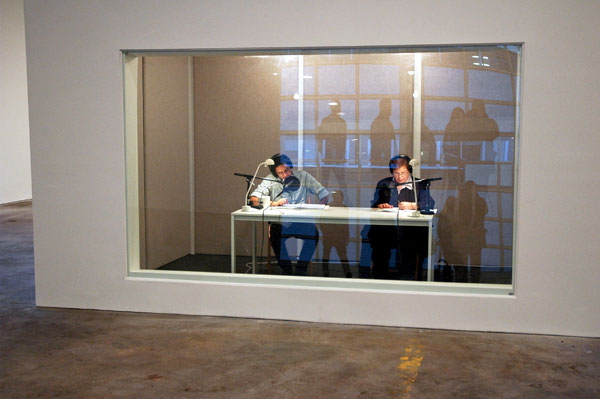
the long count continues
Figuratively, I’ve probably been walking around his neighborhood for several decades, because I’ve been encountering single examples of and groupings of On Kawara‘s “The Today Paintings” since at least the early 80’s. Until I walked into “One Million Years” however, his current show at David Zwirner [closing this Saturday] I confess I never knew what was actually going on inside the vast, minimalism/maximalism of this artist’s cerebral precinct. Although I still can’t claim a complete understanding of it, since I snapped this image inside the gallery last week I think I can say I’m now on the same planet – and in the same century.
For me it all came together for the first time when I saw and heard these two volunteers taking turns reading off (performing and recording) the successive dates which compose this awsome work’s simple, descriptive title while seated inside a temporary studio, a sound technician posted outside.
Did I mention that when I walked out onto 19th Street I felt like I had just left a great temple? And I haven’t a spiritual bone in my body, or at least that’s what I’ve always thought. I highly recommend the experience. Go, if you can, and stay a few minutes. If you’re with a friend, and you say something while you’re there, you’re certain to be whispering.
A million years? We’re none of us there yet (I’m guessing the “readers” are only somewhere around the 40th millennium right now, even though these readings have been going on, and off, at different sites all over the world since 1993). Also, none of us will live to see this conceptual (and also very real) performance completed, but I’m thinking what an extraordinary privilege it is to be a part of it – although I have to live with the thought that, even if it weren’t a question of money, this audiophile would never be able to listen to the entire CD set.
I’ll just have to be content with the more miniature epic song projects of Kawara’s rivals, like Wagner, Feldman, Stockhausen and La Monte Young.
Zwirner’s notes provide a background for the continuing audio project currently visiting the gallery in this description of the original, printed work:
One Million Years is a monumental 20-volume collection, comprised of One Million Years [Past], created in 1969 and containing the years 998,031 B.C. through 1969 A.D., and One Million Years [Future], created in 1981 and containing the years 1996 A.D. to 1,001,995 A.D. Together these volumes make up 2,000,000 years. The subtitle for One Million Years [Past] is “For all those who have lived and died.” The subtitle for One Million Years [Future] is “For the last one.”
ADDENDUM: It’s a few minutes since I wrote the above. I’ve just read Jerry Saltz’s piece in New York magazine. I had already decided to write about “One Million Years” when I saw it but I wouldn’t let myself read it until I had finished my own brief account. I was afraid I’d be scared off by his erudition and charm.
As it turns out, I certainly would have been; this blog slot would have used for something else: For this particular task, Jerry had, among his many other advantages, his brilliance as a critic and writer, and the nobility – and the guts – to actually volunteer to read a section of the text – to be an integral part of the piece itself. It’s really great, and great fun. It’s titled “Reeling In the Years” and you can find it here.
p.s. While looking for the article on line I discovered Jerry’s homage to Steely Dan, and this.
Richard Wilson’s Mr. Benn’s world at Jack the Pelican
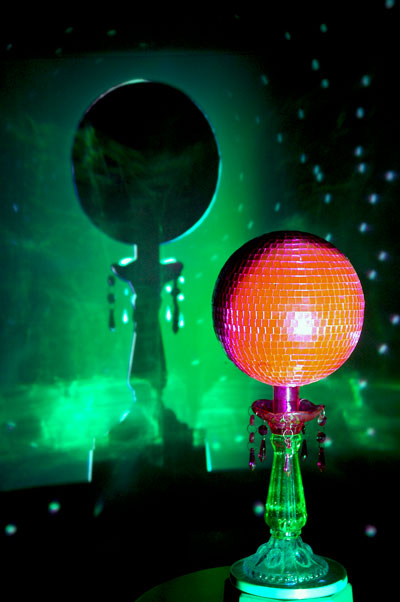
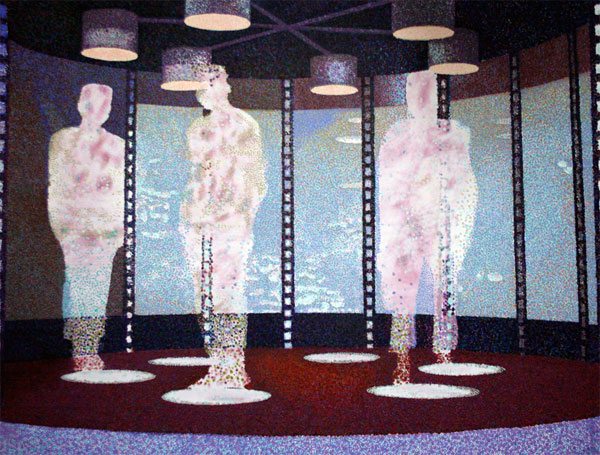
The current exhibition at Jack the Pelican, “Mr. Benn’s Spare-time Continuum” will close tomorrow, Sunday, at 6. This means that there are only two days left for a chance to enter into the squirmy/cozy comforts of what is described here in the gallery press release:
The timely anachronism of Richard Wilson’s mechanistic renderings of super-tech ideas points to Britain in an era when unassuming people lived in modest circumstances [my emphasis, since I love that phrase].
Wilson’s introduction of Mr. Benn to New York gallery goers might have been a risky proposition, since the popular early-1970’s BBC show, based on a popular children’s book published a few years earlier, never made it to our shores, but the installation resonates with our own island’s 21st-century fantasies, sentimentalities and anxieties.
The exhibition may be one of the strangest scenes to be found in an area gallery right now, but I’ve found myself going back to it in my mind since I left it one week ago, no small thing for this crowded ADD head.
The mirrored ball may suggest the iconic 1964/1965 New York World’s Fair Unisphere, and the transporter room painting appears to be a riff on Seurat’s pointillist “A Sunday Afternoon on the Island of La Grande Jatte” [surely what all “trekkies” were thinking each time that set showed up in Star Trek].
If you go, enjoy the soft, tufted Chesterfield sofa and take advantage of the hot water urn and tea makings.
[second image provided by the artist; my own was corrupted by the very low light, but it otherwise had the advantage of including a number of pink points of light thrown from the disco ball across the room]
Wooster door
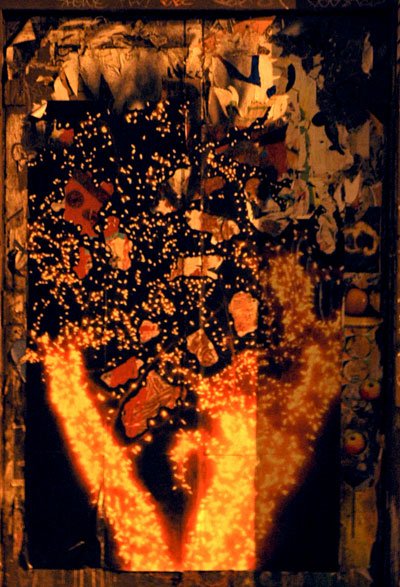
The picture may be a bit colorless and slightly shaky, since there was almost no light off the corner of Wooster Street near Grand at 6:30 tonight, and no tripod in sight, but I still wanted to try to capture the mystery of this doorway. It’s on the side of a building which has attracted (almost literally) tons of street art over the years.
I had heard some time ago that it was slated for demolition, but who knows what’s going to happen to it now?
The image I got makes me think of one of those spooky shadow boxes crafted variously out of feathers, seeds, shells, hair and cut paper that were so popular with the Victorians. When I lived there I used to see them all over New England in shop windows and at barn and estate sales, preserved inside framed glass boxes or cabinets, but now I can’t find a single pictorial relic of their weird vogue on line.
Matt Mullican at the Drawing Center
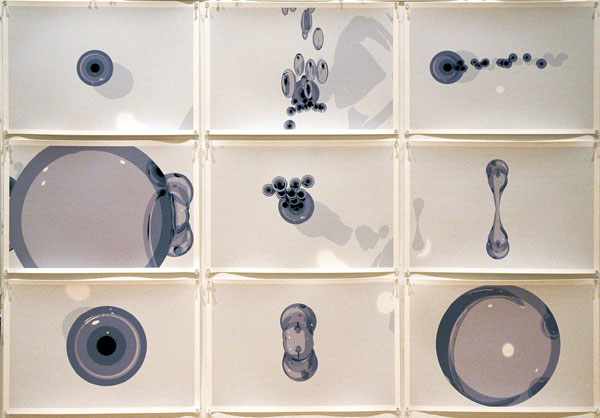
installation view* of nine drawings included in Mullican’s exhibition at the Drawing Center
Matt Mullican‘s just-closed show at the Drawing Center, “A Drawing Translates the Way of Thinking“, was a treat. And what a perfect venue for this extraordinary artist!
When I first walked in and saw its extravagance, knowing even the little I did about the breadth of his sources, the bottomless well of his imagination and the complexity of his sytems, I told myself I was just going to walk around and enjoy myself in that huge room, where central, museum-like vitrines were surrounded by works hung tightly together until virtually no wall space was left uncovered. I stayed much longer than I expected to, but of course not long enough to give even a half-assed account of this extraordinarily beautiful show.
Here is a large excerpt from the press release prepared by the curator, Jo�o Ribas:
For over three decades, Matt Mullican has created a complex body of work concerned with systems of knowledge, meaning, language, and signification. Ranging from schematic diagrams and arcane symbols to explicit text-based drawings, installations, and self-created cosmologies, Mullican�s work classifies, orders, describes, maps, and represents an understanding of the world, using drawing to collapse the division between subject and object.
Since the 1970s, Mullican has conducted performances and created drawings under hypnosis to investigate the nature of the subjectivity and identity. Mullican�s practice ultimately confronts the nature of subjective understanding, rationality, perception, and cognition �proposing a �picture� of the world articulated through the medium of drawing.
*
The shapes which look like reflections? They are not.
Nayland Blake at Location One
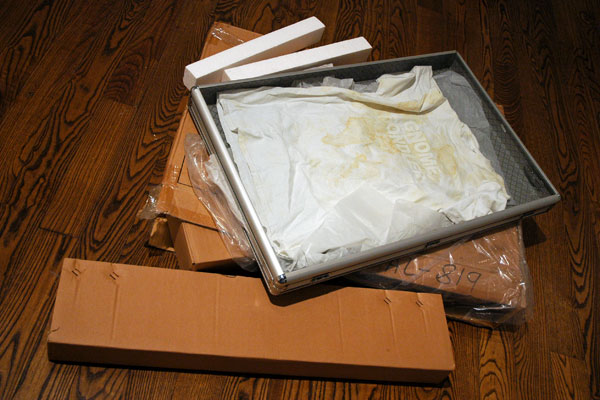
Nayland Blake Companion 2006 t-shirt, bubble wrap, trunk 48″ x 50″ x 9.5″ [installation view]
Just about as inscrutable as Matt Mullican, but different. Very different.
Soho’s Location One is hosting what the gallery describes as a 25-year survey of Nayland Blake‘s work in almost every medium. Curated by Maura Reilly, the show is titled “Behavior“. Even for a visitor familiar, even comfortable with the transgressive, it seems Blake doesn’t really care whether you get much of what he’s doing. But then he’s something of a virtuoso in this field. You can get lost in this installation, but you won’t get out unaffected by some of the images.
Oh, the printed text on the soiled shirt in the image above reads, “GNOME FONDLER”.
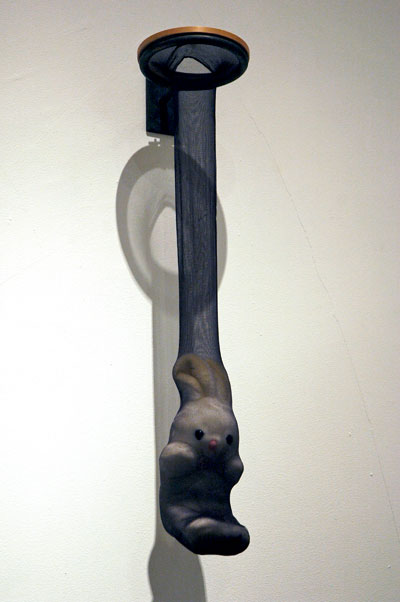
Nayland Blake Bunnyhole II 1997 steel, nylon, wood and stuffed animal 40″ x 7″ x 8.5″ [installation view]