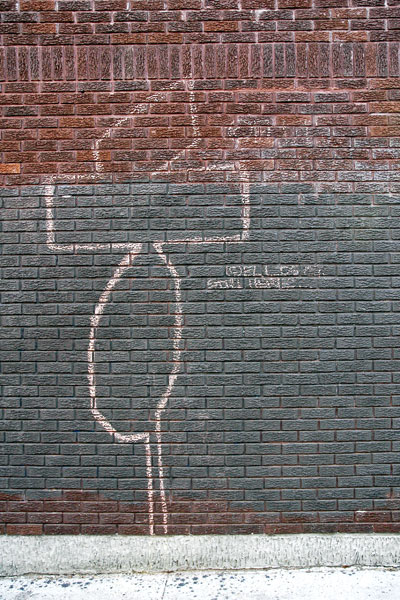
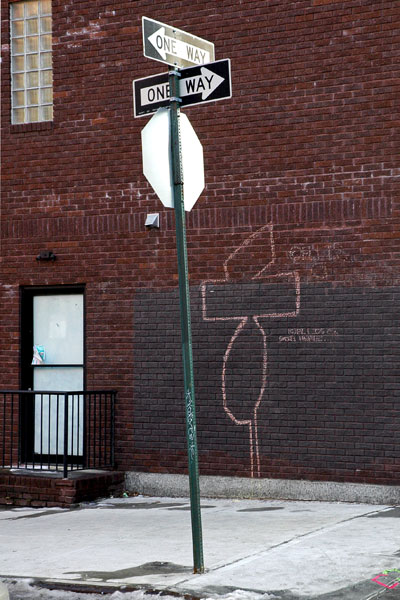
This �ELLIS G. intervention in Williamsburg included the artist’s signature plus the additional note, “STILL HERE”, a possible reference to the arrest of Poster Boy on Saturday.
ADDENDUM: Wooster Collective has a video documentary on the artist.
Category: Culture
Cordy Ryman at DCKT
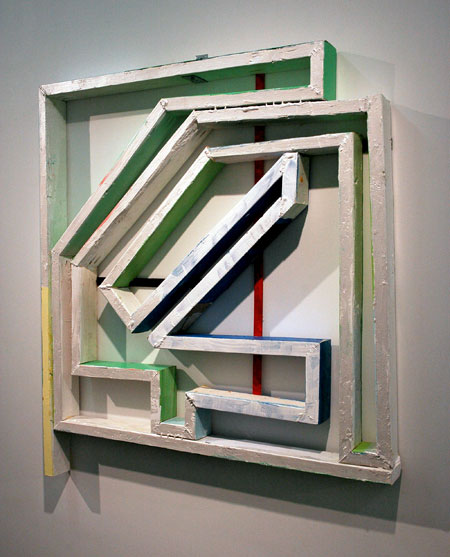
Cordy Ryman Coil 2 2008 acrylic & enamel on wood and metal 47″ x 43.5″ x 3.5″ [installation view]
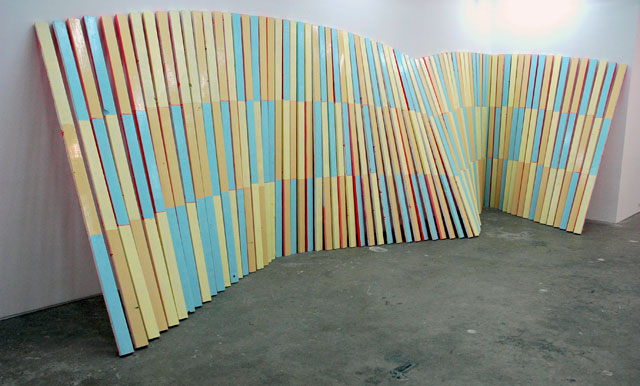
Cordy Ryman Third Wave 2008 acrylic on wood 96″ x 274″ x 79″ (dimensions variable, up to 480 linear inches) [installation view]
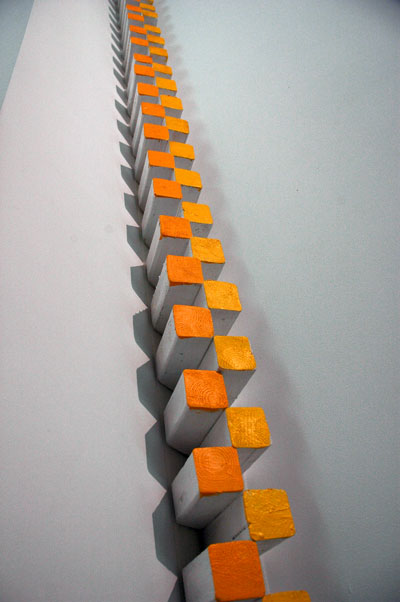
Cordy Ryman Yellow Spine 2008 acrylic on wood 130″ x 3″ x 5″ as installed (dimensions variable, up to 144″ x 3″ x 8″ overall) [large detail of installation]
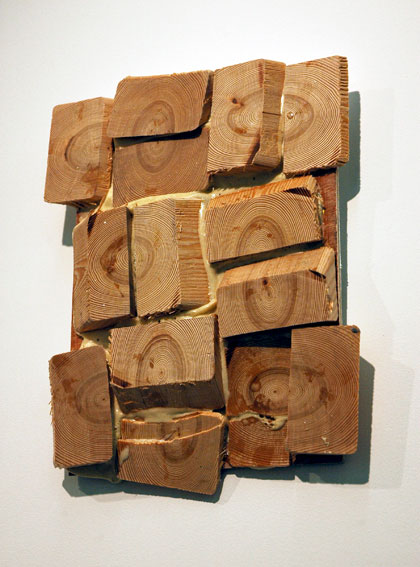
Cordy Ryman Raw Chips 2008 gorilla glue and wood 12″ x 10″ x 1.5″ [installation view]
It’s an appearance which I’ve been anxiously anticipating for months, or even longer: DCKT is currently exhibiting paintings, sculptures and installations by Cordy Ryman, the artist’s first solo show in the gallery.
Ryman regularly wields hammer and nail, glue, staplers velcro strips and much more for what promises to be an infinite supply of solid forms and colored shadows in every size and shape. The work is composed of found pieces of (mostly) wood, finished (usually) with paint applied from a brilliant pallet with the confidence of a first-class AbEx. He balances drama and humor in the result, seemingly effortlessly.
My only quibble? The fact that, unlike some of his earlier outings, their were no droll surprises this time in the form of almost-hidden little pieces hiding about in the gallery’s nooks and crannies. But it may be one of the best things the artist leaves with us: We’re likely to keep looking for art – everywhere – even where we’re not supposed to expect it.
LINK: conversation between Phong Bui and Ryman in the wonderful Brooklyn Rail
soft face on Wooster Street
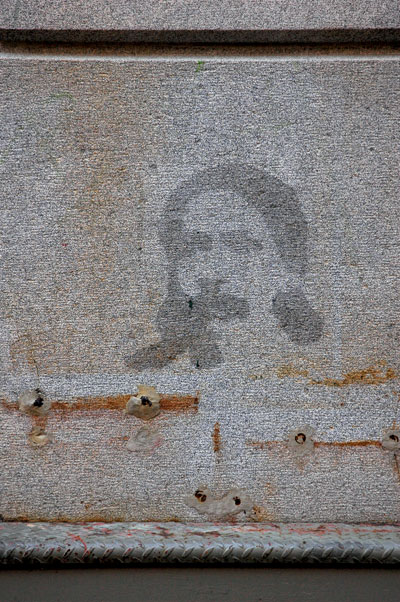
I have no idea who did this quiet piece, or who the image represents.
New York shad return to old Delancey farm waters
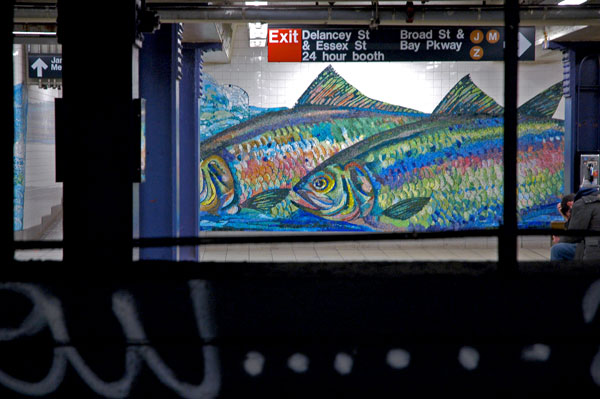
I’ve become totally enchanted by this piece through several years of F train transfers. This is a large detail, taken from the other side of the tracks, of one of the glorious mammoth glass mosaic murals installed inside the Delancey Street Station. Created by Ming Fay, this one is entitled “Shad Crossing”.
Andy Piedilato at English Kills
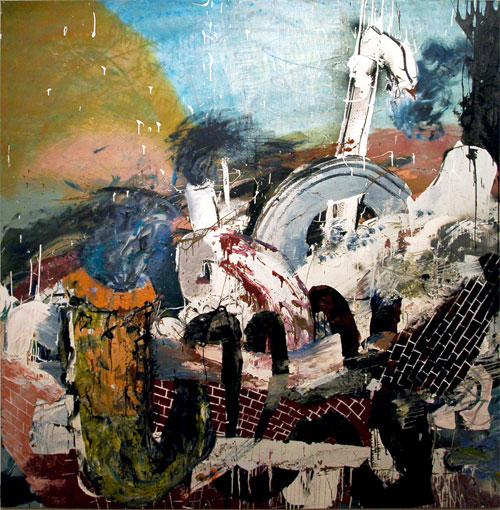
Andy Piedilato Engine 2009 industrial enamels and oil on canvas 99″ x 96″
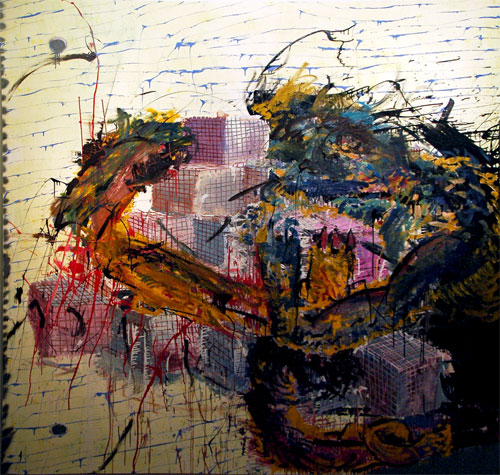
Andy Piedilato Notebook Paper 2009 industrial enamels and oil on canvas 99″ x 96″
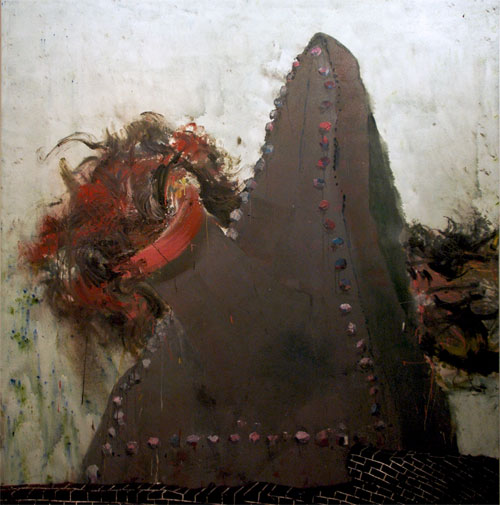
Andy Piedilato Steamship 2009 industrial enamels and oil on canvas 99″ x 96″
I’ve written about Andy Piedilato‘s paintings more than once before, so I don’t have to include much text here. These are just three of the nine or ten mostly huge (up to 12 or 14 feet square) oil canvases in his current solo show at English Kills.
They don’t disappoint.
James Turrell, on a cloudless day
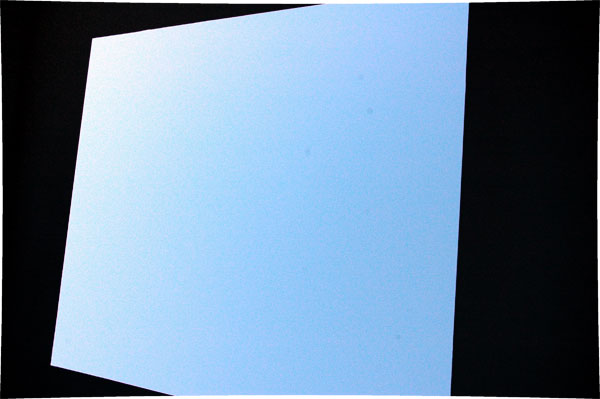
James Turrell Meeting 1986 [detail of installation]
It was cloudless, yes, but just a mite hazy – and freezing cold. Still, sitting inside that quiet, perfect room at PS1 (quiet once the voluble little kids had left) while it was still light outside, and looking up through the open roof was, . . . ineffable.
a return to Michael Mandiberg and his “viewing”
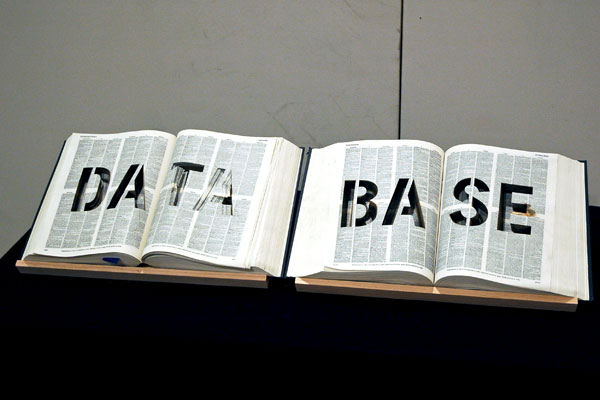
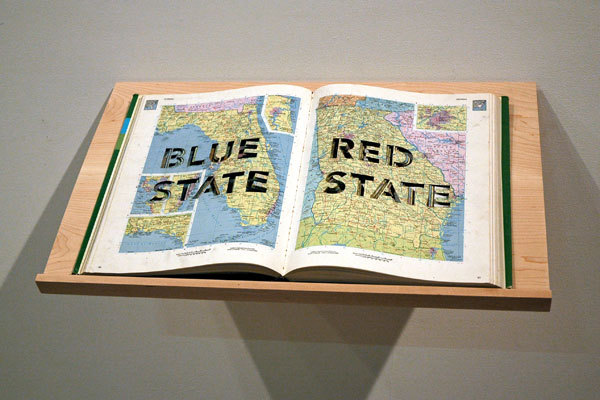

(look closely at the borders within the drawing above)
NOTE: Yesterday I wrote a hurried and perfunctory post on the work Michael Mandiberg has produced while he has been associated with Eyebeam, because I had been told he would have an open studio last night. The information proved to be mistaken; the date of the formal viewing is instead going to be next Tuesday, January 27, at Eyebeam, from 2 to 4, or by appointment [michael at mandiberg dot com] through the end of that week, until January 30.
Mandiberg has assembled a body of work in a range of various mostly-paper forms using elements of both the old technology and the new. He’s addressing the rapidly accelerating obsolescence of our established information systems; our experience of history and language; what we do with time; our direct participation in changing social structures and the disappearance of old political certainties; and old art subsumed in the new. He does it sometimes with ordinary words, and sometimes with the line of the artist. His tool in expressing both of these languages is the modern laser cutter.
His sitter may be the OED, the New York Times, the World Book, the National Geographic Society or Josef Albers. For these portraits he has cut through variously somewhere between one and several hundred pages of “dated” printed texts to produce dramatic, even ravishing negative spaces, words, which symbolize or articulate the contemporary, cutting-edge approach to words and information, and he carefully scorches surfaces of the artist’s traditional paper medium to reconfigure for today some of the aesthetic icons and arguments of the past.
As modern as they are, these pieces are hardly accomplished just by push button. The mark of the artist’s hand is in each. I don’t know how much of it is a consequence of the process and the nature of the materials and how much of it comes from Mandiberg trying calculatedly to show imperfections; he may not know the answer himself.
Sometimes the machine itself fails to produce a perfect effect, and the artist has gone back to reproduce its desired machine perfection by hand. Sometimes Mandiberg seems to be trying to get rid of imperfections in the machine’s work (to remove the hand), and elsewhere he is trying to make the work of the machine look slightly imperfect (to introduce the hand).
If it is anything like what I describe, this approach registers on this individual, personal scale the complex relationship with our machines which we have all shared – not just the artists among us – since the beginnings of industrialization.
I don’t have the space to describe the individual work displayed, especially because they are all so conceptual, and because much of the work is still incomplete, but if you visit far West 21st Street during the next week, you’ll find the artist is totally up to that task.
Mandiberg is currently a senior fellow in Eyebeam’s R&D OpenLab facility. In a conversation Barry and I had with him there yesterday, we were discussing his art and his process when he avowed that, yes, “all of the work here lives in both the arts sphere and the nerd sphere”. Yum. Members of both communities will find much to their tastes if they are able to check out his installation.
[final image from the artist’s Flickr set]
Michael Mandiberg at Eyebeam
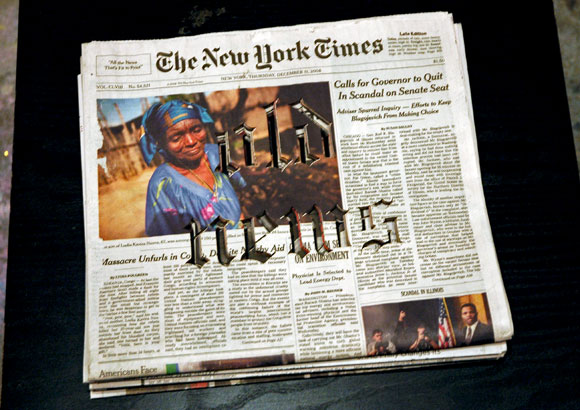
the supplanter will be coming soon in a medium near you
CORRECTION: The announcement of an open studio on Thursday evening was a misunderstanding. The formal viewing is instead going to be next Tuesday, January 27, at Eyebeam, from 2 to 4, or by appointment [michael at mandiberg dot com] through the end of that week, until January 30.
It seems like it was only yesterday that we were calling out happy new year to every one we encountered, but I’m suddenly realizing that time’s already a wasting; 2009’s baby is already talking, and will soon begin to walk: What I mean is that I’ve just realized I have to rush this one out before midnight.
Michael Mandiberg is hosting an installation of his latest work at Eyebeam tomorrow night, Friday, January 22, from 5 to 7 pm, and I haven’t written a thing about it.
I’ve already checked it out, and I’m hoping to expand this blog tomorrow with more images and a few additional words, but I wanted to give a heads up right now to people who might be able to stop by for the reception. For others who might still able to haunt our rich streets this month, the work will be assembled there in its own space through January 30.
Michael Mahalchick here and there
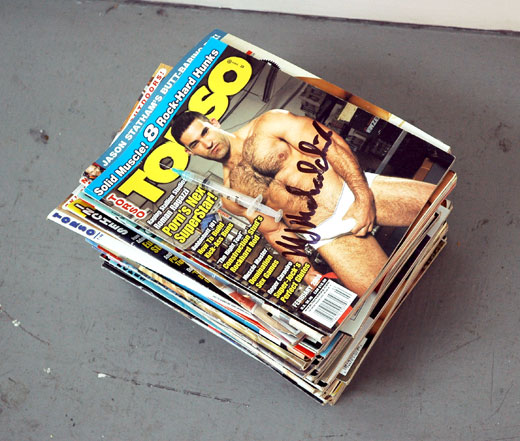
I have little idea what this is about, but it’s the piece I remember best from all the work I saw in a very interesting show of sculpture, “Without Walls“, at Museum 52. I don’t know if it tells us anything about the artist himself; maybe Michael just found this stack somewhere on the street, with or without the needle lying on top, and decided to mark it with his signature. And then maybe not.
For me the important thing is that I’m preternaturally attracted to it, and would be even if Roman Ragazzi were not staring up from the floor. It also reminds me of the happy happenstance that Mahalchick has another solo show opening at CANADA on Friday, titled, “For What It’s Worth“.
Bj�rn Meyer-Ebrecht at Pocket Utopia
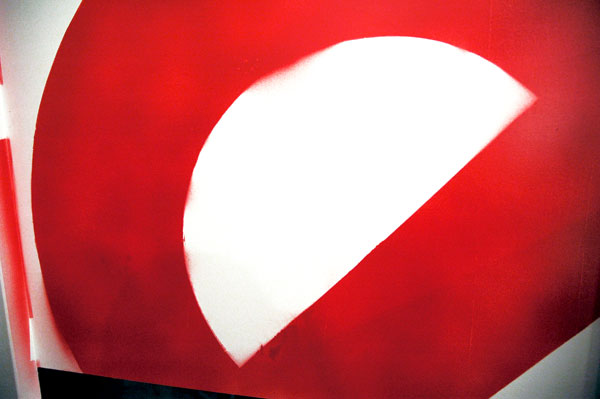
Bj�rn Meyer-Ebrecht
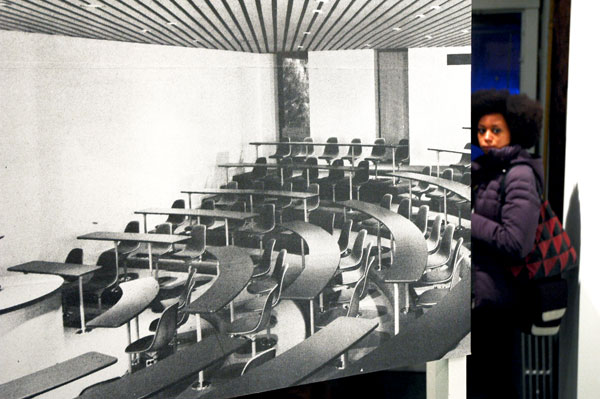
Bj�rn Meyer-Ebrecht Untitled (D) 2008-2009 laser prints, wood, paint, spray paint, 4 panels, each 69″ x 32″ x 21″ [two details of installation, photographed during opening reception]
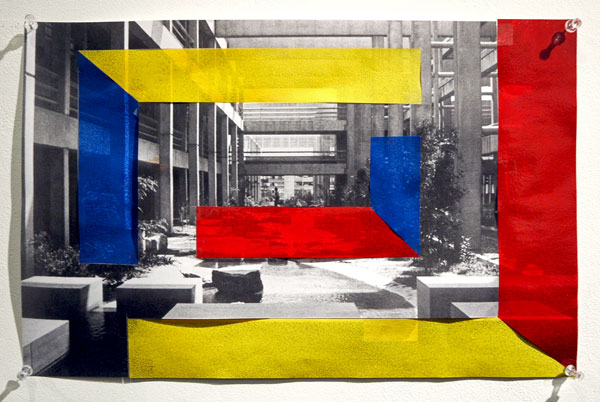
Bj�rn Meyer-Ebrecht Untitled (red/yellow/blue) 2009 collage, laser print, spray paint, transparent tape 10.75″ x 16.75″ [installation view]
Among my many other passions, some disclosed here in the past, I’m a sucker for mid-century architecture and design. In work being shown at Pocket Utopia through the middle of next month, and in images available on his own site, Bj�rn Meyer-Ebrecht presses that button and a few more besides. In Bushwick, in a gallery installation he shares with Elissa Levy and Kay Thomas, he has installed a single four-part sculpture down the center of the narrow gallery and hung several small collages on one side wall.
Today we are all children of the Bauhaus, with the signal exception of the American suburban family, which even in the twenty-first century almost unfailingly chooses neo-whatever for its domestic shelters, er . . . castles.
German-born Meyer-Ebrecht’s work might include an element of (sophisticated) nostalgia, but his affections are not wasted on garrsion colonials, or even Alpine cottages. He “constructs” drawings, collages and sculptures from found black-and-white images of the interiors and exteriors of modernist buildings, most of them built in a post-war Germany rising phoenix-like from its ashes and its shame, struggling to make good its pre-1933 promise. They generally betray a kind of modest optimism largely absent from the architecture of today.
Some of the images depict the clean minimal spaces which were designed to house the “architects” of a new representative democracy in Germany. Some are of buildings designed by German architects, refugees or exiles, but constructed elsewhere in the world. All seem to be images of virginal spaces, in specific environments. They are yet to be occupied by people, although a human presence is suggested by the tools of habitation that architects must provide.
The images, if not the buildings they depict, are all historical artifacts. The artist cuts and paints, and sometimes saws; he adds abstract “windows” and (sometimes) translucent panels of color to make them his own, to make them ours.
They are utopian. They seem to be the labor of a love he shares with us. They thrill me.
This is the last paragraph of the statement which Meyer-Ebrecht has included on his own site:
I see my drawings in many ways as portraits. The buildings often look at me like human figures that at the same time seem to both hide and reveal their inner lives. I see them also as portraits of the architects with their very particular historic experiences of emigration and their individual new beginnings after World War II. And finally these drawings are also portraying a particular time period. In my imagery of this time I find a particular atmosphere that interest me, maybe the feeling of soberness, of something absent or hidden. I am especially intrigued by the absence of history, I could call it a form of collective amnesia, which reverberates in these images.