
The end of our ArtCat Calendar, a project which Barry and I began eight years ago, whose mechanics he has pursued with great skill, generous commitment, and much love, was announced this morning on Twitter, in emails, and in a post which he published on Bloggy.com. I have reprinted that post below.
The first version of ArtCat calendar (then called ArtCal) launched in November 2004. I wrote the first version in one weekend, to make it easier for James and me to keep track of shows we wanted to see, especially once Chelsea reached 300 galleries. For a long time it was a minimal website with locations, shows, and their dates — not even images. Over time I added images, iCal and RSS feeds, and a weekly newsletter.
Over 16,000 exhibitions at more than 2,000 venues have appeared on ArtCat. We average 200-300 current exhibitions on the site. While forms for galleries to add their exhibits have existed since late 2010, we still view each submission to approve it, for quality control and to prevent duplicates. That is the most time-consuming part of running the site. We also spend a lot of time processing corrections due to galleries submitting new version of press releases, or correcting typos and erroneously-submitted dates.
Advertising revenue, even if one assumes my time is free, does not currently cover the cost of hosting the site plus paying someone to help me with approving submissions and responding to corrections. The calendar does serve as promotion for ArtCat Hosting, but the value of that, versus having more time to improve ArtCat Hosting, is unclear. Most of my hosting clients do not mention the calendar when signing up.
Advertising revenue has averaged $250/month over the last year, primarily due to the support of Storefront Bushwick and Deborah Brown. Other advertisers have included Theodore:Art and Kianga Ellis Projects. Note that all of these are Brooklyn-based. Since I ended the Culture Pundits advertising network, there have been no advertisements from a Chelsea or Lower East Side gallery. During the entire 4 1/2 year run of Culture Pundits, only two commercial galleries in New York advertised with the network.
Charging for listings, for a calendar that wants to maintain quality and promote underknown artists and galleries, is a non-starter. It is apparent to me, after eight years, that there is no financial support for an art calendar of this kind.
I don’t have the resources and time to continue to run the calendar by myself in its current form. I am spread too thinly to do a good job of running ArtCat, improving ArtCat Hosting, promoting and publishing IDIOM, documenting our art collection, and actually getting out to see art. Of course, I also have to make a living through my freelance work. My goal is to narrow the focus of my work I do within the art world, and do one or two things very well, rather than provide lesser versions of many things. As the wonderful Michael Mandiberg pointed out here, there are limits to one’s time/labor/capital and it’s healthy to move one when the time feels right.
I will convert the site to an archive as of January 1, 2013. If someone is interested in the code and data (it is a Ruby on Rails 2.3 application), I’m ready to talk. The ArtCat name and domain will stay with me, as I own the trademark for it, to be used specifically for my art website hosting business.
If you would like to express your gratitude in some way, please consider a tax-deductible donation to IDIOM.
Please think about how, with even a modest amount of support, you might help IDIOM continue to publish and flourish. Thank you.
Category: Culture
Ensemble Pi, much more than another new music group
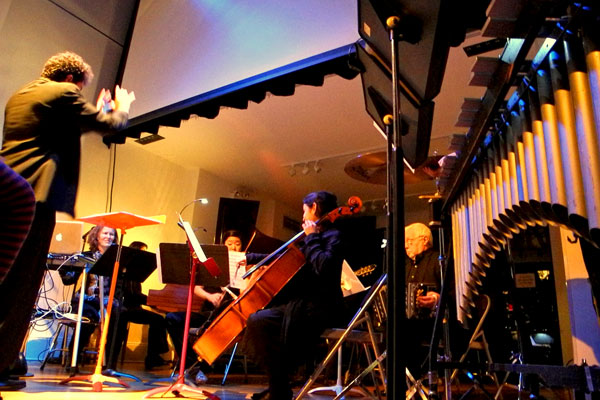
Eduardo Leandro leading members of Ensemble Pi in Kristin Nordeval’s “Three Character Studies”
On Saturday Ensemble Pi [Ensemble Π] presented “What Must be Said”, its 7th annual Concert for Peace at The Cell, a jewelbox non-profit theater space carved out of the bottom floors of a handsome, early-19th-century Chelsea townhouse. I was delighted to be able to record some images from the concert. By the way, I’ve decided that the hardest part about photographing performances may be the thing about trying hard not to annoy the rest of the audience.
The evening was one of the most extraordinary and profoundly-moving musical performance events I have ever experienced. The concert was conceived and presented with an intelligence and compassion which intensified the independent merits and beauties of the (seven?) works scheduled. The pieces included were by one writer and three composers all of whose work performed that night, as described by The Cell in its press release, “addresses some of the ‘silences’ enforced or suggested by governments or the media”. All of the works were compelling for their historical and contemporary relevance, brilliant in their composition, and interpreted with consummate elegance by an ensemble which has adopted the most generous of missions.
The collective describes itself as “a socially conscious new music group dedicated to performing the music of living and undiscovered composers”, but that description doesn’t do justice to the sincerity and bravery of what the group, under its artistic director Idith Meshulam, has been doing for eleven years.
One constant in its programming, perhaps unique among both musical groups and performance venues, is its addressing of serious ideas about which there is not universal consensus even among progressives, and, just as important, the discussion of those ideas. Designed at least partly towards that end are the ensemble’s regular collaborations with visual artists, writers, actors, and journalists.
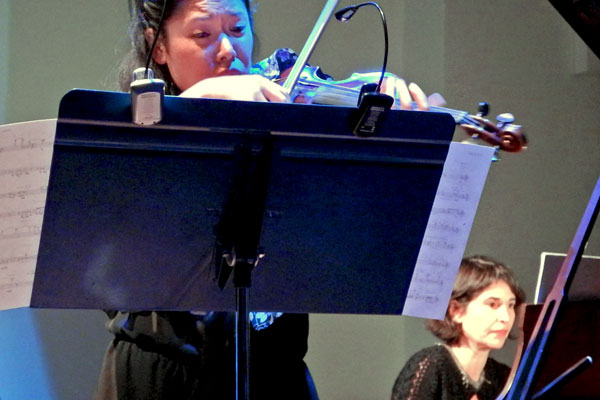
Airi Yoshioka and Idith Meshulam playing Susan Botti’s “Fallen City”
On Saturday and Sunday the program began with Susan Botti‘s “Lament: The Fallen City”, for violin and piano, which, the program describes, “reflects upon the fall of Troy as a metaphor for modern cities that have experienced natural or human-made disaster (i.e. Baghdad; New Orleans; Pisco, Peru; or Greensburg, Kansas)”. I’ve never heard some of the kinds of sounds Airi Yoshioka (violin) and Idith Meshulam (piano) were able to produce in this affecting piece, but they were always as eloquent as they were anomalous.
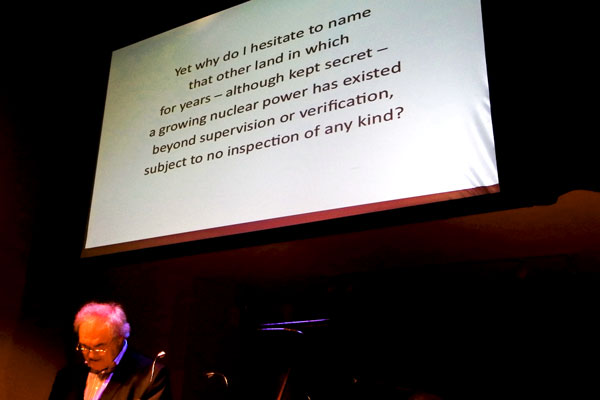
Kai Moser reading Günter Grass’ “What Must be Said”
Günter Grass‘ controversial poem on Israel, Iran and war, “Was gesagt werden muss” [What Must Be Said], from which the evening took its title, was read in German (with an English translation projection) by Kai Moser. Grass has gotten hell for what he wrote, not least because of his earlier, late-life confession that he had been part of an SS tank division (drafted at 17) near the end of the war.
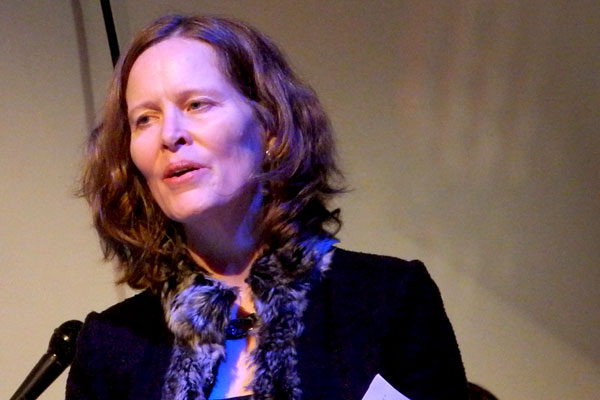
Kristin Nordeval singing “Ask Me”, from her “Three Character Studies”
The concert began a transformation into intimate musical theater with the performance of “Three Character Studies”, excerpts from composer/soprano Kristin Norderval‘s opera in progress, “The Trials of Patricia Isasa“. Both Emily Donato and Daniel Pincus sang beautifully, Donato in the role of the teenage Isasa, and Daniel Pincus as the federal judge convicted for his role in the torture and kidnapping of many Argentinians, including Isasa. Norderval herself was the superb soloist in the the third section (as the adult Patricia, now a media figure), accompanying herself with some sound processing on her laptop near the end.
This beautiful and very moving piece could be staged as a mini opera on its own right now, and I very much look forward to hearing the completed opera, which will boast a powerful libretto by playwright Naomi Wallace.
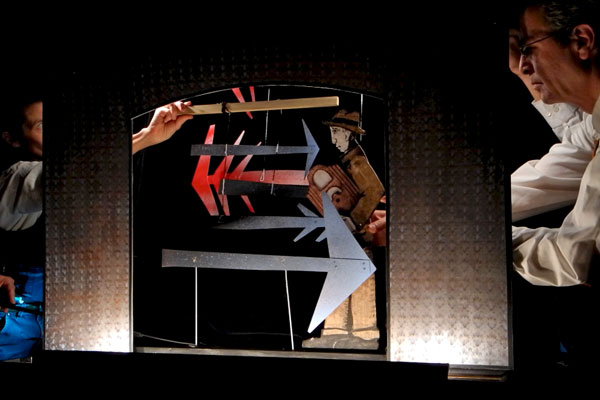
a scene from An den kleinen Radioapparat [to the little radio]
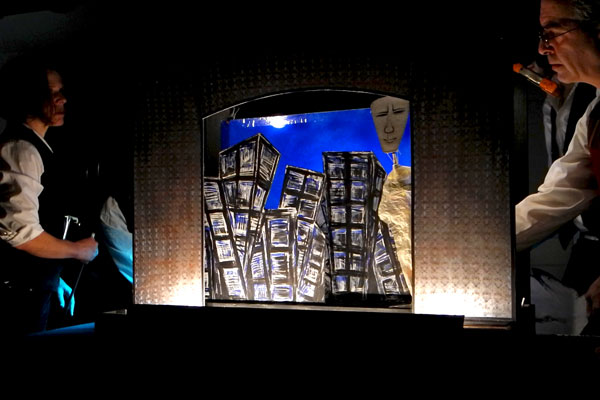
from Und es sind die finstern Zeiten in der fremden Stadt [the times are dark and fearful]
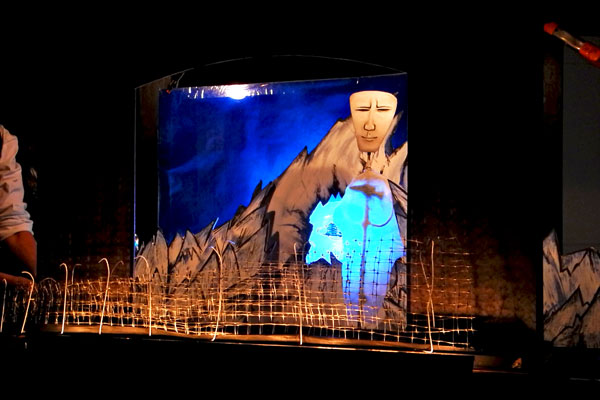
the concluding, concentration camp scene, Harte Menschheit, unbewegt, lang erfror’nem Fischvolk gleich [people hard and impassive, like fishermen long at sea]
The evening continued with the premiere of “Eisler on the Go”, a beautiful, animated puppet show by the New York collaborative, Great Small Works, on the life of Hanns Eisler. The composer’s studiedly-accessible music, his personality and his loyalties, his proletarian activism, and his sad fate (beginning long before he was expelled from the U.S. as a communist), has been something of an obsession for me ever since I first came across his music and his story a number of years ago; I’m very happy to find lately that his fans are now becoming legion.
The tiny-theater show animated three of the most familiar of Eisler’s many songs, each sung by Nordeval. They were: “Song von Angebot und Nachfrage“, “An den kleinen Radioapparat“, and “Und es sind die finstern Zeiten in der fremden Stadt” [the links are to three awesome videos, with three very different performers; enjoy].
After the Puppenspiel Meshulam played the first movement of the composer’s “Piano Sonata No. 3” and his “Klavierstück Op. 32 no V and VI”, gently bringing the chamber back from the darkness, the anger and the funk – brilliantly.
The program was repeated the following night.
No Art Was Harmed In the Making of This Show
Nancy Spero “Tattoo” 1996 silkscreen
Barry and I love art and the art world, or at least most of the art world. We were recently rudely reminded of the part we don’t like.
One month ago we asked for permission to reproduce an image which I had photographed myself, of a work we own, which was created by a great artist we much admire. We wanted to add a photo to the entry in our collection site, and also to include an image of it on a card announcing a show at English Kills Art Gallery. The work is “Tattoo”, a 1996 print by Nancy Spero (1926-2009), and it was going to be included in the large group installation inside the Bushwick gallery.
The owner, Chris Harding, had approached us with the idea for the show, and he had selected 46 pieces from among the works mounted inside our apartment. I think his very first choice was the Spero; it was certainly his first choice for the invitation, and we were delighted with his pick. We’re very fond of the artist, and we treasure the piece itself.
Once we were told it would be Spero, we set about to get photo permission from the estate. We wrote first to Galerie Lelong, which represents the artist. They asked us to send an image and to explain further the purposes for which it would be used. They would then forward the request to the estate. About two weeks later we were told it had been approved, and that an agreement form would follow, meaning the final paperwork to authorize the copyright, from VAGA (the Spero estate’s licensing agent).
Everyone on our end got very excited. It seemed we would make the printing deadline, and the world would now see a little more of Nancy Spero.
Two days later we heard directly from VAGA for the first time, and this time the news was not so good: We had proposed a large detail of the print for the face of the card, believing it would be more easily read and more compelling in the 5 x7 inch format, but they would not approve cropping of any kind. Also, we would have to come up with hundreds of dollars in “copyright license fees” for the right to use it for the invitation and for the right to display it on our collection website; the fee for the latter would have to be paid every 5 years.
Now we are both pretty well known as activists opposed to camera prohibitions as found sometimes in galeries but much more commonly in museums – and also opposed to the current national obsession with prohibiting cameras almost everywhere else – but we generally abide by the photography rules, and never more scrupulously than in uploading images of art onto our on-line collection site. We have entered more than 800 pieces there, and while we’d like to show a proper image of each, that will require not only time, but also the permission of the artist or the estate. In the meantime we will not show anything larger than a thumbnail, since the artist retains the rights to reproduction.
We have never been refused when we have asked for an okay, except for one extraordinary circumstance, and we certainly have never been asked for money.
I wrote back to the gallery and to VAGA, explaining what we do, that we have not and do not intend to ever sell the art we own, and that absolutely no money was going to change hands in the mounting of the show (although I didn’t go so far as to describe English Kills as the un-Mary Boone). I got a response saying that the representative for the estate and VAGA had jointly agreed to give us a 20% discount on the fee for the 5-year website JPEG license, but not for the card reproduction. We were told however that we could not publish or print anything until after the estate was persuaded that “Tattoo” was actually a Spero work. The letter added that the process of gathering the information they needed would help authenticate it for our own records and for the forthcoming Catalogue Raisonné*.
I have to say that we have absolutely no quarrel with Galerie Lelong’s part in the negotiations; in fact we were pleased by the gallery’s courtesy and quick response, especially as it was over a holiday weekend.
After that last letter from VAGA we walked away, and instead went with the wonderful Alejandro Diaz image, “Esta Galeria”, which can be seen on the invitation. Also, we have not uploaded a larger-size image of the Spero on the collection site.
Several notes (really just a start):
1) Neither the gallery nor the estate had an image of the work we own, and it seems pretty clear that they didn’t know it even existed until I wrote to the gallery.
2) The Estate, or VAGA, was happy to charge us money to show an image I took of a work we ourselves owned, and of which it knew nothing; only when I responded in surprise at being asked to pay did anyone show any interest in the art itself.
3) The non-commercial purposes, of the collection and the show, are quite clear, and were made apparent to the gallery, the artist’s estate, and VAGA more than once, yet they wanted to exploit them.
4) Do artists really need a corporation to protect them from people like us? Incidentally, while one look at the VAGA site shows that they control the visibility of hundreds of dead artists, they are actually dwarfed by another property guardian, Artists Rights Society (ARS).
5) We have spoken to a number of younger artists about Nancy Spero, and very few have even heard of her or her work; perhaps we can now understand why.
6) Both Nancy and her partner of a half century, Leon Golub, in their lives and in their art, addressed power relations; it’s inconceivable to me that either would want her/his art to be shielded from view.
* The last time we were a part of a Catalogue Raisonné project both we and the estate (of Mark Morrisroe, owned by Fotomuseum Winterthur) bent over backwards to help document an artist’s work; there wasn’t a hint of image insecurity.
[The image is only a thumbnail, and therefore almost completely useless, because I do not have permission from the artist’s estate to publish a larger size; the framed print itself can be seen at English Kills Art Gallery through October 28]
Come to our show!
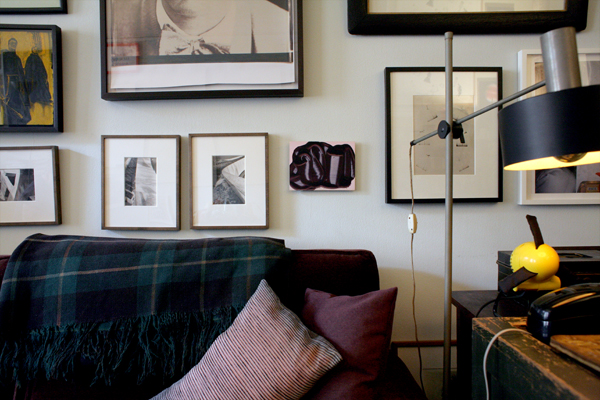
Installation view of a portion of the collection installed in the apartment, with works by David Reed (center), James Wagner (to the left). Photo by Fette
Chris Harding of English Kills Art Gallery has selected 48 works from our art collection, and will be showing them at his gallery in Bushwick, 9/21-10/28. Please join us at the opening, or come see it one weekend while it’s up.
The press release:
English Kills Art Gallery has installed a few dozen works from the Hoggard Wagner Art Collection in an exhibition which opens with a reception this Friday, September 21, 2012 from 7 to 10 pm.
Barry Hoggard and James Wagner, who share an interest in all of the arts, have assembled a large, very personal and extremely diverse collection of visual art begun modestly by Wagner ten years before the two met in 1991.
They began by acquiring a few works to enjoy in their own home, but very soon realized that part of that enjoyment came from supporting artists, galleries and non-profits which they believed should be encouraged. They were concerned, however, that there are limits to the number of people who could see the work they took into their home (and only a fraction of the collection can actually be displayed there). It was largely to make it accessible to as many people as possible, and for information purposes, that they created the Hoggard/Wagner Collection website.
For the same reason, the couple enthusiastically agreed to the suggestion of English Kills that a part of the collection itself be installed in Bushwick for six weeks. The Gallery alone is responsible for the choice of works displayed; the selection was made from among the 300+ pieces visible on the walls and surfaces of their home. There are approximately 600 more in flat files.
Hoggard and Wagner have never sold a single work from the collection and they do not intend to do so. No sale of any kind is involved in the English Kills exhibition.
Artists include*: Nancy Spero, Keith Haring, David Reed, Wolfgang Tillmans, Clement Valla, Eric Doeringer, Sharon Louden, Felix Droese, Jules de Balincourt, Marco Breuer, Tom Fuhs, Bryan Zimmerman, Yasser Aggour, Michael J. Dvorkin, Deborah Mesa-Pelly, Jason Simon, Louise Fishman, Clarina Bezzola, Michael Meads, Mike Asente, Tracey Baran, Teresa Moro, Jaishri Abichandani, Rupert Deese, Alejandro Diaz, David Humphrey, Matt Dojny, Dan Golden, Gregory Botts, Rochelle Feinstein, Robert Wilson, Hiroshi Sunairi, Charles Goldman, Michael Williams, Wijnanda Deroo, Amy Feldman, Janine Gordon, Joe Ovelman, Kim Schifino, Joyce Pensato, Bruce High Quality Foundation, Margaret Lee, Ben Godward, Kiki Smith
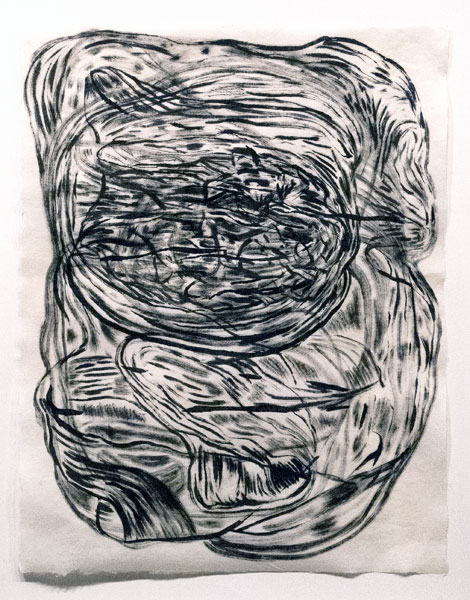
*NOT INCLUDED in the list on the press release is the creator of this work, an artist whose name is currently unknown to us. Come see the show and help us to identify her or him. An image of the work is shown below.
‘Animal Farm: A Musical’ at the Brucennial 2012
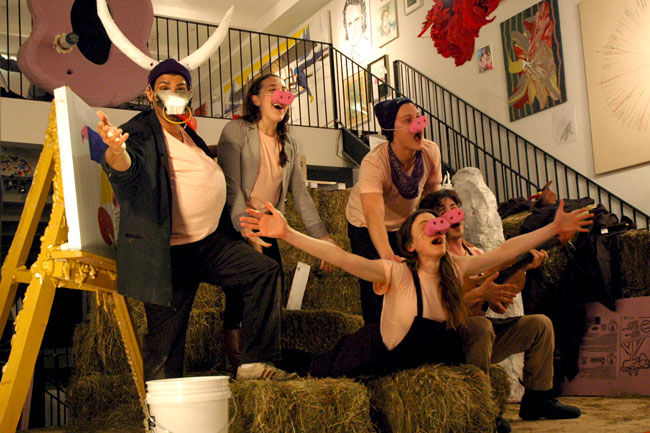
graduating Piggy Artists celebrate the breakthrough which made the Brucennial possible [from left to right: Ian Lassiter, Liz Olanoff, Joe Kay, Maria Dizzia, Matt Nasser]
Last night the earnest, tuneful sounds of the Bruce High Quality Foundation‘s production of Animal Farm: A Musical further enlivened the halls of an already almost-impossibly-vigorous second edition of the arts collective’s Brucennial, first visited upon the unsuspecting city in 2010.
The fable, based only very loosely on Orwell’s allegorical novella, describes the redemptive journey of “the graduating Piggy Artists of the class of 2012” (from the BHQF site) after their confrontation with their school’s alleged penury; its chicken trustees’ incompetence, cowardice, and stinginess, and their move toward charging tuition for the first time after 150 years; its greedy dog financial-advisors, and the dispersal, for a time, of the collective creative energy of the porcine members of the class itself.
While somewhere in BHQF materials there’s a reference to the group’s own institution of higher arts learning, the Bruce High Quality Foundation University, the real story of the high-spirited lets-put-on-a-show production is that of The Cooper Union for the Advancement of Science and Art and the handful(s) of former Cooper students which founded the collective in 2004.
Following the conclusion of the show one of the Bruce’s made a very straight appeal to members of the audience, asking them to help ensure that the college on Cooper Square not betray its legacy as a pure meritocracy: It was founded by the self-made industrialist Peter Cooper to give young people the opportunity of the good education he never had, a tuition-free school whose facilities were open to anyone who applied.
We were asked to go to freecooperunion.com for more information, and to spread its words. Those of the Bruce High Quality Foundation University anthem, printed inside Sunday’s handsome “Playbill”, offer an inspiration:
Every Pig is an artist.No pig flies alone.Teaching others is our greatest work.We can’t do it on our own.
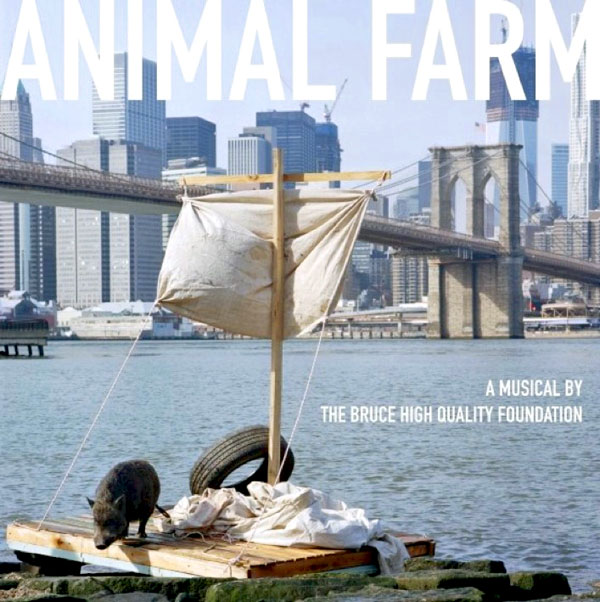
[second image, the program cover, from GalleristNY]
Eve Sussman’s “whiteonwhite:algorithmicnoir”
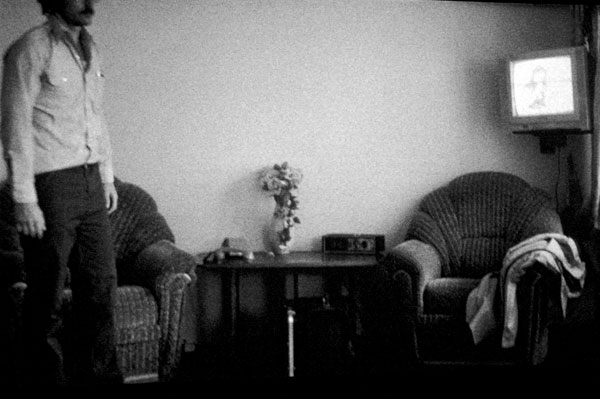
Mr. Holz inside his hotel room in City-A
Have you ever sat in a theater watching a film and wished it would go on forever? Eve Sussman and the Rufus Corporation have made a film which can do just that. “whiteonwhite:algorithmicnoir” is installed inside a Chelsea gallery, complete with several rows of theater-style seats, for just one more week. While the hours at Cristin Tierney are finite (10 am – 6 pm), the film can theoretically run forever, never repeating itself and never coming to an end.
Ideally it should be installed in a space accessible 24 hours a day, and it should be there permanently. But even in its current arrangement it was one of the most beautiful, spellbinding films I’ve ever seen, and I was there for less than an hour. As I could never expect to actually move in with it, just knowing that it was essentially “open” at either end of my own experience of it may be enough.
I still want to go back.
It’s a gorgeous, ustopian-noir algorithmically-shuffled continuously-evolving work, with a stunning soundtrack equal to the its astonishing images.
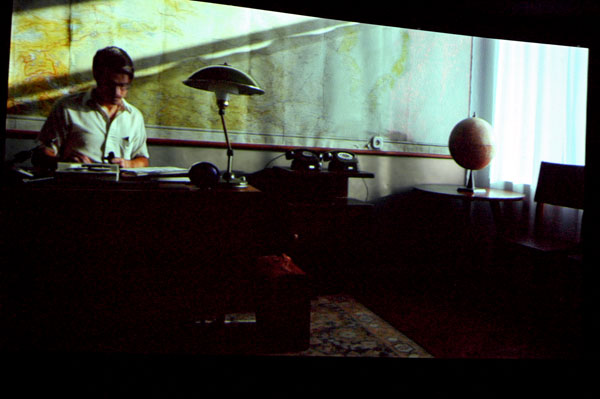
Mr. Holz in Yuri’s office
[images are stills, large details, captured from the installation]
Issue Project Room benefit this Sat, Oct. 1, in W. Village
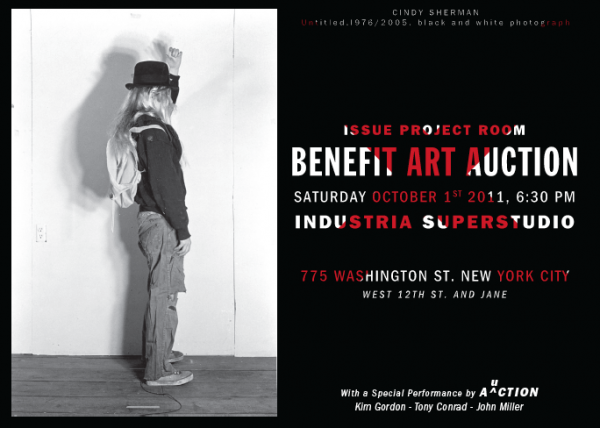
I had wanted to do my own text for this reminder of the benefit for Issue Project Room being held in the West Village this Saturday, Octobber 1, but I think Barry has already said it all. We’re both committed to this art and performance center – its a great program – and very excited about this event.
The only thing I’d like to add is to make it clear that the event is being held, not in either the group’s temporary or future homes, but in the West Village, at Industria Superstudio, 775 Washington Street (between W 12th St and Jane).
This is Barry’s announcement, except for edits switching my name to his (we’re really not always so interchangeable):
Most people expect Barry and me to only be interested in the visual arts for some reason, but we’re also fanatics about any “new” art, be it music, theater, dance, etc. Since 2003, one of the places to hear and see new things, especially multi-disciplinary work (why isn’t there more of that?) has been Issue Project Room, founded by artist Suzanne Fiol.
They are now raising money to make capital improvements to their new home in an amazing space at 110 Livingston. Their benefit this weekend (Saturday, October 1, 2011) includes a special performances by Steve Roden and A^ction: Kim Gordon, Tony Conrad, and John Miller, plus an amazing art auction. Artists include: Peggy Ahwesh, Jo Andres, Paolo Arao, Kenseth Armstead, Assume Vivid Astro Focus, Donald Baechler, Paul Chan, Tony Conrad, Ethan Cook, Wayne Coyne, Peggy Cyphers, E.V. Day, Devon Dikeou, Daniella Dooling, Shawn Dulaney, Devin Elijah, Rochelle Feinstein, Suzanne Fiol, Neal Franc, Isa Freeling, Michelle Handelman, Joseph Holmes, Mi Ju, Art Kane, Robin Khan, Todd Knopke, Jutta Koether, Lauren Luloff, Christian Marclay, John Miller, Paul Miller (DJ Spooky), Stephen Moore, Ulrike Muller, James Nares, Yoko Ono, Tony Oursler, Carissa Pelleteri, Tristan Perich, Barbara Pollack, Lee Ranaldo, Brett Reichman, Steve Roden, Julia Rommel, Kevin Ryan, Cindy Sherman, James Siena, Gary Simmons, Jude Tallichet, Mickalene Thomas, Stephen Vitiello, Andy Warhol, Martynka Wawrzyniak, John Waters, Alyssa Taylor Wendt, Robert Wilson and Marina Zurkow.
Barry and I will be there, and hope you will join us in supporting this important organization. Tickets are only $125, or $50 if you are already a member. You can also bid online for the silent auction artworks. However, if you don’t attend you will miss the performance and Ned Sublette as the live auctioneer!
Zodiac Heads: Ai Weiwei wasn’t at the Plaza today
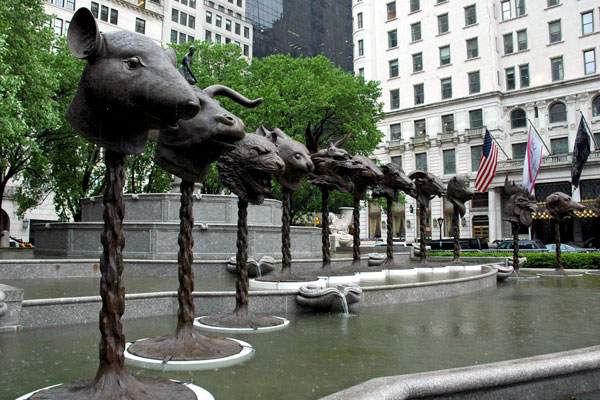
the sculptures terrassed
Okay, I love Ai Weiwei, and all his creatures, perhaps more than anyone I know, but I’m going to be a little grumpy here. I left the apartment early today, much earlier than I am want to (or ever want to) in order to be a part of the unveiling of “Circle of Animals/Zodiac Heads,” the artist’s installation at the Pulitzer Fountain in front of the Plaza Hotel. I’m an incorrigible activist, and I think of Ai as an activist as much as as an artist. I thought I would be joining a crowd of fellow enthusiasts dedicated to the artist and to what he has come to stand for all over the world (even before he was “disappeared,” which is now more than a month ago).
I didn’t expect a huge throng, and since it was raining, I told myself I wasn’t going to be too disappointed if the numbers were modest. But I didn’t expect to be disappointed, as I very much was, both by the installation and by the event. When I arrived I saw that the subject of numbers had become irrelevant; I was able to enter the establishment precinct surrounded by steel barricades only by identifying myself as a member of the press. I didn’t know I would otherwise have had to have an invitation.
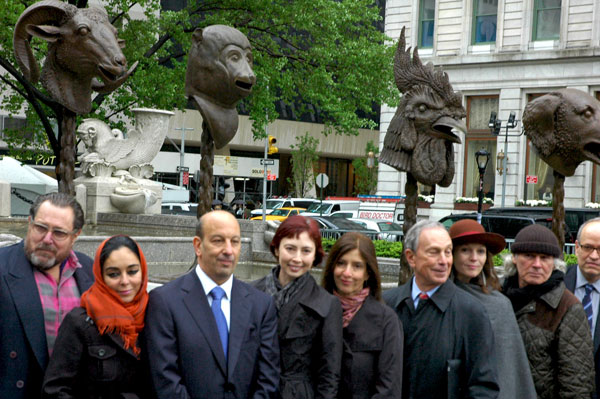
Zodiac Heads and talking heads
It was described several times during the ceremony as Ai Weiwei’s first public art installation, but the public was not permitted to be a part of the event (apparently only “dignitaries” and the press were allowed in).
The occasion was supposed to be a celebration of a youthful, bold and courageous artist, but there were only suits and a few older pros in the temporary shelter with the Mayor (twelve of them had been asked to recite short excerpts from Ai’s writings).
The work means nothing outside of its conceptual element, but there was no mention of that. The public talk was only about its eye-appeal and importance, whatever that may have actually meant to the speakers during the ceremony and in the Q&A after.
The title of the piece is “Circle of Animals/Zodiac Heads,” but oddly there was no circle.
The artist was absent from the event, hosted by the city which he loved and which we shared with him for over ten years, only because of his magnificent activism, but there was no room today for activism, aside from that of Susan Henoch, who was holding two hand-written signs (“where is weiwei!” and “free weiwei”) just outside the police barricades.
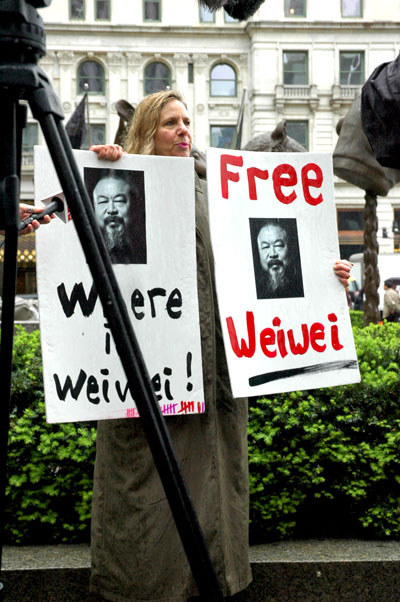
the demonstration, outside the barricades
Ai Weiwei’s work was there, but the artist was not. Of course this was not the fault of the organizers or of the well-meaning folks who took part in the event, but I missed any sense of loss, or urgency, in the conventional procedures to which we were witness. It felt like a ribbon-cutting ceremony on some dull, secure site not accessible to ordinary people. It wasn’t only uninspiring; it was lifeless.
Actually, maybe Ai Weiwei’s work wasn’t really there. I know I didn’t feel it. For an event intended to celebrate an artist and his art, maybe the most damning verdict I could hand over was, for me, the surprising absence of art in the scene on Grand Army Plaza today, and only part of that was the fault of the gracelessness in the placement of the 12 zodiac heads*. I have to believe Weiwei would have had it all very much otherwise.
*
They are supposed to be installed in a circle, and ideally, I think, around a fountain, but their arrangement here, in an arc stepping up and across the lower terraces of the Pulitzer Fountain, seemed a bit like my childhood memories of church, when the florist would arrange huge flower baskets in front of the altar on the occasion of some important wedding (or funeral).
ABC No Rio benefit May 3
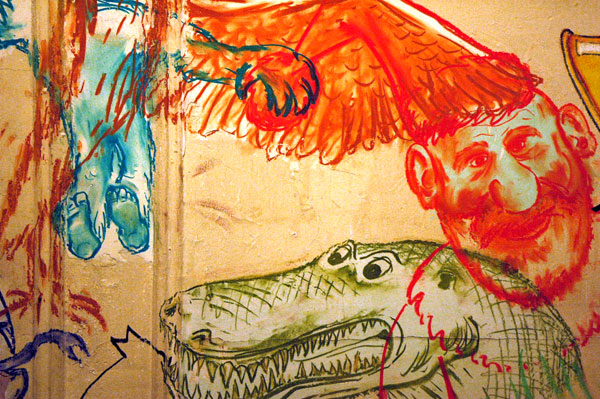
just like those in the Chauvet-Pont-d’Arc Cave, maybe these walls belong to the ages (detail of 1998 mural done by Chris Benfield to which other artists later made additions – customary practice in the ABC No Rio space – but those elements are not shown here)
Barry and I are going to be at the ABC No Rio benefit on May 3rd at Allegra LaViola on the Lower East Side. We’re both really looking forward to it, for the interesting company, the beer and the food, a great silent art auction, and guest DJs including Anna Kustera, Doug McClemont, and Kembra Pfahler.
But the occasion is also about the opportunity to help out, in at least a very modest way, one of the most interesting arts institutions in the city, an activist (and tenacious) DIY art, performance and community space on the Lower East Side (156 Rivington Street), a “collective of collectives,” with an awesome past, a dynamic present, and an exciting future.
The current building is a monument, but it’s pretty distressed structurally, and in a serious state of disrepair. Restoration would cost nearly as much as a creative new design offering more space and significantly-enhanced facilities, and it could be constructed on sustainable design principles. The decision was made: Start from scratch.
While I love a snappy new building as much as the next guy, it’s going to be tough watching the old ABC No Rio go down. I think there will be an effort to salvage some of the bold murals created – in layers – over the last three decades: The image at the top of this post is just one of a number I captured last month on a tour of the old tenement on Rivington Street.
The institution is now well on its way toward realizing a handsome new Green home, designed by Paul Castrucci, to be built on the same site. Anyone can help it along by attending the party next Tuesday, or if unable to do so, by making a donation of any size.
Full disclosure: Barry and I are on the benefit committee. Details here. Tickets start at $50.
Ai Weiwei has not really disappeared, or been silenced
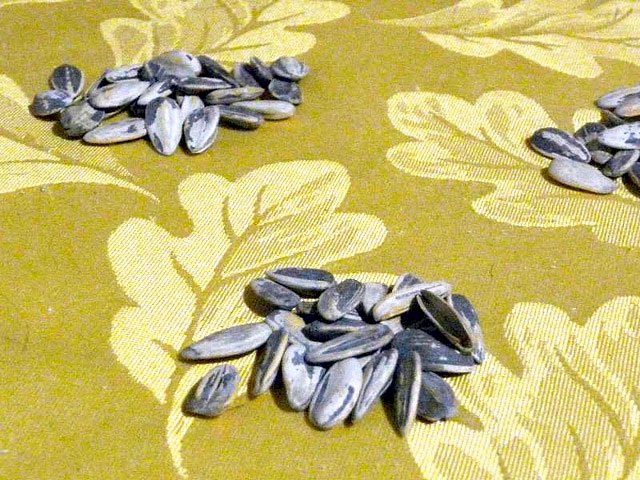
real sunflower seeds waiting for fertile soil
There are all kinds of artists, millions of ways to create art, and all of them must be respected, but Ai Weiwei is The Compleat Artist, as much as anyone else now on earth, particularly because he is a social activist as well. I call him a saint.
I really haven’t been able to completely stop thinking about this man since I first became aware of his art. I was almost immediately astonished by the signs of his courage and the size of his heart, and my admiration for the artist and the man has only grown with each report of his comings and goings. Six days ago the reports stopped. We know that the artist has been “disappeared,” and that the man has been silenced, but ironically the frightened regime responsible has ensured by its cruelty and stupidity that an important part of the artist-activist’s work continues, and his voice might actually now be louder than ever, thanks to his friends, millions of admiring strangers everywhere, and the power of the modern connectivity on which he doted – and thrived.
I cannot imagine a China, indeed a modern world, without his presence, his conscience and his art. If we deserve the art we get, the government we get, we will have to do everything in our power to see Ai Weiwei return to the people of China, and the world.
[image by An Xiao from anxiaostudio flickr]