three Robert Ashley operas in repertory at La MaMa

Robert_Ashley_Celestial.jpg
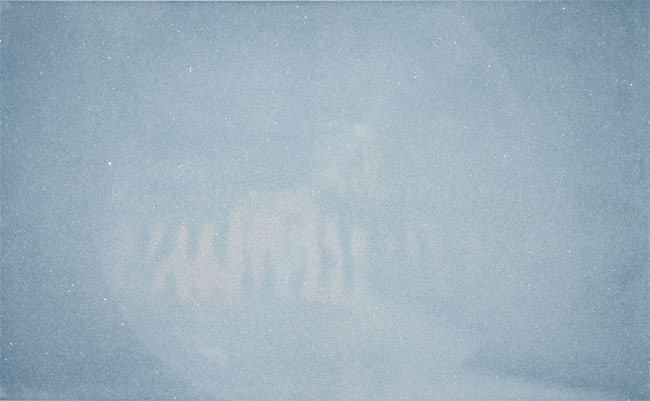
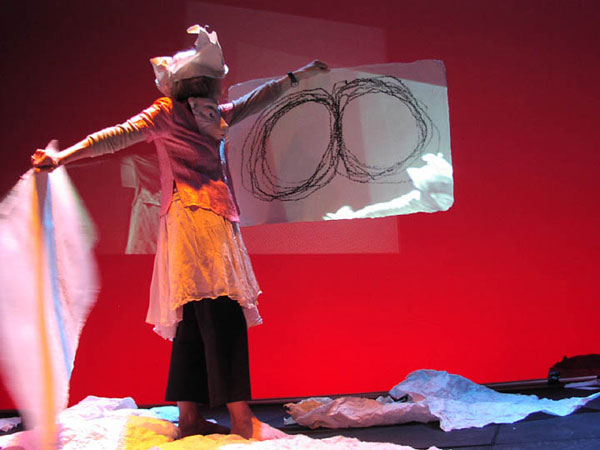
Joan Jonas in the 2003 production of “Celestial Excursions” at The Kitchen

Almost six years ago I wrote these words about the artist who may be my favorite living composer:

For a taste of what people will be talking about and, yes, singing, twenty years from now, not unlike the way that the music of Donizetti or Verdi was popularly enjoyed in nineteenth-century Italy, head for The Kitchen tomorrow evening (Saturday). Robert Ashley is the prophet of modern opera, even if he is still not properly honored in his own country.

I’m reminding myself of that post even as I recall that when I once asked the composer about what he thought of older composed music, Ashley told Barry and I, and David Behrman standing with us, that people should only listen to music from living composers; as soon as a composer dies, we should throw the records out the window. We asked, even Beethoven? he replied: “Toss them out!” We were taken aback, and Behrman seemed just as shocked. I understand what Ashley meant, but should I outlive him I don’t intend to follow his advice, at least in the case of his own music.
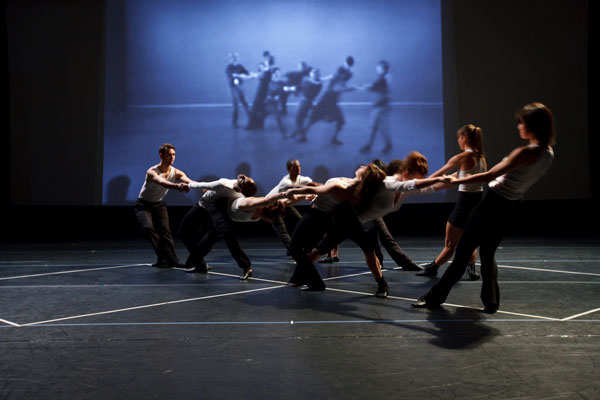
In the meantime I am counting us all very fortunate indeed to be still alive and able to see and hear a cycle of Ashley’s three latest operas – “Dust” (1998), “Celestial Excursions” (2003), and “Made Out of Concrete” (2007/09), in newly designed productions to be presented at La MaMa from January 15th through the 25th.
I wouldn’t miss these performances for anything you could throw at me from the Met.
For more information, see Ashley’s own site, where there is a link to an extended press release (PDF).

[image by Mimi Johnson provided by Performing Artservices]
�How To Cook A Wolf: Part One� at Dinter

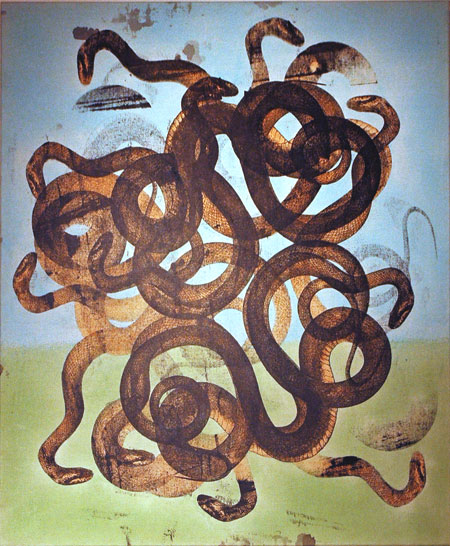
Philip_Taaffe_Caligraphic_Study.jpg
Philip Taaffe Calligraphic Study 1997-2008 mixed media on canvas 35.5″ x 30.25″

Aaron_Sinift_sex.jpg
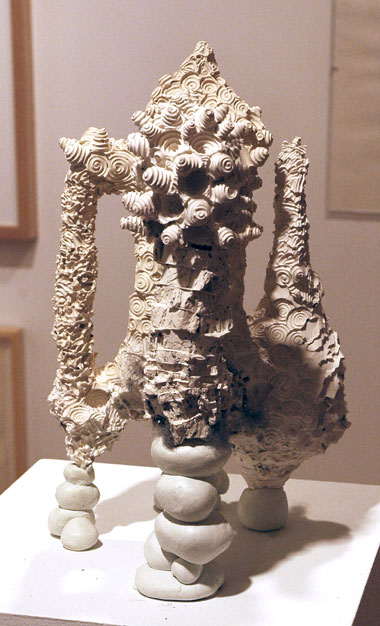
Aaron Sinift* As Yet, No Title 2008 hydrocal and bone infusion, sandalwood powder, poppies and felt 13″ x 8.5″ x 8.5″ [installation view]

Mary_Heilmann_pink_cup.jpg
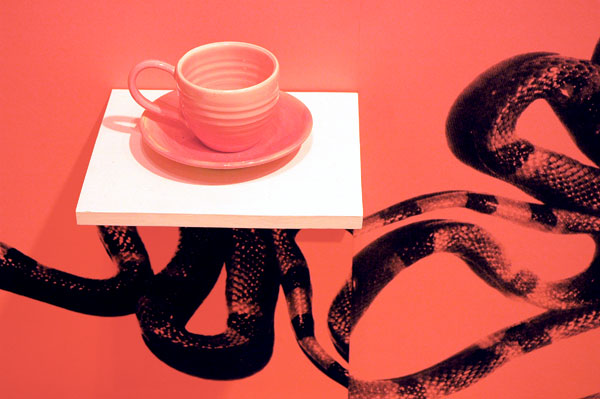
Mary Heilmann The Pink Cup 1983 glazed ceramic 4.25″ x 8.5″ x 3.5″ [lying on a shelf attached to a section of] Rob Wynne Snakepaper 2008 hand-screened ink on paper, dimensions variable [installation view]

The current show at Dinter Fine Art, �How To Cook A Wolf: Part One�, has been extended through January 31. It’s definitely worth taking advantage of the extended lease of this sexy, rich bricolage of work created over the last several decades (with one 19th-century exception) by dozens of artists of all ages, both familiar and new.
The list, in the order of the gallery handout, includes David Dupuis, Nicolas Rule, Donald Baechler, Rob Wynne, Judith Bernstein, George Condo, Aaron Sinift, Martin Kruck, Mary Heilmann, George Horner, Jack Pierson, Phillip Taaffe, Mia Brownell, Elizabeth Lennard, unknown artist, Michael Byron, Chris Hmmerlein, Judith Hudson, Donald Traver, Betty Tompkins, Dinne Blell, Julie Ryan, Jason Osborne, Paula Collery, Karen Hesse FLatow, Tracy Nakayama and Konstantin Kakanias.
I’m thinking as I’m typing them just now, wow, that’s an amazing number of names, and several artists had more than one piece in the exhibition. Yet while Barry and I were in the space the show didn’t feel like it was particularly chockablock with stuff. I think that was at least partly because of the clever use of Rob Wynne’s wallpaper.
I’m looking forward to “Part Two”.

*
for a look at another piece by Sinift, scroll 1/3 down on this post I did last May

“In Your Face” at BUIA

Andrew_Guenther_two_portraits.jpg
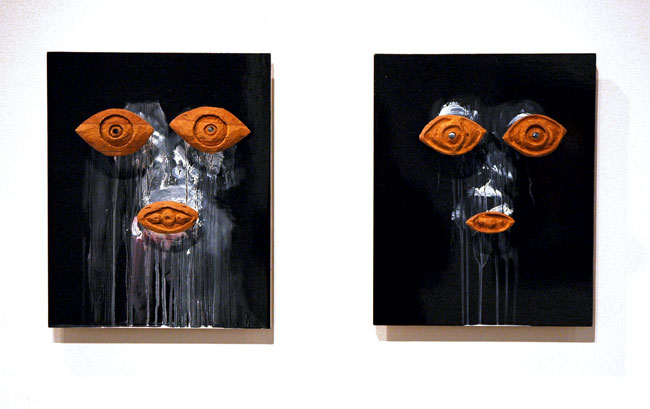
Andrew Guenther Horse Face 2006 and Water in the Planet I 2007 enamel, oil and wood on panels 17″ x 11″ each [installation view]*

I know I just recently did a post on this artist’s show at another gallery, but I couldn’t resist snapping up this image of two of his works I saw at BUIA today. They are the 20th century looking out at the 21st. These two extraordinarily-compelling faces are in an interesting group show on the theme of portraiture (the word interpreted pretty broadly). “In Your Face” will be up through this Saturday.
The other artists represented, by wonderfully quirky works which seem to have nothing in common but their difference, are Rico Anderson, Ion Birch, Brent Birnbaum, Holly Coulis, Dana Frankfort, Daniel Heidkamp, Ridley Howard, Erik Lindman, Matt Jones, Shay Kun, Federico Pietrella, Tom Sanford, Peter Saul, Rachel Schmidhofer and Barnaby Whitfield.

ADDENDUM: It’s now the next morning, and as I look at the image at the top I realize that I should probably have noted two things: One, that the dimensions shown for the two pieces, taken from the gallery’s checklist, may be slightly off, as they don’t appear to be quite the same size; two, and more importantly, that it would have been better to indicate that there is yet a third dimension, since the unpainted, carved wooden eyes and lips hover at least two inches above the planes of the painted panels (each feature is attached with two hand-whittled sticks).

Andrew Guenther at Freight + Volume

Andrew_GUenther_Skull_Pile.jpg
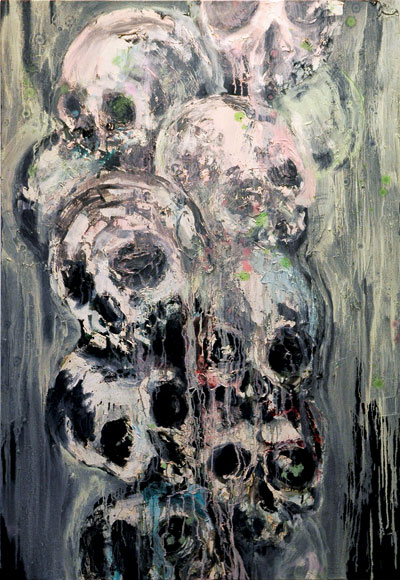
Andrew Guenther Skull Pile 2006 oil on canvas 68″ x 48″

Andrew_Guenther_wall.jpg
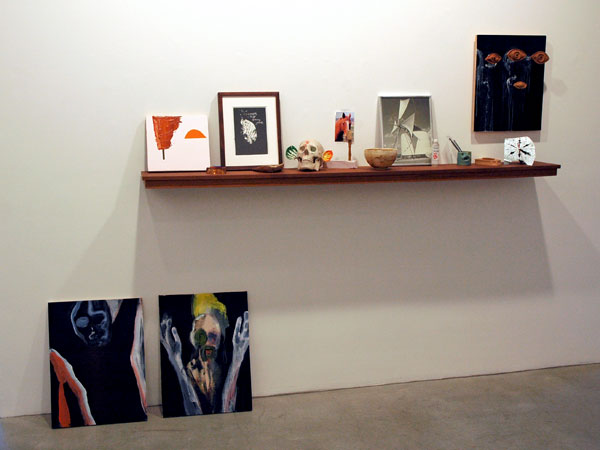
view of one wall of installation, including both paintings and objects

Andrew Guenther‘s show at Freight + Volume, “Looking For Culture Part III: Back to My Old Ways“, includes some terrific oils, acrylics and sketches, and a number of indefinable objects. Many of the pieces assume both individual and compelling shared identities, since they’ve been placed on, above or below simple wooden shelves. The drawings and paintings are incredibly fresh, even sweet (don’t let the skulls put you off), and the gallery’s small “cabinet”, boasting as it does so many curious, wonderful, handmade doohickeys, looks something like a collection marshaled by a particularly-inventive Prospero.

Lily Ludlow at Canada

Lily_Ludlow_Lovers.jpg
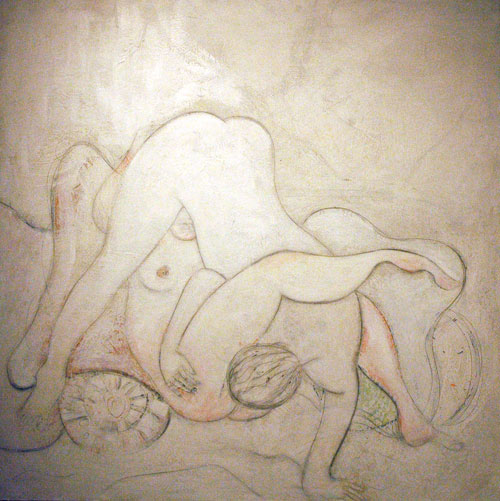
Lily Ludlow Lovers 2008 graphite, gesso and acrylic on canvas 48″ x 48″
Lily_Ludlow_Lovers_detai.jpg
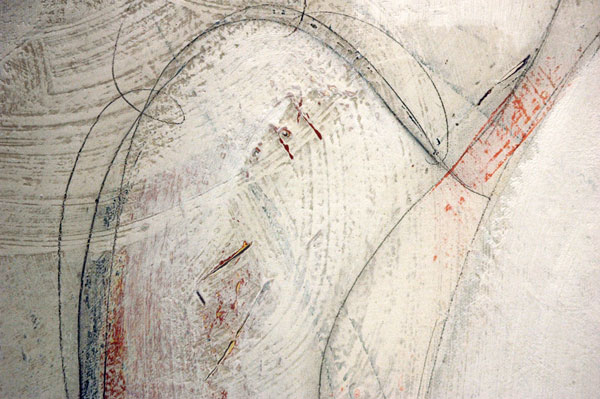
[detail]

Canada gallery is showing some beautiful erotic paintings by Lily Ludlow along with a multi-channel video, “Sewing Circle”, in which she collaborated with Allen Cordell. I love the paintings.
When I started this entry, because I was also so charmed by the beauty of the detail’s abstraction, the clarity of the lines and the subtlety of the colors it revealed (the rich textures can really only be seen if you’re right there), I was tempted to do something I rarely do, reverse the order of the two images you see here, making the larger one into a thumbnail and showing the detail shot first, and full size. I guess it’s an old publishing trick. I like the way it sometimes gingers things up, but I decided that the full painting, although it was very dimly lit in the gallery, was just too beautiful to diminish or underplay. It also displays some of its own ginger.

don’t let Art Fag City die!

tinkerbell.jpg

Paddy Johnson is having a year-end fundraiser for her increasingly indispensible cultural blog, Art Fag City. Contributions are tax-deductible, through the generous support of another of New York’s precious resources, Momenta Art. Go here to Paddy’s site for more information and an easy contribution form.
Tom Moody has assembled, on his own site, an impressive, but unassailable description of what her site means to the arts community it serves:

Johnson’s blog is a necessary counterweight to the institutional writing that constitutes current criticism: magazines chasing ad dollars, 501c(3) organizations that have to say nice things about everyone, and museum curators at the beck and call of powerful board members. Johnson produces a staggering amount of original content each year, including interviews, essay series, and reportage. Her comment boards are moderated in a civilized fashion and are a good place to hash out issues that aren’t being discussed elsewhere. Plus she is that rare writer that can cover both the art gallery scene and the online scene with equal knowledge and confidence.

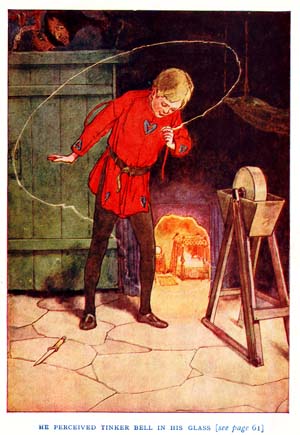
In J.M. Barrie‘s “Peter Pan“, the play, the novel and the film, children are urged to clap to show that they believe in fairies, lest Tinkerbell die. I feel a bit like when we were first asked to save that little sprite, but this time we’ll need to do more than clap if we’re going to help keep Art Fag City alive.

[1915 image, by Francis Donkin Bedford, from Project Gutenberg]

R.H. Quaytman at Miguel Abreu: “the blind spot”

Quaytman_Fresnell_lens.jpg
R.H. Quaytman Chapter 12: iamb (Fresnell lens) 2008 diamond dust, silkscreen, gesso on wood 32.5″ x 52.5″

Quaytman_Chapter_12_iamb.jpg
R.H. Quaytman Chapter 12: iamb 2008 silkscreen, gesso on wood 40″ x 24.75″
Quaytman_iamb_detail.jpg
[detail]

Quaytman_iamb_yellow_line.jpg
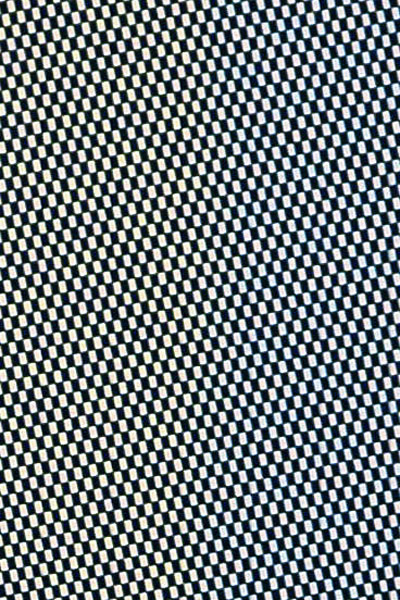
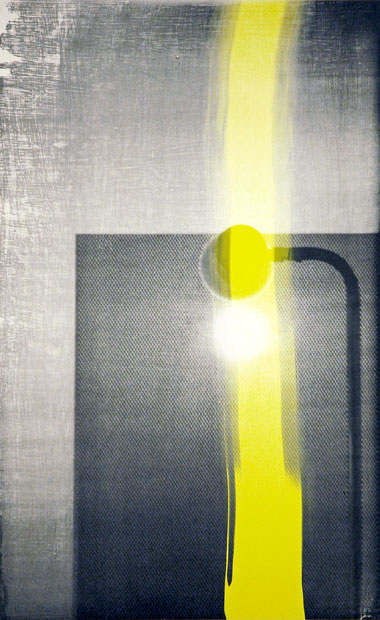
R.H. Quaytman Chapter 12: iamb silkscreen, gesso on wood 32.5″ x 20″

The gallery press release tells us that the subject of “Chapter 12: iamb“, R.H. Quaytman’s exquisite and very brainy solo show which opened recently at Miguel Abreu, is “painting itself and, specifically, its relationship to the blind spot.” The notes go on:

Like actual vision, Quaytman�s paintings have a blind spot, whether it be from a light source in the picture, an optical illusion, a trompe l��il effect, the absence of color in a black and white photograph, or the picture in plan. This recurring �absence� enables the works to activate one another, yet it also often shifts the axis of legibility between neighboring paintings.

About the images I’ve uploaded here: Since her show is about �absence�, I suppose I should consider that I had fair warning. Color is always a problem, and the pixels on a screen can play havoc with reproduction under the best of circumstances, but the first two images above are, more than usually, only an approximation of what you will see unmediated when you stand in the gallery itself. For example, the detail I show here, of a section located one third of the way from the right edge of the painting, actually includes parts of two color fields (this is more apparent if you move back from the computer screen).
Fortunately, since it’s a part of the work being shown (each piece is intended to be viewed both by itself and in the context of its neighbors) the installation is also a triumph. It’s museum quality, and I mean that in a good way: I felt like keeping my voice down, I suppose out of awe or respect, and that’s not my usual approach to new art.

Kate Gilmore at Smith-Stewart

Kate_Gilmore_Higher_Horse.jpg
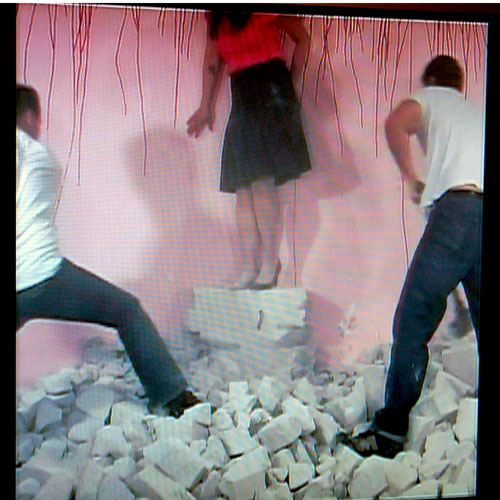
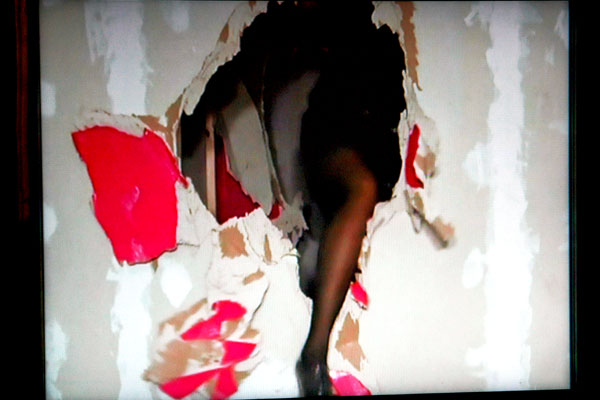
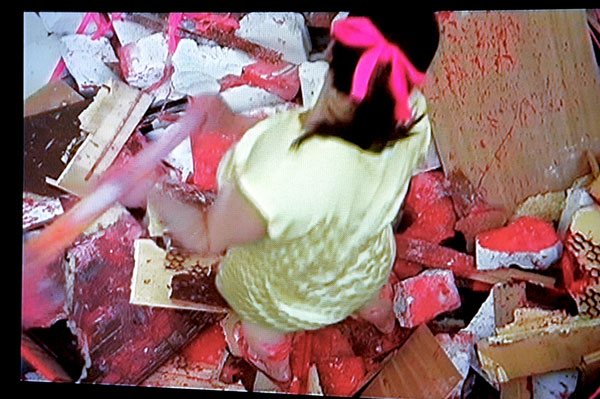
Kate Gilmore Higher Horse 2008 single channel video [large detail still from installation video]

Kate Gilmore’s current installation at Smith Stewart is even more gripping than I’d expected, and I’ve grown to expect a lot from this smart artist.
While you pass through the debris left over from one of the performances documented on the monitors inside the gallery, Gilmore can also be seen in three other recent videos, equally and typically engaging, and very physical. Her face is often obscured in her work, as it is here. But in these four pieces, dressed in high heels and skirts, Gilmore’s costume at least is a star, neatly color-coordinated with some element of her artist-built sculptural props. In each case she is, as usual, totally involved in half-goofy challenges presented by her sets, but in the video installed furthest from the door, “Higher Horse”, where she introduces two husky males armed with sledge hammers, she appears more as frightened, cornered prey than as the wild, ransacker encountered elsewhere in the room.
Gilmore’s work, regularly evokes responses like horror, frustration, pity, anger, compassion, empathy, fear, love and admiration, and certainly bemusement, humor and delight. None of these appear alone, instead they’re all tangled together in my experience of the pleasures of her art.
And I’m not alone.

Kate_Gilmore_Walk_This_Way.jpg
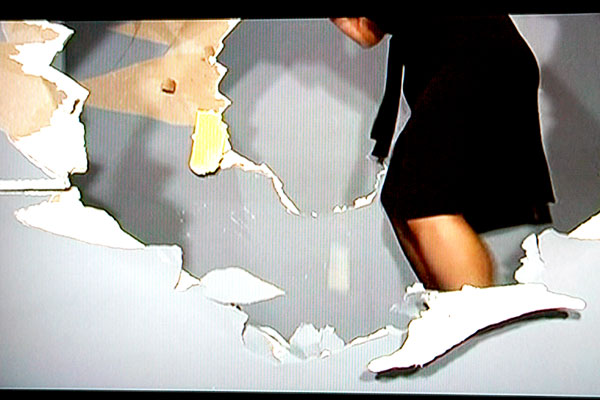
Kate Gilmore Walk this Way 2008 single channel video [large detail still from installation video]

Kate_Gilmore_Between_a_Hard_Place.jpg
Kate Gilmore Between a Hard Place 2008 single channel video [large detail still from installation video]

Kate_Gilmore_Down_the_House.jpg
Kate Gilmore Down the House 2008 single channel video [large detail from installation video]

Maureen Cavanaugh shines in 31 Grand’s final show

Maureen_Cavanaugh_Black_Flowers.jpg
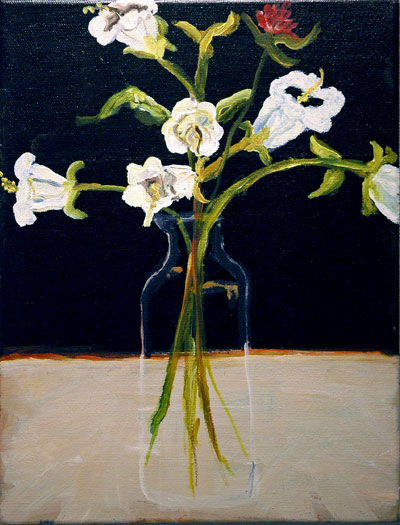
Maureen Cavanaugh Black Flowers 2008 oil on canvas 9″ x 12″

Maureen_Cavanaugh_Old_Room.jpg
Maureen Cavanaugh Old Room 2008 oil on canvas 10″ x 10″

I liked these paintings when I first looked at them, and I find they’ve only grown more beautiful each time I’ve returned to them (in photos). Maureen Cavanaugh‘s solo show at 31 Grand, “Stay With Me“, which closed one week ago, was terrific, but unfortunately it proved to be the final regularly-scheduled exhibition in the gallery’s space on Ludlow Street.
And then last night we were excited to be able to drop by the gallery for one last blow-out show, “Death Is Not The End“. It was a one-night only thing, a retrospective group exhibition of artists who had made appearances in 31 Grand’s spaces in Williamsburg and Manhattan over the nine years of its very full life.
The strength of this last brilliant flare of an installation, and the crowd which poured into the space one last time last night, should attest to what I read as prophecy in its title: It’s not over. I know nothing more about the future of the art world than anyone else, and less than many, but I expect Heather Stephens and Megan Bush will be back, either together or separately; the love and the respect both have earned for the work they have done over the past decade should foretoken as much, and more.
The artists included in the show last night were:

Adam Stennett, Alessandra Exposito, Eric White, Barnaby Whitfield, Carol “Riot” Kane, Fanny Bostrom, Randy Polumbo, Francesca Lo Russo, Helen Garber, Mike Cockrill, Jade Dylan, Jason Clay Lewis, Jason Cole Mager, Jason Weatherspoon, Jeff Wyckoff, Joel Adas, Jon Elliott, Karen Heagle, Kristen Schiele, Kyle Simon, Lauren Gibbes, Magalie Gu�rin, Maureen Cavanaugh, Megan Leborious, Michael Anderson, Michael Cambre, Michael Pope, MTAA/Michael Sarff, Nelson Loskamp/Electric Chaircut, Orly Cogan, Paul Brainard, Rebecca Chamberlain, Sean McDevitt, Spencer Tunnick, Tim Wilson, Tom Sanford, Ursula Brookbank and Claudine Anrather

David Gordon’s “Trying Times (remembered)”

David_Gordon_Pick_Up_Performance.jpg
why, . . . it was just yesterday, and now it looks like tomorrow

DO NOT miss it, if you’re any where around Chelsea today, Friday or Satruday. There are still three more nights to see a (sorta) revival of David Gordon and the Pick Up Performance Company’s 1982 “Trying Times (remembered)” at Dance Theater Workshop, and Barry and I both recommend it highly. You don’t really have to bring any special equipment with you to enjoy this beautiful piece, but, especially if you’re unfamiliar with the choreographer and the company, it wouldn’t hurt to see it after: 1.) a quick study of its history, here [Gia Kourlas for Time Out] or here [Claudia La Rocco for the NYTimes]; 2.) a look at David Gordon; 3.) a peek at the phenomenal Valda Setterfield; and 4.) some background on Stravinsky’s gorgeous 1928 “Apollo“.
Deborah Jowitt (sadly, one of the only reasons still left for picking up a copy of that once-indispensable Downtown rag, The Village Voice) will also help with her review, whether you read it before or after experiencing this wonderful work.

[Steve Gunther image, of Pick Up Performance Company dancers together with dancers from the Sharon Disney Lund School of Dance at CalArts, taken from Pick UP and supplied by DTW]