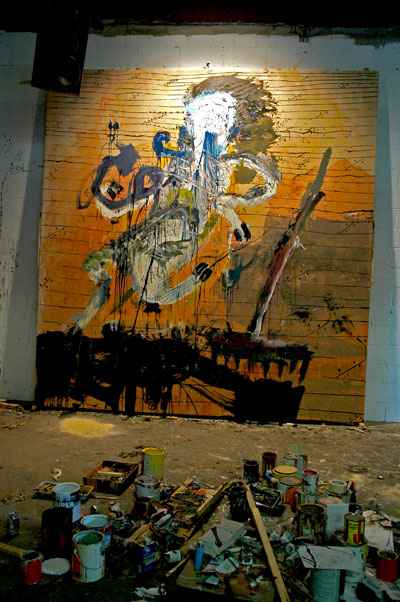

[detail]
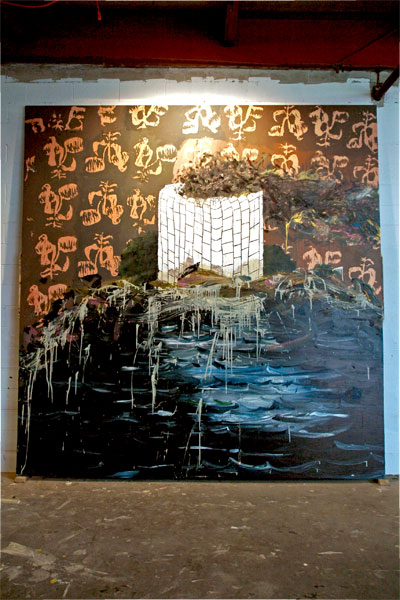
It was a great studio visit. Along with the pleasure of some fine work, there was the pleasure of conversation with an animated artist (actually two or three) and some other good people (some familiar, some not), even if the ambient lighting turned out to be a problem for decent pictures.
These are the views with which I left Bushwick. They show two of the very large canvases Barry and I saw in situ at Piedilato’s shared studio during a visit to this former ground-floor factory space. I believe these two were both completed works, but in my enthusiasm with their impact I neglected to ask. We met the artist for the first time that afternoon. His own site has much better images of more work from this series, and earlier ones. They shouldn’t be missed; If you take a look you’ll understand why I’m so excited.
I liked Piedilato’s painting the moment I first saw one seventeen months ago. It’s a little strange, but until going back today to my earlier post I hadn’t remembered that work as being particularly large, even though I had actually included its generous dimensions in my text. So I was pretty surprised to see the latest pieces. They were all pretty “awesome”, but not just because of their monumental size. Piedilato continues to combine exuberance and discipline in his new work, now being registered on an even larger scale: Everything we saw the afternoon we were there was roughly twelve feet square.
I love the strength and repetition of the various kinds of blocks, boards, and wallpaper ‘prints’, and then Piedilato always introduces some mad explosion or delightfully messy thing to take it much further than you’d imagine it could go. Not every exhibition space can handle 12-foot canvases, but with work of this quality, I can’t believe this guy doesn’t have serious gallery representation right now.
Category: Culture
Brent Green at SUNDAY
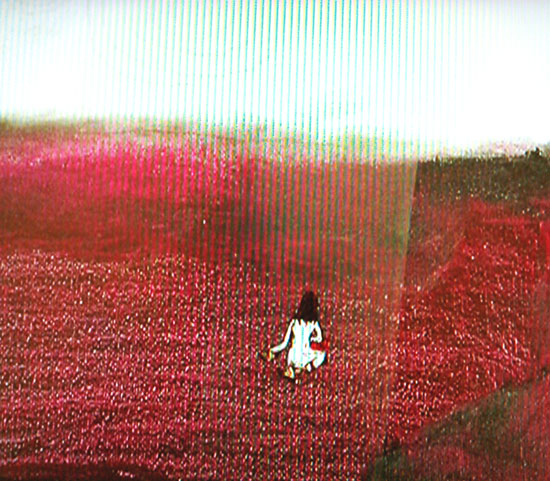
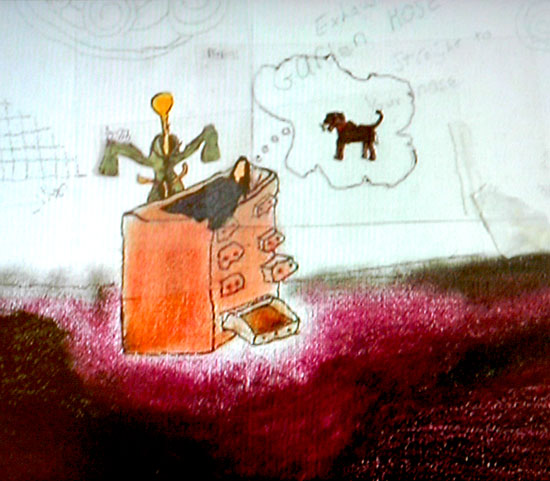
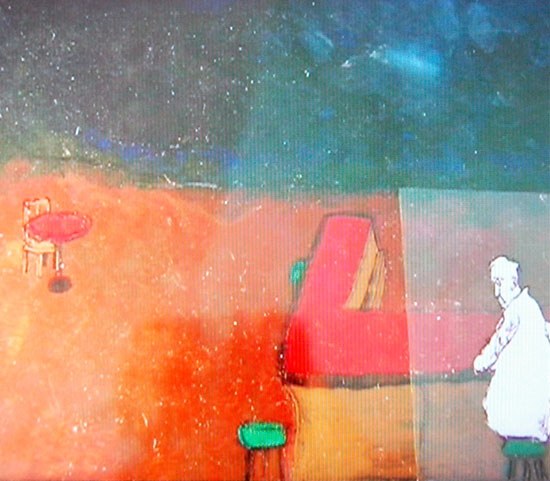
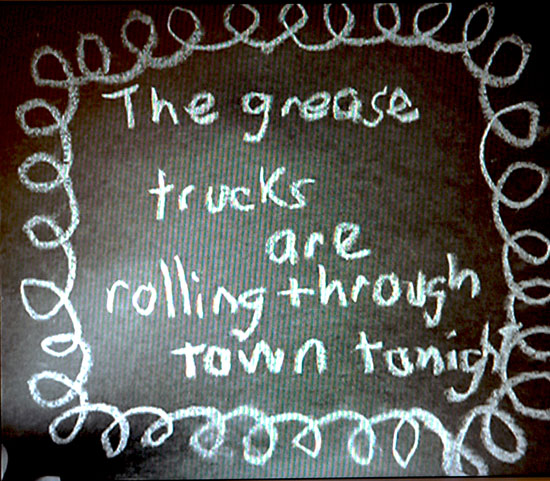
four large-detail stills from “Susan’s Red Ears” (2002), Brent Green’s 6-minute, 16mm transfer to DVD
SUNDAY has a must-see group show, “Tenderly“, which includes work by twelve artists: Erik Bluhm, Martha Colburn, Carl D’Alvia, Edward del Rosario, Echo Eggebrecht, Joel Gibb, Brent Green, Kirk Hayes, Asuka Ohsawa, Ruby Osorio, Hills Snyder and Rachell Sumpter (and almost as many mediums).
The exhibition press release talks about their use of humor, childlike forms and other devices “to soften some of life’s more dramatic, and often tragic, moments”. It worked for me: A perfect mix for a hot summer day perched in the midst of particularly perilous times.
They’re all worth seeing, and I want to go back, but I was totally taken with the video by Brent Green, a young artist not entirely unknown in avant film circles, but whose work I don’t think I’ve come across before. Every frame of this little hand-assembled video is a painting by itself, so it was no problem capturing a few to show here.
Six of his films, including “Susan’s Red Ears”, are available on YouTube, through links shown on the artist’s site.
Green’s doing a live show at the Hammer Museum in Los Angeles next month, screening all of his films with live narrations and improvised soundtracks by himself and four other artists on July 22. It sounds just too good to pass up, if you’re anywhere in the area.
after Jackson – or maybe Pablo
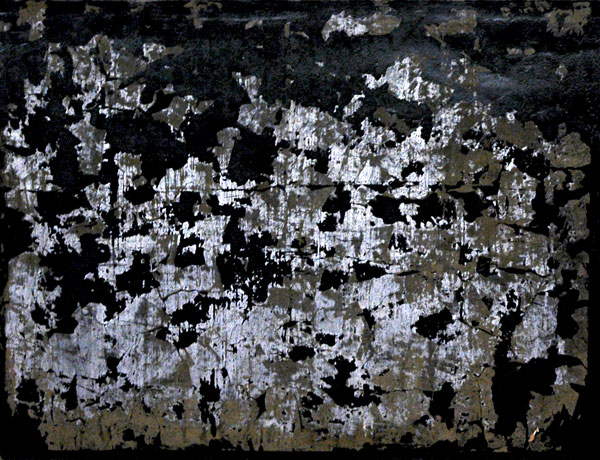
untitled (subway frame) 2008
2008 Affordable Art Fair (“art to go”)
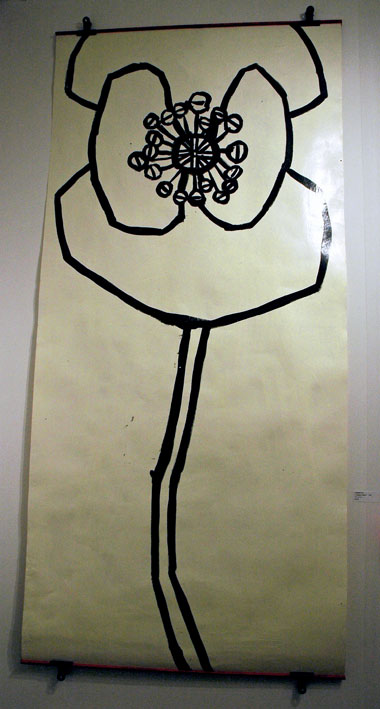
Chihiro Ito‘s 2006 poppy drawing at Shion Art (New York, Nagoya)
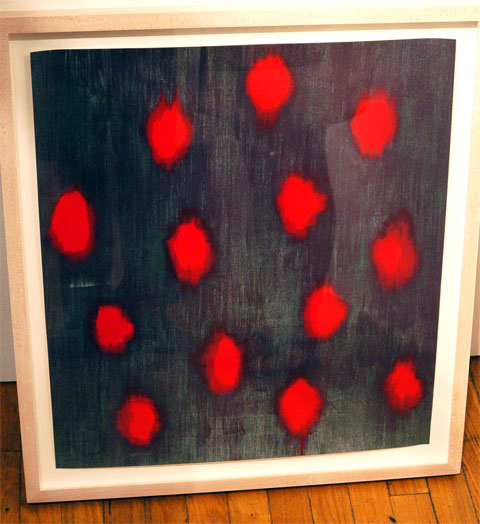
2007 Ross Bleckner print at Hal Katzen (New York)
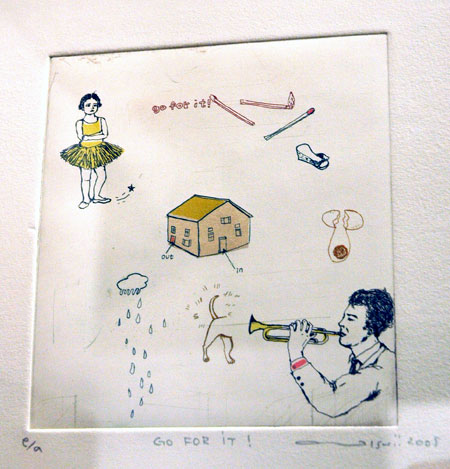
small Atsuko Ishii etching from 2008 at Envie d’Art (Paris)
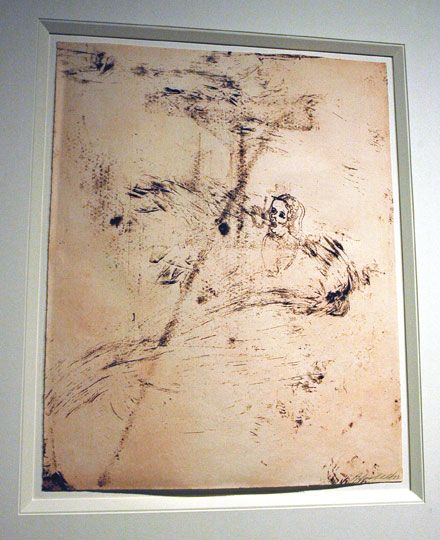
1983 Julian Schnabel etching at Peter Gant Fine Art (Carlton, Australia)
I went to the 2008 Affordable Art Fair [AAF] preview last night thinking, on the basis of previous incarnations, that the slim hour I had allotted for a visit might be enough. It wasn’t, by a long shot. I was very pleasantly surprised that even after overstaying into a good part of another hour I had probably only seen about a third of the exhibitors, and I promise I was hardly schmoozing at all.
There’s some very good stuff to be seen on West 18th Street this weekend, and some of it really is affordable. I think I’m using the adjective judiciously, because with prices which start at $100 or $150 much of this art will find a home with folks who may have only very modest incomes.
I’m not being patronizing about the quality of some of what is available; there are works I wouldn’t be surprised to see in fairs with much higher visibility – and pretensions.
With that reference I should say that on my way down the aisles and past the bar areas I had to slip through dense throngs of well-dressed and well-lubricated bargain-hunters last night, many of whom were doing more than just schmoozing themselves: The rich love a good bargain as much as the rest of us; they’ll compete even with impecunious collectors so long as the packaging looks good, and the organizers have done a very good job with this package.
Prices seemed to be pretty visible, either on the labels or lists set out. The works shown at the top of this post ranged from $150 to $6000. The Fair says the works start at $100 and go to $10,000 (well, “affordable” is always what you think is affordable).
As usual there were still a huge number of gallery names (they came from all over the world) I didn’t recognize. The organizers and the galleries have done a great job this year, but if only to emphasize the idea that money is not the standard by which good art should be judged, it might be nice to see the AAF attract galleries from all levels of “respectability”. Last night I saw some gallery owners walking about who weren’t exhibiting at the fair. They may have just been socializing, or they may have been there for r&d, a professional investment analogous to that of galleries haunting art school studios and graduate shows. But I’m thinking that surely even a blue chip space can find work from its existing shelves or files which it could position for entry-level art patrons. Or perhaps even better, how about “big-deal galleries” exhibiting work at AAF by artists they’re currently only considering representing? Of course it would mean they’d actually have to go out and look at some new art.
AAF continues through this Sunday at 135 West 18th Street.
real terrorists don’t photograph anything
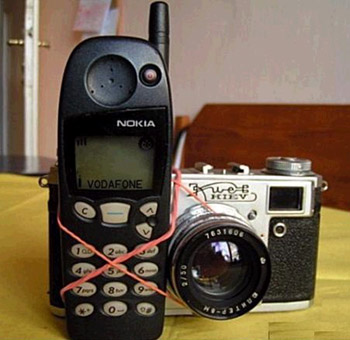
really scary
Why is everybody so afraid of my camera and your camera, even though they all own at least one themselves, and sometimes these same people are the ones spending fortunes installing security cameras to watch us?
I saw this Guardian piece in a Bloggy “linkage” post which appeared yesterday. The paper had published it the day before that. It’s too good, and far too important not to share. And don’t miss some of the links in the second paragraph.
It’s written by Bruce Schneier, an internationally-known security expert and currently British Telecom’s chief security technology officer.
Here’s a tiny excerpt:
Given that real terrorists, and even wannabe terrorists, don’t seem to photograph anything, why is it such pervasive conventional wisdom that terrorists photograph their targets? Why are our fears so great that we have no choice but to be suspicious of any photographer?
Because it’s a movie-plot threat.
[delightful image created by bloganything]
“Dance for Music” at Judson for Movement Research Festival
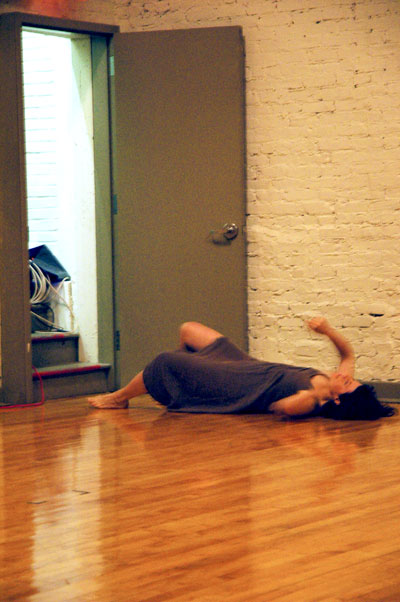
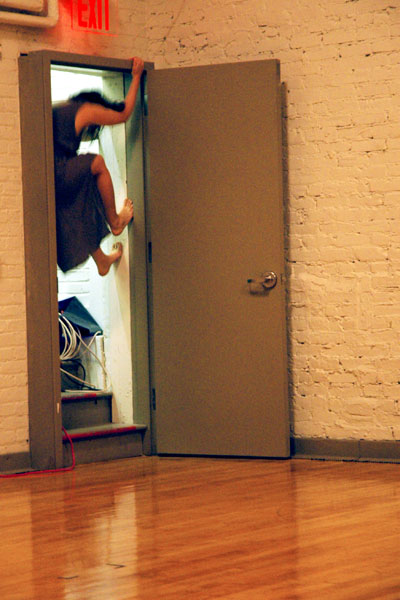
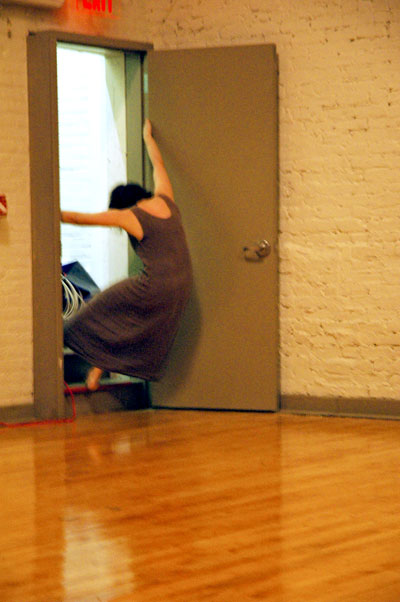
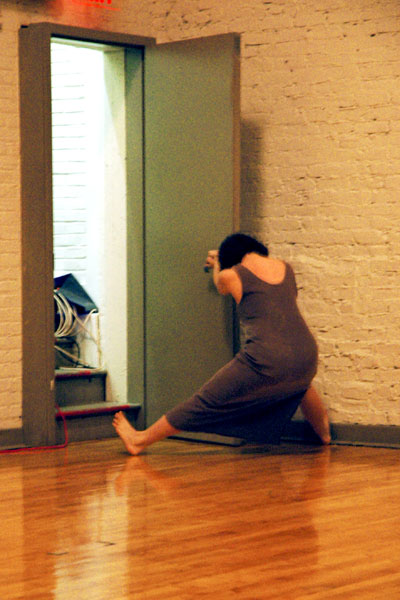
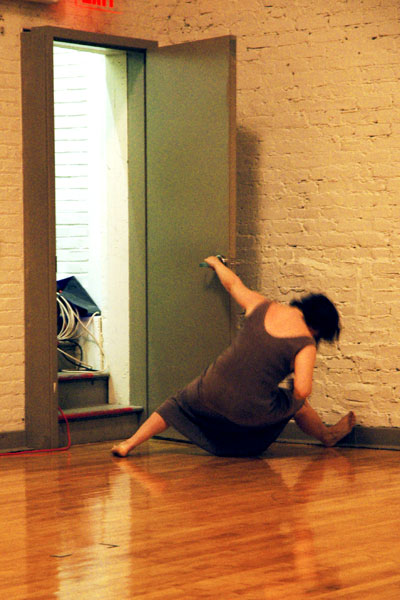
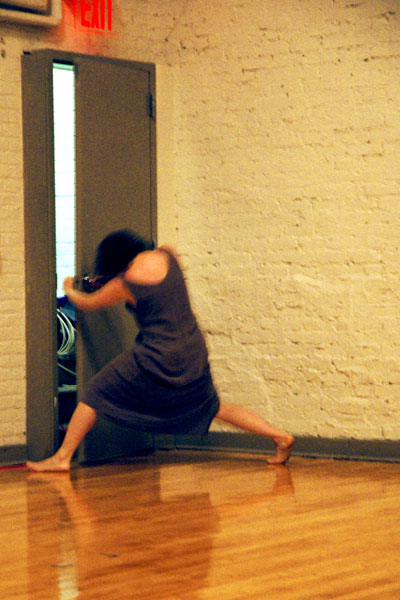
more than a door, and more than a sigh
We were seated (most of us) in a sometime basketball court in the basement of Judson Church. It was this past Tuesday, and it was another event of this spring’s Movement Research Festival. This is what used to be called “experimental” performance. Once again there were no props and virtually no theater lights had been installed. There were no elaborate sound systems; instead, each of the three sets of composer/musicians brought whatever they might need. What we did have were some very-much-alive musical writers/performers and their very lively music, created for choreographers and dancers chosen by the artists responsible for the music. The conceit of the program itself was to be an experiment too, since it was a reversal of the conventional order in which the music is chosen by those who create the movement.
My favorite part of the evening was that which Nate Wooley and Newton Armstrong commissioned for the dancer Jennifer Mesch.
All the seats faced toward two unadorned white brick walls, and at their intersection on the far side of the gymnasium there was an unremarkable plain metal door. We had barely settled down after a short break and only some of us were looking in that direction when the door suddenly burst open with a loud and extended BLAAAAACK! – a fierce explosion of electrifying and other-worldly, animal-like “noise” At precisely that same moment Mesch was thrown/threw herself out of the opening onto the wooden floor.
The excitement almost never slackened during the five or ten minutes which followed, although it was quickly joined with our laughter. The terrific and terrifically-overwrought dancer was having a ferocious battle with that raucous door. It was never clear who was winning, or whether either might have come out on top, even after Mesch had returned through the opening for the last time and the door closed for good.
Only after the piece had ended and all three performers had emerged could we see that the wonderful monstrous sounds had been created by Wooley’s trumpet and Armstrong’s electronics, stationed on the stairs inside the landing. When it was all over I told Barry in my innocence that the work made me think of Pierre Henry‘s “Variations pour une porte et un soupir” [Variations for a Door and a Sigh]. At home last night we decided that in fact it was almost certainly intended as (less-than-concr�te and solo) homage to Henry and Balanchine on the part of these three young artists. I’m playing our copy of the CD as I’m writing this today.
Catch 30 in the Movement Research Festival
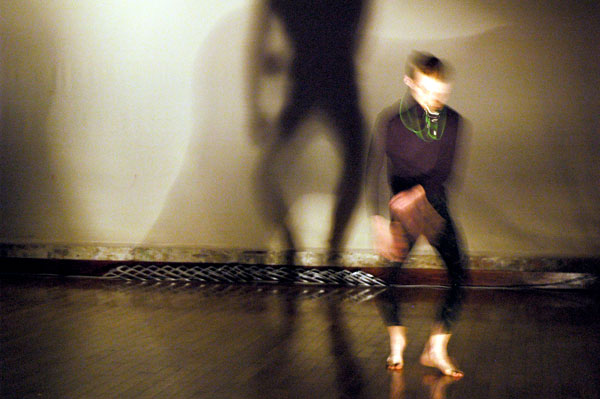
Christine Elmo [the totally amazing Peter Hanson dancing here]
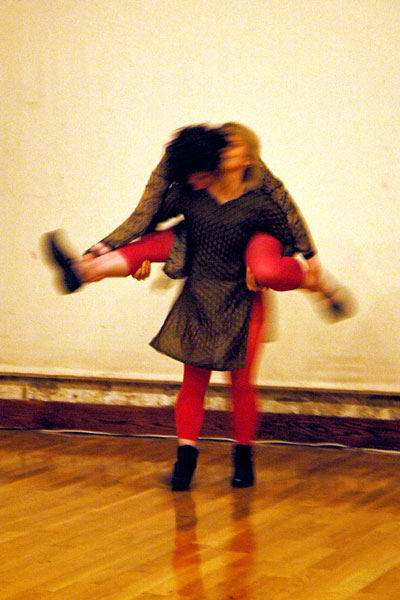
Anna Marie Shogren & Katie Rose McLaughlin
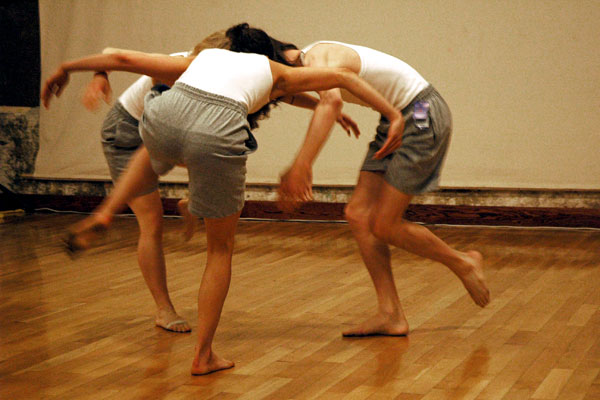
Justin Jones [Anna Marie Shogren, Sarah Baumert and Justin Jones dancing]
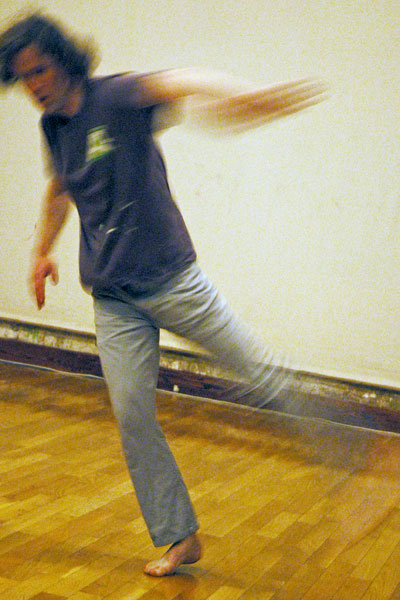
Chris Schlichting
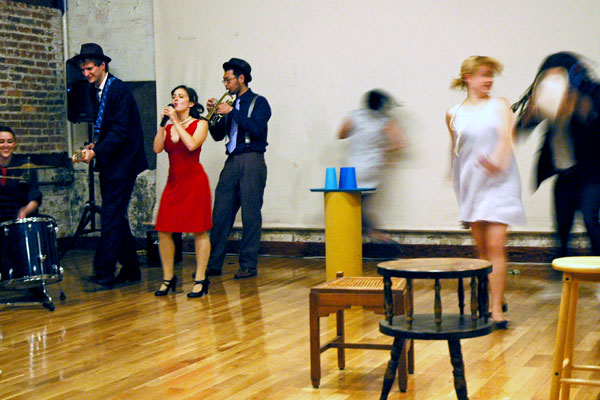
Scott Riehs [only part of the company of eleven]
These are images of five more short performances included in the Catch 30 night of the Movement Research Festival I wrote about in my previous post. The lighting was a challenge, and I didn’t leave my seat, so my images are both compromised and few.
I think all of the ten pieces we saw were either excerpts, works in progress, or just tantalizing glimpses of more ambitious works. I wish we could be given strings attached to [most of] these artists, to be sure we’d be alerted to what comes next.
Sorting out the printed program was something of a challenge; this is the alphabetical list of the names of the choreographers alone, taken from the CATCH site:
Christine Elmo
JERK
HIJACK
Justin Jones
Myles Kane
Elliot Durko Lynch
Scott Riehs
Chris Schlichting
shitheads on dynamite/living lab
Anna Marie Shogren & Katie Rose McLaughlin
For a real reviewer, see the intrepid Claudia La Rocco, whose NYTimes piece I read just after finishing this post. La Rocco’s also a blogger now.
Elliott Durko Lynch with Catch 30 at Starr Space
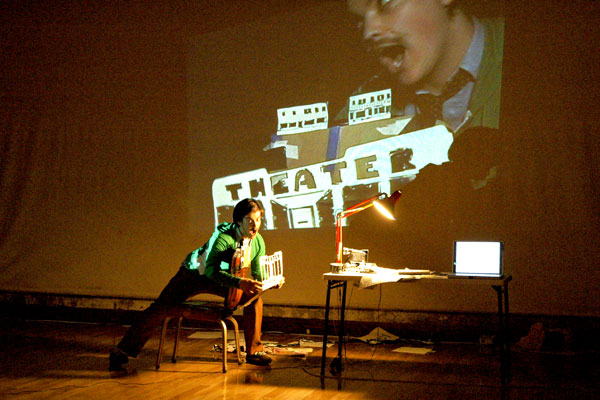
“Everything’s for sale!”
Barry and I were at Starr Space [their own site is down] on Friday night for Catch 30, part of the Movement Research Festival which continues through June 8 throughout the city.
Including the one straight video there were ten separate performances in all (if I’m counting correctly), by dancers and choreographers based in Brooklyn and Minneapolis. The evening was curated by Jeff Larson and Andrew Dinwiddie. It was all very fresh, and there was a huge variety of work. While I enjoyed each of them, I only broke my silence in the midst of one, “Bryant Lake Bowl Intermission #3”, by Elliott Durko Lynch with the special assistance of Kristin Van Loon. Half way through it I whispered to Barry, “he’s a genius!”.
Lynch’s piece is apparently only a snippet from an evening-length performance in progress, so we might find more structure and fewer loose ends if we are privileged to see the completed work, but I really hope that won’t be the case and I really doubt that it will.
In the space of ten minutes, maybe less, Lynch managed to deconstruct the idea, the reality, the nonsense and the value of the twenty-first century American city and the rich life it has repelled and attracted. Most of all what it’s about what it is now becoming. Beginning with an odd “presentation” while seated at a desk/table with projector, he raced through an extreme condensation of an impressive personal repertoire which on that night included tutoring or coaching, rapid-fire drawing and sculpting, a magic-lantern show presentation, photography and film projection, declamation, singing, stage directing, choreographing, dancing and, . . . snacking. He succeeded in weaving a story as sincere as it was mad, but this artist’s satire is totally authentic. The title of the full work will be “The New York Historic Artists Lofts and Residences + Hotel!”.
Shortly after the lights came back on for good we spoke to Lynch. I said that I thought he was a genius, and I told him how much we both had enjoyed the piece. He thanked me shyly and asked, “What is it you liked about it?”. A good answer would have been as difficult as unraveling the performance itself. Maybe it’s best that I didn’t get a chance to explain, since I doubt that I could have. I just know that I was attracted to the energy, the weirdness, and the odd beauty of the images and the movement, and I wanted to keep going with it, even if I never succeeded in sorting it out any better- especially if I never did.
Barry really got it: See Bloggy and especially Barry’s blog on the Movement Research site.
ADDENDA:
more photos after the jump
Continue reading “Elliott Durko Lynch with Catch 30 at Starr Space”
ACT UP oral history marathon
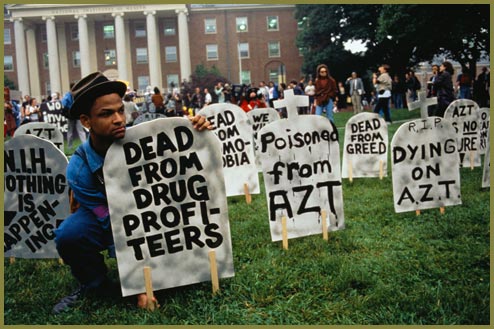
we were never alone*
CORRECTION: I’ve corrected the text for screening location
ACT UP veteran Deb Levine is viewing the entire ACT UP Oral History Project videos from start to finish in a performance project she calls “ENDURING ACT UP”. She is inviting us to join her.
Levine has been working on her PhD. in Performance Studies at NYU and is writing about ACT UP for her dissertation. She says she’s focusing on one aspect in particular:
. . . how collectively people took care of each other during meetings, demonstrations, in committees and affinity groups, and especially as members became ill. I am most interested in the ways in which those relationships became an ethical and political practice – a topic that is not often foregrounded in other histories of the organization.
While she has been watching the interviews recorded by the Oral History Project, which was undertaken by Sarah Schulman and Jim Hubbard, and I assume she’s been through them all, she says that what she is missing is the opportunity to turn around and discuss what appears on the screen with others who witnessed and were a part of the phenomenon of this remarkable band of AIDS activists in the 80’s and 90’s.
The screenings began this morning at 10 at 721 Broadway on the 6th floor, room 613. They will continue through June 15. For a complete schedule and more information, go to the project’s web site.
*
the image is from the ACT UP protest at the National Institutes of Health [NIH] in May, 1990, when we stormed the NIH to protest the slow pace of research; things picked up a bit later (the troublemaker seen in the foreground is Brian Keith Jackson)
[Donna Binder image from NIH library – yes, the NIH!, and the site has much more about medical activism]
Anthony Pontius at 31 Grand
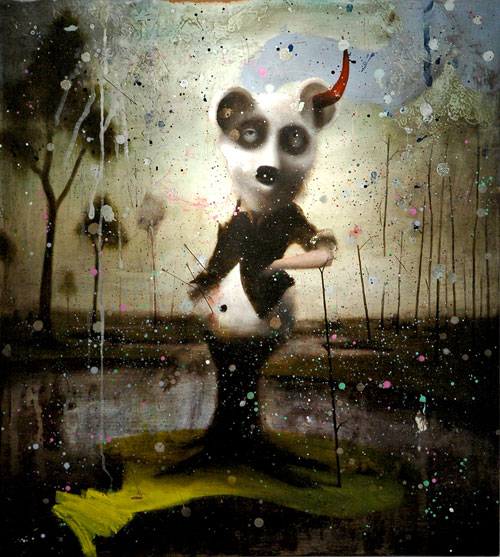
Anthony Pontius there is an end in flight 2008 oil and ink on panel 32″ x 36″
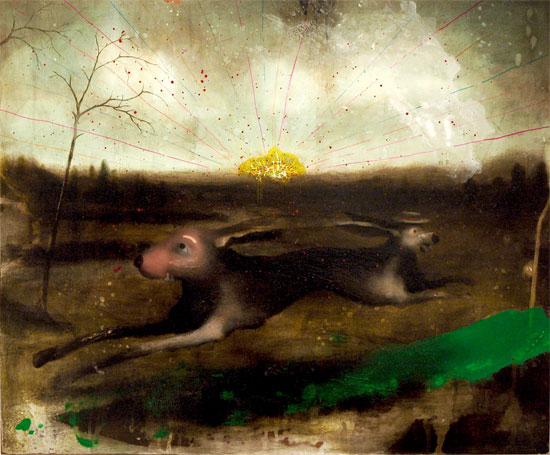
Anthony Pontius the ill-fated march of a plouged jogger 2007 oil and ink on panel 30″ x 36″
It was gorgeous, and now its gone, but 31 Grand’s recent how of work by Anthony Pontius, “Why on Earth?” isn’t forgotten, at least here.
The press release tells us that Pontius examines “the importance of the human connection to history and nature.
By recontextualizing historical imagery, stories and concepts in the world of now , he presents a new narrative that is familiar yet the full meaning is not immediately accessible. Employing a mix of past and present techniques, he forms these new arrangements; using classical clarity to define a specific part of a story and at the same time abstraction to complete or destroy the formation of the work. The finished painting is a proclamation of something new and not easily defined, realizing that history and memory are not clear or concise, but the consequences of interpretation.
I’ve loaded this post with a few images taken in the gallery, but I have to explain both the presence and the appearance of the one just below.
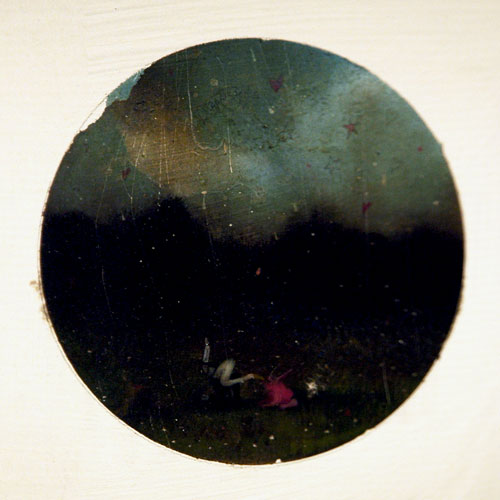
Anthony Pontius the april fool 2006 oil on paper 4″ diameter [large detail of framed paper]
I don’t think this tiny “the april fool” was a part of the show proper, but I fell in love with it immediately. It was hanging near the desk, and its dark colors and shapes were framed behind a piece of glass. A photograph seemed almost impossible, but I gave it a try and snapped the piece from an acute angle, thinking the most I could do with the image would be to remind myself of its charm once I returned home.
This afternoon I decided to play around with it on Photoshop (where my skills are actually pretty abysmal). I managed to bring some life back into the very dark image and I even returned it to its neat circular shape. Now that I’m pointing it out you’ll see some blurring on the right edge of the drawing. It’s caused by either a narrow depth of field or, more likely, the stress of my converting its shape from the oval the camera left me. In any event, I think that what you can see is a fairly good representation of the beauty which caught my eye that day.
Related: “No New Tale to Tell ” at new 31 Grand [scroll down]