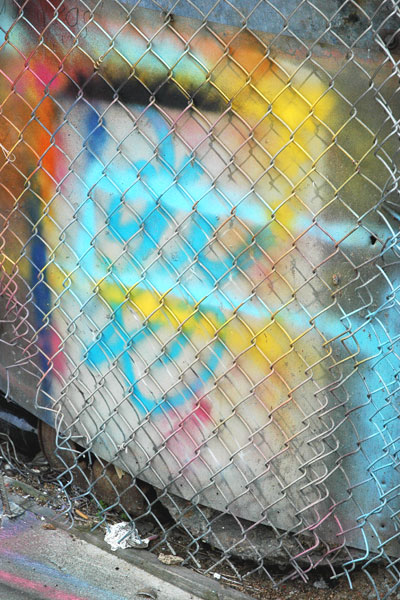
untitled (chain links) 2008
Despite its lively diversity, Bushwick isn’t always as colorful as this “palette” sighted next to a building which houses a number of artist studios near the Morgan stop.
Oh, and in spite of its appearance to the contrary, the painted board is actually in perfect focus.
Category: Culture
Katherine Bernhardt at CANADA
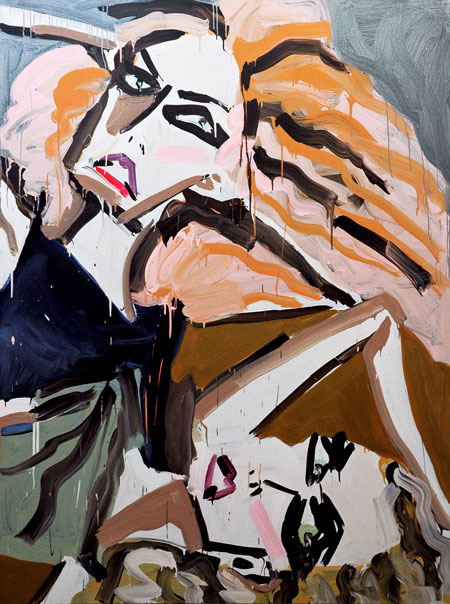
Katherine Bernhardt Silver on Gold 2008 acrylic on canvas 96″ x 72″
Katherine Bernhardt’s loose-limbed and painted-face of a show at CANADA, with the can’t-miss-it title, “Kate, Gisele, Agyness, Natalia, Kanye, George & Simon” (George and Simon? I think I missed them) is only up for three more days. The gallery says she’s been
. . . hosting a month-long sleepover party at CANADA with her favorite people and we are all invited. Fashion models, rappers and pop legends populate Bernhardt’s paintings in dizzying displays of weightlessness and celebrity, all painted in a colorfully loose style on huge canvasses.
These paintings are expressionist sketches, only they’re done with hardware store brushes and (unblended?) paint. They’re also terrific abstractions.
I may not be the best or intended audience, because I’m absolutely terrible with celebrity rags and a lot of pop culture, but I thought Bernhardt’s stuff was great.
Go visit. It’s CANADA, so you probably know you want to.
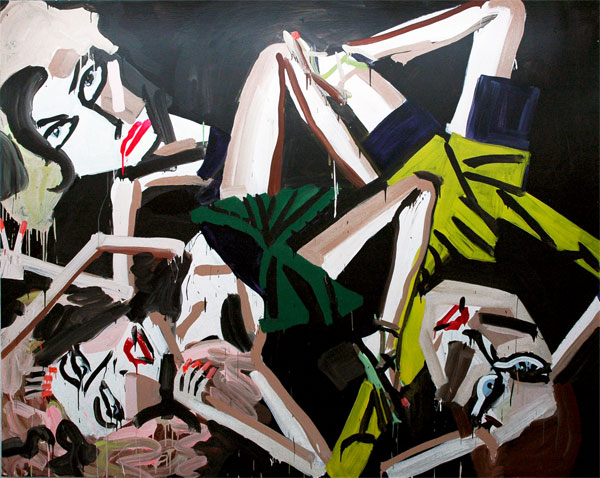
Katherine Bernhardt Triangles and Stars and Legs and Peace 2008 acrylic on canvas 96″ x 102″
memorial to Nazi homo victims: “but no survivors”
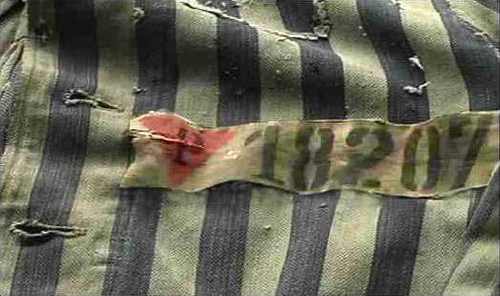
only part of the story
Berlin’s memorial to the thousands of homosexuals who were variously persecuted, tortured or murdered by the Nazi regime was dedicated yesterday. The official name of this German parliament commission, Denkmal für die im Nationalsozialismus verfolgten Homosexuellen [National Memorial for the Homosexual Victims of the Nazi Regime], may be formidable, but the structure itself is incredibly simple and ineffably moving in its sylvan setting within the Tiergarten, Berlin’s central park.
Positioned close to the iconic Reichstag Building, not far from the buried ruins of Adolf Hitler’s concrete bunker and across the street from the German capital’s very different but equally-astonishing Holocaust Memorial, the new memorial was designed by Elmgreen & Dragset, Danish-born Michael Elmgreen and Norwegian-born Ingar Dragset. The artists, who are based in Berlin, used the block shape, gray color and slight tilt of the individual steles of Peter Eisenman’s masterpiece for part of its inspiration, but a small video screen embedded in a recess on one side of this somewhat larger slab will portray a one and a half minute film loop by director Thomas Vinterberg of either two men or two women kissing. In the background of the figures in the videos, which were created before construction began, can be seen the same trees which surround the memorial as built.
Near the end of a very short article in the NYTimes today: “On hand for the unveiling was Berlin’s openly gay mayor, Klaus Wowereit, but no survivors.” The short article goes on to explain that Pierre Seel, who was the last known survivor of the camps, died in 2005.
As a queer man who first heard about this project in the mid-nineties when it was being proposed, and having now seen images of the powerful monument that these two wonderful artists have created, I’m unable to think of this work as a memorial only to the German and European victims of 1933-1945. Many homos who were not murdered but were imprisoned by the Nazis remained incarcerated in the new Germany long after the war. Homosexuality remained illegal in the Bonn Republic until 1969 and was only formally decriminalized in 1994.
Of course queers have been persecuted everywhere on the planet for thousands of years, but especially during the last few decades some societies have managed to grow up. They now recognize and protect the rights of all their members, while nowhere in the Western world do queer men, women and children remain more abused today, both by law and society, than they do in the U.S.
Berlin’s newest monument can be a memorial to all homos hunted in the past. Let it also be a foil for those who would hunt us still.
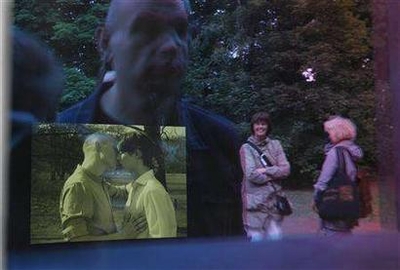
the protective glass in front of the video screen reflects viewers and surroundings
Note, and more: As the ambient landscaping is still immature, I haven’t included an image here of the structure or “pavilion” in its environment. This link to the memorial’s own site [currently in German only, but with a pretty exhaustive list of links in many languages]; and there’s an AP video below, recorded on the grounds of the memorial during grounds cleanup, with a short statement from the artists:
[image at the top from andrejkoymasky; image of memorial’s screen by Johannes Eisele from Reuters via Yahoo!]

Sarah Chuldenko at Fake Estate
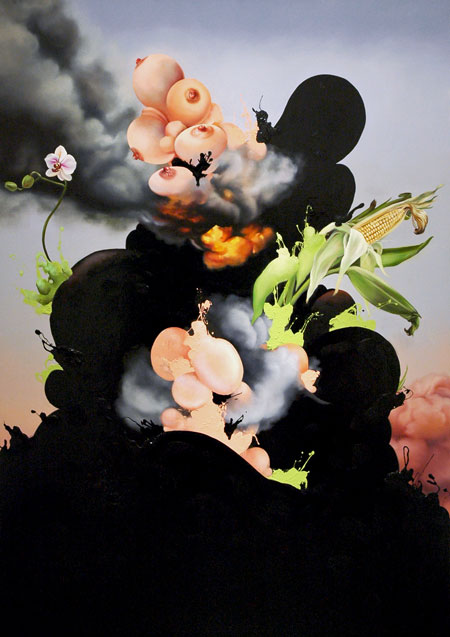
Sarah Chuldenko Love and Rockets 2008 oil an enamel 7′ x 5′
It was at Fake Estate, so it was physically one of the smallest shows in New York this spring, but the impact of the work Sarah Chuldenko showed in this broom-closet of a space was not minor in any sense. The show was called “Casualties of Beauty“, and although it closed on Saturday, I’m sure we’ll soon be seeing this artist again.
Some of her squishy images may verge on the off-putting, but I think it’s a good sign that the latest painting seems to be the most successful of all of them. Without losing her quirky organic vocabulary, Chuldenko has managed to open a very different conversation with “Love and Rockets”. The work is no less mysterious for the clues she may be providing us inside the disturbing beauty of the chaos she has created; the artist has only added more complexity to the language of the earlier pieces.
If not quite put off, we remain a little disturbed.
Christopher Brooks, and some other stuff
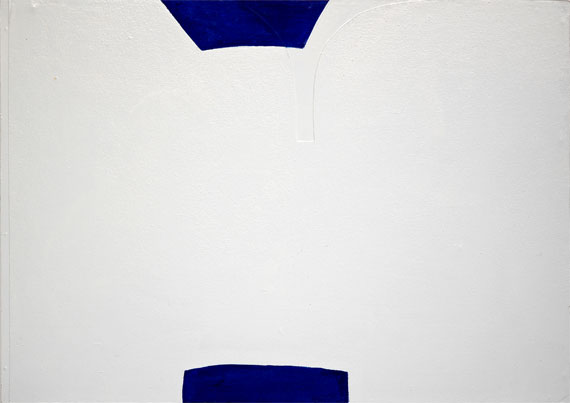
Christopher Brooks Untitled 1999 enamel on canvas and board 17″ x 24″ x 2″
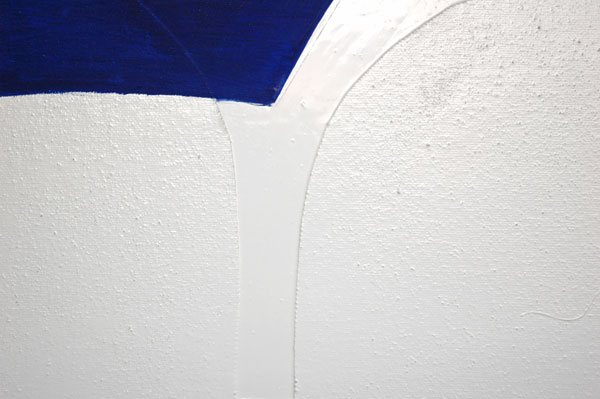
[detail]
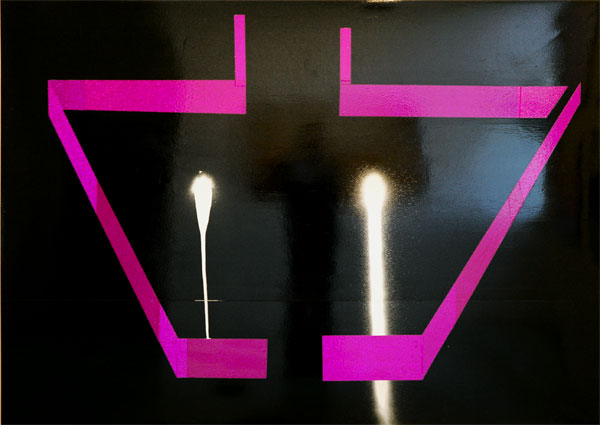
Christopher Brooks How to Lose 10 lb (easily) 2008 enamel and spray paint on masonite 5′ x 7′
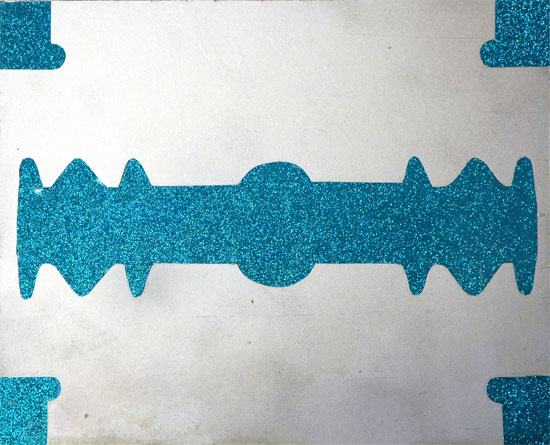
Christopher Brooks The Land That Time Forgot 2006 enamel and glitter paper on masonite 16.75″ x 20.75″
I can never get much information on the artist Christopher Brooks when I try looking on line. He did unfortunately pick a name which makes a web search very difficult, but still I’d expect to find him surfacing more often than he does by now. I did manage to find this, but only by looking through my paper file on the artist.
Brooks first came to my attention in a group show in Brooklyn curated by Lithgow Osborne in 1997. The artist and gallery owner Rupert Goldsworthy presented solo exhibitions of the artist’s work in his eponymous Chelsea space in 1998, again early in 1999 and then finally in 2000. In the first of those three shows, reviewed here by Elizabeth Kley, half of the gallery space was devoted to some large, very handsome but rather odd C-prints of the artist fully obscured and personally abstracted inside an inflated black rubber fetish suit.
I still have the notes from the 1998 show’s press release, and this small excerpt tells us something about Brooks’s work as he conceived of it at least up to the late 90’s:
Christopher Brooks will present a series of paintings and photographic work addressing the theme of the ‘institutition’. Invoking modernist establishments such as the asylum, hospital, clinic, prison and museum [!], the hard-edged geometry and institutional colors simultaneously invite and reject the human content they propose.
Ah, restraint or control. A collaged white and blue painting we found a little over a year later, which without this hint of kink would be as inscrutable as the photographs in that show, remains one of our favorites today; it occupies an honored place in the parlor, on what would be the prime television wall in regular homes. Barry and I were surprised and delighted to secure this untitled 1999 work by Brooks at the New Museum Benefit Art Auction of that year.
That painting and our two other purchases of the day were and remain good company, for we also went home with a terrific John Bock collage and a Roe Etheridge C-print we’re still nuts about. We were and still are impecunious collectors, but we really liked the cause (and Marcia Tucker still at the helm) and I guess we were feeling pretty flush. We were also very, very lucky: All the works together barely cost us $1000, and of course all three bids were below market even then. It’s been our experience and it remains our prescription: Benefits benefit everyone.
I confess to having had one tiny regret at the time: Unlike most of the other paintings by Brooks which I had seen by up to then (all of which were much larger, and each would have been way beyond our budget as a gallery purchase) the piece we adopted didn’t have any tiny, weird cartoon stickers on its surface.
Last week we saw two beautiful and very shiny new paintings by Brooks in an interesting group show in Chelsea, the gallery Massimo Audiello’s “Cmon shake it!ah ah Check it!ooh ooh”. Thanks to their efforts we now have a workable bio for this elusive artist.
Finally, only a few nights ago we managed to be incredibly lucky in our draw at the Momenta Art benefit; Barry’s number was pulled out of the raffle bag first, meaning we were able to go home with the work we had put at the top of our long list (we had 45 other choices written down, just in case we were going to be near the end). We were dazed and more than excited to get another Brooks painting, but judging from its reaction I think most of the room may have been fairly nonplussed.
We’re obviously biased, but we think we should have been seeing more of this artist already, and I wouldn’t be surprised to find stuff happening soon.
I just realized the mere existence of this post might look like part of a personal agenda. All I can say is that we have works by a truly huge number of artists. Neither Barry nor I could possibly avoid writing about some of them at sometime, but we’ve never sold a thing and we don’t intend to. These two Brooks paintings aren’t going anywhere; we’re expecting Brooks will.
UPDATE: I guess I didn’t look hard enough a couple days ago. While searching today for something related to this post I put another combination of words into my search engine and – voilà! – I found Brooks’s own site. It has a wonderful store of images of work as far back as 1996.
Dona Nelson at Thomas Erben
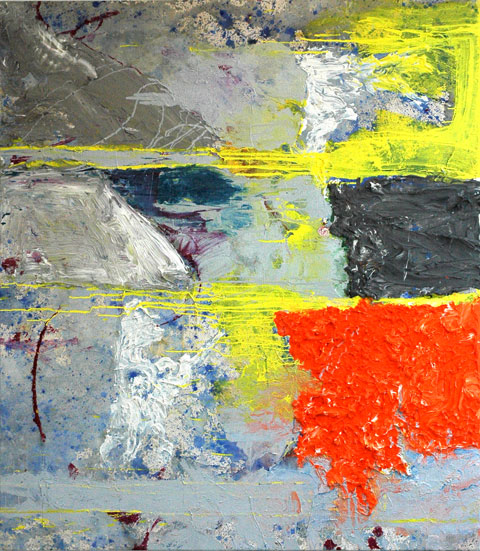
Dona Nelson Line Street 2007 acrylic and acrylic mediums on canvas 79″ x 70″
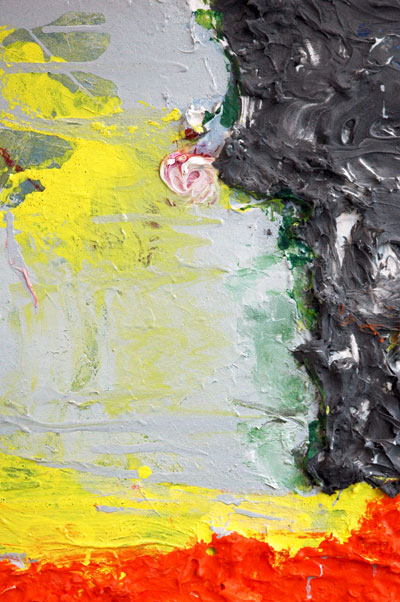
[detail]
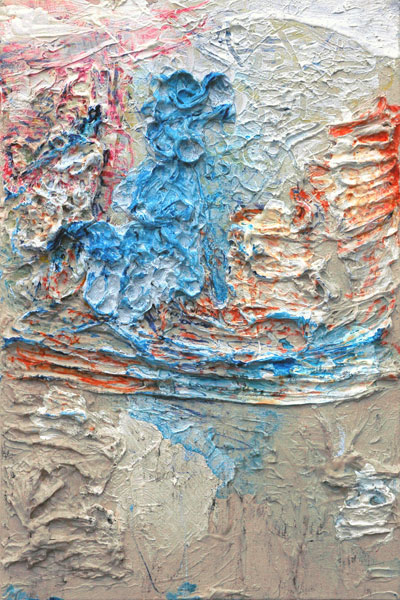
Dona Nelson Hag’s Song 2008 cheesecloth and acrylic mediums on canvas 30.25″ x 20″
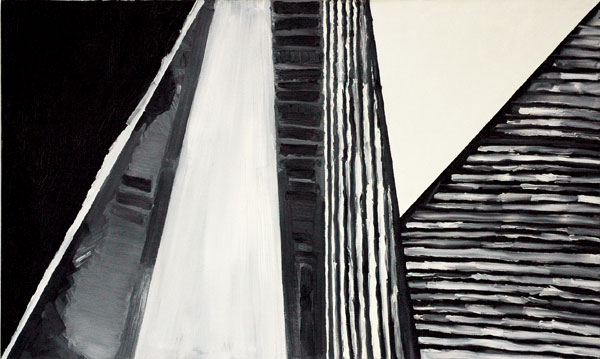
Dona Nelson No Title 1977 oil on canvas 24″ x 40″
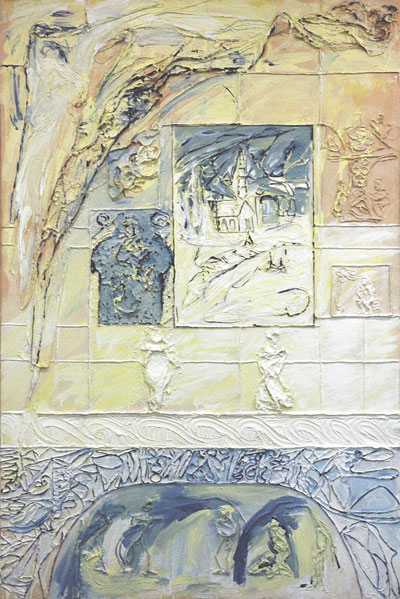
Dona Nelson My Home IV 2001 cheesecloth and acrylic mediums on canvas 90″ x 60″
I’m thinking Dona Nelson’s work is looking better and better, but I’m sure the reasons are simple: I’m seeing more and more of it and Thomas Erben is such a great curator. Like the last show he mounted for the artist this one is something of a closely-edited mini-retrospective. The current installation, “in situ: paintings 1973 – present”, remains on 26th Street through May 31.
Momenta Art Benefit 2008
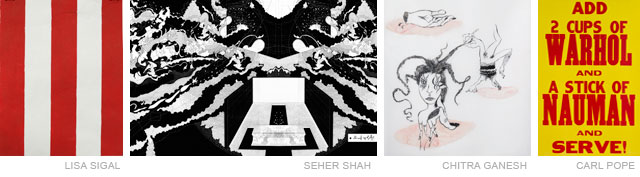
just four of the works available at the Momenta Art raffle
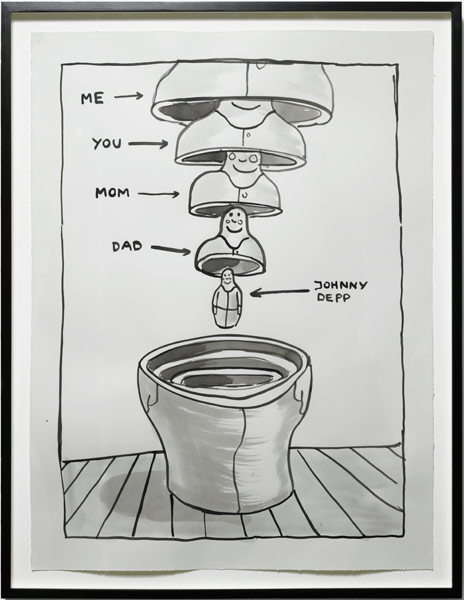
an Olav Westphalen acrylic on paper, one of the works being auctioned
Tomorrow night is the Momenta Art annual benefit party, which includes a raffle and a live auction. The event will be in Manhattan, at White Columns (320 West 13th Street, entrance on Horatio Street). The live auction starts at 5pm. The raffle begins at 7.
This artist-run non-profit space is absolutely as good as they come; they totally deserve and definitely can use our support, and after having stopped by today I can’t say enough about the curatorial quality of the art available to those who will be able to rise to the occasion.
A $225 ticket gets two people in for free food and drink, and you get to go home with a work of art as well!
The number of tickets is limited by the number of works available (approximately 140), and as of this writing at least, there are still slots available. Go on line here to get one or more tickets, or call the gallery at 718-218-8058.
To attend the party and auction without participating in the raffle, entrance for two is $100 and tickets can be purchased here.
Even if you can’t make it to the scene inside the White Columns space, where the works are now on display all day tomorrow and where the event is being held, you can still order tickets and arrange for a proxy to make your selection from among the items in the raffle.
[image from Momenta Art]
Rauschenberg was gay? How was anyone to know?
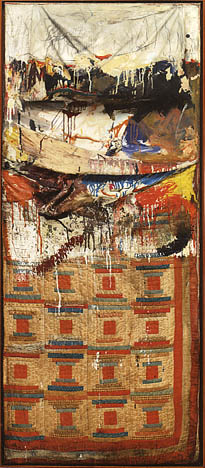
Robert Rauschenberg Bed 1955 mixed mediums 75″ x 32″ x 8″
Yes, the great man was queer. I had thought I made it pretty clear in my own post on March 14, but today I note that Tyler Green’s Modern Art Notes has gone and shoved it down the prissy throats of both members of the “regular” media and the art world’s own sophisticated pundits. Almost all of them seem not to have ever noticed, or, much more likely, were convinced it was too shameful a condition with which they could risk frightening the horses – or asses.
Green’s post, “Hetero-normalizing Robert Rauschenberg”, is totally on target, and bursting with links to his references and sources (there’s even a link to his links on the subject).
Bravo, Tyler!
[image from MoMA]
cutups or mashups flourish as New York street art
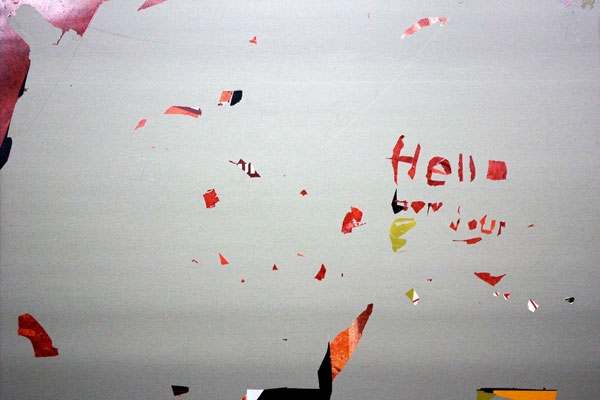
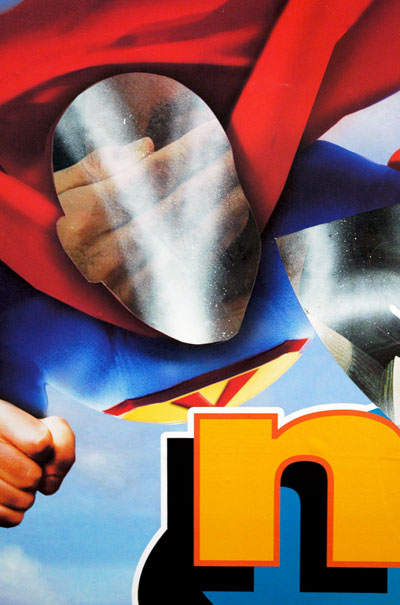
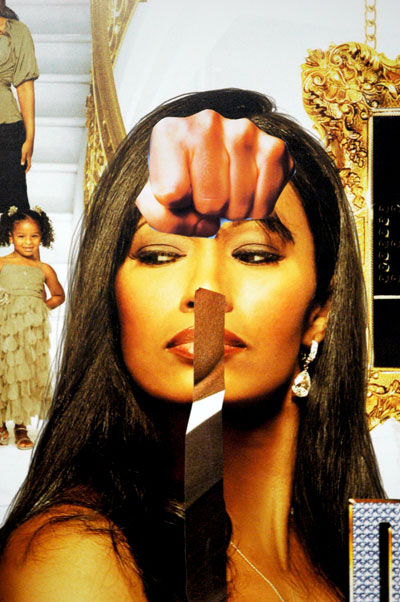
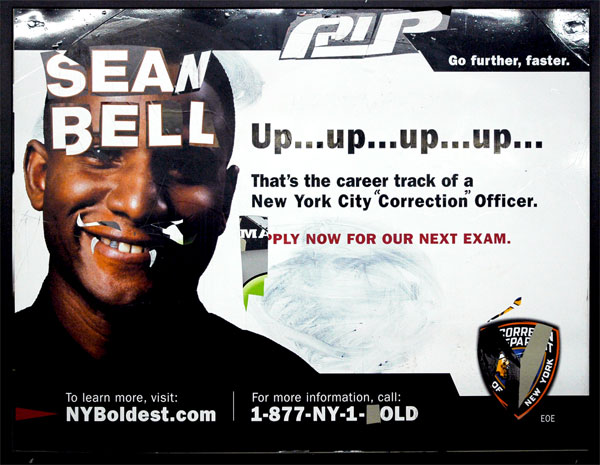
I may never be able to ignore a street or subway poster again; I might not even feel I have to bring a book with me when I head for the train. It seems there’s a current (and possibly snowballing) genre of street art which involves the alteration of commercial posters by making them into collages assembled from their own materials or paper cut from neighboring posters.
They’re potentially so much more elegant than the Sharpie alterations we’ve been seeing on these boards for years, even if they have to sacrifice that form’s occasional textual sophistication.
I spotted these examples and a number of others all near and inside the Morgan stop of the L train late Tuesday. The first image represents almost the complete framed poster as I found it, fully obscured or removed and converted into a rather delicate friendly greeting. The second two are details of separate works, but the third shows every square inch of a framed advertisement which has been converted into some serious political commentary.
This stuff can be quite beautiful, lots of fun or very provocative, and sometimes all at once. I called it “slash art” when I saw it this week, although this name probably plays into the hands of the police, who must already be pretty serious antagonists for these artists. “Cutups” or “cutup art” would seem to work too, but the form seems to have already acquired the moniker “mashup” while I wasn’t paying attention.
More examples, from Poster Boy, here.
Matt Wolf’s Arthur Russell bio: “Wild Combination”
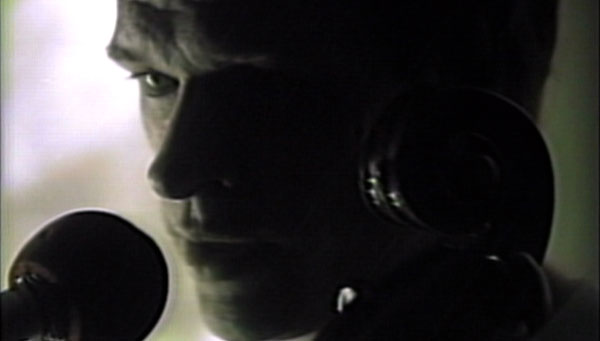
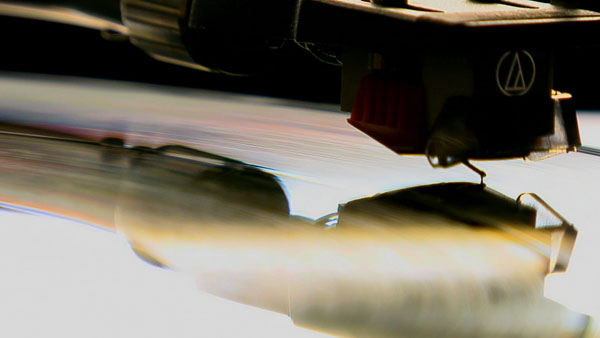
two stills from “Wild Combination”
I saw the New York premier of Matt Wolf‘s first feature-length film, “Wild Combination“, at the Kitchen last night. It’s an amazing documentary on the life and music of Arthur Russell, the innovative downtown musical composer/performer who just couldn’t stand still and wouldn’t be pinned down, even for his own visions of his art.
Unable to be really understood by most of his contemporaries, perhaps partly because of his own inadequacy with conventional communication, Russel’s cross-cultural and cross-disciplinary music never had a large audience, before his early death from AIDS complications in 1992. But twenty years later his music sounds as modern as today – or tomorrow. It now appears to be moving from an honored place in the memory of his fans and collaborators (and on thousands of reels on dusty storage locker shelves) into something like cult status among a new generation of listeners and artists which, like Russell, routinely ignores the false separation of genres and thrives on the offspring of musical cross-fertilization.
Wolf, an artist and filmmaker barely in his mid-twenties now, began his career in 2002 with “Golden Gums”. It was the first in a series of three relatively short experimental films, the others being “Smalltown Boys” in 2003 and “I Feel Love” in 2004. Their subjects were, in order, the young auteur’s own plaster dental cast offered to boyfriend as love token, a young teenage girl who seems to be the daughter of David Wojnarowicz, and the strange story of Andrew Cunanan’s hotel maid’s sudden celebrity. Only after “Wild Combination” could I imagine that each of these might be its own unique and perverse twist of the traditional documentary form. I’m not sure however if I might be able to read this into the filmmaker’s history only because his latest creation is clearly a documentary. But it’s certainly much more; it’s an imposing accomplishment and an exceptionally beautiful film in which one artist’s demonstrated imagination and fancy is directed toward showing the compelling musical beauty created by another.
But it doesn’t really matter, since all of these works do very well standing on their own. I only know for sure that I’ll be looking forward to wherever Wolf decides to go next.
“Wild Combination” will be screened elsewhere in New York later this year.
The Kitchen has organized a tribute to the music of Arthur Russell this weekend with performances tonight and tomorrow. The blurb on Time Out New York‘s site includes this on the performances:
On records such as 1986s World of Echo and the posthumous Another Thought, Russell married joyous pop to muted, inward reflection. But this Buddhist bubblegum (much of which has been reissued this decade by Audika) will make up just a fraction of this three-day program, which also offers a rare chance to hear his large ensemble instrumental pieces played live. On Friday, Russell colleague Bill Ruyle conducts Tower of Meaning, a minimalist work for brass and strings. Saturday will find Ruyle, trombonist Peter Zummo and bassist Ernie Brooks participating in The Singing Tractors, an ensemble trance work that incorporates improvisation.
Here’s an Amazon widget which will let you sample some of his music:
More:
John Schaefer’s WNYC Soundcheck program interview with Matt Wolf
Sascha Frere-Jones writing about Russell in The New Yorker in 2004
Andy Beta’s piece on Wolf’s film in the current The Village Voice
Audika Records Arthur Russell catalog
Amazon’s Arthur Russell listings
Schedule of festival screenings
[images, the first from “Terrace of Unintelligibility” by Phil Niblock, courtesy of Audika Records, are both stills from the film and courtesy of Matt Wolf]