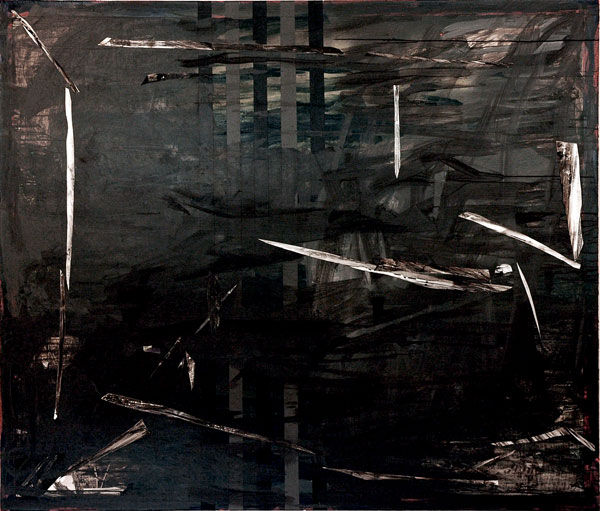
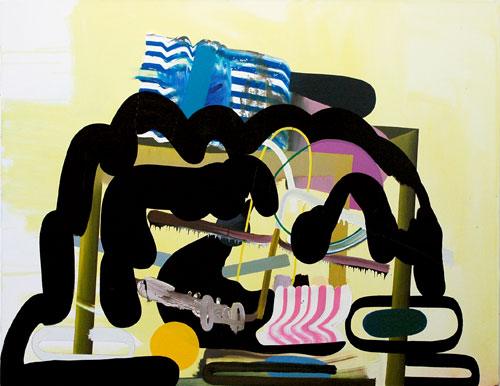
Joyce Kim One or Two Things 2008 acrylic and acrylic foil on canvas 72″ x 84″
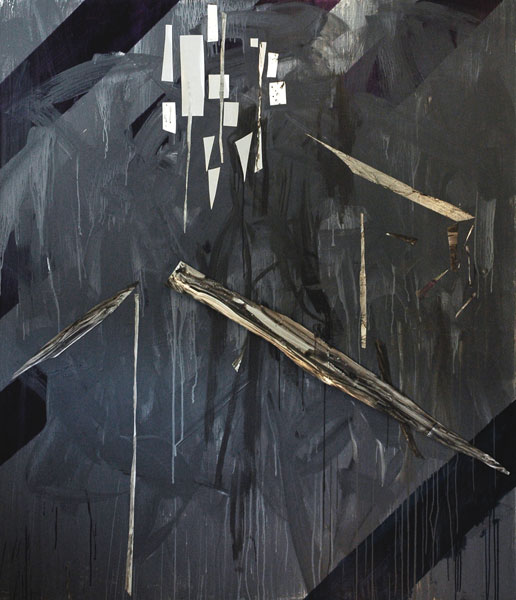
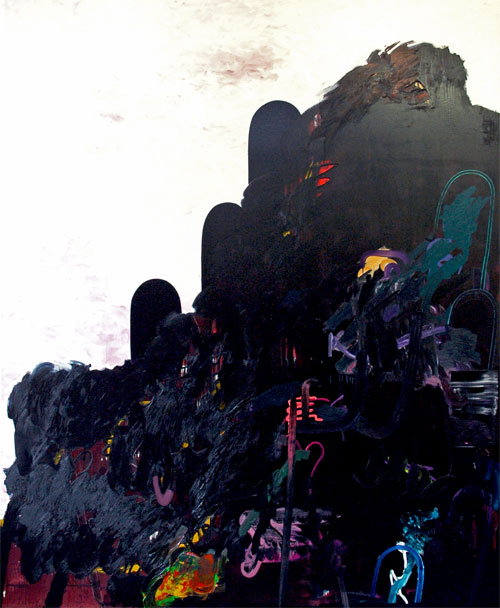
Joyce Kim Gently Strike on White 2008 acrylic and acrylic foil on canvas 84″ x 72″
Joyce Kim was showing some great paintings at the Marie Walsh Sharpe Foundation‘s Space Program open studios late last month. When Barry and I walked in we were surprised to get a partial preview of what I’m certain must be a very impressive show at Thierry Goldberg. We haven’t yet visited it, but I’d have already made it a must just to see Jonathan Hartshorn‘s contribution.
I’m shocked that these two images reveal so much. The camera seems to want to show us everything at once. While I was actually in the space most of the detail you see here wasn’t immediately apparent, in spite of the fact that these canvases were hanging in a south-facing room with strong natural afternoon light. Sometimes I can’t say it enough: If you can, go see these pieces yourself. Let them reveal their subtleties at their own speed.
Category: Culture
Bob Rauschenberg
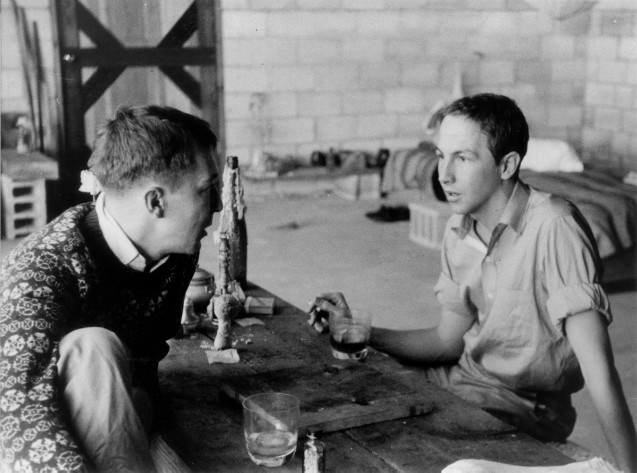
Jasper Johns and Robert Rauschenberg (1954)
Hot.
I couldn’t think of anything I might be able to add to the encomiums which have followed Monday’s announcement of the death of Robert Rauschenberg. Then this morning I saw and read the NYTimes obituary in the print edition. While growing up, and even for many years later, I remember seeing pictures of a beautiful young man whose work was more than capable of shaking up a post-war art world already conditioned to, maybe even bored by change. the Times, like too many other media sources in the last few days, showed us only pictures of an older artist, and many photographs I’ve been seeing portrayed a Rauschenberg weakened and partially paralyzed by a stroke.
Although he remained handsome and productive all his life, it was in the early years of his career that he produced most of the innovations for which he is now known and revered. I thought that we should all be able to see now what the strong, vital artist who changed so much of the world we inhabit today looked like while the revolution was underway. He was once very young and almost painfully beautiful, but he was never old.
The photograph here is of the artist relaxing in a studio with Jasper Johns. It was taken probably in the late 50s, the period in which they lived together downtown in various lofts around Coenties Slip and Pearl Street (the neighborhood of my own first New York home 25 years later). It’s interesting, although not surprising, that in his long obituary for Rauschenberg published in today’s Times print edition Michael Kimmelman describes their personal ties in “genteel” terms more familiar to readers of fifty years ago than to us today:
The intimacy of their relationship over the next years, a consuming subject for later biographers and historians, coincided with the production by the two of them of some of the most groundbreaking works of postwar art.
For a little more candor, see Jonathan Katz.
Related:
Rauschenberg
“bobrauschenbergamerica” in tears
Paul Lee at Audiello
Lawrence Weiner at Pocket Utopia
UPDATE: Shortly after I did this post I found this wonderful early image on Newsday‘s site:
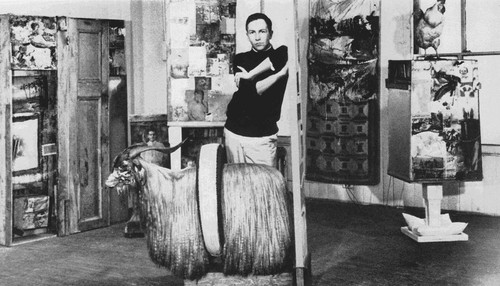
Robert Rauschenberg in his New York studio in 1958
[top image, a photograph by Rachel Rosenthal, from mettaartlove; added image from Newsday]
Eric Sall at LMCC Open Studios
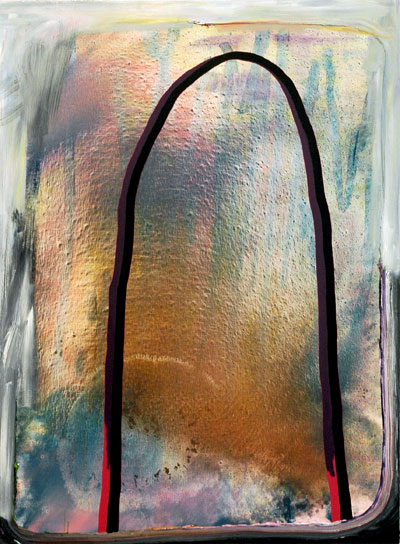
Eric Sall’s solo show of paintings at ATM Gallery closed a few days ago. Barry reported that he really liked them, when he returned from a visit to the gallery on which I couldn’t accompany him. The day I went over to 27th Street by myself I had to come home unexpectedly early and didn’t get to the show. Then unfortunately I never made it back, but having since seen what Sall was showing inside his space at LMCC open studios two weeks ago I know what Barry was talking about.
The paintings are dazzling, and being able to talk to the artist in his studio, almost in the midst of his process, may have made up for what I had missed earlier. I hope I’m sharing at least some of their beauty by being able to broadcast these images from this site.
The relative sizes of these three works are, in the order they are shown, medium, rather large and pretty small.
not my voice
After a night’s sleep and especially after reading this morning what others who have read my post of yesterday are saying about the subject of artistic censorship and our relationship to the world, I realized that what I wrote just wasn’t really in my voice. Although I suppose not everyone would agree, I think I was way too concerned with being gentle to everyone and everything: Uncharacteristically, I didn’t make my own position clear on issues about which I have very strong opinions.
While this next section looks like a partial creed, maybe I should just call it a small glossary, even if it won’t be arranged alphabetically.
GOVERNMENT: [okay, I know the word is missing from yesterday’s post, but that’s part of what I mean] I abhor everything the current administration in Washington stands for. I also believe that its enablers in the other two branches of government share equal responsibility for its domestic and foreign crimes, and that the corrupted system which has brought us to this juncture is an abomination we may not survive.
CENSORSHIP: I believe that censorship is a substitution for thought, and is its mortal enemy.
CHILDREN: I argue that children should be educated and protected through the active engagement of all adults, and not by a passive, dumb curriculum of barricades or screens.
LBIF: I am aware that simple-minded, do-good arts organizations can sometimes do as much harm as they do good. Sorry.
FOUNDATION FOR CONTEMPORARY ARTS: I probably couldn’t say enough about the good they do.
TRANSFORMATION: I regret that when it comes to the public presentation of their work artists are not always free to determine either its site or the manner in which is presented.
SUSAN DESSEL’S SCULPTURE: I affirm that the artist Susan Dessel has a great mind and a soul which is its equal, and that her work, “OUR BACKYARD: A Cautionary Tale”, is a powerful human statement and an exceptional work of art (even if I still can’t decide whether it might suffer or thrive from the remarkable gentleness of the title attached to it by its gentle creator).
I am angry, yes, but especially after reading reactions to this story from other bloggers and those who write comments, I am also optimistic about the future of art, perhaps even socially-engaged art.
I mourn the fact that this country has virtually no use for artists and thinkers, so I’m still gravely pessimistic about the future of our polity.
Susan Dessel’s “OUR BACKYARD” censored by gallery
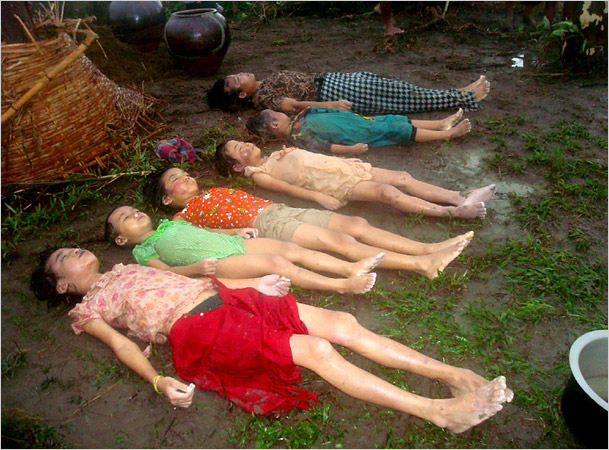
this too is our backyard
In the twenty-first century the entire world really has become our “backyard” and along with its beauty and energy, there is also much unnecessary misery and death everywhere in that yard. Provincial fears and mindless censorship cannot reconstruct fences around the familiar, confined spaces which now open onto a much larger world, nor can they make the misery and death go away.
Susan Dessel’s sculpture, “OUR BACKYARD: A Cautionary Tale” has been censored by its current host, the Long Beach Island Foundation for Arts & Sciences [LBIF]. She had been invited to participate in its current Artist Residency and Retreat Exhibition, titled “ART CONCEIVED SINCE SEPTEMBER 11”. Support from the Foundation for Contemporary Arts (NYC) made Dessel’s participation in this exhibit possible. On the eve of the show’s May 3rd opening LBIF Interim Executive Director Chris Seiz told the artist that he had been advised by some LBIF members that they found the piece offensive and were considering ending their support of foundation. In the hours prior to the opening Dessel’s installation was walled off from the rest of the gallery. Visitors who now wish to see the concealed work must first step across signage warning that them that the piece may upset or offend.
The artist has released a statement:
“OUR BACKYARD: A Cautionary Tale” was an opportunity for me to re-imagine the world as I understand it: our shared backyard. Despite the expression of dispiriting conditions found in my work, underlying it is a robust sense of hope that it might encourage viewers to consider their own role in transforming the community – local and global – through their actions and inaction.
Dessel describes LIBFs transformation of the piece as having turned the artist’s fundamental intention on its head, since it now represents our containment and continual isolation from the outside world.
This profoundly moving large-scale work was first seen at a show Barry and I curated at Williamsburg’s Dam, Stuhltrager Gallery in September, 2006. It was a site-specific installation which the artist described as a response to wide-spread images of violent death in many parts of the world. The work has been fundamentally altered with the decision to wall it in during the current show in New Jersey. Dessel sees the LIBF’s restriction of her expression as an artist as raising the new and separate issue of the role we permit art in our society generally.
It 2006 was installed in the “backyard” of the gallery in Brooklyn. There were no warnings posted, and it managed to attract more positive attention from visitors and press (both old and new media) than any other work in the group show.
The picture at the top of this entry was taken only a few days ago. It is not an image of a sculpture. Nor were any of the other horrific news images we have seen in our lifetimes from New Orleans, Jonestown, Haiti, and Cambodia, from Lebanon, Israel and Palestine, from Sarajevo, Darfur, Argentina, Sudan and Rwanda, and of course from Afghanistan and Iraq. Dessel’s “OUR BACKYARD” addresses our response to all of these tragedies and too many more, perhaps with the hope that if it helps us to engage in their reality with a shared humanity the world might do a little better going forward. I cannot begin to understand how people accustomed to viewing the horrors presented on what passes for ordinary entertainment on large and small screens today could possibly be upset or offended by twelve carefully-assembled shapes wrapped in sandbag tarp and lying on fresh sod.
I’d like to think we could do better, but the kind of censorship being exercised by a gallery in southern New Jersey this month is hardly unique even in the art world, and it’s certainly of a piece with the bowdlerization which has been standard media practice in this country for decades. It’s no wonder we continue to do so little to help prevent or ameliorate, and in fact contribute so much ourselves to creating, the catastrophes which litter our global backyard.
The Long Beach Island Foundation for Arts & Sciences is celebrating its sixtieth anniversary. I can’t know the motives behind its censorship of Susan Dessel’s art, but it’s unfortunate that so many of us will have first come to know the LBIF not for patronage of arts or science but for institutional behavior not worthy of an amateur craft club in Colorado Springs, and at this juncture that analogy may do a disservice to the city popularly considered the most radically “conservative” in the nation.
The images which appear below show Dessel’s installation before the curtained wall was in place, after it was installed, the sign at the entrance to the curtain baffle, and finally what it looked like inside the enclosure.
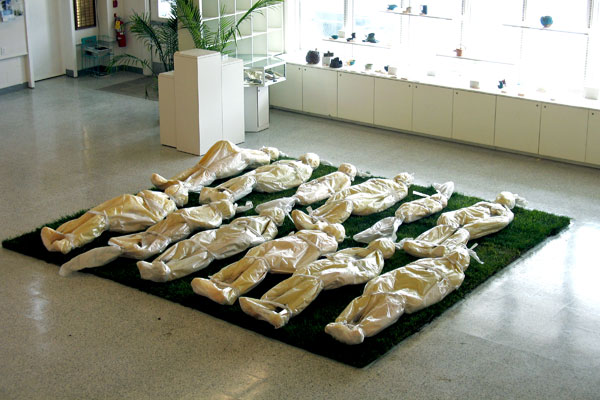
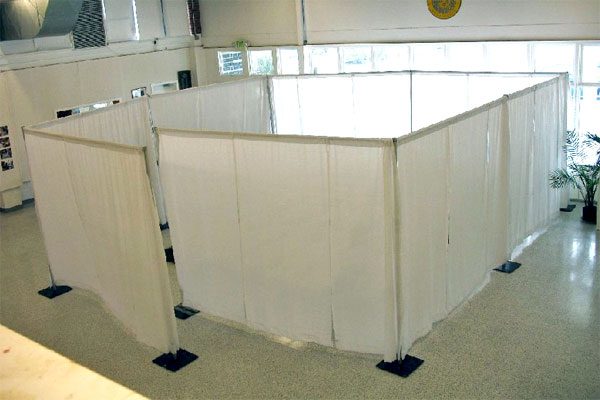
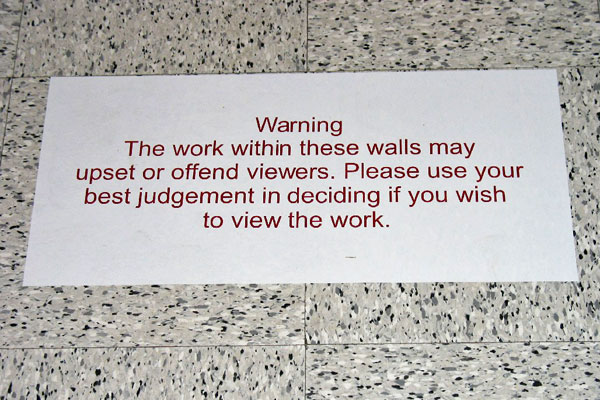
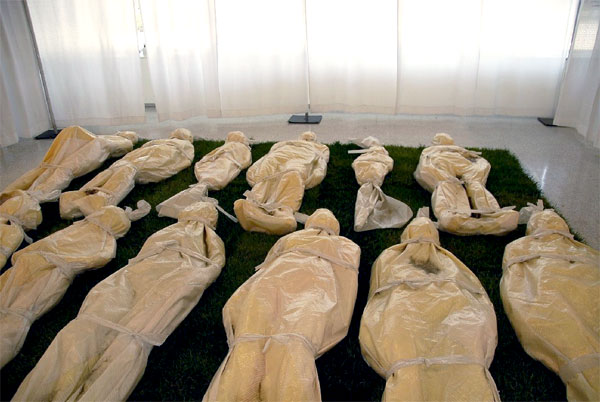
[Burma image from European Pressphoto Agency via NYTimes; remaining images courtesy of the artist]
further nuttiness at 303 Gallery
all eyes
In spite of the power of my day-to-day fancies, sometimes I’m reminded that the art world is not all sweetness and light, especially when power or money is involved. There are definitely some real Grinches out there, but I’d like to hope that eventually they’ll all sled back to Whoville.
I’m talking about people behind this business of camera bans. I’ve been arguing and demonstrating against photo prohibitions on this blog and elsewhere for years. I think I’ve seen and heard just about everything on the subject, but I’m finding it incredibly difficult to stomach the latest photo-ban nuttiness coming from 303 Gallery. On Wednesday Barry received an email from artist/blogger Mark Barry which included an email Mark had received from someone at 303 asking him to remove from his Flickr set two images he had taken of work by one of the artists the gallery represents in New York. The two-year-old photos were taken during the press preview for the 2006 Armory show. Barry posted this item on Bloggy yesterday. Today it’s all over the art blog world and the comments are still coming.
There are some terrific arguments in defense of the right to the non-intrusive use of cameras in galleries and museums, but my favorite to this moment is the one which comes closest to my personal understanding of what I and many others are doing when we use cameras in these places. Juana B. Riquena made this comment this morning on C-Monster’s post:
When I go into a gallery, I want my readers to see what I see. That�s why I�m writing my blog. If it were just a matter of J-pegs, I could write �Thomas Nozkowski, Pace Wildenstein Gallery,� and provide a link.
Also, shooting a show is part of the thinking process. I�m connecting the dots visually and verbally. I want to be able to get up close for a detail or shoot two paintings that are in a particularly interesting visual conversation.
Journalists and bloggers work in different ways. When I worked as a paid journalist, I had the luxury of planning a day�s worth of gallery visits, calling from my office, and then going to the galleries. As an unpaid (but no less serious) blogger, I don�t have that luxury. I�m a working artist who fits in visits to the galleries. I don�t have an assistant or a secretary. I do it all myself.
I do understand and appreciate a gallery�s need to protect its artists and images, but bloggers�whose reach is far greater than the average print journalist, if only because the posts remain viable in the blogosphere pretty much forever�offer far greater long-term coverage. The art fairs recognize this and issue press passes to bloggers. Some of the galleries understand and permit pictures. I�m at the point where if I can�t get permission to shoot, I�m not reporting on the event.
I would like to go beyond galleries and museums and assert here that were it possible for me to capture photographs of live concerts and performances without either audience or performers being distracted (and without interfering with my own experience of the work) I would do it in an instant and the best images would appear on this site. In the meantime, if this blog continues to concern itself (beyond the occasional perfervid political distraction) almost exclusively with the visual arts, to the relative neglect of everything else I cherish, meaning work from emerging artists in theatre, music, dance and performance, it’s because on this picture screen it’s the visual arts and only the visual arts that I can represent visually.
“I want my readers to see what I see.”
*
303 Gallery was already on the list of galleries Barry and I maintain which prohibit photography. We will not announce or review shows which these galleries host on either our blogs or on ArtCal.
[image from freemasonry.bcy.ca]
Disarmory
attendant
art dealer
Disarmory art fair, the child of the dBfoundation, “dedicated to creating and fostering ephemeral edifices and intangible structures”, had the potential for being the most fun (and genially provocative) experience of the entire New York art fair week this past March. The all-weekend party/exhibition was inspired by the original Armory Show, installed inside the 69th Regiment Armory building in New York City in 1913, for which the huge, annual New York fair, “The Armory Show” (now ten years old) was named.
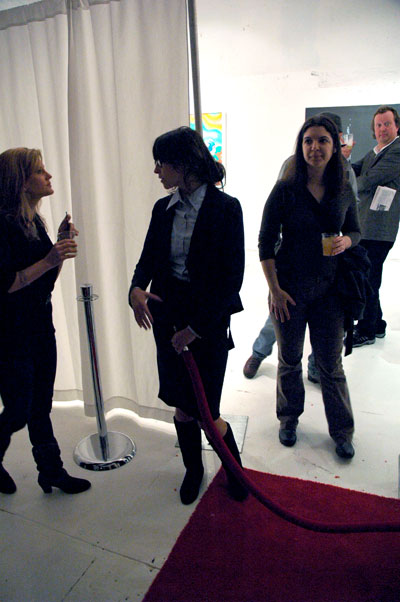
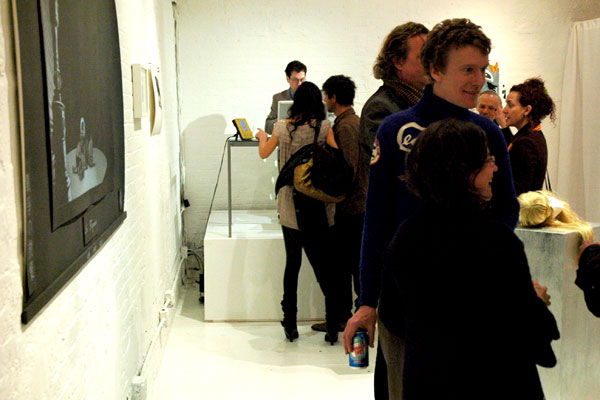
A number of events teasing the arts and political establishment were scheduled both on and off premises during the three days in which Disarmory was installed at the venue on Mulberry Street (there was even a handsome, zesty newspaper) but Barry and I could only visit it on one evening. We did manage a thorough tour of the heart of the show, an curtained installation of work by ten contemporary artists, each of whom was inspired by one particular early 20th-century antecedent exhibited in the original Armory. We were eventually able to access the gallery precinct itself, overcoming the faux-barrier presented by the classic haughty guardian of the velvet ropes. Inside we spotted another poseur, a faux-diffident, conservatively-suited, make-believe “art dealer” (in fact the righteous artist Dan Levenson) perched on an elevated platform.
Meanwhile, much further uptown the fair which began in 1994 inside the slightly tatty guest rooms of the old Grammercy Park Hotel, and then moved to the historic site of the 1913 show, where it picked up its current name, sat fat and prosperous in its current incarnation on the Hudson River piers which hosted transatlantic luxury liners through much of the century which followed America’s legendary introduction to modern art. During the art trade shows of this past March only Disarmory seemed to remember the party which started it all.
The artists we saw “disarming” early 20th-century monuments were Aaisha, Joan Banach, Madeline Djerejian, Jacob Dyrenforth, Peter Gerakaris, Sarah Oppenheimer, Tom Russotti, Aaron Sinift, Suzanne Treister and Treva Wurmfeld.
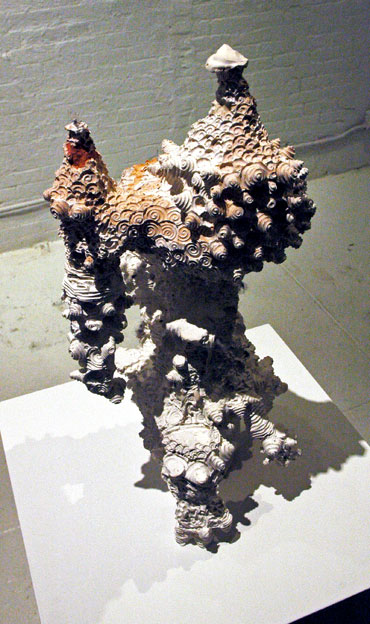
Aaron Sinift revisits George Duchamp’s “Nude Descending a Staircase”
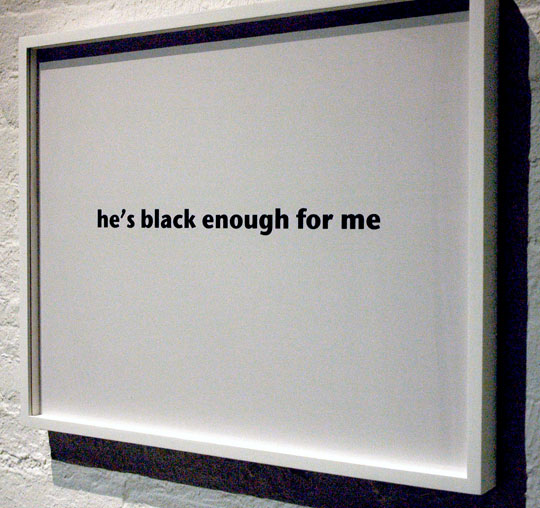
Madeline Djerejian addresses Renoir’s “Algerian Girl”
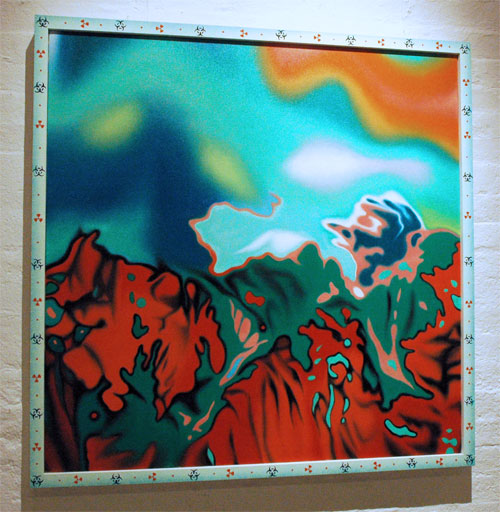
Peter Gerarkis’s impression of impressionist Allen Tucker’s “Mount Aberdeen”
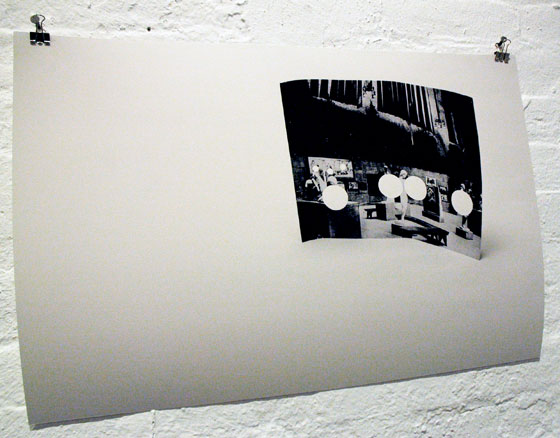
Sarah Oppenheimer’s work disarms the modernist statuary in a photograph of the original Armory show installation
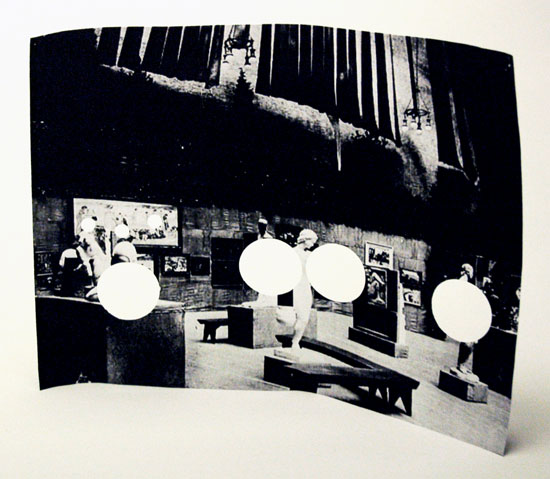
[detail]
Beka Goedde with Glowlab at Bridge
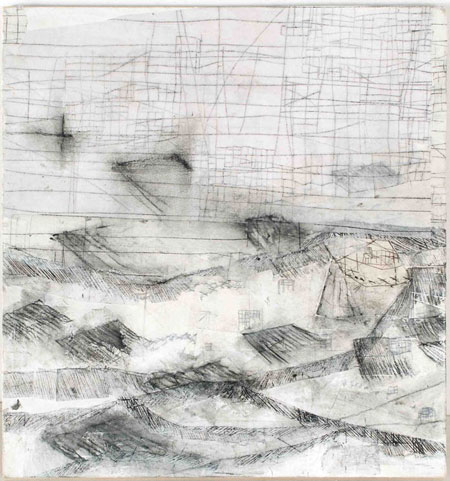
Beka Goedde Replacement (study) 2008 etching, pencil on panel 10″ x 9.5″
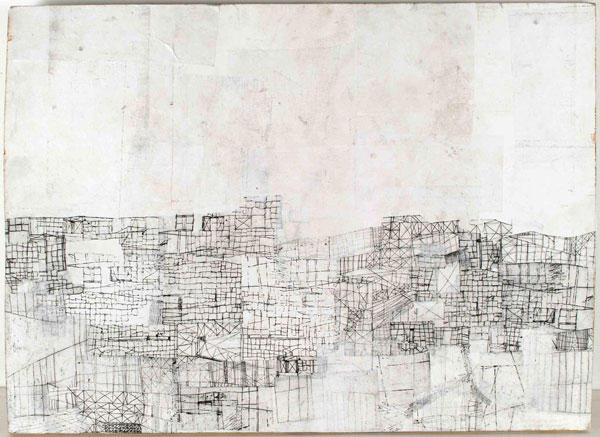
Beka Goedde Resettle (study) 2008 etching on panel 18″ x 13″
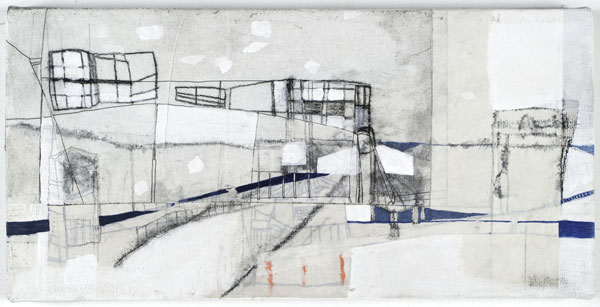
Beka Goedde Watershed collection 2007 paper and pencil on canvas 6″ x 12″
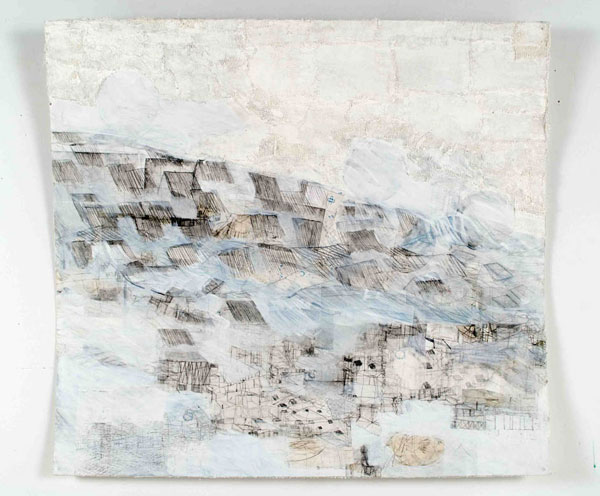
Beka Goedde For the destruction of successive suns 2007 plaster gauze, etching,
pencil, gouache on panel 28.5″ x 31.5″
Thinking they looked just as mysterious and almost as tactile as cuneform texts on stone and still as delicate as the lines of an early Chinese landscape scroll, a collection of Beka Goedde‘s stunning etchings pulled me into Glowlab’s space at the Bridge Art Fair last month.
I had already made this allusion to texture or touch, first in my mind then and just now in the rough draft of this entry, before I actually took a look at the gallery site. There I read that as an undergraduate at Columbia Goedde had concentrated on Behavioral Neuroscience and Philosophy. The note further explains:
Her thesis work focused on the sense of touch, specifically a non-dualist way of conceiving of the space of ones body and the space surrounding oneself, on both a phenomenal and neurophysiological level.
Wherever it comes from, the work is really beautiful, and it just keeps on going on, in space and, it seems, even in time.
Some of the drawings are very small, but these are no less complex or seductive than the larger pieces; in fact they seem even more so. I like the more abstract pieces, and that’s what I’m showing above, but abstraction here seems to be no more than a light gloss; these elegant etchings feel barely any remove from whatever material things may have inspired them – or not.
There are more images here on the gallery site.
[images from Glowlab]
Ena Swansea with Andre Schlechtriem at Volta
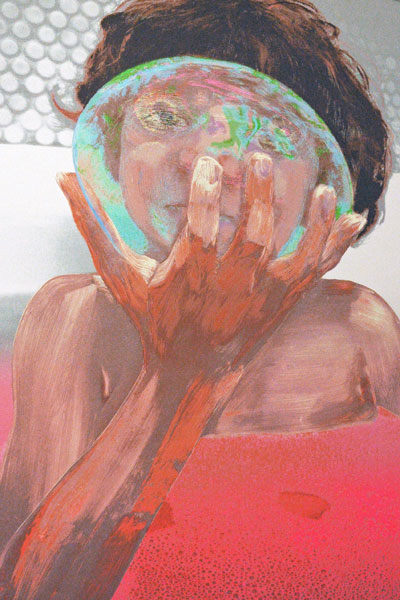
Ena Swansea One 2007 color serigraph 39.5″ x 29.5″ [large detail]
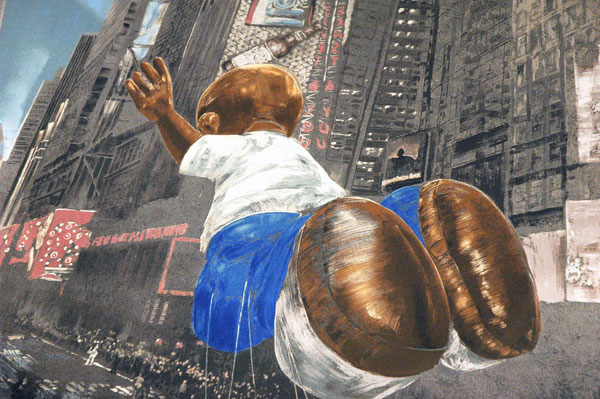
Ena Swansea Three 2007 color serigraph 29.5″ x 39.5″ [large detail]
Andre Schlechtriem showed some beautiful work by Ena Swansea at Volta. The oil and graphite paintings were very beautiful, but I think I was even more excited about the large-scale serigraph print portfolio, “4 Seasons”.
Because of light problems inside the space at the fair I don’t have a decent image of my own documenting any painting from the show. All of this gorgeous stuff has to be seen in person to be properly appreciated, but still I wanted to show a painting here too so I looked on line for a good copy of a work I found particularly interesting. Swansea’s mammoth study, “Theory of Relativity”, fills the bill very nicely, even if it is from a few years back and wasn’t at Volta.
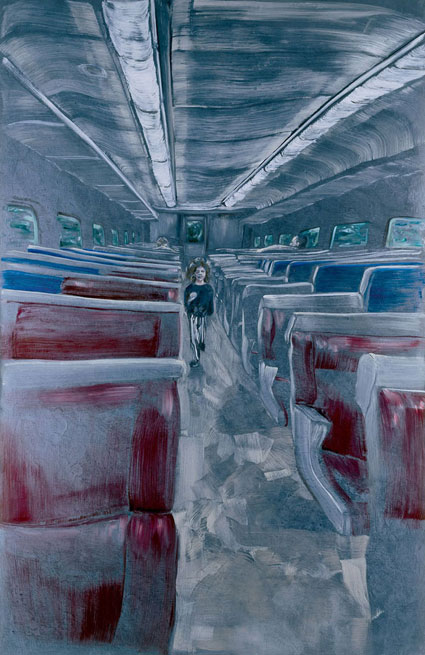
Ena Swansea Theory of Relativity 2004 oil and graphite on linen 120″ x 98″
[third image from Saatchi]
Adrian Williams with Voges + Partner at Volta
Adrian Williams ALBATROSS ADO 2008 16mm celluloid silent film [large detail of video still from installation accompanied by performance]
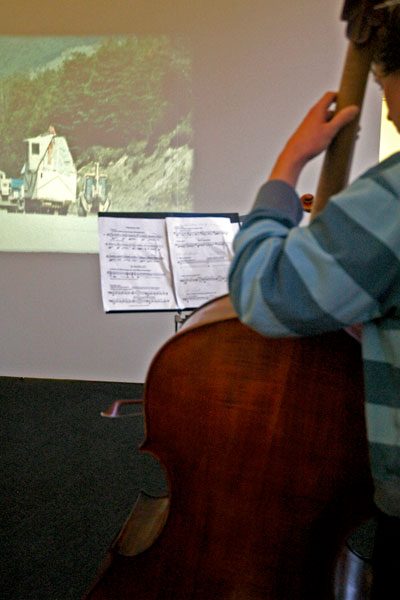
Rarely have I been so totally engaged in a work of art as I was with Adrian Williams‘s “Albatross ADO” shown by Voges + Partner at the Volta fair last month. And the materials were so simple: A film was projected in softly-faded colors onto a wall in a partitioned space otherwise empty except for some unattended string instruments. The ten-minute picture was shot during a visit Williams and an artist friend made to Patagonia in 2006. In it a small house is seen being carted through the town of Ushuaia as two men perched on the roof use a broomstick to lift cables and wires, clearing the way for the structure’s passage. There are a few spectators along the hilly route and two dog buddies make several appearances in the road. That’s it.
Of course no small part of the work’s impact was the fact that every hour on the hour the projection was accompanied by a small string ensemble of young musicians playing some very elegant atonal music in live performance.
The title of the musical piece was not provided. It may share a title with the visual element and I confess I don’t know whether they exist independently. The composer was Theodor Köhler and the performers were Christoph Klein and Alma Deller on violas, Friedmar Deller on string bass.
The effect I describe might be difficult to reproduce in a collector’s home (although what a wonderful thing to contemplate), or for that matter inside even a very well-endowed museum, perhaps demonstrating the artist’s lack of interest in art which ends up as a commodity, sometimes even in spite of itself. A look at the gallery site and at the small pamphlet I was able to take home on this very musical visual artist’s work would later confirm this impression. In addition I was pretty impressed that any gallery would present this ethereal performance inside a Midtown trade show, even if it was one of the more high-minded of the batch of fairs which arrived in New York this spring.
My Googling today taught me also that Williams may love birds as much as Barry and I do.
We stood or sat for two performances. There were a lot of young people crowded inside that space during both. Yay!
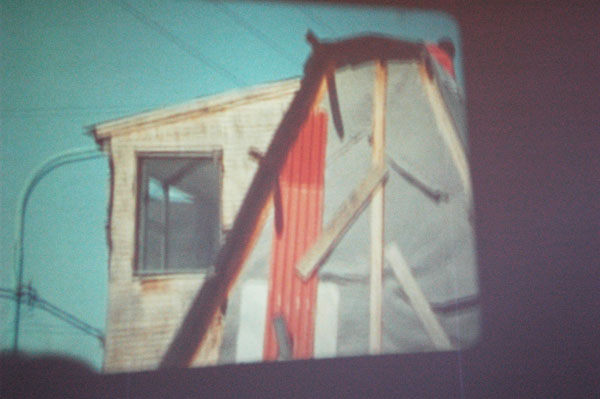
[large detail of video still from installation]