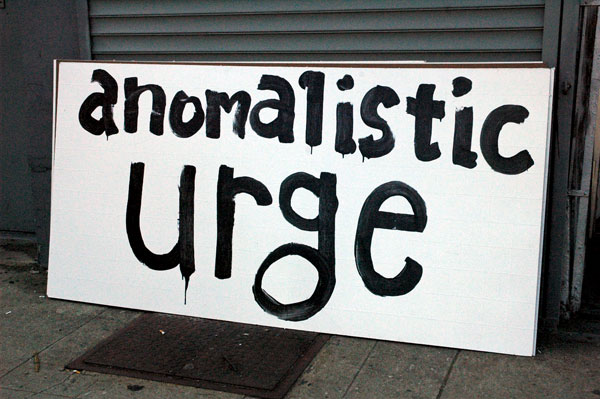
show sidewalk shingle
I wanted to get this post published before it was too late to send anyone to see this wonderful short-run (only ten-days) group show of sculpture in Williamsburg. Barry and I stopped in at Vaudeville Park last Sunday to see “Anomalistic Urge.” intrigued by the siren of a new space and a new curator. Some of the artists were very familiar to us; some of them were not (although maybe we should be embarrassed to admit that).
Courtney Tramposh, whose work we had not encountered before, gathered together gorgeous and exciting pieces by some 30 sculptors for this show. Tramposh is a sculptor herself and for this show she created the room environment as well as the unconventional but aesthetically sympathetic platforms on which the works are displayed. She describes the installation as “a tabletop sculpture show.” For a large group sculpture show, it’s contained within a fairly small space, but it all works. “Anomalistic Urge” is her first outing as a curator, and it’s a doozy.
Courtney was anxious to point out all of the other artists’s work, but never mentioned she had a piece of her own in the show. I thought we had already stayed past closing time, so unfortunately we didn’t quite see everything, and I didn’t snap an image of her own work (outside of its supporting roles).
The complete list of artists includes Justin Adian, Michael Berryhill, Shawn Bluechel, Strauss Borque-LaFrance, Sung Jin Choi, Tania Cross, Ben Dowell, Stacy Fisher, Jashin Friedrich, Joachim “YoYo” Friedrich, Gerald Giamportone, Susana Gaudencio, Hiroshi Tachibana, Rachel Higgins, James Hyde, Kristen Jensen, Michael Johnson, Tom Kotik, Denise, Kupferschmidt, Emily Noelle Lambert, Colin O’Con, Jonathan Peck, Courtney Puckett, Nathan See, Emma Spertus, Madeleine Stern, Jennifer Sullivan, Raphael Taylor, Courtney Tramposh, and Austin Willis.
Vaudeville Park is as much a (very interesting) music and performance space as anything else, and so we’re not surprised to hear that there will be a closing party and “sound performance” this Sunday, April 10, from 6 to 9 (not to mention some quirky contemporary classical music tonight, and “feral chamber music” on Saturday).
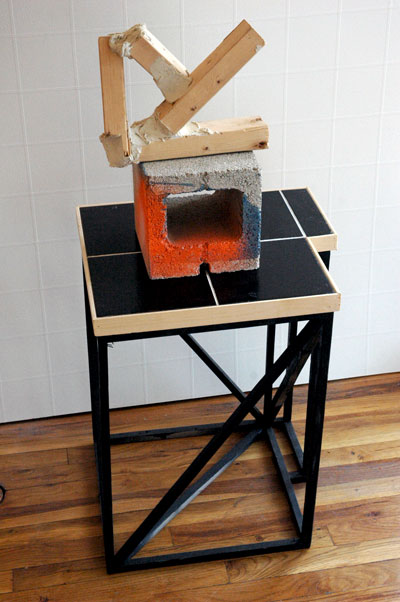
James Hyde OR 2008 Parex on wood 24″ x 12″ x 12″
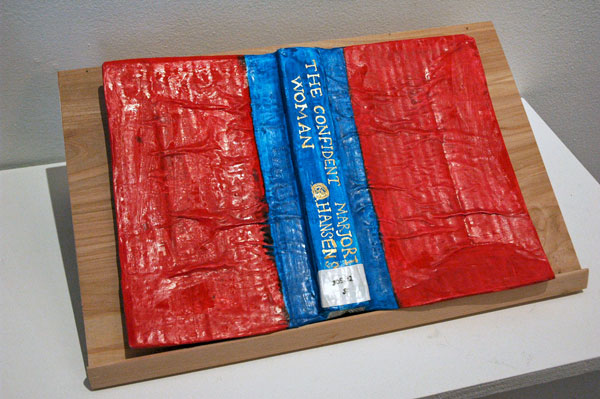
Jennifer Sullivan Borrowed Confidence 2008 gouache, ink, collage on cardboard 10″ x 16″
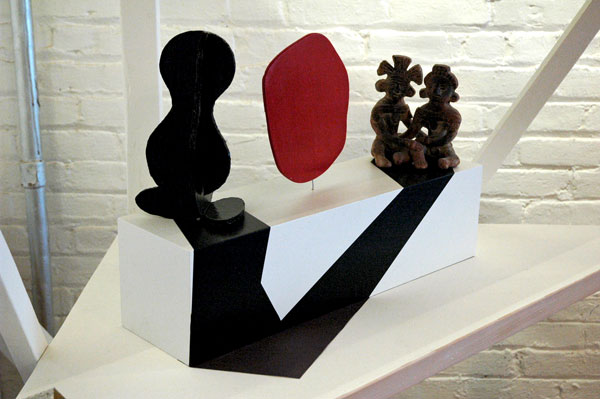
Nathan See The Triumph of Logic 2011 clay figurine, wood, cardboard, paint, paper
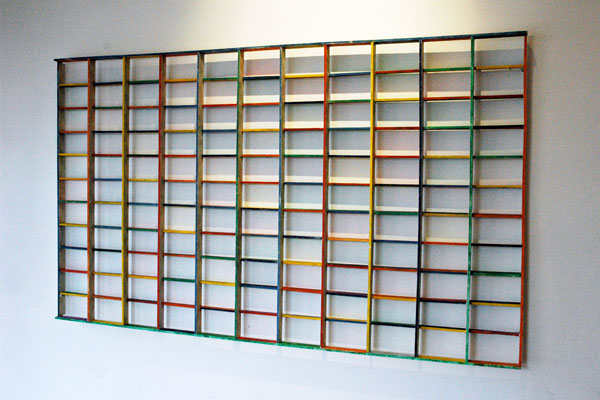
Joachim “YoYo” Friedrich Untitled 1976 oil on wood 2′ x 4′
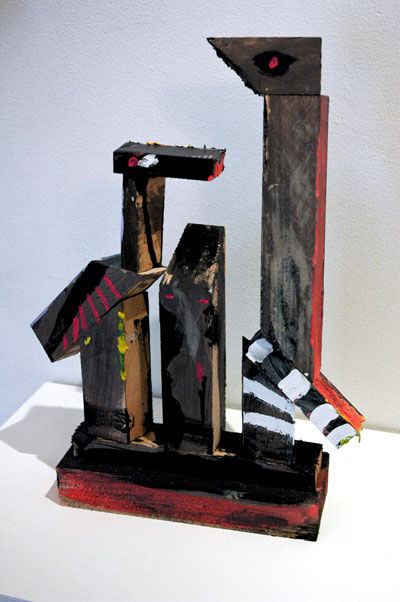
Emily Noelle Lambert Flock 2010 paint on wood
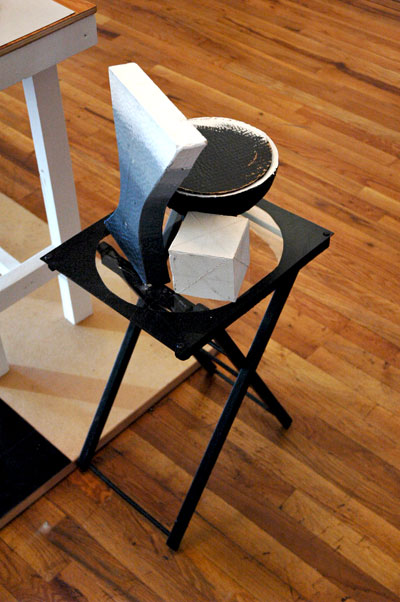
Denise Kupferschmidt Vase, Bowl, Block 2011 cement, plaster, paint, string, plexiglass, wood
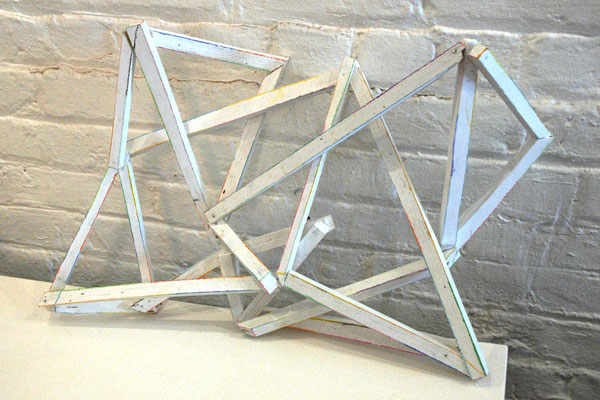
Hiroshi Tachibana untitled 2009 hand-cut plywood, latex paint and oil pastel 16″ x 24″ x 6″
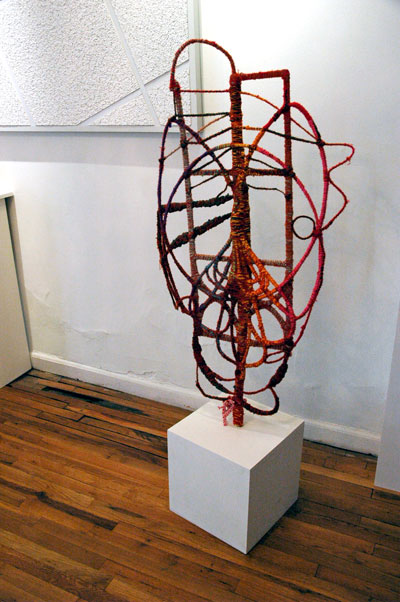
Courtney Puckett Bug 2010 wood, wire, string 5′ x 1′ x 1′ [with detail of Raphael Taylor’s “Designer 737 02/21/11 13:11, #1”]
Category: Culture
John Blee returns to DUMBO
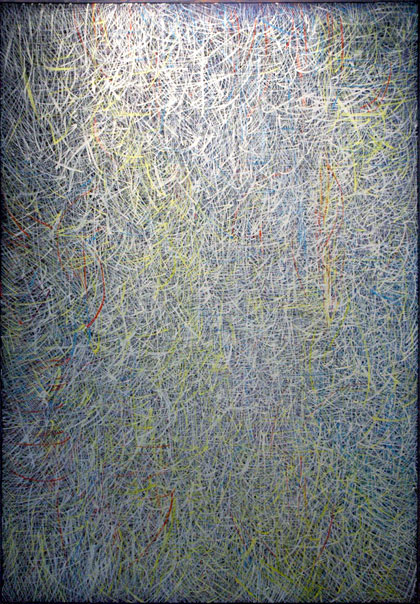
John Blee Jewel Return 1982 acrylic on canvas 48″ x 33″
I met our friend John Blee soon after I had moved to New York in 1985. I knew him first as a brilliant mind and an engaging conversationalist. I quickly found out that he was a painter and was relieved, and delighted, to learn that I really liked his work. It might not be too much of a stretch to attribute much of my ensuing engagement with the New York art world to our friendship in the 80s. John moved to D.C. years ago, much to my sorrow, but we never lost touch.
At the time we first knew each other he shared an incredibly vast unfinished loft with several truly tonic friends in what was just beginning to be referred to as “DUMBO” It faced Manhattan, and its windows overlooking what I used to call the “electricity factory,” where a transformer would occasionally act up, lighting the night sky. Of course it made me think of the paintings.
John is still in Washington, but he’s having a show this weekend in DUMBO, in the gorgeous apartment (with incredible views) of Norma Jean Markus. It’s a return of sorts to the neighborhood which gave birth to so many beautiful canvases, even if the neighborhood itself has changed dramatically. For one thing, a visitor from Manhattan will no longer be the only one on the street after the end of the day shift.
Event Details:
Reception: Sat., March 12, 4 – 7 pm and Sun., March 13, 1 – 4 pm
Location: 70 Washington Street #12G, DUMBO, Brooklyn
To visit by appointment: Contact Norma Jean Markus at 917.446.7234
As Barry writes on Bloggy, many visitors to our apartment have admired the two paintings we have of John’s. The larger one was actually one of the first works of art I had bought for the apartment. In Brooklyn this weekend you can see a range of his work from the 1980s to the present.
Related blog post: Art Wrap.
Below is an essay by writer and art critic David Matlock on John’s work.
John Blee in DUMBO
As the 100th anniversary of Kandinsky’ s breakthrough approaches, it is fair to ask: what
has been achieved? Are abstract paintings today repeating what has already been said–
and with each repetition, fading in strength? Or do they have something new to say, both
from a technical standpoint and in terms of meaning?
At the beginning, abstraction exploded. Kandinsky himself tried to consolidate a more
controlled language and connoisseurs still argue about his degree of success. When the
Abstract Expressionists adopted the language on a larger scale, canvases exploded again
in shamanic frenzy. Success was hit or miss, all too dependent on possession.
John Blee’ s first mature paintings, dating from the early 1970s, were also shamanic,
painted on the floor, and dependent on force and a possessed dancing. In a career of 40
years, the man has achieved total control over paint and, more importantly, now owns
his meditative inscape. He owns the land that earlier painters had to burst into by force.
His paintings are deliberate acts of self-intoxication. (It is worth noting, that although he
came of age in the 1960s, he has always disdained the use of recreational drugs.) The
Hindu and Buddhist art he experienced as a child and adolescent in India were formative;
as was the medieval sculpture in the caves of Ajanta and Ellora; and the work of Indian
modernists in the National Museum. Blee responds to Asian art as an insider–someone
who was shaped by the culture before he received his American inheritance.
The paintings on display are easy to enjoy but difficult to understand. From a technical
standpoint, the rendering of space is unique. There is nothing arbitrary or ” atmospheric”
about the backgrounds–they are architectonic–that is, they create a definite space in
which ” painterly event” unfolds. It is easy to take pleasure in the paint–casual admirers
often remark, ” What a painterly painter! What a colorist!” without suspecting the hidden
narrative. I strongly suspect the hieratic ” Sphinx” (2009) is one of Blee’ s dogs, posing
nobly on the grass–the humorous title a reference to the difficulty of knowing what the
animal is really thinking. These paintings are truthful because they begin from within
and encompass the outside world in an ecstatic veil of paint. Earlier abstract painters
discovered a new continent; John Blee is traveling inland and is providing a faithful
record of what he finds.
John Blee studied with Helen Frankenthaler, Robert Moskowitz, and Robert Motherwell.
His paintings have been shown in Paris, Moscow, Boston, Washington DC, and New
York City (including the Andre Emmerich Gallery). His work is in the Museum of
Modern Art and the Los Angeles County Museum.
He currently living in Washington DC.
– David Matlock
Reproducing the subtleties of a painting is always a challenge, one which can never be met fully, but I hope John won’t be too unhappy with shot at this wonderful painting. I photographed it with an available (overhead) light while it was hanging on the wall of the Brooklyn apartment where it can be seen this weekend. It also appears here on the artist’s own site, more evenly lit, but on a smaller scale.
Armory Arts Week 2011, a few personal impressions
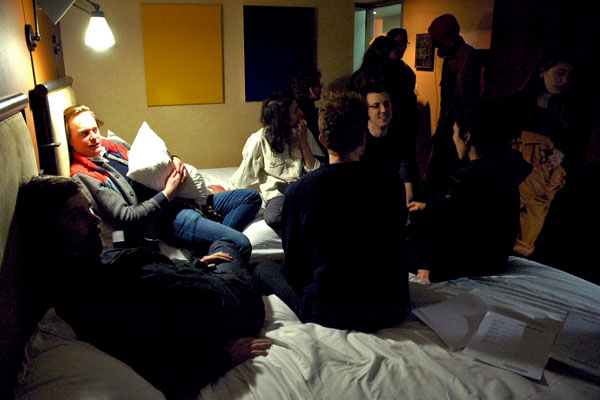
The Dependent, where boundaries blurred (here the New York Fine Arts room)
I’ve found my art fair. “Armory Arts Week” worked this year: Institutions often don’t age any better than people, and maybe the secret of life for old art shows is in the spawning of the new.
The Armory Show itself was, well, armorial, although there were pockets of real humanity.
Independent, which was such a hit last year on its first outing, was definitely more cerebral than both the Armory itself and even its own first manifestation. But there was little eye candy or energy, and it felt surprisingly stiff and corporate. I’m certain many individual conceptual projects would open up if only I could hang around some more, but on a frustratingly-short weekend of compelling attractions there’s almost never enough time.
Speaking of candy, Daniel Reich hosted a modest, slightly roguish party inside his gallery on Friday afternoon. A salute to the 60s and the current gallery installation, Jack Early’s Ear Candy Machine, it included continuous live music performances. it will probably remain one of my personal highlights of the week, and only partly for its odd folksy character (and Daniel’s inimitable conversation).
The Dependent was the event I had most anticipated since I first heard about it, and I wasn’t disappointed. Last night the Gramercy Fair (The Gramercy International Contemporary Art Fair), the 1994 progenitor of the modern Armory Show, was resurrected for a few hours. This was no sterile reproduction however, but a brilliant, exciting original. On the basis of the magic created last night, may have already created its own legend. It was “let’s put on a show,” and the results were pretty compelling, beginning with the contagious enthusiasm of the crowds on both sides of the “proscenium,” and continuing through the marvelous blur of boundaries between art, environment, artists, viewers and listeners. The dozen or so exhibitors were given one hour to arrange their installations inside an equivalent number of smallish rooms (inside the Sheraton Hotel on West 25th Street) before the doors were opened at 4 pm. The show was supposed to end five hours later, but the crowds were still lined up outside when we left at nine o’clock.
The Armory Show 2011: a surprising warm ambiance
I tried resisting the lure, and I almost didn’t go to The Armory Show this year. So I think I was feeling a little grumpy in the first hour or so at the preview last night (it didn’t help that Barry had once again refused to make the trek with me).
My personal best experiences with the West Side piers will almost certainly remain history, as they involved embarking and debarking from great ocean liners – or just “cruising,” while today the most they can offer are trade shows.
I hate the getting to and the coming from when it comes to the the Armory Shows on these piers, and even being there is a strain. It’s a desert over there: Nowhere else in New York do I feel I have to bring supplies with along me or I might starve or die of thirst. It’s worse than the Chelsea gallery “neighborhood,” and that’s saying something. Because of the lines and the logistics, those piers are always barren of refreshments, even when the organizers claim to have made food and drink available. I couldn’t even find a water fountain last night. Four hours in I was saved, just in time, by Pommery, thanks to a friendly dealer.
My enthusiasm for some of the art which hundreds of handlers had arrayed on the far West Side above the Hudson gradually picked up after the first hour or so. I ended up seeing some good work, and I had a great time, but the big reward, for me, came when I arrived at the CANADA stall. I always look forward to visiting the gallery – and visiting with the art keepers themselves – but last night, in the midst of so much intensive marketing up and down those long aisles, their space felt more than ever like an oasis of sweetness and light.
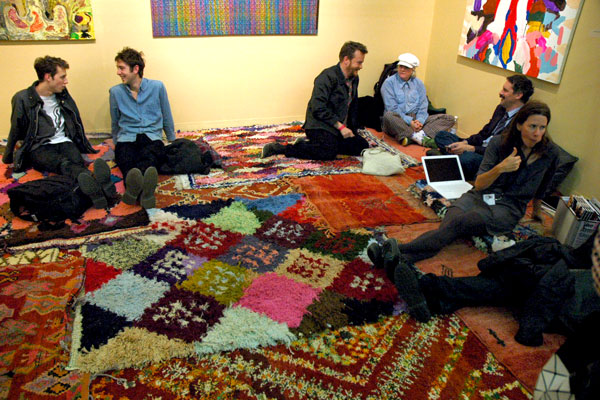
Of course Katherine Bernhardt‘s gorgeous thick Moroccan carpets helped, but they probably wouldn’t actually have been necessary to establish the ambience that was drawing visitors so easily. I think I was there for almost an hour.
The image at the top includes, from the left, lower portions of paintings by Michael Williams, Xylor Jane, and Katherine Bernhardt. The work hanging on those warm umber walls can be expected to change throughout the show.
IDIOM announces IDIOMbooks
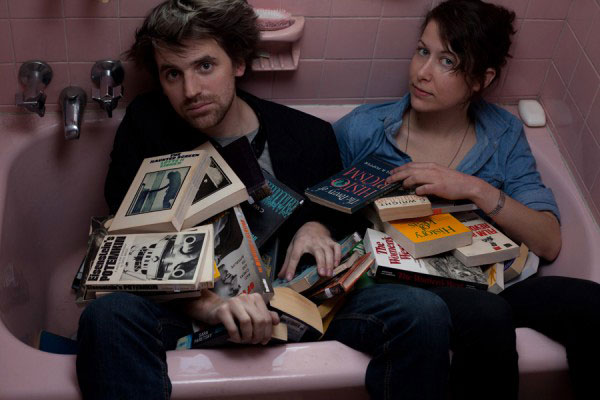
Stephen, Jessica, and friends
When I first saw this terrific image by Kristianna Smith I thought, “the only thing missing here is the cute puppy.” In fact however both the photo and this post are all about the books. IDIOM, which we describe as our online magazine of artistic and cultural practice, has just launched a book section, IDIOMbooks.
We’re very excited about it, not least because of our confidence in the folks you see conferring above. Stephen Squibb is the overall editor of IDIOM and Jessica Loudis will be editing IDIOMbooks.
We’re also announcing the appointment of Kristianna as Staff Photographer (Yay!), the redesign of IDIOM itself, and a lot of goodies in the form of new articles in both sections of the site.
[image by Kristianna Smith]
Duchamp haunts old White Box
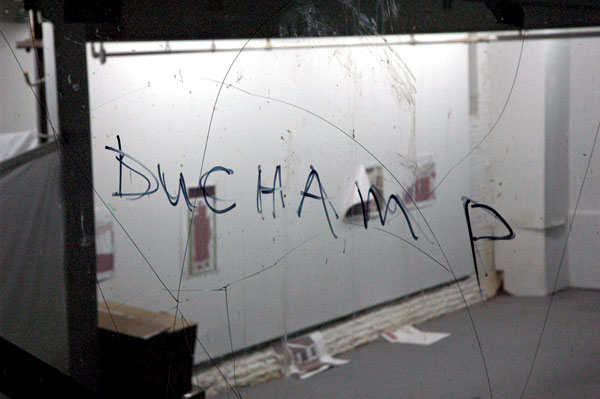
“Battle of the Brush,” encamped in Bryant Park
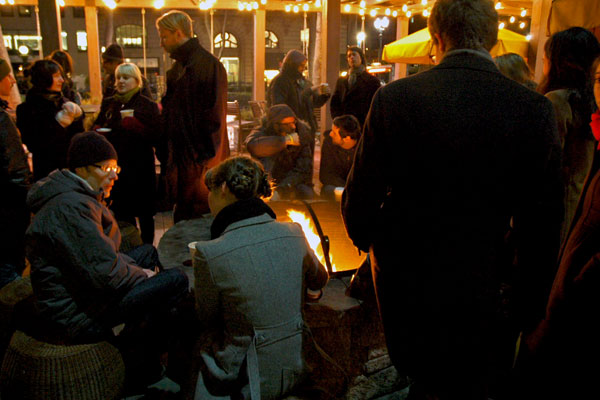
this is not a reenactment
It looks a bit like a hobo encampment, but the group huddled around the fire in the picture above is actually a part of the very jolly crowd attracted to the opening of “Battle of the Brush” in Bryant Park Thursday night. The occasion was one of the oddest openings of the year, to one of the most creative art shows of the year.
Great idea: Bring the art to the street (or at least the park); adapt an existing venue; and still end up with a clean, white space.
The work is on view in closed, retrofitted and climate-controlled vitrines (actually, two of the booths which had recently housed The Holiday Shops at Bryant Park). Visitors will be able to see the art, en plein-air, until February 2.
I suppose it could have been even colder on the “opening night,” but normally I don’t find myself standing still outside on a wintery night in January. I thought it was pretty frigid, especially after I had to remove my gloves to operate the camera.
The burning wood was a boon (boonfire?) however, as were the bottomless cups of hot chocolate proffered by the freezing ‘wichcraft folks. Incredibly, overhead heating lamps actually made it possible for some of the crowd to lounge about in the Adirondack chairs we normally associate with summer – or ski resorts.
The crowd was great. I had a ball.
I think the full title of this small painting show, organized by Alex Glauber‘s Corporate Art Solutions, is “Battle of the Brush: A Civil Reenactment of Two Painterly States.” The reference to “battle” is perhaps less than half-serious, but it pretends to describe a clash between current abstract and realist styles of painting. Located where it is, the exhibition draws upon Bryant Park’s history as an encampment for soldiers during the Civil War. Ironically, the eight paintings in the show, by eight painters, are installed in two enclosed kiosks , or “camps”, and are arranged across from each other on a terrace dominated by a fountain dedicated to the Progressive reform leader and adopted New Yorker, Josephine Shaw Lowell, who spent much of the Civil War nursing the wounded.
The participating artists include:
REALISM REGIMENT: Alison Blickle, Tom Sanford, Nicola Verlato, Eric White
ABSTRACT REGIMENT: Justin Adian, Anoka Faruqee, Patricia Treib, Roger White
Because of the unusual ambient light, the plexiglas reflections, and the cold, the two images below are less than ideal, even by my own modest standards. I argued with myself about whether I should include any picture at all, other than the one showing the huddled fanatics, but I decided to go for some art as well, since that’s what it’s all about.
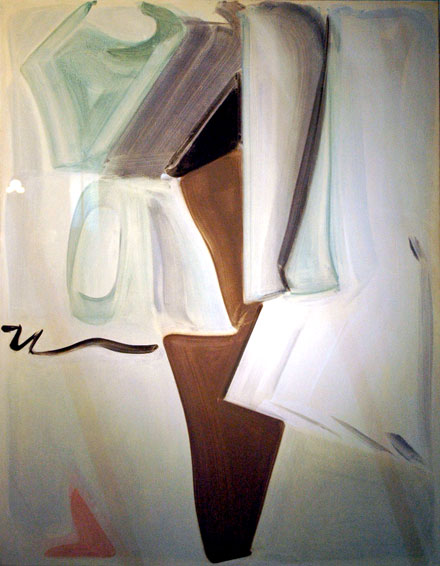
Patricia Treib Armless Sleeve 2010 oil on canvas 56″ x 50″
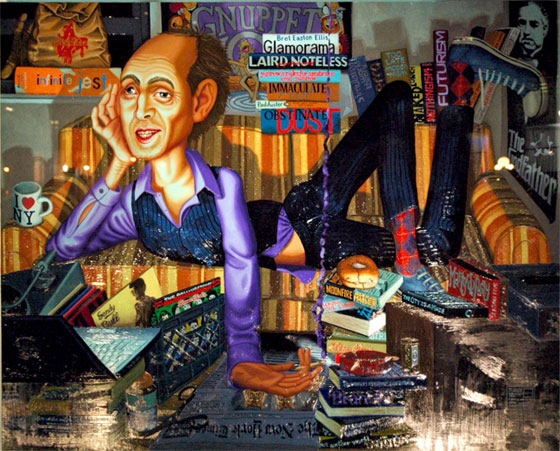
Tom Sanford Perkus Tooth 2010-2011 oil on wood panel
Greek tycoon rents Guggenheim Bilbao to show his stuff
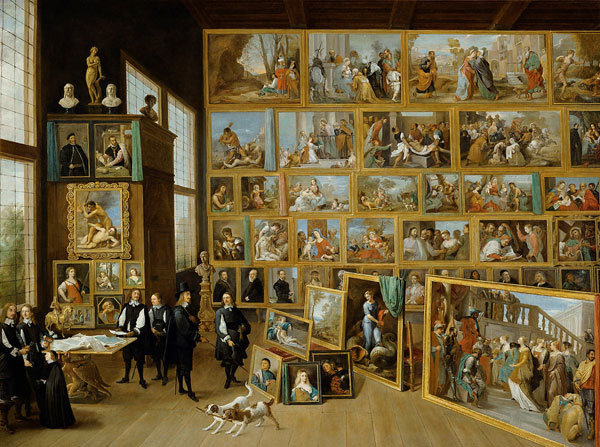
David Teniers the Younger Duke Leopold Wilhelm in his [own] gallery in Brussels (ca. 1651)
We’ve been through this thing before, and it doesn’t go down easier the second time: Another Greek tycoon has rented (at no charge) the museum of which he is a trustee, in order to showcase his expensive art hoard.
Fifteen months ago I was the first to complain about the New Museum’s judgment and ethics when it announced that it would be hosting “Skin Fruit”, a show of work owned by Dakis Joannou.
I don’t think I’m the first to complain this time*, since the news was reported by New York Times’ Carol Vogel (once again the messenger, as she was for NuMU’s plans) a week ago. That article reports the basic facts, that in the coming spring the Guggenheim Bilbao will be hosting “The Luminous Interval”, a show of work owned by Dimitris Daskalopoulos, Unlike the article she wrote in 2009, this one asks questions, or rather it appears that the museum itself anticipated questions, defending its decision and arranging for their friendly big-deal collector to be available for a statement.
I’m not satisfied with the answers. While there may be no law against it, the ethical problems are obvious: installing a private collection exhibition in a public museum is just wrong, unless ownership of the work has already been transferred to the museum.
Museum directors should know this.
I know I may sound like a scold, but when it comes to the art world I really don’t normally go out of my way to look for things to criticize. My experience of the last year or so has saddened me however, as I watch our museums making some very bad decisions. I’d rather be looking at art, or listening to or watching a performance, but it seems to me that museums are “acting up” (and not in the good way) a lot these days.
Maybe it’s because of the ubiquity and curiousity of the internet that so many ethical missteps are being exposed within institutions we really cherish. Perhaps we’re just more impatient with custom or superciliousness then we once were. It’s even possible we’ve given up believing we can influence government behavior and so look to our own neighborhoods, our own family. Whatever it is, it’s not easy to ignore these institutional failings, or the cant which tries to disguise them.
We have the right to expect better of the people who guard our heritage and our sacred spaces. Philip Kennicott, in his excellent Washington Post commentary on “Hide/Seek”, published yesterday, describes the extraordinary importance of the museum to people who do not worship in a church, temple, mosque, or forest:
“The museum has become a quasi-sacred space, with rules as complicated and inviolate as any church liturgy. People who don’t find the meaning of their existence in churches are often passionate about museums, where a set of fundamental values – openness, fearlessness, truthfulness – are celebrated with all the historical trappings.
ADDENDUM: Whoa! ARTINFO had the story two months ago. I’m sorry I missed both their scoop, and their complaint about how the Guggenheim stonewalled them:
When preparing the original scoop, “IN THE AIR” [an ARTINFO blog] contacted the Guggenheim for comment, which the museum declined to provide – relegating the news to “rumor” status despite multiple well-placed sources confirming the story, and the now-evident accuracy of its substance.
[image from Wikipedia]
thrown out of Gagosian for addressing Kiefer’s art
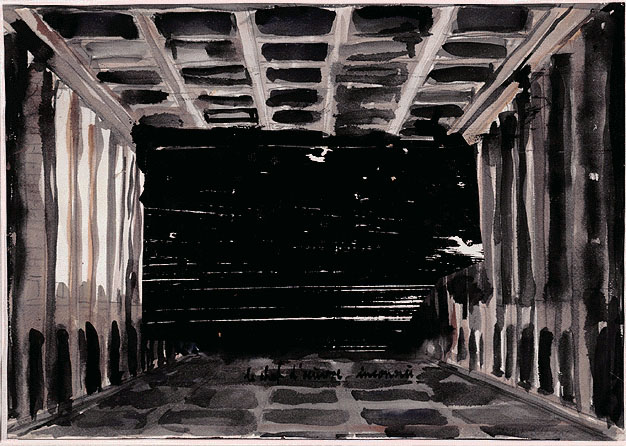
Anselm Kiefer le chef d’oeuvre inconnu (“unknown masterpiece”) 1982
“This is private property,” a gallerista in towering heels shot back. “We’re here to sell art.”
A small group of activists were thrown out of the Gagosian Gallery on West 24th Street this past Saturday on the final day of Anselm Kiefer‘s solo show, “Next Year in Jerusalem”. Claudia Roth Pierpont reports from the New Yorker’s online News Desk that a woman in her late fifties was swept up in the fracas which resulted when New York police officers called by the gallery arrived to evict the last four of the group (they had originally numbered eight). They had explained to gallery representatives that they had wished to participate in the conversation initiated by Kiefer’s work, and identified themselves as part of U.S. Boat to Gaza. Ingrid Homberg, who was visiting the exhibition independently, and who had tried to discuss it with the activists, was injured and fell when one of the officers dragged her out of the gallery.
It’s worth reading the Gagosian press release for the show, for the ironies provoked by Kiefer’s steely, overprotective New York gallery alone. The text includes these words, describing the central piece of the exhibition, “Next Year in Jerusalem”:
This imposing structure contains Kiefer’s provocative act, literally and imaginatively, to remind [us] of what has happened and what can still happen in the world. Occupations [the name of the piece, begun in 1969] is a visceral confrontation between history and the present that is lodged in the stuff of memory
.
ADDENDUM: The artist and writer Mira Schor has more information, and a wise, ruminative essay, “Anselm Kiefer@Larry Gagosian: Last Century in Berlin“, on her own blog.
[image (of a work not included in the Gagosian show) from Deutsche Bank]
Smithsonian/Wojnarowicz censorship protest, NYC
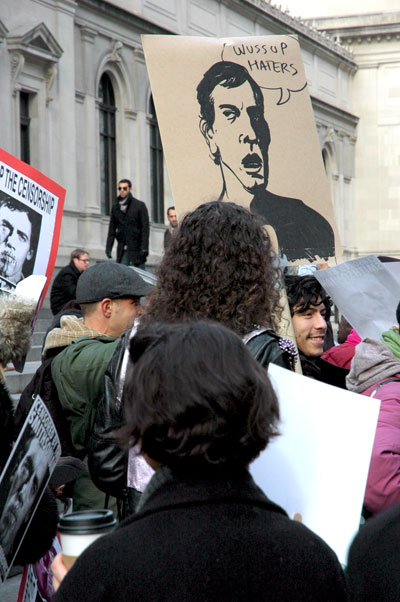
what would David think?
Sunday’s march up Museum Mile attracted around 400 to 500 people to the Smithsonian’s Cooper-Hewitt Museum to demand the return of David Wojnaroowicz’s video, “A Fire in My Belly,” to the National Portrait Gallery (NPG) exhibition, “Hide/Seek.”
I’ve uploaded here a few images from my experience of the rally; they are arranged in chronological sequence.
Committed artists, writers, thinkers and other citizens demand that the Smithsonian, which controls the NPG, restore the work so the public can see the exhibition as the curators intended. G. Wayne Clough, the Secretary of the Smithsonian and the man who cowardly pulled the art from the show one month after it opened, must apologize to the entire country, and to the people of all the first, second and third world countries which should be able to expect of the United States something other than institutional and governmental censorship and the pandering to demagogues and the benighted.
The arbitrary suppression of words and images inconvenient to those who wield power cannot go unchallenged.
We attracted a lot of press coverage both before and after the protest. The issue and our demands have been broadcast to a lot of people, but even as I headed uptown on Sunday I was wondering if, in defending light and reason, we might also be helping the devil. Those thoughts disturbed me then and they still do.
It’s like this: Bill Donohue is dumb, and although John Boehner and Eric Cantor may be little smarter, none of these hollow men is too dim to know that when they and other self-appointed censors and moralists pull these publicity stunts they only ensure that more people get to see what they think they shouldn’t.
So while Donovan and the others make lots of money off of their bullying and intimidation, they and others drawn into encouraging and supporting this transparently-cynical chicanery continue to do so because of both the illusion and reality of power produced by the wide media attention it draws. What discourages me most is the thought that the more public the blowup today, the more successful the censorious attacks of the wacky Right may be tomorrow, intimidating future victims from doing anything which might offend the morality police. These rows may actually inhibit free speech and expression going forward, and we have already seen that the leaders of our institutions are spectacularly lacking in courage.
While I’d rather not dwell on these gloomy thoughts, unfortunately the National Portrait Gallery show remains expurgated as I write this, with no sign of any change. Of course the whole thing is ridiculous, but are the censors winning? We have to know what we are up against if we hope to defeat them.
Since the demonstration on Sunday I’ve come across two links which may help explain to those who first came across this old war story only this month: They describe the issues, relatively unchanged in over two decades, and their historical context.
James Romberger, David’s collaborator, writes about his friend. And this 1990 video, showing the artist talking about the right-wing backlash against the NEA and arts funding, helps us to realize how much we lost when David’s voice was silenced, in the end not by the bigots, but by AIDS.
A printed excerpt from the video, David speaking:
And the thing that makes me laugh is that in the last twenty years images and words that artists or writers make have had absolutely no power, given that we’re essentially competing against media, you know, in order to create something that reverberates in those image or words. And the fact that, if at this point the images and words that can be made by an individual have such power to create this storm of controversy, isn’t that great?
It means the control of information has a crack in its wall.
Recent national and international stories, involving an explosive challenge to the dominance of corporate and government news sources, suggest that the crack can be protected, and enlarged, only if we’re willing to work at it.
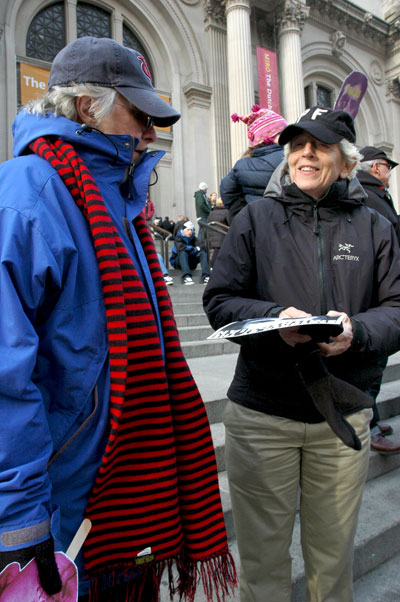
Betsy Crowell and Louise Fishman on the steps of the Metropolitan
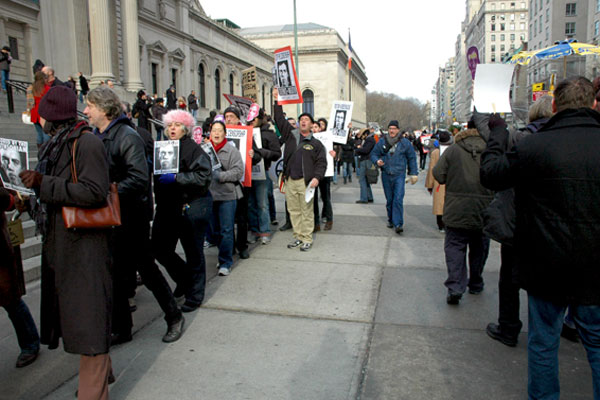
the picket forming on Fifth Avenue
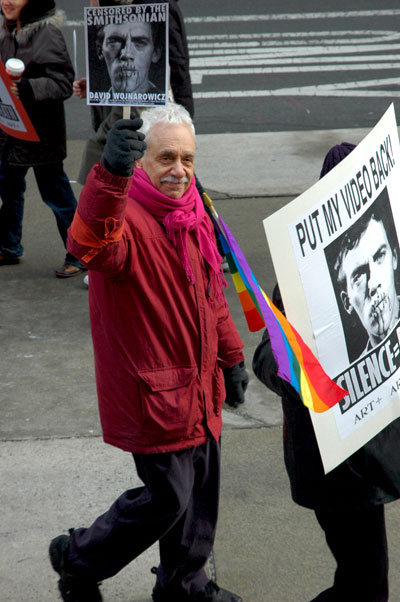
Jonathan “Ned” Katz below the steps
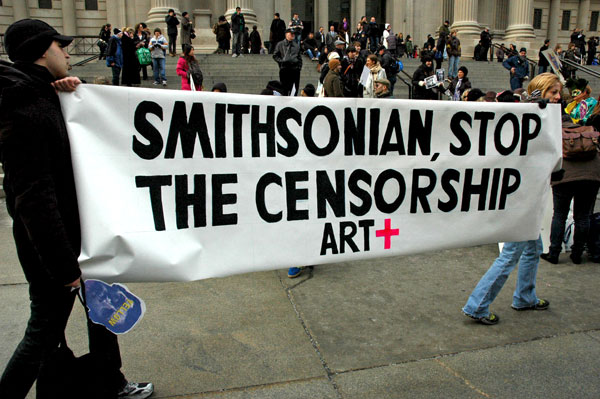
our spanking-new ART+ banner
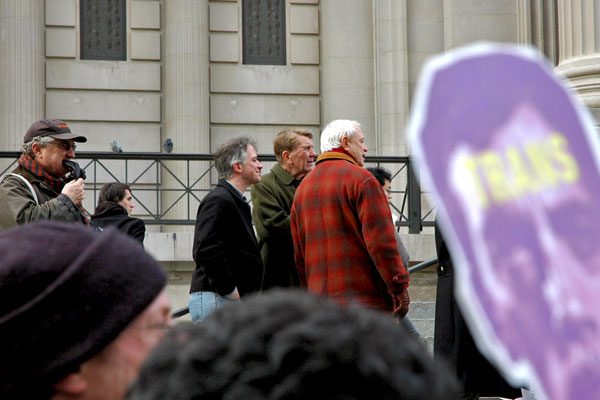
A-list establishment queers, plus one random journalist, checking out the scene
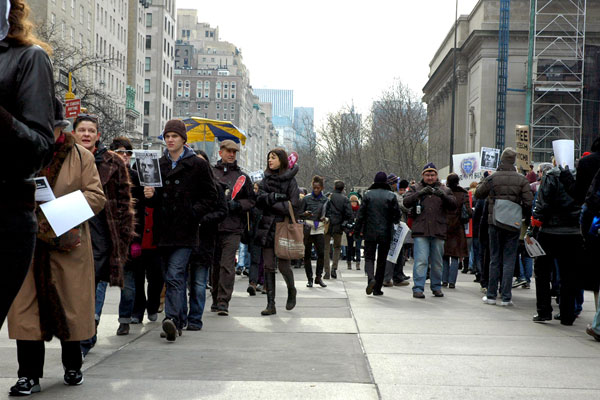
the picket about to head north
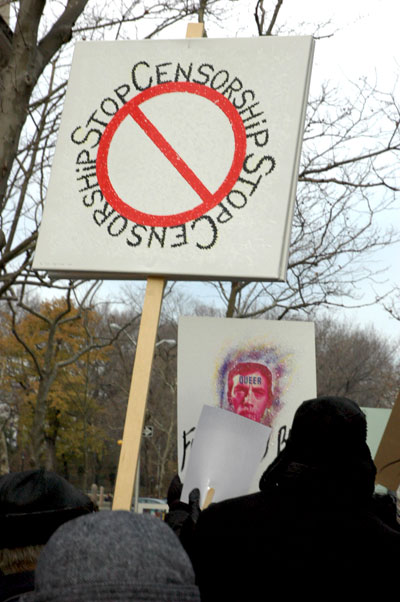
international sign
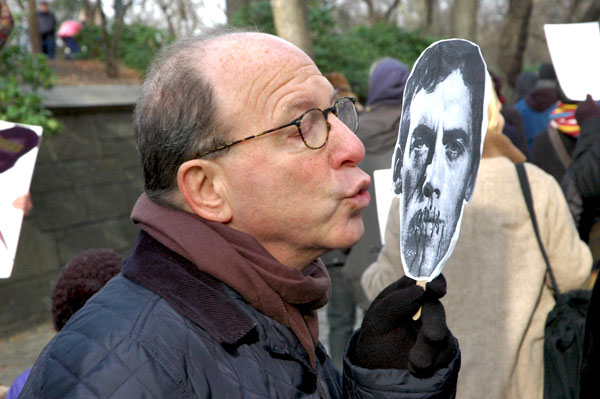
Jerry Saltz loving David
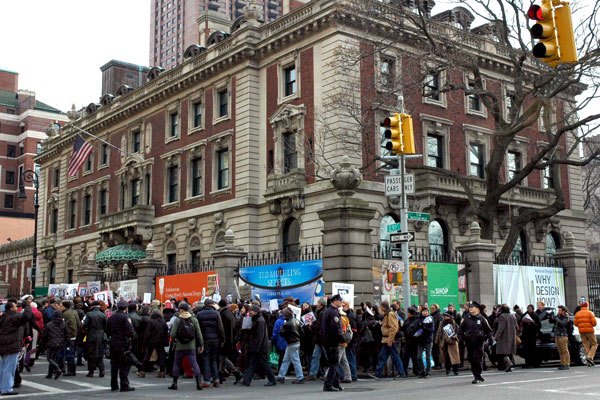
target Smithsonian, here its Cooper-Hewitt satellite
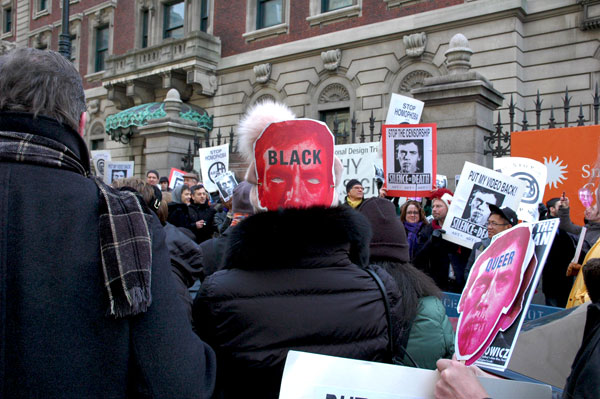
masks as epithets designating “the other” (black, red, yellow, queer, female. etc.)
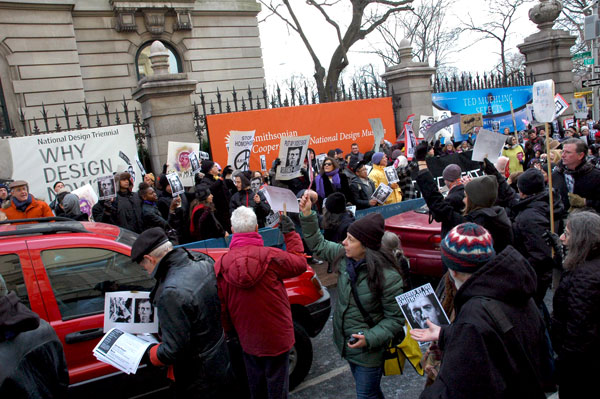
on 91st Street, haranguing the Smithsonian
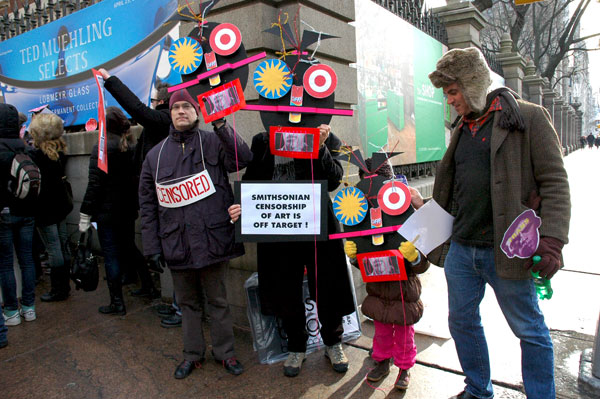
family of art ants outside the museum (Target is a major funder of the Smithsonian)
ADDENDUM: Philip Kennicott has a smart, even electrifying piece in the Washington post, “After removing video from ‘Hide/Seek,’ Smithsonian chief should remove himself“.