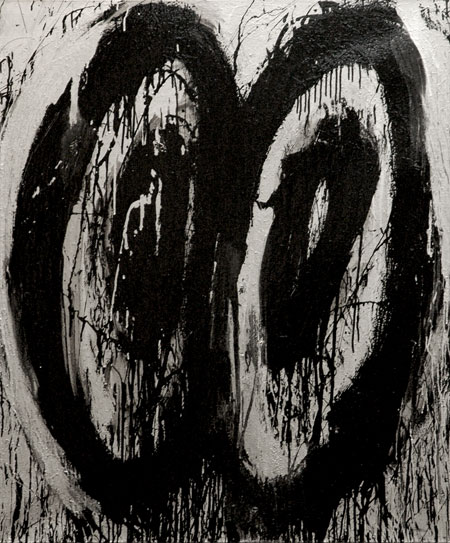
Joyce Pensato The Drippy Droopy Eyes 2007 enamel and metalic paint on linen 48″ x 40″
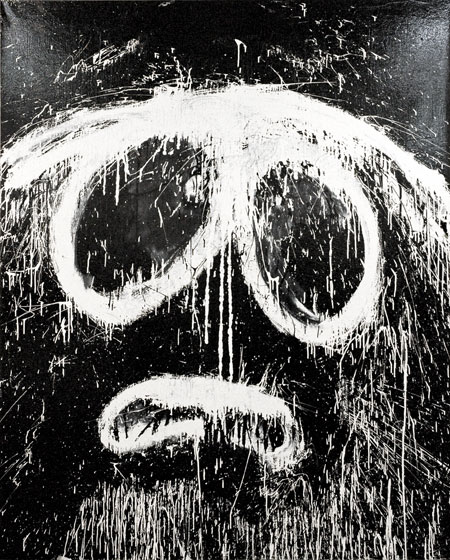
Joyce Pensato Evil Stan 2007 enamel on linen 90″ x 72″
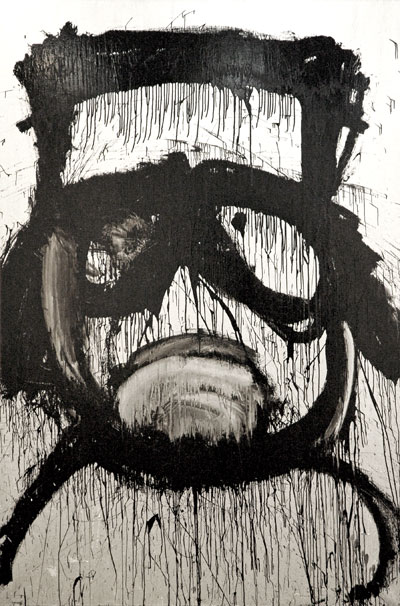
Joyce Pensato I Don’t Want to be Tamed 2007 enamel on linen 108″ x 72″
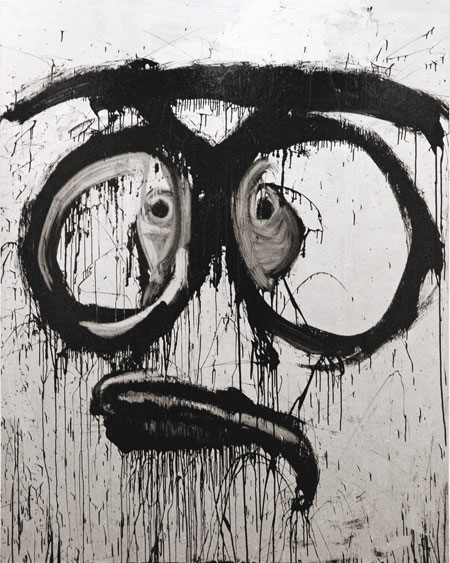
Joyce Pensato Psycho Killer 2007 enamel and metallic paint on linen 90″ x 72″
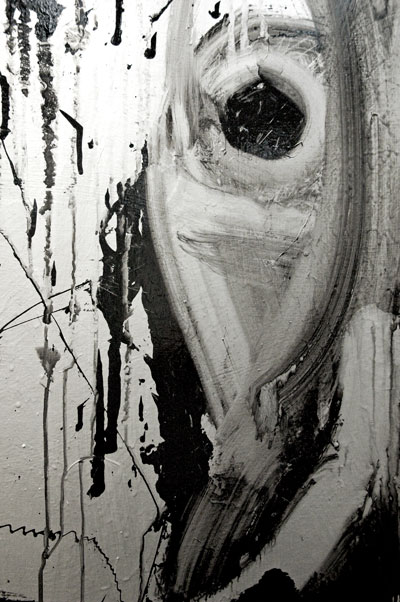
[detail]
Joyce Pensato is back in Chelsea. I first came across her work in the early nineties at Bill Bartman’s Art Resources Transfer. She had donated some wonderful drawings to this legendary non-profit gallery’s annual benefits. They are still among our very favorite things.
Around this same time I spotted a silver and black, medium-sized canvas by the artist at Max Protetch’s gallery. I had missed Pensato’s show at the gallery, but thought this piece was just about the most exciting thing I’d ever seen. I agonized for what now seems like forever over whether I could cover the gallery’s more-than-fair price. Unfortunately my answer was no, but deep down I knew even then that I’d always regret not swinging it somehow. Since then Pensato has shown in Elga Wimmer‘s Chelsea space, installed her studio inside Exit Art for a while, and appeared in a number of galleries in Brooklyn. I don’t think Barry and I have missed any of them. She’s also had solo shows all over Europe, but she hasn’t really been attached to a Manhattan gallery since the nineties.
Until now. Friedrich Petzel has invited her in to mount a show of large paintings in the larger of the gallery’s two spaces on West 22nd Street. These twelve canvases are spectacularly alive, whether seen from across a room or inches away from their surfaces. I’ve always thought of her work as belonging to abstraction, although of course every piece, whether a drawing, a painting, a sculpture or a mural, begins with some iconic American cartoon character.
I don’t really know why American collectors, curators and museums haven’t already gone crazy over Pensato’s work. I hope it doesn’t escape them this time. I don’t normally think of the domestic market for contemporary art as particularly naive or conservative, but I suspect that if she isn’t considered marketable enough it may stem from some weird combination of, on the one hand, collectors’ disdain for what they mistakenly dismiss as a hackneyed choice of cutesy subject and, on the other, their fear of the frightening, even perverse directions in which she seems to take them.
Pensato seems to aim for an ambiguity which balances cuteness and horror. She succeeds over and over again, without ever repeating herself.
Painters have loved her for years and the museums will parade her tomorrow. More people should see her today.
Over the years I’ve become increasingly fond of Pensato’s works on paper (or tortured sheetrock, in the case of many of her murals), partly because of the bits of color which manage to creep into or peek out of the black and white or black and silver sweeps of charcoal or paint, and partly because they so satisfyingly boast the artist’s characteristically-vigorous, even violent erasures. It’s interesting that there are no examples of either medium in this show, although the title, “The Eraser”, alludes to physical operations which are less evident in the paintings.
Go now for the paintings; come back for the drawings I hope the gallery will show next.
Category: Culture
more re photo prohibitions and fair use

(invisible art)
I’m not the least surprised that I’ve gotten responses (in comments, emails, and conversation) of all kinds to my several posts on the subject of gallery photo prohibitions. What I have found surprising is the fact that even when they support the idea of openness in general it seems that many people remain confused by the legal issue of accessibility as it relates to copyright.
I know that with this post I’m really asking to be inundated with arguments from all sides, but the issue isn’t disappearing and I don’t think, especially as photographers, that we should be feeling around in the dark.
I’m confident about arguing for openness, but I’m not adequately versed in the case law which supports it, so in order to shed some light on the issue I turned to someone who is. Artist and activist Joy Garnett had to become an expert when her work, which reflects the issues of access and alteration to images found in the media, was challenged by a photographer in 2004.
First off, there’s simply no legal basis for a photo ban based on the argument of copyright infringement. Quoting from the excellent Fair Use Network site:
The fair use doctrine permits anyone to use copyrighted works, without the owners’ permission, in ways that are fundamentally equitable and fair. Common examples of fair use are criticism, commentary, news reporting, research, scholarship, and multiple copies for classroom use.
Staying specific to the discussion here, Garnett emphasizes that in the U.S. film or photographic documentation for purposes of reporting or reviewing, as well as for scholarship and education, especially if it’s non-commercial, is protected in the Constitution under the doctrine of fair use.
The Fair Use Network site continues with this sorry advisory:
Unfortunately, creative industries are often overly cautious in establishing their informal practice guidelines, with consequences that unduly restrict the exercise of fair use rights.
And that’s where we are today. When galleries tell us that we are not permitted to take pictures, they aren’t protecting the artist. More likely, they’re protecting what they see as their responsibility to control what’s going on in their private bailiwick. It may be counterintuitive, and counterproductive to the interests of the visual artist, and of the arts in general, but it is very a part of much human nature.
For more on the subject of fair use and free expression, go to The Free Expression Policy Project [FEPP] site, or the “fair use” entry on Wikipedia.
Now for a change of air, and an excellent immersion course on a topic only partly related to the subject of this post, “Artists, Documentarians and Copyright”, see the excellent Hungry Hyaena.
[image from abandonedbutnotforgotten]

Marlborough Gallery prohibits photography
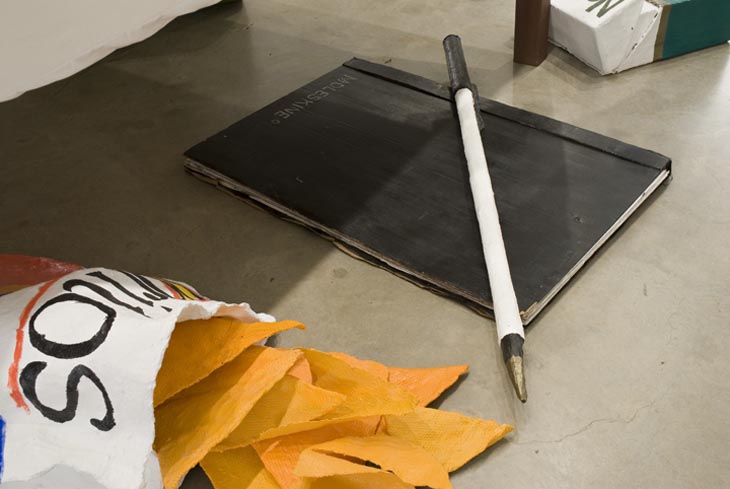
Will Ryman The Bed 2007 papier-m�ch�, magic sculpt, resin, acrylic, wire mesh, wood, cloth [detail of installation]
(the artist taking notes)
No, that headline is not about the fact that Marlborough doesn’t seem to have ever shown artists whose work is photo-based, but rather that the gallery will not permit photography goings-on in its spaces.
This afternoon I watched the attendant at the front desk race across the floor to tell an unsuspecting enthusiast visiting the current installation by Will Ryman that pictures were not allowed. When I followed her back and asked whether the rule was general or only for this particular show, she said that it was regular Marlborough policy, and added by way of explanation (I’m paraphrasing here) that the owners didn’t want people to use their photos for something unauthorized.
Sure, that would be something like, um . . . selling t-shirts with images of Will Ryman sculptures? I don’t think the artist is going to worry about that. Nor do I think he would regret having visitors extend their memory and their pleasure in what should be treasured by all, circulated and displayed, as a demonstrably visual art. Even better, what about the ability of photography (the modern word of mouth) to enable others who are unable to visit the gallery to share in the pleasure of someone who can, before the work itself disappears into the home of a rich collector? Maybe the unauthorized snapshot would be simply the equivalent of taking notes.
Perhaps when we visit Marlborough and galleries with similar policies we’re actually in the wrong century or on the wrong continent: Photography hasn’t been invented yet, or it must be some foreign sorcery being used to steal our souls (or “copyright”). Would a visitor be permitted to sketch the work or scribble some paragraphs on a pad?
Barry and I have admired Will Ryman’s work for some time and both of us have mentioned his show appearances on our sites. I’m very sorry that our shared position on the stupidity of photo prohibitions will prevent us from reporting on such a major event as this one. The Marlborough Gallery has never been featured on either of our blogs, but because it was Ryman’s this show was included in the listings (we made it a pick) on ArtCal listings, our on-line edited calendar of New York gallery shows. As long as the management maintains its current policy it won’t happen again.
[image from Saatchi Gallery]
Daniel Joseph at BUIA
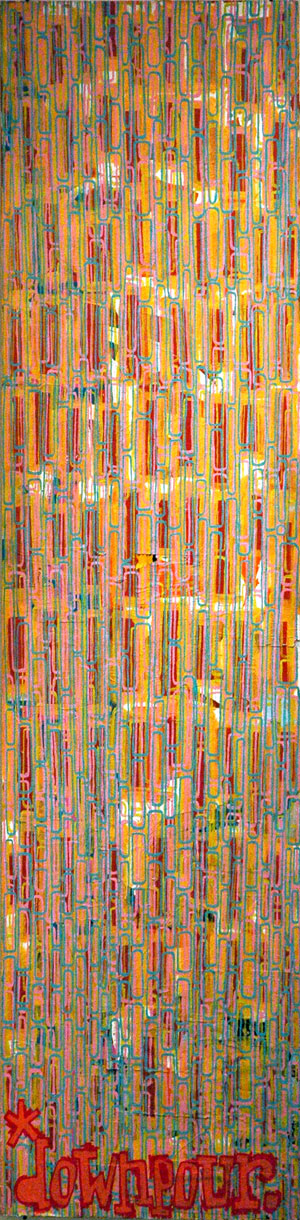
Daniel Joseph It’s starting to rain acrylic, latex and collage on wood 96″ x 24″
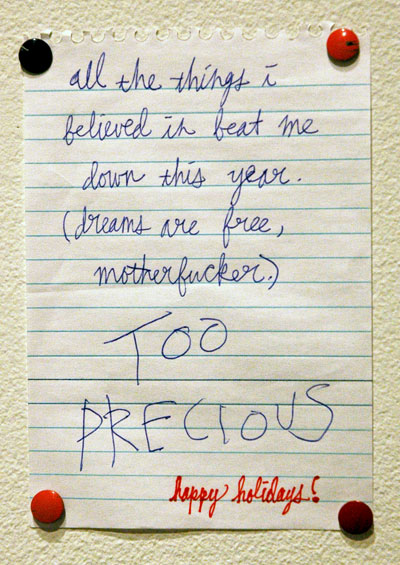
[artist’s note mounted to right of painting, completing installation of “It’s starting to rain”]
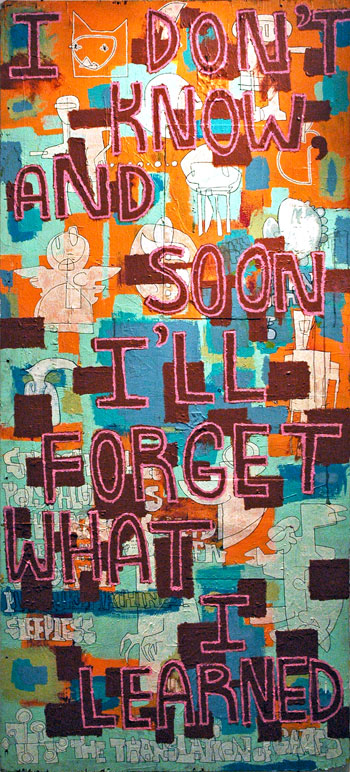
Daniel Joseph I’ll forget eventually 2007 acrylic, latex, oil and collage on wood 96″ x 43″
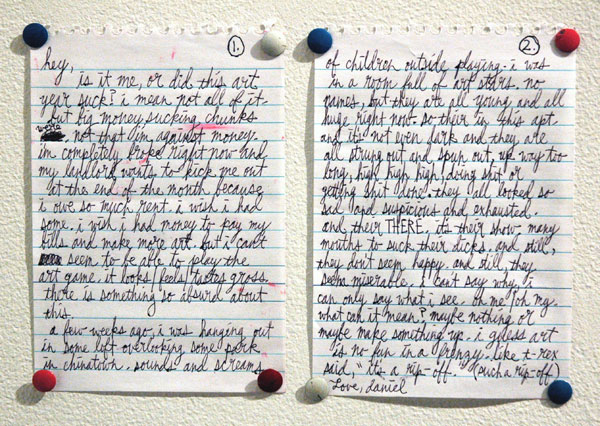

[artist’s notes mounted to left of painting, completing installation of “I’ll forget eventually”]

[full view of “I’ll forget eventually” installation]
I did not know about this wonderful artist until two weeks ago. There were apparently any number of missed opportunities to do so, as I’ve learned about since visiting a group show, “Holiday!“, mounted by BUIA gallery last month, but somehow I had not come across the work of Daniel Joseph until then. The artist is known for painting, installation, performance, video, works on paper and music. Even now, of all those mediums, I’ve only seen his paintings first hand. These gorgeous pieces may represent the most traditional form of his expression, but apparently he couldn’t just do a painting; he had to make it an installation, leaving us little hand-written messages which bring his complex wood and paper constructions into the viewer’s own world.
But these particular works are also not just paintings. They’re actually more like painted collages. I’m sorry my photos don’t really show their full richness. I guess I was a bit too quickly distracted by our conversation with Vanessa about the artist while Barry and I were in her eponymous gallery. Although the show from which I snapped these images is now gone, I’m tempted to go back and ask if I might be permitted a stab at a detail shot or two.
Joseph had a solo show at the gallery last year. I missed it, but I’m not going to miss the next one.
In the the press release for the 2006 show, novelist/essayist/wit Mike Albo was quoted speaking about Joseph’s work:
I dont think Mr. Joseph believes in silent retreats. Instead of stripping things bare he would rather dive into the mess. His collages have a shredded beauty, made out of layers and layers, drizzled with symbols. He piles things on and leaves heavy footprints. He refuses to believe its too late for love or that it comes from somewhere above our heads in some kind of refined, expensive air. He wants us to scream and find to each other through the tatters and chatter.
Somewhere down here, deep in the mess, are fresh moments, orgasms, friendship and the lurching laugh-cry you used to get when you laid on the front lawn and looked at the sky. These pieces drag you through all the trash as if you were pulled along by a loving arm that wont let go. Here are Daniel Josephs buoys- swim to one and signal to someone else that you are in love.
Ester Partegàs in Miami
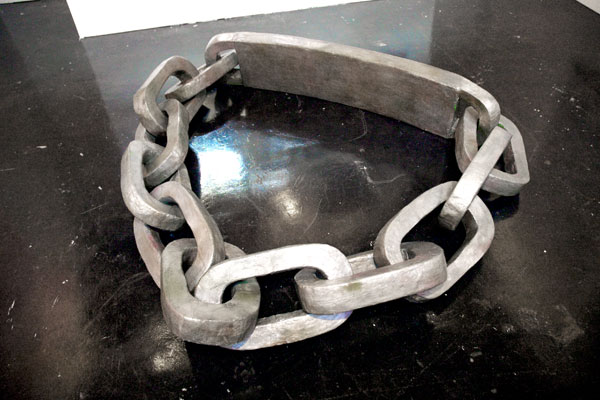
Ester Partegàs Yes Collection 2007 resin, spray acrylic and enamel paint 12.25″ x 82.75″ x 59″ [installation view]
Barcelona’s Nogueras Blanchard gallery showed work by Ester Partegàs at NADA, including this over-size identification bracelet. I thought the gallery’s images of a room installation, “Invaders”, being put together at that moment in Madrid’s Reina Sofia were very impressive, but light reflections made them impossible to record.
The museum page includes a statement about Partegàs‘s work in general which is even more useful than its description of the current installation itself. Wish I could see it.
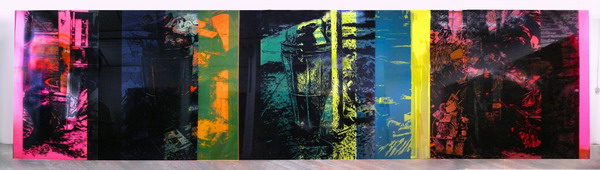
one of the huge sets of layered paintings on methacrylate, which surround a central sculpture in the Reina Sofia’s Producciones
[second image from the Spanish Ministry of Culture]
Lilibeth Cuenca Rasmussen at Basel
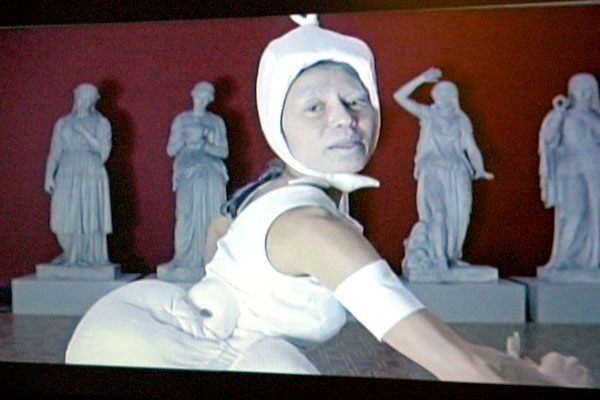
Lilibeth Cuenca Rasmussen The Artist’s Song 2007 video (16mm film transferred to DVD) [large detail of still from video]
Lilibeth Cuenca Rasmussen’s terrific rap take on the state/hotness of the current art scene was one of the most entertaining performances, live or recorded, I witnessed at the Miami art fairs. The video was presented by Copenhagen’s Kirkhoff gallery.
The gallery supplied this description in a statement which accompanied Rasmussen’s solo show this past spring:
In the film, “The Artist’s Song”, the artist sings about (in)famous works from the history of art which have influenced the concept of art, just like [her live performances at the March 10 opening]. The film also deals with an artist’s dream of fame and immortality as an incentive behind the works. The film shows the artist at the museum Glyptoteket in Copenhagen, dressed as a sculpture on a pedestal and surrounded by classicistic sculptures. Her descriptions of the competetive art scene, the various positions, the artist’s dreams and ambitions become both general and personal statements. The film is part of Lilibeth Cuenca Rasmussen’s work with identity, whether it is nationality, gender, religion or as in this exhibition – the identity as an artist.
I was already sorry that I missed the Brooklyn Museum show, “Global Feminisms”, also mounted this spring, but learning now that the artist was a part of it makes me want to kick myself.
To watch Rasmussen talking about her work, showing excerpts from some of her videos, click onto this image:
ADDENDUM: Rasmussen will have a solo show here in New York at the Renwick gallery in February. It will feature reenactments of performances, including “The Artist’s Song”. I wouldn’t miss it.
[second image/clip from Brooklyn Museum]
Ara Peterson at Miami Basel
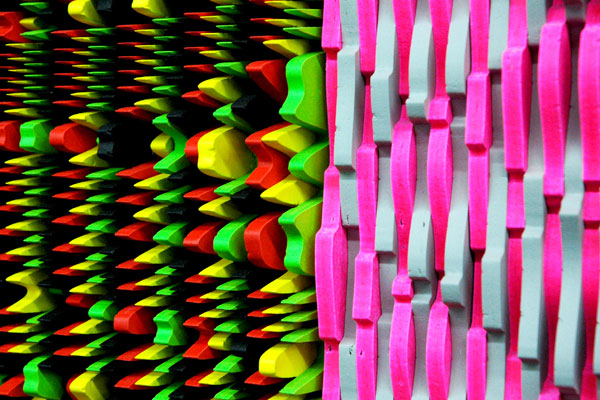
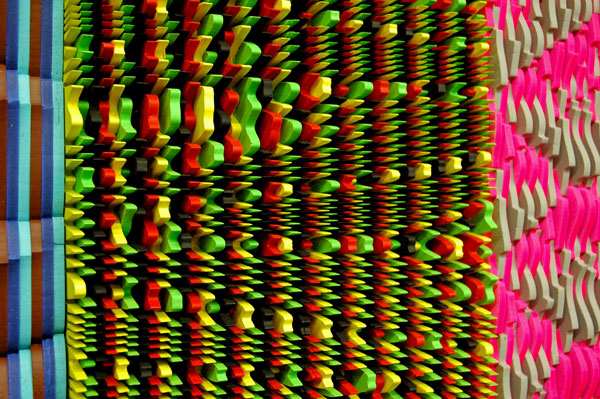
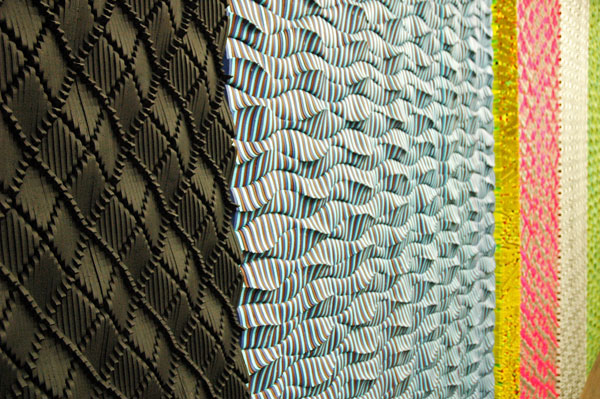
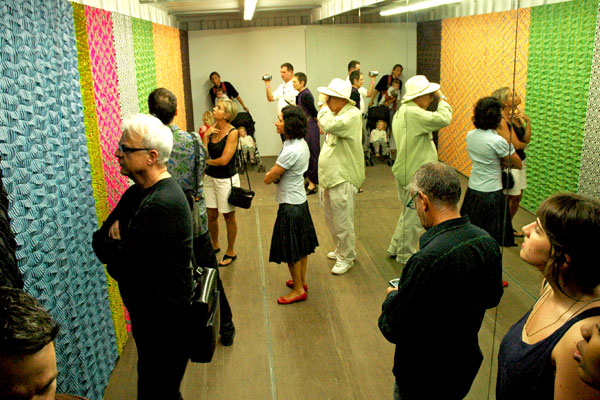
four views of Ara Peterson‘s site-specific wall relief inside one of the most popular containers of “Art Positions” at Art Basel Miami Beach last week.
This installation, of hand-painted, laser-cut birch plywood, glass mirrors and space, was arranged by John Connelly Presents.
It’s my birthday, so although I already like Peterson’s work a lot, I have another good reason to put up these images today: It’s a very happy piece. I got some great flowers this morning, but no balloons; these colors and shapes will do very well instead.
Art Basel in Miami
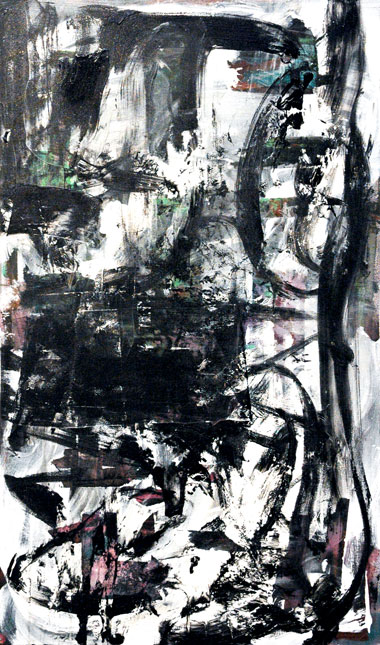
Louise Fishman’s “Dartmouth Quartet I” at New York’s Cheim & Read
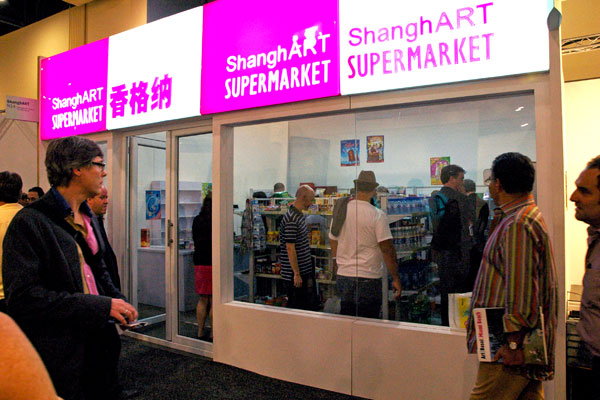
large detail of Xu Zhen’s “ShangART Supermarket” at Shanghai’s ShangART Gallery
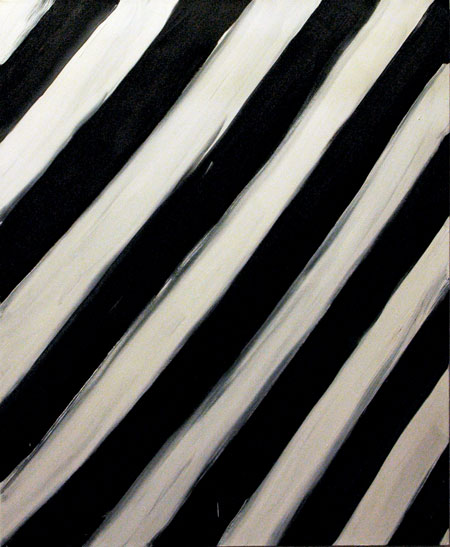
Ann Craven’s “Stripe” at New York’s Klemens Gasser and Tanja Grunert
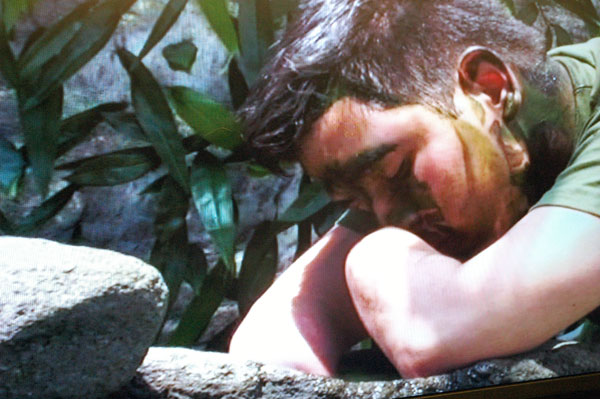
large detail of still from Miguel Ángel Rojas’s “Caquetá” at Bogota’s Alcuadrado
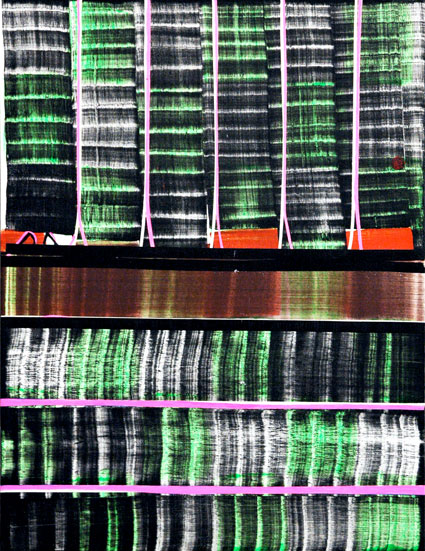
Juan Uslé’s “Mardi Gras I” at Cheim & Read
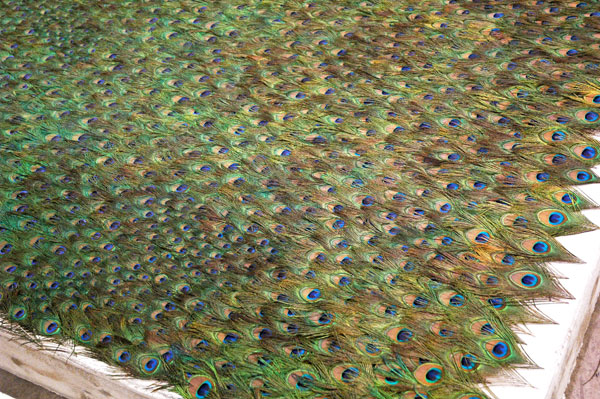
detail of Carol Bove’s installation at New York’s Maccarone
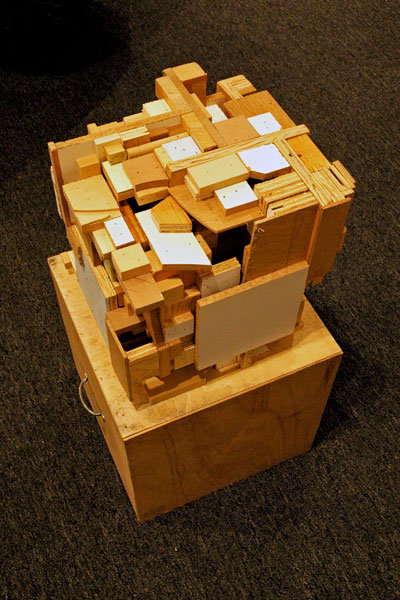
Charles Goldman’s “Scrapwood Sculpture” at Toronto’s Birch Libralato
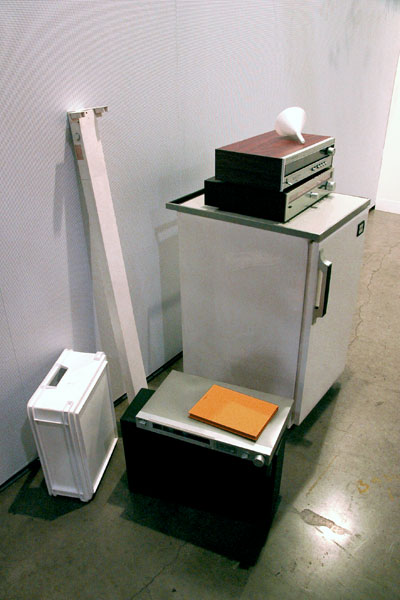
Zilvinas Landzbergas’s 4-part installation, “JPG 3”, at Amsterdam’s Fons Welters
Two years ago Barry and I missed Art Basel Miami altogether (car rental problems during the vernissage), even though it was the first of what has morphed into a virtual circus of annual trade shows, er . . . art fairs throughout the Miami area (there were dozens this year, and they came in all sizes). We ended up having a great time visiting and looking at so much else that year.
We skipped last year’s excitement, but returned this year seduced by a friend’s generous offer of a part of his beautiful South Beach apartment, and by the prospect of meeting people around this country and beyond with whom we’d only communicated on line.
We did make the Basel vernissage this time, arriving only minutes after the doors opened. Of course the big-deal collectors had already had their preview earlier in the day and by the time we arrived they were probably sprucing up for the a large private dinner party scheduled for that night. While we were boarding the plane at Newark we had spotted Paul Miller and learned that he (aka DJ Spooky) would be showing one of his latest projects, “Rebirth of a Nation” to 150 invited guests at the Rubell Family Collection across the water. Now that would definitely have been worth a detour had we been offered the opportunity.
Meanwhile the aisles and the gallery booths at the fair were crowded with both press people like ourselves and “ordinary” guests, including many artists. Many of these folks, including some of the exhibitors, were our friends. With that kind of stimulation, plus the lively mosaic of individual works which competed for our attention, it was pretty difficult to focus on a single piece, even a single gallery set up. We had three hours, but in that time we were able to get through little more than the booths on the periphery and two special rooms.
We made one sortie through the center of the Convention Center to check out Cheim & Read, since we were told they would be showing Louise Fishman’s first work in acrylic, done this past summer in New Hampshire. Only near the end of our tour did we realize we had actually lucked out in our chosen route around the edge, since it was to the spaces on the outside walls that the less mainstream galleries new to Basel Miami were assigned – galleries more in tune with our normal appetites.
The images at the top describe only a few of the more interesting pieces I encountered along the way:
Louise Fishman‘s 66″ canvas turned out to be pretty spectacular.
Xu Zhen’s convenience store was a huge hit, and many visitors couldn’t resist purchasing samples of its (totally empty) containers and wrappings.
Ann Craven‘s birds had really gotten to me several years ago and since then I’ve watched her move into even more conceptual work. This “Stripe” painting opens up very new territory.
I’d been attracted to Juan Uslé‘s work when I had seen it in group shows before, but this vivid painting really stood out even in the rich company of both its gallery colleagues and those in the larger show itself.
Carol Bove‘s peacock blanket had been covered in the media, but nothing had prepared me for the unearthly beauty of the thing itself.
Miguel Ángel Rojas was our first “discovery” in Miami. The fact that Barry and I hadn’t known this artist’s work before probably demonstrates our New York provincialism. The Columbian gallery, Elcuadrado, showed nothing other than work by this wonderful, mature artist, and I thought it was awesome, the video and photography-based installations in particular.
The video cited here shows a 21-year-old lieutenant who lost the lower part of both arms in the Columbian government’s war against the peasants in Caqueta province. It’s a continuous loop which begins with his face covered in grease paint camouflage and it continues as it records the labored process of the young man washing it off from a basin of water.
We’ve seen and loved Charles Goldman‘s work for years, and eventually came to know and love the artist as well. At Basel he was represented, in this wonderful piece and another not shown above, by Torontos’ Birch Libralato.
Zilvinas Landzbergas‘s work was pretty special, for its very ordinariness, a pile of things so easy to overlook beside a partition, as well as the non-ordinary choice of subject, the extraordinary skill of its execution (in cardboard and plastic) and its surprising beauty.
Pierogi / Feldman / Hales in Miami
Barry here, to say go visit the show created by Pierogi, Ron Feldman, and Hales galleries around the corner from Pulse. Today (Sunday the 9th) is the last day. More information is on bloggy.
ArtHaus Miami at the Miami art fairs
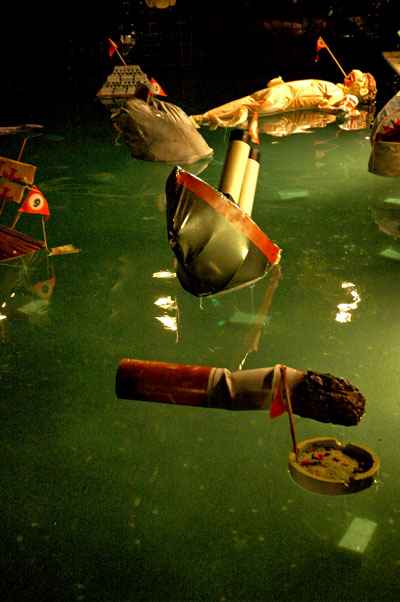
Bruce High Quality Foundation arthur kills again 2007 [detail of installation]
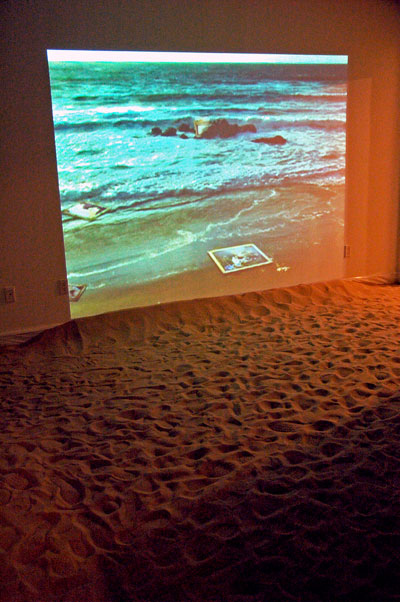
Eugenio Ampudia Impression Soleil Levant 2007 video [installation view]
I’m not going to be able to do regular posts while Barry and I are still in Miami for the two dozen art fairs and related events, but I wanted to get the word out on one particular smaller-scale attraction we visited last night which definitely hasn’t yet gotten the publicity it deserves. If you’re here in the topics this week, don’t miss ArtHaus Miami.
The first image is of an installation which is something of a combination coin toss and miniature golf operation in the mansion’s very formal backyard pool. It’s all a very funny and imaginative take on the history of a wilder body of water located somewhat further north, Arthur Kill.
The second is of a video installed in an upstairs chamber of the house. It was at the moment I was taking this picture that I realized we had to had to leave for our next stop and come back when we have more time. Unfortunately, except to show this great installation, I can’t say anything about the work itself right now.
These two pieces are among a great many more spread throughout the rooms and gardens created by dozens of artists. They are part of what is also known as ArtHaus UnFair 07. The haus is located behind an arched gate in a large old deco mansion at 1616 Drexel Avenue, just north of 16th Street, close to all the other Miami Beach art venues, and it’s open from 1 until 10 pm through Monday.
Have fun!
_____
As for reports of my other favorite experiences of the fairs’ bounty, I may be able to do some very brief posts including nothing but an image and an attribution. Because of time demands and only irregular access to the computer however, any real summary will have to wait for our return in the middle of next week.