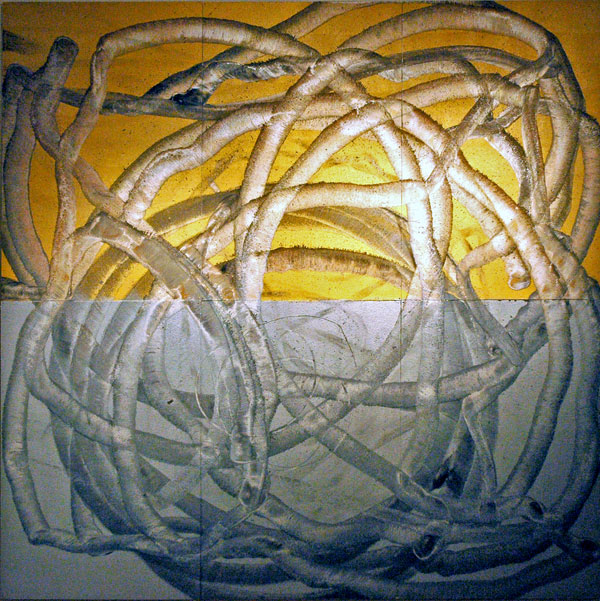
Aaron Young Untitled (silver and gold) 2007 acrylic paint and rubber on aluminum 144″ x 144″ engineer: Wink 1,100
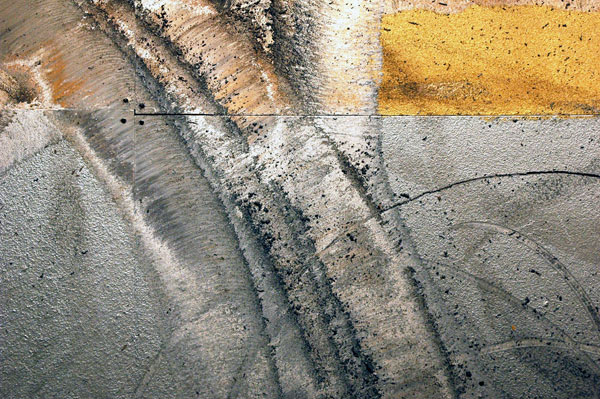
[detail]
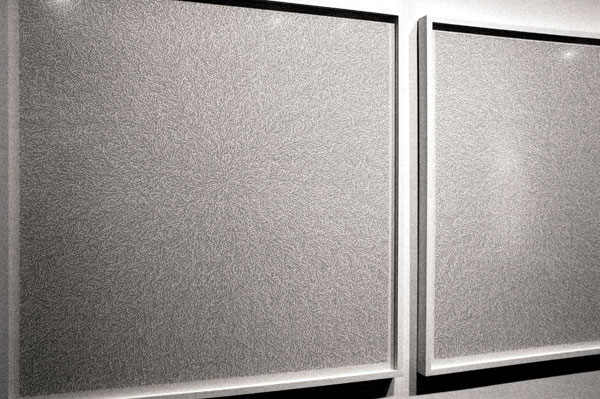
William Stone Branching Drawings 1996 computer printout on paper, dimensions variable, engineer: Charles Waldman
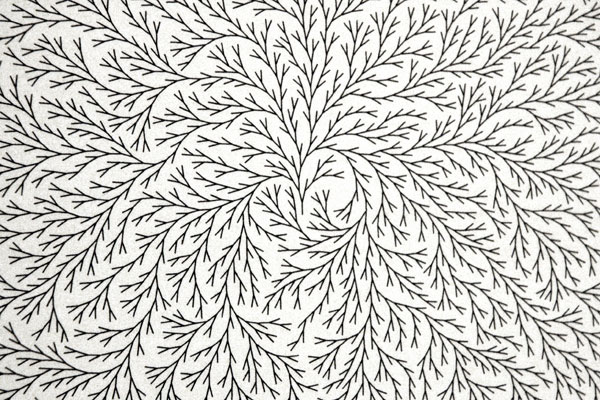
[detail]
I knew we had made a big mistake for not having visited James Fuentes’s gallery yet. I mean, it’s near our scary Police Headquarters, but I used to live not too far away from the site, and it’s not really so very far from the Lower East Side neighborhood now hosting more and more worthy new gallery spaces. A visit to a new space on Broadway this past week confirmed the error of our neglect: It’s going to be very hard to miss a show at 35 St. James Place in the future.
The latest show in his own gallery has just closed, but Fuentes was given responsibility for curating the inaugural show in the New York gallery of the Emily Harvey Foundation. After our visit there this past week and a look into the history of Emily Harvey and the ambitious young foundation bearing her name I’d say it’s a perfect fit. The EHF space is a classic, finely-patinated second-floor loft on Broadway in SoHo. Fuente’s installation, “Programming Chance“, continues through this Saturday.
This small group show includes work by John Cage, Jean Dupuy, Alison Knowles, Ken Knowleton, William Stone & Aaron Young. Their connection here is the artists’ shared interest in connecting their art to the genius of machines or computers (working with collaborators the curator calls “engineers”), although there are at least sixty years difference in the ages of the artists and engineers, and the works themselves range from the mid-sixties to 2007. This is clearly no fad.
And it didn’t start just forty years ago: Da Vinci liked machines, but then he was his own engineer.
I confess I hadn’t read Carol Vogel’s NYTimes article on Aaron Young’s installation/performance/painting last September. At a distance, the whole thing looked to me too much like hype and excess, perhaps both, but when I saw the large work by Young which concluded the chronology of this show I understood the excitement. It’s terrific. Of course it was a great help, and a privilege, to have Fuentes himself deliver a commentary on this piece, and on each of the others in the show.
Category: Culture
David Reed at Max Protetch
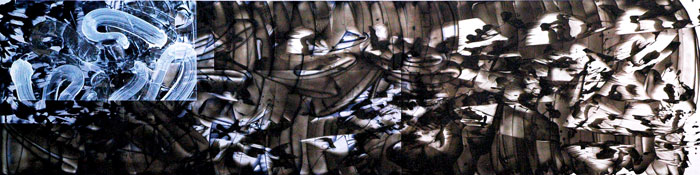
David Reed #575 oil and alkyd on polyester 40″ x 160″
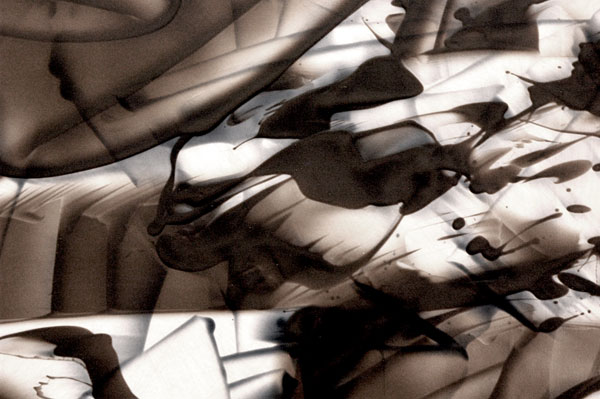
[detail]
I’ve enjoyed looking at David Reed‘s work for years, and this is one of the most beautiful paintings I’ve seen yet. He’s definitely not standing still.
The show is “New Paintings“, and it continues at Max Protetch through December 22.
the new New Museum’s inaugural installations
In my earlier post, and its addendum, I’ve shown views of the inside of the New Museum building itself; with this one I’m uploading images of [only some of] the works I found most interesting, and photographically accessible, on my too-brief visit during the press preview.
But first a serious, negative note about New Museum policy:
While I was able to take pictures as a member of the press visiting during a press preview, photography is not permitted in the Museum galleries to anyone without this status. This is a serious affront to the purpose of any museum of the visual arts, but especially for an institution devoted to broadcasting the work of artists who do not have public exposure or critical acceptance. In its own handout it describes itself as “A site of ongoing experimentation and questioning of what art and institutions can do in the 21st century . . . through programming that is open, fearless and alive.” Especially in our contemporary world, where the camera is increasingly ubiquitous, and its own creative purposes progressiveley more diverse, how can photography be considered the enemy of an agenda of light, one devoted to making emerging visual art more visible to more people?
I am genuinely saddened, and a little frightened, by the kind of blindness I see among certain individuals and institutions in the arts world which produces blanket photo prohibitions. If you agree, don’t be shy about telling the offending museums, and the occasional gallery, what you think about their wanting to keep some people in the dark.
I think no-photo policies are at best foolish and misguided, and at worst an indication of a craving for power or control. I see the phenomenon as an anachronism, and I have to believe it will ultimately be discredited as common sense comes to prevail among people of good will. If I am proven totally wrong on the last point, I think a gallery or museum photo ban will be among the least of our concerns: It would be only one aspect of a new, very dark age everywhere in our society.
And now, from my privileged camera:
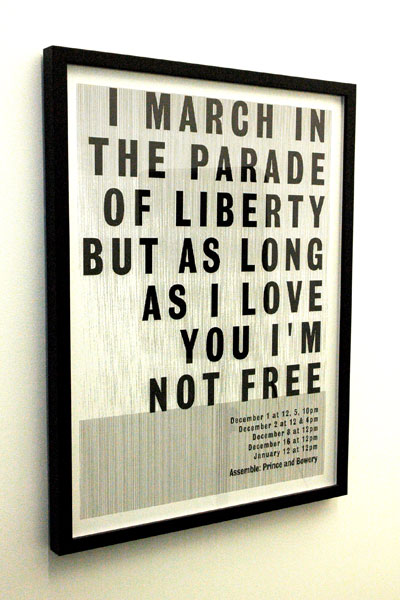
Sharon Hayes I march in the parade of liberty, but as long as I love you I’m not free 2007 site-specific performance piece [detail]
Hayes’s wonderful, noisy piece is not part of the museum’s major installation, “Unmonumental: The Object in the 21st Century”, the first of a four-part exhibition to be mounted this winter. The images which follow however are all from “Unmonumental”.
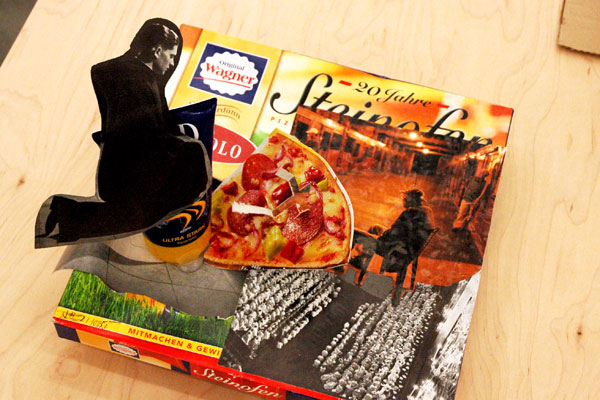
John Bock Untitled 2005 plastic bottle, cardboard box, paper and ink 8.5″ x 10.25″ x 10.25″ [installation view]
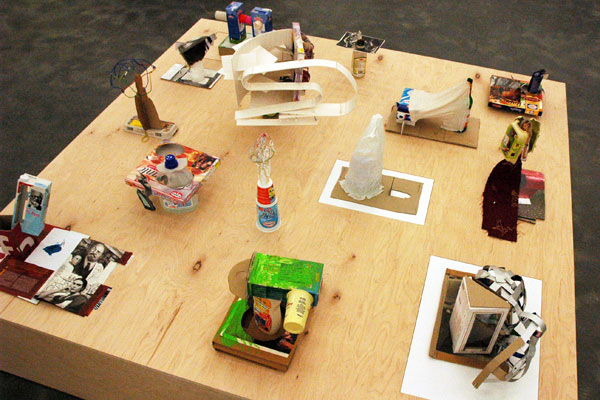
[complete installation of all 14 works]
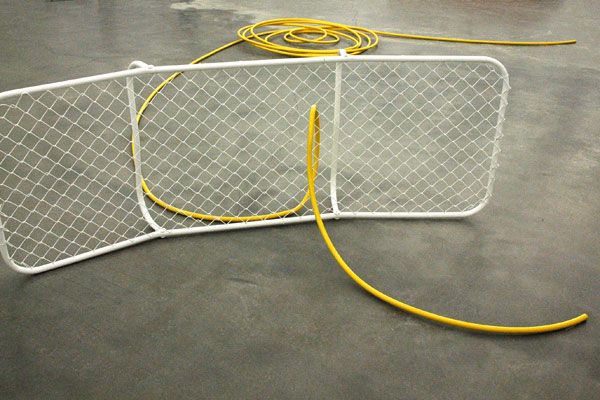
Martin Boyce We climb inside and everything else disappears 2004 powder-coated steel tubing, wire mesh, cast aluminum, one deck chair (white) and one hose tube (yellow), two parts, dimensions variable [large detail of installation]
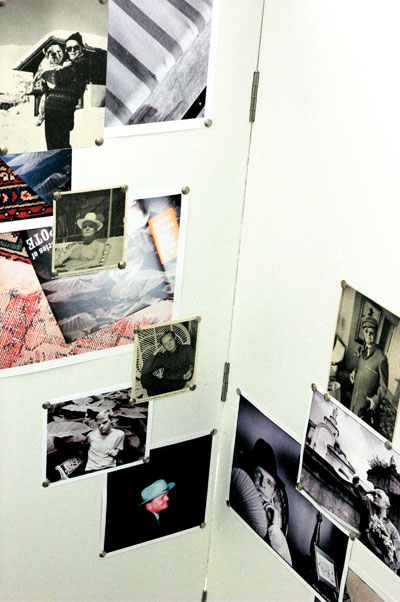
Tom Burr White Folding Screen (T.C. II) 2005 pained plywood, mirrored plexiglas, photographic material, hinges and pins 47.25″ x 68.75″ x 25.5″ [detail of installation]
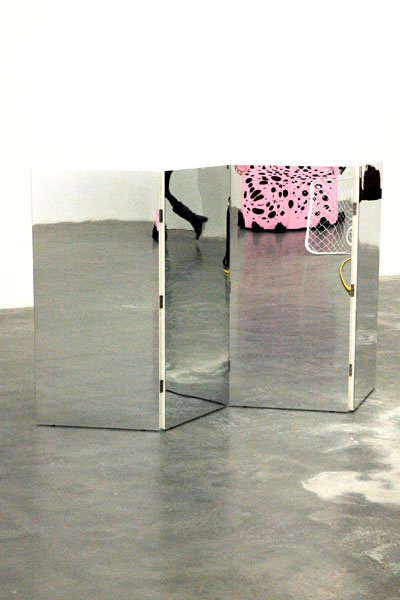
[full image, obverse]
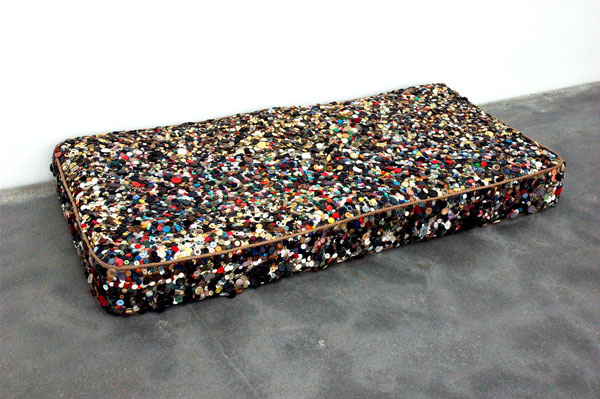
Jim Lambie Bed-Head 2002 mattress, buttons and thread 20.25″ x 75. 25″ x 50.75″ [installation view]
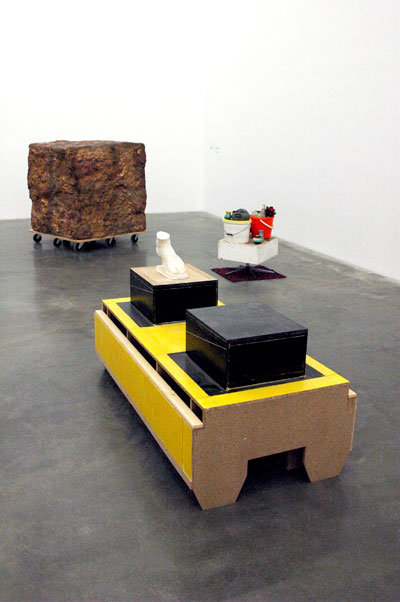
Manfred Pernice Commerzbank 1 2004 painted particleboard and plaster 38″ x 32.5″ x 66″ [installation view, showing Pernice’s “Untitled” to the right rear, and Rebecca Warren’s “Cube” left rear]
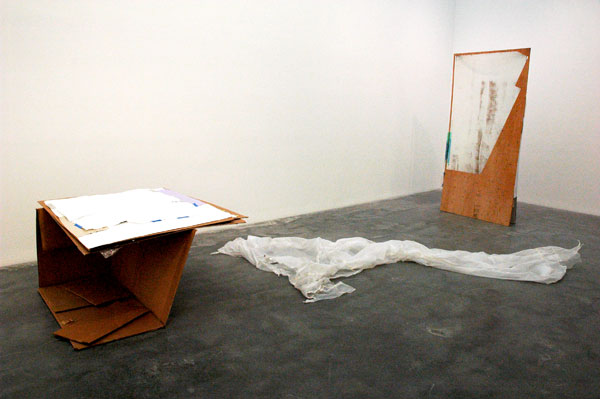
Gedi Sibony The Circumstance, The Illusion, and Light Absorbed as Light 2007 various materials [large detail of installation]
new New Museum (extra)
A few footnotes to my earlier post on the architecture of the New Museum:
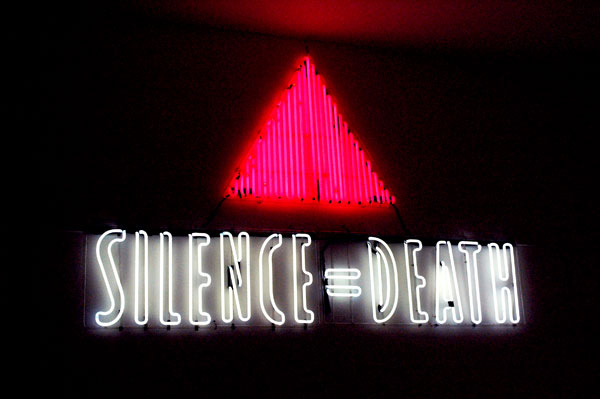
This piece was my favorite continuing thing in the old New Museum, where it hung near the front door for years. This ACT UP/Gran Fury neon icon is now part of the Museum’s permanent collection. It’s been installed on the landing of the beautiful stair which descends through glass railings from the lobby floor to the level below, where the theater and Jeffery Inaba’s installation, “Donor Hall” can be found.
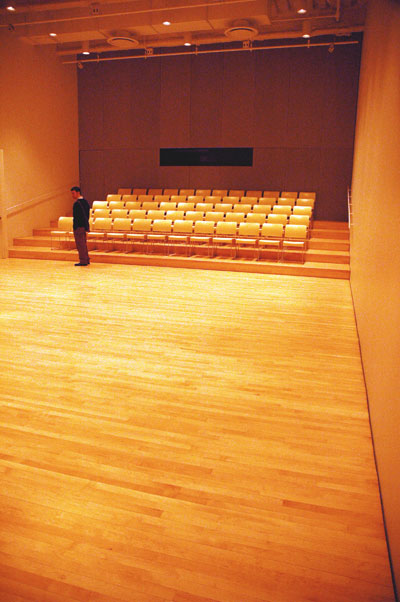
The theater in the basement looks like a minimalist high school gymnasium, but there are no hoops and no painted floor; this one is for the art and theater fags. A simple full-height movable curtain hung on a ceiling track can be snaked around the stage area to create either a proscenium or a backdrop.
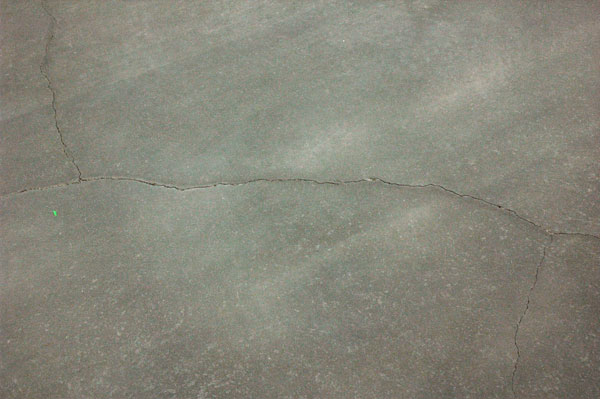
During the press preview on Thursday Barry pointed out this crack in the floor of one of the galleries. I said something about the need for expansion joints. Now I’m not so sure our assumptions were correct. Maybe we didn’t get the press packet the NYTimes got, because their architecture critic, Nicolai Ouroussoff, was able to write, “That effect [a hint of mystery] is reinforced by the rawness of the spaces exposed beams, painted white walls, cracked concrete floors [my italics].
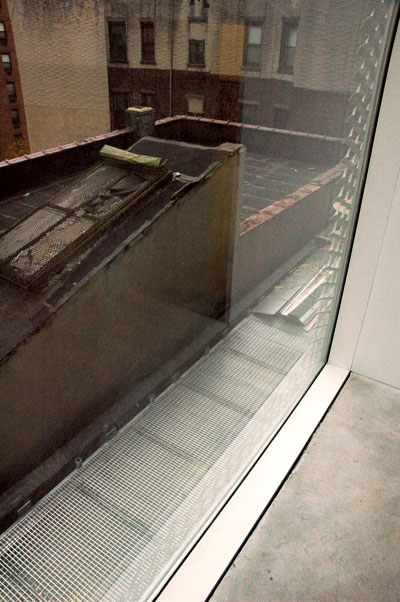
The window on the landing of the long, east-west staircase showcases a skylight in a gallery below and suggests the rich historic complexity of the neighborhood.
new New Museum building is a new New York treasure
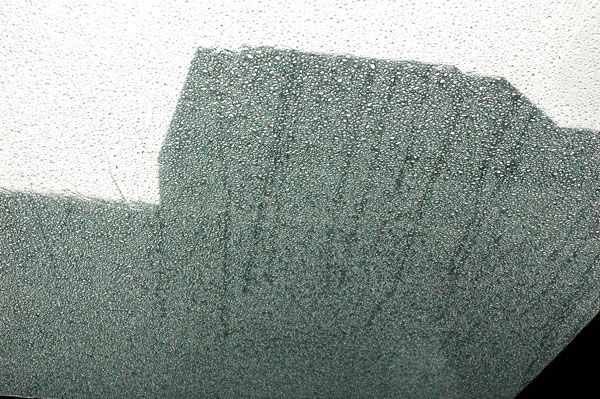
raindrops on the roof of the temporary tent at the entrance obscure the Bowery facade
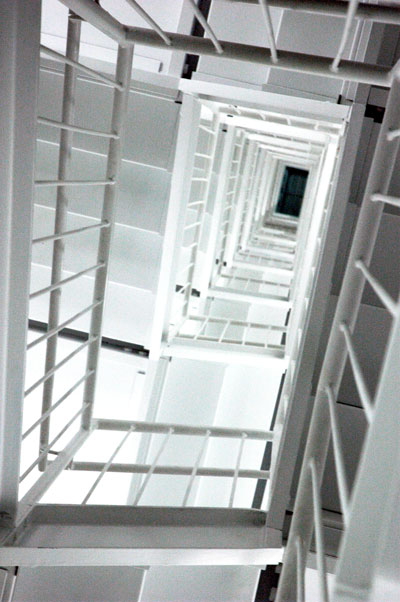
each of the building’s sets of stairs is a star, including this interior tower
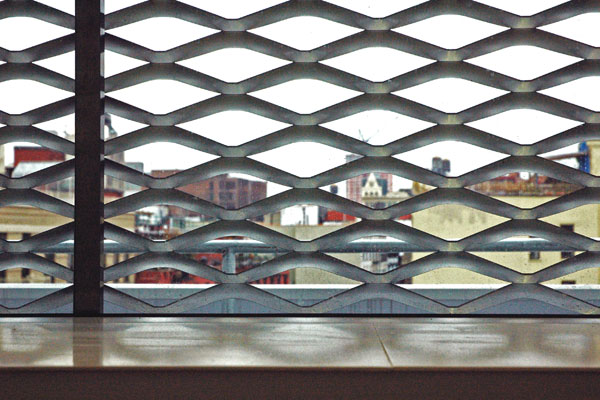
the aluminum mesh covering the facade shades this row of 4th-floor windows
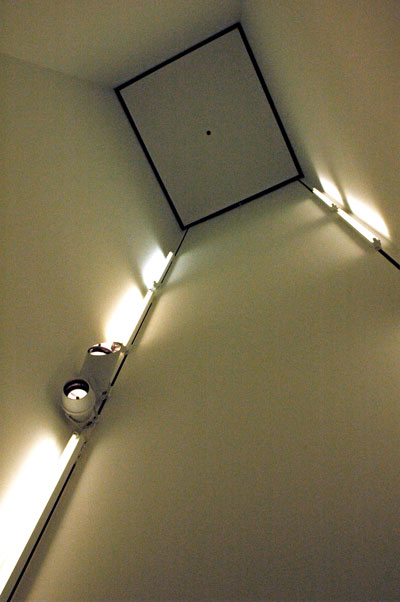
on the interior stair landing, looking up from inside a niche used for installations
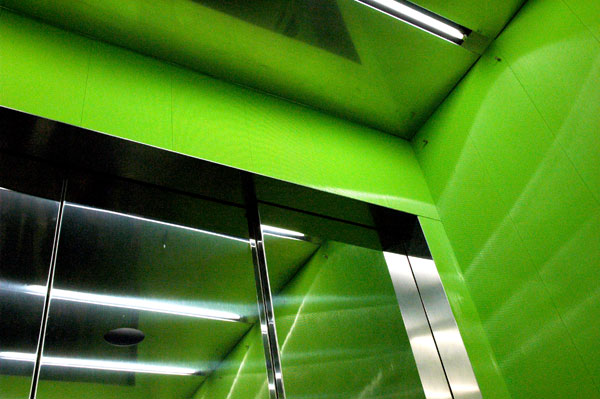
the larger elevator, a mobile color platform in the core of the tower, opens at either end
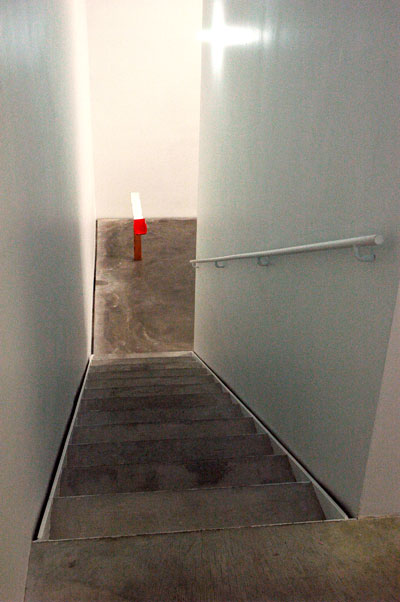
the very cool interior staircase frames or provides access to several installations
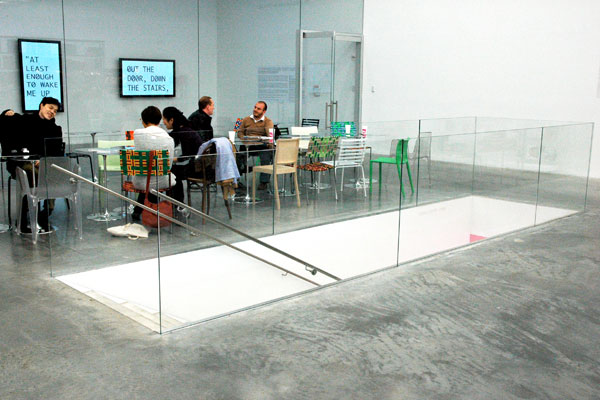
the cafe was not operating, but the light, the vantage, and the chairs were welcoming
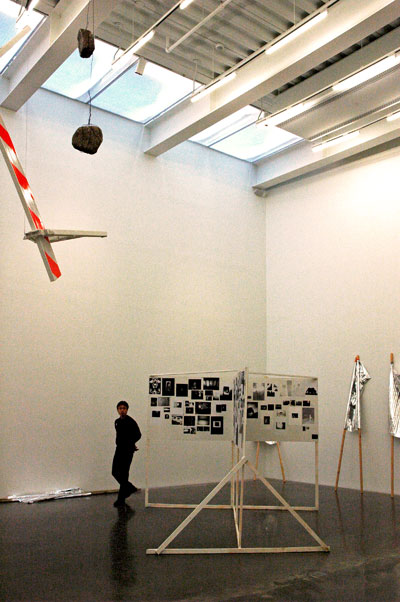
a view of the balance achieved between a building and work it briefly shelters
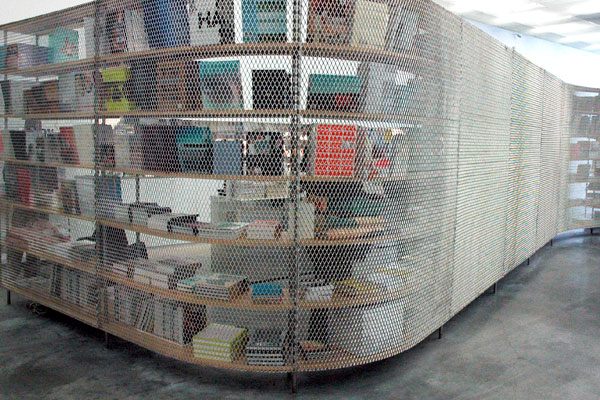
the outside curve of the bookstore wall on the south side of the ground floor
It was a thrill to welcome to the city this morning a splendid new house of art, the new New Museum. It stands on the Bowery on the Lower East Side, a neighborhood already changing rapidly but which still remains one of New York’s most interesting.
I loved the Sejima + Nishizawa/SANAA building from the moment it was presented to us as a conception. That was in May of 2003. Construction began two years later and the Museum opens to the public December 1 [meanwhile, we’re still looking at a big hole down at the World Trade Center site one mile southwest of the museum; always ask an artist, or arts person, if you want something done well]. Those who haven’t already reserved a time slot for the marathon opening, a 30-hour window of opportunity which begins at noon on Saturday, will have to hold off until the initial excitement dies down. Their people say they’ve already given out the entire number of allotted timed tickets for those free hours of admission.
It’s worth the wait. The building is as good inside as it is on the outside. There are several installations in various parts of the building, in addition to the major one. The three full-floor galleries are given over to the first wave of “Unmonumental: An Exhibition in Four Parts“. It’s a stunner.
It seems so very odd to be in a modern museum where the building itself is both very present (when presence is exciting and welcome), and discretely invisible (when invisibility is appropriate and appreciated). But what wonderful things fill these wonderful spaces! I was thrilled for to be able to experience truly contemporary art (almost emerging art) in a museum environment in New York for a change. In spite of what we’re used to being told in this city and what we have finally come to expect, all Museums don’t have to function only as warehouses for our authenticated treasures. The Smithsonian is not a proper model for the institutional treatment of the visual arts.
The founding director of the Museum of Modern Art, Alfred Barr, proposed to deaccession work the museum owned once it became 50 years old, in order to pay for the purchase of new work. Obviously MoMA has not followed through with this program. Whatever the merits of the arguments on either side, it is possible to argue that the increasing maturity of its vast treasures today has gradually caused MoMA to be distracted from its original purpose and lose its way as a leader or innovator in assembling and broadcasting the wonders of contemporary art. It’s become increasingly difficult in recent decades to think of it as an institution able to lead in recognizing developments in the art world (if not actually the newest art itself) and for introducing it to and educating both a general public and arts institutions, presumably all with lesser talents and fewer resources.
We are told that the institution Marcia Tucker founded thirty years ago displays a deliberate paradox in its name, “New Museum”, but the fact that its fans and even its critics have never really thought of it as a museum probably isn’t much related to our disappointment with MoMA. Museums really are repositories, and we’ve always known that the New Museum functions more like a European Kunsthalle, way ahead of the old guys, but maybe only one step behind the kids working the best trailblazing and innovative galleries somewhere along the front lines.
May our New Museum never bury itself under an acquired stash, no matter how worthy (I’ve heard there are plans to begin maintaining a permanent collection for the first time), and may it never grow old.
_____
I expect to do a follow-up post with images of a few installations, and even the images above don’t include all of my favorite things about the inside spaces of the building itself. I’m thinking of the neat little theater in the basement and the elegant penthouse space at the top, and the possibilities suggested by both; the beautiful stylized flowers on the tile walls of the basement restrooms; the tantalizing, open-plan bookstore; the glass-walled gallery located at the back of the ground floor and which is apparently able to isolate installations that include sound; the anticipation of the 5th-floor “Education Center” as an important international nexus for new art and new art forms; the beautiful floors; and over and over the architectural and profoundly urban pleasure of discovering an unexpected outside window, skylight or door.
“Divine Find” at Stonefox Artspace
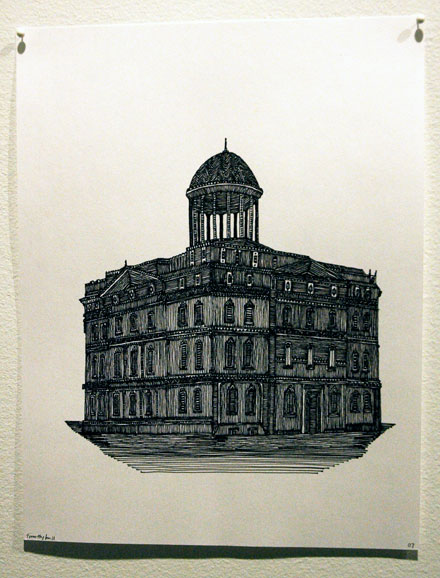
Timothy Marvel Hull Untitled 2007 ink on paper 11″ x 8.5″ [installation view]
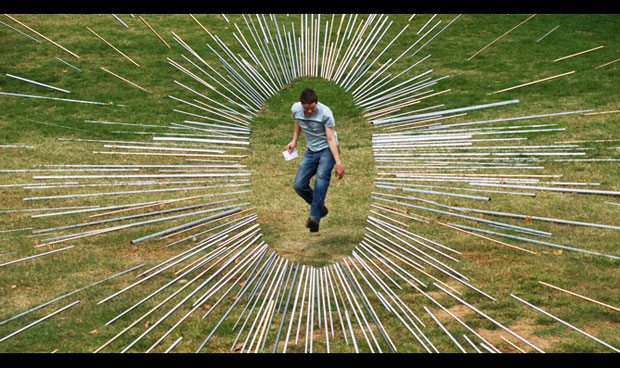
Tex Jernigan [one image, not in this show, from “One: Across America” (2006)]
Lauren Ross has curated a very neat group show, “Divine Find“, inside a new space in SoHo. Yes, SoHo, and it’s even northern SoHo. Er . . . it’s actually just north of Houston, so technically it might be in NoSoHo. The artists are Timothy Marvel Hull, Tex Jernigan, Christopher Miner, Mariah Robertson and Peter Rostovsky, and the theme is described in the press release as “locating the sacred in the commonplace”.
I’m pretty sure that phrase doesn’t refer to the venue itself. The gallery Artspace Stonefox is no commonplace. Showing emerging art in a working office: It’s a great concept, and I’ve seen it happen before, sometimes with mixed success. The curating must be sensitive to the art and the environment, as it is here, and even with the best wills and the finest curatorial resources it’s not an innovation easily accomplished – or reproduced – since neither the appearance nor the routine of most office environments lends itself to the requirements of a gallery space. Cheers to the people of Stonefox for going out of their way to do it, for doing it right, and for playing such gracious and enthusiastic hosts. The architecture and design firm has set aside a significant portion of their office to create Stonefox Artspace. They describe it as a temporary project and exhibition space. A lot of artists and curators will be hoping that “temporary” only refers to the duration of individual shows.
This one continues until December 4th. Since it is an office, we shouldn’t complain that (except by appointment) the hours are Monday through Friday only, from 12 to 6.
But a small note about the exhibition itself: If I leave wanting to run to my computer for more information about the artist or artists, a show has been a success, at least for me, and that goes for any art, including performance. This one more than qualifies, since a day later I’m still wanting more and frustrated with how little I can find on line. Christopher Miner is a good example: Try looking around yourself, and you’ll see why I’m going to have to visit Mitchell-Innes & Nash.
I’ve learned to trust Lauren Ross.
[second image from Tex Jernigan]
“Out of the Box” (continued)
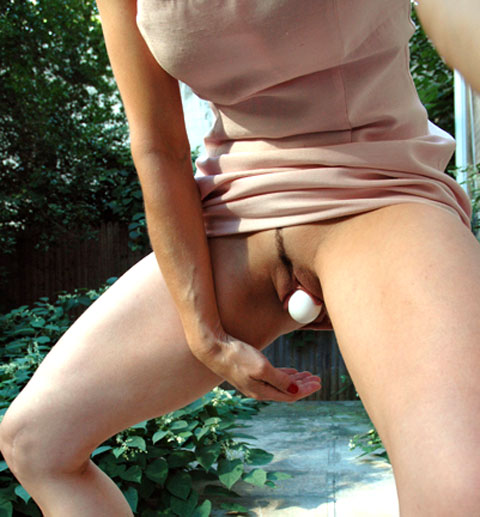
Heide Hatry Expectations IV, 2007 C-print
Since my Friday post about “Out of the Box” show at Elga Wimmer I’ve gone back to the desk and written a paragraph on each of the artists included in the installation:
Regina Jose Galindo‘s 47-minute video, “Piel” [skin], documents the artist striding very deliberately over the stones of Venice, beginning at a stone wall of a busy passage where she shears and completely shaves the hair from her body and scalp and removes all of her clothing. It ends simply, with very little drama, on a broad terrace at the edge of the Grand Canal. The performance requires the participation of both her cameraman and the many pedestrians we encounter along the way, most of them remarkably indifferent to her appearance. This piece, like many in this show, left me wondering what the effect might have been had the the artist been presenting to her collaborators a body less beautiful than the one we see here.
In the past Heide Hatry has repeatedly worked with another kind of epidermis, pigskin, and it’s the one most closely related to the one we all share. In the video diptych she shows here however, which she has titled “Adaptations” [2 min 47 sec], she works with her own, and not much else. The work represents two very different, even extreme, responses to the fulfillment of the principle biological function of a woman’s body, birth. We first see her naked in an leafy Eden of sorts, giving birth and immediately performing the role which society has traditionally demanded of one half of its members, that of nurturing mother. In the second segment another successful (and equally abbreviated) labor ends with a very different outcome for a young, smartly dressed professional carrying her MacBook out of that same jungle.
Sonia Khurana may first attract our attention because the proportions of her naked body represent something less than the modern ideal, but her art is what holds us, and it’s the art which brings us back. “Bird” [3 min 20 sec] finds the artist in a number of excited dances magically eliciting imagery related to its title. The silence of the video and the gorgeous purple, satiny sheen and bleeding contrast of the picture is extremely attractive and a perfect instrument for this tender piece. Khurana’s success in realizing her avian compulsion may be improbable, but we are first curious, then charmed, even solicitous, but finally we are captivated by the documentation of her efforts.
Carolee Schneemann is both the inspiration for and the grande dame among the artists in this show, and so perhaps that is why she is represented by two [more or less separate] pieces. The first is “Unexpectedly Research” (1992) something of a “story board” of laser prints and text representing performance work done in the twenty years after 1962. The more recent piece is the video, “Cave” (1995) [7 min 30 sec], projected high on a wall not visible until the visitor has completely entered the gallery. The sound dominates the room, and eventually the images themselves become inescapable, composed as they are of documentation of a 1995 group performance which included the artist and seven other nude women re-enacting her 1975 piece, “Interior Scroll”, where she painted her body with mud slowly extracted a paper scroll from her vagina while reading from it.
He Chengyao‘s has always used nakedness in her art, and her art has usually related to her personal experience of growing up in a Chinese society far less open to individuality than today. Whatever difficulties she had to overcome in a rural county were magnified by a nightmare which arose from the circumstances of He’s birth. Her mother suffered a nervous breakdown and subsequent insanity brought on by community displeasure and a social and economic ostracism, but the family survived together. Her mother has been a part of most of He’s work that I have been able to see on line. Her mother does not appear in the piece included here, “Broadcast Exercise” (2004) [5 min], but since its traditional Chinese exercise form relates to the conventions and solidarity of a rigid society as much as to the conflicting demands of attachment and independence, her mother is not really very far away.
Considering the richness, the tragedy and the hope represented by the modern history of her ancient homeland, it’s no surprise that Minette Vari’s identity as a South African is very much a part of her art, but “REM” is more than an evocation of that history. It’s a gorgeous strip of animation with the wondrous feeling of the earliest form of “film”, more “magic lantern” than modern, manipulated video. In a dreamy, continuous loop images representing the glorious and the horrible in the geography and culture of the South African experience float behind a cut-out of Vari herself, the proportions of her torso and limbs expanding and contracting in a luxurious weightlessness. The figure is that of the artist sleeping, hence the title. The poses and the magnificent bulk of her thighs suggest the heroes found on early Greek, red-figured pottery as much as images found in Bushman cave paintings.
[image from Heide Hatry]
“Out of the Box” at Elga Wimmer
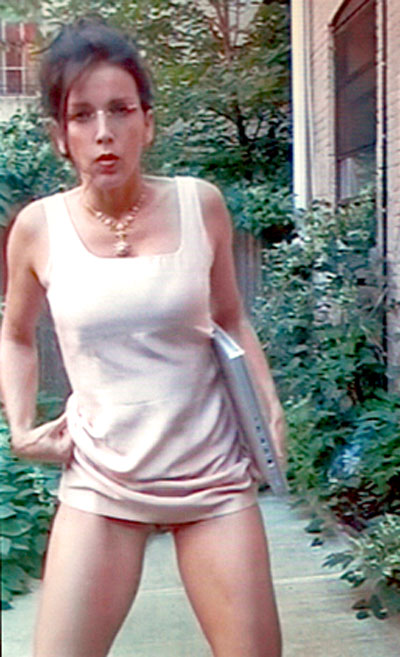
Heide Hatry Expectations 2007 [still from video]
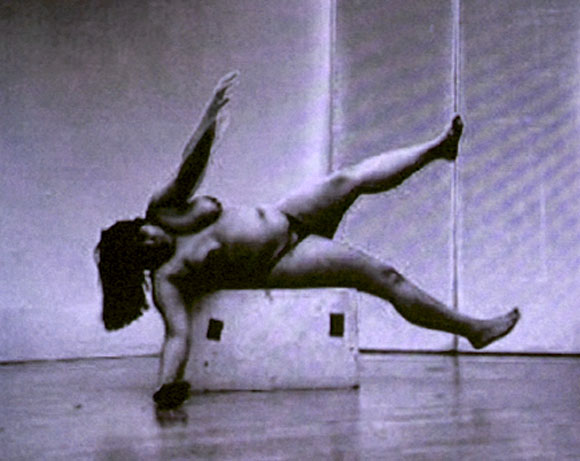
Sonia Khurana Bird 2000 [still from silent, b&w video]
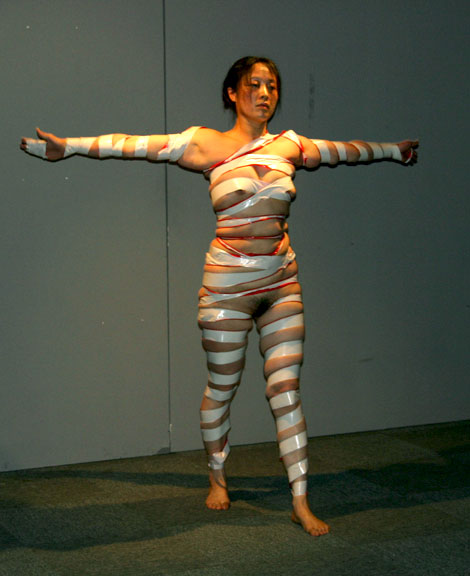
He Chengyao Broadcast Exercise 2004 [still from video]
I’d always felt very much an outsider when it came to art by women which might involve an assertive sexuality,. I confess this failing or inadequacy in spite of my natural inclination to welcome and embrace the unconventional or the anomalous – in art or almost anything else. Yes, I’m a guy, but while my neuroses may be those of a male, they are those of a queer male. Should that make it easier or more difficult to reach across the barrier? Could the circumstances of my pre-1960’s dating experiences (dissembling in order to survive, but fearing any intimacy with women since it might call for performance) have allowed a healthy relationship to women’s bodies even with the best will? Intimacy with a body matters, and heterosexuals and bisexuals may always get a head start in understanding gender – if not sex.
Whatever the answers, I humbly admit that the show currently installed at Elga Wimmer, of performance art influenced by Carolee Schneemann and other trailblazers, was a major breakthrough for me. “Out of the Box” was curated by Wimmer and Heide Hatry. I had wanted to visit the show because of my long experience with Wimmer’s excellent program, because of my interest in anything related to Schnnemann, and because I was interested in Sonia Khurana, one of the artists. The exhibition, of both video and still images, is a small miracle, “small” only because of the physical limitations of the gallery’s size. The artists are Regina José Galindo, Heide Hatry, Sonia Khurana, Carolee Schneemann, He Chengyao and Minette Vari. This small group includes women who began working in Latin America, Europe, Asia, North America, China and Africa, and it represents living artists of all ages.
They work with in very different materials and they communicate very different things, but all of the is courageous and tight; the art is breathtaking and ravishing; the statements are both incredibly intimate and extraordinarily public.
ADDENDUM:
See a subsequent post for more on the works themselves.
[images from Heide Hatry]
“The Blogger Show” at Agni Gallery
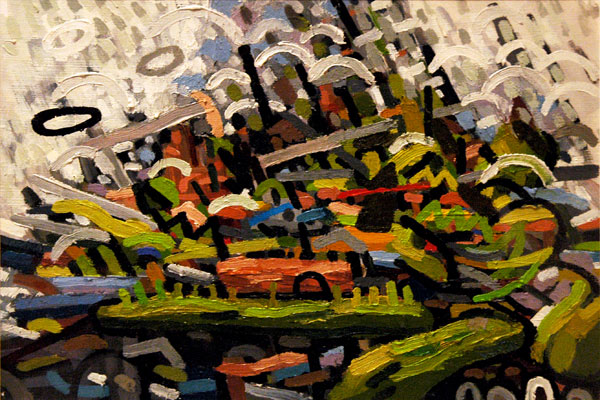
Cable Griffith Summer Pile 2007 oil on paper 11″ x 17″ [Seattle-based blog: Cable Griffith]
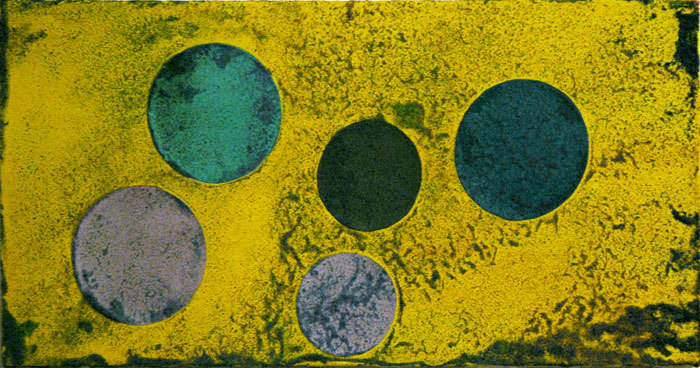
Martin Bromirski Untitled painting on canvas 8″ x 16″ [formerly Richmond-based, and now a New York State-based blog: anaba]
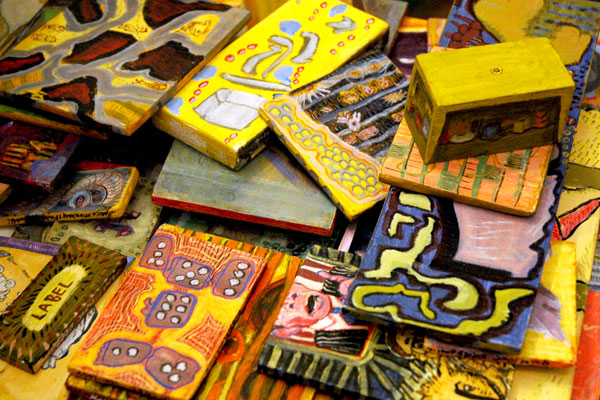
Fallon and Rosof 48 Useful Paintings from the Useful Painting Series 2001-2006 (this is a random pile of small paintings on found wood scraps) [Philadelphia-based blog: roberta fallon and libby rosof’s artblog]
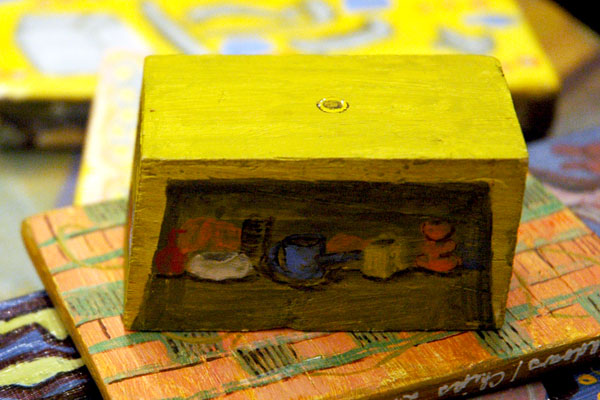
[detail, table from above]
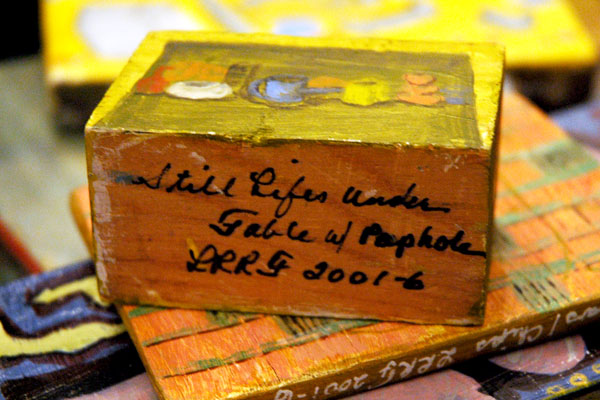
[detail, table upturned]
Bloggers do it on line – and some do it in studios too.
These folks don’t just blog about Art; they’re making some of that stuff themselves. There are some real treasures at “The Blogger Show“, installed at Agni Gallery in the East Village through January 12. Unfortunately I can only show a very few of them here.
The show was organized by John Morris and Pittsburgh’s Digging Pit Gallery. It’s actually a joint venture with Panza Gallery in Millvale, Pennsylvania. A list of the thirty or so artist/bloggers from around the country who are represented in the New York edition, together with the names of their blogs, can be found on the show’s own site, which is actually a blog itself. Looking at the art they produce it would seem they have nothing in common but their blogging, but there’s also an enormous, shared enthusiasm for other people’s work, something which couldn’t be missed when I met many of them at the New York opening earlier this month.
Claire Oliver shuts out photographers
NO CAMERAS!
Barry and I had decided to stop by receptions at only two or possibly three galleries last night. At one point during the evening a friend of ours asked if we had seen the show at Claire Oliver. He had liked work by the artists (AES+F) he had seen elsewhere earlier this year. We told him we hadn’t been there. I wasn’t even aware there was an opening at Claire Oliver, mostly* because the gallery doesn’t usually show work that would attract us, and when it comes to receptions (only), we usually end up going to those where we know the artist, the gallerist or where we expect to know some of the crowd (even then, a return visit is usually necessary to see the art itself).
Not long after our conversation with our friend we realized we were passing by Claire Oliver’s space on the way to our next stop so we decided to check it out. A minute or two after entering the front door we were in a room on the lower level watching a video. It seemed to us it would be the nucleus of the show’s photographic images upstairs, so we had decided to start there. Seconds after I snapped a still image of the projection with my camera a gentleman stepped up to me, from I’m not sure where, to inform me that photography was not permitted. I turned around and we both went back upstairs. There I handed my card to the two women at the desk and asked them to give it to the director informing she or he that I was an enthusiastic fan of the arts, and a committed art blogger, but I had no interest in visiting, broadcasting or reviewing shows where photography was prohibited to anyone.
If this post is more strongly worded than most of my art entries, it’s because it’s not about a particular artist (collaborative) or a particular gallery, but because I feel very strongly about ensuring and increasing the public’s access and enlarging its connection to art, and issues involving cameras and photography are very much a part of this discussion and my activism. It’s always about control, just as it is when the controllers are outside the white box.
Claire Oliver has been added to a list of galleries whose shows I will neither discuss on this site, nor visit personally, because they maintain camera prohibitions. Shows will also not be recorded in ArtCal if the editors know there is a camera prohibition. There are some galleries which maintain prohibitions that are selective or vague, making avoidance more complicated and imperfect, but leaving the principle and its effect no less crucial. This list is subject to change, and above all we will welcome news which will enable us to remove names.
This is the annotated list at the moment:
303 Gallery (one show)
Gagosian (one show)
Capla Kesting
Jonathan LeVine
Pace on West 22nd Street
Paul Kasmin (vague)
Claire Oliver
*
Only once has the gallery’s name ever shown up on either of our blogs before. The story of our experience then might help account for our shared lack of enthusiasm for Claire Oliver. Oddly, it has a connection (almost certainly a coincidence) with last night’s incident. Nearly four years ago we found ourselves in the gallery’s old space on 20th Street during an earlier show by the same artists. This is from Barry’s post on December 7, 2003:
On 20th Street we tried to see AES+F’s King of the Forest at Claire Oliver, but I didn’t feel like spending much time with the work, given the reception from the gallery guy working there. We had come in from the snow to check out the show, and given that it’s a highly conceptual show, it seemed reasonable to ask to see the press release or checklist. His response? “Sorry, my friend. The show’s coming down today, and we’ve given out all of the materials.” Ugh. No wonder sometimes people want to go into galleries and say, “Oy, shopgirl!“