Lawrence Weiner at Pocket Utopia

Weiner_Show_Hurst_poster.jpg
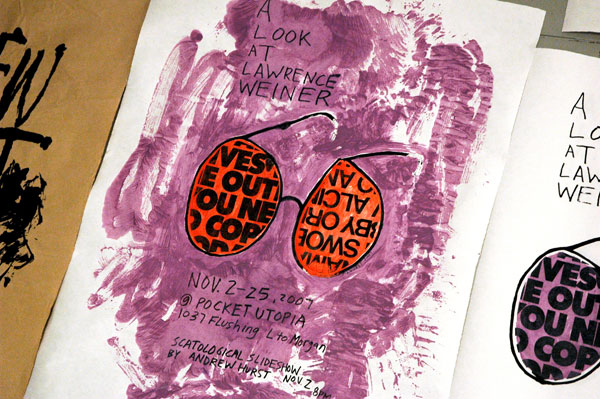
detail of a selection of Andrew Hurst‘s posters for the show
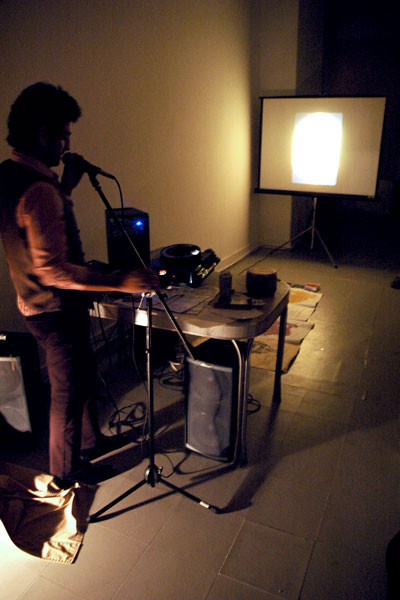
Weiner_Lawrence_Andrew_Hurst_performance.jpg
a moment during Hurst’s sound and slide show performance, created specifically for the opening
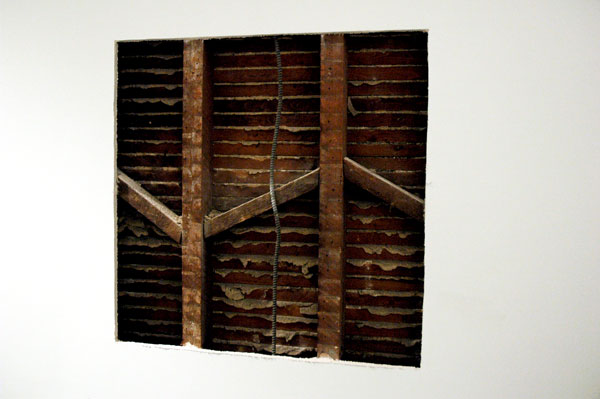
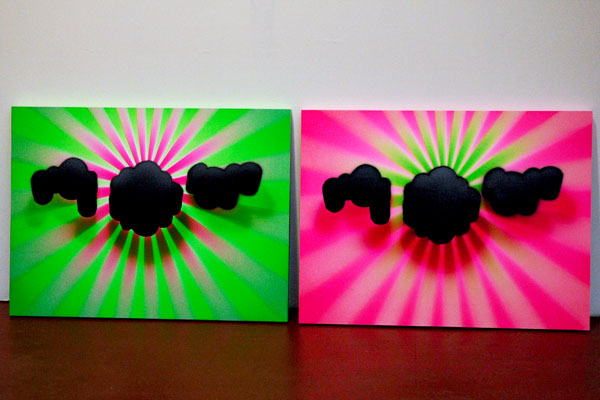
Weiner_Lawrence_A_Re-Creation.jpg
a re-creation of a piece referencing painting, which Weiner first exhibited in New York in 1968
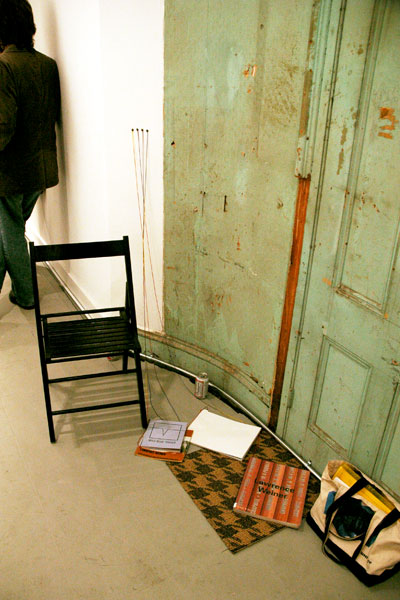
Weiner_Lawrence_Reading_Room.jpg
one of several reading room areas reserved for further study of Lawrence’s work
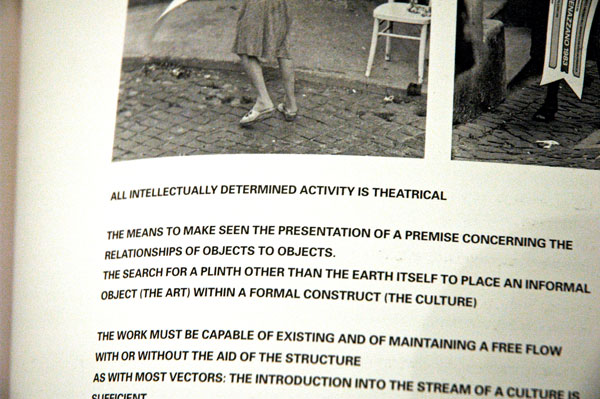
Weiner_Lawrence_the_open_book.jpg
holding the camera in my right hand, I picked up a book with my left and it opened here
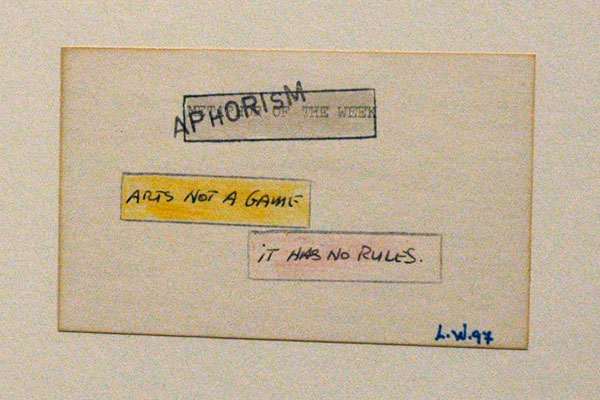
Weiner_Lawrence_Aphorism.jpg
a Weiner text piece, reading, “Aphorism of the Week: Art is not a game, it has no rules” (1997), the medium being rubber stamp, with colored pencil, pen and paint on paper 4″ x 6″ [installation view]

A Lawrence Weiner Salon” at Pocket Utopia may be one of the coolest shows in the city right now, not just because it was launched by Austin Thomas, and not because I still can’t figure out what’s going on in there. I’ve tripped over this modern icon for years, and the enigmatic promise of his work never disappoints. While I’ve always been convinced he’s the real thing, I don’t mind admitting that I should have some spent time in the several comfortable “Reading Rooms” scattered about the gallery this month.
All l dare offer here are some images snapped before the opening got too crowded, and this excerpt from the press release:

Pocket Utopia is pleased to organize an experimental salon of conceptual art’s key figure Lawrence Weiner. The salon will feature a reading room, a re-creation (“A 36″ x 36″ Removal to the Lathing or Support Wall of Plaster or Wallboard From a Wall,” 1968) and a text piece. Weiner has long pursued inquiries into language and art-making and posits a radical redefinition of the artist/viewer relationship and the very nature of the artwork. Here too, the venue or gallery and its relationship to the artist also gets redefined.

ADDENDUM: In related news from inside today’s NYTimes, Roberta Smith (who almost never ventures into Brooklyn’s high-yielding art fields these days) writes about the Weiner exhibition which just opened at the Whitney: “Be grateful, then, for Lawrence Weiner’s mind-stretching 40-year retrospective at the Whitney Museum of American Art, which is respite, wake-up call and purification rite all in one. It should be required viewing for anyone interested in today’s art, especially people who frequent contemporary art auctions.” She ends her review:

Driven by the joy of language and quite a bit of humor, Mr. Weiner’s ebullient work asks tough questions about who makes or owns art, where it can occur and how long it lasts. It reminds us that while art and money may have been inextricably entwined throughout most of history, art’s real value is not measured in strings of zeros, high-priced materials or bravura skill, but in communication, experience, economy of means (the true beauty) and, yes, the inspired disturbance of all status quos.
It also affirms that art ultimately triggers some kind of transcendence that can only be completed by the viewer. Mr. Weiner has elevated Robert Rauschenberg’s famous dictum – to the effect that “this is art if I say so” – to the more inclusive “this is art if you think so.” His polymorphous efforts create situations in which such thoughts feel not only natural, they feel like our own.

Ooooh.

One more reason to head for hot and friendly Bushwick this week: Thomas has declared this Saturday afternoon “Social Saturday at Pocket Utopia”. The gallery’s two artists in residence [not named] will be “receiving” from 4 to 6 pm, and the curious are invited to meet and discuss their continuing work. The announcement also mentions something about a “beeramid”.
Dan Levenson’s “Little Switzerland” at EFA

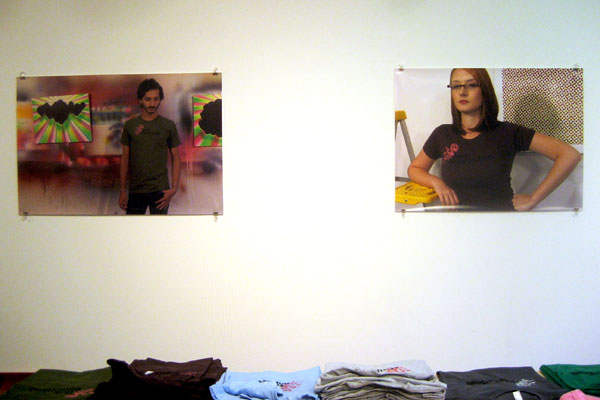
Levenson_Dan_Little_Switzerland_two_photos.jpg
images of two fictive young Swiss artists hanging above the t-shirt and thong table

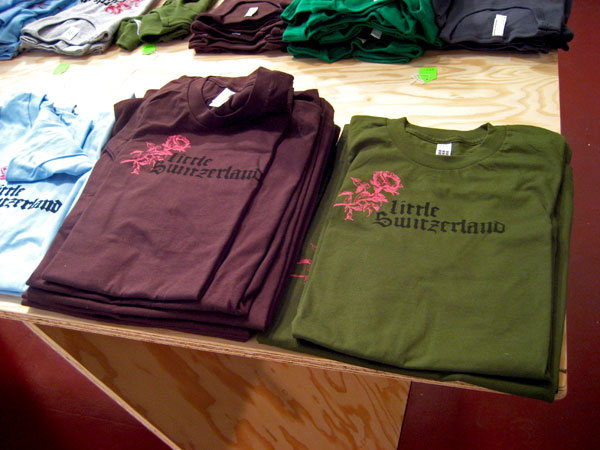
Levenson_Dan_Little_Switzerland_table.jpg
a detail of the t-shirt display, showing the gallery’s unforgettable logo

What does an excellent young artist do when he wants to stretch his wings and diversify his brand or just investigate other tracks, and at the same time exercise his previously-tested and proven performance skills? Dan Levenson decided to open a shop, er . . . gallery.
Levenson was already known for his very smart, beautiful and bright, pop/torquey/Neo-Geo/black hole/bleeding-edge/perspectived, acrylic confections. I mean all of that in the very best sense: I’ve really liked everything I’ve seen him do. He’s also initiated some very cool conceptual projects [see FrEE MoMA!]. This fall the artist turned his studio at the Elizabeth Foundation [EFA] into an imaginary Berlin art boutique representing young Swiss (we probably don’t have to ask why “Swiss”) art and its accoutrements.
The invitation Levenson sent out to his open studio installation, “Little Switzerland” reads as follows:

A Switzerland of the Mind
For three days this week, a Swiss art gallery will open its doors in Manhattan. Little Switzerland is a Berlin-based art gallery representing a roster of eight emerging Swiss artists. None of this would be unusual except for the fact that the gallery doesn’t really exist, and the artists are all the fictional creation of one (American) artist: Dan Levenson.
This year Little Switzerland will present large-scale color photographs showing several of the gallery artists at work in their Zürich studios and modeling the new line of Little Switzerland branded apparel featuring the gallery’s distinctive logo. Little Switzerland apparel will be on sale for those who’d like to become a part of this conceptual project.
-Hans-Ruedi Girschweiler, Zürich

What visitors found when they arrived in Suite 506 was the artist’s conceptual project itself. Dressed minimally in commercial-looking photographs of the loft-like gallery’s eight artists posed inside their tidy studios as well as several examples of their paintings, executed in eight different styles (all ghosted by Levenson), the installation also included a stylish modern table and a chic industrial-pipe wheeled hanging rack, where various kinds and sizes of clothing and drinking vessels bearing the Little Switzerland brand – which always appears in German Fraktur – were displayed and offered for sale.
I really liked the photographs, enjoying the invented world each represented. I can also say that at least some of the paintings and drawings their creator attributes to his fictional artists could stand on their own, without help from the conceit carved by their Gepetto. Check the site. I wonder whether and where his experience with them might take Levenson from here? Oh yes, there were also some super examples of the very latest in Levenson’s primary and continuing series of paintings, the more recent of them incorporating elements of stylized, slinky highway markers (or star tracks?).
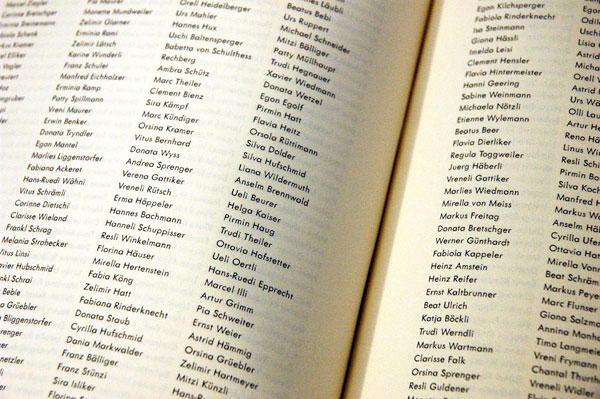
One of my favorite things was a thick, black, generic, fabric-bound artist-published book, “SWISS ARTISTS”. Inside there were 650 pages, each running four columns of full names printed in small type (not arranged alphabetically, so not very Swiss, it would seem). The given names were from a book of Helvetian baby names; the family names were taken from the Zurich phone book. I think I heard that there were no repeats, but I know I was told that Filip Noterdaeme bought a copy. Now Noterdaeme’s partner Daniel Isengart reads to him from the book every night before they retire. Even without a sensitivity to sound, to Dada and surrealism, this is poetry.

Levenson_Dan_two_paintings.jpg
two of the artist’s own recent paintings

Levenson_Dan_Swiss_Artists_book.jpg
the opened name book, “SWISS ARTISTS”

[first two images from Barry]

notes from the Asian Contemporary Art Fair [ACAF]

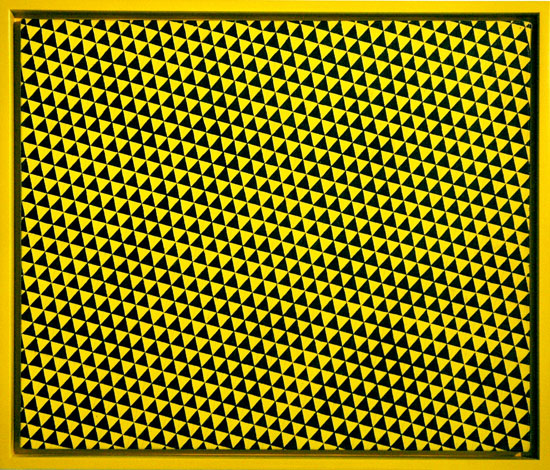
Yayoi_Kusama_ATM.jpg
a small Yayoi Kusama painting from the mid-sixties (less than 2′ square)

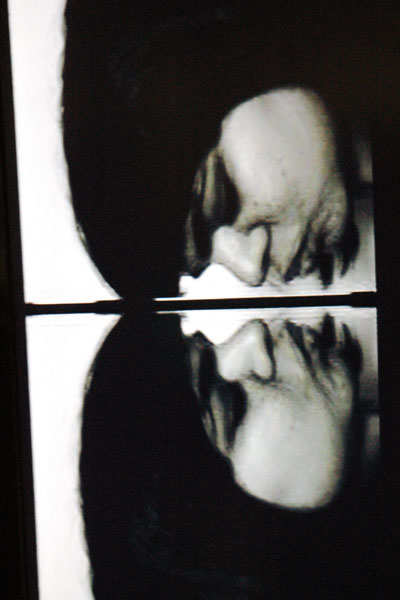
Khurana_Sonia_Lone_Women.jpg
Sonia Khurana Lone Women Don’t Lie 1999 video [large detail of still from installation]

Mekhala_Bahl_Gallery_Espace.jpg
Mekhala Bahl Ramp and Slide acrylic, ink and collage on printed canvas 60″ x 60.5″ [large detail, including reflections on plexiglas]

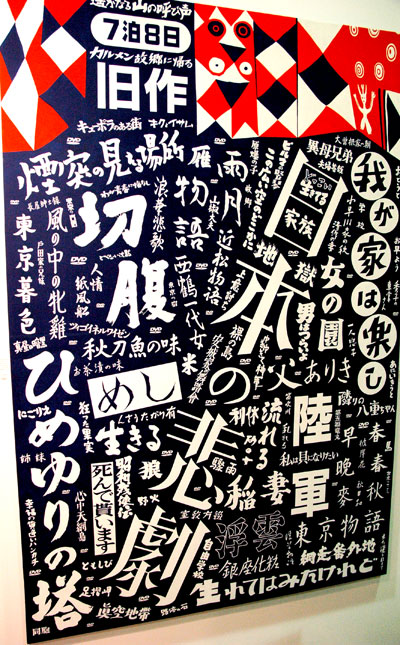
Junya_Koike_Japanese_Tragedy.jpg
Junya Koike Japanese Movie/Japanese Tragedy 2006 (approximately 5′ high) [large detail of installation]
Junya_Koike_Yae-chan.jpg
Junya Koike Japanese Movie/Yae-chan, the girl next door and TANGE Sazen 2006 (approximately 1.5′ x 2′)
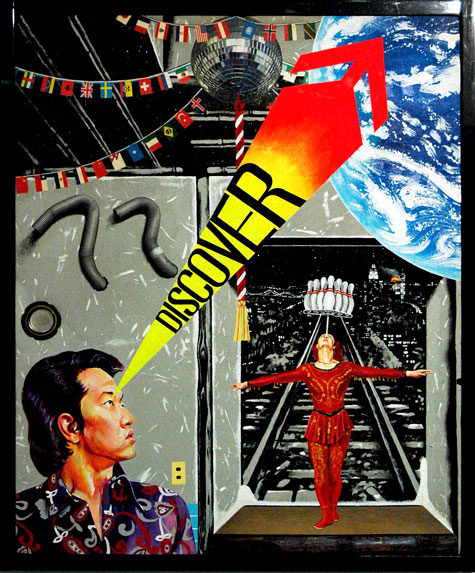
Junya_Koike_Discover.jpg
Junya Koike “DISCOVER JAPAN” 4 2001 (approximately 2′ square)

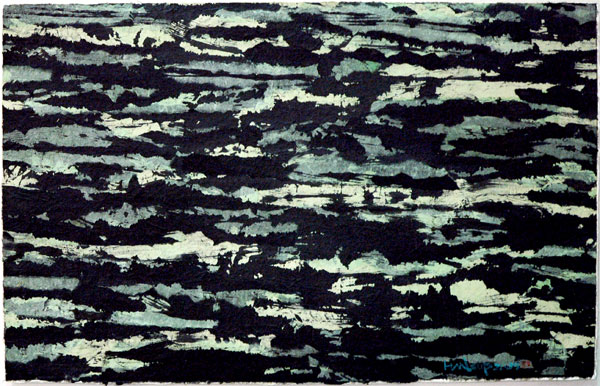
Young-Sup_Han_green_Chosun.jpg
work on paper by Young-Sup Han (approximately 3′ wide)

I want to see everything, because my interests are pretty broad, but I’m getting better at “filtering” the work I engage with when visiting large art fairs. Even in the outside world I’ve always been able to make myself pretty much blind to anything visual that doesn’t please me (unless I decide I have to look). For an arguably-too-sensitive guy huddled inside this pretty tawdry and often incredibly shoddy modern American civilization, I think it stems largely from an instinct for aesthetic survival. When it comes to the specific environment within art exhibitions, or even the pattern of a long afternoon going from one gallery to another, it’s more a simple matter of the triage required by calendar-keeping and blogging obligations.
My visit to the Asian Contemporary Art Fair is a good example of what I’m talking about. I really don’t remember much about the bad stuff, but in this post I’m sharing a few of the more memorable things I did come back with.
The attractive booth of Bill Brady’s ATM gallery (New York) near the entrance had the dazzling piece by Yayoi Kusama shown above. I remember first being introduced to Op Art in 1963 by an artist friend studying in Munich while I was there myself under a DAAD fellowship. It was very exciting, and it was also like being a privileged initiate in a new cult. Now over forty years later I have to say this piece looks better than anything I saw then or since. It’s an alien life form which positively shimmers inside its handsome yellow box.
Gallery Espace in New Delhi was to me one of the best exhibitors in the show, if not the best. My favorite works were the videos and video stills of Sonia Khurana* (Barry and I both love this artist), the paintings of Mekhala Bahl, and the photographs of Ravi Agarwal.
Junya Koike was represented by Tokyo’s Gallery Yamaguchi. The large graphics of “Japanese Movie/Japanese Tragedy” was what first attracted me, but the smaller pieces with film and invented images are just as successful.
The Seoul-based gallery Chosun had a few very beautiful paper abstractions by Young-Sup Han. I was as least as much interested to two smaller monochromatic pieces; I’m not showing them here only because they were hung very high and my photographs were disappointing.
Among the other works I remember well were a very impressive Mannerist Wei Dong in the Goedhuis booth (New York, London, Beijing); u-fan Lee’s delicate drawings at Jean Art (Seoul) and Wool Ga-Choi’s delightful small oils, each titled “for enjoy play”, also at Jean Art; the intense, compulsive beauties of Anil Revri’s canvases at Sundaram Tagore (New York); and Li Luming’s small, gray Richter-ish paintings at Alexander Ochs (Berlin and Beijing).
And then there was the “Simulasian” exhibition, a very interesting show within the show, curated by Eric C. Shimer and Lilly Wei. There I saw Ataro Satu’s large paper drawing installation (courtesy of Mehr Midtown), Ran Hwang’s huge pink Buddhist wall sculpture (courtesy of 2 X 13 Gallery), Chitra Ganesh’s wonderfully-disturbing mixed-medium-on-board pink and blue goddess (courtesy of Thomas Erben), some more Yayoi Kusama, and much more.
Oh, a reminder to those who can take advantage of it, tomorrow is the last day of the fair. It’s open from 11 to 5, and on this day it’s totally free.
And an editor’s note: Assembling this post would have been much easier, and the information more complete, had I been able to take home a catalog Thursday night. They had run out by the time we left; we were told they would put one in the mail, but that was no help in the meantime. I thank my hard-working digital camera for its excellent note-taking skills almost every day of the week, but it can only record what the label tells it – and that’s if there’s a label.

*
Khurana will be part of what is sure to be a fascinating show at Elga Wimmer opening on Tuesday in Chelsea. “Out of the Box: Body Related Performance Art After Carolee Schneemann” includes work by Schneemann, Heide Hatry, He Cheng Yao, Minnette Vari, Regina José Galindo and Khurana.

Asian Contemporary Art Fair

ACAF_server_Lu_Peng.jpg
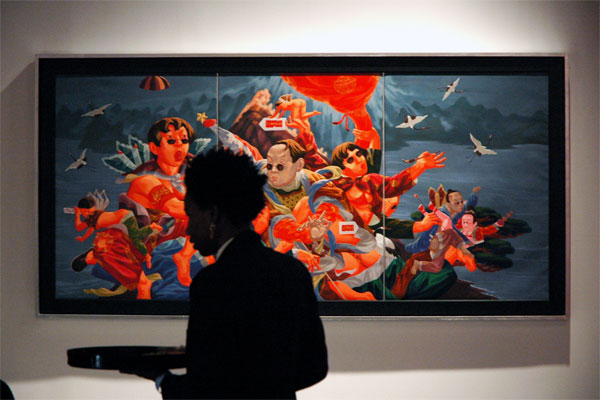
Lu Peng showed up everywhere, but this particular painting was holed up in the VIP room

We were at the preview reception of the Asian Contemporary Art Fair last night. As a veteran of just about every similar event held in New York over the last ten years I think I may say with some authority that this one is more than worthy of an excursion to Pier 92.
Right now I don’t have the time to go into even some of what I thought were the highlights (we were with family today and then decided to run off to Williamsburg tonight), but since the show exists only through Monday, I wanted to get the word out. We saw lots of really good work, both old (well, at most a few decades old) and new, and I think it means something that we spent almost four hours there without expecting to, particularly as we had hoped to fulfill two other obligations that same evening. We didn’t make either.
The work looked great, the entire fair had a very good vibe last night (no “attitude”) and the whole thing is very well run. Admission, by the way, is only five dollars for students and seniors, and Monday is free for everyone.

ACAF_speakers_platform.jpg
from his lofty “Watchtower“performance artist Cai Qing’s signs alternately warned us of the coming Asian invasion

ACAF_conversation.jpg
gallerist and fans converse at the booth of Gallery Yamaguchi

ACAF_Hiroshi_Sunairi.jpg
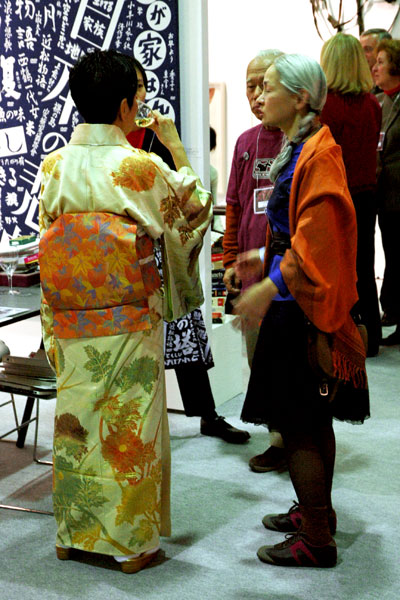
distinguished artist and teacher Hiroshi Sunairi greets admirer

Duke Riley at Magnan Projects

Riley_Duke_cat_vitrine.jpg
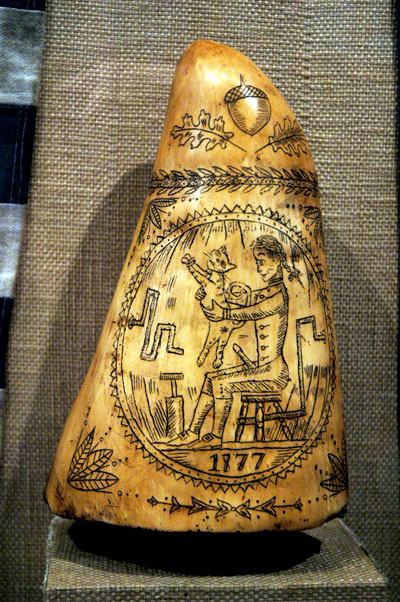
Duke Riley Burgees attributed to seditious faction of Marblehead Militia 2007 [detail of vitrine displaying items salvaged from the vessel, including “Tooth of giant sperm whale believed to have been engraved by Davis”]

Riley_Duke_diver_love.jpg
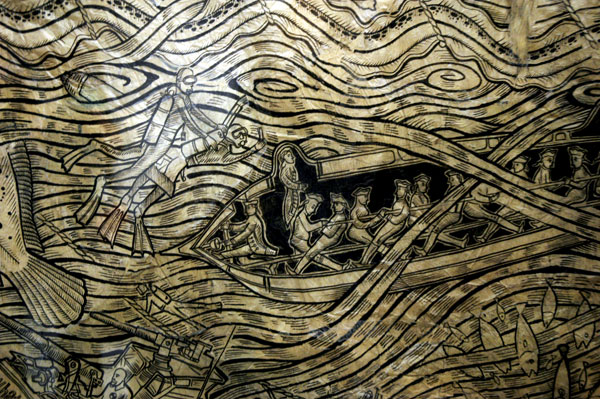
Duke Riley After the Battle of Brooklyn 2007 ink on canary paper 87″ x 86″ [detail of installation]

Riley_Duke_submarine_yard.jpg
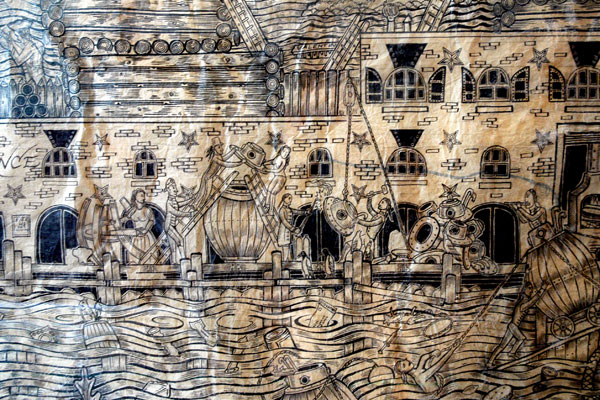
Duke Riley Curtains for the Free World 2007 ink on canary paper 74″ x 111″ [detail of installation]

Riley_Duke_NYPD_gun_video_still.jpg


Riley_Duke_The_Acorn.jpg
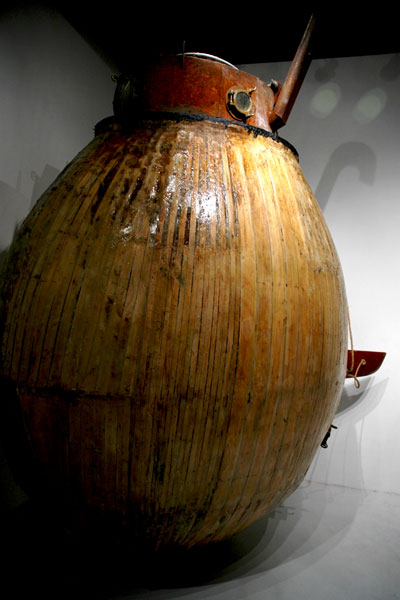
Duke Riley The Acorn Submarine 2007 approximately 8′ x 6′ [installation view]
Riley_Duke_Acorn_cabin2.jpg
[detail of the The Acorn cabin seen through the lower porthole revealing ship’s library, evidence of exhausted rum ration, and hull damage suffered during seizure of the vessel by the Coast Guard]
Riley_Duke_Acorn_book_detail.jpg
[detail of The Acorn cabin revealing ship’s library]

By this time readers of this blog won’t be surprised to hear that Barry and I were at Thursday’s opening of Duke Riley’s show at Magnan Projects, “After the Battle of Brooklyn: East River Incognita II”.
This time we are treated to the story of the interrupted voyage “The Acorn”. The gallery press release explains that Riley’s gallery projects are presented in gallery spaces in museum-like settings, with “artifacts of questionable provenance and mock documentaries . . . presented alongside drawings and mosaics”.

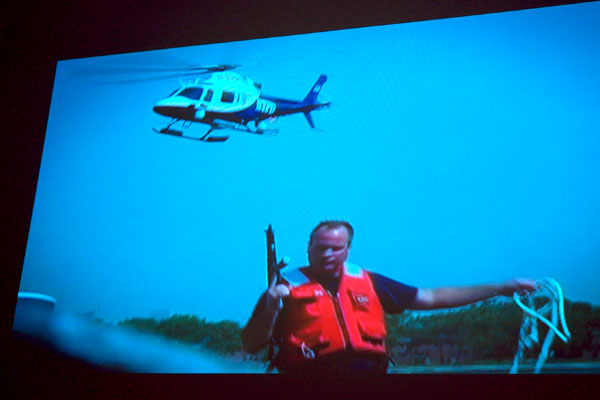
This exhibition, After the Battle of Brooklyn, revolves around historical obscurities that took place in New York during the American Revolutionary War. In addition to drawings, mosaics and videos, Riley constructed a replica of the first primitive Revolutionary War submarine (“The Turtle”) that is propelled by a hand crank and submersible for up to 20 minutes. In 1776 George Washington’s Continental Army used these subs to target the British flagship The Eagle. Putting a contemporary spin on this idea, Riley launched his submarine (“The Acorn”) while the Queen Mary 2 was docked in the Brooklyn Harbor and captured the attention of the Coast Guard, NYPD and major newspapers.

Riley’s art appeals, and succeeds in its appeal, on virtually every level. He shows a remarkable degree of comfort with both his materials and his subject, and he uses it to describe a very personal relationship to a mélange of regional geography and history, the twenty-first century’s politics of disaster and absurdity, the inescapable claims and demands of the media (including a self-referential look at news coverage of his arrest with the “Acorn” submariner), the shape of our environment and the complexity and the complications of a contemporary community, a rich surviving mythology and a healthy and very graphic omnisexuality, all of these embedded in an infectious wit. That sounds like a lot of ground to cover, but it really is all there, and it’s regularly delivered to us with enormous charm, in both visual and performance art forms.
Superficially each of these pieces may at first have the aspect of a homey, antique craft and the performances may look like stunts, but it’s the art that survives our scrutiny and in the end his hand skills and his adventurous exploits are revealed to be only some of the many tools Riley recruits to create this vigorous body of very creative work.

Because of the nature of the exhibition and the relative narrowness of the museum/gallery, your humble correspondent has had to confine his visual documentation to detail images of some of the displays. He would like to assure the reader that the work handsomely rewards a much less abridged examination.
The installation continues through December 22.

J. J. Garfinkel at Hogar Collection

Garfinkel_J_J_Myriad_Quay.jpg
J. J. Garfinkel Myriad Quay 2007 acrylic and oil on panel 45″ x 48″

Garfinkel_J_J_Myriad_Quay_detail.jpg
[detail]

Garfinkel_J_J_Scribble_Terrace.jpg
J. J. Garfinkel Scribble Terrace 2007 acrylic and oil on panel 45″ x 48″

Garfinkel_J_J_Clingman_Rope.jpg
J. J. Garfinkel Clingman Rope 2006 acrylic and oil on panel 30″ x 24″

Although it took a few minutes of walking about the space and talking to Martin, probably the sweetest gallery dog in New York, I eventually became so taken with this work that I found it very difficult to leave. That doesn’t happen very often, no matter how much I like a show.
Nine paintings by J. J. Garfinkel are currently installed at Hogar Collection in “View Sheds” the artist’s first solo show with the gallery. Every one of them is terrific, with a very strong presence. They’re two-dimensional, except for some closely-outlined fields of wavy-textured brushwork, but the viewer sees – and feels – more than just a surface. The combination of the artist’s elegant pallet of colors, both muted and dazzling, the variety of his surface finishes, and his layering of images in combinations as disciplined as they are organic suggests nine fantastic miniature jeweled landscapes inside three-dimensional illuminated dioramas.
Because the exotic, sophisticated beauty of the paintings can’t be isolated from Garfinkel’s skill in representing their material properties, nothing can replace the experience of standing in front of them, but I’m hoping that these images, especially with the inclusion of one detail shot, will help account for my excitement.

Adam John Stennett at 31 Grand

Stennett_Adam_girlintub2.jpg
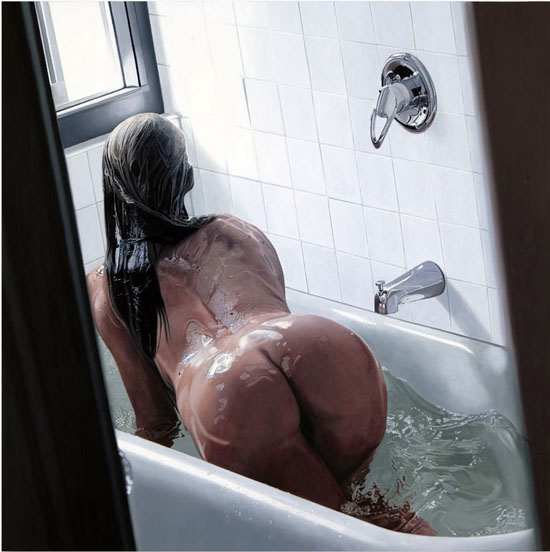
Adam Stennett Girl in Bathtub 2007 oil on wood 48″ x 48″
Stennett_Adam_girlinbathtub_detail2.jpg
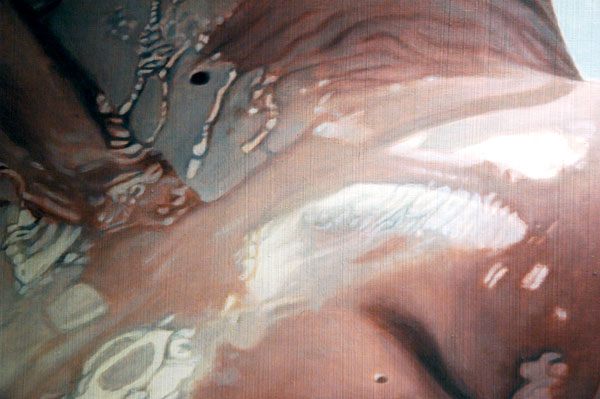
[detail]

It’s not just another pretty face. I’m having a hard time getting this painting out of my head. I can’t explain it, especially since I’m just about one hundred percent gay. I know it’s not just what Adam Stennett does with the illusion of polished chrome, of wetness and of water itself, because it’s not just this painting that gets to me. While I was in 31 Grand last week I made an effort to capture only this particular work from among the four others in the artist’s current show, each an image of a beautiful woman swigging from a bottle of Tussin DM cough formula as if it were some kind of candy cocaine, but I now find its siblings at least as compelling. Go to the 31 Grand site to see what I mean, and if you are able, get to the gallery before November 10.
And what happened to the cute little rodents so prominent in Stennett’s earlier work?
The gallery press release explains:

With this show he continues his exploration of the intimate dramas of the everyday, and the precarious balance of awareness and oblivion. His subject matter has evolved—the adventurous mice that had been his trademark are now replaced by images of girls poised precariously near turbulent water and various medicinal products put to queasy, off-label uses.

I don’t think photorealism has ever looked so seductive, but I’m almost as excited about the abstract beauty which shows up in a closeup image.
Oh, my own photo image of the complete painting couldn’t come close to the perfection of the gallery’s own jpeg, which I ended up using here. I scuttled my own photo and settled for showing only the detail.
Stennett also has a short video in the room at the rear of the gallery. It’s quite strange, and quite wonderful.

Stennet_Adam_harmfulvideostill10opti.jpg
Adam Stennett Harmful or Fatal if Swallowed 2007 video [still]

[first and third images from 31 Grand]

perhaps we need more mirrors

charm_bracelet_for_chair.jpg
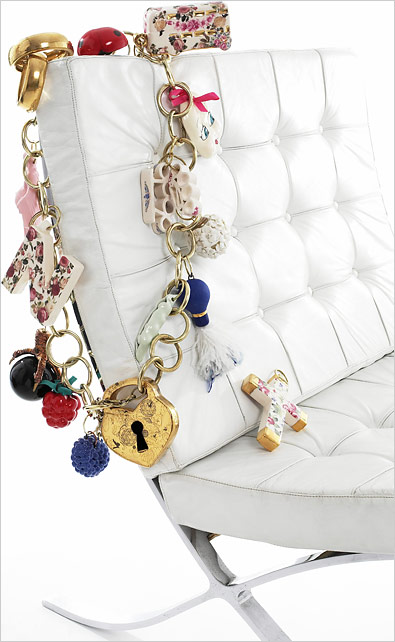
FINISHING TOUCH The giant charm bracelet by Nicola Malkin, a designer and ceramicist, is typically displayed on chairs, large tables or bedposts, as at the J. Roaman furnishings store in East Hampton, N.Y.

I don’t think anything could better express the empty hideous aesthetic which is companion to our new age of robber baronry than this image of monied, store-bought style which succeeds so perfectly in evoking the late Victorian, Philistine monstrosities of the last one.
The NYTimes article in yesterday’s “Home & Garden” section begins:

At J. Roaman, a home furnishings store in East Hampton, N.Y., a painted white iron bed wears a giant charm bracelet over its left head post. The bracelet isn’t there because the bed wants for visual interest; it’s already enveloped in a brightly colored quilt by Lisa Corti, a Milanese designer, and topped with four pillows, five throw pillows and a bolster. The reason for the jewelry, according to Judi Roaman, a former fashion retailer who opened the store in May, is that furniture, like any carefully curated outfit, should express its owner’s personality. “Accessories make the bed into who you want her to be,” she explained.

I thought at first it must certainly be a satire. While it certainly is, it’s not intentional.
I can only hope this is the beginning of the end.

[image and unexpurgated caption from the Times]

coming soon: Duke Riley at Magnan Projects

Riley_Duke_Queen_Mary_2.jpg
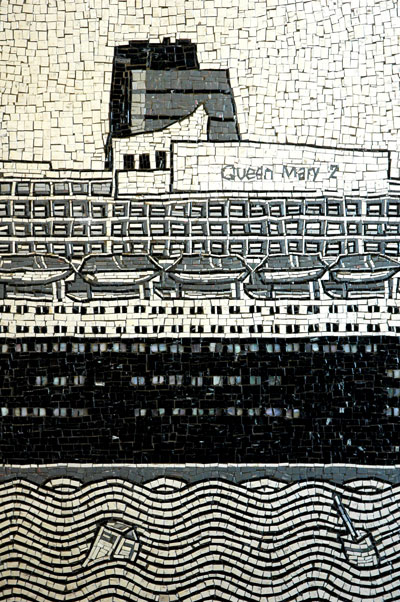
detail of Duke Riley’s enormous mosaic of the current British flagship in New York waters*

We managed to slip into Magnan Projects this afternoon for a peek at the Duke Riley show, “After The Battle of Brooklyn”, opening in just two days. Of course I was totally smitten with the work, even if much of it was still being put together. Don’t miss it, even if you can’t make it to the opening reception.
I almost never do this sort of thing and I’m not quite sure why I’m now posting this particular preview. It’s not as if the artist needs the extra attention, especially thanks to the advance work of the NYPD, the US Coast Guard and the NYTimes. It’s already pretty unlikely there will be any room to move inside the gallery on Thursday evening.

*
we note the carefully-rendered port-a-john and drink cup floating in foreground

we go live at CUE Arts Foundation tonight with Brian Sholis

cue_logo.gif

Tonight Barry and I will be in conversation with the writer and critic Brian Sholis at the arts education and support forum, CUE Art Foundation, as part of its career development program for artists called “Meeting Artists’ Needs”.
The announced topic for the evening is “In the Public Eye: The Role of Today’s Critic”. The event, scheduled from 6:30 to 8 pm, is free for CUE members and $5 for non-members. CUE is located at 511 West 25th Street on the ground floor. Tickets may be reserved here.

[image of logo from CUE]