
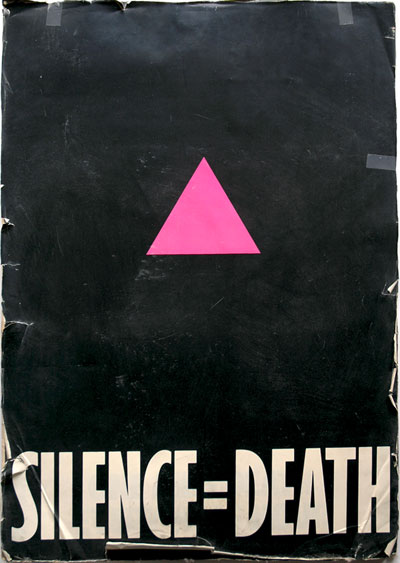
I never thought we’d still be doing this 20 years on. The image above is of a thin stenciled sign I held up on the steps of the Metropolitan Museum of Art August 1, 1989.
I thought of it as a work of art; I was thinking of both the sign and the afternoon.
I didn’t make the sign. Along with a lot of others just like it, and any number of other images and texts, it was a small, elegant part of a powerful New York demonstration protesting the Corcoran Gallery of Art’s cancellation of the D.C. exhibition of the show, “Robert Mapplethorpe: The Perfect Moment” and the Helms Amendment. The amendment was designed to prohibit the National Endowment for the Arts (NEA) funds from ever being used for so-called “obscene” or “indecent” materials, descriptions that at the time had repeatedly been applied to much of Mapplethorpe’s art, and to that of Andres Serrano, who had also become a target in what was being called the American “culture wars.”
While the artists attacked became more famous than ever, neither the NEA nor our other cultural institutions ever recovered from the assault on their artistic integrity and independence. I’m reluctant to employ the war metaphor (we’re going off in every direction with real wars already), but I think most people would say that, whatever it is called, a fundamental culture struggle continues today: There are too many frightened people in this country, and too many anxious to profit from that fear.
Bill Donohue is a vile and disgusting little opportunist with a computer and a fan base which he regularly whips up to get them to send checks his way. A retrogressive darling of the crazy Right, he invents issues and targets which can attract enough visibility to provoke the fears and hatreds of ignorant older Catholics, allowing him to draw a very generous salary of some $400,000 a year. His primary targets are gays, jews, women, progressives of any kind, and all news media (excepting the just-pretend one, Fox).
While Donohue does not represent the Catholic Church, officially or otherwise, he operates within its comfort zone. He may be the crazy ranting uncle everyone would like to ignore, but the Church hierarchy has never disavowed anything he has said; and they all go to the same banquets.
I thought that the kind of primitive depravity he represents had been pretty much squished twenty years ago, but on the 1st of December, which was, whether incidentally or not, World AIDS Day, the head of the Smithsonian, institutional parent of the National Portrait Gallery, pulled the David Wojnarowicz video, “A Fire in My Belly.” from the excellent NPG exhibition, “Hide/Seek,” and apologized for its contents. The show had already been open for an entire month when complaints from Donohue’s Catholic League, several Right-wing House Republicans, and Fox News [sic] resulted in its peremptory censorship, or debasement.
So we have a professional gay-bashing Catholic fanatic leaning on two fellow political and social fundamentalists, House Republicans John Boehner and Eric Cantor, to blackmail a great museum by threatening to cut its funding if it did not remove a work of art to which the Catholic nut objected. Viz. ants on a crucifix. We know it’s not about ants: Donohue and his own coterie are unhappy about everything that has happened in the West since the suppression of the Spanish Inquisition. His Republican fellow-travelers may be in it for power, but their sympathies may actually be sincere, however warped.
I hate to do anything to give more visibility to Bill Donohue, or his Congressional altar boys, but this madness has now been covered by the media everywhere, and roundly condemned in as many places, and the Smithsonian has so far failed to reinstall the art it was so anxious to agree with the nasty little man was offensive.
PUT IT BACK – NOW!
A lot of people are going to be on Fifth Avenue this Sunday demanding that the Wojnarowicz video be returned to the National Portrait Gallery. We will be demonstrating as colorfully and dramatically as we can that we care about censorship and homophobia.
We have to be there, at one o’clock on the steps of the Met, Fifth Avenue and 82nd Street. And why the Met? Because it’s the front porch of the art world, because there’s plenty of space and a grandstand of sorts. From there the group will march up to the Cooper-Hewitt Museum, which actually is a part of the Smithsonian.
The 1989 demo included the ACT UP group “Art Positive” (broadcasting a double meaning for the second word); the primary target then was homophobia and censorship. The 2010 demo will include members of the 1989 collaborative, and the entire demonstration has been designated “ART+” (only a slightly altered written form of the 1989 name); the primary target is essentially, and shockingly, the same, homophobia and censorship.
But since we’re talking about the public treatment of work by an artist closely identified with a disease which as a nation we still haven’t fully confronted, the subject of AIDS must not be left out of the discussion. Silence does equal death.
Finally, because we are dealing with people identifying themselves as representing the interests of the Catholic Church, we also have to understand that the targets of their assault necessarily include all women everywhere.
And there’s more: America’s continuing failure as a society to deal with what it thinks of as the very scary subjects of sex and art (and not only when they are combined, or ignited by the inclusion of AIDS) is inseparable from the ignorance and fear which prevents it from addressing our newest, and rapidly-mushrooming real problems.
In this country the public conversation always gets back to religion (if it ever leaves it in the first place). Organized and intensifying public religion gums up the works of virtualy every institution and increasingly ties our hands when we have to deal with impending national and planetary disasters. We may never grow up enough to understand the damage it has done and continues to do, but there’s a slim hope that a larger percentage of the next generation will be able to think for itself.
For more information on the censorship outrage:
ART+ [the demonstration site]
Modern Art Notes [Tyler Green – one of many posts]
NEWSgrist [Joy Garnett – see many posts]
Diamanda Gal�s [Washington City Paper, Arts Desk]
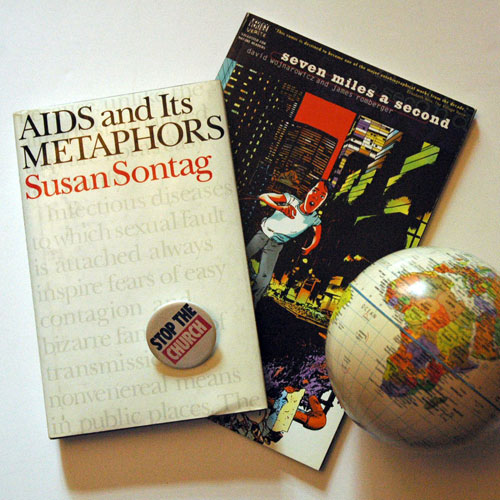
[the second image is of a slightly-battered veteran ACT UP foamcore-mounted sign which spends its retirement leaning on a wall in our apartment, a constant reminder; the third photograph includes, in addition to the Sontag volume and an old ACT UP “Stop the Church” button, the cover of “Seven Miles a Second“, a posthumously-completed graphic novel written by Wojnarowicz in collaboration with James Romberger and Marguerite Van Cook, and a small globe turned toward Africa]
Category: Culture
finally, almost the entire “Big Bambú” experience

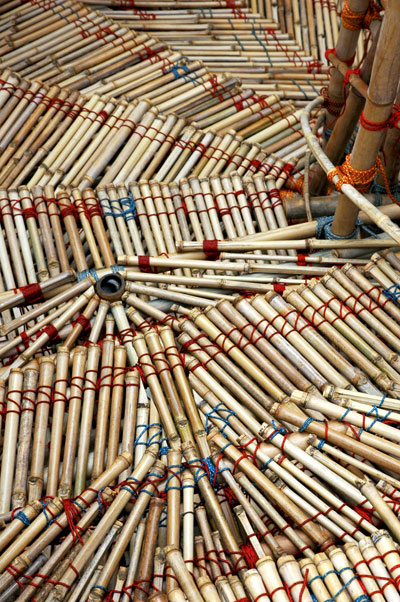
The last time we were on the roof of the Metropolitan Museum we were partially rained out, even if it was not quite raining. It was the press preview of the completed first stage of Brothers Mike and Doug Starn‘s extraordinary installation, “Big Bambú” (the Museum closes the beautiful bamboo gates if the surfaces are too wet). We were only able to admire the “forest” from below and, staring up, we could only imagine the experience of actually walking along its ascending, curving, elevated trails.
We were back for another try last Monday, four months later, also to see how much more had been completed by the artists and their team of rock climbers in the interim. Since it had been raining earlier in the morning our chances for getting any higher than we had in April didn’t look good, but we were eager to chance it (it was another press preview and we would be able to record the work with our cameras).
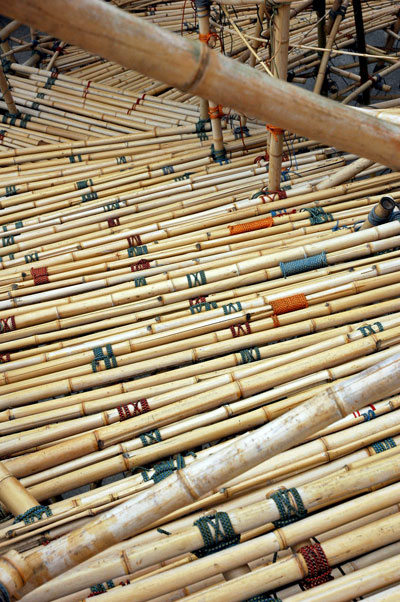
We did check roof conditions with the Communications Department before we left, and it sounded promising. By the time we arrived at two the rain had long stopped and a favorable zephyr had done much to dry the reeds. The rewards of our gentle climb were those of being able to see the beauties of the work’s more functional forms close up, and the thrill of knowing we were walking where no one would have been able to before this spring, and would not be able to again after this fall.
Once up in the air, born by the squeaky bamboo and its nylon bindings, seduced by the rhythms and the patterns of the paths, and listening to the sound of birds on a misty afternoon, I found it very difficult to come back down. Only the sight of two hawks circling high above, visible through a clearing of the tapering verticals, could remind me of my customary attachment to the earth.
We slowly retraced our steps to the roof surface, and still we lingered.
Oh, by the way, “Big Bambú” is big, and getting still bigger: It’s probably about the size of the Temple of Dendur downstairs. Maybe bigger.






downtown “Dream Hotel” shows off its portholes
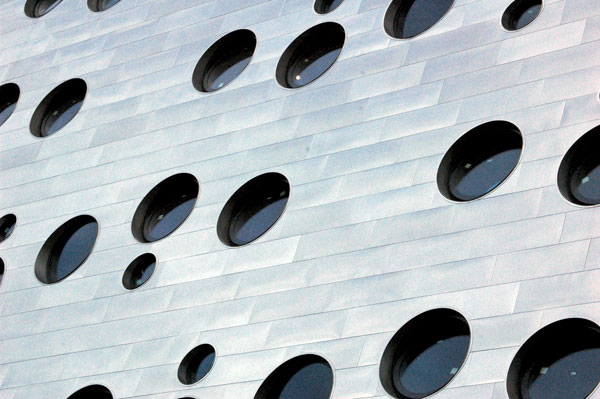
Because I believe so strongly in preserving an interesting building’s integrity, and an artist’s vision, I find it hard to say this, but what’s happening to the building that once housed Fr. Bruce Ritter‘s Covenant House shelter for homeless and runaway youth may just possibly be an improvement over the original concept – and execution.
I’ve now seen what looks to be the almost-finished “Dream Hotel Downtown” of hotelier Vikram Chatwal, located at 346 West 17th Street. It is a refitting of a building designed and constructed for the Maritime Union half a century ago to accommodate medical and recreational facilities for its members. The 11-story building is located behind the re-conceived Maritime Hotel, and both eccentric structures were designed by a young architect named Albert Ledner.
I remember the buildings when they were new, and the excitement they created, and I’m delighted that at least two of this architect’s trio of Village commissions has survived at all.
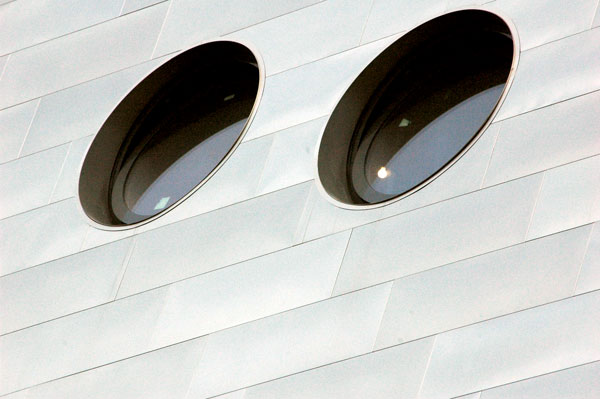
I say that the new building may be an improvement because, while I’ve always loved its perfect round windows, along with their beautifully-crafted frames and hopper-like opening mechanisms, the new dancing pattern punched out by the current design team, Handel Architects LLP, in two different sizes of openings, really makes me smile. Also, the building’s original tiny ceramic tiles were replaced by stucco years ago, probably because of problems inherent in the materials, and the way the horizontal lines of the (tile-like) rectangles composing the new shiny (hull-like) metal skin wrap around the tilted corners of the main facade, and dip down along the sides, showcases a very different effect, one at least equal to the 1960’s original.
The overall building shape remains unchanged.
Now if only somebody would change that name: “Dream Hotel” scares me silly.
NOTE: Except for its romance-novel appellation, I think I could love this building, but now I’m wondering if it’s already a doomed affair: While looking for additional information on the building’s design and construction, and searching, sometimes fruitlessly, for links to incorporate in this blog, I got the impression that the project may be on hold. There are some indications that the “dream” may be trouble, because of problems related to money, the health of the principal, or (perhaps the least daunting challenge) engineering problems, and I notice that the hotel web site itself is still “under construction”.
Saint-Gaudens’ “Hiawatha”, and Manifest Destiny
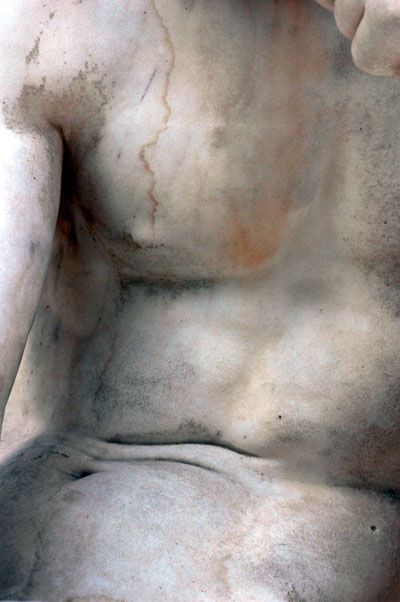
Augustus Saint-Gaudens Hiawatha in clay, 1871-1872; this marble carving, 1874, 7 feet 9 inches high, including pedestal [detail]
Barry and I were leaving the Metropolitan Museum cafe in the American Wing yesterday when we passed the Saint-Gaudens marble “Hiawatha”. I must have passed it any number of times before, but now I found myself zeroing in on the beautifully-modeled torso of this noble young man, created by an artist who was only about 23 himself when he began the work in clay. Then, thinking about the date, 1870, I thought about the time and geography of the work’s origins.
In the very midst of the beginnings of the last segment of our protracted Indian wars, a very young Augustus Saint-Gaudens, fled Paris, where he had studied for three years, on the outbreak of the Franco-Prussian War. He settled in Rome in late 1870 where he began work on “Hiawatha”, his first full-length statue. His inspiration was the legendary Chippewa chief and founder of the Iroquois confederacy who was the main protagonist in Henry Wadsworth Longfellow’s enormously popular 1955 poem, “The Song of Hiawatha“*.
In 1870 Saint-Gaudens’ native country was still nursing the wounds of the Civil War; France and Germany were engaged in a duel which quickly realized the end of one empire and the birth of another, both with enormous consequences which continue today; the Italian army had crossed the papal frontier (finally completing the wars for unification), in the same month the artist arrived in Rome. Saint-Gaudens however was otherwise engaged.
The War Between the States may have ended (he had been too young to participate), but there was hardly going to be any peace on the other side of the Atlantic, where twenty more years of wars directly impacted – in fact completely devastated – the people represented in his early masterpiece.
Americans were eager to settle the lands which had been opened up in the west, and Civil War veterans, adventurers and misfits were volunteering to secure their right to be there, defending it from the legitimate claims of the peoples we were already making into legends and heroes. The United States was determined to fulfill its own peoples’ “manifest destiny” and would not allow what remained of native American civilizations to stand in the way of its claim to the “Land of Many Uses“. In spite of occasional sensational – and hugely popularized – news events like “Custer’s Last Stand”**, the full horror of these last Indian Wars was largely removed from the consciousness of Americans back east, much as in the case of our own wars today.
It was all over by 1890: Providence had made the entire country safe for the American Empire, but the devil had taken the hindmost; the Indian was now almost gone, and almost forgotten, except where and how it served the victors to remember him.
But it is a beautiful statue.
*
The fame and legend attached to both the poem and its subject continued well into the 20th century: I remember my class being told in grade school to memorize the trochaic tetrameter of this Longfellow poem, and we barely questioned the assignment (I never got beyond a few stanzas).
**
When my own family drove west in the big Buick on a long vacation 55 years ago, the Little Big Horn ranked extremely high on our own list of “must sees”, and in fact, I’ve never forgotten my impressions of that sad, and then still very desolate, little-visited place.
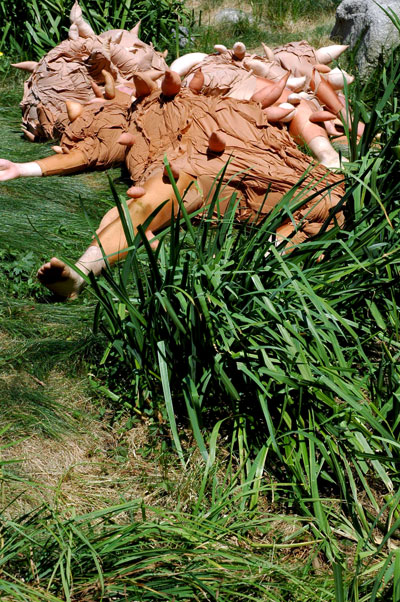
“The Voyage of Garbhglas” at the Irish Hunger Memorial
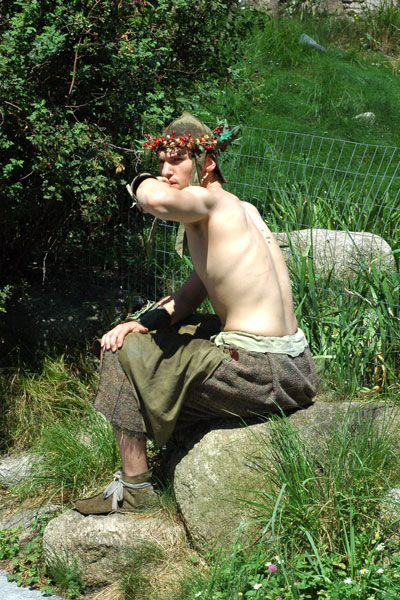
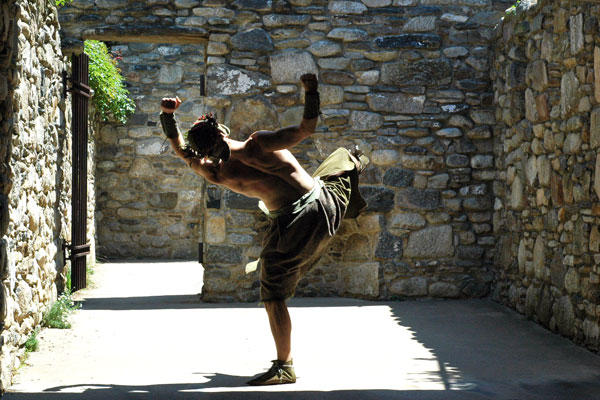
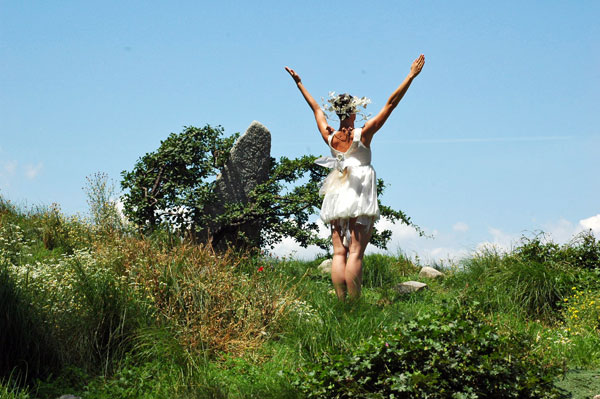
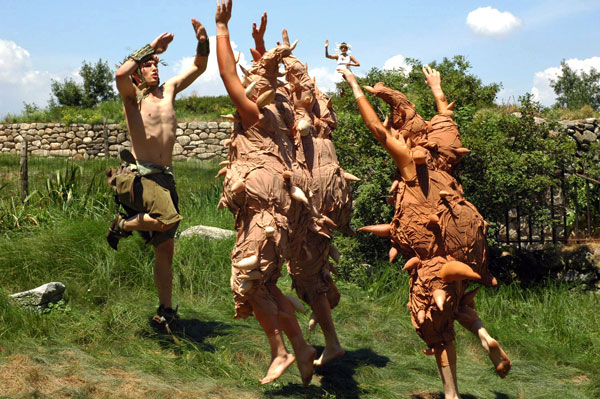
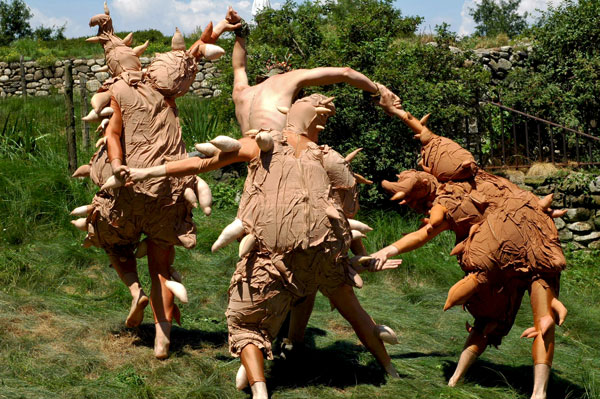
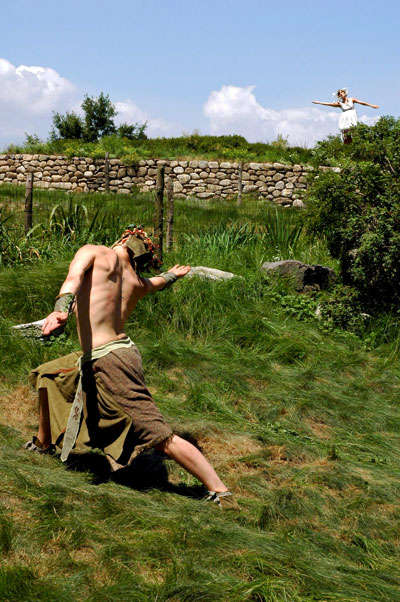
Barry and I headed for the Irish Hunger Memorial shortly after noon on Monday (after my visit to City Hall Park) to see an excerpt of “The Voyage of Garbhglas“, choreographed by Christopher Williams and presented, courtesy of the Lower Manhattan Cultural Council, as a part of the River To River Festival.
It was a total delight, a magical allusion to ancient Irish faerie lore performed in a magical Irish place on a beautiful afternoon, and I recommend it to anyone who can make downtown for the two performances remaining, Wednesday and Thursday, at 12:30 each day. The Memorial is located inside Battery Park City, 290 Vesey Street at North End Avenue, an easy, almost straight walk west from the World Trade Center stop of the E train.
The performers were Ursula Eagly, Kira Blazek, Caitlin Scranton, Michael Ingle, Sydney Skybetter, Moses Kaplan, and Andrew Smith. I believe Michael Ingle was the celtic youth, and the three other male dancers were what I’ll call “the tubers”. Christopher Williams himself and Matthew Tutsky played troubadour harps of different sizes, and the music was by Gregory Spears, who can be seen in some of the images directing the singers.
Barry has posted a video, on Bloggy, of a short segment of the 30-minute performance and has a link to his Flickr set.
As someone who tries to take advantage of what New York has to offer culturally, I think a lot about how everyone who would like to see art in performance (in any medium) can find a way to do so without having to deal with discouraging lines, fifth-balcony-in-the-rear seats, or even sold-out notices. In my own case it helps that I’m usually interested in work that most people are unlikely to even be aware of, and I’m lucky to have the leisure to seek it out. But what happens when something really good becomes well known, and suddenly everyone wants to see or hear it?
I was considering this subject with Barry when we left the performance of “Garbhglas”. His answer was that the ideal would be that there would be so much art out there, and really good art, that there would never have to be a line or a crowd. We’d all have so many options that we wouldn’t have to keep bumping into each other, or fight for tickets. Of course that ideal assumes we all think and feel for ourselves and aren’t seduced by the inevitable hype – including, I suppose, in this case, my own modest efforts at making a ballyhoo.
This time the subject had come up because in Monday’s surprisingly intimate, georgic performance by Williams’ dancers and musicians, while everything took place outdoors, it seemed that there was really room on the Memorial’s platform for only about a hundred people to fully experience it, not including whatever the numbers were for those standing on the street below.
While I imagine there must be other things to do at lunch time Wendsday and Thursday, if you go, maybe it wouldn’t be a bad idea to plan on getting to “Garbhglas” early for its final two performances.
“Other Spaces” at Center 548
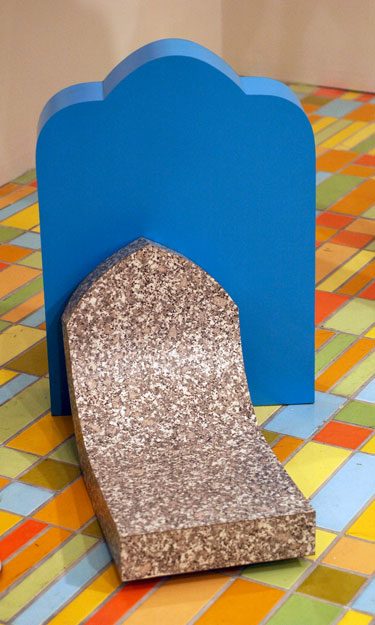
Kristof Wickman Untitled 2008 laminate, mixed media 28″ x 18″ x 22″ [installation view, including a floor section of a work by Jorge Pardo]
“Other Spaces“, an elegantly-installed two-week-long show of work by seven artists, curated by Jayne Drost, is located inside Center 548, the latest designation for the former Dia Center for the Arts space on West 22nd Street.
The small temporary gallery has been carved out of a section of the museum’s former book store, which had itself been reconfigured in 2001 by the artist Jorge Pardo.
The artists in the show are Palma Blank, Leah Dixon, Sam Falls, Left Coast, Daniel Turner, Timothy Uriah Steele, Kristof Wickman.
I was there at the opening on July 18. Because of the crowd, this image of Wickman’s tender, anthropomorphic, warm/hard sculpture was the only clear shot I was able to get with my temporary replacement lens*.
“Other Spaces” closes tomorrow, Friday, at 7.
*
I’m using my Nikkor 60mm macro (equivalent to 90mm on a 35 mm film camera) while my jammed 18-70 zoom is being repaired; I love the macro. It’s a terrific instrument, and for years I used it as a standard lens on my old FM, where it really was a 60, but it just doesn’t work if I want to document art inside galleries and studios, especially with the digital Nikon box I use now.
Sonoma County settles out of court with Clay Green
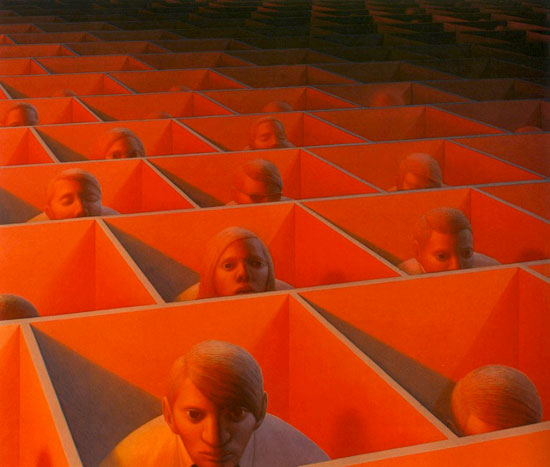
George Tooker Landscape with Figures 1965-1966 egg tempera on pressed wood 25.5″ x 29.5″
we are alone . . . but we are not alone
Their nightmare began only two years ago, and no one can undue the psychological damage done to Clay Green and Harold Scull or return to the surviving spouse the home and virtually all the property and personal possessions the two men had shared for 20 years, but their injuries have finally been acknowledged.
Last Friday, just two days before his suit would have been opened in court, California’s Sonoma County, agreed to a settle Greene’s complaint out of court, for the amount of $653,000. Greene will retain $275,000, his lawyers will take $300,000*, and Scull’s estate will be given the remainder. It was announced in the San Francisco Chronicle that the nursing home will pay $53,000, but it was not made clear where it will end up.
Greene’s suit against Sonoma had claimed that his sexual orientation was the reason social workers had separated him and his dying partner and why the county had summarily sold off their belongings, including shared personal mementos.
Under the terms of the agreement Sonoma County did not admit it had discriminated against the two elderly men, but the county’s lawyer, Gregory Spaulding admitted that there had been �procedural errors� in the disposal of the property.
The Sonoma County Press Democrat** reports that Spaulding said that the error had led to policy improvements at the Public Guardian’s office regarding property disposition and case management, but that he had also spoken on the subject of the Harold and Clay’s own status before the law:
He said the dispute might have been avoided if the men had been able to be legally married or if they had registered as domestic partners. Because they weren’t, their funds were viewed as separate, he said.
�Marital status played a role in what options were available to them,� Spaulding said.
In my April post I pointed out that, while Harold and Clay may not, and today could not, have been married, they had been a couple for 25 years and “. . . had taken the precaution of naming each other both beneficiaries of their respective estates and agents for medical decisions, and the authorities still proceeded as if they had no personal or legal relationship.”
Barry and I know any number of heterosexual couples as friends, and we occasionally ask them whether they have ever had to prove they were married. They inevitably answer no, that they are never asked to furnish copies of their marriage certificates. Some of them in fact had never actually married, and yet they have been able to take advantage of all of the perquisites which are attached to a state which is supposedly carefully circumscribed by law.
People like Harold and Clay – and Barry and James, our friends Jill and Gabriella and others, and millions of other couples around the world – don’t even get to be asked.
*
The National Center for Lesbian Rights in San Francisco had represented Greene, and Amy Todd-Gher was his lawyer, so I’m wondering about this compensation figure.
**
I and a number of other bloggers had complained months ago that like most of the commercial media, the Sonoma County, New York Times-owned paper, the Press Democrat, had long refused to cover this story altogether. The paper has finally acquitted itself with its coverage of the settlement, but this excerpt from the paper’s July 22 post however is a bit disingenuous:
The case grabbed national media attention with its shocking claims of abuse at the hands of those meant to protect the frail and vulnerable. Gay rights groups pummeled county officials with strident e-mail and some threatened a boycott on county tourism and wines.
Although the suit was filed in August 2009, it didn’t become widely known until a report about it ran in April on the website of the National Center for Lesbian Rights.
[image from eric reber]
Johannes Wieland’s roadkill at Dance Theater Workshop
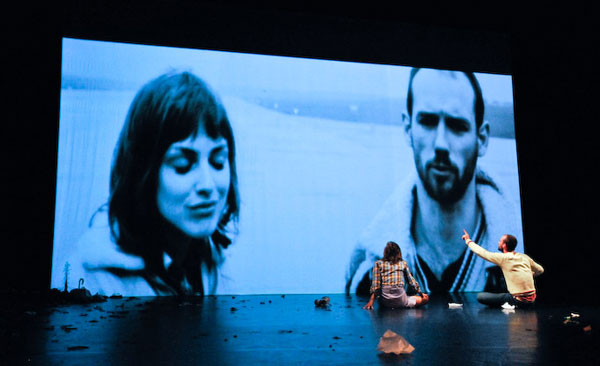
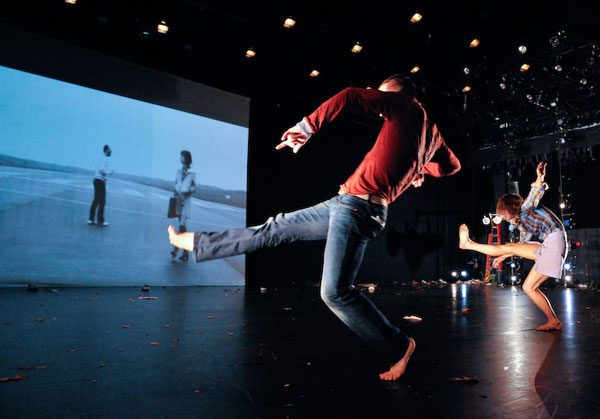
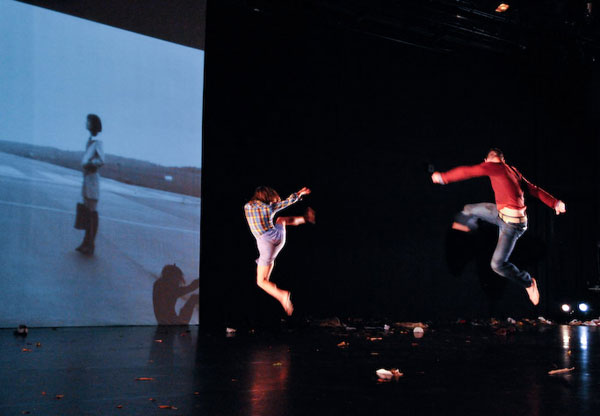
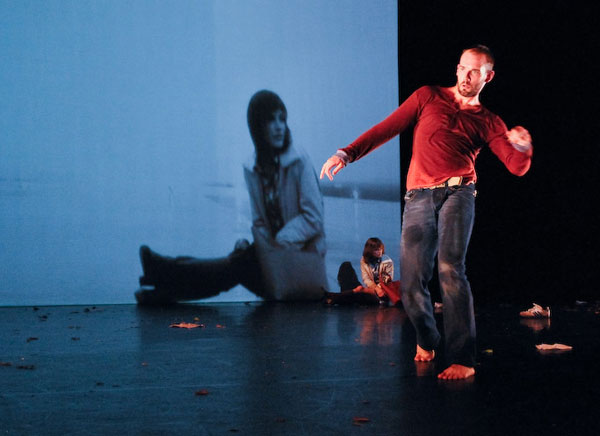
Barry and I went to Dance Theater Workshop [DTW] last night for a performance of “roadkill”, a dance, text, video and music work choreographed by Johannes Wieland. The performers were Ryan Mason and Eva Mohn. They were doubled by their own moving images in the huge projection which dominated half of the far wall. It was a video by Wieland, who was also responsible for the text, the set and the costumes. The music was by Ben Frost.
The piece itself was phenomenal, even by the standards of DTW, and the performers were incredible.
Mohn is an extraordinary dancer and actor (and musician, and one of the most hauntingly beautiful women I’ve ever seen. Mason was no less beautiful, with an incredibly elegant athleticism. He seemed to be in almost constant motion, leaping and spinning in midair, frenetic but disciplined, much of the time dressed in some serious layers of clothing. We watched his body do things I had I would not have thought possible for a mere mortal. Barry said it almost seemed like they both could turn their waists 360 degrees.
The music perfectly matched the dance and the theater; Frost was clearly a full partner in the success of the work.
Don’t miss it.
At the beginning of the performance, a young man and woman in ordinary street clothes are seen stranded on a barren airplane landing strip which is suggested on the stage by random weeds and paper debris. The two people, who appear � quatre, on a real runway through the magic of light, are alternately delighted and frightened by the sudden bizarre circumstances in which they have suddenly found themselves.
I experienced the piece largely as an abstraction, but its recurring and richly-drawn suggestions of narrative and purpose were probably as tantalizing for me and the rest of the audience as they were for the the fictive couples on the floor and on the screen. The press release offers this clue:
As foreigners in their own lives, they awaken with the touchdown of reality.
Delighted in their surreal circumstances, they watch the inevitable chaos of life unfold.
There is a “trailer” of sorts on the DTW site, but it’s just a teaser; in this video of Mason in an excerpt from “Second Hand Luck”, another piece choreographed by Wieland, the dancer does what YouTube label describes as his “underpants dance”. It’s over the top.
These are the “roadkill” performance details:
Performances are tonight, Friday, and Saturday at 8 p.m., Sunday at 5 p.m.
Tickets are $15; $12 for students
The location is Chelsea, 219 West 19th Street
(212) 924-0077
dancetheaterworkshop.org
While we waited for the lights to go down (Mohn and Mason were already hugging the masonry to the right of the screen, with their backs to the audience), I overheard a phrase spoken by someone sitting behind us, something to the effect of, “it’s German, so it will be dark”.
I’m going to step over the basis for that premise here (I’m referring to the common and unaccountably tenacious fallacy about the heaviness, even dismalness, of all things German), but not before I say that it describes a prejudice which I have never been able to share. Mostly because I am pretty familiar with things German, including both historic and contemporary Germanic culture, as well as the people who preserve it and continuously shape it anew, I know there is plenty of both the dark and the light, and everything between as well.
And by the way, “roadkill” isn’t dark. Like all art, it asks only for involvement.
Wieland is a native German, although the dancers and much of the creative team are not. The most German part of the production and the company is probably the form of its patronage: Wieland is fully appreciated as an artist in his own country, and he’s generously supported, by the state.
He originally established his company in New York, in 2002. He’s gone on to amass a large resume with work in the U.S., but in 2007 he was appointed artistic director/choreographer for the resident theater company at the State Theater of Kassel, a town of less than 200,000 people in Hesse, a state with just over 6 million. There he has the full support of the local government, serving the culture at large. Because of this largesse he is able to undertake productions with 30 or more performers, with live musicians, and full orchestras, on all three stages of a modern destination theater.
Kassel, a modest town on the Fulda River, which for over 50 years has played host to Documenta, has an impressive record of support for theater and performance. The history of the State Theater began with the Ottoneum, built in 1604. It was the first purpose-built theater on the continent.
[images provided by the artist Sebastian Lemm]
Book bargains to benefit homeless LGBT Youth

New Alternatives marched in the 2010 NYC Pride Parade last month
A July 10 benefit for New Alternatives for LGBT Homeless Youth will offer both some incredible book bargains and the opportunity to do something for some of the most vulnerable (yet spunkiest) folks in New York. The organization was founded by activist Kate Barnhart, whom I first met some 20 years ago, when she was just about the youngest and most fearless member of ACT UP (and there was serious competition for both roles). She hasn’t slowed down since.
These are the details of the benefit:
Huge Book Sale on July 10
At LGBT Community Center on West 13th Street
Will Benefit Homeless LGBT Youth
�Buy a book, save a young life� fundraiser
Offers ten thousand new volumes on sale
For $10 per shopping bag
NEW YORK, NY, June 28, 2010 � A huge sale of more than ten thousand new and used books will take place in the West Village on July 10, with the proceeds going to charity. The event, called �Buy a Book, Save a Young Life,� will take place on Saturday, July 10 from Noon-6pm at the LGBT Community Center on 13th Street.
The books on sale encompass every subject and genre, including children�s, art, classic and modern literature, as well as collectables and rarities. These books were donated by veteran bookseller Robert Warren, who recently closed his landmark New York bookstore, Skyline Books. Admission is free to this event, and people can fill a shopping bag full of books and pay $10 per bag.
All proceeds of the �Buy a Book, Save a Young Life� sale will benefit New Alternatives, the East Village program based at Middle Collegiate Church. New Alternatives provides desperately needed services to LGBT homeless youth, including hot meals, emergency housing referrals, case management, and life skills training.
There will be a special pre-sale on July 10 for dealers and collectors. For an admission fee of $25 (also going to New Alternatives), shoppers can get a jump on the crowd from 11am-Noon. Admission includes one free bag of books. Additional bags of books will be $25 each.
For hardcore bargain hunters, from 5pm to the 6pm closing, the price plummets to $1 per bag of books.
To match New Alternatives goals of promoting HIV awareness and safer-sex education, each bag of books comes with free condoms, and New Alternatives promises a fun festive atmosphere. In addition to great book bargains the event will include performances from queer and queer-friendly acts such as Circus Amok, Rude Mechanical Orchestra, and The Church Ladies for Choice. Expect music, stilt walking, juggling and a good vibe to abound.
ADDENDUM: See Karen Ramspacher’s brief description of the group in her comment on Bloggy
[image from New Alternatives]
eighteenth-century New England trivet
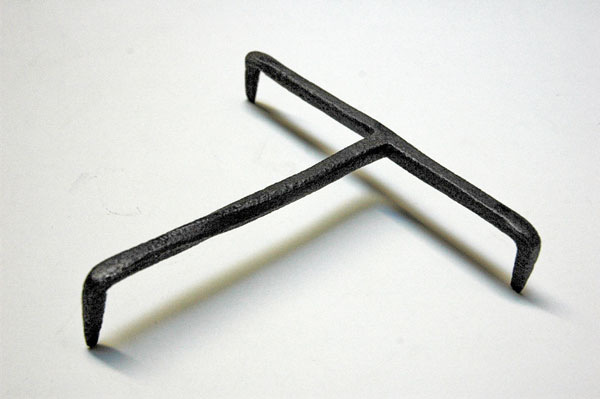
wrought iron trivet, likely late eighteenth century, probably Rhode Island 7″ x 5.75″ x 1.75″
I’m normally almost dysfunctional if asked to speak in front of a group, but I hardly hesitated when Austin Thomas asked if I would be a part of �One Image, One Minute: Significant People Present Significant Images�. The event, hosted at Hyperallergic on June 22, was a benefit for Camp Pocket Utopia, a creative summer project, social school and free arts camp for kids, being put together by Thomas and the nonprofit space Norte Maar. Their ambitious program, to be located at Rouses Point in upstate New York, will be based on a learning model created at Black Mountain College, as interpreted by Thomas, who describes it further:
The Camp hopes to inspire a conversation amongst artists, creative thinkers, and the community, empowering participants and observers to think for themselves while offering a free arts camp for the kids of Rouses Point, NY, and the surrounding North Country.
I was honored, and eventually psyched (almost) to be a part of the terrific “show and tell” organized as a fundraiser for the project. Thomas had asked twenty-five people to each submit an image of something very important to them, and to talk about it for one minute. Almost immediately I thought of the trivet shown at the top of this post, and told her I would contribute, since I knew I wouldn’t have any trouble talking about something I know well and which has meant a lot to me.
I only had to stand up there for 60 seconds. How hard could that be? It turned out that the hardest part was the time restriction. I didn’t want to read from notes, and I didn’t want to stress out by doing too much preparation, but, less than an hour before leaving for Williamsburg, when I first did a run-through, I realized I had enough material for five or ten times my time slot.
We were told we would be called up in alphabetical order, so I had plenty of time while I waited. Grade school flashback: Once again Wagner was going to be the last to give his report (I’d like to think Austin had thought of that conceit, for its connection to her larger, school-ish project). I managed to pare it down a lot from my piece while I sat waiting my turn, but much of the story survived.
It was a successful experiment. It made for a thought-provoking evening, and it drew a great group of people – on both sides of the tiny apron stage.
One of the reasons the trivet had come to my mind must have been that it was a simple and beautiful thing. It was a rough material, yet it had left the forge with an awesome grace. It was totally functional, but perfectly sculpted: Each of its branches was chamfered along its entire length and the 90-degree twist of the longest arm was an artist’s aesthetic gesture and, perhaps, a strengthening fillip.
It was also a thing whose description, and even its personal importance, I originally thought could be described in one minute.
In spite of, or perhaps because of, my enthusiasm for contemporary visual art, It had not occurred to me to look there for a subject. The reservoir was too vast, and I probably sensed that I’d never be able to focus on the one work which, using the adjective in Austin’s invitation, was particularly “important to me”. I had looked elsewhere for my subject.
For many years I had created, and still cherish, an environment pretty much removed from modernism of any kind. I chose to share something from that world; I chose this trivet, a humble piece of worked (“wrought”) iron.
It was created in southeastern New England, probably somewhere in Rhode Island, and probably in the late eighteenth century. Its working purpose: to elevate a plate, pan or heavy pot above hot coals spread onto a hearth, or, alternatively, above a table surface which would be damaged by a hot vessel.
The material is bog iron, which was once found locally near the surface of the ground (no longer of any practical interest except to antiquarians). It’s a very low-carbon metal (unlike steel), and easily malleable. It was the work of a skilled blacksmith. It has a characteristic “grain” (again, unlike steel). Because of its purity, it’s extremely resistant to rusting.
I brought it with me from Rhode Island 25 years ago, when I decided to give up the simple mid-eighteenth-century clapboard house in Providence which I and my partner at the time had bought (in 1970). We restored it [I have to say, “lovingly” restored it] over a number of years, until it looked like it had never needed restoring. It was both a home and a house museum: I thought we would live there until we died, and it was furnished entirely with things appropriate to its date, its geography and the particular economic circumstances of its original occupants. There was essentially no upholstered furniture.
This trivet was a working part of that house, and so was I.
The curatorial assignment my partner and I had undertaken (after we learned the real antiquity of what we had initially thought was just an old rundown house, a very rundown house) precluded living with contemporary art, in spite of the interest we both had for the art of our own time. Instead, for 15 years I lived with art that was contemporary to the earliest period of the house, and there was very little of that.
In the years of assembling things for the house I consciously avoided interesting examples of regional New England folk art, even though it wouldn’t have been difficult to secure such things, because it seemed so unlikely that the interior of our very modest, and genuinely urban, house would have seen much of the folksy kind of decoration so prized today. Also, Shaker design did not yet exist at the time the house was built, and when it did, the communities which produced it were nowhere near Rhode Island. Much of what I did have may have looked “Shaker”, but I can’t say any of it was.
But I kept my passion for both historic and contemporary art, even if I was sheltered under a very old roof and beside a large, fully-equipped cooking hearth. Beyond my newly-founded antiquarian interests, I still wanted to be surrounded by art. The house itself was an incredibly understated design, and I found myself going for the simplest, most elegant forms of practical furniture and artifacts, in wood, glass, metal and pottery: There was that fabulous Mochaware mug with a geometric shape and pattern which would not have looked out of place in the Bauhaus, and that beautiful provincial Sheraton side chair with squared, vertical splats, that could have posed as a Josef Hoffman prototype.
I did some serious cooking in that house, in both the almost-modern kitchen and on the open hearth (I cook more than ever today, but without those wood fires), so I’m not surprised that I almost immediately fell in love with the small tool which I had picked up, probably in an old barn, soon after we were first able to use the fireplaces.
My partner and I broke up, and when I finally decided to decamp to New York, in 1985, I sold much of its contents and put the house up for sale.
I brought the trivet with me. Today it rests only on the counter or the table. Its cooking days may be over, but I prize it as much as I ever did, for its function, its beauty and its associations. Although there are hundreds of drawings and paintings hanging on our walls, when guests are here, especially for dinner, I’m just as likely to pull this little black tripod off the kitchen counter and play “show and tell” with it as anything else in the apartment.
So is it sculpture? I seems to defy categories. Although it may end up on the table at many meals, while the pot it supports will return to the kitchen, the trivet remains. I never tire of looking at it.
The other presenters at the benefit were Laura Braslow, Deborah Brown, Paul D’Agostino, Anna D’Agrosa, Jen Dalton, Kianga Ellis, Louise Fishman, Veken Gueyikian, Rachel Gugelberger, Chris Harding, Valerie Hegarty, Roger Hodge, Lars Kremer, Ellen Letcher, Matthew Miller, Brooke Moyse, Ellie Murphy, James Panero, Gravelle Pierre, Cathy Nan Quinlan, Paul Rome, Adam Simon, Jonathan Stevenson, and Douglas Utter.
[someday soon I hope to set up a gallery devoted specifically to images of the house]