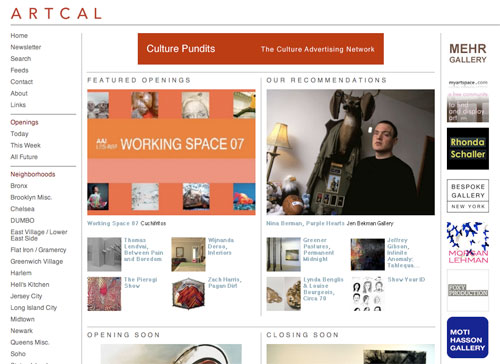
As the chief says, “we’re still working on a few features and tweaking the design”, but the new ArtCal site is now live. By next week at this time, with the opening of New York’s vigorous fall gallery season, the nearly three-year-old site will be displaying more shows than ever before, but sorting them out will be easier than ever before. Some additional features have been added, and there will be more to come.
Go see for yourself.
The clean design is by Michael Mandiberg.
Category: Culture
“Office Party” at Participant Rental temp space
Lovett/Codagnone All Work No Play 2007 vinyl lettering and mirror [installation view with detail reflection of two bloggers]
Barry and I were both very happy to be able to get to a Participant show this summer, since the gallery had to abandon its previous home on Rivington Street earlier this year. “Office Party” was the title of the gallery’s very cool installation in its temporary quarters at Rental [check the link for press on the gallery itself and the press release for “Office Party”]. The show closed August 19, but we’re hoping to hear soon about the new permanent address of this vital Downtown non-profit space.
The artists represented this summer, all addressing the idea of work or workplace, were Eric Heist, Lovett/Codagnone. DIana Punter, and Børre Sæthre. In the project room there were additional pieces on the theme by Stephen Andrews, Matthew Antezzo, Michel Auder, Lutz Bacher, Robert Boyd, Kathe Burkhart, Robin Graubard, Michael Lazarus, Virgil Marti, Laura Parnes, Luther Price, Adam Putnam, and Shellburne Thurber.
The gallery concept represented by Rental, now in both Los Angeles and New York, is an interesting and one welcome on both coasts. It helps to answer a genuine need for broadcasting the work of emerging artists in new milieaux, one which is almost never addressed otherwise.
This is Roberta Smith writing in the NYTimes May 25:
Rental, the latest addition to the expanding Lower East Side gallery scene, is the first one to have the light and views — if not the interior design — of a Chelsea space, thanks to its location on the sixth floor of a corner building with big windows. But that is not its distinguishing characteristic: true to its name, and like its predecessor in Los Angeles, Rental is for rent to selected out-of-town dealers. The first Rental was founded in 2005 by Daniel Hug and Joel Mesler; the New York version has been set up by Mr. Mesler.
This could unsettle the gallery scene’s home-away balance of power in interesting ways. Dealers who give artists their first shows elsewhere will not necessarily have to hand them over to New York galleries to obtain exposure here. They can do the work, walk the walk and talk the spiel themselves.
Scot Kaplan parks on West 24 Street
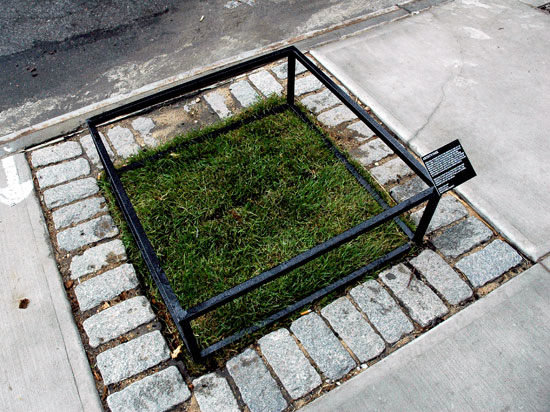
Scot Kaplan Artist’s Park 2007 mixed media, dimensions potentially variable [installation view]
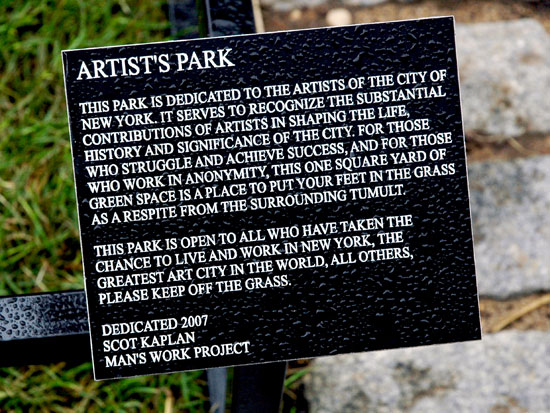
[detail]
We can never have too much park – or too many artists – and an “artist’s park” sounds like a good thing to me, even if it’s smaller than a nightstand. I came upon this piece by Scot Kaplan on the south side of West 24 Street while bouncing from one gallery to the next two days ago. Maybe it’s also some kind of homage to the Beuys basalt pieces two blocks south on 22 Street. The sod looks like it just got there, but I did spot a small piece of cellophane and one bird feather lying on the grass.
The galleryese verbiage in the caption below the photo is mostly my invention.
I really hope this thing’s a permanent installation.
“Substance & Surface” at Bortolami
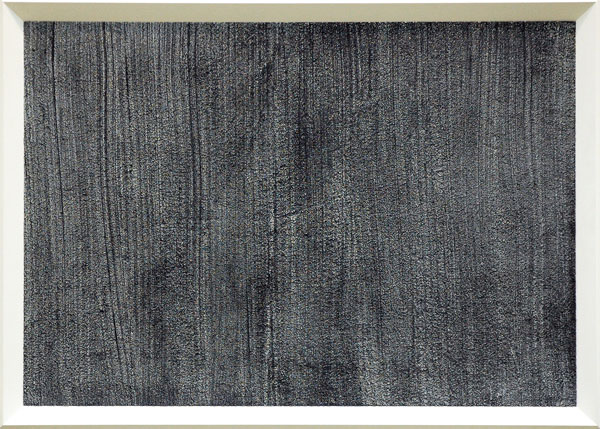
Mike Kelly Carpet 7 2003 acrylic on carpet, mounted on wood panel 46.25″ x 64.25″
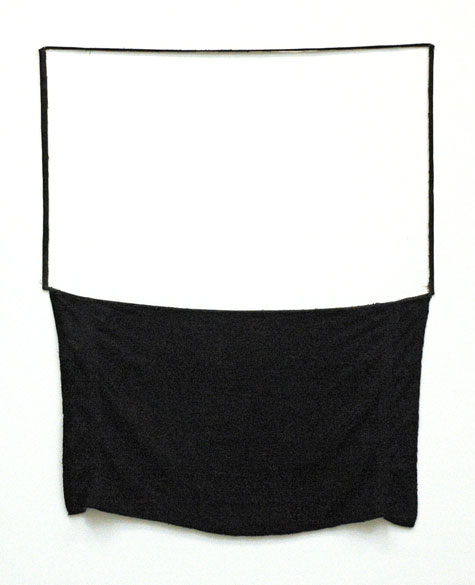
Paul Lee Untitled 2007 cotton towel and ink 46″ x 41″ [installation view]
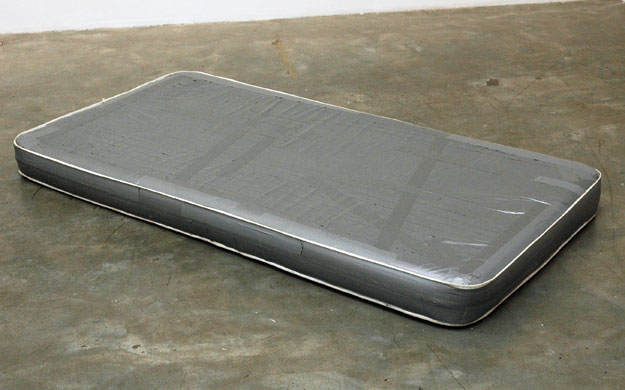
Jim Lambie Y-Footo 2002 mattress and silver vinyl tape 72″ x 38″ x 5″ [installation view]
Bortolami’s main space is devoted to “Substance & Surface“, a group installation of work by a [baker’s] dozen artists working here with monochromatic (and overwhelmingly colorless) non-traditional materials. The artists are Ghada Amer, John Armleder, Bozidar Brazda, Piero Golia, Thilo Heinzmann, Gregor Hildebrandt, Mike Kelley, Jim Lambie, Paul Lee, Glenn Ligon, Lovett/Codagnone, Daniel Joseph Martinez, Donald Sultan and Eric Wesley.
It’s a beautiful show, beautifully installed. For this profane acolyte the experience may have ben a bit like what some people feel inside an austere house of worship.
“Slava Mogutin & Justin Beal” in the back room at Bortolami
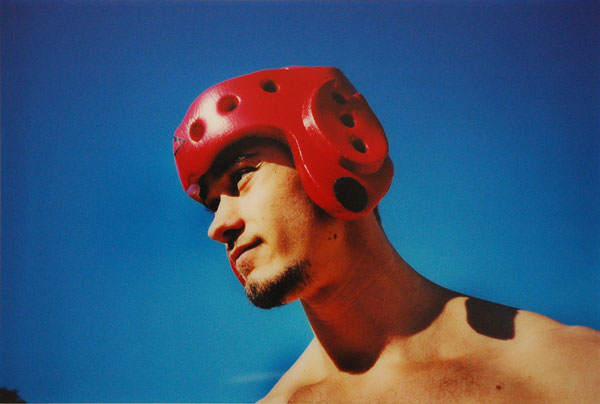
Slava Mogutin Joey San Francisco, 1999 archival C-print mounted on aluminum 30″ x 20″
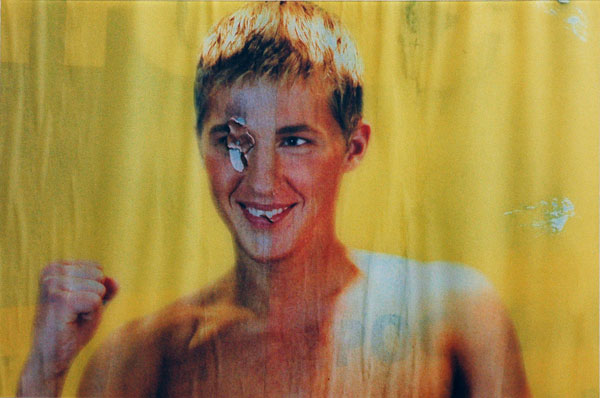
Slava Mogutin Yellow Billboard Moscow, 2004 archival C-print mounted on aluminum 30″ x 20″
There’s nothing about this installation on the gallery’s site, so I’m not sure about its status or (perhaps more importantly for visitors) its dates. I’m referring to an intense show of some work by Slava Mogutin and Justin Beal which I saw in the small room at Bortolami almost two weeks ago. Since I’m unable to call to the gallery office at this time of night, I’m going to assume it will remain up until August 31, when the show in the larger space closes.*
These ten photographs by Mogutin, sweetly-badass Russian poet and American visual artist, were made over a period of the last seven or eight years. I’ve seen some of them before, but I enjoyed the intelligence, the humor, the sophistication, the intimacy, the eroticism and the beauty in all the work on those walls as much or more than I have ever enjoyed his art before – which is to say, a lot.
Unfortunately I missed capturing an image of either of Beal’s elegant floor sculptures, but I’m looking forward to seeing more of this artist’s work. The furniture-size pieces at Bortolomi are composed, as they often are, in a mostly-monochromatic construction with at least one transparent element and any number of other re-configured common objects.
*
UPDATE: The gallery has now told me that “back room” will be open until August 28.
“Greener Pastures, Permanent Midnight” at Moti Hasson
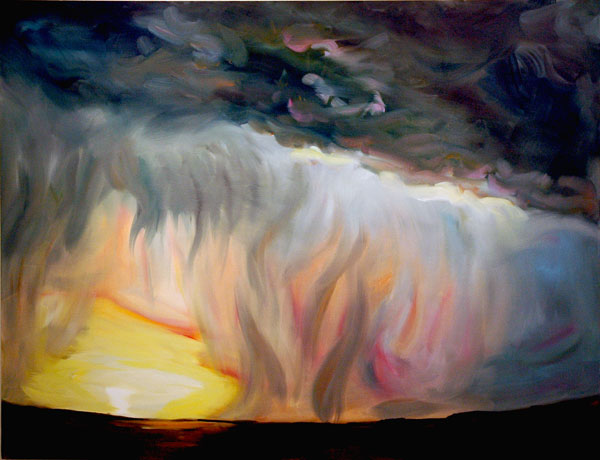
Joy Garnett Storm 2006 oil on canvas 60″ x 78″
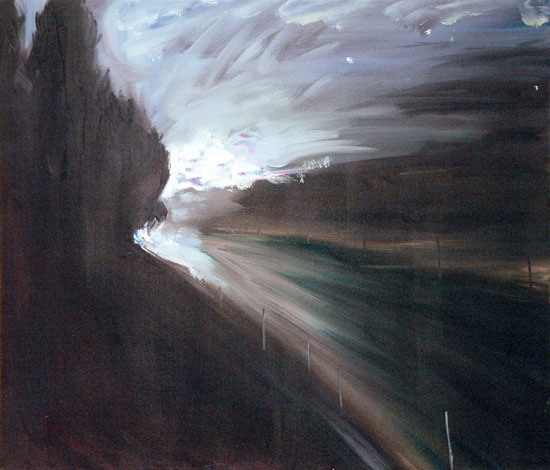
Joy Garnett Road 2007 oil on canvas 30″ x 35″
Regular readers of this blog already know how much Barry and I think of the prolific and innovative painter Joy Garnett, who continues to re-invent and re-ignite the found contemporary pictorial world. Garnett has two oil paintings in “Greener Pastures, Permanent Midnight“, a beautiful small group show at Moti Hasson which continues until September 1. They’re both terrific, but the smaller and darker work, “Road”, is equally as dazzling as the larger and more fiery, “Storm”.
The other artists in this spare installation, curated by Ingrid Chu, are Dike Blair, Franklin Evans, Emilie Halpern, and Katie Holten. Each of them would warrant a good look for their individual merits, but I only have images of two more pieces here.
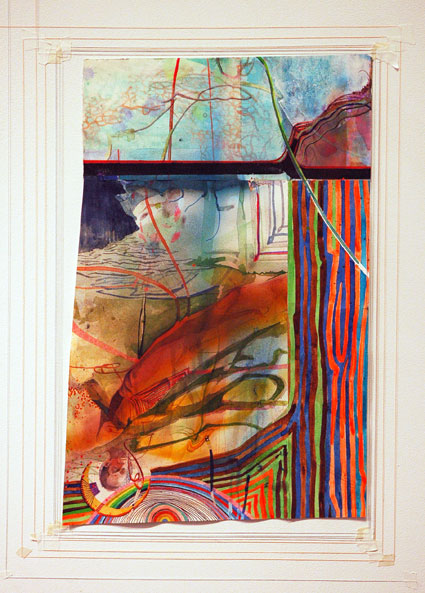
Franklin Evans FF originsoflove02 2006 ink and watercolor on paper 20″ x 13″ [installation view]
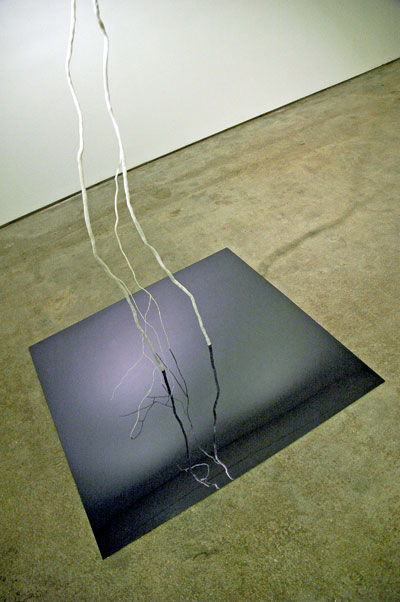
Emilie Halpern Lightning #4 2006 thermoplastic, aluminum wire and mirrored acrylic 75″ x 113″ x 40″ [large detail of installation]
“Purple Hearts” at Jen Bekman
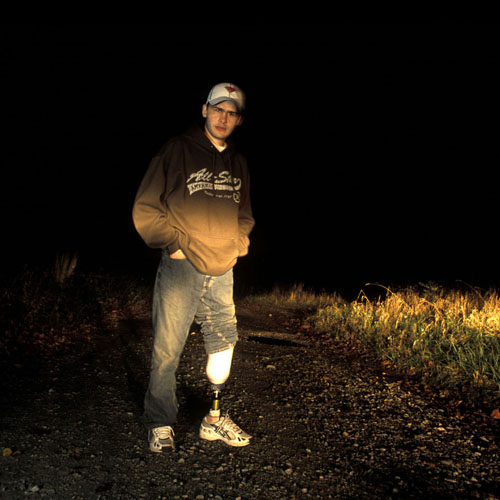
Spc. Sam Ross
21 years old, 82nd Airborne, was wounded May 18, 2003 in Baghdad when a bomb blew up during a munitions disposal operation, leaving him blinded and an amputee. After many, surgeries, Ross was sent home to western Pennsylvania where he lives alone in a trailer, in one of the poorest counties in the state.
Photographed October 19, 2003 in the woods near his trailer in Dunbar Township, Pennsylvania.
“I lost my leg just below the knee. Lost my eyesight. I have shrapnel in pretty much every part of my body. Got my finger blown off. It don’t work right. I had a hole blown through my right leg. You know, not really anything major. I get headaches. And my left ear, it don’t work either.”
“I don’t have any regrets. It was the best experience of my life.”
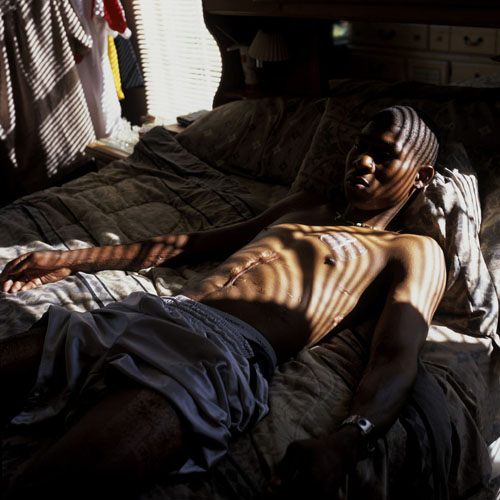
Cpl. Tyson Johnson III
22 years old, 205th Military Intelligence Brigade, was wounded September 20, 2003 in a mortar attack on the Abu Ghraib prison. He suffered massive internal injuries and is 100 percent disabled.
Photographed May 6, 2004 at his home in Prichard, Alabama.
“Most of my friends they were losing it out there. They would do anything to get out of there, do anything. I had one of my guys, he used to tell me, ‘My wife just had my son. I can’t wait to get home and see him.’ And you know, he died out there. He sure did and I have to think about that everyday.”
“I got a bonus in the National Guards for joining the Army. Now I’ve got to pay the bonus back and it’s $2999. The Guard wants it back. It’s on my credit that I owe them that. I’m burning on the inside. I’m burning.”
There is nothing like this “summer show” anywhere in the city, if not the entire country.
Jen Bekman’s current exhibition, “Purple Hearts” neither seeks nor requires an introduction. You may already have seen the book, but walk into the gallery’s very neat pocket space on Spring Street on the Lower East Side before this deceptively-quiet installation closes on August 30. You will leave speechless, if not gasping for breath, while trying to understand how we got to this, and where do we go from here?
Nina Berman began this powerful body of work several years ago . Unfortunately her young portrait subjects had beaten her to it.
The gallery has scheduled a book-signing, reception and talk with the artist on Wednesday, August 29 from 6 to 8pm. Because of the gallery’s small size, those who are interested in attending, or in reserving a book, are asked to rsvp [info@jenbekman.com]
[images from Jen Bekman]
Ayn Rand linked to Deutsche Bank skyscraper tragedy?
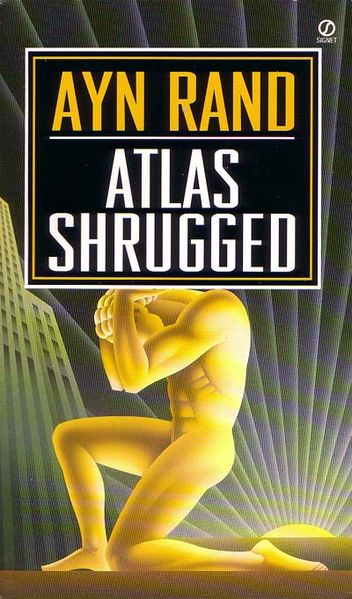
skyscrapers have very complex lives
I’ve just read that the name of the sub-contracting company in charge of the demolition at the Deutsche Bank building is the John Galt Corporation. Who is John Galt? I immediately recognized the intriguing literary/political reference within the firm’s name, and, regardless of what we eventually learn about the ultimate responsibility for the death of two firemen this week, the connection is likely to continue the fictional character’s complex association with corporate greed and laissez-faire capitalism .
ADDENDA: I’ve turned up these few bits on the John Galt Corporation by searching Google and its cached links:
The firm is located at 3900 Webster Avenue in The Bronx [718-654-5300]; its principals are former executives of the Safeway Environmental Corp., a firm with its own history of problems; Galt’s work at the Deutsche Bank site was already causing injury and incurring fines before this week; and finally, World Trade Center-area neighbors had expressed serious concerns about the firm’s qualifications since early last year.
[image from wikipedia]

“NeoIntegrity” at Derek Eller
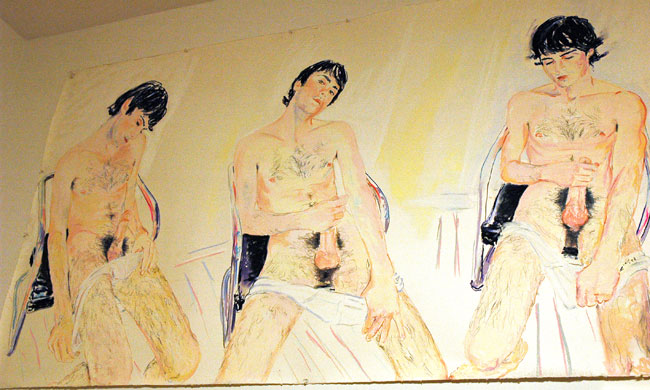
Billy Sullivan Christian 3 2004 pastel on paper 45″ x 78″ [large detail of installation]
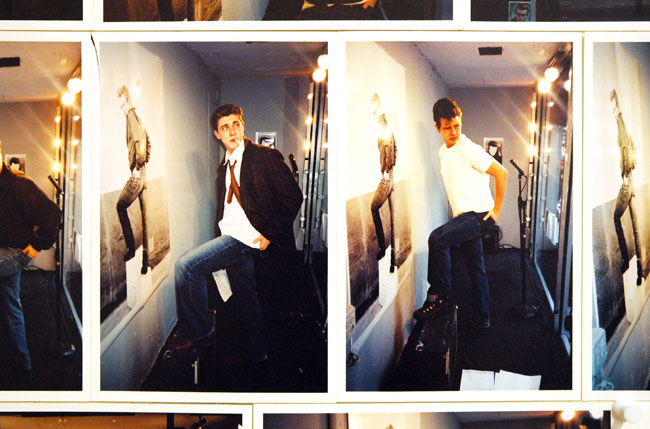
A.L. Steiner Swift Path to Glory (James Dean auditions) 2003, 25 4″ x 6″ prints [detail of installation]
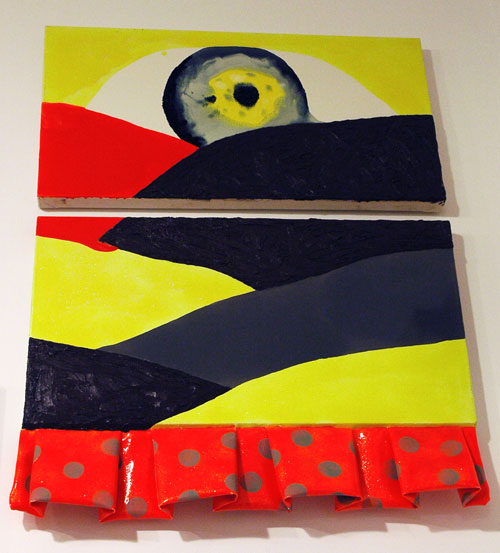
Sakura Maku Akira [no date] oil on canvas in 2 parts 39.5″ x 30″ (installed) [installation view]
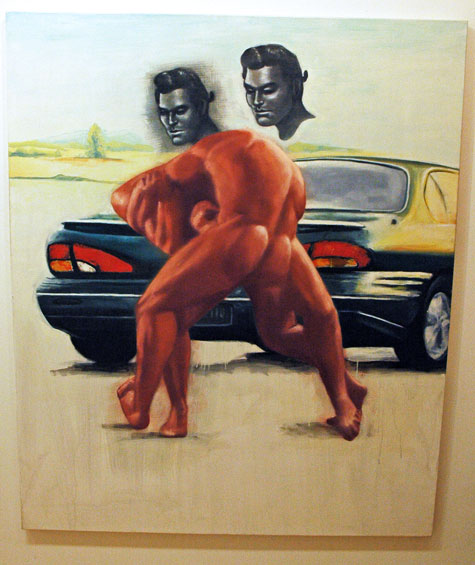
David Humphrey Wrestlers 1997 oil on canvas 72″ x 60″ [installation view]
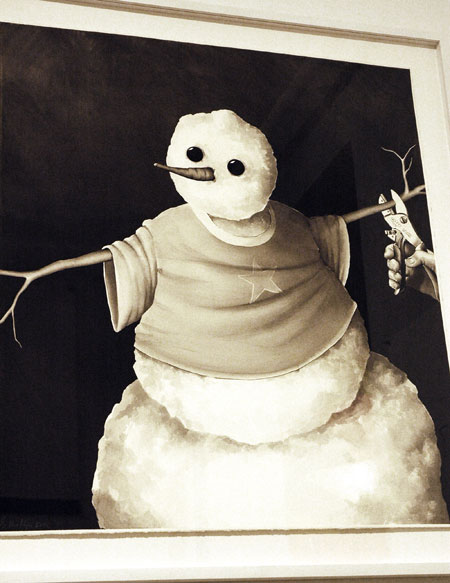
Sean Mellyn Pruning 2006 ink on paper 21″ x 25.5″ [large detail of installation]
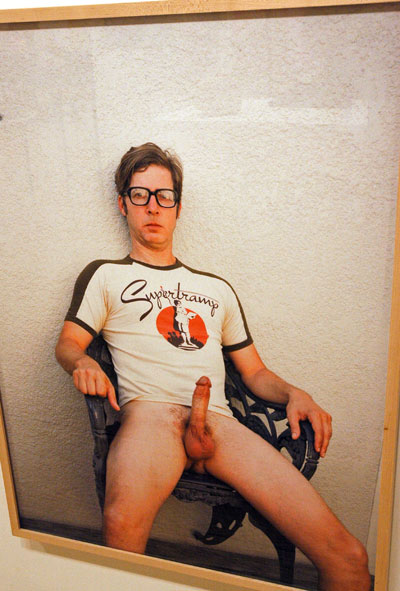
Keith Boadwee Breakfast in America 2007 digital inkjet print 30″ x 40″ [large detail of installation]
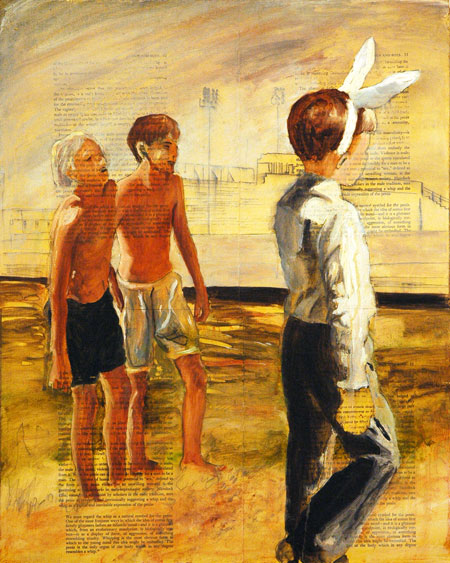
Robert Marshall Silly Rabbit #3 1993 oil on paper on masonite 20″ x 16″ [installation view]
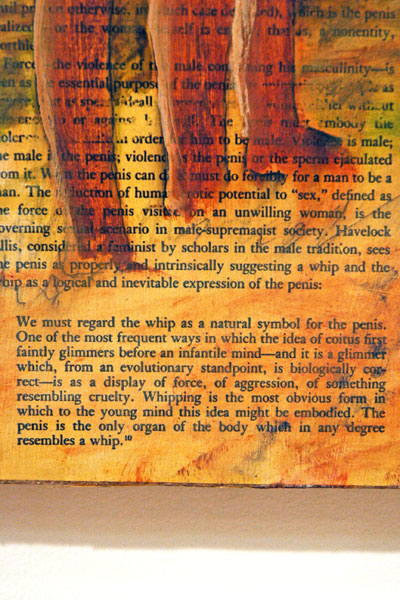
[detail]
With “NeoIntegrity“, curated by gallery artist Keith Mayerson, Derek Eller must come close to setting a record for the number of people represented in a single group show. In this case the salon-hung catalog comes in at just under 200, but the works really do share a connection, an adherence to “The NeoIntegrity Manifesto”, as expressed in a remarkably percipient checklist which accompanies the exhibition:
1. Art should be reflective of the artist who made it, and the culture in which it is produced.
2. Art is aesthetic, and whether ugly, beautiful, or sublime, it should be interesting to look at and/or think about.
3. Art is not necessarily commodity, and commodity is not the reason to produce or appreciate art.
4. Art is about ideas, the progression of ideas, the agency of the artist to have ideas, the communication by the artist to the world of their ideas because agency and ideas are important and what art is.
5. Art communicates via its own internal language, and by the language the viewer brings to a work of art. But this language is not entirely textually based, and being an aesthetic object (or image[s], idea[s], comic, or happening[s]), the work communicates in such a way to be transcendent beyond language, and traditional constructs of textually based ideology. Therefore the work of art remains a deep communication between artist and viewer, and withholds the possibility of the sublime.
6. Art is rather than tells, it is about itself; it shows itself to be about what it is rather than being an illustration of what it isn’t.
7. Art is important because it reminds us that we are human, and ultimately, that is its function.
8. Art can be, and should be sublime, in that it is able to produce images directly from the mind and imagination of the artist, producing tangible realities from the fertile imaginings of the conscious and unconscious of the artist, triggering responses from the same in the viewer via form and light and color, that transcends language and received ways of looking at things, that, while ideological, comes closest to directly communicating from one animal to another in the most broad, base, but considered aesthetic language possible.
9. Art should be alive, have a life of its own, transgress intended meaning or hand or wit of the artist in that it arranges, via form, light, color, and space, other worlds that are optical and transmit cognitive reactions in the mind of the viewer that cause an ineffable schism between belief and reality that cause the work as to appear to be breathing life.
10. Art can indeed be windows onto other worlds, windows into the soul, able to capture dream space/time unlike any other medium because they are produced by the mind, gesture, hand and intellect of the artist, who consciously or unconsciously cannot hope to ultimately control the meaning, interpretation, or event described by the hand and mind of the unconscious.
11. Art should be experienced: a good work of art cannot be successfully reproduced or explained, indeed, that is ultimately the only reason art is important in the age of corporate commodity culture: it has an aura that cannot be contained-it is a result of a peculiar man-made alchemy that comes closest to recreating the soul.
I’ve shown at the top a few of the striking images among so many, many others in this show, and I’ve taken the liberty of including with them some of the more outrageous of the lot – because I can, but also because outrageousness seems, properly, to set a good part of the tone for the whole exhibition.
The installation continues on West 27th Street through this Friday.
two Greenpoint survivors
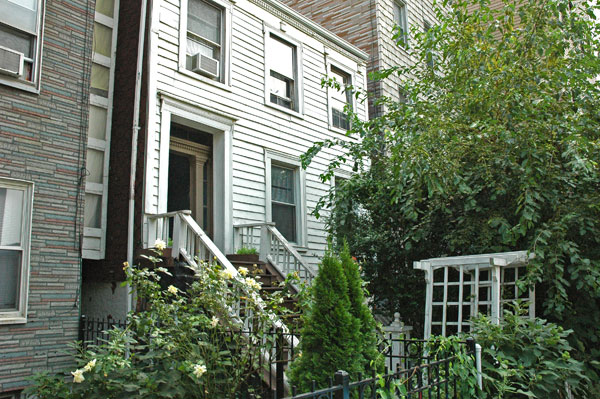
Its neighbor’s roses and its own arbor gate standing at the edge of the sidewalk are homey touches for this unreconstructed wooden Federal house on Green Street in Greenpoint. The house is built in exactly the same form as the typical urban row house but in fact, apart from late excrescences on either side, it’s actually free-standing. It’s probably a relic from the second quarter of the nineteenth century.
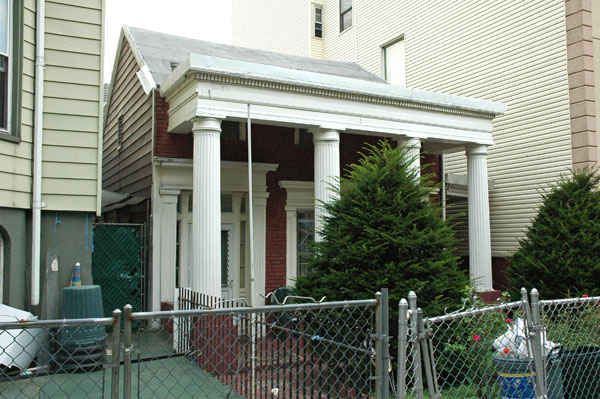
The almost-hidden eyebrow windows, the heavy flat moldings around the door and windows and the elegant porch columns express the period of this small Greek Revival house on Huron Street, one block south of the house shown above. I wonder however about the absence of a pediment, and the fluting on those Tuscan columns is a rather peculiar touch for the era. The house may in fact be older than its 1830’s or 1840’s fancy dress; I don’t know how to explain the fluting.
Both of these survivors are located only a short distance from the original eastern shoreline of the East River, with Midtown Manhattan on the other side. In the nineteenth century this waterfront was an important site for shipbuilding and its related trades.