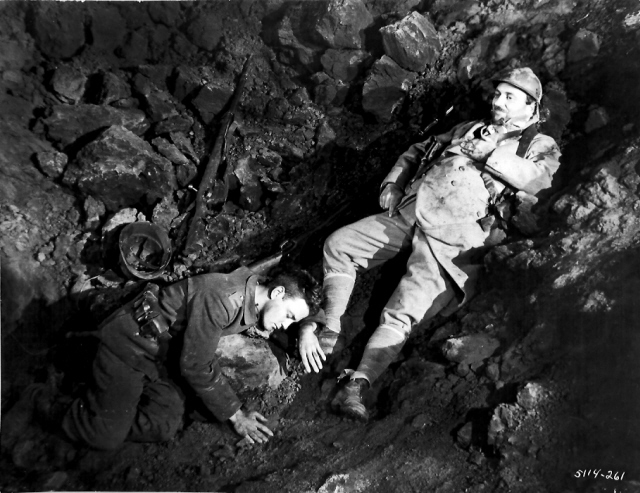
the enemies finally come face to face
We watched the restored version of “All Quiet on the Western Front” at home late last night. Before yesterday I had neither read the book nor seen the film. This early talkie, an eighty-year-old masterpiece, has survived, both as art and as a surprisingly strong piece of theater. It’s terrifying, when it’s not heart-braking, and there’s nothing maudlin or melodramatic about it.
It’s an extraordinary film; don’t wait for the remake.
As if it just watching “Front” were not already enough of a profound and moving experience, today we learned that the event that precipitated The Great War. The conflict that inspired Remarque’s seminal anti-war novel, and Russian-born Louis Milestone’s 1930 film of the same name which was based on the world-wide best-seller, occurred exactly ninety-six years ago (still within living memory – of at least a very few). While today is the anniversary of the assassination in Sarajevo of the heir to the Austro-Hungarian throne, It’s also the anniversary of the Versailles Treaty which officially ended the hostilities between the remaining major combatants. That accord was signed ninety-one years ago today.
The war was supposed to be “the war to end all wars”, the phrase a perverse, but catchy rationalization which was actually invented early on by its most enthusiastic champions.
It’s clear however that, as the direct heirs of its horrors, which include the Second World War, among others, we haven’t learned a thing in the intervening years. This is in spite of the hopes of the remarkable German author of “Front” and most of the people connected with the film, including its fictional chief protagonist, Paul B�umer, and the very real pacifist actor who played him, Lew Ayres.
In the image above Paul is lamenting the death, by his own hand, of a French Soldier who had lept into his trench in the chaos and heat of a particularly violent infantry battle.
In the Turner Classics commentary supplied with the DVD, film historian Robert Osborne sincerely and persuasively proposes that subtitles be created in every language, that the film be shown to people all over the world, and that they should see it again and again, once every year.
But today a country whose people mistakably believe themselves to be the most peace-loving on earth, have created two optional, trillion-dollar, asymmetric wars, killing fields inside dirt-poor nations which have no working governments, on the other side of the planet, and it seems we can give no justification for our continuing these wars other than the fact that we are at war(s). In retrospect, a century later, even the fools and jingoes who marched off in 1914 don’t look so singularly absurd as we once thought they did.
Besides, while the number of casualties in 1914-1918 certainly dwarf the total of all losses in the Middle East, that war was at least brought to a halt in four and a quarter years. Our own, current madness has already gone on twice that long.
[image from leftofcybercenter]
Category: Culture
Cooper Union End of Year Show
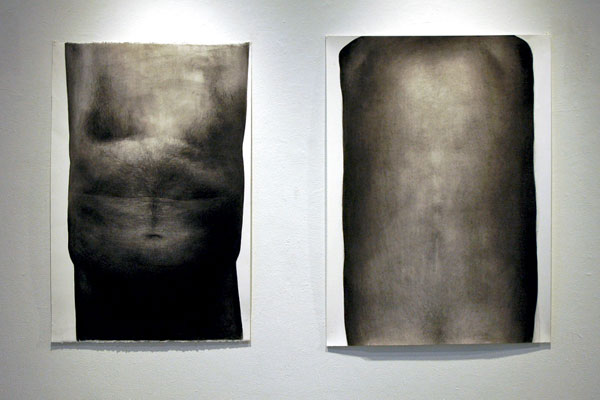
Cleo Newton’s large graphite diptych of a male torso is stunningly powerful
CORRECTION: Contrary to what I had written here originally, having seen the dates on the school’s own site, I have now learned (June 24) that the End of Year Show had already closed last week, and have edited the headline and text accordingly.
Although we caught the Cooper Union End of Year Show a number of weeks back, I’m just now getting around to posting a few images. Barry and I were pretty excited about much of the work, and really liked the vibe. We didn’t manage to see everything, barely touching the work from the Architecture faculty, and we never even got to the Engineering installation.
When we left I resolved to go back for more, but never did. These images represent just a small part of what I went home with after the opening reception.
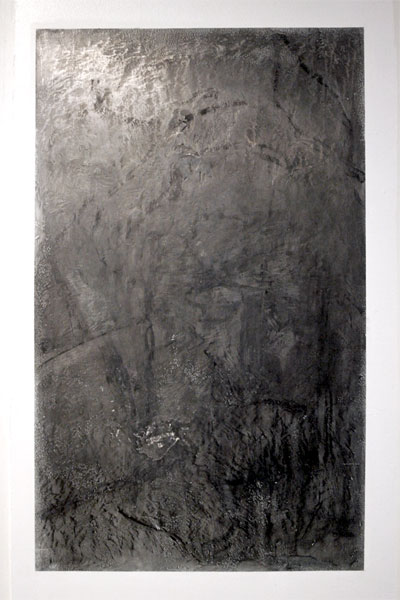
Raoul Anchondo’s large graphite piece is drawn directly onto the irregular-surface of a white-painted plastered wall, suggesting an embedded sheet of metal, something of an opaque mirror, in fact.
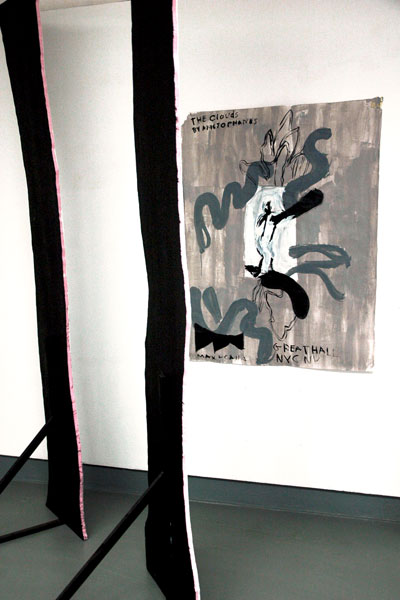
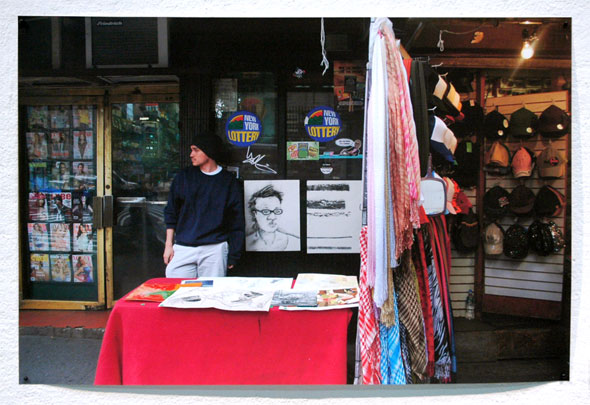
Christian Hincappie’s images were accompanied by a placard with this note: “For this performance piece I collected the work of my classmates without their consent. Performing the role of a street vendor at the intersection of St. Marks’s Place and 3rd Avenue allowed an appropriate context in which to sell the work I collected.”
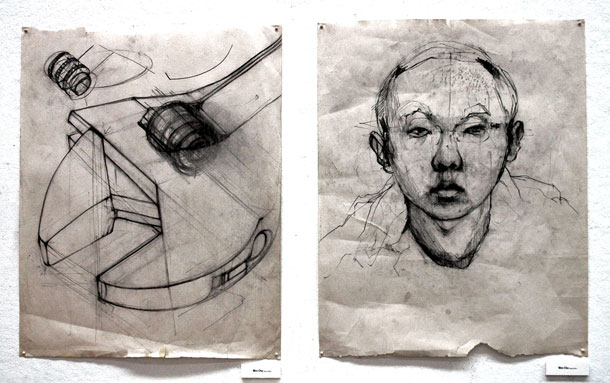
Won Cha’s exquisite drawings seem to bridge all three faculties of the Cooper Union
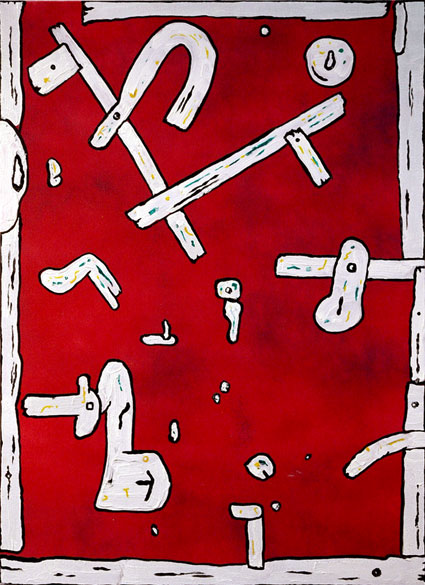
Skye Chamberlain’s painting is a thing of beauty, and great charm
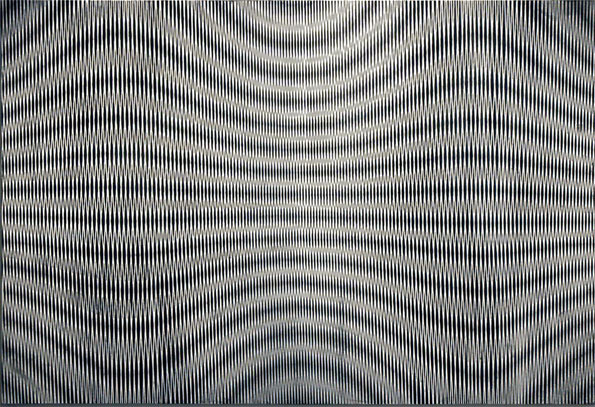
Larry Lairson resurrects op art, and the idealism of its Bauhaus antecedents
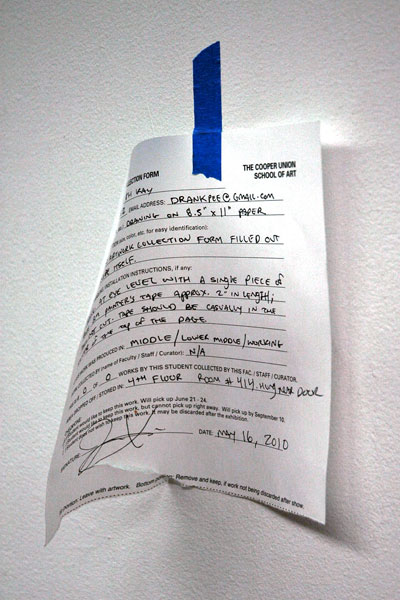
Joseph Kay’s work on the wall of a narrow hallway almost manages to escape notice
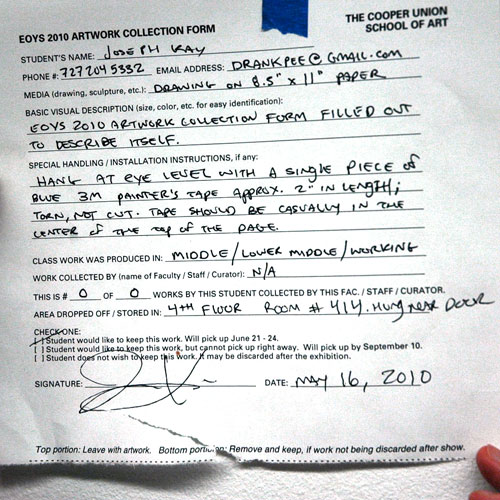
[detail]
This is the only image I shot from the architecture section, thinking at that moment that I would have plenty of time to come back:
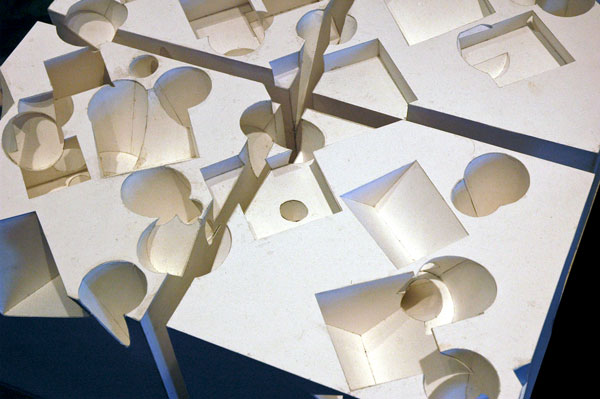
[I couldn’t locate the name of the creator of this beautiful paper model]
Finally, one more large drawing by Raoul Anchondo. In this piece the graphite had been applied directly onto an irregular white-painted plastered wall surface, producing the appearance of an embedded sheet of metal, something of an opaque mirror, in fact.
tomorrow is the last chance to “Escape from New York”
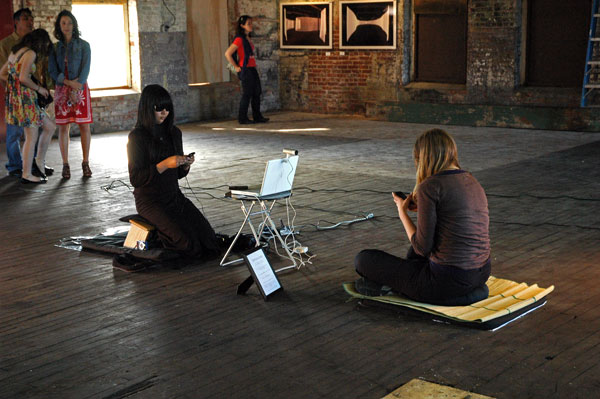
An Xiao The Artist is Kinda Present [still from five-hour performance]
Tomorrow is the last day for the tonic and pleasures of the huge-scale Paterson, New Jersey installation, “Escape from New York“, and I just realized that I hadn’t uploaded any images yet. The show, curated by Olympia Lambert, is a treat on its own, but added to that, for those willing to leave familiar streets, are the curiosities (nineteenth-century usage) represented in the numerous and varied reminders of the town’s industrial and social history.
The old core of Paterson still displays countess monuments to its former wealth, most of the public, banking and commercial buildings plainly marked to show they were erected at the turn of the twentieth century.
There are also an amazing number of nineteenth-century mill buildings just beyond the center, many of them handsomely restored (and presumably looking for artists), One of them (unrestored) shelters the work of the 43 “Escape” artists Lambert has collected. It and its dozens of sturdy brick neighbors share an old mill race and are perched below tree-covered hills just below a surprisingly idyllic Passaic Falls.
The cataract is the the second-highest large-volume falls on the U.S. East Coast, which accounts for Paterson’s importance 200 years ago. Okay, the day we were there we saw a wedding party being photographed before it on a wide grassy ledge while we watched from above. Together with the architectural treasures the falls offer an additional incentive for a rail trip, a brief, comfortable ride on NJ Transit from Penn Station.
If you miss your own escape to New Jersey and these combined pleasures, there will be at least a chance to see some of the work in Manhattan in July (minus Paterson, of course). Lambert is putting the finishing touches on arrangements for “Return to New York”, to be installed at HP Garcia Gallery July 7-31.
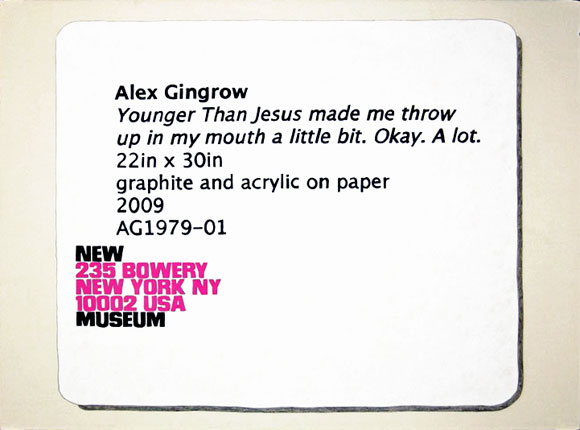
Alex Gingrow Younger Than Jesus made me throw . . .
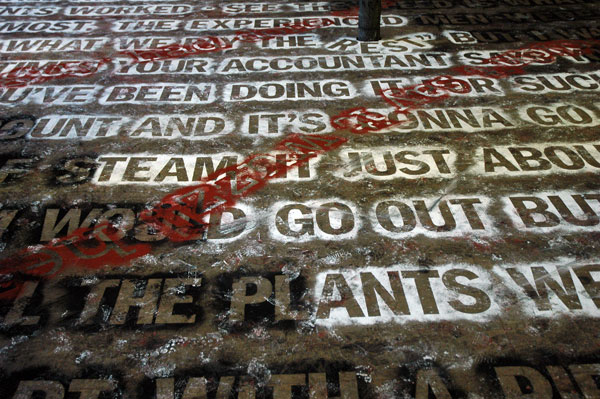
Nicholas Fraser The Paterson Project [detail]
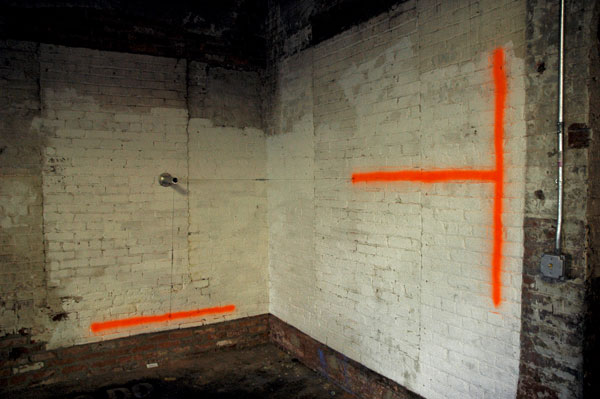
Peter Soriano Other Side # 82 (MEC)
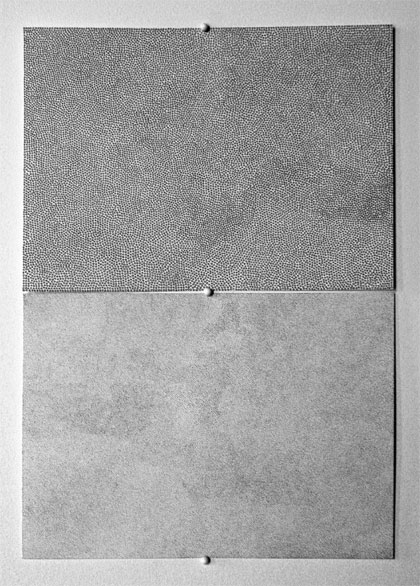
Man Bartlett circle drawing XII – rendition above pointpiece II – constant
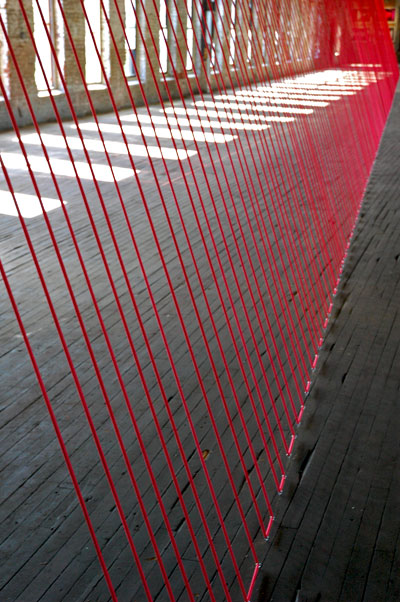
Thomas Lendvai Untitled ([large detail]
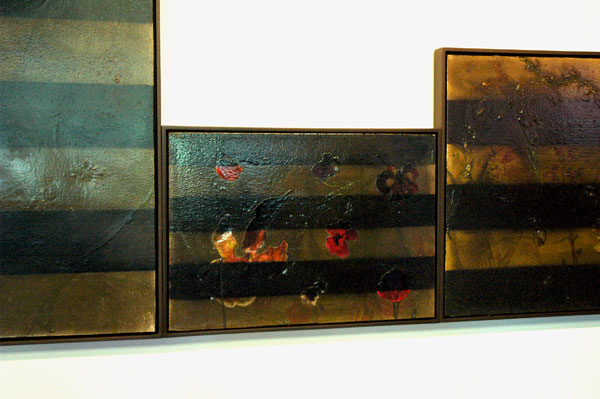
Tamas Veszi Dark Matter [detail]
Lagniappe: An abbreviated look at a few of the mills, and the falls:
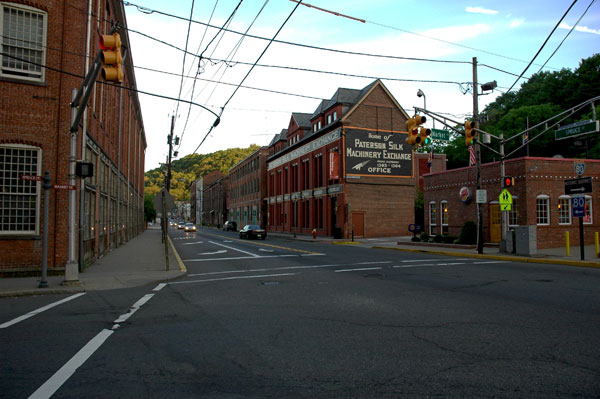
the corner of Spruce and Market, at dusk on a Saturday
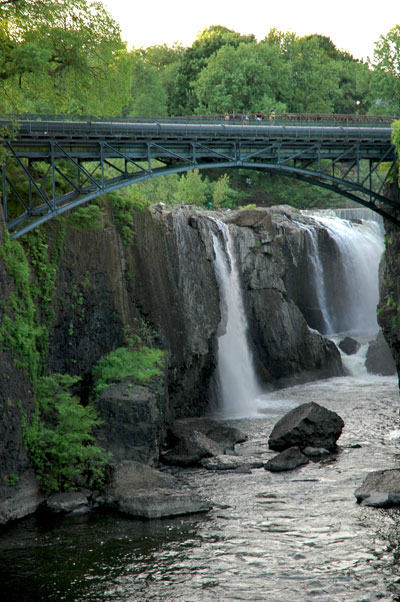
the footbridge is historically the eighth on the site
[image of “Younger Than Jesus made me throw . . . ” from the artist’s site]
Update on Joel Sternfeld and Luhring Augustine
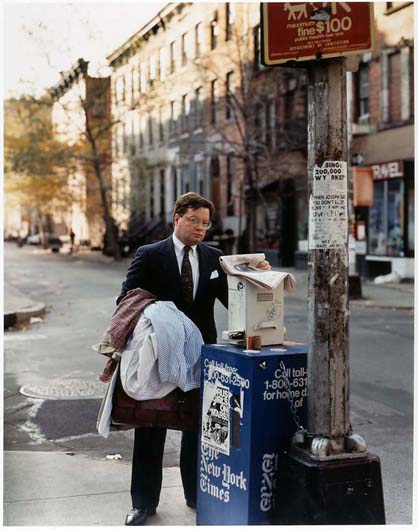
Joel Sternfeld Attorney with laundry 1988
NOTE: This is a follow-up to the preceding post.
This morning it was made clear to me that Joel Sternfeld himself had nothing to do with the contretemps over the recently-published Idiom piece, “The Portrait of a Lawyer“, and it appears that his New York gallery, Luhring Augustine, however good its intentions may have been, was not only overreaching in its representation of the claims of copyright, but also misrepresenting its artist client.
Prior to the publication of the article the author, Sam Biederman, and the editor, Stephen Squibb, had been looking all over the net and elsewhere for the image central to Biederman’s piece, eventually contacting Luhring Augustine. With the wisdom of hindsight it seems they had good reason to have begun elsewhere in their search.
The gallery replied that neither it nor Joel Sternfeld had an image in their possession. When the piece was published, having been frustrated in the unsuccessful pursuit of the original objective, Squibb substituted an image of another work by the artist. It had been found on line, and originated on the site of another gallery, one which also represented the artist.
When Luhring Augustine saw the published Idiom article and image, the editor was contacted and told he was not permitted to show any Sternfeld image without the approval of the artist. Curiously, even after telling the editor to remove it, the gallery’s message critiqued the choice of that particular alternative image as unsuitable for the article.
When Squibb wrote back, offering to exchange the picture for another, Luhring Augustine’s reply was that no picture would be supplied or permitted. The email continued: “. . . the artist does not particularly agree with the opinions expressed in [the article] and does not wish to grant copyright permission for his image to be reproduced in conjunction with the piece.. ” We were then told to remove the image,
“. . . as the artist wishes.”
The assertions about the artist’s wishes don’t appear to represent the facts.
Luhring Augustine does seem to have asked Sternfeld if he had the image Idiom originally requested, but it doesn’t appear that the artist had been told anything else. This morning I received an email from Sternfeld himself. It was extraordinarily gracious, especially considering how hard I had come down yesterday on what I thought had been his response to Idiom’s request.
In his email the artist denied that he had requested the image be taken down and wrote that he would have been pleased to furnish an image of the “barefoot attorney” if he had one (or had been given more time to find one). He added that he thought the piece itself was thoughtful and that he was “grateful” to read it.
He finished, before extending good wishes to everyone involved with the article, by addressing a part of Sam Biederman’s memoir specifically, adding the artist’s own playful thoughts on the photograph he had taken of the author’s father many years back:
I wish [Sam] had considered as a possible reading my intention to to point out� that regardless of societal role one’s feet can hurt at the end of the day and the temptation to kick off shoes and socks may prove irresistible.
The image which served as a stand-in for the one Idiom originally sought, appearing at the top of the Idiom post when it was published and later pulled, has now returned to the site. The jpeg used was found on MoMA’s site.
Me, I went looking for another lawyer, and quickly found “Attorney with laundry”.
[image from hotshoeinternational]
Joel Sternfeld demands removal of his photo on Idiom

Mark Tansey The Innocent Eye Test 1981
UPDATE: see “Update on Joel Sternfeld and Luhring Augustine”
Is it still visual art if it’s not visible? Is it even still there?
A thoughtful piece by Sam Biederman, “The Portrait of a Lawyer” appeared last week on Idiom, which is an online publication produced by Barry and myself. The editor, Stephen Squibb, had tried to include at the top an image of the work by Joel Sternfeld which had inspired the ruminations of the essayist, but he was unable to do so. Instead, he and the author carefully selected another photograph done by the artist to serve as an appropriate and representative substitute.
The photograph they used, “Solar Pool Petals, Tuscon, Arizona, April 1979”, has now been removed from Biederman’s piece, because Idiom was instructed by the artist himself, through the agency of his New York gallery, Luhring Augustine, to remove the image.
An image of “Portrait of a Lawyer” could not be found anywhere on line, so the gallery was asked if they had one that could be used. There was no response, so Squibb uploaded the other photograph. When Luhring Augustine became aware of the piece days later they did reply, writing that neither they nor Sternfeld had in their possession the image requested. They added that they disapproved of the use of the photograph chosen in its stead, and by the way, Idiom had no right to publish any of the artist’s images without his approval. When asked to proffer an image themselves, they refused, and effectively denied the publication’s right to show any any of the artist’s work. The real and expressed reason turned out to be that Sternfeld didn’t like the article and wished to disavow it to the extent he could.
While suppressing the use of an image based on your personal preference may not quite be a form of artistic censorship, it is a story about one artist disrespecting another in a public way, and it does not make Joel Sternfeld look good.
I have always greatly admired Sternfeld’s art, and had believed I had reason to think of the man as humanistic, enlightened and liberal. Now I just don’t know. He confounds my expectations. I have no idea what’s going on here, but nobody should get a free pass, regardless of who they may be, and especially if we’re talking about an artist who might be described as august.
For me this troubling and somewhat unfathomable incident once again suggests thoughts about an artist’s right, and ability, to control how the work is experienced, the distinction between a work of art and the representation of it, the continuing insecurity of artists who work in a photographic medium, the under- and misunderstood principle of fair use, who gets to see art, who decides what art gets seen, and ultimately the question of just how visible, and accessible, the visual arts should be.
And I can’t help thinking of class.
Okay, now can I say I’m crazy I am about the inclusion of the Mark Tansey image, and that it ended up at the top of Biederman’s essay?
[image from the University of Hawaii]
Louise Bourgeois (1911-2010)
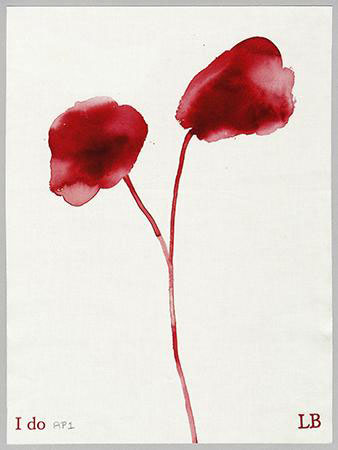
Louise Bourgeois I do 2010 archival dyes on cloth with embroidery
Louise Bourgeois died this morning. I had hoped, and fully expected to see this magnificent, (can I say ballsy?) artist, and extraordinary human being continue well into her second century, but although she almost made it, it was not to be.
Her art is likely to go on forever however; her legend had already begun years ago.
“I do“, an edition of an image of two flowers joined on a single stem designed for the Freedom to Marry campaign, was to be one of her last activist contributions to the world blessed by her presence.
I think I first became aware of her generosity and her personal activism in the early 90’s when she agreed to contribute to the ACT UP Art Box (those balls again).
This site includes some wonderful images of both the artist and the artist’s work.
[image from eyeteeth]
Manhattanhenge, from its western, 23rd Street stones
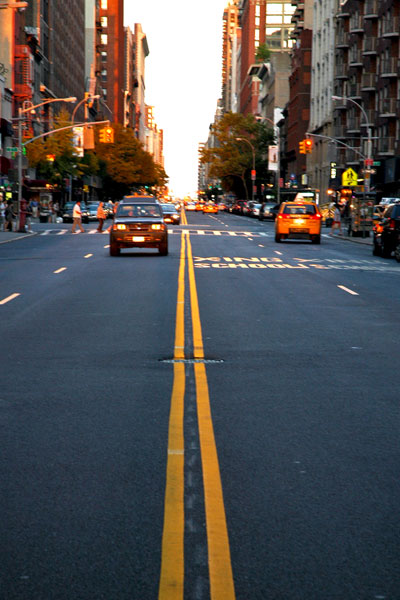
looking at the light cast from the west toward the stones to the east
As I prepared to leave the apartment this evening to go to the market, Barry reminded me that the phenomenon known as Manhattanhenge was about to light up our east-west street in its semiannual visitation. He said he’d heard on Twitter that it would take place precisely at 8:17. At that moment it was only 8:05, but as I didn’t know exactly what I would see when I got outside, I immediately headed out the door.
There I found that our doorman already knew all about our modest urban astronomical occasion, just as he always seems to know everything that goes on inside the building and anywhere in its proximity, so I didn’t have the satisfaction of inducting a new member into the cult. I then learned that, if anything, I may have been a moment too late rather than too early. The sun seemed to have already hidden itself somewhere in the Hudson River, but its corona was centered on the street axis and was still able to impede a direct glance.
I turned around to see what the eastern axis of the street might look like, stepped into the middle of the holiday-emptied six-lane thoroughfare, and snapped the picture above. Just as I got to the corner of Seventh Avenue (it was now 8:17 exactly), where the traffic signal was momentarily arresting the progress of the few east-west vehicles, a dozen or so pedestrians suddenly appeared in the crosswalk out of nowhere. Everyone seemed to have a camera and was snapping pictures of the setting sun, all the while totally ignoring the rich golden light momentarily transforming everything behind them, even to the white lane-dividing lines on the pavement.
I’m thinking the original stone-age celebrants on the Salisbury Plain would also have been more interested what the stones made of the sun’s rays running east, but there’s no way to know for sure. As I told my friend at the front desk, nobody stayed around to tell us.
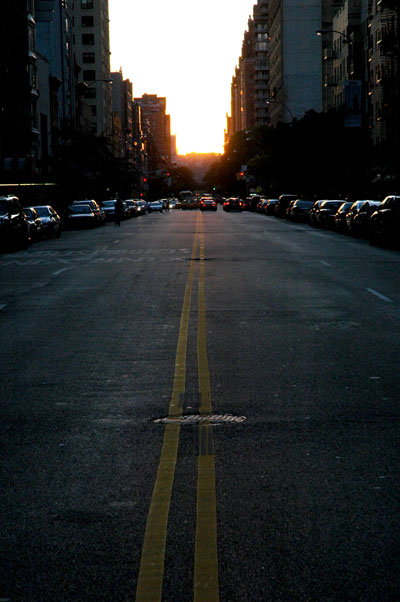
and looking at the sun positioned in the portal between the western stones
the real meaning of Memorial Day (or Decoration Day)
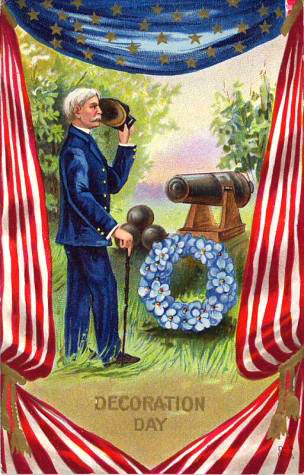
but where’s the gray, and, for that matter, the colors of our countless other fallen foes?
And it’s not for generals.
It seems Memorial Day is not supposed to be just about hot dogs, the Indianapolis 500, or summer whites. In fact the holiday formerly known as Decoration Day (the official name by Federal law until 1967) wasn’t even originally owned by war veterans. While today it commemorates Americans who died in any war throughout our extraordinarily-aggressive, warlike history, it was first enacted in response to the horrors of a civil war. The date itself, now established as the last Monday of May, was originally determined by the month of the final surrenders which marked the conclusion of the American Civil War.
But its disjointed history is actually far from the tidy story which an official declaration might seem to suggest.
What became Decoration Day, and eventually Memorial Day, had many separate origins. Towns in both the North and the South were already memorializing their recent war dead, and “decorating” their newly-dug graves, in spontaneous observances in the years before the 1868 official proclamation by General John Logan, the last national commander of the Grand Army of the Republic, in his “General Orders No.11”.
The holiday the general created was first observed on May 30, 1868. Flowers were placed on the graves of both Union and Confederate soldiers at Arlington National Cemetery. That cemetery, incidentally, was located on land the U.S. government had appropriated from Robert E. Lee at the beginning of the war, a development likely to have made an significant impression on the defeated South as much as on the Lee family itself.
Within two decades or so all of the northern states were observing the new holiday, but the South refused to acknowledge it. This should not have surprised anyone, either then or since. Even though the date May 30 had been picked precisely because it was not associated with any battle or anniversary, the observance itself was tainted by its association with the victorious and hated Union.
The various states of the old Confederacy continued to honor their own dead, on separate days, until after World War I, when the holiday was broadened to include not just those who died fighting in the Civil War but Americans who died in any war. Even then, most of the states of the old South still maintained separate days for their own dead, and do so to this day, although with varying degrees of enthusiasm.
I checked into this history yesterday when I was trying to decide whether I could honorably display the antique 48-star flag I’ve had for almost 40 years (antique in fact when I acquired it). I had kept it in a Chinese camphor-wood trunk for decades because our flag had come to be associated almost entirely with American jingoism; it had been hijacked by the crazies on the Right. Although I still had my doubts about the direction of this country even after Obama’s 2008 victory, I pulled the old banner out and hung it in the apartment last year, on the day of his inauguration, and again a few months later on July 4th.
Bush’s wars have now become Obama’s wars, and my very tentative interest in flag-waving, even flag-hanging, has (please excuse the choice of word) sort of flagged, although I still find things to love about this increasingly dysfunctional country.
When do we get a holiday celebrating the peacemakers? Of course that’s entirely a rhetorical question, coming from a citizen of a country which has almost never not been at war somewhere.
I went to Wikipedia in my search for a quick answer to my question about the original significance of the day we celebrate today mostly as just another excuse for a long weekend. There I learned that one time the holiday many originally associated with uncomplicated patriotic sacrifice did not mean the same thing for everyone, even in the 1860’s. In the Wikipedia entry for “Memorial Day: History”, I found this very moving and evocative window onto an America which was cursed to know war far better, and was far more weary of and horrified by it than our own:
At the end of the Civil War, communities set aside a day to mark the end of the war or as a memorial to those who had died. Some of the places creating an early memorial day include Sharpsburg, Maryland, located near Antietam Battlefield; Charleston, South Carolina; Boalsburg, Pennsylvania; Carbondale, Illinois; Columbus, Mississippi; many communities in Vermont; and some two dozen other cities and towns. These observances coalesced around Decoration Day, honoring the Confederate dead, and the several Confederate Memorial Days.
According to Professor David Blight of the Yale University History Department, the first memorial day was observed by formerly enslaved black people at the Washington Race Course (today the location of Hampton Park) in Charleston, South Carolina. The race course had been used as a temporary Confederate prison camp for captured Union soldiers in 1865, as well as a mass grave for Union soldiers who died there. Immediately after the cessation of hostilities, formerly enslaved people exhumed the bodies from the mass grave and reinterred them properly with individual graves. They built a fence around the graveyard with an entry arch and declared it a Union graveyard. The work was completed in only ten days. On May 1, 1865, the Charleston newspaper reported that a crowd of up to ten thousand, mainly black residents, including 2800 children, proceeded to the location for included sermons, singing, and a picnic on the grounds, thereby creating the first Decoration Day
So, the real meaning? I don’t think we have agreement even now, and for myself I haven’t yet decided whether to pull that faded old cloth from the trunk tonight.
[image of pre-WWI Decoration Day postcard from vintagepostacards]
Momenta Art Benefit Wednesday: tickets still available
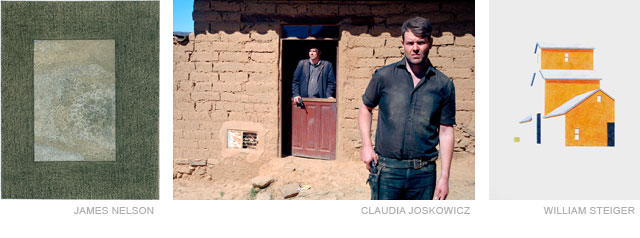
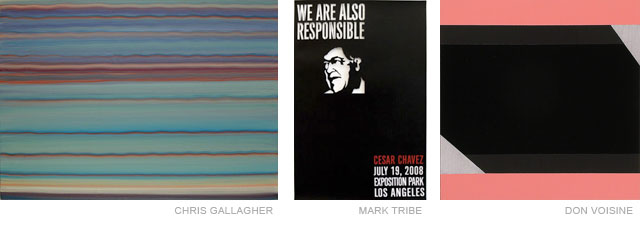
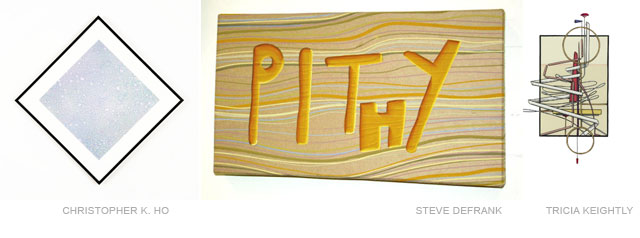
Barry and I went by Momenta Art last Thursday to preview the raffle and auction artworks available in their annual benefit Wednesday evening, May 26. We’ll be there because we want to help a great institution. We’re also going because we know we will be taking home a terrific piece, even though right now we have no idea right now what it will look like. Our confidence comes from the space’s great curating of donated work, from our own experience in every previous year, and from seeing the entire selection of some 150 works first hand.
It’s one of our favorite non-profit arts organizations in the New York area, and we have a number of great pieces in our own collection from earlier benefits. This artist-run non-profit space based in Williamsburg is absolutely as good as they come; they totally deserve and definitely can use our support.
I’ve put up images from their site of just a few of the over 150 raffle artworks; the next opportunity we’ll have to see the entire assemblage (and put together an exciting list) will be at White Columns on West 13th Street beginning at noon on Wednesday. The event itself starts at six, with a performance you won’t want to miss soon after that by Guy Richards Smit. Tickets are only $225, and as I’m writing this there it appears there are some still available. Please join us that night.
[images from Momenta]
Man Bartlett will be your parrot, if you can #24hEcho
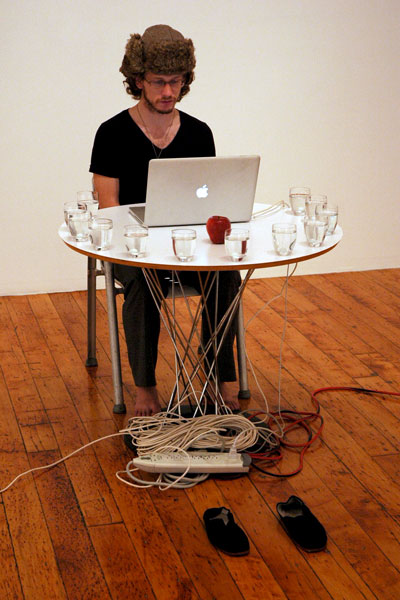
Man reading Barry’s Manchurian Candidate tweet
UPDATE: the artist speaks for himself
As I’m writing this Man Bartlett is in the third hour of his contribution to P.P.O.W. Gallery’s Hostess Project, “#24hEcho“.
The artist has vowed that for 24 hours he will repeat, into a webcam, whatever we tell him to. “I will be present in repeating your words. I will be your puppet, your sounding board, your refuge. Otherwise, I will be silent.”
If you want to part of the performance go to Bartlett’s website for further directions.
Barry and I were at the gallery at 7 o’clock tonight, just as he had arranged himself behind his computer, and the tweeting half of our partnership communicated this from his iPhone, an homage to a bit of the history we share:
William Powhida is the kindest, bravest, warmest, most wonderful human being I’ve ever known in my life.
The artist will be present until 7 o’clock tomorrow night, and, as they used to say in the darker ages, the lines will be open throughout the night. Help keep the guy company, and see if you can inspire a conversation with strangers.