Gavin Green at Outrageous Look

Green_Gavin.jpg
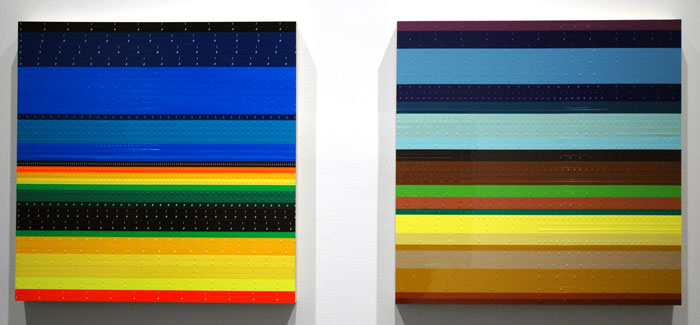
Gavin Green If (A) 2006, and If (B) 2007, both embossed plastic on panel 24″ x 24″ [installation view]

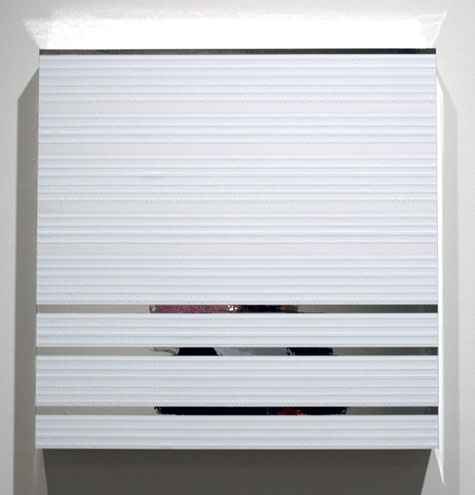
Green_Gavin_Hoalam_Haba.jpg
Gavin Green Hoalam Haba 2006 embossed plastic and mirrored vinyl on panel 24″ x 24″ [installation view]

Outrageous Look is showing a dozen of Gavin Green‘s brilliantly-colored and finished abstractions, painted almost entirely with embossed strips of plastic produced by an ordinary home and office label maker. The pieces are each named for the letters, words and phrases which have been punched out on long strips and wrapped around 12, 24 or 36-inch square panels.
Green discussed this series of work in an interview with the director of the gallery, Brook Bartlett. This is small excerpt from the pages which were available at the desk:

The work, if it’s going out into the world, needs to communicate.
….
Taking things (and words or phrases) that one might ignore, or take for granted, and subjecting them to an inquiry – I try to make work that asks questions. But it’s not just asking a question, it’s trying to look into subjects with rigor that I get excited about.
Asking questions, to me, doesn’t have to imply that you are searching for answers; it’s more about the act of asking the question, because it opens doors to the unexpected – it keeps things alive.“

“Intelligent Design” at Momenta

Williams_Aaron_Forever.jpg
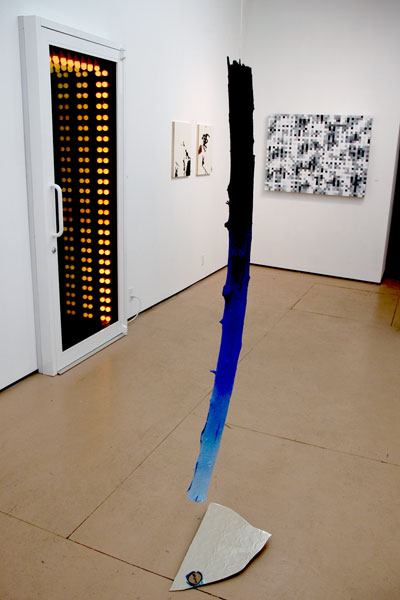
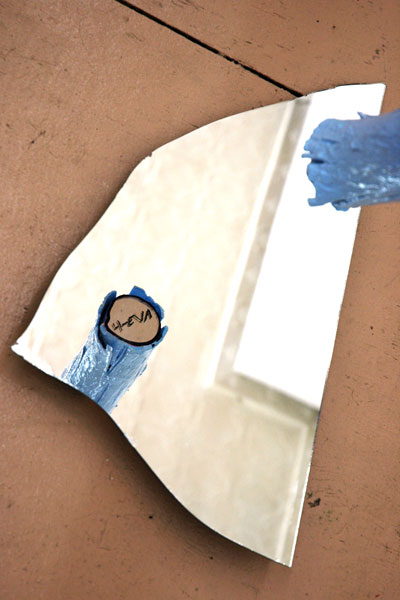
Aaron Williams Forever 2006 tree, mirror, acrylic and enamel paints, wood shim, string 72″ x 16′ x 12″, in the foreground, with works by Ivan Navarro, Deborah Grant and Aron Namenworth on the walls [installation view]
Williams_Aaron_Forever_deta.jpg
[detail of “Forever”]

I love to find a show that’s as attractive as it is challenging, but it’s bingo! when it’s also photogenic. Momenta’s current exhibition was “guest organized” (the phrase taken from the press release) by Rico Gatson and Ellie Murphy, and it is all of the above.
The theme shared by these 18 works by 14 artists is their use of different systems to get at material which is essentially unsystematic. The gallery notes say that the title of the show, “Intelligent Design”, is intended to reference an indifference to theories of evolution or arguments for intelligent design. As someone living in America who is profoundly secular in orientation, I really feel the heat from that last phrase; I also found the discussion contained in the complete text somewhat abstruse. I’d like to think that it’s essentially about the thought and practice of a generation which has walked away from the old, bogus debate and is now proceeding to address the world on its own terms.
The participating artists are Jane Benson, Judy Blanco, Sanford Biggers, Nicole Cherubini, Rico Gatson, Deborah Grant, Elana Herzog, Ellie Murphy, Aron Namenwirth, Ivan Novarro, Kelly Parr, Ara Peterson, Traci Tullius, Aaron Williams, and James Yamada.

Navarro_Ivan_White_Holeway.jpg
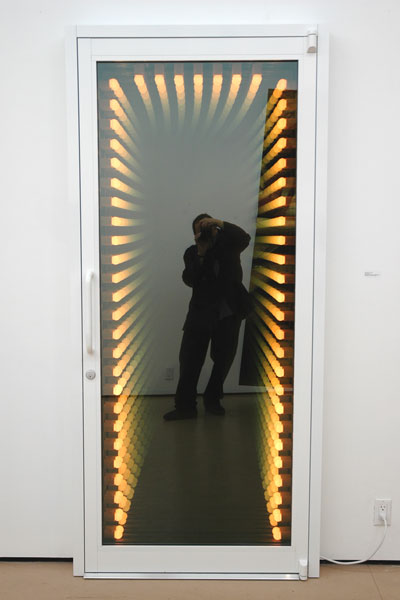
Ivan Novarro White Holeway 2006 aluminum door, mirror, one-way mirror, light bulbs, and electic energy 86″ x 39.5″ x 4.5″ [installation view, including image of photographer]

Parr_Kelly_Threes.jpg
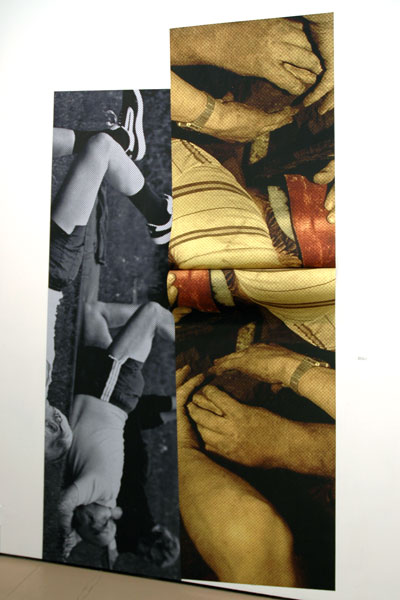
Kelly Parr Threes (January and July) 2007 digital print collage 108″ x 60″ [installation view]

cupcake preservation?

cupcake_trespass.jpg
cupcake as landmark?

I know I’m going to regret bringing the subject up again, and not only because the additional notoriety may only be what the owners of Burgers & Cupcakes want. But I did a post one month ago reporting that the pink cupcake would come down by the beginning of April. It’s still there today, so I feel obliged to do a follow-up.
Melanie La Rocca of the office of our local City Council member Chris Quinn was told by the Department of Transportation [DOT] that the B&C owners did not have a valid permit even for a conventional framed sidewalk canopy, and that the mechanical “cupcake” mounted on the top of the unauthorized structure which is there now could not be permitted in any case, because it would be a violation of city statute. [sidewalk canopies cannot feature advertising, lights, mechanical devices or even the business’s phone number]
I was informed of this on March 2, and at that time La Rocca also said that the DOT had told her the owners had 30 days to comply with the law, meaning the cupcake would have to be removed, even if a proper permit for the canopy itself could be registered by then. I read later, in a report in a local newspaper, Chelsea Now, that the violation wasn’t actually issued until March 15 or 22 (the exact date reference wasn’t clear in the article).
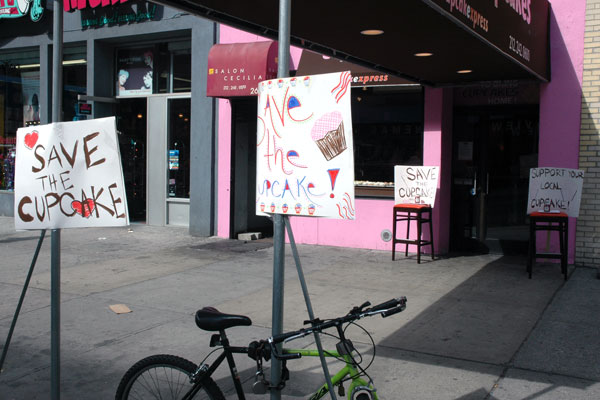
Today the owners initiated their “save the cupcake!” campaign with both cutesy hand-made signs and printed fliers outside the restaurant calling for support from anyone willing to buy something from among the scattershot reasons they give for wanting their cupcake preserved.

1.) [the DOT order is a] “beaurocratic [sic] boondoggle,”
2.) “The cupcake brightens a dreary street.”
3.) “Everyone in the neighborhood loves our cool sign.”
4.) “. . . now they are messing with a twenty thousand dollar cupcake.”
5.) “. . . loosing [sic] it will hurt our new business.”
6.) “I’m sick and tired of the city having their hands all over my business.”

I guess they think the same New York which recently wasn’t interested in saving an authentic landmark, like the former Huntington Hartford Museum, designed by Edward Durell Stone, is going to be interested in rescuing their cupcake.
Let me describe once again the reason for my interest in this admittedly less than life-and-death issue: A large lighted, revolving plastic cupcake mounted above a public sidewalk, and in fact perched virtually on the street curb, is an encroachment upon a public way. The sidewalk is part of the street, not of the building lot whose property line ends where the pavement begins. There are certainly safety issues for drivers and pedestrians as well, explaining why it’s the Department of Transportation which has responsibility here, but I’ll leave the details of addressing those subjects to the professionals. As a citizen I am most concerned with the danger of commercial encroachment and the precedent it would establish.
These are our streets; they can’t be turned over to the highest bidder.

Okay, although it is not and could not be the basis for the complaint I registered with the DOB last December, I admit that I do think the pink and brown shop and its canopy are both truly ugly. Also, unlike the B&C owners I do not think my street is “dreary”, and I believe the clutter and crude disruption created by their ugly little shop adds nothing of value to the streetscape. I repeat, these are my personal opinions and nothing more, but if we are talking about aesthetics, I believe, ironically, that it’s only the cupcake itself which might be worthy of a first, even a second look from a civilized New Yorker – if it were installed in an appropriate context.
“A Cloudy Day’s Epiphany” at Dinter

Van_Slyck_Valaire_words.jpg
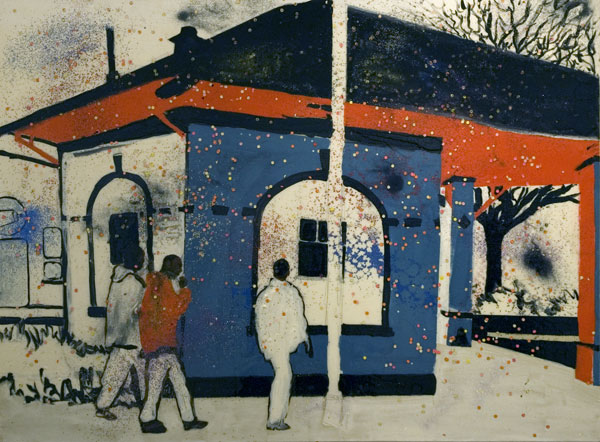
Valaire Van Slyck And even though we don’t mean what we say, we throw our words like bombs and handgrenades 2006 enamel, acrylic, confetti, glitter and clear-coat canvas 36″ x 48″

Guenther_Andrew_Space_2.jpg
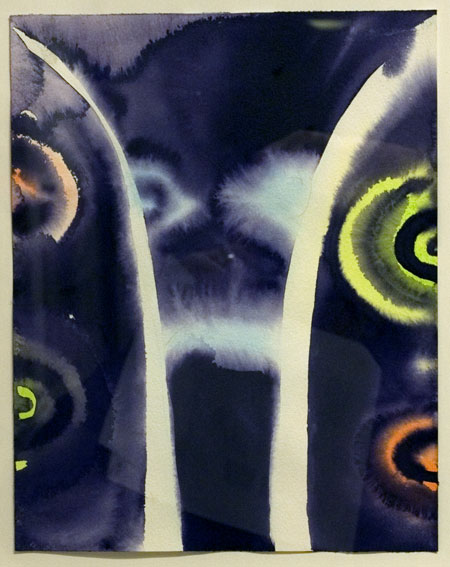
Andrew Guenther The Space Between Faces 2006 acrylic on paper 12″ x 9″ [installation view]

Ridge_Brent_Execution.jpg
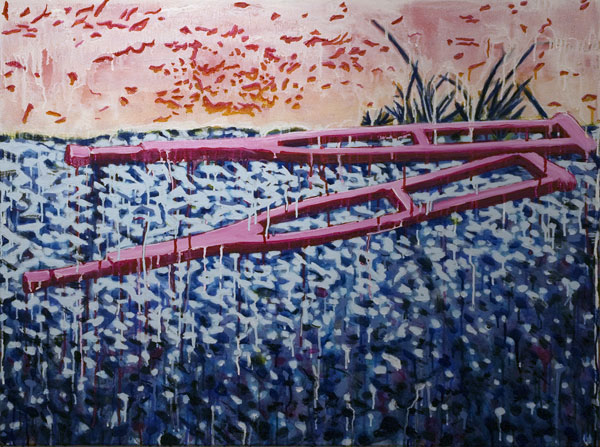
Brent Ridge The Execution of the King 2007 acrylic and pencil on canvas 30″ x 40″

Two weeks ago, in my post about the Cynthia Broan show, “What F Word?”, I wrote that my next entry would be something of a foil for its concentration on art produced by women. Sorry. I’m finally getting around to the men only now.
There seems to be an almost unanimous agreement that 2007 is to be the year of women and art (I hope the new attention is not just a vogue). There are big museum shows, important gallery retrospectives and even traveling exhibitions devoted to all sorts of angles on the modern history of what has always been the largest group of neglected modern artists.
The distortion and waste of this fundamental imbalance means that we’ve all been missing out on a lot. And that’s not even mentioning the baleful personal consequences for the one half of the world’s artists who have been locked out by the other – or by those who care for and feed them.
None of this is new to anyone reading these lines. We also know that everyone has a lot of catching up to do, even if there’s no danger the art that men make will be ignored in the interim. All of which brings me to “A Cloudy Day’s Epiphany“, the group show installed currently at Chelsea’s Dinter Fine Art, curated by Simon Cerigo. The artists are Devendra Banhart, Andrew Guenther, Brent Ridge and Valaire van Slyck. Dash Snow had been invited, but [perhaps because he’s such a guy*] his work hadn’t shown up by the time of the opening reception. I see his name is no longer included on the gallery’s site for the show.
I walked into the Dinter immediately after leaving the Broan show. When I was reminded who had curated this one and recalled what I knew about his own art from a terrific show I had seen at Capsule gallery, I looked around and immediately saw “Epiphany” as a boys’ club. But this actually seems to be the good club, the one you wouldn’t mind being a part of, even (or perhaps especially) if you were a girl.
It’s a very good group and there’s some very good work. I don’t think this is work which can be used to dramatize a male/female artistic dichotomy, and it’s not just because of the tie dye and glitter elements. I’m glad that even guys now seem to know that it really does take all kinds to make this world, and that we may finally be trying to come to terms with that reality.

p.s. It’s a four-artist show and, as I’m only including images of three, I feel I have to explain: I just didn’t get a good image of any of Devendra Banhart’s works.

*
or maybe there’s another story

Oliver Herring at Max Protetch

Herring_Oliver_Wade_1.jpg
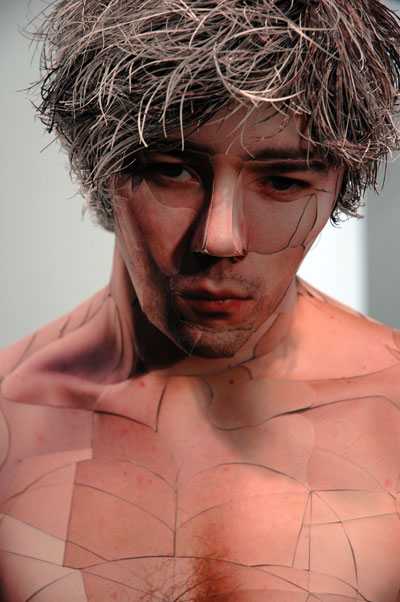
Oliver Herring Wade 1 2006 digital C-prints, museum board, foam core and polystyrene 68″ x 22.5″ x 15″ [detail of installation]

Oliver Herring‘s show at Max Protetch closed on Saturday.
Everything in this multi-media installation was breathtakingly beautiful, but this life-size photo-collage sculpture of a young male nude was of another dimension altogether. I found it almost impossible even to stand in front of the piece in order to capture this image; I didn’t think I could lower the camera, and I’m no prude. I don’t know whether my unease was from being in the presence of such beauty (the entire body was as sensuous as the face and shoulders), or because this figure standing before me was strangely so much more alive than anything sculpted with surfaces less pellucid.
An excerpt from Roberta Smith’s review of Herring’s 2004 show in the gallery:

But the showstoppers here are two pensive life-size sculptures fashioned from hundreds of close-up photographs of a thin young man in his underwear and a beautiful young woman in a flowery sundress. The delicate patchwork beings, at once whole and dissected, suggest a mind-bogglingly painstaking process for all concerned, as well as artist-model relationships of unusual intimacy.

Go to the gallery site for more images of the show just ended.

“The Art of the Deal” at Kantor/Feuer

Kantor_Feuer_Liberman_Tan_2.jpg

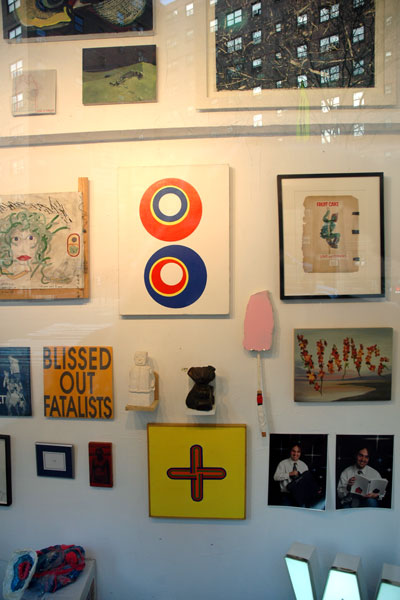
The Kantor/Feuer Window show, “The Art of the Deal”, which opened on Saturday may be “The ultimate art show for insiders.”, as Art Fag City calls it, but if you do happen to find yourself inside it’s actually very funny.
All visitors to the show will in fact be outside, since the “gallery” doors are locked and the exhibiton space itself is the equivalent of a building vestibule. And truthfully, since there are no real big-deal galleries represented by these twenty or so gallerists, this particular insiderdom is still a pretty comfortable neighborhood.
From the press release of artist/curators Justin Lieberman and Lumi Tan:

“The Art of the Deal” is an Artist-curated exhibition of early works by well known gallerists who once sought their calling on the other side of the table as artists. Far from the cynical venture it might at first appear to be, this show presents the idea of creative production as an egalitarian venture open to all who would choose to embark on it, regardless of their vocation.

My favorite piece, at least as seen from five feet away through reflecting glass, may be (Sunday gallery) C. Sean Horton’s pink popsicle-like sculpture in the center of this capture.
The complete list of the artists/gallerists who will be hanging together on 10th Avenue until May 11, are:

Roland Augustine (Luhring Augustine), William Brady (ATM Gallery), Elizabeth Burke(Clementine), John Cheim (Cheim and Read), Burr Dodd (Brooklyn Fireproof), Derek Eller (Derek Eller Gallery), Zach Feuer (Zach Feuer Gallery), Jane Hait (Wallspace), Sean Horton (Sunday), David Kordansky (David Kordansky Gallery),Nick Lawrence (Freight + Volume), Philip Martin (Cherry and Martin), Sheri Pasquarella (SLP Art Culture Commerce), Jeff Poe (Blum and Poe), Andrea Pollan (Curator’s Office) Becky Smith (Bellwether), Fred Snitzer (Fredric Snitzer Gallery). Kelly Taxter (Taxter and Spengemann), Elisabeth Wingate (independent consultant), Mike Weiss (Mike Weiss Gallery) and Scott Zieher (ZieherSmith)

Incidentally, this is the only show in Chelsea which can be seen 24 hours a day, seven days a week.

Hunter Reynolds at Artists Space

Reynolds_Hunter_dress.jpg
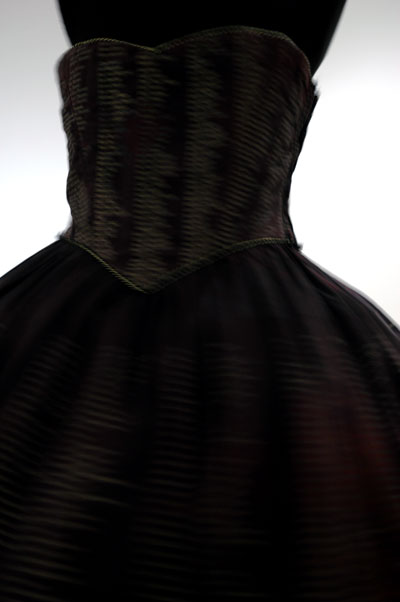
Hunter Reynolds Patina du Prey’s Memorial Dress: 1993 to 2007 [detail of installation]

Spinning, spinning, spinning.
Hunter Reynolds‘s elegant installation, “Patina du Prey’s Memorial Dress: 1993 to 2007“, is currently installed in one of the galleries of Artists Space. The performer/artist/activist‘s elegant, couture, strapless ball gown hangs from a torso mannequin in the SoHo gallery, not-so-slowly spinning on its axis (as it did when so memorably inhabited in the past by its creator himself), accompanied by an ambient piece of music composed for and contributed to the installation by the contemporary composer Edmund Campion.
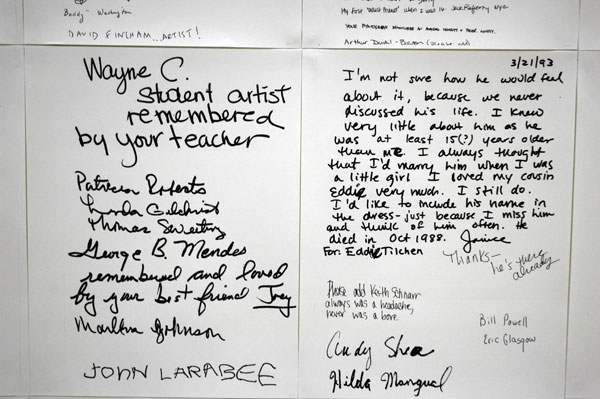
This is not just another cold tally of the epidemic, but rather a very human, a very personal collection of thousands of memorials, and a rich artistic gesture as well: The names on the dress were initially drawn from the list of names on the AIDS quilt as it existed in 1993, so it embodied the memories of friends and family members. Since then, wherever the dress has appeared the artist has invited visitors to write additional names, also of people lost to the disease and remembered by friends and family members, in an accompanying ledger book.
Is the supply of names running down? No. While the death rate for this epidemic may have slowed or declined in industrial nations during the last ten or fifteen years, at least within the population segments hit first and hit the hardest, the toll for the planet as a whole has skyrocketed. More significant to the specific groups which have seen his installation, when Reynolds’s project was begun in 1993 the friends or families of people with AIDS were far less likely to admit they were friends or families of people with AIDS; they were very unlikely to come forward with names to be added to a memorial of any kind. Reynolds confirmed to me on Friday that even in the American and European cities visited by the Memorial Dress, cities where life-sustaining HIV drugs are most generally available, the frequency of the ledger entries continues unchanged. It seems the survivors of a plague whose casualties themselves the world branded odious from the start are still coming out of the closet today.
What can be seen at the gallery this month is the second (1996) realization of Patina du Prey’s mangown. The first was the 1963 dress; the current version is constructed of a rich dark (faux-black?) silk fabric covering a fitted bodice and crinoline skirt printed in gold to include thousands of additional names added during the travels of the original. The artist hopes to create a third dress, which will incorporate the four to five thousand new names which have been added to the books in recent years.
This image is of a detail of one page from one of those books:

REynolds_Hunter_dress_names.jpg

PANEL AND PARTY
On Tueday, April 10, between 6:30 and 8 pm at the Artists Space gallery on 38 Greene Street in SoHo, Visual Aids and Artists Space will co-host a panel discussion, “Diamonds and Pearls: Remembrances and Recent Thinking on the Memorial Dress”, with Hunter Reynolds, Lia Gangitano, Alexander Gray and Simon Watson, moderated by Benjamin Weil and Amy Sadao.
Following the panel, from 8 until 9, guests are invited to party with Patina du Prey; there will be food and drink. [suggested donation: $5-7].

ACT UP party tonight

Gran_Fury_tshirt5.jpg

This t-shirt was designed by the legendary activist artist collective Gran Fury 17 years ago.
Today South Africa has national health care.
A lot of people still think they can do something to help drag our own country into the [twentieth] century. Some of them know they have to ACT UP to get there. But activists also know how to party, and sometimes a little cash is needed to help make a stink, so ACT UP is throwing a $20 celebration/benefit bash this evening, and everyone is welcome.
The doors of Manhattan’s LGBT Center at 208 West 13th Street (just west of 7th Avenue) will open at 7 pm. The program will start at 8 or 8:30 and will feature readings/performances by Pulitzer-prize winning author Michael Cunningham, the notorious Church Ladies for Choice, Mark Hannay (formerly of the Hot Peaches), and fabulous downtown performance artist Penny Arcade. The evening ends with a dance party that goes until midnight.

[image via ACT UP]

ACT UP renewed, and transformed

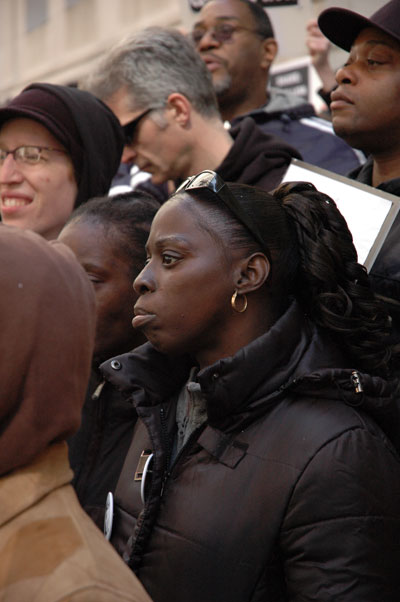
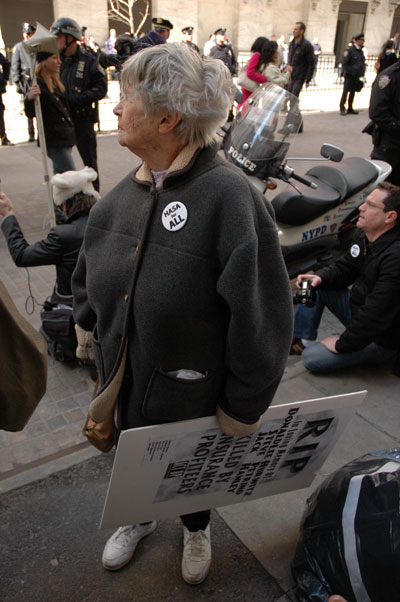
ACT_UP_faces_sign.jpg
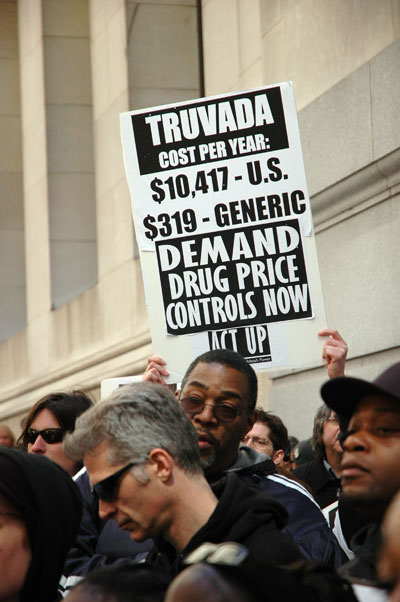
across from the Stock Exchange yesterday

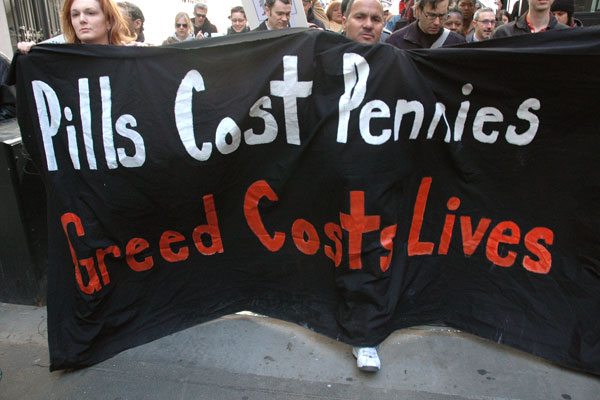
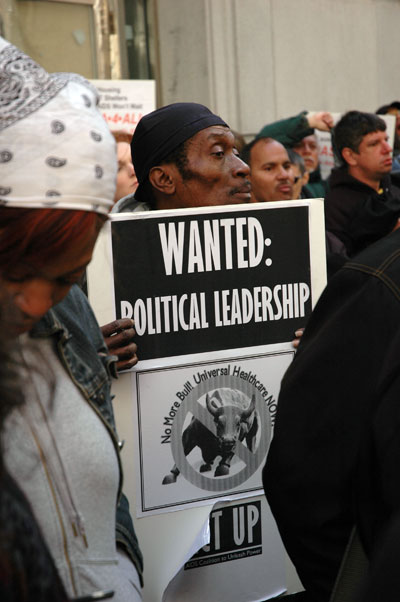
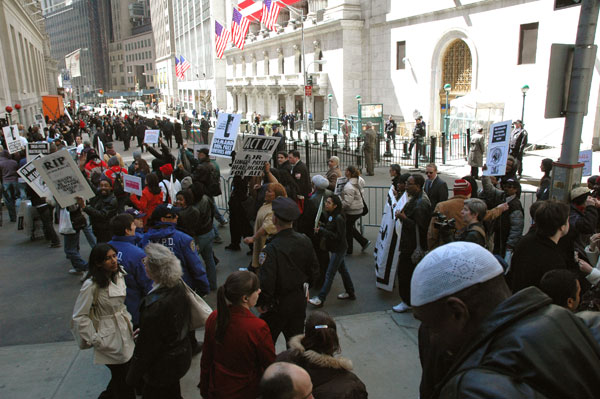
If yesterday’s ACT UP twentieth-anniversary action demonstrated anything, it was the coalition’s own renewal, and its transformation from an AIDS activist group once largely made up of young middle-class queer white males into one devoted to the this country’s larger, evolving healthcare crisis and composed of a much broader community of people who have realized we are all directly affected by both AIDS and a medical system completely inadequate to address it or other health needs.
In New York yesterday every age group and every community in this hugely-diverse city appeared to be represented in the crowd which gathered in and around the Wall Street area. They hurled chants at a powerful corporate medical, insurance and political establishment, reached out in conversations to regular passersby, they brandished both printed and hand-lettered signs addressing an aloof, fortress-minded establishment, and they carried or dragged with them some 50 bulky black body-bag props as they wound through the narrow downtown streets in a band of roughly a thousand souls. At the site of the bull statue near Bowling Green some 30 people were arrested for civil disobedience while lying down in the street amongst those bags.
The NYTimes did not consider the event worthy of a single word or image. See See Andy Humm in Gay City News for the best account of the day.
The new ACT UP appears determined to be only the nucleus [or perhaps, this still being ACT UP, really only the trigger] for re-igniting an enormous popular movement, coinciding with the run-up to the 2008 election, directed toward finally securing this nation’s adoption of a single-payer healthcare system after something like one hundred years of broken dreams and promises.
What follows are a few scenes from the struggle as renewed just yesterday.

ACT_UP_face.jpg
ACT-UP_pills-greed.jpg
ACT-UP-man.jpg
ACT_UP_Wall_St.jpg
ACT-UP_lady.jpg

ACT UP back to the Wall, this time for single-payer healthcare

ACT-UP_first_action.JPG
going back for more, 20 years later

Apparently as a nation we can accept throwing away something like half a trillion dollars (and counting), and very likely some 700,000 lives, on a remote elective war whose only accomplishment was a second term for the regime of the biggest Big Brother we’ve ever had, but we [or at least our media and our elected representatives] still think a single-payer healthcare system means handing over too much power to government.
ACT UP has always supported a single-payer health care system, and its members have always understood the role of war in thwarting its achievement. Tomorrow morning, Thursday, at 11:30 this remarkable and unfortunately still indispensable activist group of stalwarts will be marching on and in Wall Street to mark its twentieth anniversary and the beginning of its campaign to make access to healthcare for all, including single-payer insurance and drug price controls, a major issue throughout the 2008 election campaigns.
Anyone who is able to make it is welcome to join us as we gather for the march at 11 am. We will be stepping off from the Federal Building downtown, on the east side of Broadway at Worth Street, just above Chambers Street.
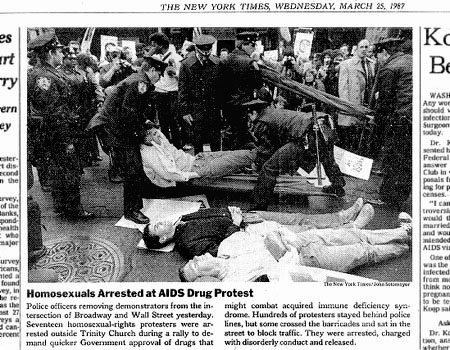
Twenty years on, the press will no longer be labelling us all “homosexuals”, as did the NYTimes in its coverage of the first action, shown in the image above, although it was exactly that powerful picture and its caption which sucked me into the group. As far as tomorrow is concerned, while it should be assumed that only those who have decided to commit some form of civil disobedience could be arrested, there is less certainty about that than there ever was in our present terrifying, and terror-stuck, political climate.
I’m bringing my camera, for surveillance purposes.
An editorial in the current issue of The Nation is an excellent tribute* to the historic accomplishment of ACT UP and a reminder that neither the role nor the actors have yet disappeared. Excerpting the last three paragraphs of the editorial:

During the years that followed, ACT UP stormed the National Institutes of Health, the FDA and the Centers for Disease Control to protest their shortcomings. On the local level, Catholic dioceses and boards of education were targeted for blocking HIV information in public schools; city governments for failing to provide care and housing; jails and prisons for setting up segregation units. Some ACT UPers set up guerrilla needle-exchange programs; others staked out the entrances to junior highs to distribute condoms directly to students. Just as essentially, ACT UP members became self-taught experts in such arcane fields as virology and patent law and in so doing rewrote the patient-doctor relationship and helped put the idea of universal healthcare–now favored by a majority of Americans–on the political map.
Along the way, ACT UP borrowed strategies from other radical movements: antinuke protesters for techniques on civil disobedience, antiapartheid campaigners for bringing political funerals to the streets. Many of its tactics–videotaping demonstrations as protection against police brutality, coordinated but autonomous affinity group actions–have become standard fare in the global justice movement, as has ACT UP’s deeply democratic tradition.
ACT UP is now a shadow of its former self, but its alums have gone on to found Health Gap, a driving force for global treatment access; the Treatment Action Group, which continues to push the AIDS research agenda; and Housing Works, which has won housing for thousands of New York City’s HIV-­positive homeless. And true to form, the organization will mark its twentieth anniversary with a march on Wall Street March 29 to demand single-payer healthcare for all.

*
including a candid apology for the progressive journal’s own historic neglect: “Though barely noticed in the pages of this publication, ACT UP would revolutionize AIDS research and treatment, as well as inject new life into the gay movement and infuse the tactic of direct action with its own style of theatrical militancy.”

[image from actupny]