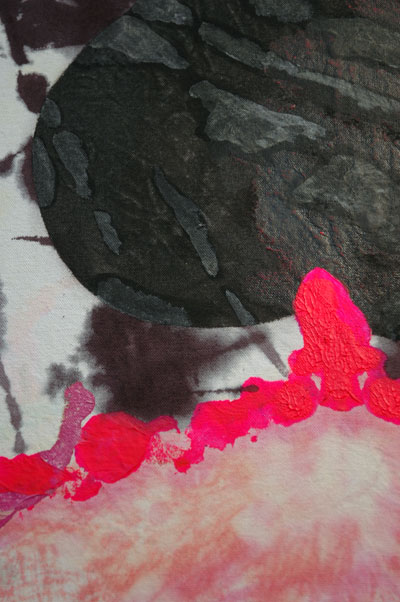
Frankie Martin the (rainbow) stinker 2006 fabric and acrylic paint 82″ x 50″ [detail from installation]
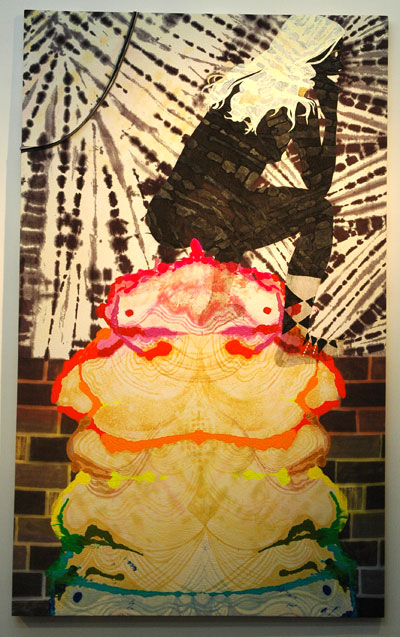
[installation view]
I visited “in your dreamz“, Frankie Martin‘s first solo show at CANADA twice, a luxury I unfortunately don’t allow myself often. I liked it the first time; I loved it the second.
I can’t remember the last time I saw a tie-dyed painting.
Martin has always had tons of fun with her art, and fortunately she lets us all in on it. This show was no exception, especially as it involved madly-conceived, energetically-executed and weirdly-disposed drawings, videos, music, installations, sculptures, assemblages and, well, . . . painting. The two large paintings on the west wall of the gallery stuck out, mostly because they were just so darn beautiful. And then I noticed the tie-dyed fabrics, the sparkle dust and the subject matter itself, and I was transported back into the cool wit embodied in the ambience created by the rest of the show.
Category: Culture
possibly the last word on photographing others’ art
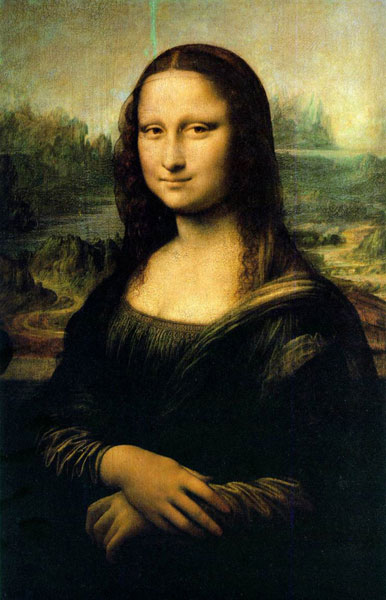
not without its replicas – and its history
I think the most sensible (and succinct) take on the question of visually recording visual art is contained in the second paragraph of a short comment submitted on my original post by the artist-blogger Hungry Hyena:
“As you suggest in the last paragraph, I think most artists would want the image to be passed along to the institution requesting it.
Furthermore, once the work leaves the studio, it has its own life, and random photos of the piece are just one more piece of that history.”
By the way, many thanks to Ed Winkleman for his post taking up the subject raised here this past week about restrictions on the public’s use of cameras in museums and galleries.
I couldn’t help noticing however that Ed’s entry manged to attract five or six times the number of comments mine did. Now I’m pressing tongue firmly in cheek here: If jealousy were not enough reason to be concerned about my colleague’s readers’ healthy response, perhaps, borrowing the spirit of the restrictive photo policies adopted by some of the most respectable cultural institutions in America, I should regret not having posted a preemptive do-not-record notice, or (reflecting the opinion of some of our more gentle readers on the subject of photographic captures) at least not having insisted that bloggers entering my site ask permission of the person sitting behind the screen before running away with copies of my proprietary posts.
[image from Georgetown University]
the invisible artist, the invisible art

invisible art [large detail]
This is a true story (only the names have been withheld, for considerations of privacy and copyright):
A young artist is chosen to be in a group show at a respectable small non-profit space.
An appreciative and enthusiastic art blogger captures an image of the artist’s work installed in that space and publishes it on his site.
On a return visit to the space months later the blogger is told by people in charge that photographs are not allowed at any time.
The blogger ceases to photograph any artists’ work in that space.
Two years after the image of the young artist’s work appeared on the blogger’s site a major museum in another city writes to him asking if it could have permission to use it in publicity materials being prepared prior to a solo show it has scheduled of the artist’s work, since there is no other photograph of the piece available.
The blogger suspects that the piece itself may no longer physically exist, thus explaining the importance of his photograph.
What does the blogger do in this case, and in the larger scheme of things, what does this scenario say about our cultural institutions’ photography restrictions generally?
[invisible image from alpinebutterfly]
“What F Word?” at Cynthia Broan
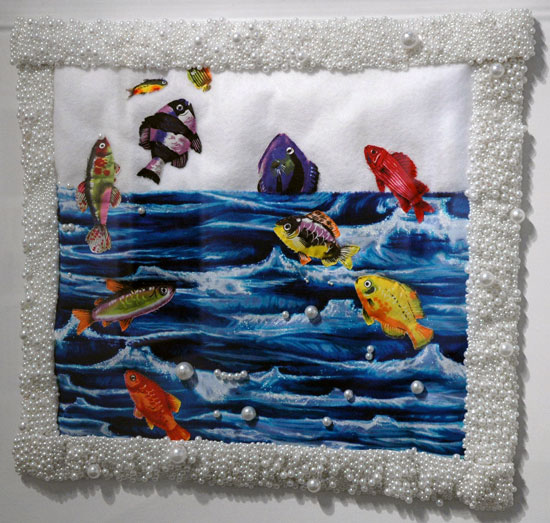
Sabyna Sterrett Flood 1979 faux pearls, fabric and thread 19.5″ x 22″ (25.5″ x 28″ in plexiglas box) [installation view]
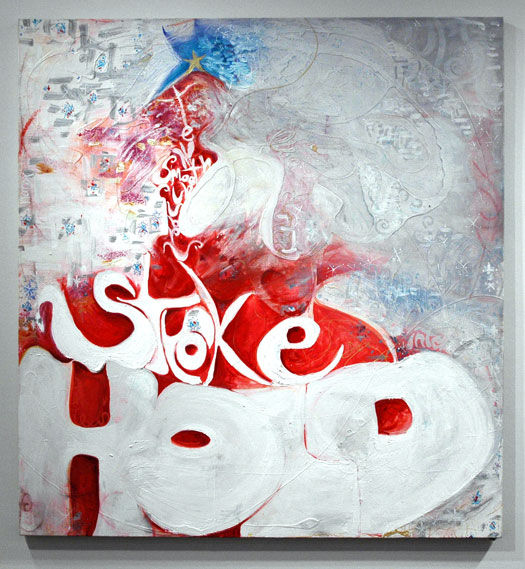
Suzanne McClelland Coming to a Head 2007 oil on linen 60″ x 56″ [installtion view]
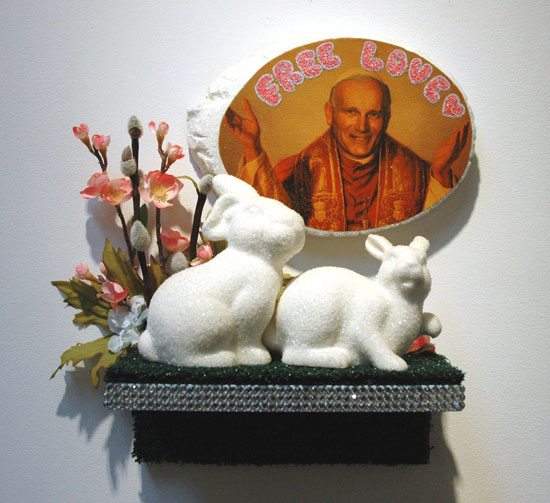
Lauren Gibbs Free Love 2006 ceramic, silk flowers, diamond dustwood, astroturf, acrylic, rhinestones 15″ x 17″ x 7″ [installation view]
Cynthia Broan’s show of feminist art, bearing one of the season’s more delightfully ambiguous titles, “What F Word?“, closed last Saturday, but some of the work included there (much, much more than what I’m showing here) deserves another shout.
I would say this is especially true because of its contrast (or harmony?) with a guy show (masculine art?) running concurrently just two streets south of her 29th Street space. [but more on that in the next post]
The work in the Cynthia Broan installation, which included, if I’m counting right, 33 artists or collaborators and twice as many pieces, spanned the last 45 years. I’d call that slice of time the years which will always have to be considered heavily touched by the 60’s, even if that amazing decade’s social innovations and political progressiveness has sadly been largely reversed. The arts thankfully somehow escaped that numbing and conservative fate which has ever been attached to an aging population.
It was wonderful to see firsthand so much revolutionary work from many years ago, but one of the most remarkable things about this show was the difficulty in dating the pieces without a scorecard. Sabyna Sterrett’s pristine, plastic-boxed pillow sham could have been made yesterday, and some of the newest work, at least partly because it employed found or organic materials which already showed physical age, looked like it could have been around for decades. Moreover, since many of the issues and obstacles facing women artists today are little changed from 1962, it just wasn’t that easy dating the work on the basis of its substance.
I left the gallery thinking I would like to have felt something more of the presence of the curator, the artist Carol Cole Levin, but the cast was certainly terrific. In alphabetical order they were: Ghada Amer & Reza Farkhondeh, Janet Biggs, Phyllis Bramson, Carol Cole, Patricia Cronin, Nancy Davidson, Lesley Dill, Diane Edison, Susan Paul Firestone, Dana Frankfort, Lauren Gibbes, Gina Gibson, Kate Gilmore, Nancy Grossman, Jane Hammond, Rajkamal Kahlon, Robin Kahn, Deborah Kass, Suzanne McClelland, Beverly McIver, Ulrike Mueller, Barbara Nessim, Shay Nowick, Brenda Oelbaum, Lesley Patterson-Marx, Elaine Reichek, Beatrice Schall, Rachel Selekman, Lowery Stokes Sims, Anita Steckel, Sabyna Sterrett, Jennifer Viola and May Wilson.
“Surface Wave” at Foxy
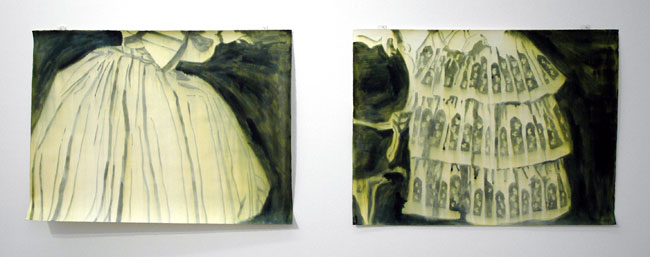
Ulla von Brandenburg Jupe 1 and Jupe 2 2006 ink on paper, diptych 22″ x 30″ each [installation view]
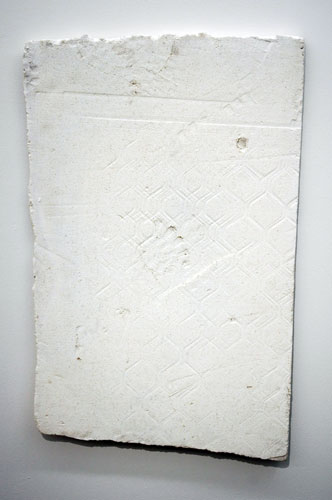
Hany Armanious Unrealistic 2007 cast Polyurethane 37″ x 24″ [installation view]
Sometimes a group show just looks right, although the curatorial theme may be elusive – sometimes even after a look at a press release. That probably says more about this visitor than the curator’s efforts, since I have a habit of using gallery texts more as “instruction sheets” (for difficult work) than guides.
With our without extra help, Foxy Production‘s current show, titled “Surface Wave”, does it for me. Both the installation and the individual works are first-rate. I realize that my statement about theme comes from someone whose apartment “group show” betrays no recognizable thesis either, but I’d also like to think that the choices Barry and I make are just as unmistakably idiosyncratic in their own modest way as those regularly exhibited so brilliantly on this stretch of West 27 Street are for the directors Michael Gillespie and John Thomson.
It’s a small group this time: The artists are Hany Armanious, Matthias Bitzer, Louisa Minkin and Ulla von Brandenburg. They are represented by ten elegant works on four walls.
Jesse Lambert
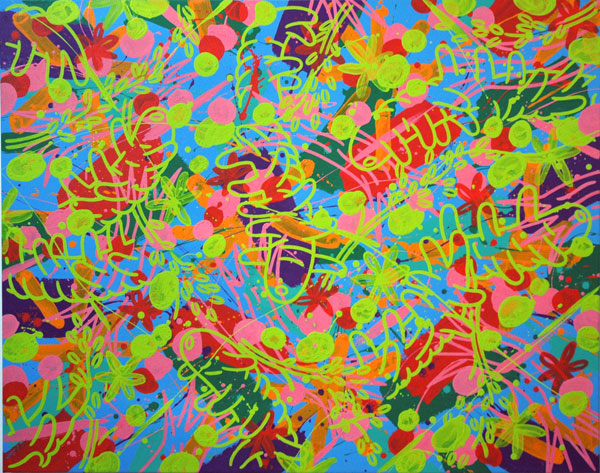
Jesse Lambert Soft Shelled Vehicles 2007 acrylic on canvas 38″ x 48″
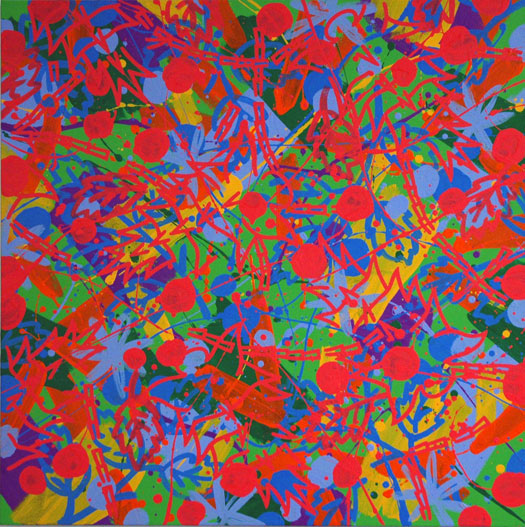
Jesse Lambert Tropical Shale Shatter #1 2007 35″ x 35 ”
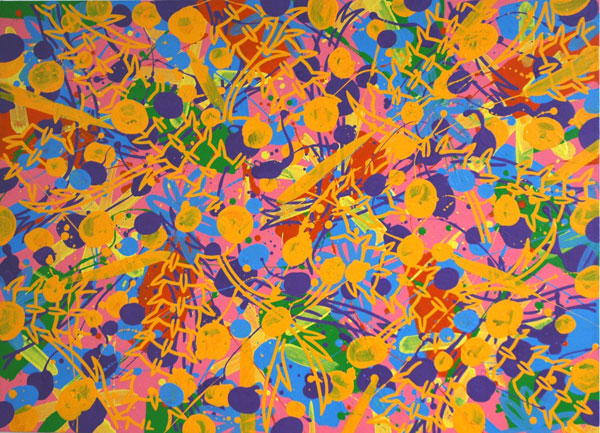
Jesse Lambert Segments and Broken Tubes 2006 32″ x 44″
Barry and I first saw Jesse Lambert’s work when he was included in a small group show curated by the excellent Lauren Ross at White Columns in the fall of 2004. We were very fortunate to be able to be part of a reception where each of the invited artists described her or his work and we were particularly charmed by his gentle presentation, by the simple ordinariness of his [almost-abstract] subjects and by his explanation of the color combinations he had chosen (basically, as I recall it, Lambert tries for the most unlikely, most improbable or most difficult combinations possible).
It may only be coincidence but today the artist’s subjects are even more closely related to his palette than ever before: Lambert has been scouring volumes of esoteric printed biology material for both information and inspiration. Most if not all of the latest paintings now incorporate the shapes of micro-organisms which are not the least bit restrained about calling attention to themselves when subjected to the lens of a scientific instrument. Lambert brings this world closer to the rest of us with these luscious acrylics (and these gorgeous gouache drawings as well).
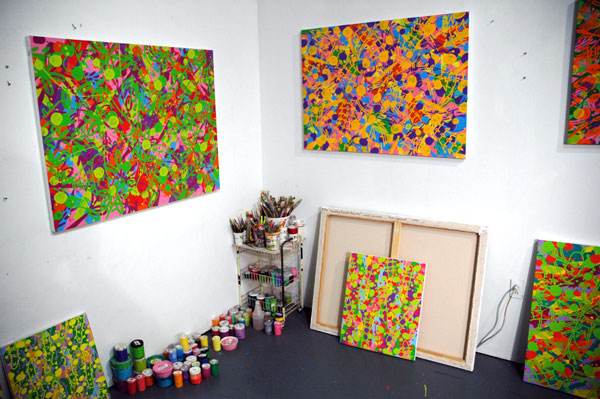
[studio corner]
Last December at the Wagmag benefit in Williamsburg we were delighted that his generosity to the Williamsburg art community helped to make one of his paintings our own, and two weeks after that we found ourselves in his Long Island City studio because we had decided to see and learn more about what he is doing now. The images of these rich garden carpets which I show here came back with me from Queens, but there is much more on his site, including a visual chronicle of his work showing how it has developed over six years.
Lambert is currently in a small group show, “BROOKLYN ABSTRACT”, at eyewash@Supreme Trading in Williamsburg, where he is represented by two terrific and quite recent canvases. (this large space on North 8th Street has recently been very nicely cleaned-up and now looks like a proper European Kunsthalle)
Cathy Begien at Winkleman
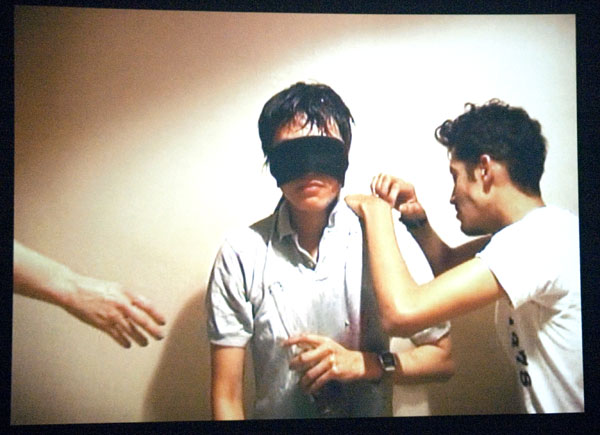
Cathy Begien Black Out 2004 single-channel video, audio on DVD [still from installation]
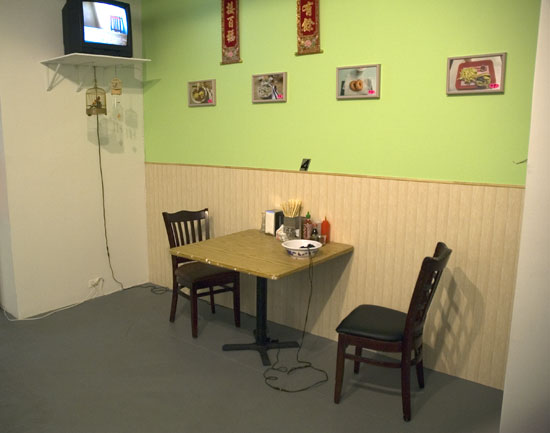
Cathy Bergien My Favorites 2004 single-channel video, audio on DVD [large detail of installation including artist’s props]
We did make it a top pick on ArtCal, and everyone seems to love it. The show runs for only one more day, so at least some of you still have a chance to see Cathy Begien’s terrific work at Winkleman Gallery.
A description of two of the artist’s three installations excerpted from the gallery’s press release:
In turns hilarious and devastating, [“Black Out”] features the artist (blindfolded and seated facing the viewer) retelling of a heavy night on the town with her friends. The narrative is delivered rather monotonously as several people continuously hand her drinks, cigarettes, and other props, acting out the evening’s excesses. As the story grows ever more messy, however, the stark set and low-budget production values serve to balance the overwhelming heartache of the episode’s climax, offering the viewer a rare, but safe, window into a raw, exquisitely sincere sentimentality.
In the second installation, Begien recreates the interior of a home-style Vietnamese restaurant as the setting for her video of her continuously eating her favorite foods. The obsessiveness suggested by her systematically eating meal after meal stands in stark and funny contrast to the cheesy furniture and menu photos of the referenced eatery.
Robert Gober at Matthew Marks
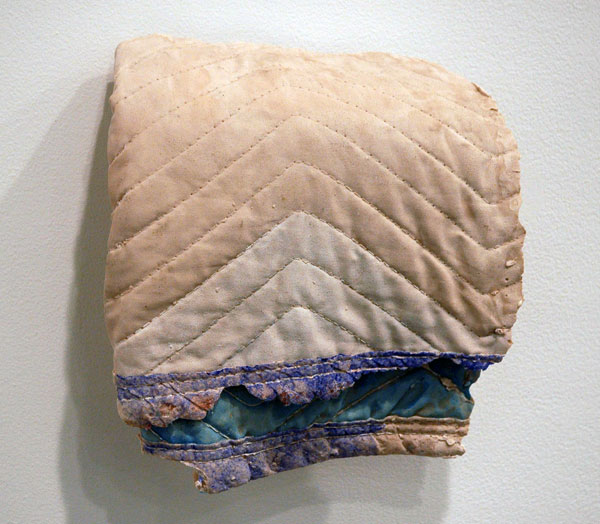
Robert Gober Blanket Sample 1 2006 gypsum polymer and watercolor 10″ x 9″ x 3.25″ [installation view]
The show is now gone, and in the end I only saw the 22nd Street space, but this image, which was not shown or mentioned on the gallery site, is the one which remains with me. Matthew Marks showed spare installations of sculpture and drawings by Robert Gober in a show which closed March 10.
If I may paraphrase the press release, Gober’s work continues to render our vulnerabilities visible, referencing a shared history which is within living memory, and always employing a very American vernacular.
marquee poetry
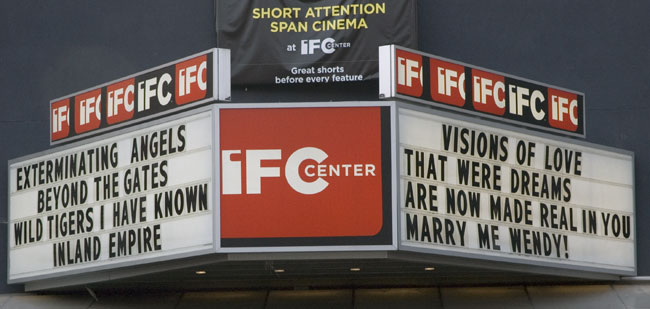
In this image of the Waverly Theater (now the IFC Center) marquee, as seen from across the street yesterday afternoon, it’s not immediately apparent that motorists, approaching from the left on this one-way street, got to see only the feature titles/first stanza; pedestrians could enjoy the entire poem.
pink pig Bush
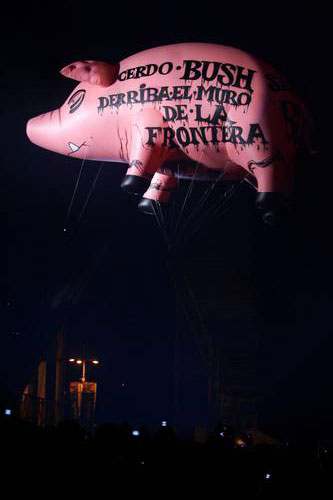
(PIG BUSH, DEMOLISH THE BORDER WALL) reads the message on the side of the big pink pig aloft during the Roger Waters concert in Mexico City on March 6, two days before his Bush visit warm-up performance in Bogota
Bush’s imperial entourage dropped into Bogota yesterday, but the presidential visit to what the media describes as the administration’s strongest South American ally was cut short because of security concerns. The President, who had traveled to and from a private stage set downtown in a 55-car motorcade which was preceded by an additional, 12-car phony/decoy motorcade, fled the country after staying little more than six hours. Oh, should I mention here that I’ve read that on this trip, and apparently on every trip, our president apparently has access to Marine One (perhaps shipped in the hold of a jumbo cargo jet)? Pretty soon we’re talking real money.
The idea of the visit had been to give a morale boost to a government dogged by a scandal involving its association with drug traffickers and brutal right-wing paramilitary death squads . Bush’s meeting with Alvaro Uribe Velez in the presidential palace on Sunday brought out some 2000 protesters (and 20,000 police and heavily armed troops). On Friday, in a concert in the same city (presumably, traveling sans motorcades) former Pink Floyd frontman Roger Waters introduced the subject of the huge amounts of U.S. money which maintains and corrupts the Columbian regime (Colombia receives more U.S. aid than any country outside the Middle East and Afghanistan). The band’s legendary helium-filled pink pig hovered above the stage, this time bearing the legend:
EL PATRÓN BUSH VISITA EL RANCHO DE COLOMBIA
(PATRON BUSH VISITS HIS COLOMBIAN RANCH)
Sigh. Do we have any idea of what we look like?
Are the Americans who voted for this regime noticing that from the very beginning of his term in office Bush has been unable to appear or speak in public except before military or invited audiences, and that this is also true on the rare occasions he travels abroad, even when he is a guest of a government described as closely-allied to our government? What does this say about Bush, and what does this say about us?
Do those same Americans believe that all those “foreigners” hate us personally, and not just the selfish and exclusive policies of our government? If we continue to choose governments like this one I have no doubt that eventually, as very fortunate people who represent ourselves as part of a democratic system, we will come to be despised by the world as individuals, and very rightly so.
[image of Fernando Aceves and Marco Peláez from laJornada]