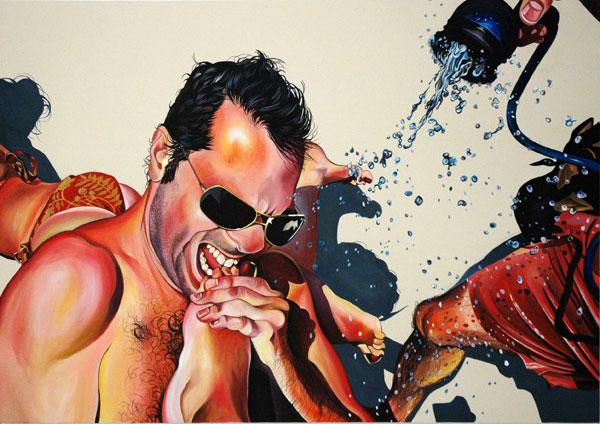
Leah Tinari Enjoying the Hose Down 2006 acrylic on canvas 48″ x 68″
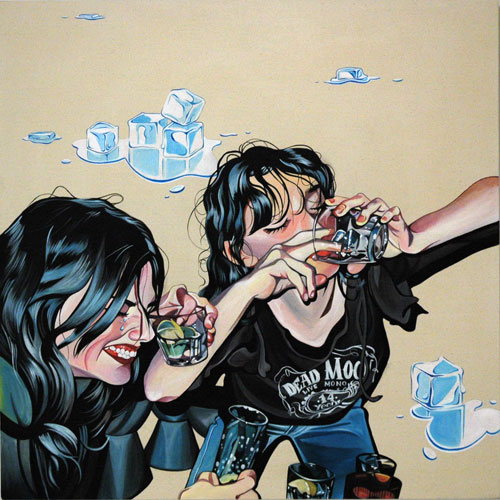
Leah Tinari Chug-a-Lug 2006 acrylic on canvas 40″ x 40″
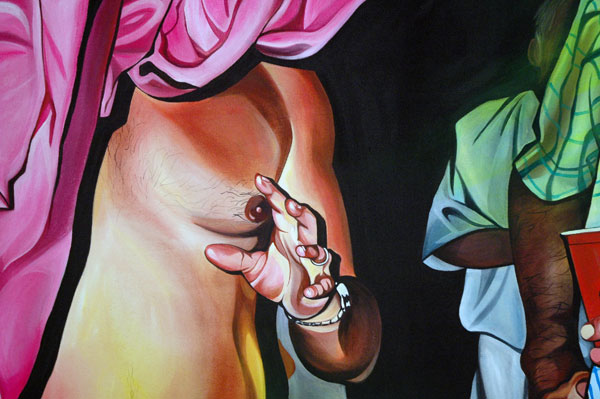
Leah Tinari Disappearing Act 2006 acrylic on canvas 48″ x 68″ [detail]
That’s just hot.
Leah Tinari’s show at Mixed Greens, “We Could Definitely Run for the Presidency“, closes on Saturday, and that’s a shame, because West 26th Street just won’t be the same when it’s gone. “Enjoying the Hose Down” is currently the hottest piece of art on the block, and it’s visible outside the gallery or even from across the street. In fact the fresh crisp lines and shapes of Tinari’s cartoon-like paintings, their backgrounds variously washed in white or black light, read as well from fifty feet as from fifty inches.
The most common subject of what I have to describe as her increasingly-mature work is the artist’s own family and friends, gathered together mostly in lusty parties. Captured originally in snapshots, their merriment is transformed by an unlikely combination of paint strokes both lush and neat into hugely-seductive acrylic cartoons more colorful and alive than the work of either a camera or any ordinary brush.
This old dude is thinking he wants to be in there with the rest of the party, even if he’s actually looking into the hysterical eye of a bridal shower or the beery scrum of a group of maturing frat-boys. Or maybe because.
Category: Culture
Andrew Piedilato at Black and White Chelsea
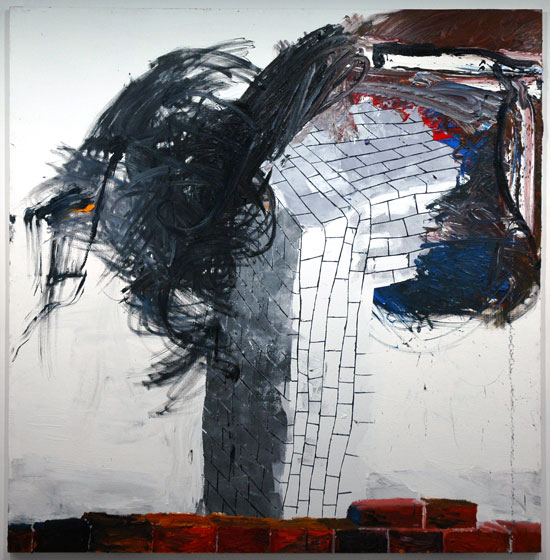
Andrew Piedilato Untitled 2006 oil on canvas 83″ x 78″ [installation view]
Sometimes in a group show there will be one piece that just jumps out at you. This is sometimes a totally subjective experience of a balanced show; on a return visit the work and the installation might look very different, but with 300+ galleries in Chelsea alone these days, the likeihood of a return may be only fantasy.
“The Sheltering Sky”, the current show in Black and White‘s large 28th Street space, houses Andrew Piedilato‘s stunning, untitled 45-square-foot canvas. This very physical, semi-abstract painting is as beautiful as it is enigmatic. The semblance of an Escher-like brick wall/road suggests that while Piedilato might never let you into the space toward which it seems to be moving, he’s also not going to leave you standing where you started out.
The work is part of a show of emerging artists whose title was borrowed from the novel by Paul Bowles.
Ruben Lorch-Miller at Schroeder Romero
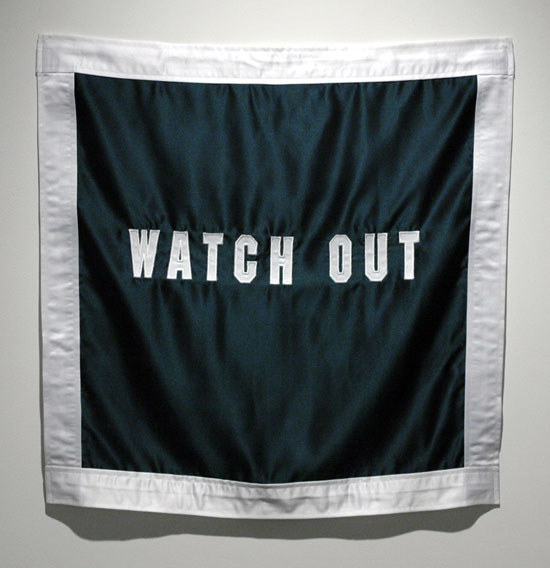
Ruben Lorch-Miller Watch Out 2006 satin and thread 30″ x 30″ [installation view]
As usual I’m way too far behind on posting everything I want to. I’m not about to stop seeing new stuff, so although it will still be only a futile gesture toward addressing the logjam I may for a while just blog images, accompanying them with very few words.
Schroeder Romero has a multi-media installation of work by Ruben Lorch-Miller, “Just the Other Side of Nowhere”. The title may be the easiest part of this disturbing show, which should be apprehended as a whole (the artist’s notes speak of basic themes of power, language and representation), but some of the individual images are stunning.
Louise Fishman
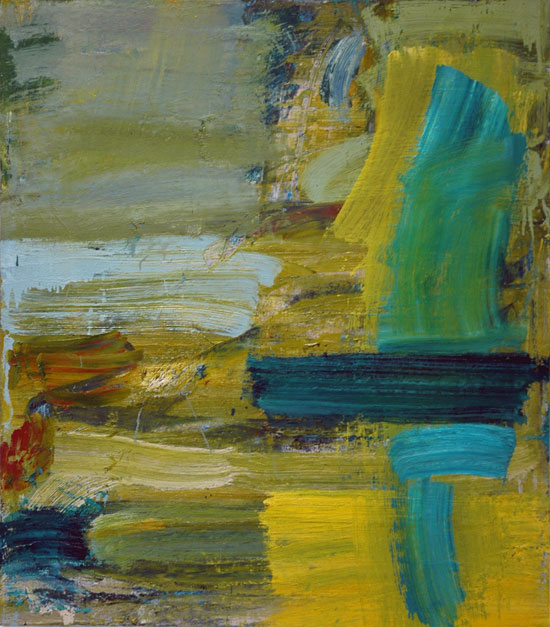
Barry and I stopped by Cheim & Read recently with some firends, specifically in order to show them some of the latest work by our friend and neighbor Louise Fishman. We were joined there by the artist herself, and I had such a good time that I neglected to take notes on this painting. I can’t provide the title or its measurements. While not the size of her largest canvases, I would say it’s “life size” in every dimension.
Tribeca industrial lofts
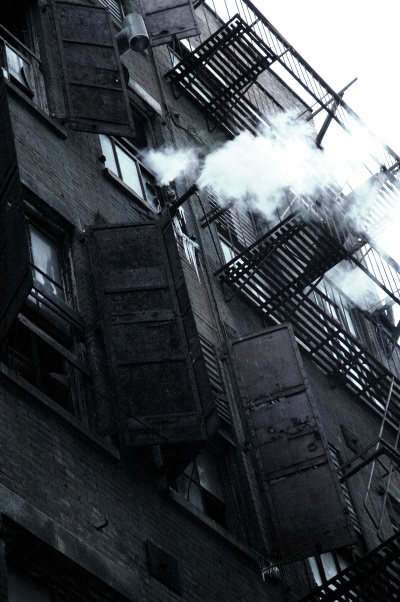
a steamy Cortlandt Alley, on a freezing Saturday afternoon
Not all of Tribeca has been turned into luxury lofts – yet.
Homeless Museum at home to guests this Sunday
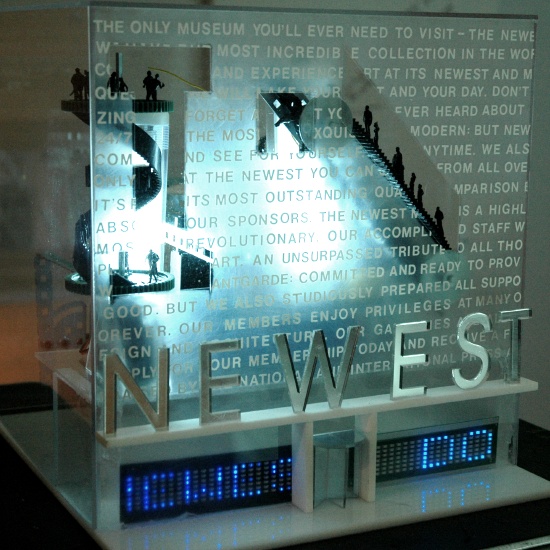
Filip Noterdaeme THE NEWEST� 2006 model (plexiglass, LED screens, figurines, remote-controlled robotic system) [installation view]*
The Homeless Museum (affectionately referred to as HoMu by both adoring fans and its own creators) will be welcoming visitors once again this Sunday. I don’t think anyone could describe this incredible institution as well as the creators themselves do on the museum’s website, and I’m certainly not going to try:
A product of New York City’s cultural decline, the Homeless Museum (HoMu) is a budget-and-staff-free, unaccredited arts organization that enables and engages cultural dialogue practiced at the intersection of the arts and homelessness.
Originally established mostly as a concept, two years ago the museum found a home in the fifth-floor walkup the founder shares with his partner Daniel Isengart. Once a month they open their doors to guests by invitation. Visitors are encouraged to email (info@homelessmuseum.org) or call (718-522-5683).
The NYTimes has found out about it and last month Dan Shaw wrote an excellent account of its mission and its work. The Believer has an extended article by Samantha Topol in the December/January issue.
I highly recommend a visit to the museum. Barry and I were there several weeks ago and we were charmed by the wit and sincerity of our hosts and delighted with the museum experience. We had first encountered what I’ll call the creative humanism of Filip Noterdaeme’s projects two years ago when we read about his campaign to shame the Museum of Modern Art (called MoMa by both supporters and critics, with little warmth from either) for its introduction of a compulsory $20 admission charge. Noterdaeme encouraged and inspired visitors to pay the entire amount in pennies, making it necessary for the museum to place buckets beside the station of each ticket clerk.
The admission at HoMu itself is determined on the basis weight (1�/lb.), cash only. The Times article describes its membership policy:
The museum raises money for the homeless with a twist on the usual cultural memberships. ”We encourage visitors to become members,” Mr. Isengart said. ”We tell them they can choose from any levels, from $5 to $125, and that they must give the money to a homeless person of their choice directly. We do it this way so that 100 percent of their donation goes to the homeless.”
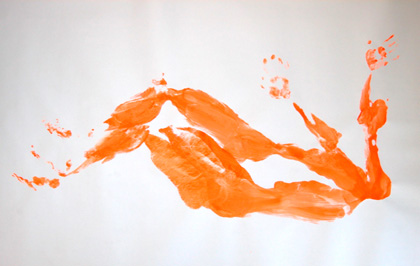
Filip Noterdaeme Spoon, 1/8 Iroquios drawing
“Spoon, 1/8 Iroquios” is in the museum’s collection. It is part of a series which represents a kind of empathetic curating concern absent from any museum of my experience. From the HoMu website:
The One-on-One Collection is a deeply felt and authentic engagement with the grim and stultifying lives of countless homeless adults who yearn for love, but instead must settle for broken dreams, abuse, and danger.
What began as a fascination with the sex lives of homeless men and how they fulfill their sexual desires has inspired this collection of body prints that are reminiscent in style of Yves Klein’s Anthropometries. Paintings on paper made by the imprint of naked bodies previously drenched in “Homeless Orange” provide a range of erotic connotations, addressing taboos such as homelessness, public sex, and homosexuality. For example, in “Spoon, 1/8 Iroquois”, two silhouettes suggest a hurried sexual encounter between two men.
What’s the tie-in between HoMu’s championing of the homeless and its critique of the museum? I think it lies in a profound awareness of the contrast between the outlandish sums of money and attention devoted to the increasingly-elaborate (and increasingly-inaccessible) temples in which we house the high-end items branded as our official cultural idols, and an incredibly wealthy society’s neglect or spurning of its own most-forsaken things and people, including its own material detritus but above all the homeless, the outsider, and the uncompromised artist. Noterdaeme and Isengart bring it all home with their phenomenal mix of minimalist panache and compassion.
The open house is Sunday from 1 to 6, on Clinton Street in Brooklyn Heights.
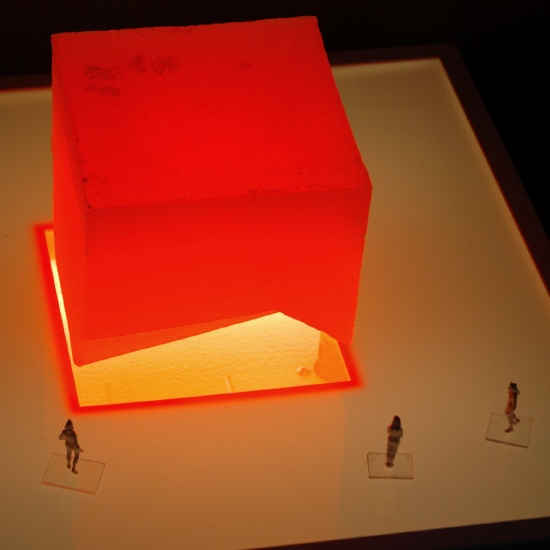
Filip Noterdaeme ISM (The Incredible Shrinking Museum) 2004-2006 model (glycerin soap) [installation view]*
*
descriptions of the two works shown in model form above, adapted from material furnished by the artist:
“The Newest�” presents itself as a new contemporary art museum. Viewed from the front, it appears to be a building that is inundated by visitors whose silhouettes can be seen moving about behind its see-through fa�ade, outfitted with several slogan-flashing LED screens. But a look behind the scene reveals the effect to be a choreographed deception: The Newest� is not a building but an oversized stage-set simulating a building front. The visitors turn out to be dummies circulating on conveyor belts and rotating platforms. The machinery is controlled from a computer operated by a single person, the museum director.
“ISM (The Incredible Shrinking Museum)” is a project for an interactive museum consisting of a sixteen-foot cube of glycerin soap. The cube is subject to constant change through exposure to the elements. In addition, visitors will be invited to exploit the structure like a mine until is it is used up, the goal being to reach out to a new audience and challenge visitors to think about their role as active participants in the shaping and destruction of culture through direct participation in the realization and, ultimately, the deconstruction of a museum.
[image of “Spoon” from HoMu]
Boston authorities crazy about LED street art

1/31 changed everything
I’m so embarassed for my friends in Boston. No, wait: Maybe our good neighbors are all actually onto something really, really big (I’m not talking about the suits and uniforms – or an impressively stupid Boston Globe editorial*): the growing role of the artist as the new and very visible hero of whatever pockets of progressive political life may still survive in locked-down America today. Fortunately the best of our twenty-first-century court jesters are not really part of the court, and they’re not really just jesting.
This Aqua Team Hunger Force LED bomb scare thing sounds like the outrageous scenario for a summer movie, so why aren’t Boston’s mayor and police department laughing?
Go here for the press conference archtype for a new age. It’s Dada!
*
the editorial, from this morning’s edition, isn’t available on line without a registration, so here are some excerpts of “PARALLYZED BY A GIMMICK”:
. . . Turner’s ad gimmick, undertaken in 10 cities from coast to coast, affected tens of thousands of people in the Greater Boston area. Businesses lost customers. Commuters lost time. Even more serious, first responders from local, state, and federal public safety agencies were called away from their legitimate duties.
One wouldn’t expect the promoters of the TV program “Aqua Teen Hunger Force” to score high on a maturity index. But anyone older than 8 or 9 should be able to understand the dangers of staging such a stunt in the post-Sept. 11 world. Homeland Security experts will need to review the response of local law enforcement. Public safety personnel may have overreacted ; local bloggers apparently identified the guerrilla advertising campaign early on. But it’s hardly surprising if others who weren’t in on the gag were suspicious. As a rule, first responders are left little choice but to assume they are facing a legitimate threat.
Perpetrators of terror hoaxes face prison sentences of up to five years if convicted. Police arrested an Arlington man last night in connection with the ad stunt, but potential criminal prosecution is only one consideration. The tricksters at Turner, a unit of Time Warner Inc., should pay the bill for the consequences of a lame marketing gimmick.
[image of Boston supporters of the artists Peter Berdovsky and Sean Stevens by Bizuayehu Tesfaye/AP via Gothamist]
Joe Ovelman at Oliver Kamm 5BE
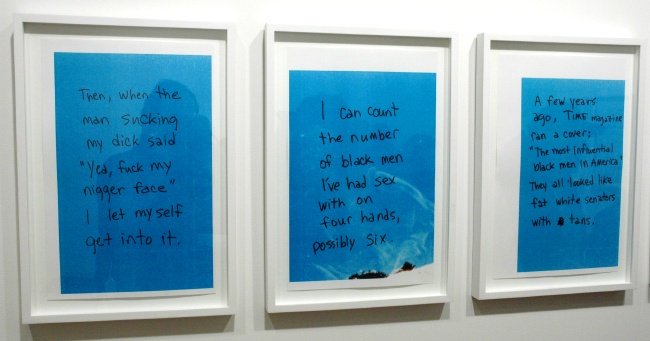
Joe Ovelman: the first three drawings from the series, Twelve Drawings 2007 [installation view]
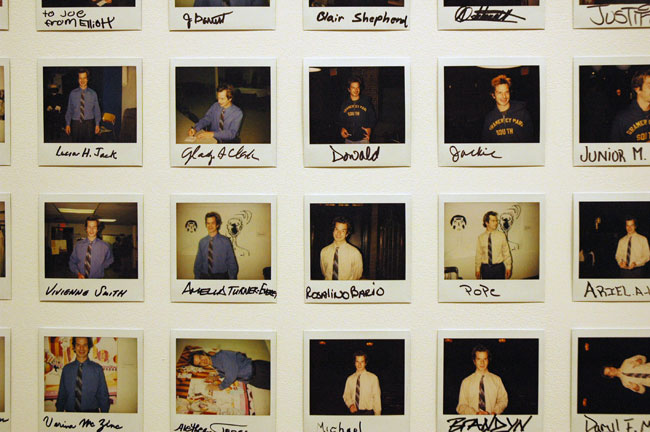
Joe Ovelman Rosa Parks 381 2007 381 polaroids and ink [detail of installation]
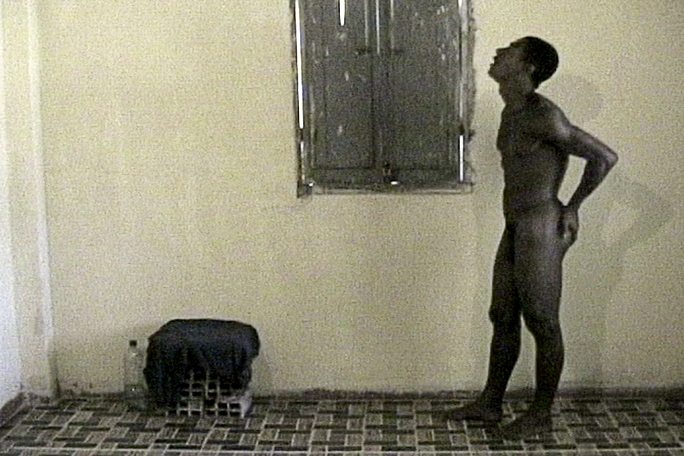
Joe Ovelman Regi 2005 video [still from video installation]
It’s a tough show. Joe Ovelman gets right inside the wretched, beating heart of white racism with his passionate exhibition, titled “For Whites Only“, currently at Oliver Kamm’s 5BE Gallery. There are only about seven works in the gallery, but the minimalist, and oddly almost sanctuary-like installation manages to include one piece from just about every one of the media forms available to an artist today.
Missing however from this virtuoso show, perhaps significantly, is any representative of his own still photography, the medium with which Ovelman has been most closely associated until the last year or so. The 381 polaroid portraits of the artist installed on one wall were taken and signed by 381 different people who could self-identify as African-American.
The press release describes the show’s one video, and the source of its ambient sound, very simply:
“Regi”, 2005, is a video in which the paid subject, chosen for his African decent, stands naked and confined to one end of a room for 8 hours, the length of a typical work day. The video was shot in Porto Seguro, Brazil, a historic slave-trading port.
UPDATE: See Holland Cotter’s review in the NYTimes February 3.
[third image obtained from the artist]
“Every Last Day” at Chashama
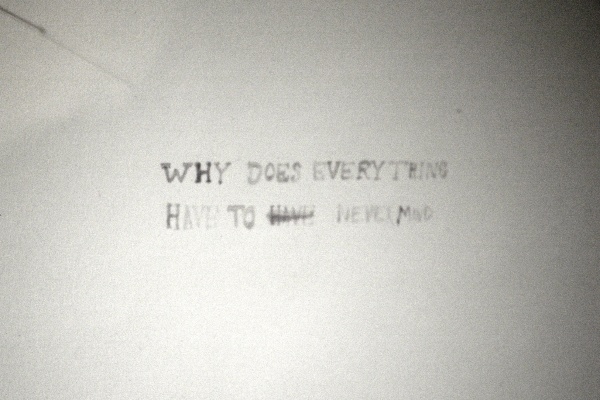
a small, faint, almost painfully sad drawing by Vivienne Griffin, from the show “Every Last Day”
There were a number of interesting gallery openings in Chelsea and elsewhere on January 11. We had tickets for a 7:30 performance in SoHo, but we still might have been able to make a number of shows before heading further downtown. We decided instead to visit perhaps the least obvious opening, that for a show called “Every Last Day“, at the current, storefront location of Chashama, just off Times Square. We weren’t disappointed.
The exhibition was mounted by an expanding collective of inventive artists called Dos Pestañeos. The show is called “Every Last Day”. I want and expect to see more from these people, whether together or otherwise.
The last day of the show is February 28.
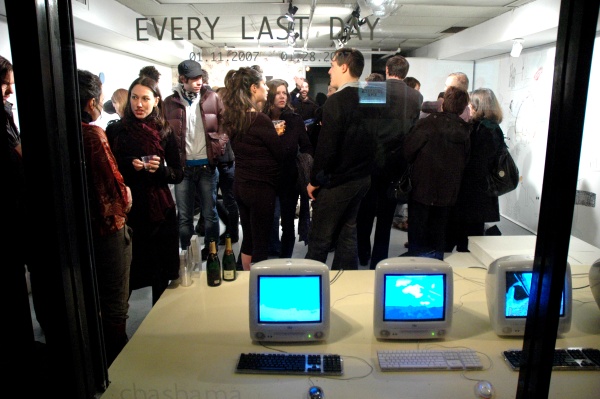
the reception crowd, mixed together behind work by Alex White with Lori Scacco in the window, as seen from the busy W. 44th Street sidewalk at 6 pm.
“Concrete”: Robert Ashley tells stories and sings
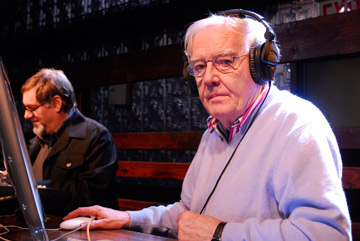
I told the salesman I’ve been dealing with for years at Sweetwater that I
should be recognized as the oldest composer to be using Abelton Live. He
asked, ‘How old are you?’ ’76.’ ‘Boy, that IS old. Well, just keep doing
it.’ Thanks, kid. – Robert Ashley
We were privileged to be part of the audience last night for the premier of Robert Ashley‘s latest opera, “Concrete” at La Mama. It’s sad to imagine, as I do, that only in future generations will large numbers of people be familiar with the work of this giant in our midst today. Even though it could hardly be described as “difficult” and even though its creator has been at it for almost a half century, this music is almost unknown to the people who are both the artist’s muse and the only subject of his loving creation.
Not every one music listener today would be a candidate under any circumstances for the ranks of adoring fans of Wagner’s Ring or Stockhausen’s Licht cycle [I confess I am almost fanatical about both], but it may only be the tight corporate control of access to radio and television waves that can be blamed for the general public’s total ignorance of the wonderful stories and music of the man who invented televison opera decades ago – and specifically as a popular and indigenous American art form.
Titles like these (from his catalog) are not made for an elite, and should not be kept in its possession: “Your Money My Life Goodbye”, “Purposeful Lady Slow Afternoon”, “Interiors Without Flash”, “Outcome Inevitable”, “Improvement (Don Leaves Linda)” and “Music Word Fire And I Would Do It Again (Coo Coo): The Lessons”. The music is even lovelier.
Performances of “Concrete” continue through Sunday.
Last night at the end of his rich daydream odyssey one of the voices of this semi-autobiographical opera’s protagonist sighs, “I tell stories and sing; I’ve nothing else to do.”
NOTE: “concrete” is here an abstraction for the poet’s cherished city
[image from robertashley.org]