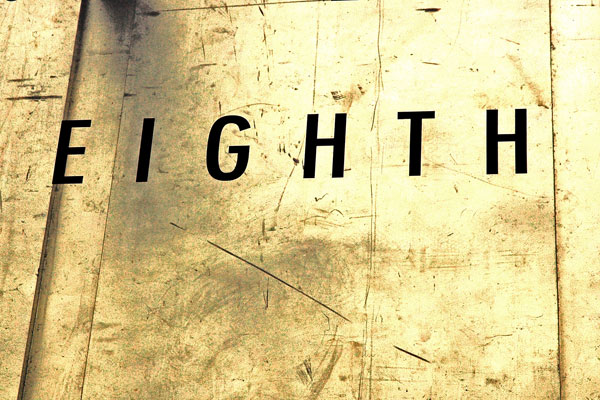
Today is the eighth anniversary of this blog.
I said it last year, and I’m delighted and incredibly privileged to say it again: This is also the anniversary of what turned out to be the most important event in my life, the night Barry and I met (now nineteen years ago).
Last year I also wrote, looking at the world outside our circle of close friends, that I was “more upbeat about the world” than I had been the year before, the eighth year of our second Bush, adding, “but only a bit”. That hasn’t changed, a bit.
And happy birthday, Paddy Johnson!
[the image is of a portion of the street number on the glass above one of the Art Deco entrances of the former Port Authority Commerce Building (1932), 111 Eighth Avenue the wall seen several feet behind the glass is covered with gold leaf]
Category: Culture
the Starns install “Big Bambú” on the Met Roof Garden
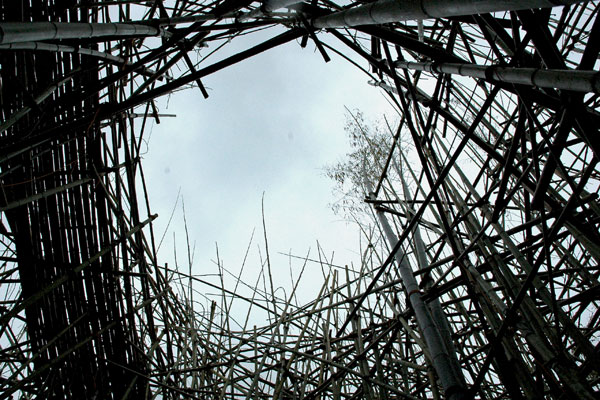
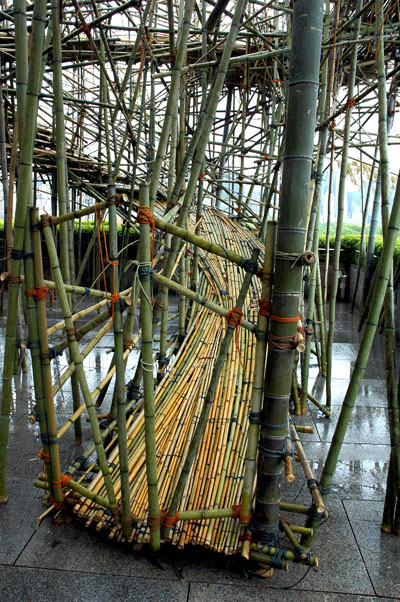
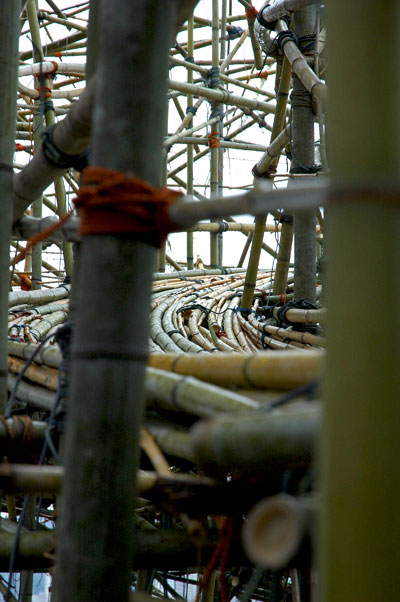
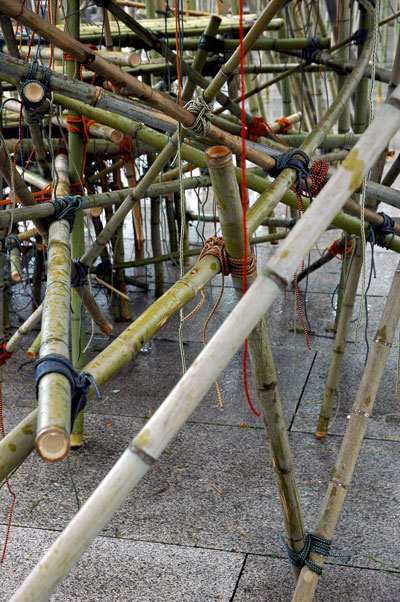
Brothers Mike and Doug Starn‘s Metropolitan Museum roof installation, “Bambú: You Can’t, You Don’t, and You Won’t Stop“, opens today, April 27. Barry and I were at the press preview yesterday morning. I’m sharing here a few of the images with which I returned.
I’m not really drawn to openings (of any kind, galleries, performances or film) just for the sake of being there first. There has to be some other lure; it might be the prospect of being around creative friends. And only the promise of something very special, also something which almost has to be experienced in the relative isolation of a preview could normally bring me to the Upper East Side before noon, but there we were yesterday at 11 am, standing in the rain on the roof of the Met, and there wasn’t a friend of any kind in sight.
Oh yes, I admit that I was also there because I was looking forward to some terrific, uncrowded photo opportunities, even if we weren’t going to be able to scale the heights of the bamboo cloud surrounding us.
It turned out that the “Bambú” itself was friendly enough, even if the wet-blankets working at the underwriting desks of the museum’s insurance company refused to let anyone enter the internal footpaths. It’s a prohibition which can be expected to be applied, throughout the spring, summer and early fall, whenever the surfaces become wet.
The Starn’s piece will not move across the roof, as did their earlier bamboo sculpture at the former Tallix factory in Beacon, New York. There the structure, assembled inside an enormous, 320-foot space, was continuously reconstructed by dismantling individual poles and carrying them down the floor to be reassembled into (another?) monumental piece, several times over and over, and then back again.
The forest at the Met will continue to grow in height throughout the spring and summer, and the existing paths constructed within it (in the sky, so to speak) will be extended further during at least much of that time. Visitors who are not so unfortunate as to show up on a drizzly day can expect to encounter a number of sturdy rock climbers, mustered from northern New England and the European Alps, working on the piece above their heads.
The other friendly faces we encountered were those of the Starns themselves. I’ve been encountering their work for more than 25 years, and I’ve never been disappointed by what I’ve seen as they’ve reconfigured the world around them. On Monday they were completely generous with their time and open to any queries from the press.
“Bambú” likely represents the most complete transformation of the Iris and B. Gerald Cantor Roof Garden in the twenty-three years of the space’s history. It may also turn out to be the most successful, not least because for its visitors it’s probably going to be the most exciting ever.
I thought it was a pretty awesome piece, not least for the fact that its rather serious scale depends on only a rather smallish carbon footprint, and for being a frankly ephemeral construction (ephemeral except in the memory of those who will experience it). The very fact that it was done at all is a remarkable accomplishment for the artists, the Museum, and, yes, that insurance company too.
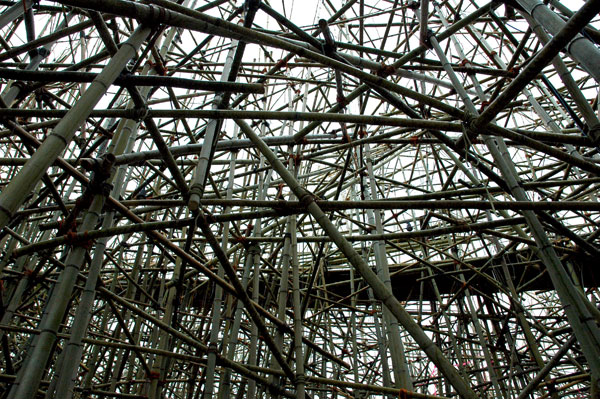
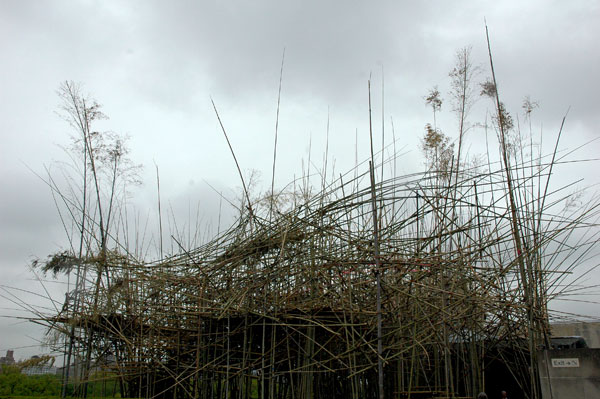
Now I’m thinking about the piece as art. It’s a maze, with elements both random and designed. It’s a forest of natural, wooden materials, yet bound together with synthetic, nylon cords. But this “forest” has been planted in the middle of, and yet above, a great artificial metropolis by the hand of man alone. It has been accomplished through the borrowing of the products of nature as well as human genius. It displays attributes of chaos as well as order, and the contributions made by nature and by man both exhibit each of those. Every piece in it was assembled, arranged, and bound into place by artists, although working closely with their collaborators. Every element of the structure has an intelligence and a rhythm. Not one part of it is quite accidental or entirely superfluous.
The forest maze closes forever on October 31. I wish instead that we could flood the roof and watch it grow forever.
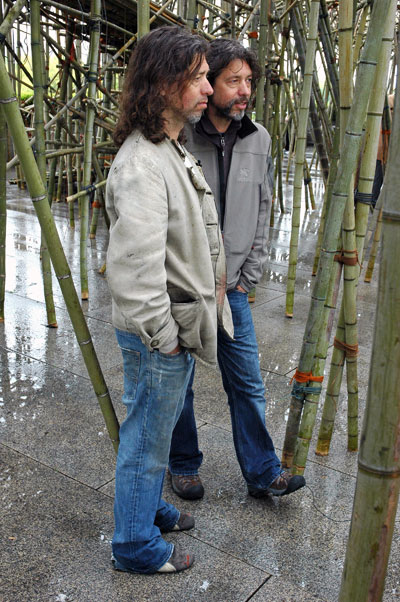
the artists: Doug (l.) and Mike
“ECSTATIC” at St. Cecilia’s Parish
It’s probably not technically a pop-up show. It’s also not merely another spawn (if here a silver lining) of our continuing Great Recession, like most of the new spaces hosting new art in New York and elsewhere. Then could we be watching the birth of a Greenpoint Biannual, a shelter for the emerging artists’ own periodic “cross section of contemporary art production”, to borrow a phrase from the Whitney itself?
Barry and I were in the former Catholic St. Cecilia Convent last Sunday for the second time in six months. Once again Father Jim, the pastor of the parish had generously and visionarily turned the space over to some young curators and artists. The Round Robin Collective‘s “ECSTATIC“, both an exhibition and a series of events and performances, assembled by a group of invited artists, ends its four-week run this Sunday. An excerpt from the statement which appears on the show’s website:
While some of the participating artists’ work deals directly with notions of ecstasy, the title of the show does not allude to an overt theme in the work presented; rather, it refers to the process of making and encountering art and the results produced from inspired relationships.
Yes!
Three floors of the formerly-empty rooms of the nearly century-old building are filled by underknown artists with interesting new work in virtually every medium. I had been eagerly anticipating a visit, because of the pleasures we had encountered last September in the show put together by a different group of artists, but almost as soon as we walked in I thought I had died and gone to heaven. There are certainly great pleasures to be found in visiting museums and galleries, but they are nothing like those associated with the immediacy and serendipity of sharing in the work of good artists in any medium when they decide to put on a show with only a minimum of structure or system provided from without.
While some of the work may not completely unfold while competing with the intrusiveness of the abandoned-convent environment (just about the opposite of the clean white box so associated with the exhibition of art in the late twentieth century), in many if not most cases the circumstances of the installations seem ideal, oddly better than what a gallery might provide.
The list of artists includes: Lisa Boumstein-Smalley, Mary Billyou, Amanda Browder & Stuart Keeler, Caroline Burghardt, Lisa Caccioppoli, Ofri Cnaani, Chris Cobb, David Coyle, Jeff DeGolier, Martin Esteves, Gisela Insuaste, Jamie Kim, Stephanie Liner, Deirdre McConnell, Katherin McInnis, Emcee C.M., Master of None, Huong Ngo, Christopher Rose, Stephanie Rothenberg, Dorothy Royle, Matthew Spiegelman, Janos Stone, Cassie Thorton + Action Club, Jenny Vogel & David McBride, and Audra Wolowiec.
For more on “ECSTATIC”, see Daniel Pearce’s piece on IDIOM.
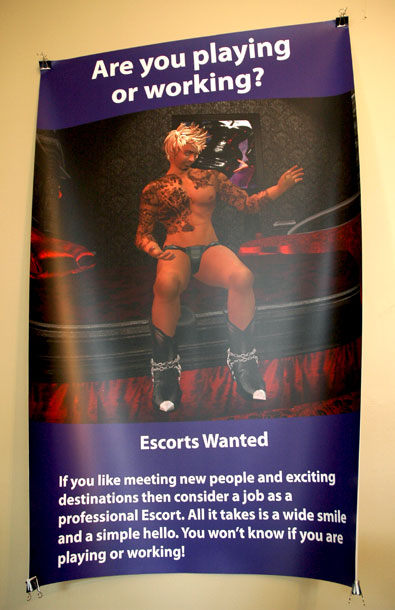
Stephanie Rothenberg
Stephanie Rothenberg installed a fairly-convincing office environment in a room just inside the front door of the convent. This image is of only one of a handful of posters suggesting advertising for an imagined employment agency. From the “Ecstatic” site:
Stephanie Rothenberg’s interdisciplinary practice merges performance, installation and networked media to create provocative interactions that question the boundaries and social constructs of manufactured desires. Her recent work investigates new models of online labor and the virtualization of the global workplace, referencing post-colonial as well as DIY historical precedents.
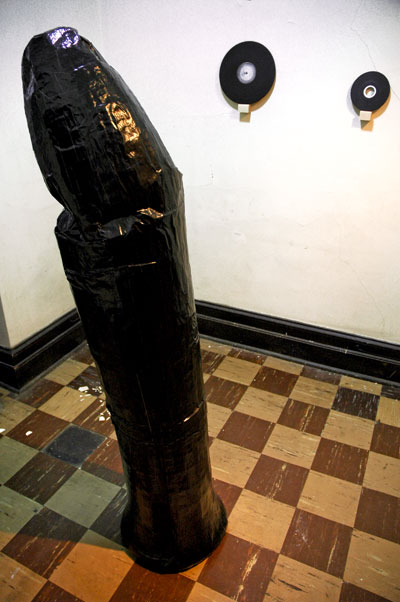
Martin Esteves Come to Mock Stay to Rock and Audra Woloweic howl and sounds of silence
The advertised sole purpose of this five-foot-tall phallic standing sculpture, the work of Martin Esteves, was to fulfill the role occasionally assigned to its medium: Something you bump into while looking at the art on the walls. In this case, neither the sculpture, which rocks on a soft base, nor the bumpee’s soft rump would likely be harmed.
The filed-down vinyl records mounted on the wall are the work of Audra Woloweic, whose work addresses sounds, forms of communication and, according to the statement on her own site, “ephemeral moments of the everyday”.
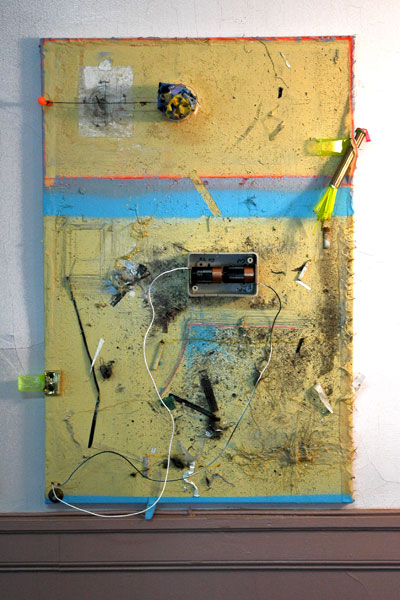
Jeff DeGolier Stride 2009 hair, woodglue, duracell batteries, hair, spraypaint, housepaint, electric motor, wire, glue bottle, etc. on found canvas
Jeff DeGolier‘s gently-animated piece appeared to be both an integral part of the disintegrating interior of the old building and its (please excuse the expression in this context) its transfiguration.
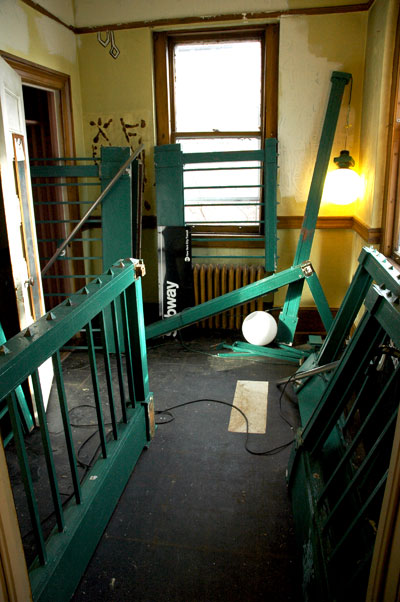
David B. Smith and Brina Thurston
David B. Smith collaborated with Brina Thurston to de-install her large site specific outdoor sculpture from a show ending at Socrates Sculpture Park, cut it into pieces small enough to fit into his car, and re-install it in a small residential room in the convent. The original sculpture, entitled Master-Station, is a life-size replica of a NYC subway entrance, complete with functioning globe lamps.
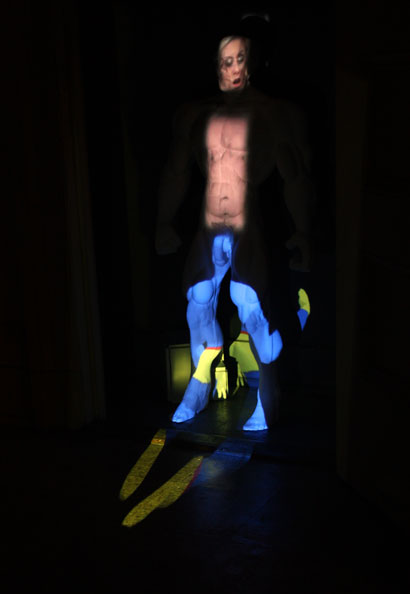
Janos Stone I Never Thought I Would Meet Someone Like You
Janos Stone‘s installation began with his creation of a monstrously-muscled heroic nude male figure upon which three distinct images were projected, changing male and female faces of porn actors at the top, pornographic videos in the center, and at the bottom a colorful Second Life figure. I’ve checked out his site since leaving “ECSTATIC” and we both visited with the artist on Friday night at his current show at SLAG Gallery, “LMIRL“, and talked to him about his future projects. My head’s now spinning.
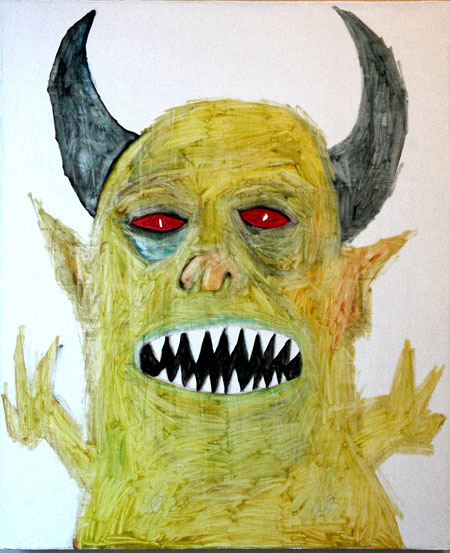
David Coyle I Killed the Monster 2008 oil on canvas 24″ x 20″
David Coyle‘s paintings appear somewhat unremarkable at first, but their severe honesty, humor, and (I don’t think I’ve used this word before) painterly grace brought me back to their small cell-like room several times.
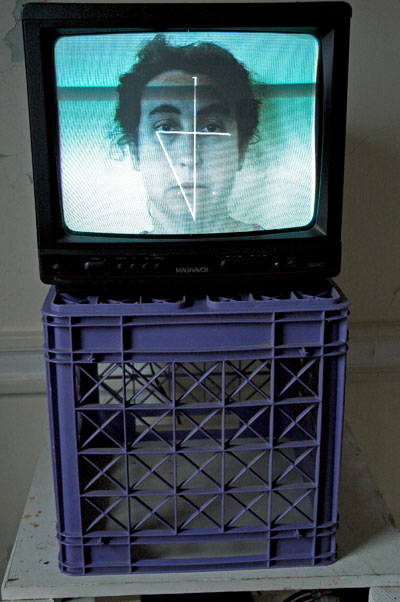
Mary Billyou Subspace Face
A simply-rigged monitor showed Mary Billyou‘s looped video combining a severe frontal view of the artist’s own face with a simple matrix, and was a part of a larger installation with a strong historical context. While it was fairly mesmerizing it remained pretty enigmatic absent more information.
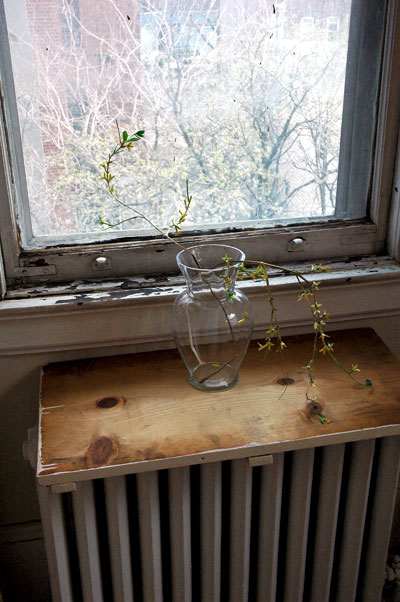
Dorothy Royle
Dorothy Royle’s installation of a glass vase of hand-made forsythia branches just inside a window was literally an unfolding performance: The artist visits the site regularly to gradually open up, and wither. The label informed us also that “. . . bright green leaves will grow from ends of the strongest branches. Inevitably, some petals will fall”.
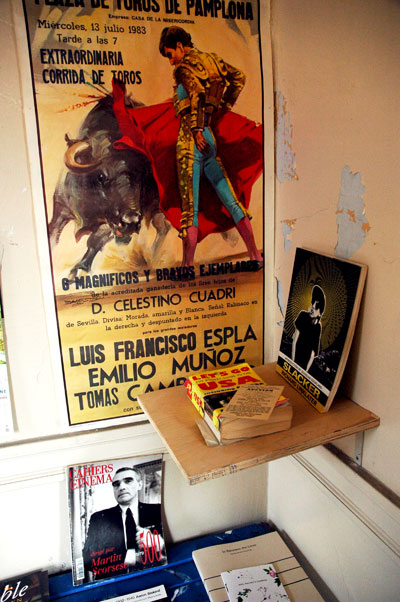
Emcee C.M., Master of None Reading/Radio Room
The installation by this collaborative, which tells us that its work always “combines large-scale public, social and collaborative event-based projects with a more internal process of self-reflection through fiction, storytelling, and filmmaking. This corner of the building, titled “Reading/Radio Room”, could easily cocoon a visitor for hours.
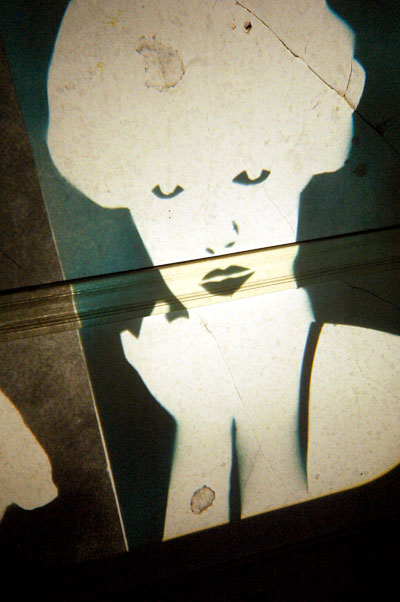
Ofri Cnaani
Ofri Cnaani‘s art evokes the magic of the ancient magic lantern, but she addresses gender, architectural space, myth and reality in seductive imagery and movement. I first encountered her work in 2008 and I find myself captivated once again.
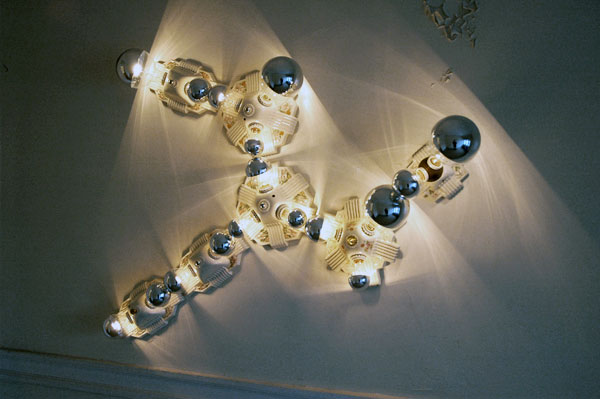
Matthew Spiegelman
Matthew Spiegelman has assembled several lighting installations inside the convent, each of them abstracted from homey old lighting fixtures and each more infectiously joyful – and oddly spooky – than the next.
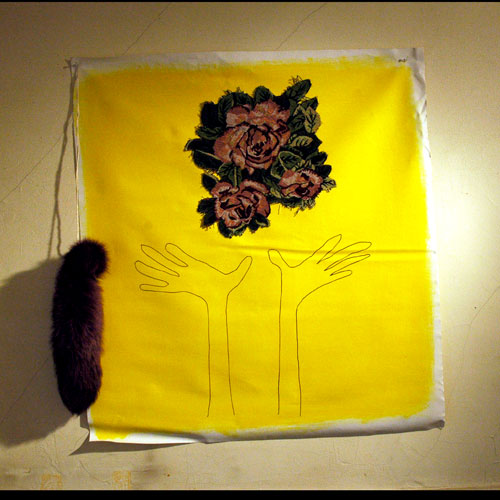
Amanda Browder Future Telling 2010 discarded (found): painted canvas, embroidery, marker, fur
Amanda Browder‘s piece was in a room which appeared to include both her own work and pieces done in collaboration with Stuart Keeler, but this piece appears to be identified as her own creation.
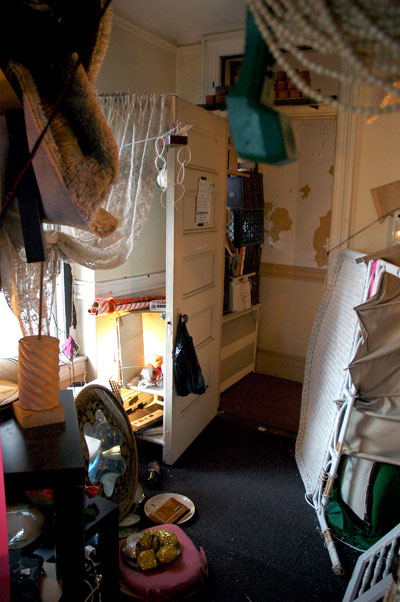
Cassie Thornton + Action Club
I haven’t been able to track down anything on the installation identified as “Cassie Thornton + Action Club” (or, variously, “Action Team”), but the planned chaos of the broom closet-size installation pictured here, and the scrim composed of countless found objects of all sizes which has been assembled in front of the third-floor hallway window just beyond, somehow suggested an advanced postmodern intelligence, and the scrappy art which can ultimately humanize it.
[Janos Stone image from the artist]
BAMart Silent Auction Ends at 8PM Today
image from Eric Doeringer’s “Bootleg Series”, in a group combining five individual pieces, 2001-2005, all ink and acrylic on canvas, the works range between 5″ x 7″ and 8″ x 10″
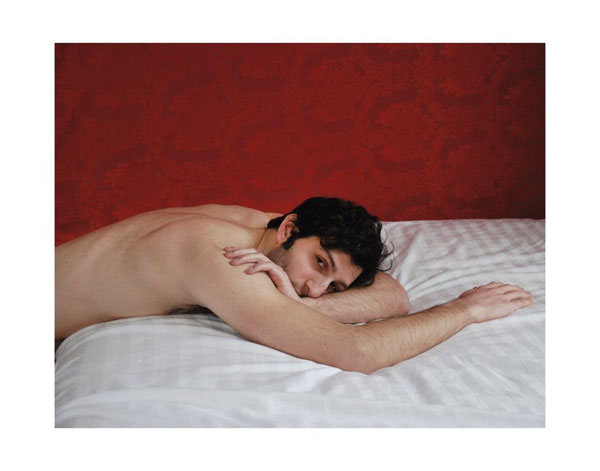
Amy Elkins David, New York, NY 2008 C-print, edition 1/5 11″ x 14″
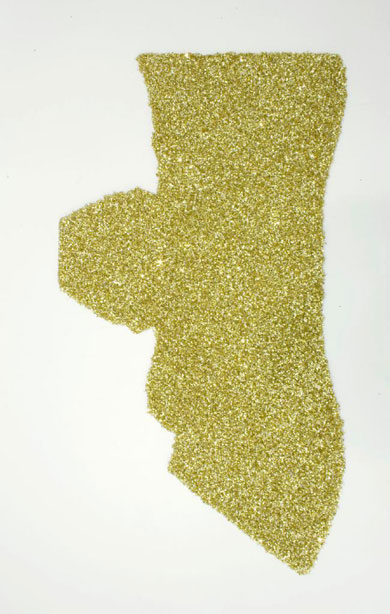
Tony Feher Untitled 2008 glitter and spray adhesive on unfolded box
11.5″ x 6.25″
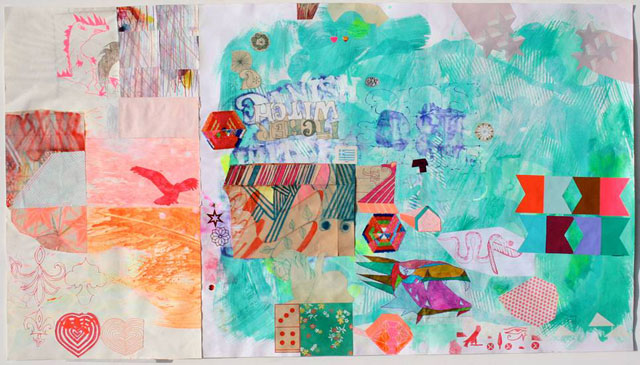
Donna Chung Untitled 2005 mixed media on paper 19.5″ x 35″
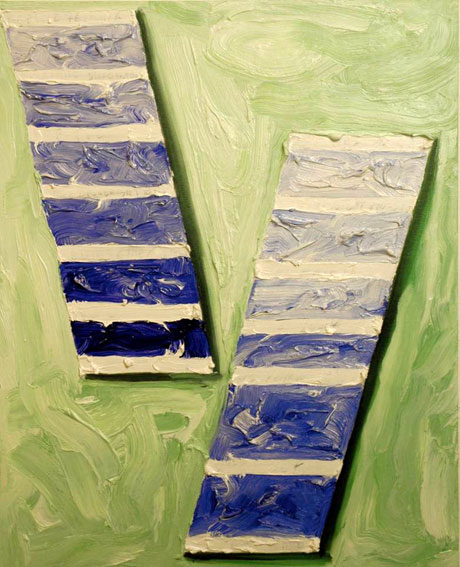
Erik Hanson Ladies of the Canyon 2007 oil on canvas 20″ x 16″
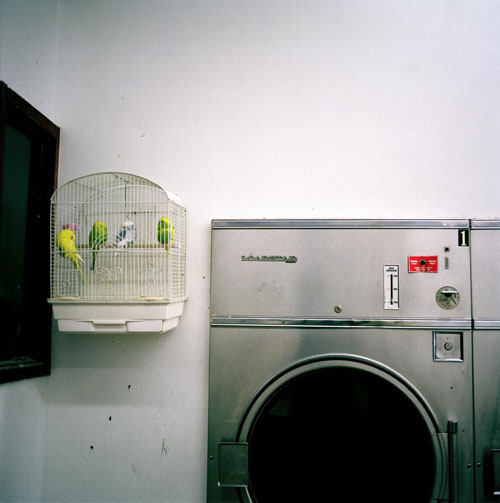
Colleen Plumb Laundromat 1997 C-print 19″ x 19″, edition 4/10
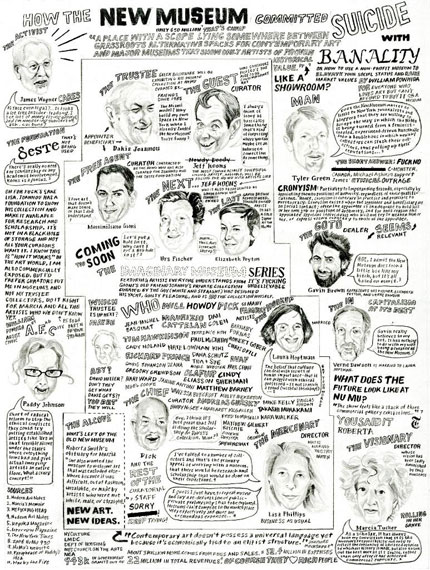
William Powhida How the New Museum Committed Suicide with Banality 2009 archival inkjet print on paper 17.5″ x 14″, edition of 20, AP 4/4
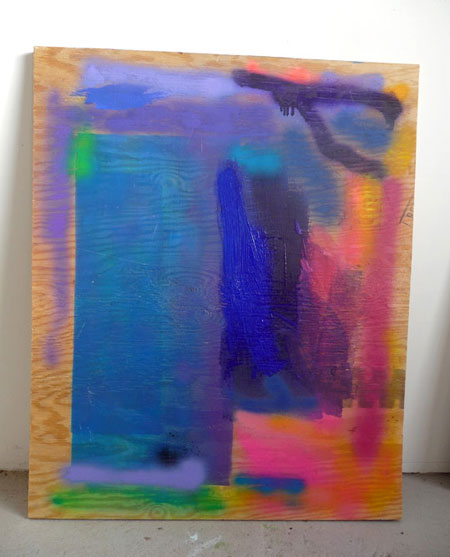
Sarah Braman Swimmy 2010 paint on plywood 35″ x 28″
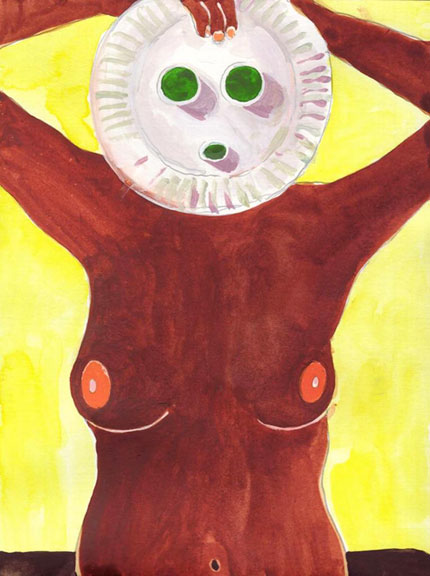
Andrew Guenther Plate Face (green eyes) 200 watercolor and pencil on paper
8″ x 6″
I just took another look at the BAMart Silent Auction site today and I ended up excited on two accounts: for BAM’s early success (many of the works are already above their estimates) and for the terrific opportunities available to patrons and visual art lovers who may have a little extra cash right now.
I’ve uploaded images of some of the works here, but there are some 150+ others on the BAMart site.
It’s not necessary to go anywhere to be a part of the event; the dedicated site shows all the works, describes the details, and makes it easy to bid.
The bidding ends at 8 this evening.
[images from the BAMart site]
Iannis Xenakis, and some very good company
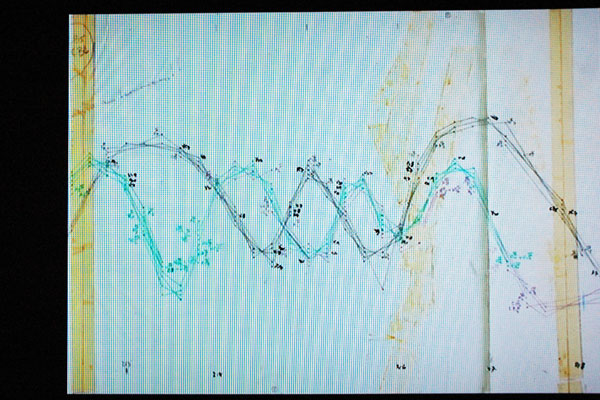
large detail of a still from a video of Iannis Xenakis’ “Pithoprakta” (1956), which has the composer’s sketches and renderings accompanying the piece itself [currently installed at the Drawing Center]
I love music, especially unfamiliar music, and since I’ve now been listening to the stuff for a good part of a century, that means my taste may not be shared with most people. The music of Iannis Xenakis (1922-2001) is a case in point, but judging from the fuss being made over this composer recently, and that without the excuse of a major anniversary, maybe I’m about to go mainstream for once.
It’s been a couple months since I first decided to do a post about the wealth of opportunities we’ve been given lately to hear the Greek-born composer’s powerful and very idiosyncratic music. It’s now the middle of March and most of the concerts to which I’d been looking forward have already happened. I’m ashamed to admit I’ve only been to two. The first was �Xenakis & Japan�, at Judson Church February 28, an evening of music and dance devoted to the composer’s interest in Japanese music and theater and presented by the Electronic Music Foundation.
I find it extremely difficult to write about music on this blog, even though all my life it’s been at least as important to me as the visual arts, and probably more so. I’ve had no significant education in anything other than the liberal arts (which, contrary to what some think, actually do not actually include any form of “art”). I am able to write about the visual arts at least tentatively, from my position as an unlearned, passionate observer, and not least because I have the help of a camera. The performing arts however are a serious problem for me, since I am normally unable to photograph the art, and stock promotion photos which are seen over and over again bring nothing new to the subject. The performing arts are an incredible challenge.
In fact I had little excuse to miss the opportunity of writing a short bit about Xenakis, since here there was a real possibility of including images. I’m thinking of the beautiful studies with which the composer rendered his aural creations on paper (creations which he sometimes described with performances in light and space as well). Maybe only John Cage‘s own lyrical (yes, lyrical) drawings could match their output, their dynamism, and their beauty.
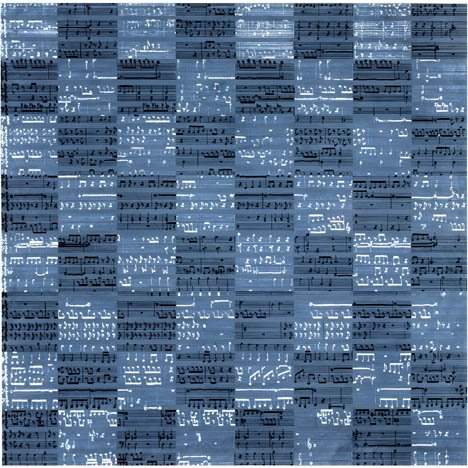
score for John Cage’s “Chess Pieces” (1944)
There were some eight or so concerts of Xanakis’ music listed on the press announcement released perhaps two months ago by the Drawing Center, and over the following weeks I learned about a number of others. We’ve now moved beyond all their dates, but the composer/architect/artist’s sketches and renderings remain on view on Wooster Street (with pretty extensive musical accompaniment on headphones) through April 8th.
In the second recent concert I attended in which his music was programmed it seemed to have been designed to play a minor role, as surprising as that may seem to anyone acquainted with it. In a concert at the Paula Cooper Gallery on Tuesday evening Xenakis was only one of three contemporary composers featured and his contribution was both the shortest and the only one which did not require a dozen or more players.
In addition to the visual art she exhibits in her eponymous gallery, Paula Cooper has always hosted, in the description found on the gallery site, “concerts, music symposia, dance performances, book receptions, poetry readings, as well as art exhibitions and special events to benefit various national and community organizations”. The page also reminds us that, “For 25 years until 2000, the gallery presented a much celebrated series of New Year�s Eve readings of Gertrude Stein�s ‘The Making of Americans’ and James Joyce�s ‘Finnegans Wake.’�
I remember many of these occasions, including two important ACT UP fund-raising auctions Cooper hosted in 1990 and 1991, which were extremely important for AIDS activism, and for me.
Gertrude Stein came back to the the Paula Cooper Gallery this week, through a performance of Petr Kotik‘s “There is Singularly Nothing”. The instrumental frame of the performance, by his own instrumental group, The Orchestra of the S.E.M. Ensemble, was an intensely-elegant affair. This roughly one-hour work, which incorporates a delicious text [“Composition as Explanation“] from Gertrude Stein, an American treasure, was first performed in the early seventies and re-invented, with different directives to the four singers, for the March 16 performance.
Collaborating with the SEM for the evening was the new-music concert series, Interpretations 21. A small vocal ensemble, augmented by Thomas Buckner and Gregory Purnhagen, who had solos in the Satoh piece, was shared by the two larger works.
The concert had begun with the world premier of Somei Satoh‘s “The Passion”, an oratorial using an abbreviated version of the Christian biblical text described by the name. I cannot account for the choice of subject by a Japanese composer whose own experience and music are both actually founded in the philosophies of Shintism and Zen Buddhism. I did recognize some poetic allusion, although perhaps accidental, in the fact that the performance of this Passion took place in a room dominated by a full-size sculpture of the scaffold used to hang the workers known as the Chicago anarchists or “the Haymarket Martyrs” in 1887. The installation was created by Sam Durant, the artist currently being exhibited in the gallery, whose recent work work has dealt with capital punishment.
Xenakis’ 1976 virtuoso piece, “Mikka ‘S‘”, for solo violin, followed the Satoh piece. The performer, Conrad Harris, stood high above the audience, at one corner of the scaffold Durant intended, bare of all but its familiar water dispenser, to double in function as a worker�s break room.
A postscript, from the text of the Kotik piece, Gertrude Stein on “modern composition”:
Those who are creating the modern composition authentically are naturally only of importance when they are dead because by that time the modern composition having become past is classified and the description of it is classical.
[image of Cage’s notations from greg.org]
the last hour of Man Bartlett’s “24h #class action”
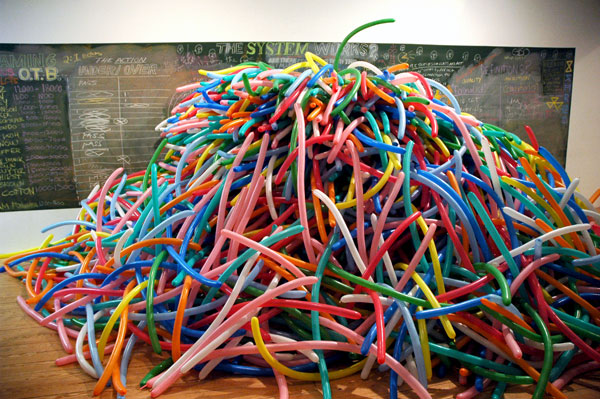
the last balloon
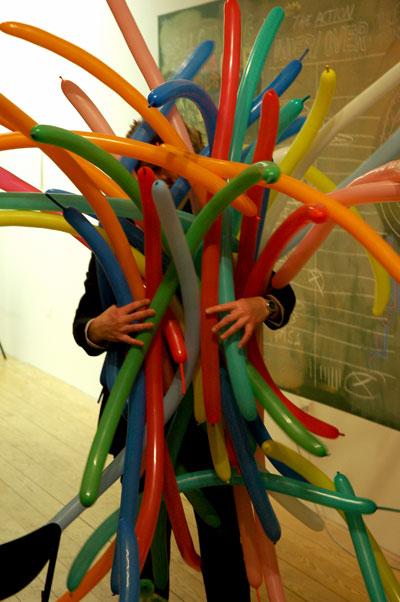
I had contributed something like a hundred or so inflated balloons to Man Bartlett’s “24h #class action” the day before, but when I arrived at Winkleman Gallery Thursday afternoon around 4:15, almost 24 hours later, it was too late to add to my score. The artist however had been going strong all that day and throughout the night before. I managed to capture one of the last long, narrow balloons he tossed onto the sculpture from the cubby he had created behind it.
Thousands of inflatables were about to disappear at the stroke of a pin, without ever having achieved a single polished mirror finish.
It was picture time.
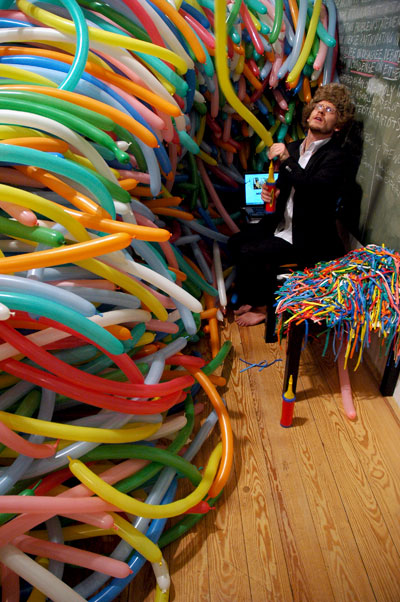
the sculptor and his tools
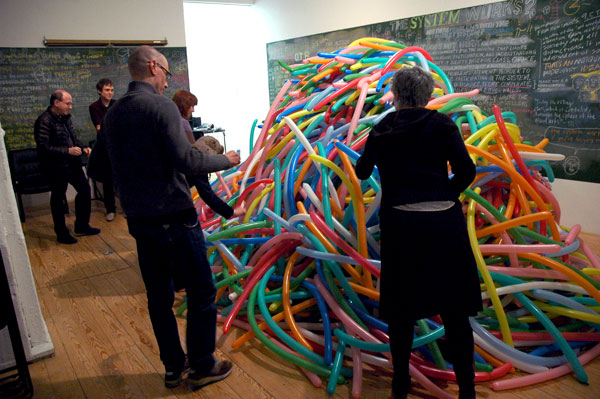
final group intervention commences
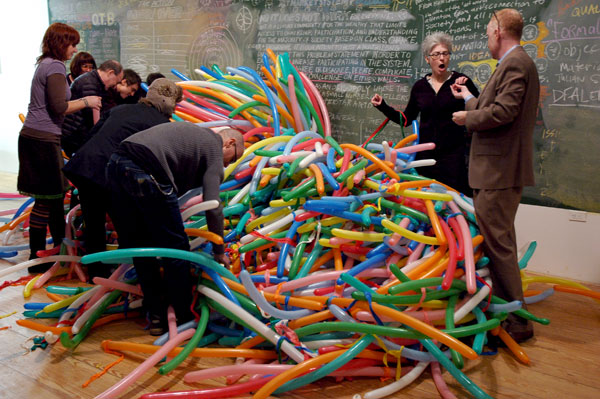
the attack underway
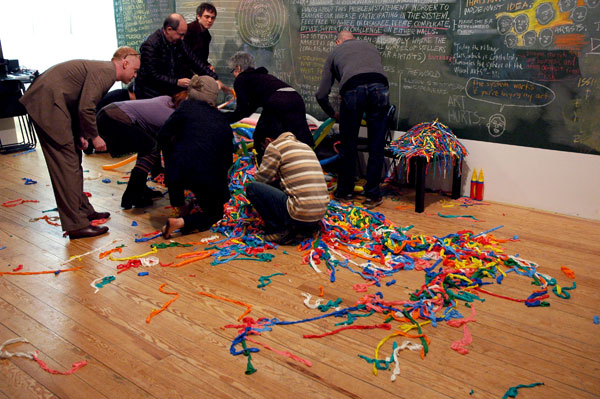
last pops/wheezes
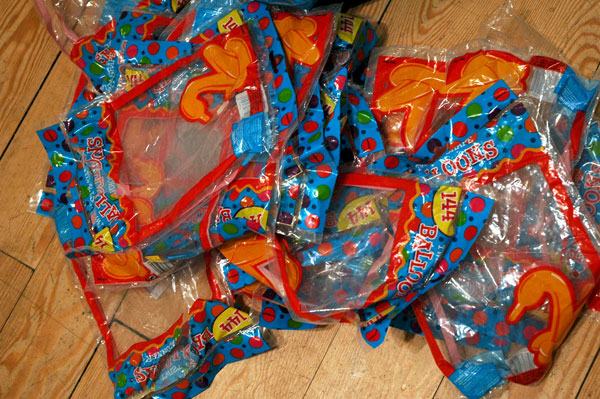
empty packaging, sadly showing suggested Koonsian applications
Wednesday’s crowded #class schedule
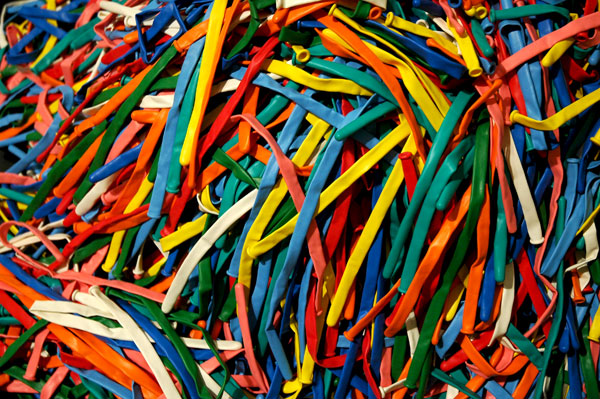
not a puppy in site
Wednesday’s schedule for #class began at 2 with a “Feminist Tea Party” hosted by artists Caitlin Rueter and Suzanne Stroebe. I saw some of it at home on the streaming video (while drinking coffee) but was unfortunately not able to make out most of the discussion. I arrived at Winkleman just as they were leaving with the accoutrements (tablecloths and porcelain cups; the finger sandwiches, cookies, and cupcakes presumably having already been shared with the issues).
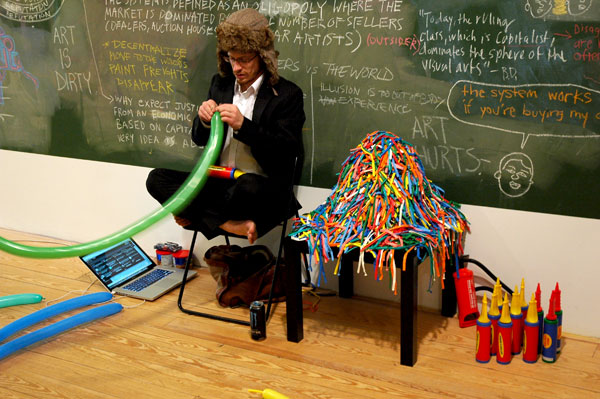
Man Bartlett was just about to begin his own much-anticipated 24 hour event, “24h #class action“, described on the site as “a marathon group intervention involving systematically blowing up hundreds of skinny balloons and popping them, without creating or harming any cute little puppies.” Any reference to proceedings inside the big bucks Olympian “art” world of bright shiny stuff, paid santa’s workshop helpers, and undisguised commerce – certainly including the current New Museum show – is not a coincidence. More from the artist:
A simple physical action, over time, can radically shift consciousness, specifically when combined with �real� and �virtual� social interactions. It is in this context that �24h #class action� plans to poke a pin into Koonsian psychological dramas.
Beneath its surface this intervention is an exercise in futility and one of joyous absurdity. The balloons will only take their long, phallic shape, without further form, and will eventually be liberated or executed. Is it possible to both celebrate and critique? Does it matter that risks were taken by Koons (and others) to create this ridiculously expensive series? Is ambition alone worth applause? Is the fact that 5 balloon dogs were fabricated a triumph? Is it �relevant?� What I�m grappling with is a complex relationship to the artist�s work, and really to all Art and Everything. And duration exposes fascinating avenues in the headspace to drive down.
Or, you know, we�re just blowing up balloons that we get to pop at the end, which is fun too.
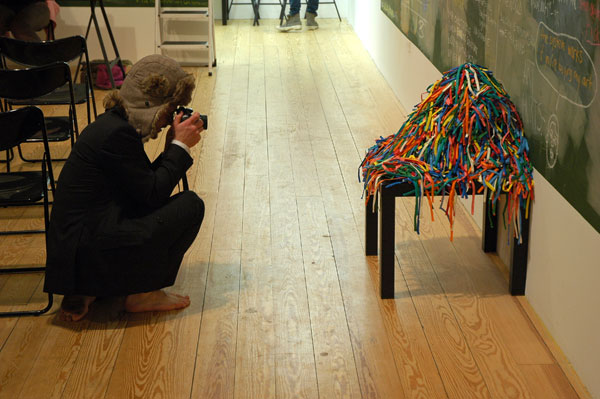
the artist contemplating his canvas
and getting into his metier
less than 24 hours to go
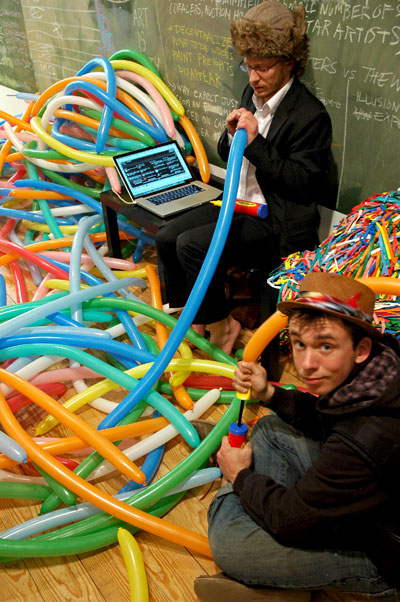
Shalin Scupham joins the “group intervention”
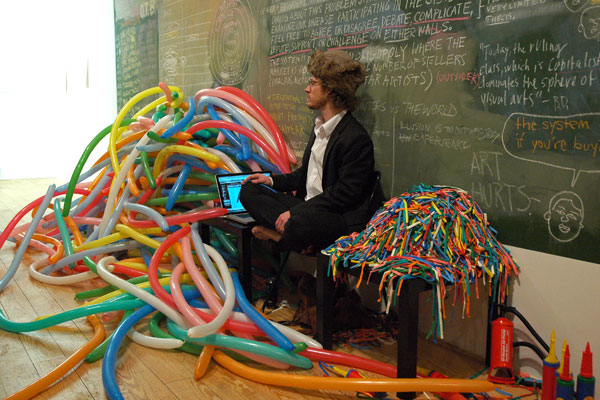
the artist during Magda’s presentation
Bartlett and his helpers began blowing up balloons at five, but took a break a little over an hour later when Magda Sawon of Postmasters Gallery arrived to host “Ask the Art Dealer.” She had vowed to “truthfully answer any and every question posed to her as long as it does not involve her weight, social security number or other people’s money.” She was incredible. Barry and I had already thought of her as a community hero, but now she belongs to the world.
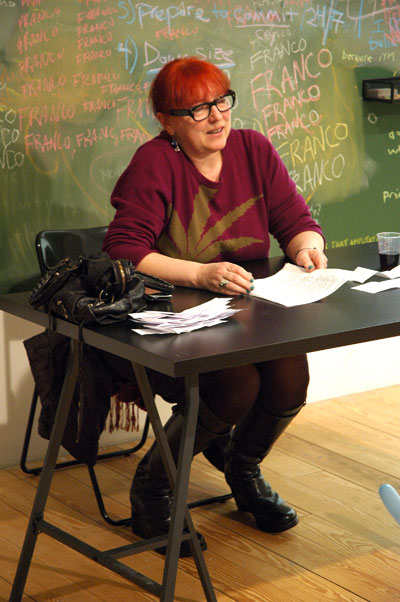
Magda holds the room enthralled
Ed Winkleman, the gallerist who made #class possible, was also in the space yesterday, with the third session of his own intervention (as a gallery owner) in what he had titled, “Shut Up Already…I’ll Look at Your Art!“. The project, the fruit of an artist’s “anonymous proposal”, according to Winkleman, (someone tell me whether that anonymity is still being maintained) has him working out a pledge that he would spend a portion of his time during #class in viewing, for no less than 10 seconds each, images submitted via an open call on the internet. The third of seven rules specifies that he and his guests would be “monitored by a volunteer as they view the work to assure full compliance with the rules.” On Wednesday his monitor was the artist Bernard Klevickas. Images of work he has seen can be found here.
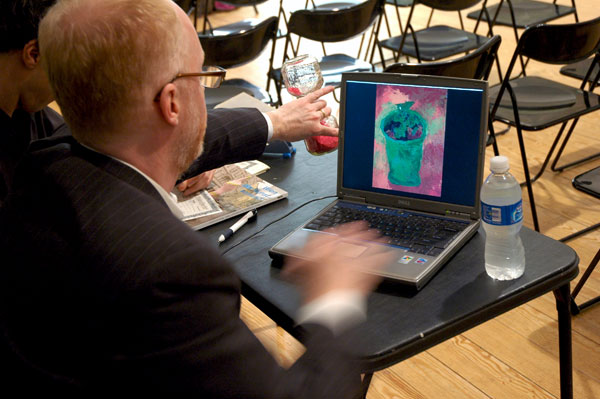
a very open call
Powhida: “No artist should have to watch this”
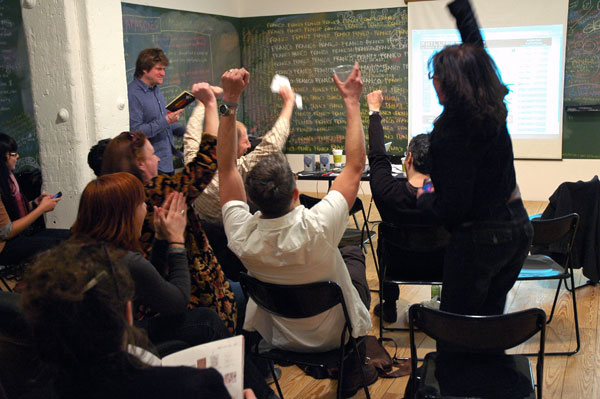
all heck breaks loose as Powhida exceeds the estimate
A number of art enthusiasts found their way to Winkleman gallery, and a Saturday in “#class“, this past weekend to take part in the (unbilled) “T-Bill Gaming” event. Tom Sanford and William Powhida had set up a projector and screen linked to a laptop, allowing gallery visitors follow the Phillips de Pury auction, “NOW: Art of the 21st Century“, in a live simulcast which began at noon.
Fans were invited, Sanford’s own blog had announced, to participate in a “relational aesthetics art project” involving “the sometimes-overlooked art of book making”. We had been invited to “watch the excitement unfold as shadowy and anonymous international art patrons determine the actual market value, not only of the works, but also of the hundreds of artists themselves!”
Fully in the spirit of the month-long project created by Powhida and Jen Dalton, the installation was described as an attempt “to make the world of contemporary art auctions more accessible to the Average Joe on the streets of Chelsea.”
The excitement in the gallery was building for hours as the auctioneer moved closer and closer to lot #257, a drawing by Powhida, “Untitled (Dana Schutz), which the artist had donated to a Momenta Art benefit five years ago. All heck broke loose when it went for $1,900 ($2,375 including 20% premium, and before taxes). The piece exceeded the high end of the auction house estimate. Since only a few years earlier someone had taken it home for $150, it certainly represented a good “investment” for its original owner, even if neither its author nor the non-profit space to which he had gifted it shared one penny of the bounty.
At some time in the midst of the excitement buildup the artist himself was heard to say:
No artist should have to watch this
For the artists and their friends and confederates in class that afternoon it was good fun, but mixed with the fun were melancholy thoughts framed by the sudden and direct confrontation with the reality of the art market. Inside the auction gallery however it all appeared to be only about money.
I’m sure we all had far more fun in class than did the crowd a few blocks south. I have a decent amount of experience with New England antique and estate auctions, and some familiarity with New York art auctions produced by a slightly less prestigious house than this one. I had always associated auctions with great fun and drama, even for the parsimonious participant, so I was shocked at how hurried and perfunctory the proceedings were on Saturday. Not a whit of drama – and no wit – came from the podium. The only excitement generated by the house (as opposed to that created by our own party on 27th Street) happened when the man in the $5000 suit, who normally finds himself selling off Picassos and Rauschenbergs, started the bidding on one item at $9 (it finally sold for $100).
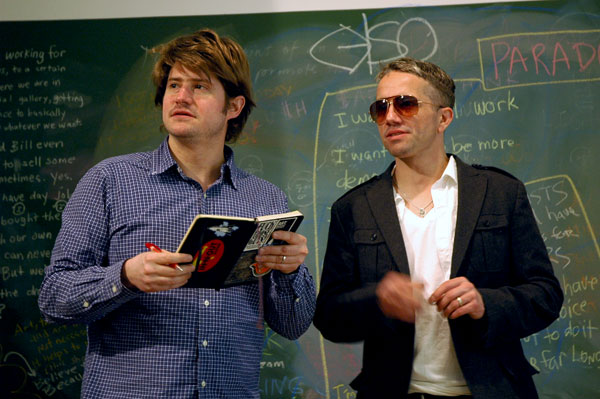
the gamers
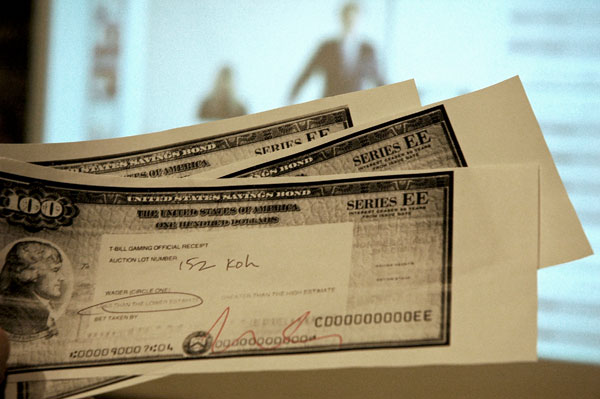
bets placed
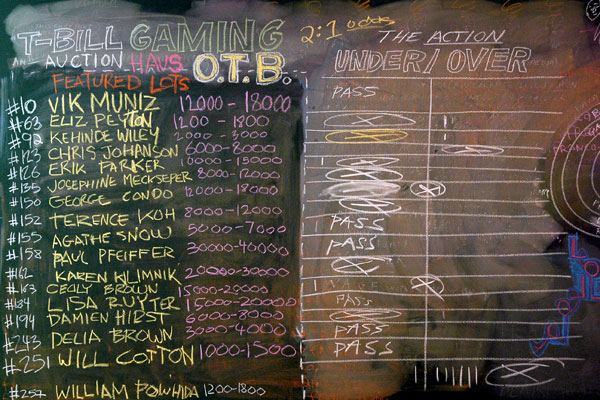
the board
Yevgeniy Fiks names names in Communist Tour of MoMA
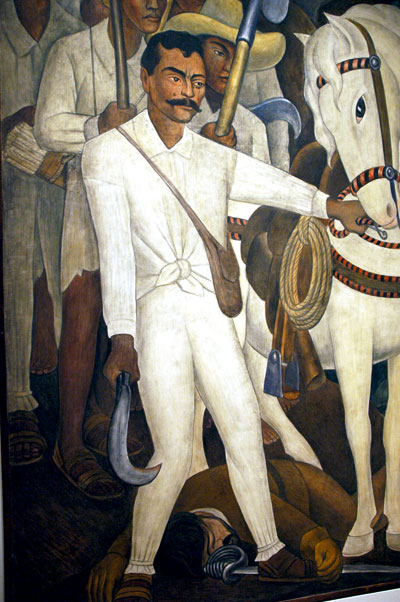
Diego Rivera Agrarian Leader Zapata 1931 fresco 7′ 9.75″ x 6′ 2″ [large detail taken from a slightly oblique angle, of the painting in MoMA’s collection]
Of course there was Rivera, and Kahlo, but most of the other committed pinko commies hanging around inside the Museum of Modern Art have been largely hidden from our history, from the institutional history of MoMA, and from the history of the art and the artists themselves.
Leading a tour of the Museum on 53rd Street this past Monday, artist and teacher Yevgeniy Fiks started to sort things out for the record. Barry and I were extremely fortunate to be a part of the discreet group of enthusiasts which he directed in a “Communist Tour of MoMA”.
One of my favorite parts? Enjoying the fact that any number of other museum visitors who happened near us were learning more than they had bargained for when they walked into the galleries of the permanent collection that afternoon.
If you missed the road trip clear your calendar for Fiks’ presentation, “Communist Modern Artists and the Art Market” at Winkleman gallery March 12, another event in William Powhida and Jen Bartlett’s month-long project, “#class“.
I’ve uploaded below images taken at a few of our stops (devotions, secular “stations”), and Barry has a more narrative report, assembled from his notes, on his own site.
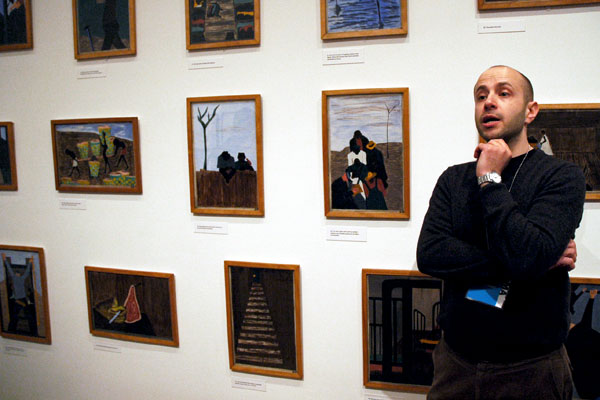
Jacob Lawrence
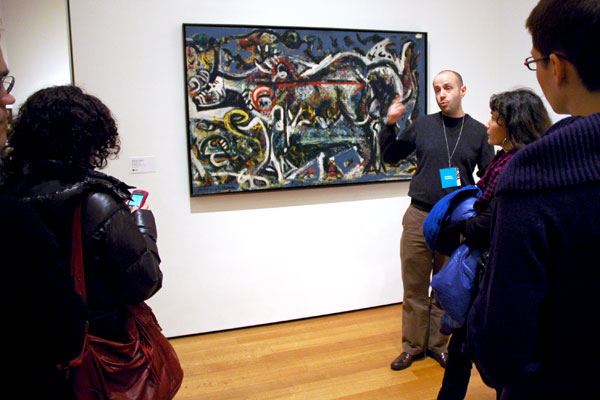
Jackson Pollock
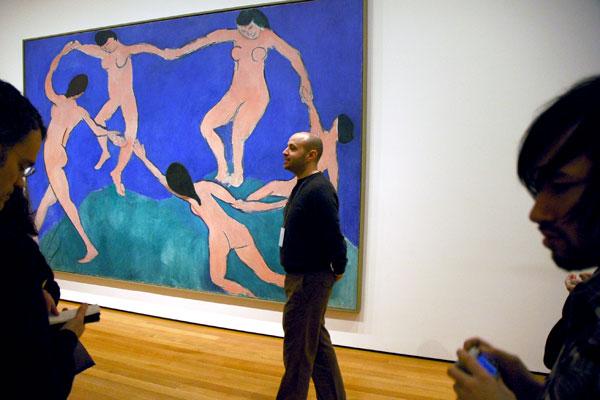
Henri Matisse
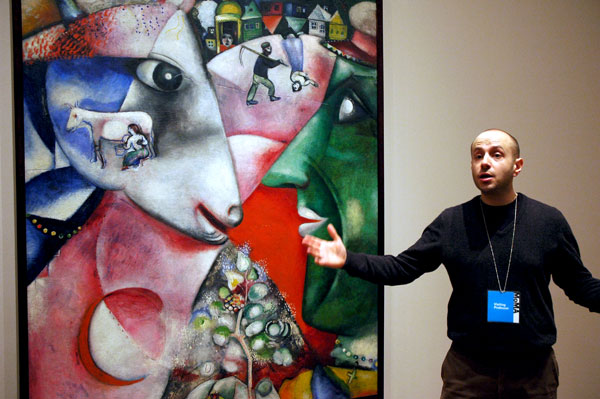
Marc Chagall
#class collecting panel at Winkleman
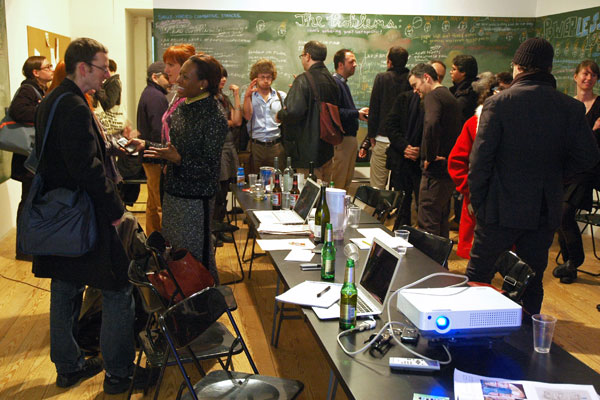
hanging out after class
Thanks to everyone for following the #class collecting panel last night, both those inside the space and elsewhere online (there were over 1700 people watching the live stream at one point). We had a great time!
Thanks above all to Julia Weist, our facilitator, and the rest of our lovely and distinguished panel, whose names many may not have gotten when they were introduced.
Greg Allen
Denise Kupferschmidt
Adam Simon
Kianga Ellis
Austin Thomas
Ben Tischer
Jonah Groeneboer
And many thanks also to Ed Winkleman and Murat Orozobekov, our hosts, and to Jen Dalton and William Powhida, the overtaxed artists who dreamed up and continually enable #class for us all, for their own own vocal contributions to the conversation last night.
Barry and I were pretty pleased with how it went off, although we were surprised that most of the discussion stayed with practical issues, and, in spite of our pretty modest efforts during the evening to provoke it, there may have been little that would satisfy the larger project’s intention that participants would meet “to examine the way art is made and seen in our culture and to identify and propose alternatives and/or reforms to the current market system.”
We wanted to keep a light hand on the wheel, and more or less let the room run with the discussion, but we had hoped it would move onto a more theoretical level. We tried to nudge it in that direction, including posing the question of whether there was another way than the collecting model to serve both artists and the larger culture. In the end however, the “class” system survived the evening pretty much intact.
All of which makes me anticipate even more keenly the #class event which will discuss Ben Davis’ “9.5 Theses on Art and Class“, on a date not yet established.
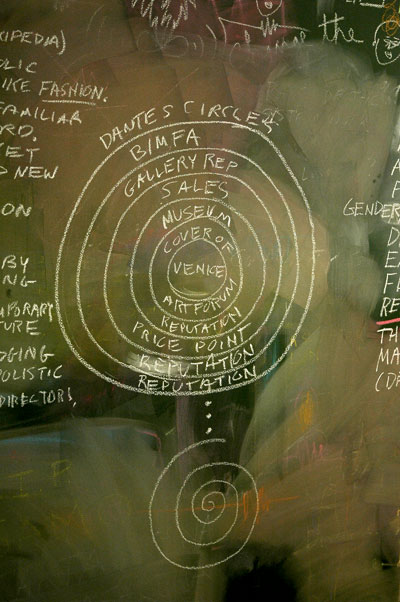
art hell [section of chalkboard-painted wall in the gallery]