BHQF’s “We Like America” at Whitney 2010 Biennial

Bruce_High_Quality_We_Like_America.jpg
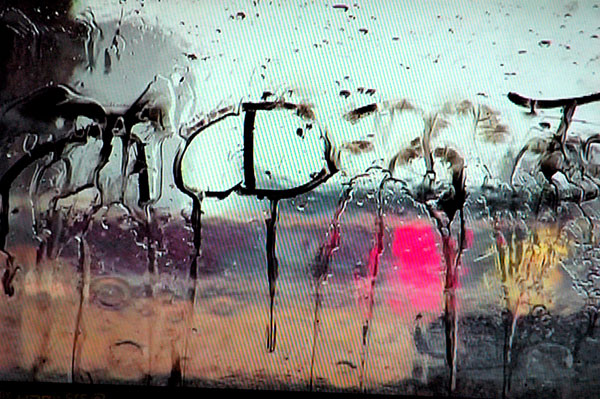
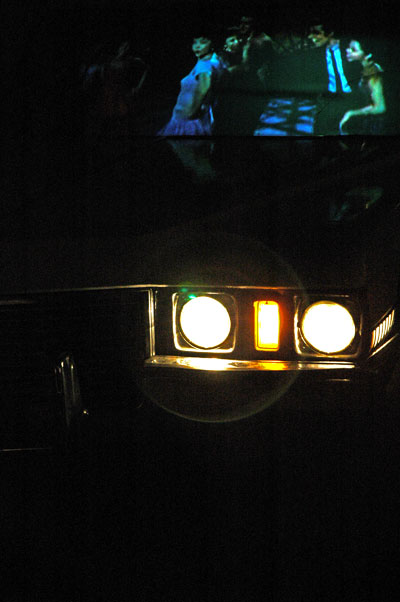
Bruce High Quality Foundation We Like America and America Likes Us 2010 vehicle and educational implements, dimensions variable [detail of installation]

ADDENDUM: [April 30, 2010] The entire sound video projected onto the inside of the windshield can be viewed here on vimeo, although as the April 20 comment at the bottom of this post (which alerted me to the link) says, it’s not quite the same isolated from the ambulance/hearse; the experience of the darkness of the installation itself, the imperfect acoustic of the space, and the murky projection, can’t really be reproduced on a computer screen.

I feel good about the Whitney 2010. While I like excitement, I resist hype like the plague. This Biennial has been accompanied by neither, which at the very least gives visitors a better chance to experience the individual works for themselves, and unencumbered with a theme. There is some very good, even awesome work on the three floors of the exhibition I saw at the preview (the floors not devoted to favorites from earlier years), but for me none of them had so fundamental an impact as the Bruce High Quality Foundation installation, “We Like America and America Likes Us”.
In “Art Class“, a 2007 piece published on Artnet, Ben Davis had described Picasso’s “Guernica” as “the most successful political image of the 20th century”. His argument was that isolated artistic gestures cannot resolve social contradictions “without any social movement backing them up to give them force”, continuing:

This does not mean that art or artists cannot play any political role; it is just that some model besides the middle-class one of “my art is my activism” is necessary, one based on concrete solidarity and practical action. Picasso�s Guernica is the most successful political image of the 20th century. Guernica, in fact, embodies the fact that art�s political value is determined in its relation with mass struggle, not in its individual content — the imagery of the painting, moving as it is, is completely drawn from a vocabulary of forms Picasso had already developed in previous work. Yet, during the Spanish Civil War, after its appearance at the Spanish Republic�s booth at the 1937 World�s Fair, Guernica was literally removed from its stretchers, rolled up and toured internationally to win support for the Republican cause. In England, visitors brought boots to send to the front.

The Bruce High Quality Foundation seems to be taking a different route with its own institutional, social and political critique, probably one more suited to our own politically-lethargic times. Bruce’s confrontations with our own tropes have been found just about everywhere: on our streets, our waters, our public plazas, even inside the galleries and expositions of the system they speak to.
I have to confess to a penchant for political art, and to a number of years spent in sort of a groupie relationship to this arts collective, and yet “We Like America and America Likes Us” is one of the most affecting works, in any genre, I’ve ever encountered. Where do we bring our allegorical boots?
We are all wounded, wrapped in felt. Are we inside an ambulance or a hearse? What is to be done?
Like much of what Bruce does, it’s not conventionally “beautiful” – except as truth is beauty, and yet the incredibly elegiac recorded remembrance of “America” which accompanies the fast video montage of heterogeneous clips projected onto the tall Cadillac windshield is riveting, and profoundly moving.
I don’t know the length of the loop (and there was no indication on the museum’s wall text); but for all I know it could be as long as the melancholy story it tells.
Especially for those who will not be able to visit the Whitney, I have some excerpts. The text, recited by a luscious, soothing female voice, begins:

We like America. And America likes us. But somehow, something keeps us from getting it together. We come to America. We leave America. We sing songs and celebrate the happenstance of our first meeting � a memory reprised often enough that now we celebrate the occasions of our remembrance more often than their first cause.

And a little later I listened as the gender pronouns slithered over each other in ecstasy, and in sorrow:

We wished we could have fallen in love with America. She was beautiful, angelic even, but it never made sense. Even rolling around on the wall-to-wall of her parents� living room with her hair in our teeth, even when our nails trenched the sweat down his back, and meeting his parents, America stayed simple somehow. He stayed an acquaintance, despite everything we shared. Just a friend. We could share anything and it would never go further than that.
No one really knows how love begins. A look on his face one time after we�d made love � a text message too soon after the last one. When did we become a thing to hold on to rather than just something to hold? We didn�t know America was in love with us until it was too late. Maybe we couldn�t have done anything about it anyway. America fell in love with the idea of us, with some fantasy of us, some fantasy of what America and us together would be, before we had a chance to tell him it could never work, we weren�t ready for a relationship, we weren�t comfortable being needed, we didn�t have the resources to be America�s dream.
It wasn�t easy letting America down. As we stuttered through our rehearsed speech we watched the change on her face. We could see the zoom lens of her attention clock away. We could feel ourselves receding back into the blur of the general population.

The last lines are:

There was a time we thought we were nothing without America. When she left, we realized all the excuses we�d been making. All the problems we�d been trying not to address. We drunk dialed our memory of America just to hear what we were thinking. We worked late and we told ourselves we had to, that the work came first, that this was an important time in our lives and that love could wait. Just wait a little longer and we�d fix everything, we�d say. Solving the America problem, our lack of attention, our disinterest in sex, our never being home, our thinking of her as a problem � it would have to wait.
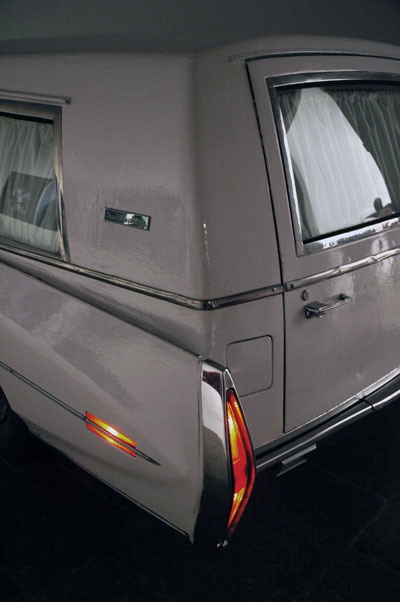
Bruce_High_Quality_We_Like_America_rear.jpg
[installation view of the rear of the curtained 1972 Miller-Meteor ambulance/hearse]

[text from the audio of the installation courtesy of the artists]
our #class: “Collecting with Your Eye, Not Your Ears”

Fett_collector_portraits_barry_james30s.jpg
portraits of the collectors, at home (featuring a sculpture by Mària Alòs, in one of over two dozen images Fette pulled out of our apartment, and now displayed on her gorgeous site, the flog.)

Barry and I are putting together a panel which will gather at 6 pm February 27, as a part of William Powhida and Jennifer Dalton’s month-long project “#class“* at Winkleman Gallery. The two artists say their initiative is partly a response to the Dakis Joannou/Jeff Koons show opening in March at the New Museum, but they describe the larger scope of their bold, and very brave venture in this excerpt from their press release:

#class will turn Winkleman Gallery into a “think tank”, where we will work with guest artists, critics, academics, dealers, collectors and anyone else who would like to participate to examine the way art is made and seen in our culture and to identify and propose alternatives and/or reforms to the current market system. By “current market system” we mean the commercial model and attendant commodification of art, but also the unquantifiable, intangible, unpaid aspects of participating in the art world.

There are already a large number of events and, well, “classes” scheduled, and more are still being added. As I understand it, anyone who has a proposal can get in touch with the artists, who will be in residence, so to speak, inside the gallery throughout the period of the project.
Barry and I have chosen to talk about collecting, how to go about it with even the most limited of resources and ambitions, how to avoid making it a job or a contest, but instead a reward, a continuous delight, and one which can be shared. We’re calling the discussion “Collecting with Your Eye, Not Your Ears”. The announcement materials for our particular segment read:

What motivates collectors to acquire work? Is it what you hear about an artist or is it the work itself? It can’t just be to fill the New Museum or flip at auction! Barry Hoggard and James Wagner have been invited to lead a discussion around how and why people build private collections, with an emphasis on the committed enthusiast with limited funds.
The evening is intended to address collecting, not as a hobby, furniture or investment, but as a way of repurposing a worthy human impulse in danger of being reduced to a convention, an adornment, even a racket.

We will be referring to our modest, pretty diverse and now sizable collection, which we’ve just made available on line (our timing was only a coincidence, but our biggest surprise was learning that no one else does it). We will describe the collection’s genesis and current form, and how we live in the middle of it, although we know that even in its most general description, our approach may not work for everyone.
Helping us to move beyond our own experience will be a panel in which we expect to include one or more artists, collectors, advisers, gallerists, curators, enablers and connectors, with some of them doubling in those roles. We are inviting a number of people to sit around the big table whose experience can inform the discussion further, and I hope we will all be fortunate enough to find the room host to others who have heard about the event and are interested in the subject.
We intend the evening to be as non-hierarchical as possible: It’s free, open to anyone who wants to come, and everyone is welcome to participate in the discussion and its energy. Just watching and listening will be okay too.
The artist and – information science specialist – Julia Weist will be our moderator/facilitator.

*
check out the daily schedule in the column to the right on the #class site

[image courtesy of Fette]

The Hoggard Wagner Art Collection goes on line

Hoggard_Wagner_Collection_Home_Reed.jpg
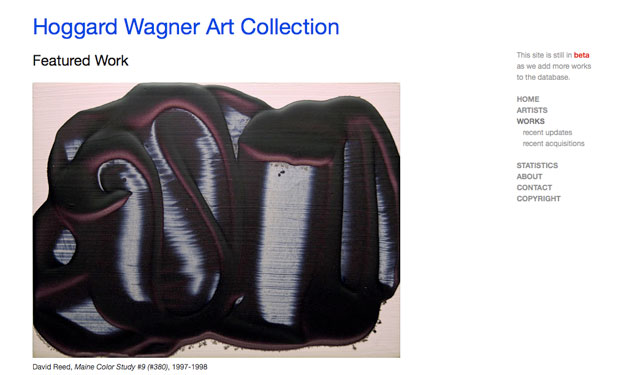
the rotating “Featured Work” page on the collection site, “grabbed” today, February 15

Barry and I have been working over many months on an online catalog of our own collection in order to make it visible to a larger public. The Hoggard Wagner Art Collection site is intended to serve the work itself, the artists who created it, and the people with whom we can now share it.
We expect that the collection, not including future acquisitions, will exceed well over 1000 items when we have finished documenting it. � Although it seems we have barely begun, we’re fully committed to the entire project.
Those elements of the site that have been finished can now be seen on line. The “about” page will provide more information and context.

RELATED: It’s only a coincidence that we were first able to activate the site (although it’s still in beta form) just before the beginning of a month of programs at Winkleman Gallery devoted to a general reconsideration of the art market in the aftermath of its virtual collapse and the attendant threat to the integrity of museums and other arts institutions [see the blog for the “show” here]. The timing of these ambitious programs, organized by William Powhida and Jennifer Dalton under the rubric, “#Class”, is not a coincidence: They are intended to coincide with the opening of the Dakis Joannou/Jeff Koons New Museum show.
[Disclosure (to be more fully-elaborated in a later post): Barry and I will be a part of “#Class”, with a panel/room discussion on February 27, “Collecting with Your Eye, Not Your Ears”]

Zoe Crosher’s “Unraveling” at DCKT

Zoe_Crosher_on_bed.jpg
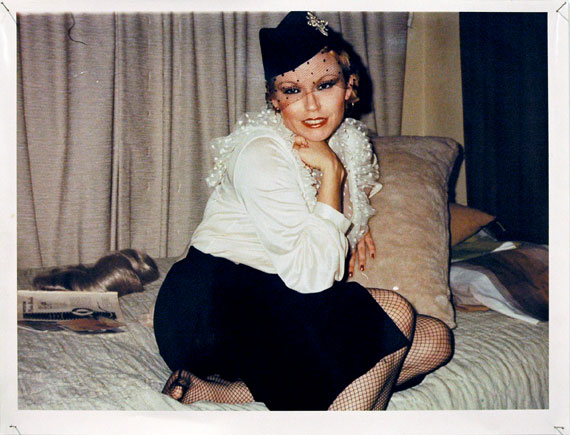
Zoe Crosher Untitled ca. 2002 C-print 10″ x 13″ image (11×14� paper) [installation view]

Zoe_Crosher_Silhouette_7.jpg
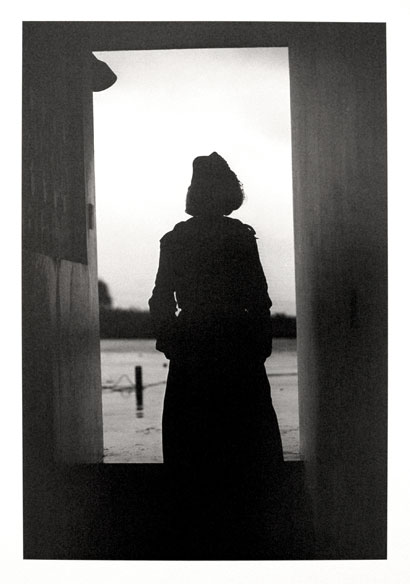
Zoe Crosher Silhouette #7 2009 inkjet print 24″ x 20″ paper [installation view, including a portion of the white border, a part of the piece]

Zoe_Crosher_Obfuscated_3.jpg
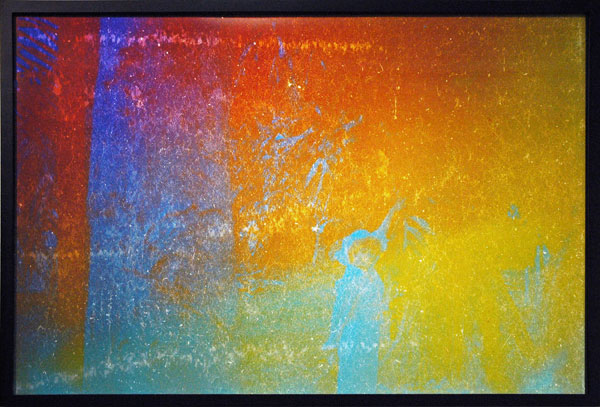
Zoe Crosher Obfuscated 3 2009 inkjet print 23.5″ x 34.75″

Zoe_Crosher_Acting_Like_A_Tiger.jpg
Zoe Crosher Acting Like a Tiger 2009 inkjet print 12″ x 9″ image alone [installation view]

Zoe_Crosher_wall_installation.jpg
Zoe Crosher [installation view of individual pieces arranged as a group]

We made it a top pick on ArtCat just this afternoon, while standing inside the gallery. The bad news is that Zoe Crosher’s show at DCKT, “The Unraveling of Michelle duBois“, closes tomorrow.
You probably don’t want to miss this one, but if you can’t make it you’ll have a chance to visit some of the work at the Armory Show next month, in the next issue of Aperture Magazine, or, I’ve been told, in a book. I’m crossing my fingers for the chances of that last one.
The DCKT show itself is described by the gallery as:

. . . a reconsidered archive culled from crates, boxes and albums consisting of endless flirtatious smiles, tourist shots, cheesecake mementos and suggestive poses in every film type and size.
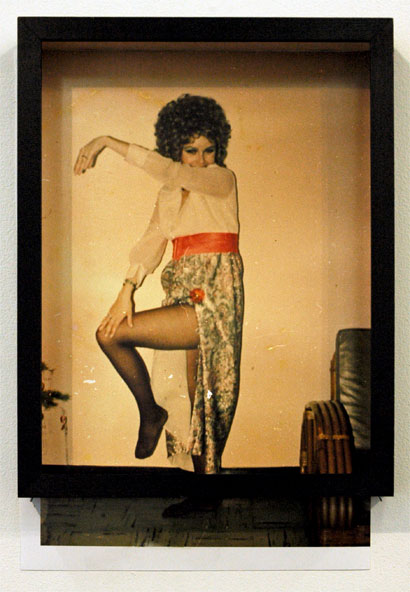
It is simply an archive. But nothing is ever simple. Michelle duBois, one of a number of aliases, kept a lot of pictures of herself. Turning tricks in the Pacific Rim during the �70s, she took on many guises for her particular profession and kept fanatical documentation of her many dramatic transformations.

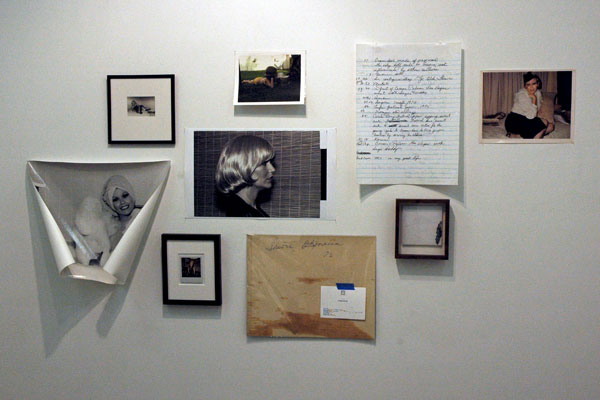
duBois handed over the materials to Crosher, who met the older woman through her aunt, who was a friend of hers. Yes, the show is made up of pictures of pictures, but what pictures, and what a triumph the artist has made of them, in both their direct and conceptual impact. The images, almost all of them portraits of the same woman in different costumes, wigs and environments, appear at first to be pure inventions of the artist (who in fact resembles the younger “Michelle duBois”) but the truth is that they are possibly more creative, and incredible, than ordinary studio constructions. They are collaborations, sensitive original concoctions composed of minimally-reworked materials which were entrusted to Crosher by another human being, and by, in more than one sense, the callous degradations of time.
They are photographs whose images, the visitor soon learns, the artist has loosed from their surfaces and advanced toward the sublime.

Two tips for additional access to the Crosher’s work:
On Tuesday, February 16, at 6:30 pm., the Aperture Foundation is hosting an evening with Crosher and Jan Tumlir, who wrote the article which will appear in issue 198. The event is described as “a conversation exploring self-invention and role-playing as told through personal photographs, and what comes of the great �archival theme� in the digital era”.
A remarkable double-sided print by Crosher was included in the 2009 edition of the Artist of the Month Club, an annual curated subscription portfolio produced by Invisible-Exports.

“Bring Your Own Art” [BYOA], the X Initiative farewell

Man_Bartlett_pointpiece_proxy.jpg
By the time I realized that I should look into buying the small Man Bartlett drawing I had seen at “BYOA” the first night, it was gone, and I hadn’t even gotten a usable image. This piece, “pointpiece II (constant)” dated 2009, is ink on paper, and roughly 6 by 8 inches, approximately the size of the piece I saw enclosed in plastic and attached to a pillar that Wednesday afternoon. All of Bartlett’s art is pure in concept, form and beauty; whether it’s been a work on paper or a performance, I’ve been drawn into each of them even before knowing anything about their context or the artist’s purpose.

I could not not go. As soon as I heard that X Initiative was marking the end of its one-year tenancy in the former DIA space on 24th Street with a 24-hour Walter Hopps-inspired event, I was on it. Everyone was invited to bring their own art and install it in the several large Chelsea galleries. They would be open for viewers and participants for 24 consecutive hours.
Of course it was more of a gathering, than a fair, and in spite of the potential for banality, or worse, it differed from events like the hoary, ineluctable, twice-a-year Washington Square art exhibit in the general quality of the art which had been brought through the door (and there were definitely some hot spots), but also in its overall fundamental earnestness and sincerity, its moments of profundity and nuttiness, its odd sweetness, and not least in the fact that, ultimately, it couldn’t escape its sad ephemeral reality.
I visited the scene twice, once on Wednesday afternoon, and again just as the event officially ended at eleven the next morning. I would also have been there for the party Wednesday night had I not already committed to attending a Meetup event, “Social Media Art” downtown.
What I did see of the X Initiative’s farewell blowout was a rich feast. As soon as I walked in I realized I’d be looking at almost every square inch of the galleries (except for the ceilings, which I think was a safe assumption) to avoid missing something, meaning either the art or the interventions, because while the scale of some of the work installed was fearlessly ambitious, there was much that might have taxed Richard Tuttle’s powers of observation.
One cavil: The lighting was tough, even before the sun had entirely set, but that was understandable given the circumstances of this fragile moment
The works described in this entry are just a few of the pieces which pleased the eye, and the camera as well, in the case of those shown below.

Sam_Sebren_Breeding_Zombie_Consumers.jpg
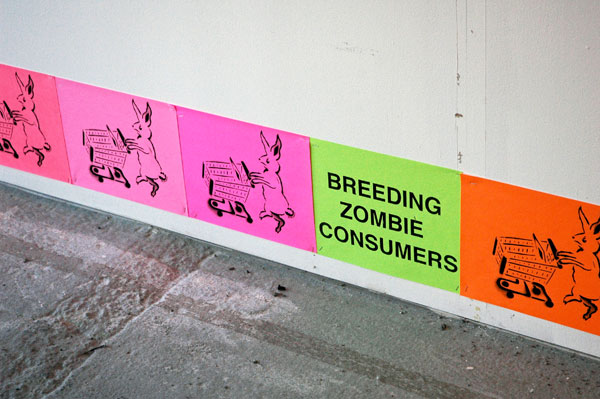
Sam Sebren (bunny) used his multiples to line the base of some of the walls. For what you’ll probably want to know about the artist, see this discussion.

Cecilia_Jurado_Miss_Taxi.jpg
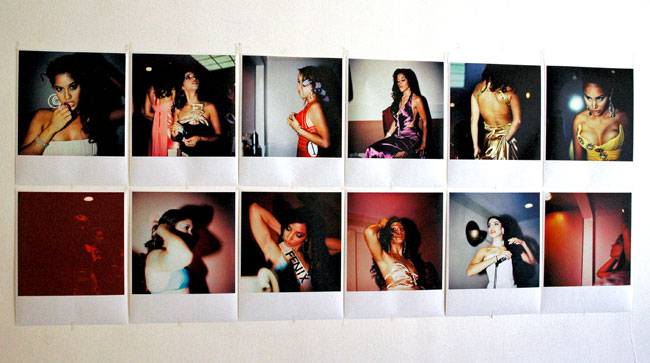
Cecilia Jurado’s �Miss Taxi�, a three-channel video and photography installation, was in the Queens International 4 a year ago; the images and the footage are taken from a beauty pageant held each year in Queens for relatives of taxi workers

Adam_Simon_Steal_This_FAAN.jpg
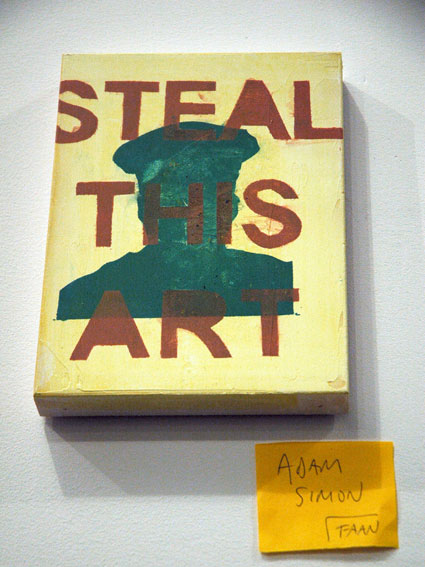
Well, maybe “steal” was misleading, but Adam Simon‘s “Steal This Art” was just one of a number of excellent pieces in the exhibition which were a part of the remarkable Fine Art Adoption Network [FAAN] founded by the artist and commissioned by Art In General.

Ryan_Compton_Go_Get_Your_Own.jpg
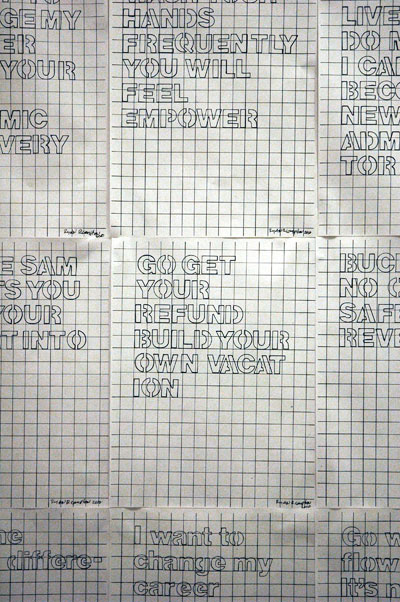
Ryan Compton’s hand-drawn text pieces grabbed me with their non-sequiturs and cut-up syntax; my favorite read:

Go with the
flow
it’s not rocket
science

Peggy_Cyphers_at_BYOA.jpg
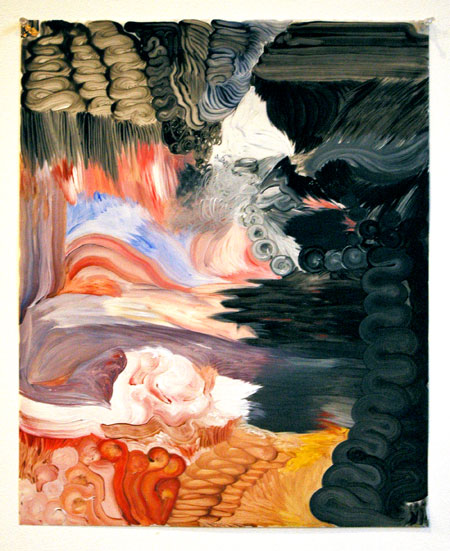
Peggy Cyphers showed several exquisite acrylic pieces (on Mylar?), and I still can’t get their richly-colored voluptuous shapes out of my head.

felixanddexter_BYOA.jpg
Felix and Dexter‘s small “snapshots” of the artists’ interactions with art and community were taped to all four sides of a column and seemed to charm everyone who managed to see them

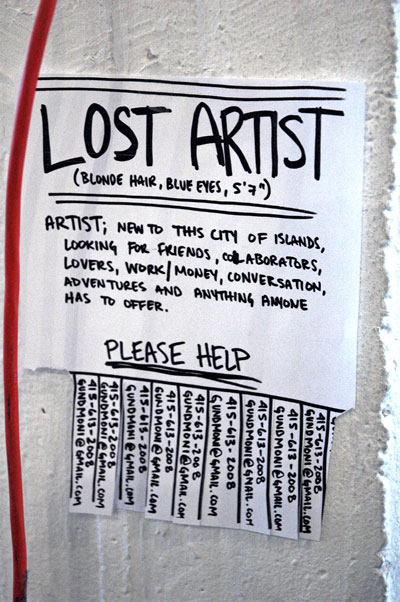
Lost_Artist_at_BYOA.jpg
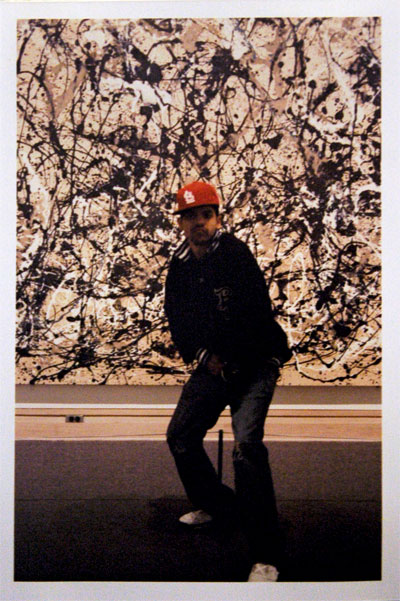
I have no idea

Judith-Hoffman_Rare_Breeds_Frozen.jpg
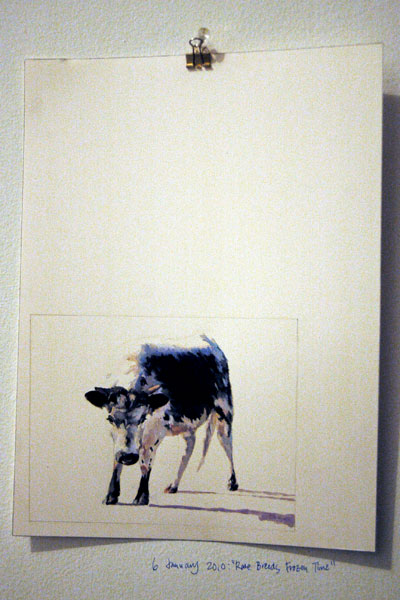
Judith Hoffman‘s year-long project requires her to paint one image each day from her local paper (it appears to be the Times), “paying homage to On Kawara and the decline of printed news”; the image of this handsome young calf, dated January 6, is titled “Rare Breeds Frozen Time

Starscream_Ross_Menuez.jpg
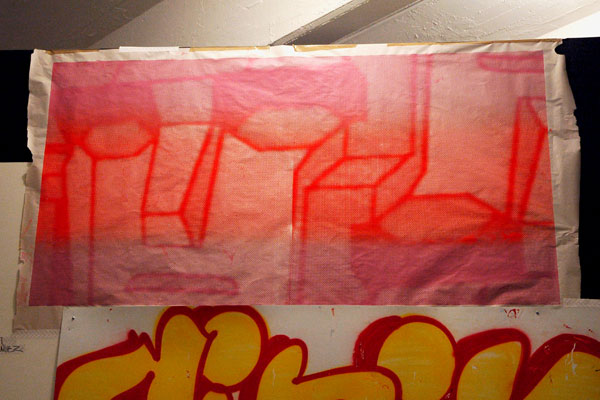
Starscream was only one of several artists there whose work could be described as street art, although in the anarchic configuration of this show their placement in the galleries ended up looking at least as conventional, or “inside”, as that of any of the other artists.

Alex_Gulla_Alexcalibur_poster.jpg
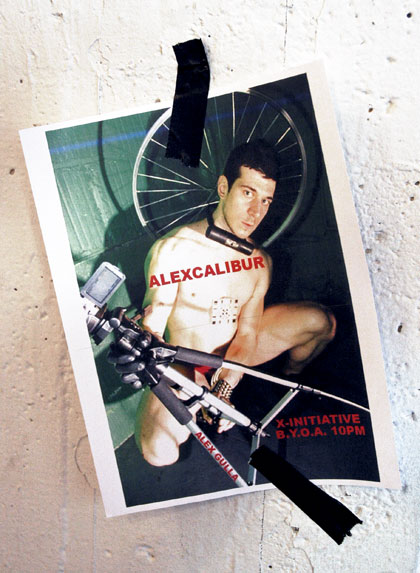
I saw several of these posters taped about the place when I went by on Thursday. I assumed it was some kind of guerrilla (or pseudo-guerrilla) poster project. Great styling. I went home and Googled “Alex Gulla” and “Alexcalibur” and I learned that the “project” was only about the electronic rock performance inside the space the previous night. I may have been disappointed on two counts (one of them of course that I had missed the party and the chanteur), but I still have my souvenir flier. The black duct tape was a nice touch.

[image of Man Bartlett’s drawing from the artist]

60’s California minimalism, at Zwirner

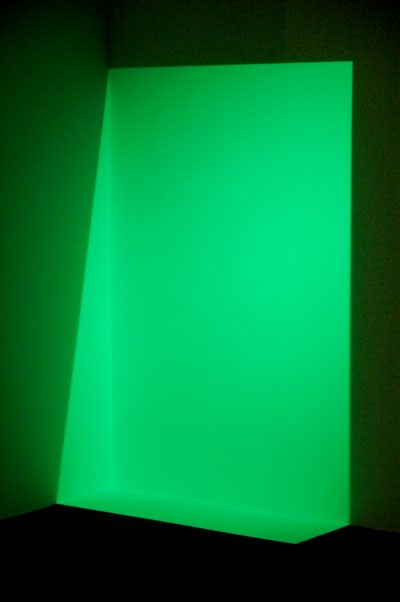
James_Turrell_Juke_Green.jpg
James Turrell Juke Green 1968 light projection, dimensions variable [installation view]

Doug_Wheeler_Untitled_white_light_square.jpg
Doug Wheeler Untitled 1969 sprayed lacquer on acrylic with neon tubing 91.5″ x 91.5″ x 7.5″ [installation view]

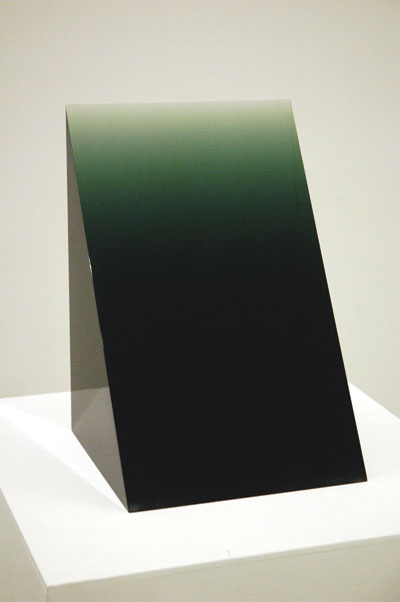
Peter_Alexander_Green_Wedge.jpg
Peter Alexander Green Wedge 1969 cast polyester resin 14″ x 8.5″ x 9.75″ [installation view]

If you’re within earshot of this post – and of the Zwirner gallery on West 24th Street – you still have a chance to see one of the most beautiful shows of the year: “Primary Atmospheres: Works from California 1960-1970” closes this afternoon at 6.
The ten artists included in this museum-quality show are Peter Alexander, Larry Bell, Laddie John Dill, Robert Irwin, Craig Kauffman, John McCracken, Helen Pashgian, James Turrell, De Wain Valentine, and Doug Wheeler.
Awesome.

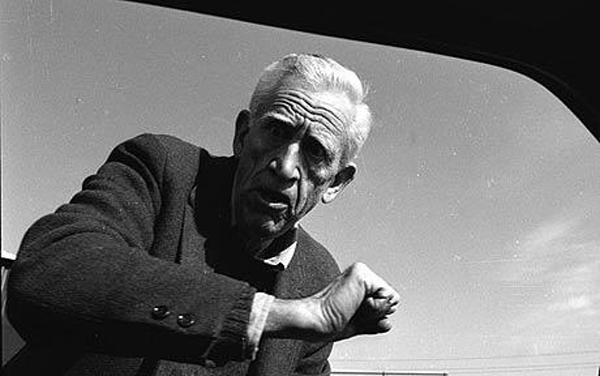
an IDIOM: a conversation with Salinger’s ghosts

Salinger_Idiom_Telegraph_3.gif
just how much could it have hurt?

I know I’m one of the publishers, and so it may not be quite proper for me to sing the praises of the online arts magazine Barry and I introduced late last summer, but I’m going to risk it anyway.
Although so much else of IDIOM is just as good or even better, because of its particular timeliness and its unexpected format I wanted the conversation between some of the publication’s writers, “On the passing of J.D. Salinger“, which we published yesterday, to get more attention than it might otherwise attract.
So consider this a flag.
The spirited short piece is nothing like the fulsome academic discourse available almost everywhere this week, and you’ll feel like you’re sitting in the room with the three young participants – even contributing to the conversation. The voices you’ll hear are those of Alice Gregory, Editor Stephen Squibb and Jessica Loudis.
While you’re at the site, take a look at the latest posting, which is equally timely, “Art and Culture in Haiti after the Quake“, by Hong-An Truong, and browse through the still-modest-size archives.
My own two cents about Salinger’s “The Catcher in the Rye” is the thought which came to me almost immediately after hearing about Salinger’s death: I don’t mean to minimize the importance of what he accomplished back in 1951, but, as a gay boy the year it was written, and a gay young man when I finally read it, “Catcher” never quite resonated with me in the same way it did with others. It seems to have attached itself to the psyche of many of my approximate contemporaries, or at least the straight, male, white, middle to upper class types.
Today I’m no longer gay; I think of myself as totally queer instead, but I can remember what it was like when being gay meant dissemblance, invisibility, powerlessness, desperation and, for “practicing” Catholics, eternal damnation. I’m now more than cool with my orientation, in fact I consider it a strength in almost every way, and I’m definitely no longer totally alone with it. So maybe I should try once again to make Holden Caulfield’s acquaintance: His own much-analyzed disconnect looked pretty trifling to me at a time when the the whole world despised my, literally, unspeakable differentness and when I would have been crushed in an instant had I revealed myself.

This last thought can only serve as a footnote, and I don’t want to make too much of a purely personal irony, but I can’t help noting that, at roughly the same time I began emerging from a closet to which I had been condemned by others, J.D. Salinger shut himself up in one of his own construction. It’s his odyssey that still baffles everyone.

[image from the Telegraph via IDIOM]

Hunter College 2009 MFA thesis exhibition – continues

Ezra_Wube_Amora.jpg
Ezra Wube Amora 2009 [large detail of still from video installation]

Barry and I visited the fall 2009 Hunter College MFA Thesis Exhibition galleries twice last weekend, and we both agreed it was probably the best collection of their MFA program artists we’d seen. We had been asked to be a part of a “walk through conversation” with the artists and others on Sunday, along with Paddy Johnson of Art Fag City and artist Clive Murphy and we had gone up to 41st Street to preview the installations the day before.
The “show” is definitely worth a visit. We made it a “top pick” on the ArtCat calendar, partly because of the opportunity to see work by artists who may not yet have shown in galleries, and because of the challenge it offers in seeing the work “raw”, without the interventions of galleries, press releases, curators, or even, in most cases, identifying labels. The exhibition has been extended through Tuesday, January 19. Details are here.
The Hunter Times Square Gallery is not normally open on Sundays, but tomorrow at 3 pm there will be a panel discussion in conjunction with the MFA show. It will be moderated by Katy Siegel, Professor of Art History at Hunter College, and the guest panelists are Bob Nickas, Gabrielle Giattino, and Oliver Herring.
I’ve uploaded here a small number of images I took on Saturday. The complete list of artists includes Courtney Brecht, Meredith Davenport, Jared C. Deery, Allison Evans, Peter D. Gerakaris, Vivienne Griffin, Nathan Gwynne, Paul Helzer, Ellie Irons, Darren Jones, Yashua Klos, Noah Landfield, Lori Merhige, Dave Mishalanie, Jo Q. Nelson, Alta Price, Sarada Rauch, Rebecca Simon, James Weingrod, Ezra Wube, and Seldon Yuan.

It may be a wrong call, but I’m going with a translation of the title of Ezra Wube‘s video which suggests the role of “teacher”, giving me an excuse to use it at the top of this post describing a magister program in the fine arts.
Wube was not at the walk-through, so there was no exchange with the artist, but I had been drawn into his multimedia installation on a visit to the galleries the day before. Today I was streaming WQXR2 while I watched this luscious, semi-narrative soundless video, “Amora“, once again, this time on line. Just as the video started so did a recording of Kyle Gann’s “Etude No. 4: Folk Dance for Henry Cowell“; then, when the image shifted from words to figures, that player piano piece was succeeded by Olivier Messiaen’s “Fantaisie burlesque“. A perfect, serendipitous cross-disciplinary, interactive invention, although impossible to produce in the gallery, or reproduce anywhere. [large detail of still from video installation]

Yashua_Klos_portraits_detail.jpg
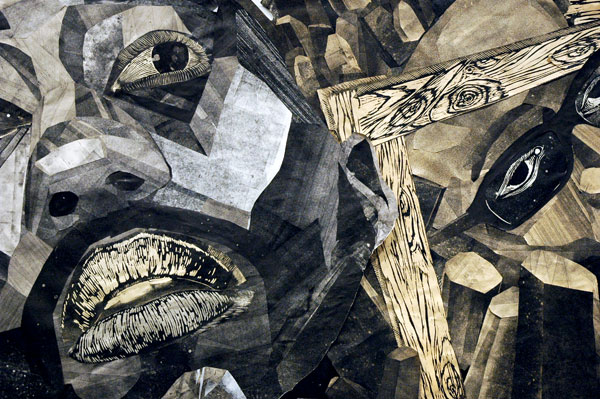
Yashua Klos‘s dense woodblock collages reveal their handsome portraits, sometimes only reluctantly [medium detail]

Ellie_Irons_twig_Litter_detail.jpg
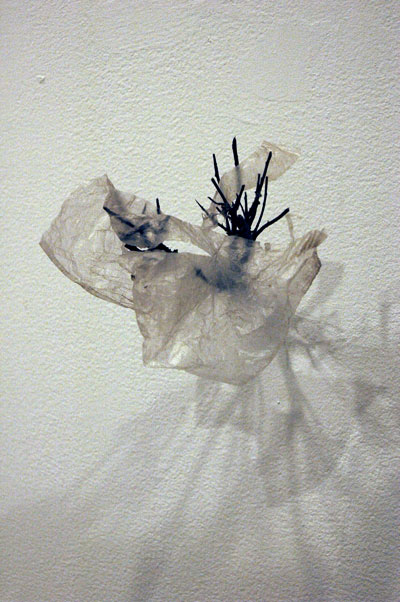
Ellie Irons, in a number of installations which include abstracted drawings of rivers, deltas and watersheds, along with reconfigured found organic materials, and the litter which is attracted to them, addresses our “attachment” to our environment, both the gifted and the corrupted. [detail of one element in the installation]

Nathan_Gwynne_album_detail.jpg
Nathan Gwynne‘s work is almost audible: “The Rhythm Method”, his installation of colorful drawings in pencil, gouache, acrylic, pastel and collage, and his freely-worked sculptures reflects the artist’s percussive music projects outside the academy. He’s gotten my attention there too. [large detail of “Greatest Hits”]

Vivienne_Griffin_card.jpg
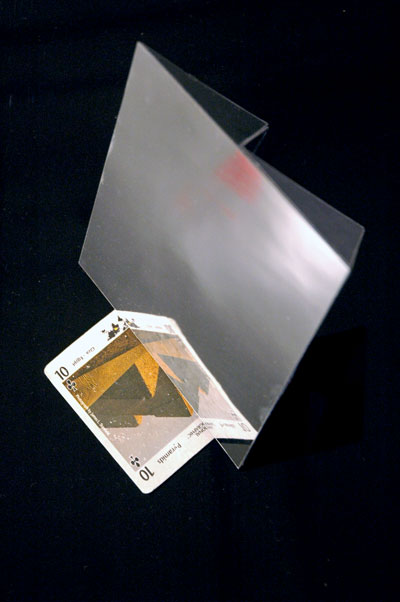
Vivienne Griffin’s work, while executed in a number of media, has an intense affair with film, although always in an extremely oblique way. [detail of installation]

Paul_Helzer_Cabin_tabletop.jpg
Paul Helzer’s richly-colored and lighted video documents a roughly-hewn cabin, paradoxically constructed entirely inside his white studio, which is oddly-alluring and almost surreal. It’s fully-occupied by a sound design as compelling as it is mysterious. [large detail of video still from installation]

Meredith_Davenport_standing_in.jpg
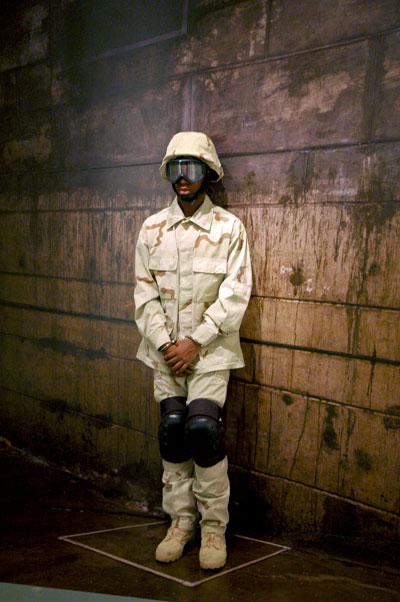
Meredith Davenport‘s installation included a revolving cast of live “stand-ins” (in several senses of that compound) and a more obscure element involving a looped video on a small monitor vis-�-vis with the printed-photo “stage”. In a country where war reenactments of all kinds and all periods manages to thrill millions, it was a show stopper, even for visitors less attuned to “art which is political” than Barry and myself. [large detail of installation, including performance]

Noah_Landfield_Regeneration.jpg
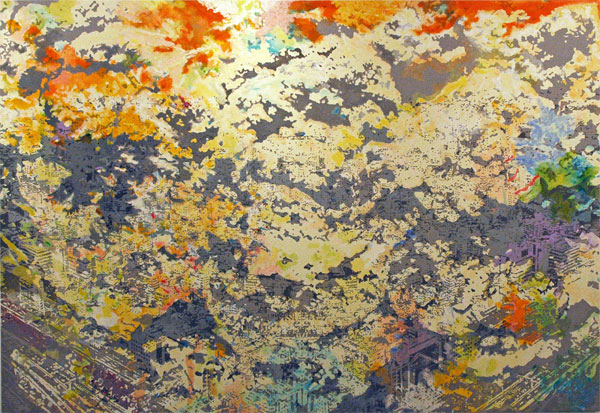
Noah Landfield‘s spectacular city/landscapes describe scenes which may be understood as gloriously celebratory or unambiguously apocalyptic. Only on Sunday did we learn from the artist that each of the paintings began with his own photograph of sections of specific Japanese cities.

Jo_Q_Nelson_chainlink_shore.jpg
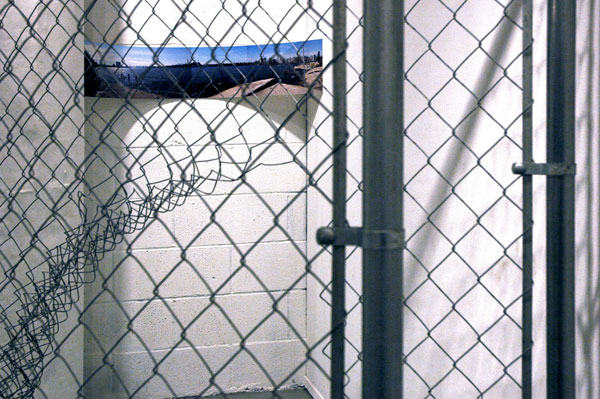
Jo Q. Nelson‘s sculpture and installation project has an important interactive element, involving her interviewees’ understandings of place, addressing their relationships with familiar private/public spaces. [detail of one element of the installation]

Peter_D_Gerakaris_painting_four_on_six_B.jpg
Peter Gerakaris straddles town and country, in his background and in his art, where he weaves natural and constructed worlds into unstable electric relationships inside his compelling, almost tantric tondos.

Dave_Mishalanie_detail.jpg
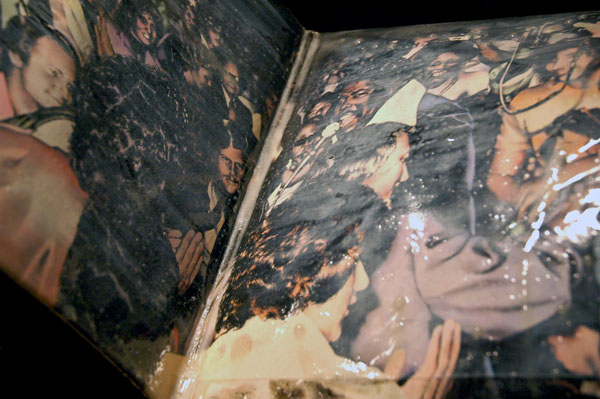
Dave Mishalanie resurrects the records of long-gone innocent, or at least ambiguous, intimacies between men in a large, very beautiful installation inspired by found images, artifacts which had been crinkled, faded or erased, re-contextualizing them among gorgeous abstractions picked out from the patterns of old fabrics, also found. [detail of installation]

NOTE: In a gallery just inside the entrance to the MFA Building and the Thesis Exhibition is an installation of work by Mathew Spiegelberg, who was a part of the 2009 class but who died on April 18th last year, after falling between two New York subway cars.

[image of painting by Peter Gerakaris from the site of the artist]

Joanna Malinowska at CANADA

Makinowska_Beuys_Ustvolskaya.jpg
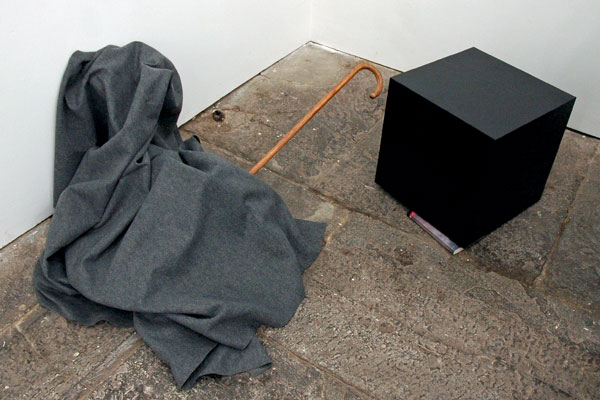
Beuys’s cane continuously raps on the surface of Ustvolskaya’s percussion box, one corner of which rests on a copy of Castaneda’s “Don Juan”

Malinowska_Boll_Malevich.jpg
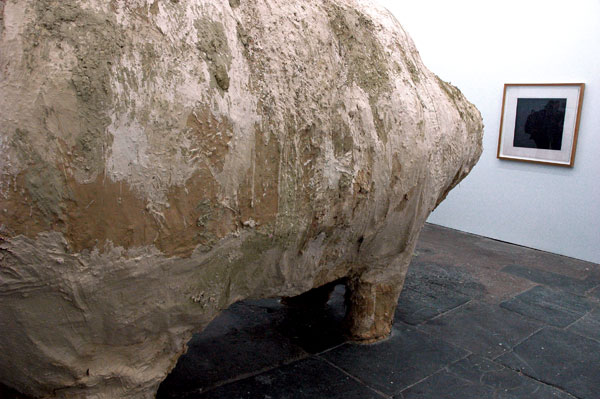
the hugely-outsize Boli, constructed of sacrificial materials, including one of Evo Morales‘s acrylic sweaters, contemplates Malinowska’s replica of Malevich’s “Black Square

Malinowska_McCarren_solar_system.jpg
a group of slightly-scruffy habitu�s of McCarren Park “performing the Solar System model falling apart”, accompanied by toy piano, in a video using Messiaen’s “Visions de l’amen” as sound

Joanna Malinowska has installed her own aggressively-idiosyncratic diagram of the universe, “Time of Guerilla Metaphysics“, inside the two gallery spaces of CANADA, on the Lower East Side.
It’s not a simple walk-through show. A certain amount of attention has to be paid when the universe is being re-imagined. Its appeal may only develop slowly, at least partly because it’s surfaces are largely brown and gray, and because its pieces echo the diversity of Malinowska’s model, the universe itself, but ultimately the installations, both separately and together, register as powerful, tantalizing, and, ultimately, deliciously enigmatic. Their mysteries mirror the artist’s sources themselves, which include traditional West African totems, Joseph Beuys, Copernicus, Mammoths, Galina Ustvolskaya, Oglala Sioux dance, Spinoza, Kazimir Malevich, Evo Morales, and Brooklyn�s McCarren Park.
I left the gallery thinking that visitors to this, her second New York show could only be scratching the surface of this artist’s creative imagination.

Man Bartlett’s “24h Best non-Buy, a Performance”

Man_Bartlett_during_24h_Best_nonBuy_blog.jpg

This sort of thing is why I don’t despair of the art world.
It’s almost 6 o’clock, and that means the artist Man Bartlett is about to complete his “24h Best non-Buy, a Performance” inside the aisles of the Best Buy store in Union Square.
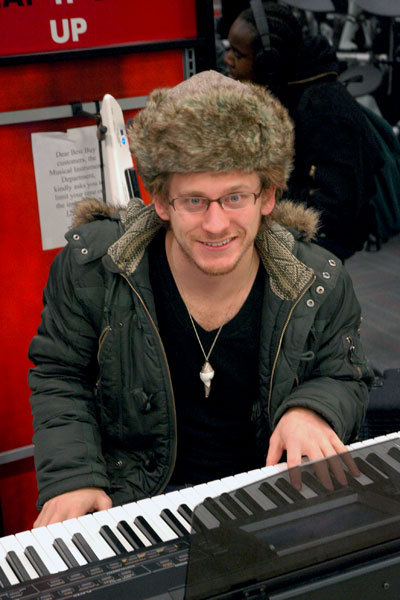
Barry and I learned about the piece through Twitter, and Barry was able to follow that traffic all afternoon. There’s also this. I visited Bartlett in person around three o’clock, on my way home from the Greenmarket. He told me that the going had been tough at times, mostly during the middle of the night, when he may have been the only “customer” in the store, but that security had been pretty cool. He also said that he fully expected to be able to leave tonight at 6 without having bought a thing.
While talking to him I learned that he had recently been asked to be a part of the residency program at the Flux Factory.
The more I learn about this artist’s work the more I find I want to know. I’m pretty sure we will all soon have that opportunity.

There’s much more, from Hrag, on Hyperallergic.