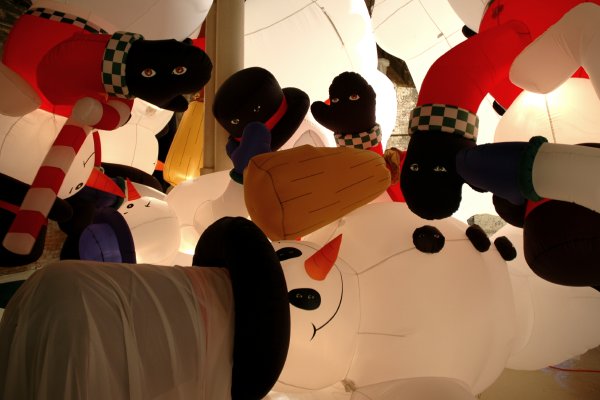
David Humphrey [detail of installation, “Snowman in Love”]
David Humphrey said goodbye to his “Snowman in Love” at Triple Candie last night, and we were there to watch as fifteen dancing and very physically-engaged, recently-retired holiday airbags were rapidly reduced to sad nylon sacks* when their lifeline compressor was switched off.
The work was a challenge to photograph as an instalaltion but a delightful subject for abstraction in closeup.
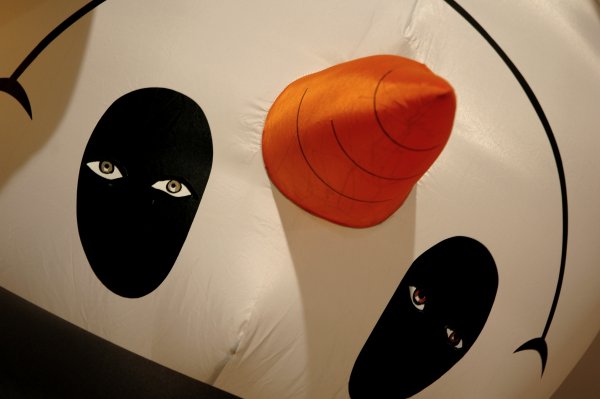
mug
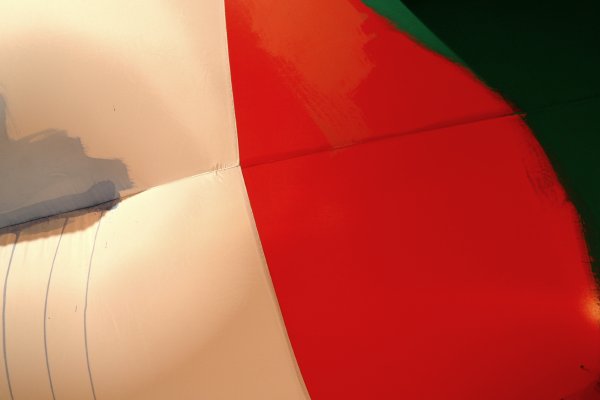
bum
*
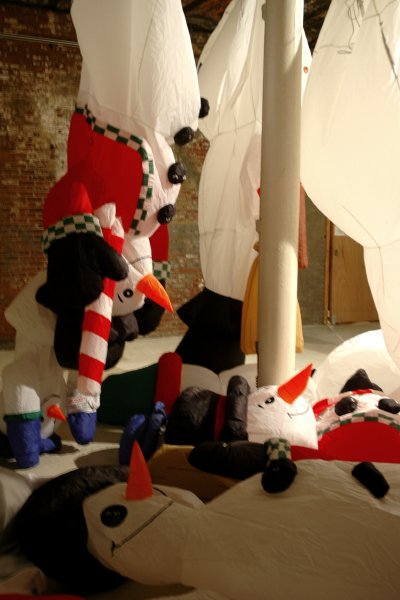
post-party
Category: Culture
Faille in Williamsburg
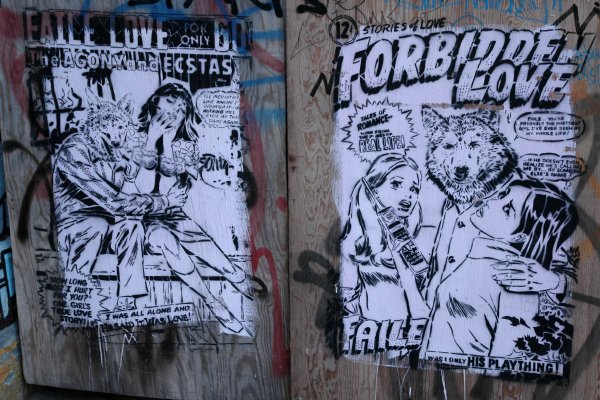
Faile is a more-than-conventionally-stealthy street art collaborative whose work is typically spotted first in the corner of an eye. This sighting was in Williamsburg, on Wythe Street I believe.
Tara Donovan at Pace Wildenstein 22nd Street
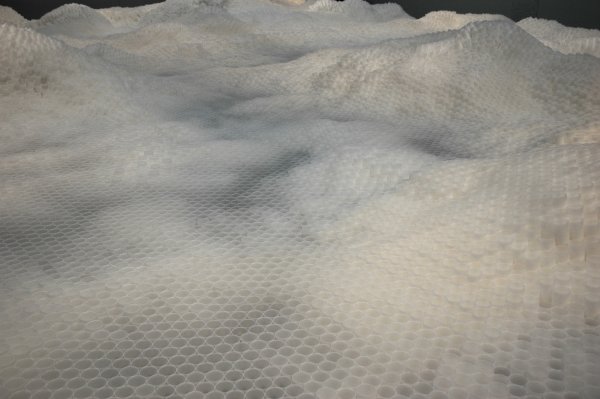
Tara Donovan Untitled (Plastic Cups) 2006 plastic cups, installation dimensions variable, approximately 5′ x 50′ x 60′ [large detail of installation]
Pace Wildenstein is showing Tara Donovan‘s remarkable ‘landscape’ installation of stacked plastic cups in the space on 22nd Street once identified as an annex to the DIA Foundation.
Plastic cups. You have to be there.
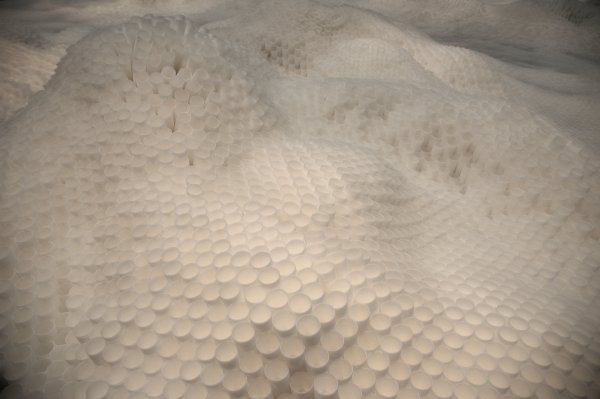
(closer)

(closest)
Crackerfarm, Duncan and Linn at Envoy
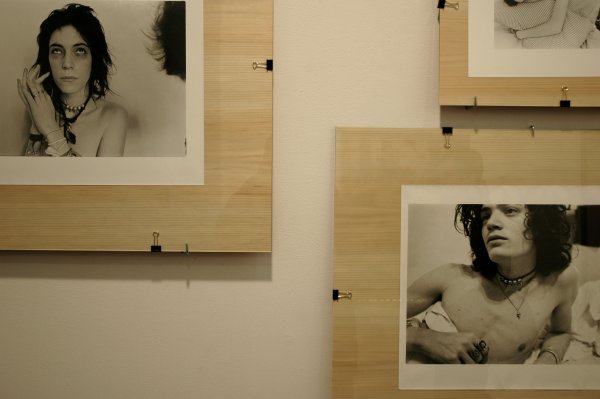
(when they looked like siblings)
(although only one of them could have passed as an angel)
The tiny Envoy gallery has currently has a show, “(Un)masked“, which includes the work of three artists or artist-collaboratives, Crackerfarm, George Duncan and Judy Linn.
The two wonderful silver gelatin prints shown above in a detail of the gallery’s installation are Judy Linn’s A saint in any form and Robert Mapplethorpe in bed at the Chelsea #2, both from the 1970’s, while her friends Patti Smith and Robert Mapplethorpe were living together in the Chelsea Hotel.
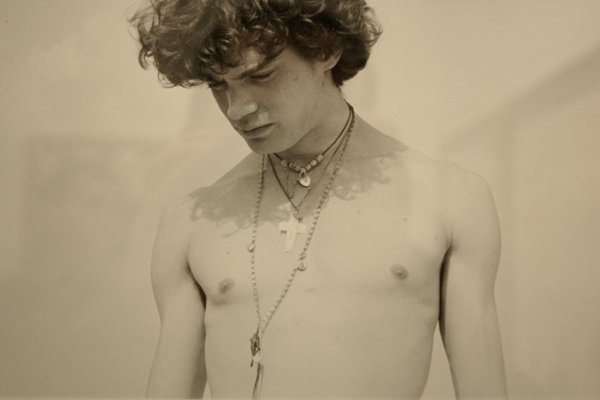
Judy Linn Robert cloud head 1969 gelatin silver print [large detail from installation]
Hannon, Jürgensen and Noonan at Foxy Production
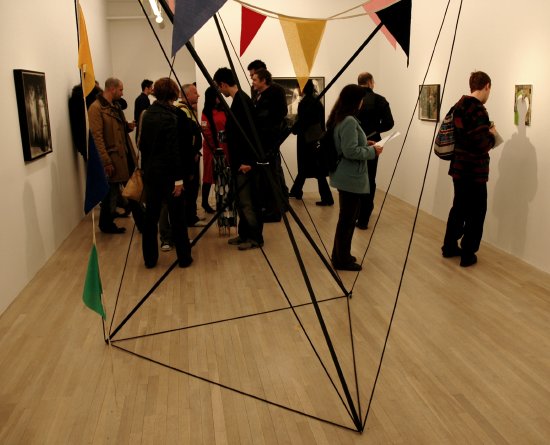
Foxy Production [installation view of the gallery show, with a large detail of Jacob Dahl Jürgensen’s Untitled Construction in the foreground]
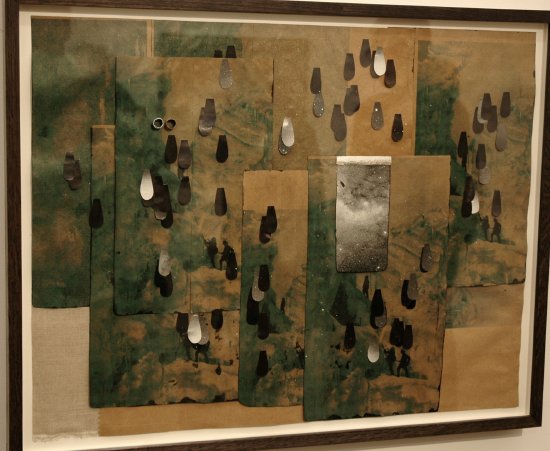
Frank Hannon Abbyssinium 2006 archival inkjet on brown paper bags, collage, ink, spraypaint [installation view]
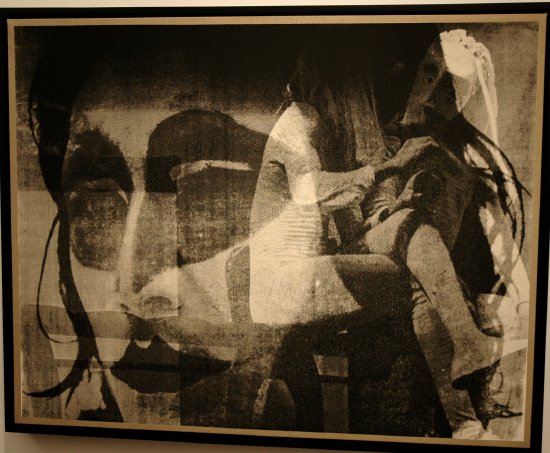
David Noonan Untitled 2006 silkscreen on linen, framed 30″ x 22″ [installation view]
It may only be coincidence, but Foxy Production‘s three-artist show, which also opened last night, seems at least somewhat related to that of Jacob Dyrenforth’s installation at Wallspace next door.
The Foxy press release describes the untitled show as:
. . . recent work by Frank Hannon, Jacob Dahl Jürgensen and David Noonan, three London-based artists who examine interconnections between memory, performance, and ritual. Making the known seem uncanny, they mix references and genres to explore how common practices and codes can determine notions of self.
I think this is what I may most look forward to in an encounter with any of the arts: I like the fact that the mind is always challenged by [especially new] art, or art by the mind. The result is that the most ordinary things never look or sound the same but also even the most ordinary idea is never unchallenged, even if I don’t always know how this is being done.
At Wallspace right now we may see the extraordinary made more ordinary; at Foxy, the ordinary is made more weird. Or is it actually the other way around? No, let’s see, it seems to be going both ways at both shows, which means that I may not understand the process inside either. Still, within the eight walls of these two galleries the physical results are stunning.
Jacob Dyrenforth at Wallspace
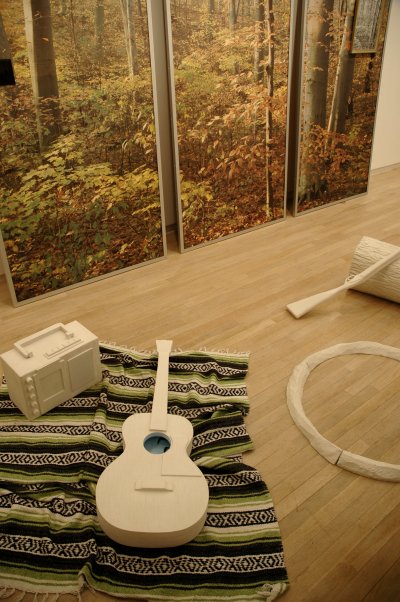
Jacob Dyrenforth [installation view, including large details of Stand-In for Ceremony in the foreground and Three in One on the wall]
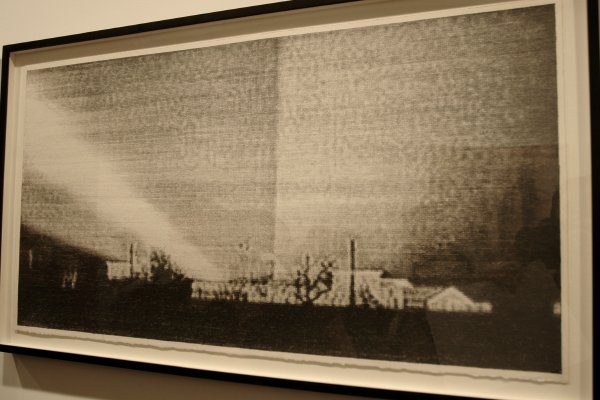
Jacob Dyrenforth The Compound 2006 graphite on paper 22″ x 30″ [installation view]
Cultural heroes, cults, sensational news stories and fantasies are only starting points in Jacob Dyrenforth’s show at Wallspace which opened last night. The idea seems to be the subjective or layered reality of both the images we encounter and those we create ourselves, especially when we turn them into fetishes.
The artist’s medium is sculpture, drawing, video, prints and sound.
The images alone are worth a visit, and the conceit of Dyrenforth’s attractive installation could not be more relevant in a world which is as indifferent to or confused about the arguments of truth as ours.
Pierogi is moving to Leipzig
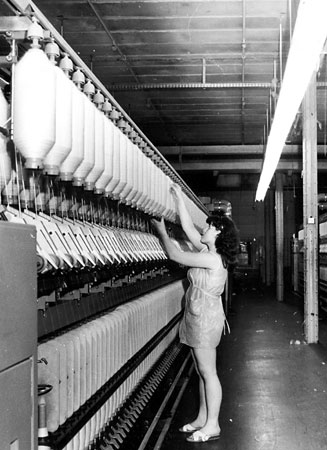
before Pierogi
No, Pierogi 2000, the pioneering Williamsburg gallery is actually only opening up a second space. Brooklyn and the island to the west can breathe a sigh of relief.
It’s interesting that it’s Leipzig [in the Spinnerei] rather than Berlin. I mean, the U.S. considers the German capital so important that as far back as ten months ago we had already decided to inaugurate direct service from New York. Who knows when it will be Leipzig’s turn? Once he lands at Tegel, Joe’s going to have to switch to a train to get to his new provincial annex.
Okay, just kidding. I know Leipzig is very important. It’s got history and trade fairs and I understand it now has a new school, and I think anything which makes the German eastern lands more interesting than they already are is a very good thing.
By the way, I only found out about this exciting new development while Barry and I were visiting our local space yesterday. I heard someone being told that Joe [Amrhein] was in Leipzig. That would have been enough to attract my interest, but on the way out I picked up a card which clearly indicated there were suddenly two Pierogi’s.
Now I have questions. Will there be a flat file? Is it for Germans? Why does its first show feature two New York artists? And finally, if Germany actually does need a real American gallery, doesn’t America need a real German gallery?
[image from Spinnerei]
Brock Enright and Ivan Hurzeler at Cynthia Broan
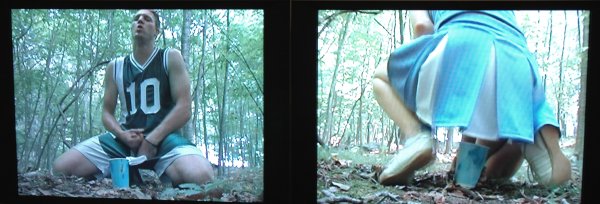
Brock Enright and Ivan Hurzeler [large detail of diptych still from installation]
Now that I have your attention I can talk up the incredible Brock Enright show installed at Cynthia Broan this month.
When I wrote a post a few days ago about his piece at the Armory Show I didn’t know that his 29th Street presence was almost a solo effort and not part of a large group show: The gallery’s announcement gives equal billing to Enright, Ivan Hurzeler and each of their dozens of collaborators. This is delightfully democratic and generous, but slightly misleading.
Every one of these intrepid souls deserves a medal, but it looks like Enright himself comes out of the experience with a new direction and quite possibly an entirely new genre of art. I couldn’t begin to give it a name but I’m sure it will acquire one even if it isn’t emulated.
The gallery includes an installation of the detritus of a five-day camping-trip-out-of-purgatory – if not hell – which took place last summer within a rather heavenly-looking park located barely outside of the city. Yes, of course it rained. The chaotic mix of youth, sex, sports, natural beauty, bodily functions and survival is alternately, or simultaneously, horrible and delicious for the observer who can survive its assault on his or her own personal demons. Ah, playing with food; who doesn’t remember the thrills?
Let’s just say it’s not “Midsummer Night’s Dream” but I am thinking about Shakespeare as I’m writing this. I mean, we can’t expect faeries in the forest of Pound Ridge, so, hey, . . . maybe?
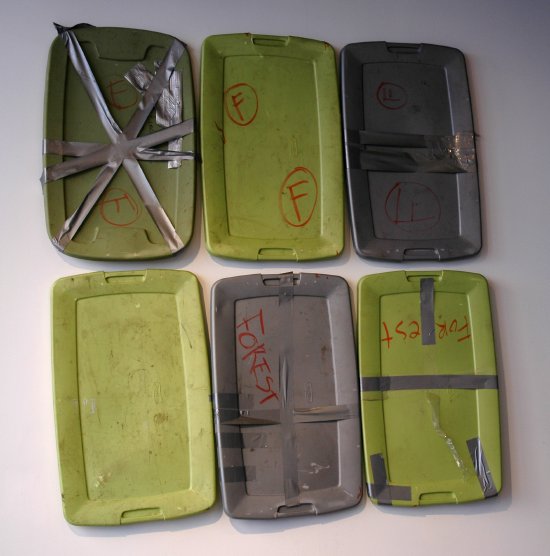
The large collection of messy relics is dominated by sports and cheerleader uniforms and their paraphernalia, as well as empty beer cans and food packets, but a select few pieces are assembled into some striking, almost traditional floor or wall-mounted sculptures.
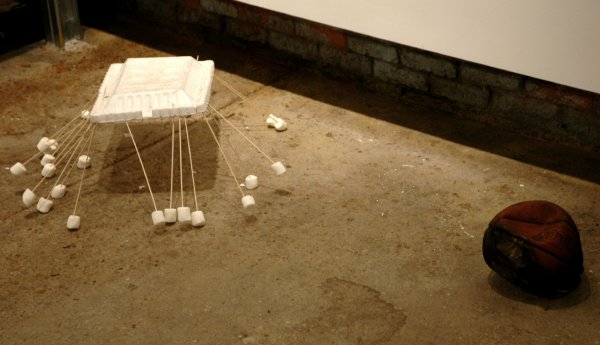
Some certainly less traditional than others.
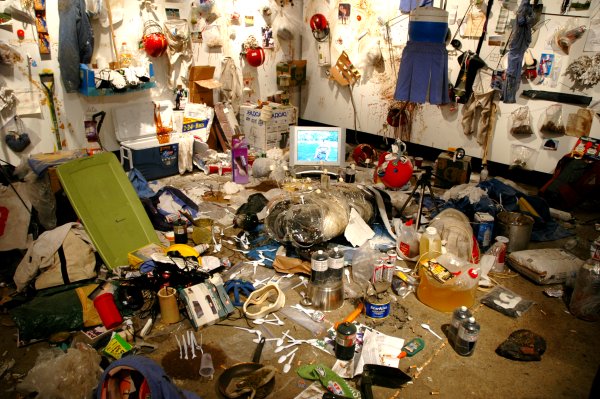
There are two videos, one a diptych, plus a short loop on a TV which sits in the midst of trash carted back from the campsite.
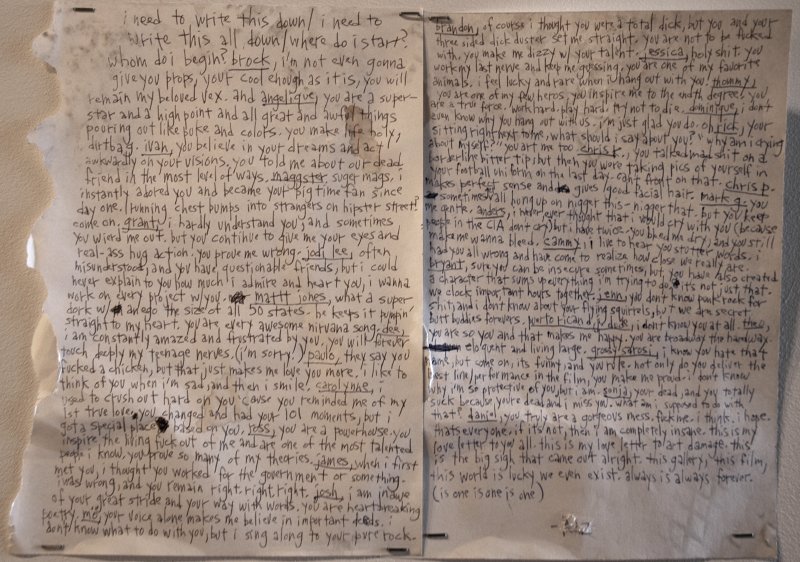
A letter pinned to a side wall is almost totally inconspicuous. It’s something like a bread-and-butter note from one member of the weekend tribe all the others, addressing each separately in short gushing tributes, some rememberances more intimate than others. The signature at the bottom has been scratched out.
Finally there’s [the] “Forest” itself. It’s a 50-minute film running continuously behind a curtain in the rear of the gallery. It’s described as a collaborative project by Enright and Hurzeler and it’s a stunner, but the large cast (see the press release) was clearly not just reciting lines and standing on chalk marks. Thanks, guys.
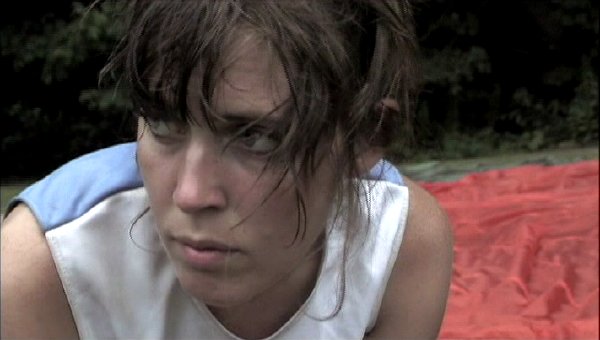
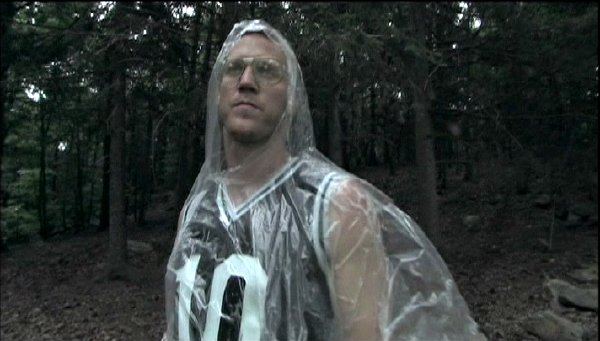
[the two stills from “Forest” are captured from a DVD]
‘Permanent Bases’ and Rachel Corrie, both in The Nation
There are few issues more important to our own survival and that of the entire world than the state of Israel and the war in Iraq. In two consecutive issues this month The Nation‘s contributors offer enlightenment in these areas to even the most knowledgeable reader.
I usually skip the many articles which only reflect what I already know or suspect, but I couldn’t do without those which highlight this magazine’s ability to reliably report or sensibly argue what what I’m unlikely to find anywhere else. These two fill that description in spades.
Unfortunately only one of these two particular reads are available on line, but you’re depriving yourself, The Nation, and the nation if you aren’t already a subscriber.
An excerpt from Tom Engelhardt’s”Can You Say ‘Permanent Bases’?“, which is not on line:
To this day, those Little Americas [at least four “super-bases”] remain at the secret heart of “reconstruction” policy in Iraq. As long as [Halliburton] keeps building them, there can be no genuine withdrawal. Despite recent press visits, our super-bases remain in policy silence. The Bush Administration does not discuss them (other than to deny their permanence). No plans for them are debated in Congress. The opposition Democrats generally ignore them.
An excerpt from Philip Weiss’s “Why These Tickets are Too Hot for New York“, which is available on the magazine’s website:
As George Hunka, author of the theater blog Superfluities, says [about New York Theatre Workshop’s cancellation of the play, “My Name is Rachel Corrie”], “This is far too important an issue for everyone to paper it over again, with everyone shaking hands for a New York Times photographer. It’s an extraordinarily rare picture of the ways that New York cultural institutions make their decisions about what to produce.”
Hunka doesn’t use the J-word. Jen Marlowe does. A Jewish activist with Rachelswords.org (which is staging a reading of Corrie’s words on March 22 with the Corrie parents present), she says, “I don’t want to say the Jewish community is monolithic. It isn’t. But among many American Jews who are very progressive and fight deeply for many social justice issues, there’s a knee-jerk reflexive reaction that happens around issues related to Israel.”
Elia Alba in “Disco” at Longwood
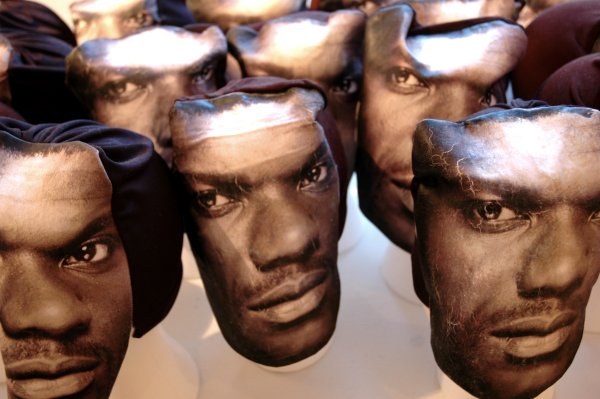
Elia Alba Masks 2005 photocopy transfer on muslin [view of installation]
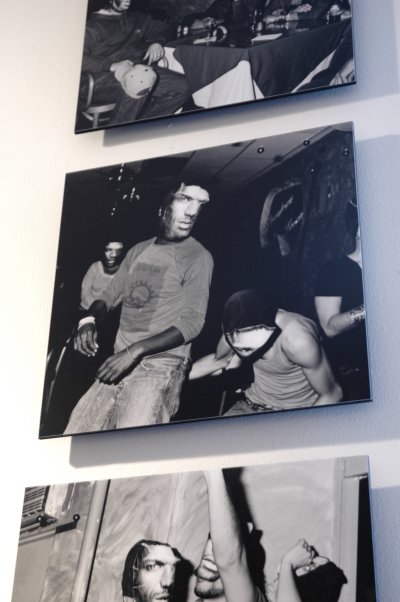
Elia Alba Muscle Boy 2006 C-print mounted on Sintra (from the series “Larry Levan Live!”) [installation view, including portions of two other works by the artist]
[continuing images from the Longwood show]