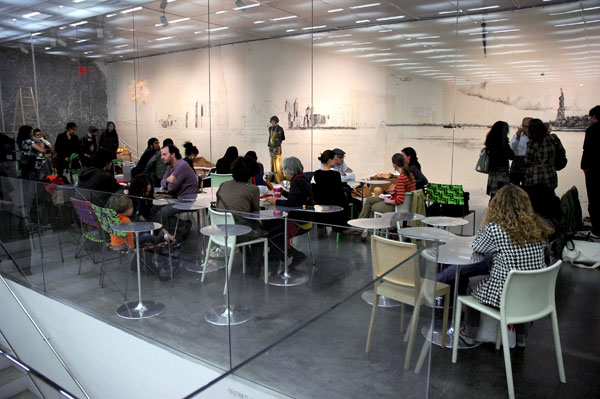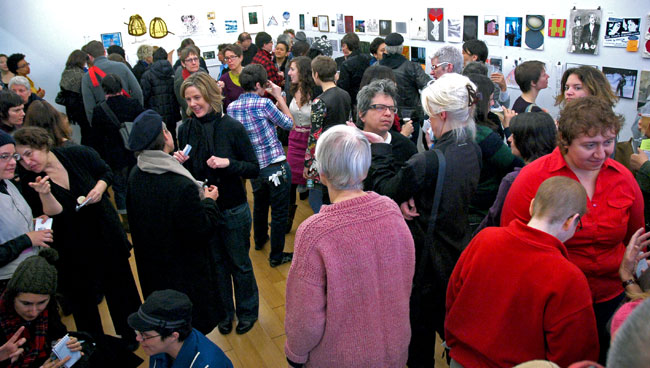
a shot of the crowd before the room filled up yesterday, from a camera held high overhead, feeling the power, and documenting all the super Lesbians, and some very enthusiastic friends and supporters
The entire event was run incredibly well, as efficiently and perhaps more efficiently than many benefits organized by non-profits that have been doing it for years. And we’ve seen a lot. Barry and I had a blast at yesterday’s first ever art benefit for the Lesbian Herstory Archives [LHA], held at the gallery of Alexander Gray Associates.
As the snow began shortly after midday, we were gathered with a lot of other people, many of them friends, many of them heroes known only from a distance, some soon to become friends. We were ten floors above the Hudson River in west Chelsea, and all we had to do was enjoy ourselves; the real champagne; the delicate cookies and savories; emcees Moe Angelos, milDRED, the artist formerly known as DRED, and Kay Turner; the work mounted on the walls; and above all the tonic of a wonderful crowd.
Oh well, we did have to wait a while for our name to be drawn, when we would be able to announce our choice of the art, but the selection was so good there was little reason for anxiety and virtually no chance that anyone would be disappointed.
But a lot of people were saddened to learn that the 80-some tickets for 80-some pieces of art had been sold out early. Many of those couldn’t come, and others did come by for the excitement, and to contribute directly to the endowment fund; maybe the LHA should rent an entire armory for their second art benefit.
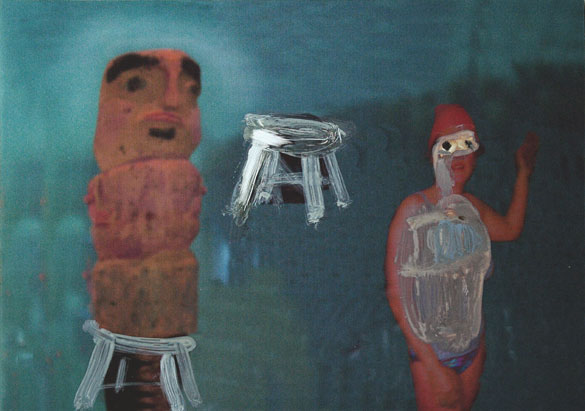
Elizabeth Bonaventura Untitled, or 2010 Olympic Hopefuls casein paint on inkjet print 2009 8.5″ x 11″
We went home with the beautiful paint-on-photograph piece by Lizzie Bonaventura [no link or website] shown above, and we were able to talk to the artist and exchange contact information even before we had a chance to pick her work.
Category: Culture
what to see on my birthday, or possibly soon after
I had already planned to do a very quick roundup of worthy shows closing very soon when I saw Art Fag City’s holiday post, “What To See Before Christmas“. Now I was further inspired to go ahead, but not wanting to copy her style (and also because I don’t do xmas or any other conventional December holiday), and finally, noticing that tomorrow is my birthday, I’ve decided to go with the self-referential title at the top.
The Cinders show actually does close tomorrow, Saturday, but the rest will be visible for another one to four days.
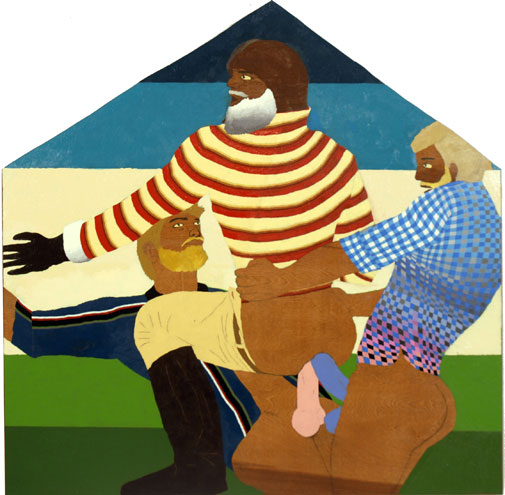
Leidy Churchman Three Beards 2007 oil on wood 48″ x 48″
The layered expression within this Leidy Churchman painting gives only a hint of what to expect from “Ridykeulouse Hits Bottom” at Leo Koenig Projekte, a group exhibition “curated with an iron fist” by Ridykeulous, otherwise known as as Nicky E., aka Nicole Eisenman and UnkAL, aka A.L. Steiner.
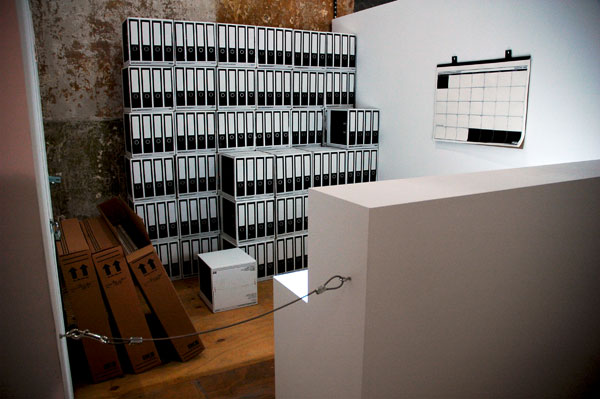
large detail of Dan Levenson’s “Little Switzerland”
“Nothing Up My Sleeve” at Participant, an homage to Stewart Sherman, includes an installation by Dan Levenson, one of the artists in this truly amazing group show which focuses, in the words of its curator, the artist Jonathan Berger, on the creation of “alternate lived realities through the use of various forms of deception”.
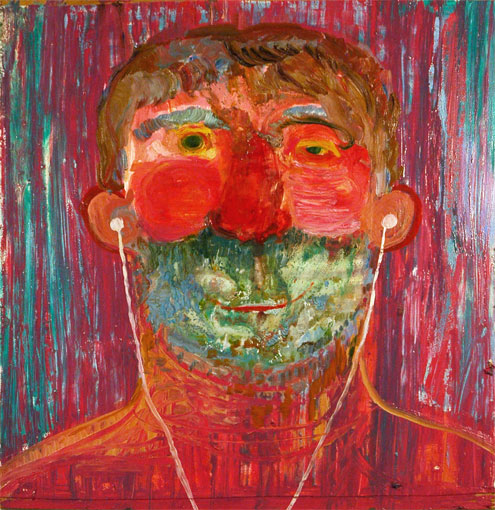
Nicole Eisenman iPod guy 2009 oil on canvas 24″ x 21″
Nicole Eisenman’s solo exhibition of paintings at Leo Koenig’s main gallery is simply wonderful, awesomely humanistic, and one her most exciting outings.
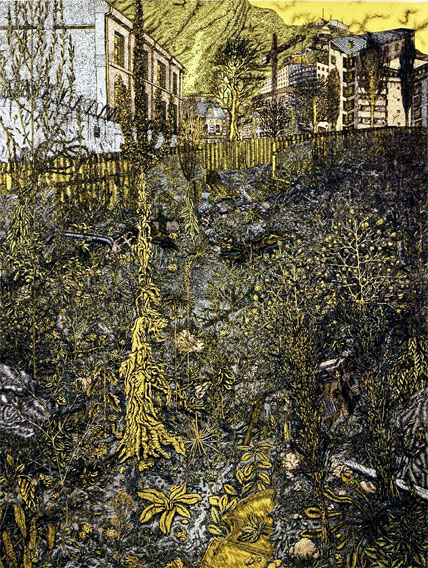
an extraordinarily-detailed print by an artist identified only as Nuvish
Cinders is hosting Le Dernier Cri: vomir Des Yeux for just one more day, displaying a spectacular selection of prints, books and video from a remarkable operation run out of an old hospital in Marseilles by a pair of artists which for 16 years has been producing, in the words of the press release, “legendary volumes of painstakingly handmade, beautiful, vibrant and violent monograph prints, books, and videos featuring some of the most irreverent underground artists in the world”, all in small runs of about 150.
These remarkable prints are also remarkably affordable: $75 sounds like a gift, in more ways than one.
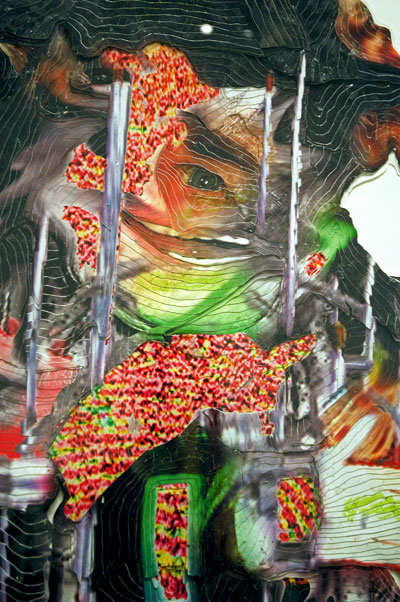
detail of one of Jacques Louis Vidal’s collages at Jancou
At Marc Jancou’s gallery in Great Jones Alley Jacques Louis Vidal’s powerful sculptures and delightfully-abstruse installations are framed on the main floor by a number of large-scale magazine-page-cutout collages mounted along the walls.
The show, “You are What You Look At” is worth every bit of time that can be spared for it.
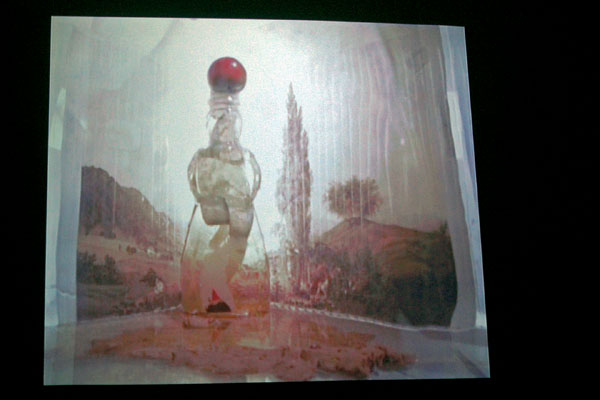
still from the installation of Tommy Hartung’s video, “The Ascent of Man”
On Stellar Rays is showing Tommy Hartung’s stunning video, “The Ascent of Man“, through this Wednesday. The title is adapted from the 1973 BBC documentary of the same name, and like the original, but with found footage and stop-action photography using his own remarkable models, it documents humanity�s ascent from ape to man.
It’s an impressive followup to the exquisite work he’s shown before, and I wouldn’t want to let this artist out of my sight going forward.
[image at the top from the artist’s website]
New Museum code, “ethics and collecting”
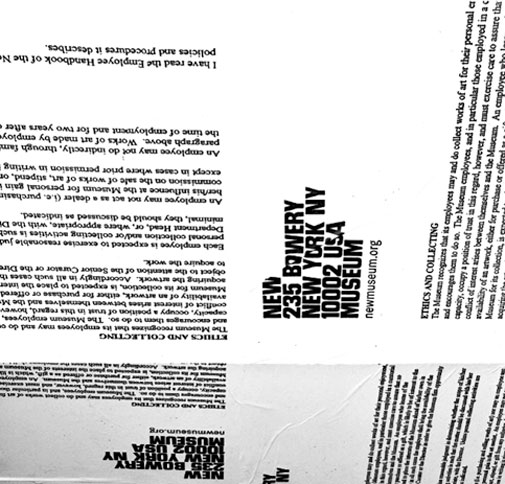
Kate Fauvell/Daniel Turner, Visitor Services/Security Guard Untitled [detail of ceiling installation]
Is an institution doing its job if its concern about ethics goes no further than the printed code it submits to its employees? A year ago a little-noticed exhibition mounted only ten blocks from the New Museum, a New York institution which is now the subject of a lively, and international, controversy about its curatorial decisions and ethical practice, seems to have anticipated some of the issues which were raised in reaction to a program announcement it released last September.
THE BACKGROUND: On September 25th this site became the first of many blogs to cry foul over NuMu’s decision to host the art collection of its billionaire trustee, curated by a celebrity artist of whose work he is the foremost collector, the Museum adding that the exhibition was to be only the first of a number of similar ventures in a series it would call “the imaginary museum”.
Since that time the story has snowballed dramatically.
In November of 2008 a group of artists mounted an exhibition at The Stanton Chapter Gallery on the Lower East Side, not far from the recently-opened new home of the New Museum. They did it entirely on their own, but their special relationship to NuMu was described in the title of the show, “New Work: Art from the Workers of The New Museum“. The installation included only art created by people working at the museum, and their capacities there were described on the art labels immediately after their names.
Daniel Turner, one of the artists in the show, has written me that during the month the exhibition was open “there was high tension in the museum, a few staff members were afraid of getting fired etc. In the end several of the ‘junior staff’* removed their works from the exhibition out of fear”.
Turner was not the only one who thought it was a very good show, although it appears to have been much overlooked at the time – except by the New Museum itself. He now believes that, because of NuMu’s September 24th announcement [the Times basically copied the press release the next day] of certain future installation practices, and the resulting and mushrooming discussion of general museum ethics and art market practice (see a short selection of recent discussions below), the 2008 show is definitely worth a first, or second, look, and argues that its merits should now command even more attention than it should have a year ago.
He wrote further that the exhibition catalog is “very rich with this topic” (ethics and practice) in general. It includes several very interesting essays, one by Ruby McNeil, the daughter of the founder of the Museum, Marcia Tucker. Although I missed the show itself, some of the work looks really great, and I totally agree with Turner about relevance, especially after looking at the piece he and Kate Fauvell created for the show (the New Museum code of ethics enlarged and wheat pasted on the gallery ceiling), and going on to read the actual text of that code, reproduced inside the catalog. The image at the top of this post is a detail of his and Fauvell’s installation.
I’ve looked at the catalog in pdf form, and a printed copy is available through Lulu here.
The New Museum code of “ethics and collecting” a copy of which Fauvell and Turner mounted on the ceiling of the Stanton Chapter Gallery, is reproduced just below. I think it’s particularly interesting In the context of current discussions both within and outside of the art world about institutional principles, as this code is addressed only to employees:
ETHICS AND COLLECTING
The Museum recognizes that its employees may and do collect works of art for their personal enjoyment, and encourages them to do so. The Museum employees, and in particular those employed in a curatorial capacity, occupy a position of trust in this regard, however, and must exercise care to assure that no conflict of interest arises between themselves and the Museum. An employee who learns of the availability of an artwork, either for purchase or offered as a gift, which is likely to be of interest to the Museum for its collection, is expected to place the interests of the Museum ahead of his/her own in acquiring the artwork. Accordingly in all such cases the employee shall bring the availability of the object to the attention of the Senior Curator or the Director in order to give the Museum first opportunity to acquire the work.
Each employee is expected to exercise reasonable judgment in determining whether the scope of his/her personal collection and/or collecting activities is such that the matter should be discussed with his/her Department Head, or, where appropriate, with the Director. Unless personal collection activities are minimal, they should be discussed as indicated.
An employee may not act as a dealer (i.e. purchasing and selling works of art) nor may an employee use her/his influence at the Museum for personal gain in the art market. An employee may not accept any commission on the sale of works of art, stipend, or gift from any collector, dealer, artist, or institution, except in cases where prior permission in writing is given by the Director.
An employee may not do indirectly, through family or friends, anything she/he may not do in the paragraph above. Works of art made by employees or family of employees will not be exploited during the time of employment and for two years after employment has terminated.
I have read the Employee Handbook of the New Museum of Contemporary Art and understand the policies and procedures it describes.
[below that line are spaces for name, signature and date]
Unfortunately one doesn’t have to be a staff member of NuMu (either senior or “junior”) to suspect or actually assert that this code of ethics, and similar protocols maintained by other arts institutions, may be honored in the breach more than the observance.
But, returning to my initial statement at the top, I think the big story isn’t about how much the New Museum, or any arts institution, should worry about what its artist employees are up to, but whether the guardians at the top are properly performing the stewardship with which they have been entrusted.
*
Artist and writer Maureen Connor expands upon the “junior staff” identification in this excerpt from her extended essay in the catalog:
As I understand it the New Work show was initiated by the New Museum staff (later defined as “junior” staff by management), not exactly as a guerilla action, but certainly one that arose from a need for agency and for some acknowledgment of their identity as artists. A proposal for New Work expresses a desire to �further the mission of the museum�new art, new ideas��, directly quoting from the New Museum’s website banner � �Manhattan’s only dedicated contemporary art museum�a leading destination for new art and new ideas.� Given the museum’s stated mission, one would hardly expect the artist members of its staff to need permission from upper management to organize and participate in an offsite show of their work. With the broad range of alternative art practices the New Museum supports and represents, one would think that the curators would recognize how this show could embody a radical approach to exhibition thematics that, to further quote from New Work’s proposal,� allows the audience to experience a museum in a completely new way�we posit the museum as the people who make a building and its program happen.�
This may only be a footnote to the argument of this post, but I think it has a significance well beyond the recitation of a fact:
I’ve noticed that there are no staff credits on the New Museum site, only the names of the trustees and benefactors, who of course don’t need the reinforcement artist-employee handlers, curators, guards, ticket takers, maintenance workers and coat checkers do. This is apparently standard, but not universal, museum practice. And just why would this seem to anyone like a good idea?
Finally, an idea of the nature of the ongoing discussion about museum practice, once it was picked up by mediums other than individual blogs, can be found in this very abbreviated list, which begins with the first critical treatment of the story by the New York Times:
- “Some Object as Museum Shows Its Trustee�s Art” in the Times November 10
- Georgina Adams. “Art for whose sake?”, in the Financial Times
- David Goodman interviews William Powhida on the BOMBlog: “I don�t think the New Museum drawing would have elicited the kind of reactions it did, [if] there wasn�t such a problematic situation.”
- Powhida inside “the belly of the beast”: a New York Times report from the Basel Miami show
- Bettina Korek on the Ovation TV blog, describing the “Elephant in the Room”
- Ben Davis on artnet, under “politics”, with: “the coronation of New York artist William Powhida as the anti-Koons”
[image, courtesy of the artists, from the “New Work” catalog]
minaret envy: Swiss suddenly terrified of certain steeples
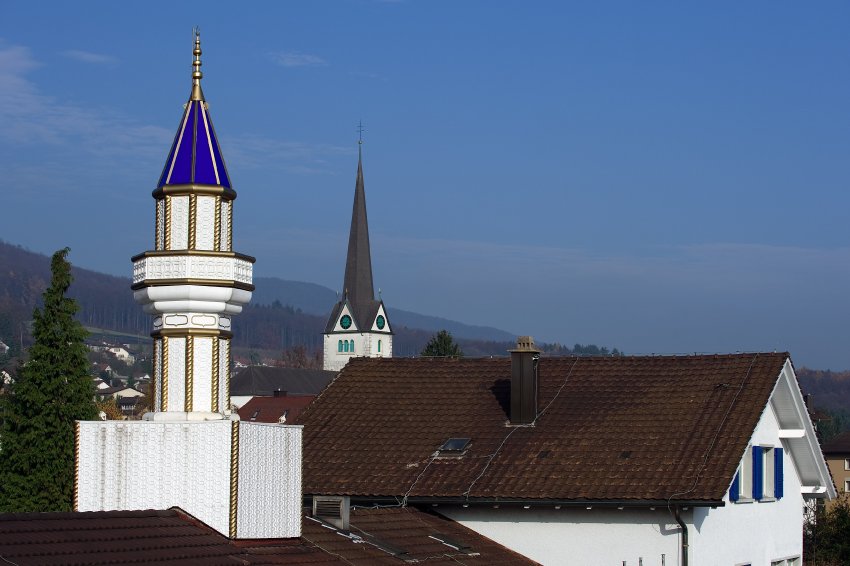
minaret and church tower in Wangen bei Olten, in the northern Swiss canton of Solothurn
Tell me again: Why is this a problem?
[image from AFP, via Spiegel]
on the New Museum, and maybe rearrangements beyond

Wayne Thiebaud Display Cakes 1963 oil on canvas 28″ x 38″
We’re telling the bakers’ families that cake just isn’t enough.
Yes, yes, the rich and powerful have always been with us, and they have always pretty much controlled what art gets seen, even if they may no longer control everything that gets made. But the playing field was almost wholly altered by the explosion over recent decades in the monetary value of the work they compete for at the top end of what they have made into just another “market”, and most remarkably in the run up of contemporary art prices.
When Barry and I first met with William Powhida to discuss the New Museum’s plan to turn over its spaces to the Joannou collection he agreed that we all knew that this is pretty much how large art institutions operate, but added, “I just don’t like them rubbing my face in it”.
That was several weeks ago. Now it’s become clear that Powhida wasn’t the only one.
In the last decade the speed and breadth of communications provided by the internet has altered the art world even more profoundly than big money, and in ways we’re only beginning to understand. Among them is the demand for transparency and accessibilty.
I’ve started to think that maybe earlier protests and movements for institutional reform in the arts, including but not limited to the one identified with Marcia Tucker and the founding of the New Museum itself, were only skirmishes; this time it might be the real thing. Watching what has been happening on line and elsewhere over the last week or so, I’m more and more convinced that we’ve started something really big, a narrowly-focused critique which has finally taken on a life of its own and gone beyond the current practice of the New Museum. I think it’s particularly exciting to find that there’s such a range of responses to the legitimate questions which are being raised. It makes me think a little of the conversations which preceded and continued within the French regional and national assemblies which eventually made a Revolution in 1789. Well, maybe now I’m stretching.
As a history nut I may be partial to discussions which invoke the past, but I think a commenter whose remarks appeared on Jerry Saltz’s New York Magazine November 16 Vulture post yesterday morning (Wednesday) may have the right metaphor:

The issue here is deeper than this one particular event at the New Museum. There has been some kind of paradigm shift that is not being acknowledged at the top levels of the arts, and they keep partying like it’s 2006. It’s not.
That’s all. It’s the Marie Antoinette issue, let them eat cake…
Something feels illegitimate about the time, as if this current era is holding on too tightly to a time that is already gone. I sense that people are simply saying “move on”. The public, contrary to Jerry’s perception, is not just made up of a bunch of pauper moralists with nothing to say. Sometimes, there is a zest of zeitgeist in the air.
by hellorinis
The rich will always be with us, but maybe, just maybe, we can show them that art is not just another commodity. The aristos can keep their heads this time.
[image from SF MoMA]
the ArtCat calendar is five years old today
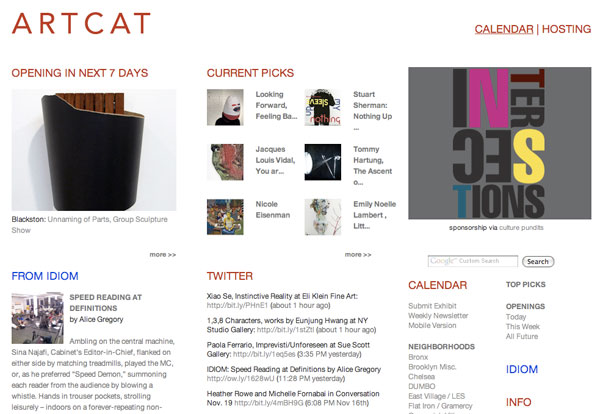
Five years ago today Barry and I launched the first version of the ArtCat Calendar (then called ArtCal). It was an outgrowth of the messy lists I used to make on a lined pad (yeah, paper) and carry around the city. The process had become pretty unwieldy as the number of galleries grew. It was also impossible to share with others.
The original on line version did no more than keep track of shows and dates by neighborhood, but it was sophisticated enough to list Chelsea galleries by street and building number.
Some history:
* Images added: September 6, 2005
* RSS and iCal feeds added: December 12, 2005
* E-mail newsletter launched: March 30, 2006
* Newsletter reaches 1000 subscribers: March 13, 2007
* Redesigned: August 28, 2007
* Merged ArtCal and ArtCat: March 2009
HOMU under the Highline today
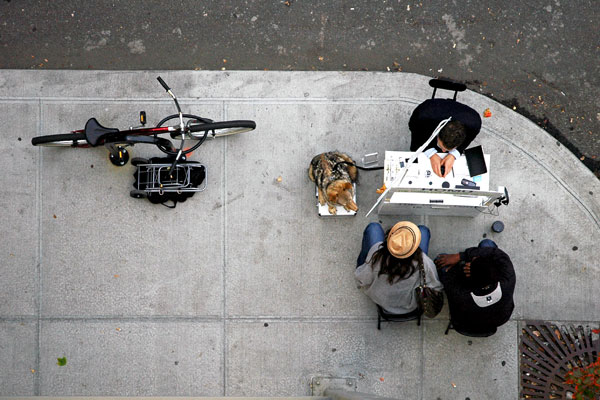
HOMU is out, and the director is in.
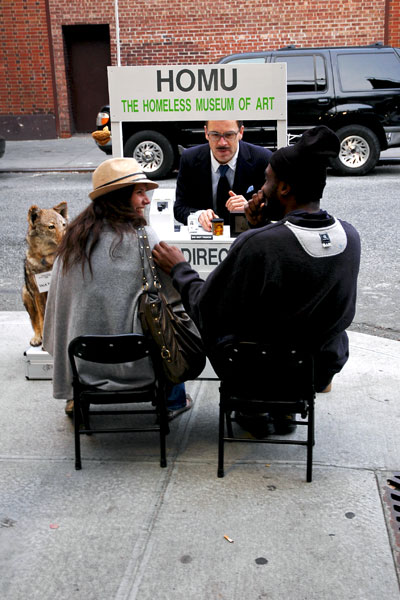
We’ve just received word that the continually enthralling, yet characteristically elusive HOMU booth will be out and about today, Tuesday, on West 20th Street (between 10th and 11th Avenues, next to the entrance to the Highline Park), as the Director writes, “circa 1-4 PM”.
These images were taken last Tuesday, when just before Barry and I had squeezed ourselves onto the little chairs in front of the “Director is [hanging square wood tile] in” sign mounted on the front of the portable booth. We were having so much fun, both constructive and unserious, that we hadn’t realized a small crowd had gathered above and behind us. We’ve been enthusiastic members of the Museum for years, so we had no problem getting up and making room for new visitors.
New Museum: moralists, grudges, and . . . good reason
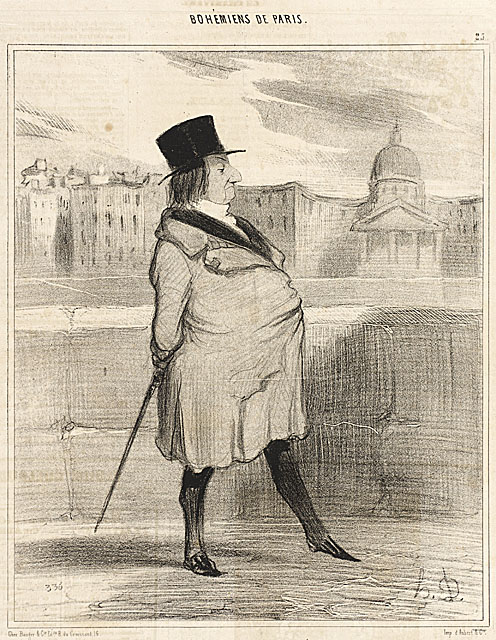
Honoré Daumier Le Membre de toutes les Académies [Member of All the Academies] 1842 lithograph 9.5″ x 7.75″ (sheet)
We’re “Art Moralists”, according to the headline above Jerry Saltz‘s second New York magazine “Intelligencer” piece. That headline reflects the attitude of some in the art world who have commented on the objections being raised to the New Museum’s intention to fill its galleries with a show of a part of Dakis Joannou’s collection curated by Jeff Koons, but others are wondering what the critics of that plan have against the museum, the collector, the curator, or perhaps even the art itself.
While it’s refreshing to see an American use a form of the word “morals” and not be complaining about unorthodox sexuality, it’s hugely disappointing to see an art critic whom I’ve long respected, and continue to respect, almost casually dismiss the genuine issues of institutional ethics (which have been raised since September 25th) without bothering to understand them or refute them with a judicious argument.
Saltz isn’t the only commentator who has failed to recognize the merits of the arguments of the people whom he describes as having “harped” on the ethics of the NuMu/Joannou deal, but at least he doesn’t question their integrity. I’ve seen a number of writers do just that, having failed to see the problem. They’re questioning the motives of what one source refers to as the “morality police”, asking what kind of grudge the critics of the arrangement might have against the principals involved.
I have complete confidence in the integrity of my original argument, and it’s pretty much the same argument outlined by William Powhida, picked up elsewhere, and still being pursued today all over the art world. While I cannot look into the souls of other writers and commenters I have no reason to believe their arguments are based on grudges any more than my own: I have always been enthusiastic about the concept and, usually, the reality, of the New Museum; I have to confess to having an almost total ignorance of the details of the current NuMu administration until this issue appeared; I’ve found Massimilliano Gioni’s curatorial input interesting and worthy of attention; and I’ve never made fun of Jeff Koons’s work or doubted its virtues or those of the artist.
The merits of the argument are genuine. I don’t doubt that they can be intelligently disputed, but only if they are understood and if hysterics can be avoided on all sides. Regardless of where the reader stands on the issue now, a calmly-reasoned Bloggy post, published November 12, is a useful reference. It succeeds in moving the entire discussion into a much larger framework. It’s well worth sharing with anyone interested in the arts in America, so I’ve re-blogged it below. [full disclosure: Bloggy is the personal site of my partner, Barry]
Bloggy:
Museums, the art market, and public subsidies
A set of scattered thoughts on the New Museum’s plans to show works from Dakis Joannou’s collection selected by Jeff Koons.
- Many people have argued online via blog posts or comments that the collection is so interesting that it doesn’t matter what the ethics are in presenting it at the museum where Mr. Jouannou is a trustee.
- I for one don’t want to see some of the limited resources and spaces available to show art in this city devoted to a huge exhibition mostly composed of previously-market-validated living artists that we have all heard of already.
- The New Museum and other museums receive public funding, to say nothing of the subsidies represented by the tax exemption of donations of art and money. The 990 for the New Museum for 2008 shows over $940,000 coming from government grants.
- Because public funding is still a relatively small percentage of their operating budgets, museums and other non-profit cultural spaces must raise money from wealthy patrons, foundations, and other sources (which are subsidized through tax deductions or the non-profit status of foundations).
- This is a country that has trouble convincing taxpayers that guaranteeing decent education and healthcare for all American children is something government should do. If that is considered a luxury in the USA, the use of tax-exempt art museums to show works (owned by wealthy collectors) by artists who have been successful in the commercial art market is a rather decadent use of public subsidies.
- If the market is how we decide what works of art are important, then the market should find a way to cover the costs of presenting these works to the public. The curatorial, educational or scholarly mission of museums is tossed aside, and thus the rationale for providing subsidies, other than the tourism draw of such institutions, disappears.
- Abandoning the assistance that non-profit institutions have provided to emerging artists, unknown artists, and artists whose work is not successful in the commercial art market will further undermine public support for any kind of funding for culture, which is already pretty shaky.
[image from Lacma Collections]
abcgallery/olga’s gallery]
Nikhil Chopra’s proposition at the New Museum
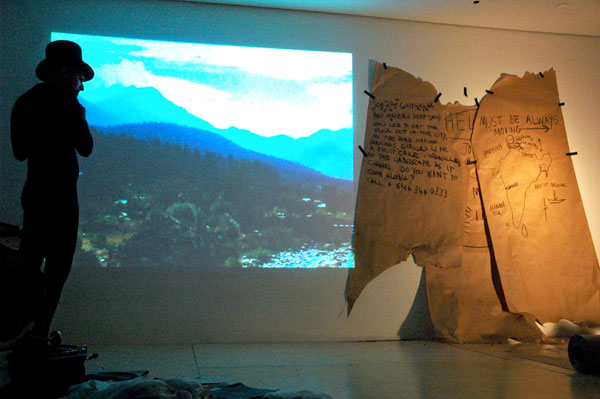
In the second of the New Museum’s public forum series of monthly seminars, “Propositions”, Nikhil Chopra presented a three-part lecture/performance over the weekend, delivering “Yog Raj Chitrakar and the Traveling Troupe“, in sections described as, hypothesis, research, and synthesis.
The image was taken near the beginning of the artist’s program on Friday evening, when he offered his hypothesis. Chopra, costumed and performing as a mime throughout the evening-length lecture/performance, is seen playing a flute to accompany the beginning of a video and slide show recording the start of the adventurous and magical story of a road trip to Kashmir, later described to the audience as “paradise on earth”.
Chopra regularly tore off a section of brown paper from the large roll seen at the bottom right. He would tape it to the wall, covering the sheet with maps and texts drawn in charcoal, then, returning to the roll, he repeated the process with another sheet – for another page in the story.
This is the text on the sheet seen above:
Yog Raj Chitrakar
(mapmaker and draughtsman)
would like to get the
fuck out of the city,
on the road, making
drawings, dressed like
a fruitcake, chronicles
of the landscape as it
changes.
do you want to
come along?
call A 646 346 0333
Earlier he had announced the odyssey with these lines:
destination Kashmir – disputed area [arrow pointing toward his map]
performances from Bombay to Kashmir
on the road six months
from village to village
town to town – chasing
ROMANCE
The ambient sound of the video, like the lecture itself, dispensed with any voice-over. It was composed of three or four basic elements: There was the thrum of the engine and smooth whine of the transmission of the truck-like vehicle in which they traveled, and the rhythms of the South Asian songs, both traditional and Bhangra, unwinding from the dashboard cassette player, but this counterpoint was punctuated by the sound of conversations in languages unfamiliar to most in the audience, whenever the party of vagabonds would pause or stop.
Throughout the performance Chopra returned again and again to a carousel slide projector and an old Victrola at the left of the platform stage, changing the still images and switching wonderful old 78 rpm records in harmony with the video and his text drawings.
The musical (and extra-musical) complexion of the evening was a striking change for an artist whose work is usually presented in almost total silence, at least in my experience over the last few weeks.
Barry and I were unable to go back Saturday afternoon, so this post is a completely inadequate account. The resolution of the proposition, the complete story of Chopra’s story, has to be left to another. If someone who was able to attend the “resolution” and wants to describe it, I’d be happy to publish the account either as a comment to this post, or, if I’m pointed to something elsewhere, to link to it in an addendum here.
returning to Nikhil Chopra at the New Museum
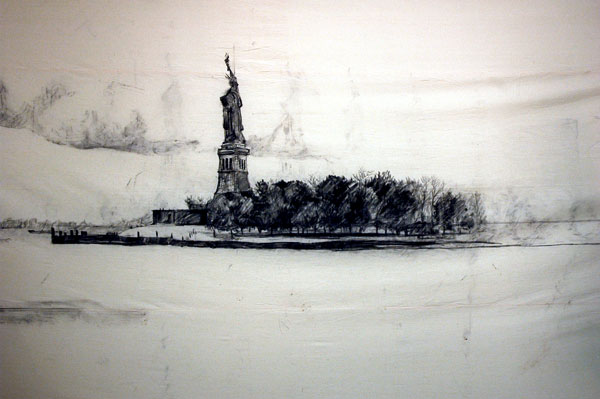
detail of Nikil Chopra’s enormous charcoal mural drawn en plein air on Ellis Island last week
Barry and I returned to the New Museum on Sunday to witness the conclusion of Nikhil Chopra‘s performance. Bloggy has the story, and more pictures.
We’re both astounded that there hasn’t been more coverage of this extraordinary piece. The installation itself, including videos of earlier performances, remains in the lobby gallery through most of the winter.
We will be there again tonight at 7 for his lecture.
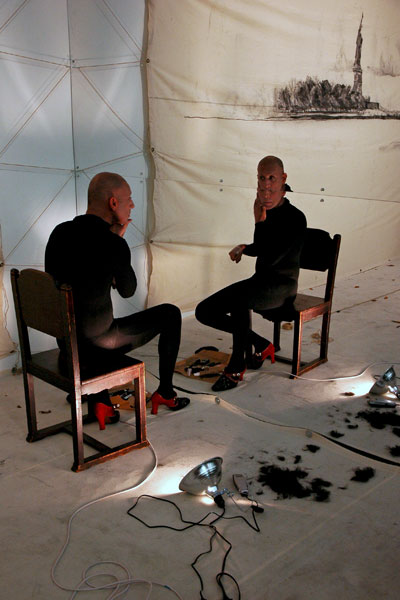
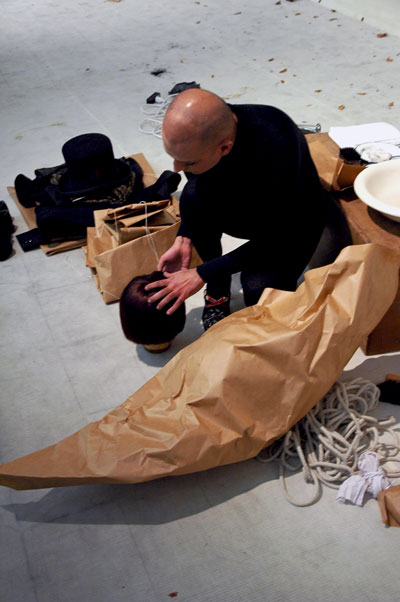
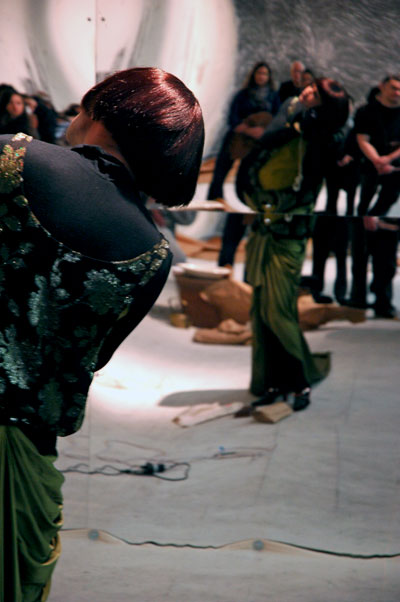
The last 45 minutes were probably the most moving moments in a performance perfectly matched to the situation of the museum’s Glass Gallery, not least because of the changing physical disposition of the people present at the time, inside and outside of the space.