POST CARD
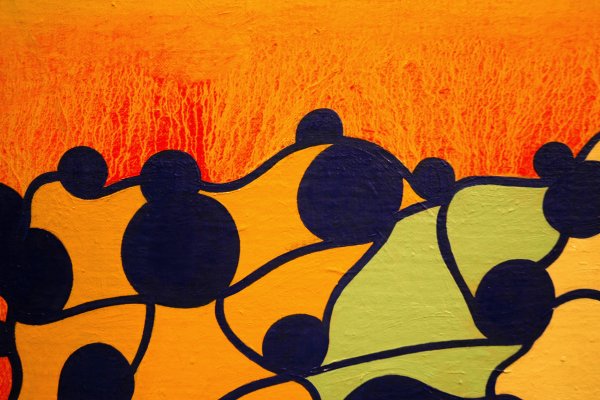
Thomas Nozkowski Untitled (8-76) 2005 oil on linen on panel 23.25″ x 29.25″ [detail]
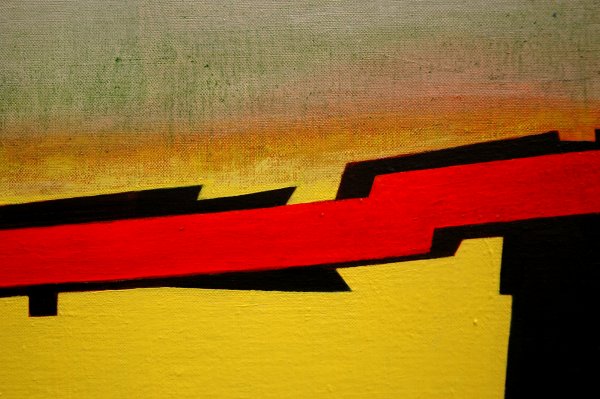
Thomas Nozkowski Untitled (8-68) 2005 oil on linen on panel 23.25″ x 29.25″ [detail]
Thomas Nozkowski has opened another gorgeous show at Max Protetch. These oils look luscious at any distance, but I couldn’t resist emphasizing [a couple of] close-ups here; the gallery site can show you the entire image, but best to see them for yourself.
Category: Culture
Scott Treleaven at John Connelly
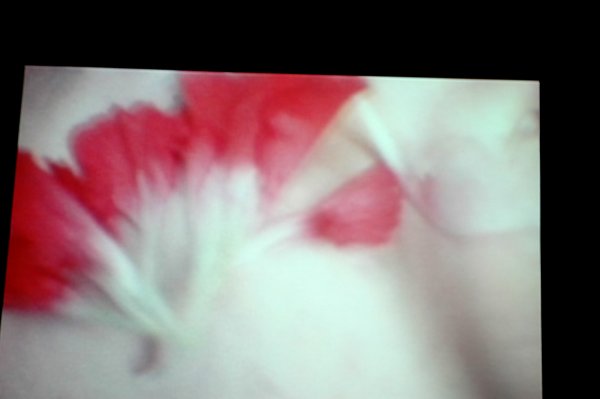
Scott Treleaven Lustre 2006 super8 and digital video [still from installation]
This image by itself will tell you almost nothing about Scott Treleaven’s masterful show at John Connelly Presents, and it doesn’t even say much about the beautiful ten-minute film from which it is excerpted.
But it’s very beautiful, very disturbing, and very smart, like everything that comes from Treleaven’s hand, in spite of or perhaps very much because of the suggestion of violence (never realized).
A first exposure to this artist’s work will inevitably leave the viewer/inductee/collaborator feeling like she or he has been missing out on something very foreign – and familiar. Some will want to know more. The best route toward what must be described as a kind of anti-enlightenment is to see more, and this is now made easier with the book. But a short excerpt from this show’s press release will help.
Based on his experiences publishing a densely collaged punk/occult zine of the same name, the film fleshed out the artists core obsessions: that a dark, anthropological current unites a number of contemporary youth subcultures; that the latter-day punks and mystics in his photographs and films represent an obsolete (or simply sleeping) warrior class; and that occult and symbolist language still remains the most accurate way of describing and dignifying the human condition.
The current show includes the new film and a number of works on paper, notably collage, as well as photography and sculpture, but it was “Lustre” which brought me back to the moment I first encountered his work almost three years ago, with a screening of “THE SALiVATION ARMY” here in New York.
The gallery has nearly two dozen images on line, including some not a part of this show, so I don’t feel obliged to add my own. Well, just one, for a taste or a tease.
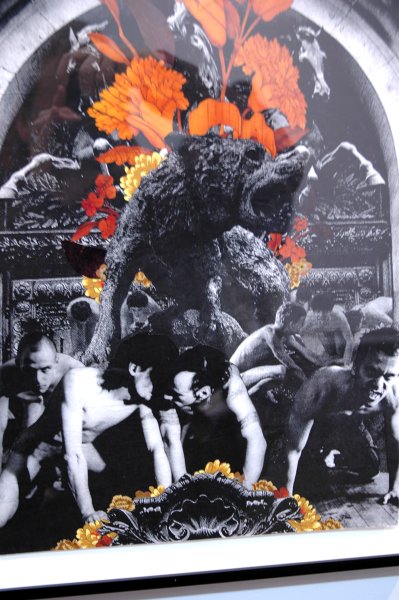
Scott Treleaven Lear, III vi 2005 Collage on paper 18.25″ x 13.75″ [large detail]
I can also show an image of a sculpture not on the web site and not even identified on the preliminary checklist provided last night at the opening. The material is simply a jumble [pack?] of coyote skulls, a reference to the cast and character of an adaptable beast of famously ambiguous status often seen in the artist’s work. Tiny cutouts from the same Japanese chiyogami paper which appears in the collages on the walls of the gallery have been glued to every surface – other than the very white teeth.
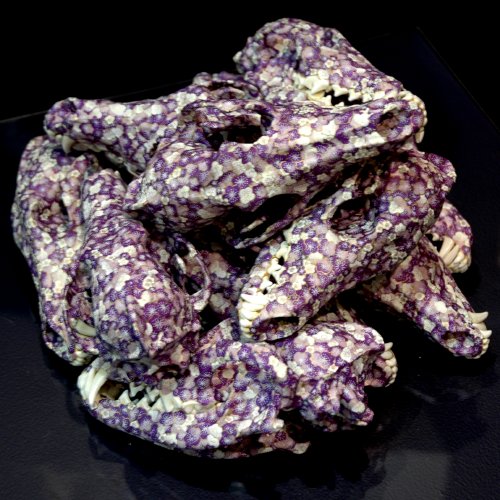
Scott Treleaven skulls 2004-2005 humanely-acquired canine skulls, paper, alkyd; dimensions variable [installation view]
Scott Treleaven at Printed Matter
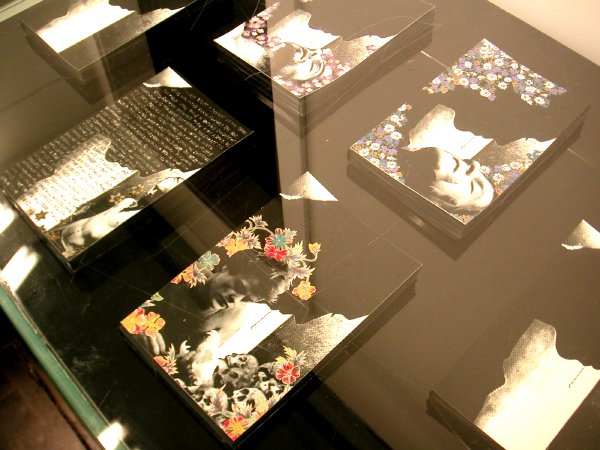
Scott Treleaven’s zine (the entire very limited collage edition) seen in a vitrine at Printed Matter
You may have read the original zine, watched the 2003 film, seen the more recent, very beautiful collages and even, possibly, seen the new photographs. The very latest of everything can be seen beginning tomorrow evening at John Connelly Presents, but if you’ve been missing out so far, or if you’re already totally hooked, as I am, on what Scott Treleaven‘s been doing, you won’t want to miss the book.
“THIS IS THE SALiVATION ARMY” was originally intended to run for only eight issues, from 1996 to 1999. With its unique combination of punk aesthetics, Blakean mysticism and sexually explicit, radical queer posturing, the zine immediately attracted press, suspicion, and a loyal cult following. During its initial three year run, the Salivation Army spawned a number of spin-off zines, set up headquarters in Toronto, Prague, London, and New York, and held a series of public and private occultural events aimed at putting the Army’s magical theory into practice.
You can pick up a copy of “THE SALiVATION ARMY BLACK BOOK” at Printed Matter. Serious enthusiasts may never want to ever leave home without it, and besides, it’s an absolutely gorgeous object, with a very practical, washable black plastic cover. [Although those who already bought out the special editon pictured above are going to want to be more careful with theirs.]
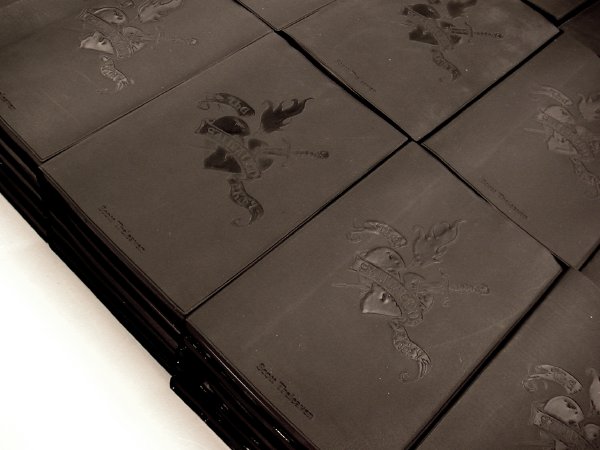
the edition which will be snapped up by the ranks
Ralf Ziervogel at André Schlechtriem
POST CARD
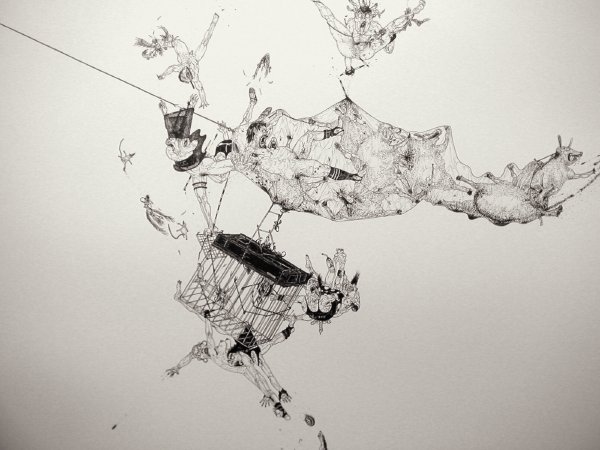
Ralf Ziervogel OFU 2006 ink on paper 54.5″ x 106.75″ [detail]
A new (but not really so surprising) addition to the huge Chelsea gallery list appeared on 19th Street last night. The young German curator opened his shop with a show of work by the Berliner Ralf Ziervogel.
Schlechtriem slaps a “temporary” sticker on all his announcements because, he says, he doesn’t know how long he really wants to be a gallerist, but he says he’ll give it at least a year.
Unfortunately we had to leave early this time in order to make an opera curtain on the Lower East Side [yup], but on the basis of the quality of the drawings I saw last night I’ll definitely be back at least as often as Schlechtriem decides to keep this thing going.
Bec Stupak at Deitch Projects
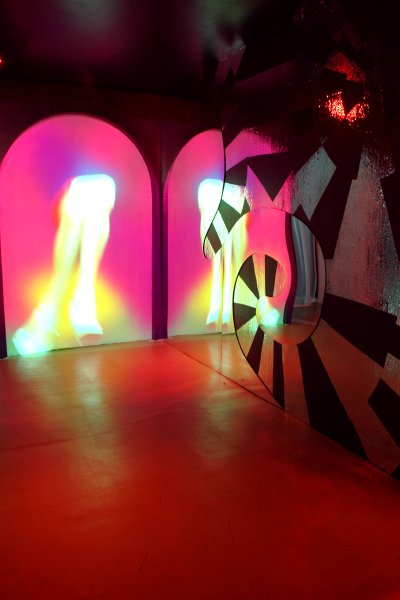
Bec Stupak Doorway 1 2006 single channel video [detail of installation]
Once I discovered the conceit of this installation by Bec Stupak at Deitch on Grand Street suddenly “it all came together”, as strange as that clause may sound when used anywhere around Jack Smith, especially a Jack Smith occupying an additional dimension.
The centerpiece of the exhibition is Bec’s blind remake of Jack Smiths legendary film Flaming Creatures. Using members of her demimonde, including performance drag group The Radical Fairies, Phiiliip, Agathe Snow, and other downtown celebrities, she recreates the 1963 cult classic based only on the impressions shes collected from others of what the film consists of.
I eventually found it very difficult to walk out of rooms whose silliness or campiness I had initially found so annoying, but most of that negativity was only about some 1960’s baggage I forget I’m still carrying around.
Barry and I were in the gallery three weeks ago, but since then whenever I think of uploading an image for the blog it’s one of these which comes back to visit – every time. A very special show.
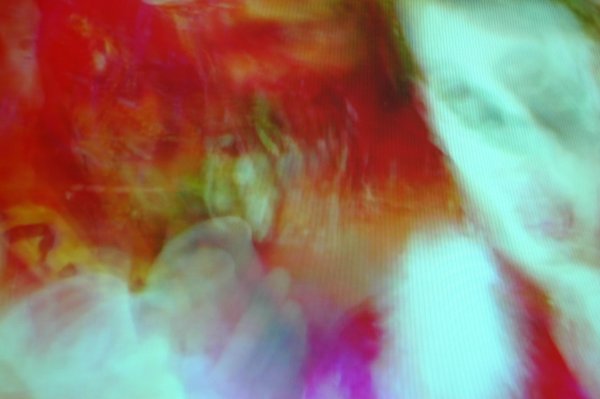
Bec Stupak Flaming Creatures 2005 single channel video [detail of slow-shutter still from installation]
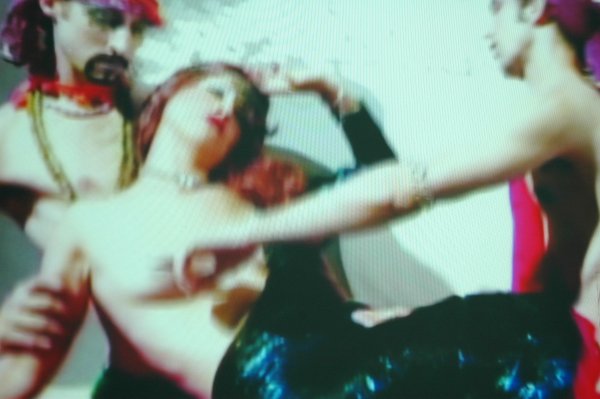
Bec Stupak Flaming Creatures 2005 single channel video [detail of still from installation]
McDermott & McGough at Cheim & Read
POST CARD
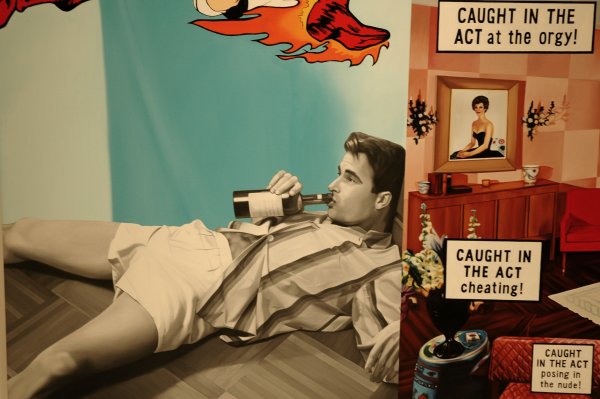
Mc Dermott & McGough The “Warm” Friendly Feelings Embodied in a Red-Pink One, 1964 (2005) oil on linen 96″ x 96″ [detail]
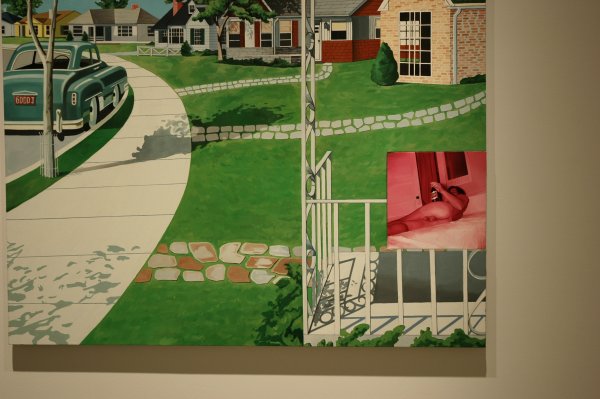
Mc Dermott & McGough Schlitz Beer, 1961 (2005) oil on linen 48″ x 60″ [detail]
For years they’ve been almost a guilty pleasure for me, because I was so sympathetic to their aesthetic, but it’s harder and harder to find traces of the guilty part.
The Cheim & Read show was a delight, and I’m sorry to see it’s now gone.
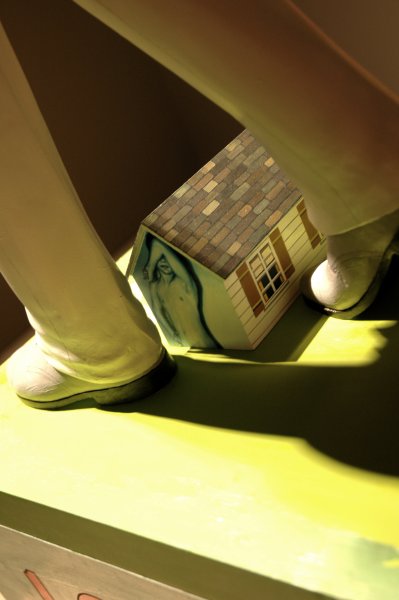
“[another] True Story Based on Lies”
Stefan Tcherepnin joins Amy Granat at Oliver Kamm/5BE
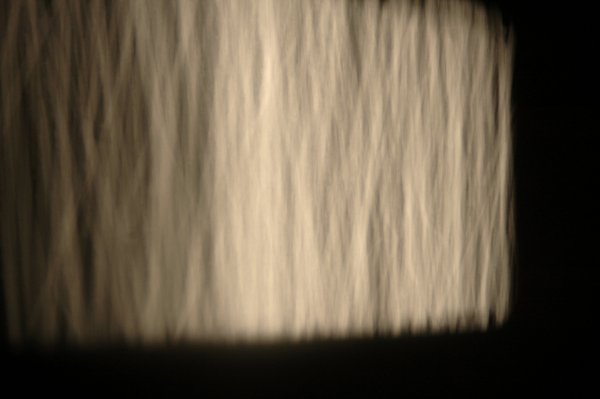
[a long time exposure in the front gallery]
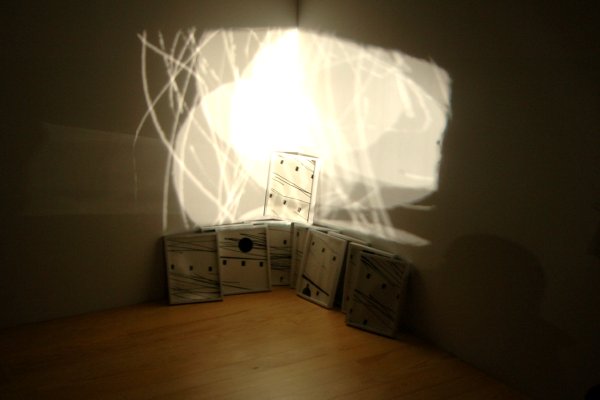
[a quicker shutter during the performance in the second gallery]
It almost doesn’t get much more exciting than this. I suppose I mean Chelsea.
We stopped by at Oliver Kamm’s 5BE opening tonight because . . . , well maybe just because, since at least one of us hadn’t done his homework. I couldn’t remember who Amy Granat was, but I did remember an intriguing subtitle, “Scratch Films / Stars Way Out (for O.K. )”.
Somehow I had confused “scratch” for “snuff” so I must have been the only one surprised to find the show was totally devoid of prurient interest and in fact safe for children of all ages.
Safe, except perhaps for the volume of a very special 7:30 performance, but more on that later on.
The work is very good, and looking at it I immediately remembered the great show she had put together in the gallery’s 22nd Street location.
Granat is a sculptor who works with sound and light (as well as some of the more substantial materials of the form) and that includes, by attacking and scratching the material’s own emulsion, the fabrication of totally abstract films for projection.
What we saw in the first room of the gallery space was excitng and very, very beautiful, but I selfishly found myself slightly disappointed. I had assumed at first that the almost total darkness and the jumpiness of her white projections would mean pictures were impossible.
In the end I was surprised that my camera managed somehow to suggest the experience (absent the sporadically-explosive soundtrack and the whirr of three projectors) of being in that very dark room. The second room, where Granat had installed in one corner a more passive sculpture of her own film stills made corporeal and delicately lit by a flood or projector lamp, would have been even easier to document, but Barry and I quickly fell into an animated conversation with friends while a larger crowd filled the gallery and blocked a view of the work.
We eventually left the space to visit several neighboring galleries also opening shows tonight, and then we returned for the performance Oliver had told us about earlier, partly because it had succeeded in advertising some of its charms through the walls which separated 5BE from the neighboring gallery.
I squeezed into the back room, emboldened as a documentarian by the challenge of relieving Oliver’s obvious dismay over the fact that his own camera had just died. One projector (from the front room?) and an ancient synthesizer had been thrown onto a small table along a wall. Granat was manipulating the former and some mad, modern troubadour was operating the electronic boards. Barry later described the environment as something of a 1960’s or 70’s downtown happening, but what does he know? Wasn’t he busy being born about that time?
I loved the intensity of the music,, which I’ll evoke here by referencing Lou Reed’s notorious 1975 “Metal Machine Music”, quite possibly my absolute favorite experimental music album.
I got a few pictures and I was so wrapped up in the energy of that room I didn’t really notice the alarming decibel level of the music until after I had gotten onto the sidewalk. Barry said he had not been able to deal with it and never really made it into the room. What, what’d you say? Can’t hear you
Leaving the gallery I spotted a thinly-packaged CD taped to the counter. Of course I bought a copy; my passion for new music actually predates and has totally survived my addiction to underknown art. Only when I got back home did I really take a look at the modest description on the paper sleeve. The artists were listed as Amy Granat and Stefan Tcherepnin. I knew the name Tcherepnin, but couldn’t remember the given name of the man I recalled as a very important electronic composer. Besides, hadn’t he died a few years ago?
I did a bit of Googling and then I recalled that early in the evening Oliver had shown us the synthesizer in the office of the gallery and had said something about the father of Granat’s collaborator having assembled it himself in the 70’s. Bingo!
We had been priveleged to watch and listen to this very execiting member of the fourth generation of a remarkable family of composers in a collaboration with a visual artist equally as exciting.
Oh yes, I can definitely recommend the CD. Not quite as intense as the work performed in the gallery, it did good service as our dinner music tonight. But then our musical tastes accomodate some pretty strange stuff. Some people might need some chemicals.
On his site, Barry shows and broadcasts moving image and [very loud] sound from tonight’s performance captured on his little magic phone!
Download 136K 36PP movie
For another, somewhat more gentle sample of Tcherepnin’s music see this Oberlin site.
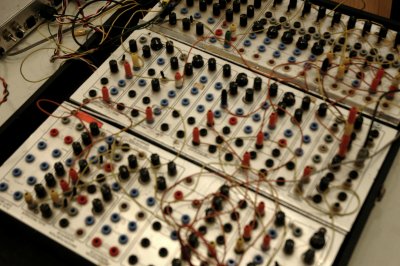
dad’s boards
the cartoon war, and Thomas Hirschhorn at Gladstone
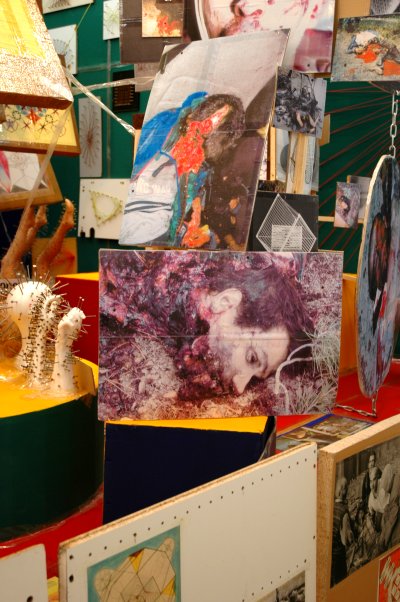
Thomas Hirschhorn Superficial Engagement 2006 [detail of installation]
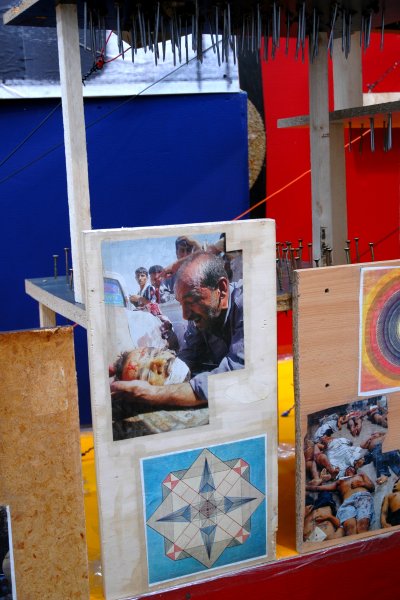
Thomas Hirschhorn Superficial Engagement 2006 [detail of installation]
Most of the commercial media has decided that Americans shouldn’t be shown the drawings which seem to have made the world go crazy over the past week, but this absurd delicacy is only the latest, and certainly not the most outrageous, insult to come from those who do a pretty thorough job of controlling access to the outside world for all but the most curious of our compatriots.
Americans, unlike almost all other peoples on the planet, have not seen the notorious Danish cartoons, but, even more importantly, they also have not seen the messy images of burnt, ground-up, chopped-up and gutted bodies which have haunted and angered people everywhere around the world for years.
We are being treated as children and we’re doing a pretty good job of justifying the censorship and restrictions to which children are subject. Of course I have to admit that as a nation we haven’t actually shown much real maturity in the last five years, but heavily insulating an already embarassingly-provincial people who make up the most powerful and most war-like state on the planet just doesn’t seem like a good idea.
Where are these notes going? Well, I’m trying to tie together the two experiences which have so disturbed my mind and my sanity this week. I haven’t been able to do any art posts for days because I’ve become so depressed following developments in the cartoon war, but most of all because of finally being confronted with crude photo reproductions of the most obscene and grotesque scenes of death as inflicted both by our oh-so-innocent selves and a lot of people who see us quite otherwise.
On my first visit to Thomas Hirschhorn‘s extraordinary installation at Barbara Gladstone last week, I was so overcome with the power of the piece that I was unable raise the camera I was carrying aound in my right hand. Several days later I decided I had to make my way back in and try to get something I could upload here, if only for the sake of anyone unable to make the pilgrimage to West 24th Street by this coming Saturday. I felt like I was profaning a sacred grove; I was nervous as hell, and I got in and out as quickly as I could.
Is it the pictures downloaded from the internet or is it what the artist has done with them? Why is moving through the groteque clutter of this gallery space so moving an experience? I don’t think I can answer the question, at the very least because as an American who hasn’t been surfing on line for these images what I saw on Saturday is still too much of a shock, even though all along I’ve considered myself pretty well informed and had thought that nothing about cruelty could shock me, short of being placed personally in its midst.
See Jerry Saltz’s “Killing Fields” for more questions and a few answers.
I will say that it is surely the most courageous show in the city right now, and that I admire both Thomas Hirschhorn and Barbara Gladstone for bringing it to us.
How can we match such a gift? We could start by growing up and putting the censor out of business.
ADDENDUM:
This note arrives with the clarity of the next morning. In a much better world it could even form the basis for reconciling the irreconcilable.
I admit that as an atheist I’m hardly in a position to preach here, but with all respect it seems to me you’re missing the point if, in the name of avoiding the dangers of idolatry, you make the unseen image into a fetish.
The real obscenity is the evil which produced these photographs, and the blasphemers come in every description.
“Ride the Subway, See a Movie”
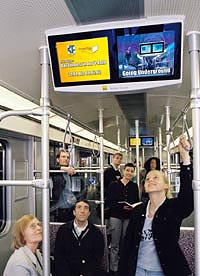
(but don’t look at the soft upholstered seating)
No, not in New York of course, where transit communications systems have changed little in the last 100 years. Instead, this is the headline of a short item by Sarah Plass in today’s NYTimes. It’s about a real film festival located entirely inside Berlin’s modern subway cars.
A ride on the Berlin subways these days is a literal and figurative trip. For 1.5 million passengers daily, a ride means access to the fifth international short-film festival, “Going Underground,” in which four ultrashort films a day are playing on 4,000 screens in the trains. Altogether, 14 international productions, each not longer than 90 seconds and all silent, were chosen from 450 shorts from 39 countries. Films from Germany, the United States, Britain and Brazil, for example, feature 3-D characters, monsters and abstract art. Several other films, competing for the Renewable Movie Award, deal with renewable resources. In what is billed as the world’s first underground film festival, passengers are asked to vote for their favorites via cellphone text messages or online [on the festival website www.goingunderground.de]. The award ceremony will be on Feb. 12, with the winner receiving $3,600, which can be used for longer productions. The festival runs through Tuesday.
The article doesn’t mention that this is actually the fifth Kurzfilmfestival in der U-Bahn!
We were very impressed with the transit system when we were in Berlin last fall. Yes, these screens are used for advertising much of the time, but they also offer grown-up news and weather segments, as well as short entertainment spots. Looking over my shoulder, Barry has just warned me to be careful about what I wish for. I’m not wishing, but I agree that if the MTA ever got around to installing a similar system, the programing would probably be controlled by FOX – and it wouldn’t be subtle and it wouldn’t be delivered at a moderate sound volume.
Right now I’d just be happy to have the L train back on weekends.
[image from Screenlabs]
art in paraphilia
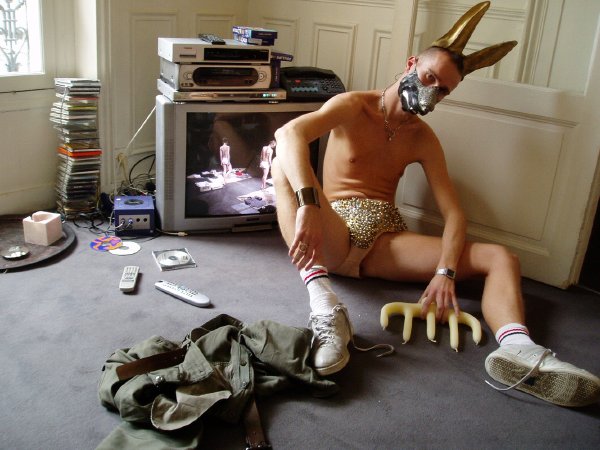
a boy and his fancy dog
Ever so often something reminds us that we really don’t know much about fetishes.
I found this fascinating but uncredited image on a site I was directed to by an email from Slava Mogutin (alright, I’ll admit it, I’m actually not totally unacquainted with the wonderful world of Le fétichisme dans lamour).
Agh, kids!
*
who may be the artist here, but go to his own site to see his credited stuff, including direction to his published writings
[image from fritzhaeg/sundown salon]