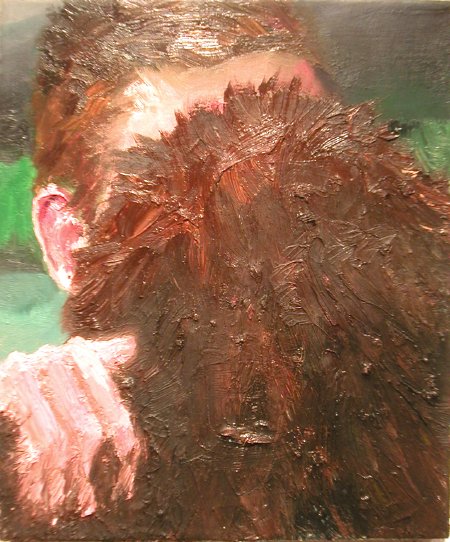
Chris Kannen Chris Making Out with Bigfoot 2005 oil on canvas 12″ x 10″ [large detail]
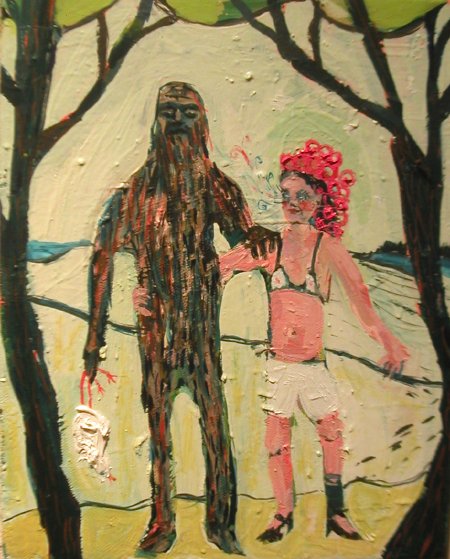
Emily Lambert They Called Him a Wildman 2005 acrylic on canvas 10″ x 8″ [large detail]
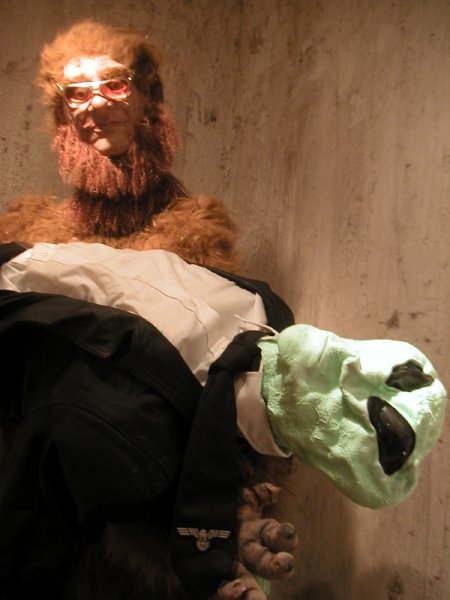
Peter Caine Untitled mixed media 8′ x 5′ x 4′ [detail of animated installation]
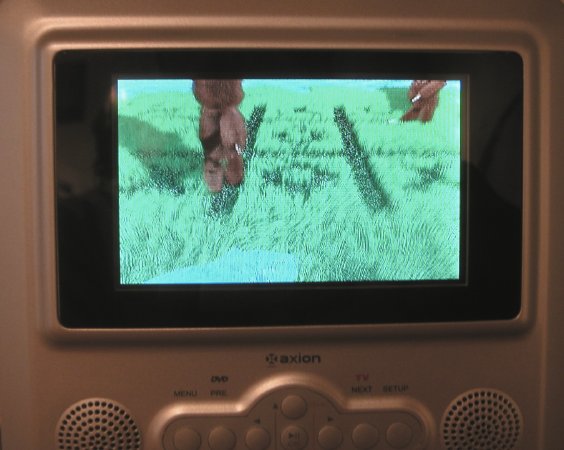
Tricia McLaughlin The Nazca Lines Explained 2005 2 min. animation [still in video installation]
Like so many of my species, I really would like to believe in these creatures, but the only thing I’m certain about right now is the quality and great fun of the group show at Sixtyseven gallery, “Sasquatch Society,” devoted to Bigfoot, Yetis and other hominoids.
There’s enough interest out there in stories about wilderness sightings of large, hair-covered, man-like animals to inspire dozens of young artists to jump at the chance to each produce one or more remarkable works illustrating our often quite intimate relationships with an elusive beast which remains stubbornly remote to [most of] us. The majority of the works in the show were created this year, but the fact that there was already a reserve of pieces which pre-dated the gallery’s Sasquatch call suggests that interest in these stories was not just something induced for our summer amusement.
Category: Culture
excellent roof garden seating – in our imaginations
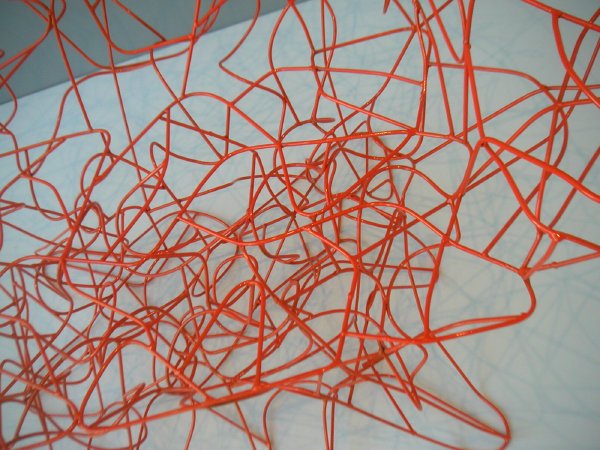
Fernando Campagna and Humberto Campagna Corallo Armchair 2004 steel wire and epoxy paint [detail of installation]
It’s MoMA’s new aquisition, not ours, but it sure is an exciting chair.
For a few seconds I fantisized that I’d found the perfect sculptural seating for our roof garden. Orange on green. Fantastic. It could accomodate two very good friends at once, but we’d probably have to commission a nice cushion or two and it would need a cover for bad weather. None of this is a problem however, since I’m sure we can’t afford it anyway. This piece is handmade, and since according to the label it was donated to MoMA by its Chairman, billionaire Ron Lauder [presumably for the Architecture and Design Collection], even if it isn’t unique it had to cost a bundle.
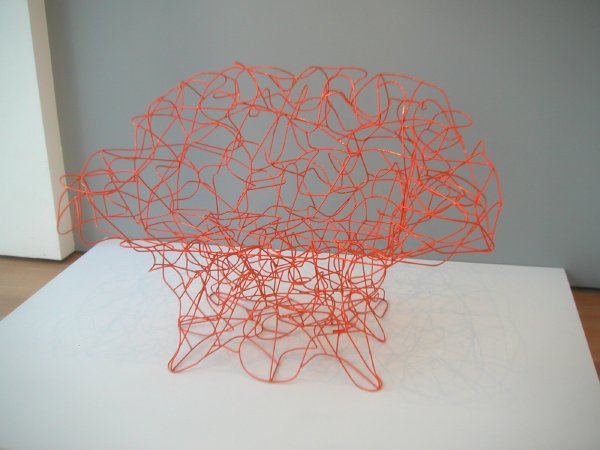
Fernando Campagna and Humberto Campagna Corallo Armchair 2004 steel wire and epoxy paint [installation view]
Maybe if I could locate an old innerspring mattress . . . .
functional, beautiful, timeless: for looking at and sitting on
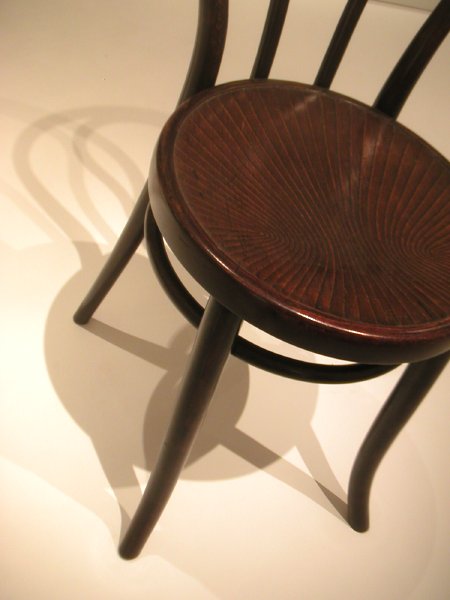
Gebr�der Thonet, company design Vienna Caf� Chair (no. 18) 1876 bent beech wood 33.5″ x 17″ x 20″ [detail of installation]
One of my favorites in MoMA’s Architecture and Design Collection is this simple chair.
Thonet patented the bentwood process, but their patent expired a few years before this chair was manufactured. D.G. Fischel Sohne was one of several Austrian firms ready to imitate their success with seductively-curved wood. Years ago, while acquiring modest colonial and federal Rhode Island furniture for my old house in Providence I managed to pick up a simple Fischel side chair very much like this Thonet for only a couple of dollars.
I appreciated its simple beauty from the beginning, but In Providence it had to wait upstairs in a small back storage room for years. In New York it has been able to join the very eclectic collection of stuff I’ve spread throughout our 1930’s apartment. Now I admire its simple dignity every day, although I have to admit that it wouldn’t have looked at all odd if I had mixed it with the skinny windsors in the little 1760’s house from the start.
where did good industrial design leave the road?
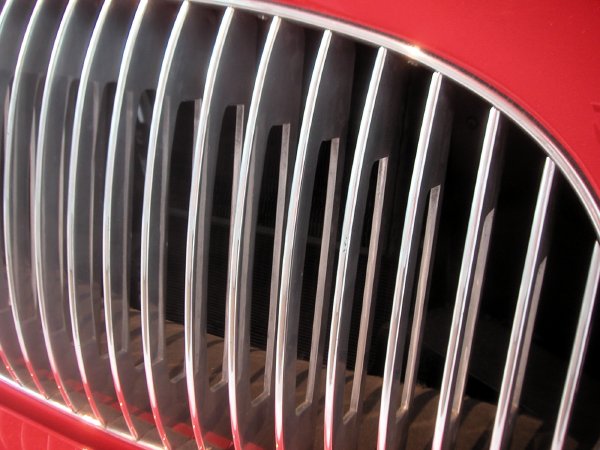
Pinin Farina Cisitalia 202 GT Car 1946 aluminum body 49″ x 57 5/8″ x 13′ 2″ [detail of installation]
I didn’t expect to look for the Cisitalia again when I casually wandered into MoMA’s Architecture and Design galleries earlier this week. I’d seen it many times before and in spite of my obsession with interesting automobiles I didn’t think it could mean much to me any more.
Uh-uh.
I was particularly sensitive to industrial design that day because we recently decided we needed a new land phone and I had just been looking at the lamentable, no, painful choices available. This beautiful car was imagined and put together almost 60 years ago. Have we learned nothing since?
I’m not even going to dwell on the ugliness and gigantism of the SUVs, Town Cars and Ford taxis which confronted me as I left an art museum which has tried since 1932 to honor good, simple design in everyday objects created over the last 150 years or so.
I’m sticking my neck out a bit by bringing up the subject of this Museum collection in the first place. Many people still think a design gallery in an art museum is inappropriate in the first place, but I’m happy with the idea that we shouldn’t be content with a world where art is only found hanging on walls or standing in public spaces.
There’s also the subject of the [ethics?] of any kind of enthusiasm for the private automobile, especially in the twenty-first century, even if Americans don’t have any real alternatives at the moment. In any event, when this car was built General Motors and the oil companies had barely begun their campaign to destroy public transportation, so the idea of a private pleasure vehicle did not carry the baggage it does today.
Incidently, this little Cisitalia has an engine smaller than that in my 1962 VW Beetle, but with more power, and it weighs about the same (1600 pounds). Hey, those power and weight figures are pretty much the same as those of a basic Smart. Now there’s an original and almost perfect design for modern industry, and it too is now a part of the Collection. But, and no surprise here, we’re not allowed to have it on our streets. Too pretty and too sensible, and it doesn’t have a brutal line in its body.
But back to the old car and the new phone. The color of the sleek Italian antique on MoMA’s third floor is a luscious red which could never be forgotten, much less ignored if you’re anywhere near it. When I’m through with this post I’m going to plug in my new phone system. it’s in a busy combination of a dull black and a grey pseudo-aluminum, and it looks like it will be almost too painfull to live with. Maybe I can cover it with a doily. But, really, it’s not about color. The colors are only symptoms.
Barenboim continues Said’s dream
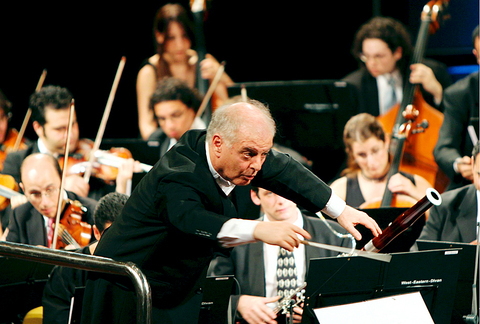
playing for peace
In a project begun with the dream of his late friend Edward Said, Daniel Barenboim finally made it to Ramallah with his West-Eastern Divan Orchestra last night. Members of the orchestra, founded in 1998, come from Israel, Palestine, Syria, Lebanon, Egypt and Jordan.
The sound of Beethoven’s Fifth Symphony drowned out the staccato of bullets on Sunday in the conflict-ridden Middle East as world-famous conductor Daniel Barenboim dazzled his Ramallah audience with both music and words.
Playing under the theme “Freedom for Palestine,” Barenboim and his new West-Eastern Diwan [sic] orchestra were able to break all barriers and help an audience fatigued by strife to enjoy two hours of pure music from Beethoven and Mozart.
. . . .
The 1,200-seat auditorium of the Ramallah Cultural Center was packed with a Palestinian, international and even Israeli audience an hour before the baton was scheduled to drop. As the seats filled, hundreds others milled in the hallways and the aisles hoping to get a seat or just to be allowed to stay in standing room and listen to Barenboim and the orchestra.
The same audience stood for 15 minutes, enthusiastically clapping and yelling “bravo” after Barenboim concluded the performance, giving Palestinians in Ramallah a chance to forget the checkpoints, the occupation, the wall and everything that has made their lives void of spirit, as one member of the audience remarked after the concert.
Outside the auditorium, the reality for West Bank residents had not yet changed after the concert, as Barenboim hoping to achieve with his music and orchestra.
A few audience members had to leave early to get home before some checkpoints at entrances to Ramallah closed. Others who waited until the end and headed home after the concert had to stop in long lines of cars waiting at checkpoints to be able to reach their homes. Barenboim realized this reality, and this is why he brought his new orchestra to Ramallah.
“What I want to say to you,” Barenboim told the audience after the orchestra finished playing, “I have already said in the music.
But it wasn’t easy getting there.
[image from European Pressphoto via Taipei Times]
more for the PS1 “Free the Art” gallery
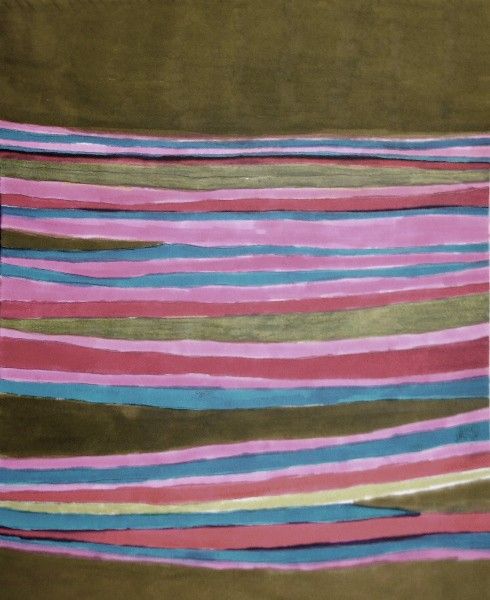
Michael Cambre’s sketch of Ann Pibal’s FLMNCO at PS1’s show, “Greater New York 2005”
Five great new [color!] sketches have been added to the “Free the Art” gallery. I’ve also added a separate link to the on-line exhibition at the top left of my home page, to make it easier to locate.
All five of these drawings come from Michael Cambre. Yes, anyone can submit as many as she or he wishes. After all, this initiative is all about making other people’s art visual, even if the process means that sketchers get their own images published – along with an appropriate link whenever I can find one.
You guys have five more weeks to visit the show in Queens with your sketch pads. There are still some 150 artists undocumented here. “Greater New York” closes September 26, when much of their art disappears from public view, perhaps indefinitely, and possibly forever.
Free the art!
For anyone only joining this conversation now, this “Free the Art” project is about helping to make visible hundreds of pieces of contemporary art to which the Museum of Modern Art seems to have been doing its best to limit viewing access. The works in the current show at PS1, which is MoMA’s child, are not even listed, either at the museum itself or on its website; of course that also means there are no images on line either, and visitors are forbidden to photograph anything whatsoever. Oh yes, a big museum book has been promised, but it’s not here now, and it’s certainly not going to be free.
Diamonds and Oranges in the East Village
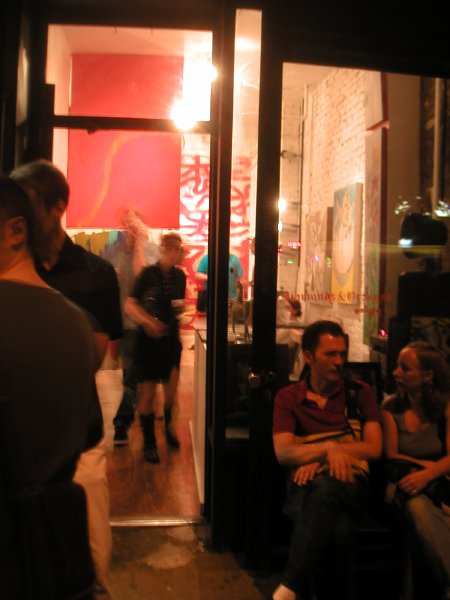
last night there was [sic] Diamonds and Oranges spilling onto 1st Avenue
Yay! A new space has arrived in a neighborhood with a rich history in the visual arts, but which has been inexplicably gallery-challenged for years. Diamonds and Oranges first opened a door on 1st Avenue, between 9th and 10th Streets, only a few weeks ago. According to the artist/gallerist, Lyon Smith, the diamonds are the art and the oranges are a reference to the stock of the tiny bodega which previously occupied the small storefront.
The current show, which includes paintings by Smith, drawings and sculpture by Derick Melander and collages by Dug Rupp, opened just last night. The work is definitely worth a detour, and on the basis of what we found we both expect to be returning for every show.
In addition, all of this couldn’t happen to nicer people, and here I’m talking about the residents of the neighborhood, the artists [well, I actually haven’t met Rupp yet] and the good folks who will be stepping by this very promising room in the future.
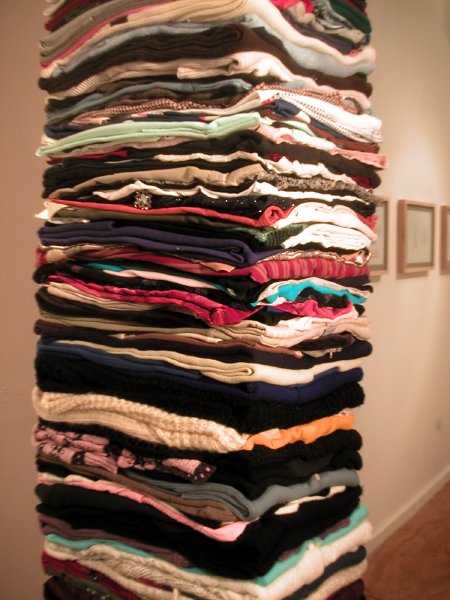
Derick Melander Where Do I Stop, Where Do You Begin (Female Stack) 2003 11′ x 17″ x 12″ women’s clothing [detail of installation]
In a statement which accompanies the show Melander says that he gathers, categorizes and folds “exorbitant amounts of ordinary clothing” to create large geometric configurations. And in lines found on his site he specifically describes the piece above:
The stacks extend from floor to ceiling and can be created for any size room. Clothing that is worn on top of other layers is placed at the bottom of the stacks, while clothing that is worn directly against the skin is placed at the top. In this way, the clothing relates to the way we layer the clothing we wear.
Once the clothing has been categorized, I allow patterns and texture combinations to occur by chance.
Don’t miss his small maquette, assembled from Barbie and Ken’s wardrobe, on the counter near the door. The full-size sculpture will be included in a show in New Jersey in November.
Barry has a post which includes an image of Melander’s poetic sculpture, Wedge, which is also installed in this show.
keeping Flosshilde afloat, so to speak
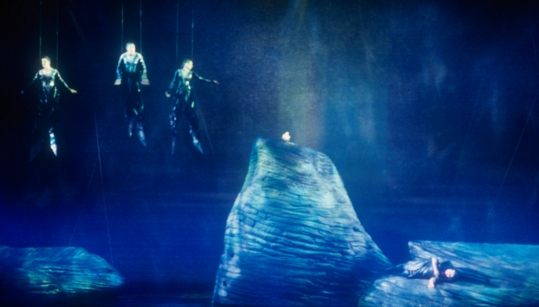
the Rhine maidens taunt Alberich [another cast, same harnesses]
What a trooper!
What an exciting diversion from the day job! How could you turn it down if the opportunity presented itself? And think of the stories for the grandchildren. Gina Lapinski saved the day for Wagner‘s “Das Rheingold” in Seattle on Monday by volunteering as a “fly-in” for one of the Rhine maidens.
The scene was the Seattle Opera at 4 p.m. Monday, only three hours before the curtain was to rise on a performance of “Das Rheingold” in the company’s “Ring” cycle, running through Aug. 28. The mezzo-soprano Jennifer Hines, a New York City Opera regular who plays Flosshilde, one of the Rhine Daughters, called in, violently ill after eating fish at lunch. The first scene of this production calls for the three Daughters, behind a scrim and wearing a flying harness, to simulate swimming during a carefully choreographed 18 minutes (and after perhaps 100 hours of rehearsal) that takes them from 5 to 30 feet off the ground. To the rescue came Gina Lapinski, an associate director to Stephen Wadsworth and an assistant director at the Metropolitan Opera, who had been in charge of rehearsing the scene. The same size as Ms. Hines, she was able to wear her costume and harness, and after rehearsing once, perform before the audience. Speight Jenkins, general director of the Seattle Opera, said, “It was as though she had done the scene a hundred times.” Sarah Heltzell sang the role from the pit, but Ms. Lapinski mouthed every word.
Huzzah!
Yeah, I spotted the story in the Times, [read the last two paragraphs] in the same box which announced, among other items, Madonna’s riding accident, a nun protesting the filming of “The Da Vinci Code,” and the sighting of a mechanical Loch Ness Monster.
[image from operajaponica]
Chris Martin and compeers at Feature
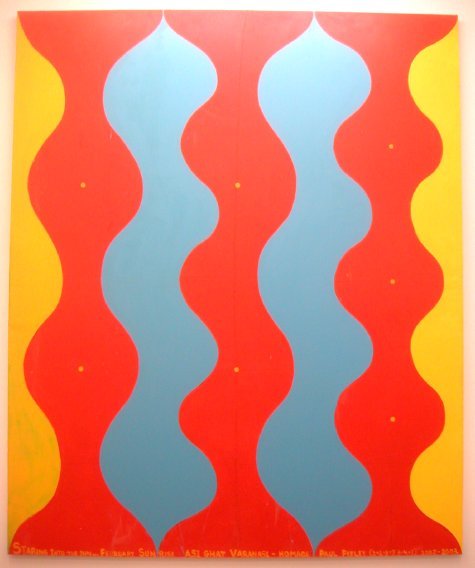
Chris Martin Staring Into the Sun 2002-2003 oil paint on canvas 143″ x 118″ [installation view]
Chris Martin is represented by two large works in the current group show, “Meditative,” at Feature Inc., where they occupy the southwest gallery space by themselves. No, they don’t occupy but rather explode from that space, they are so spectacular. I can’t meditate, and I’m not a “believer” in anything – except art – but his time I’m pretty sure I can detect something besides paint in Martin’s work.
Maybe I’m a bit in tune because of my own connection to India: Painted on the bottom of this piece is an inscription which begins with the title and then continues, “. . . February Sunrise Asi Ghat Varanasi – Homage Paul Feeley (2 + 2 + 3 = 7, 3 + 4 = 7)”
I really liked the anonymous minimalist tantric paintings from that subcontinent which both conceptually and physically introduce the show, Tom Friedman‘s delicate white paper folds, and, while apparently not by design part of “Meditation,” the very sympathetic and remarkable sculpture, “Quietly Oscillating,” by David Moreno installed above the stairs from the primary gallery.
The other artists in the main exhibition are Alex Grey, Jeri Felix, Mette Madsen and Josh Podoll.
All of the art will be on vacation for two weeks after this coming Friday, but the show can be seen for two more weeks after Labor Day.
Jack Smith lives at Grimm|Rosenfeld
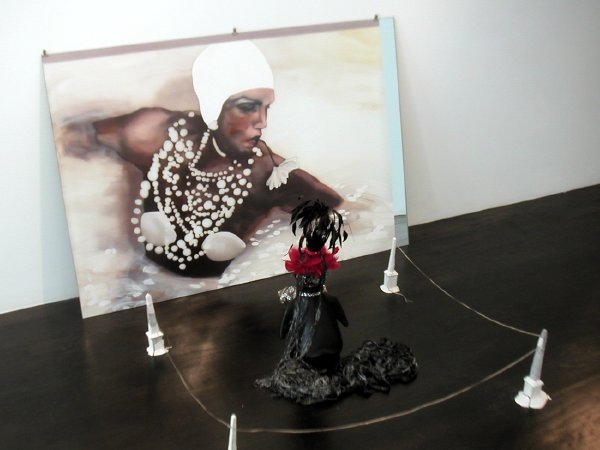
detail view of gallery installation, showing Matt Saunders‘s Mario Montez contemplated by Jack Smith’s Yolanda La Pinguina
New gallery! Well, it’s new here. But, anyway, it looks like this one’s gonna be really, really good.
Grimm|Rosenfeld has had a significant presence in Munich since way back last year, but the current show on 25th Street, “Founders Day,” is only their second in New York, and it’s very impressive.
We missed Kiki & Herb‘s opening bang last month, and because of that poor judgment we’ll probably be kicking ourselves forever, but we finally made it to a much quieter gallery this afternoon. And it’s a full week before the end of the current exhibition! The show is brilliantly curated, and beautifully installed, by the artist Jonathan Berger. It’s both a tribute to Jack Smith (the “founder”) and a platform for an understanding of the continuing impact of his pioneering work today in virtually every art and performance medium. The press release describes the show as “an idiosyncratic, iconoclastic and a little bit worshipful look at artists making use of any and all available materials to create worlds that respond to personal obsessions, ideals and dreams.”
Check that statement for some good bits on each of the remaining artists and works included in the show: Paula Court (stills from Reza Abdoh’s “Quotations”), James Hampton (monumental millenium sculpture), Peter Hujar (Ethyl Eichelberger as Nefertiti), Athanasius Kircher (diagrams of the workings of the universe), Louis Klahr (animated film materials), and Katherina Sieverding and Klaus Mettig (Jack Smith Photographs).
Thanks, Jack.
Damn, we hardly knew ya when.
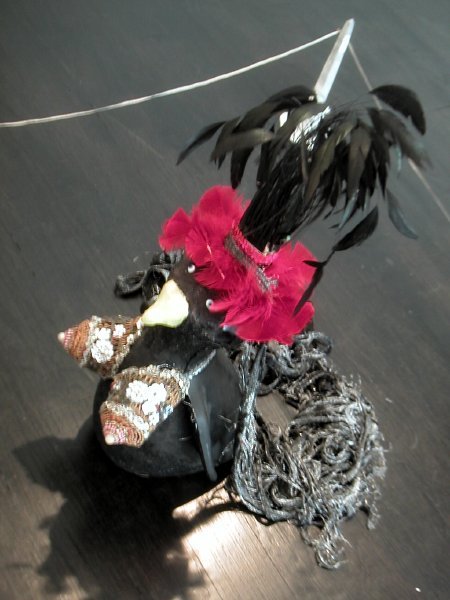
Jack Smith Yolanda La Pinguina ca. 1974 mixed media 22″ x 10″ x 30″ (does not include stanchions) [detail of installation]
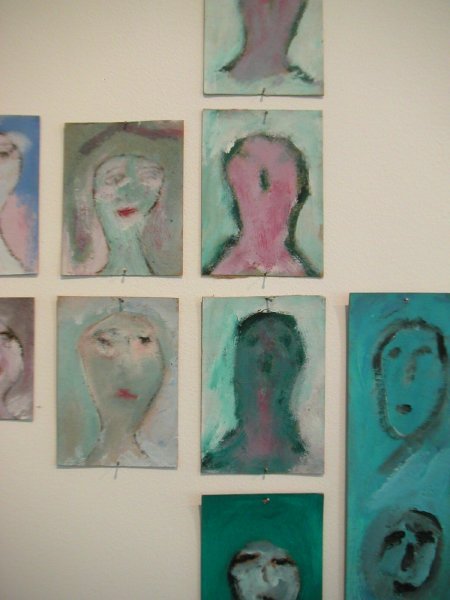
Vaginal Davis Dames Égarées: Je Veux Acheter Vos Visages 2001 mixed media [mostly make-up] on tag board, dimensions variable [detail of installation]
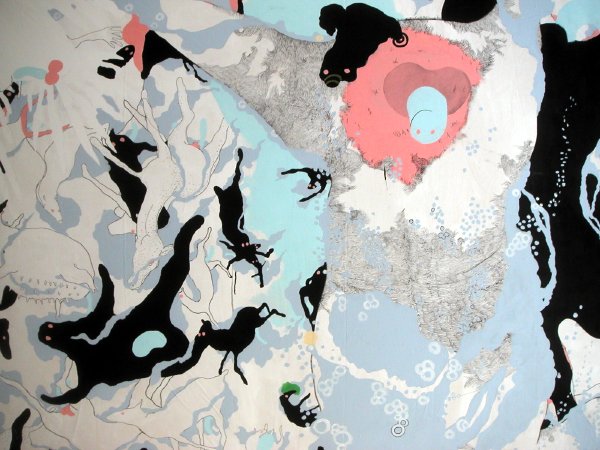
Dasha Shishkin Untitled 2005 mixed media on canvas, approx. 78″ x 161″ [detail of installationon ceiling]
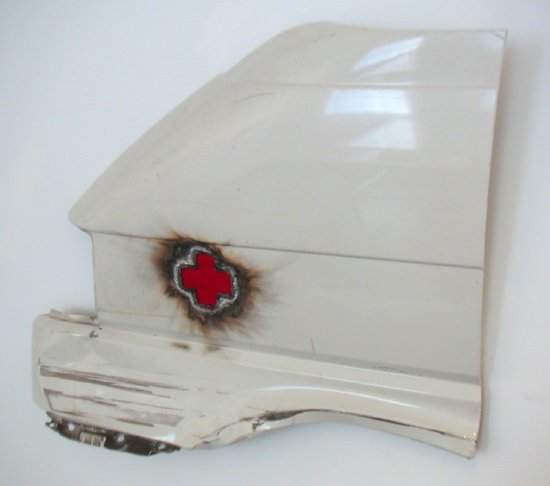
Franko B Untitled (metal sidepanel with cutlouts) 1997 metal and felt 28″ x 32″ x 4″ [installation view]