Nicole Cherubini’s interior light

Cherubiniglass04.jpg
multiplying light

Cherubinibed03.jpg
Cherubiniblueglass00.jpg
Cherubinidesk07.jpg
Cherubinigold05.jpg
Cherubinipiano02.jpg
Cherubinireddishes06.jpg
Cherubinitables01.jpg
Cherubinivanity08.jpg

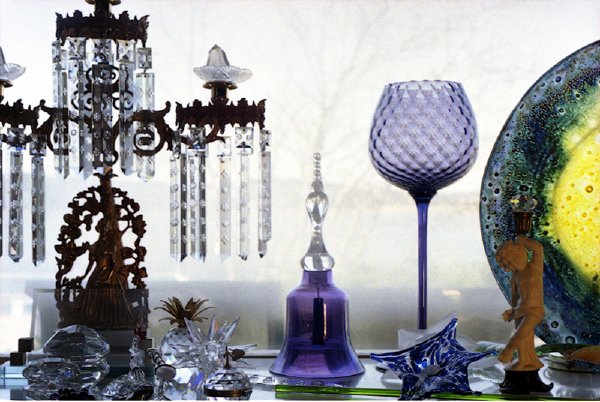
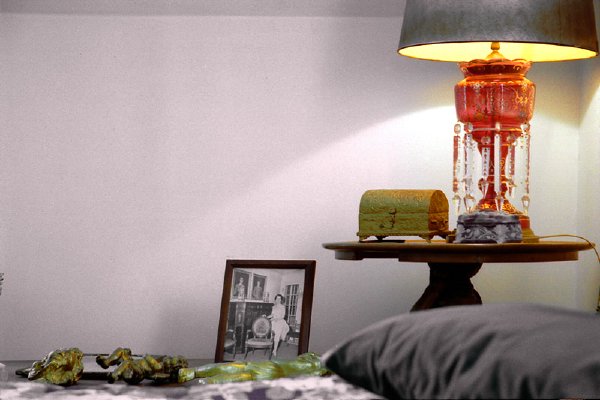
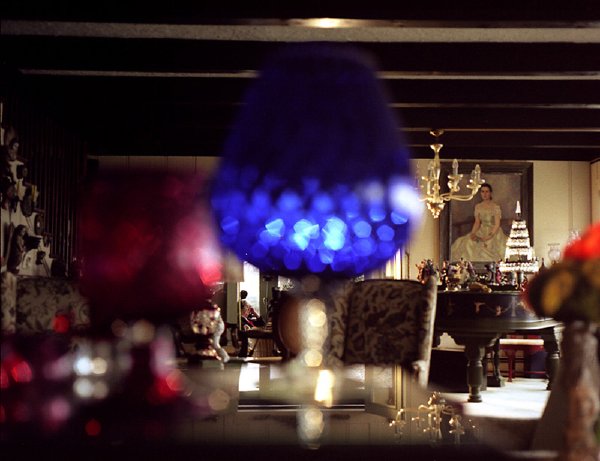
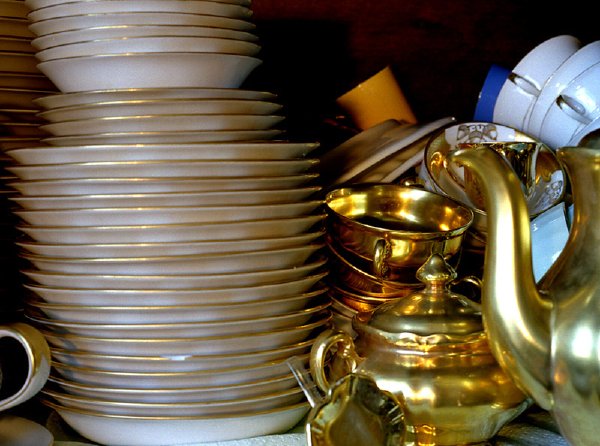
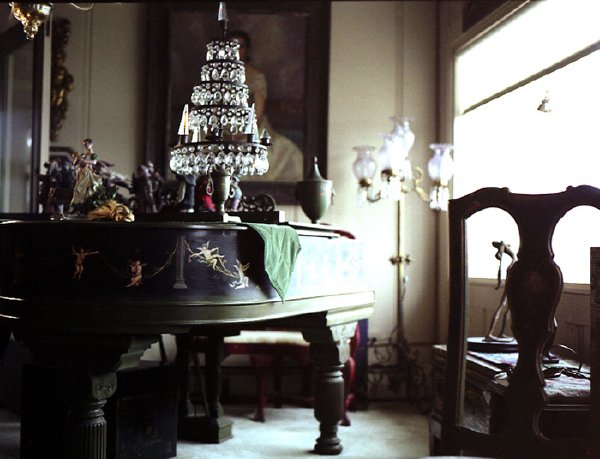
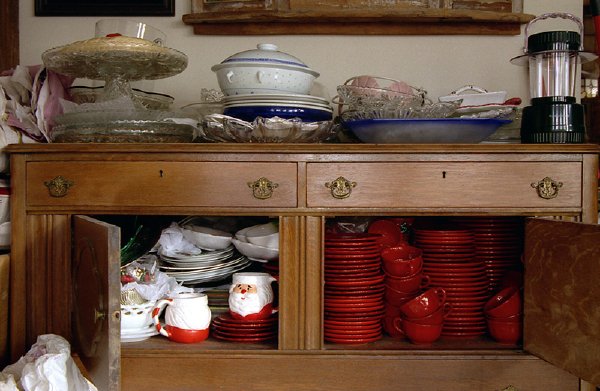
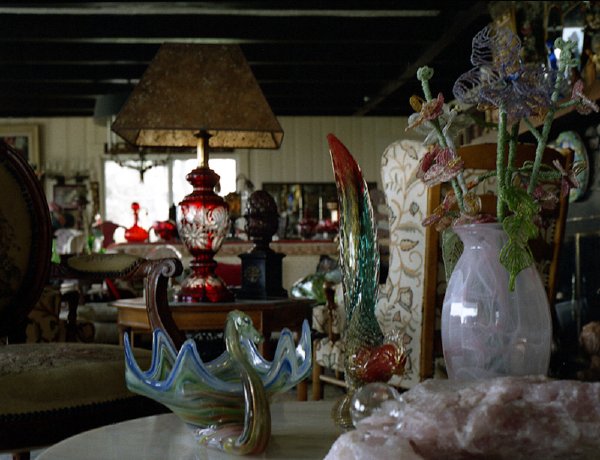
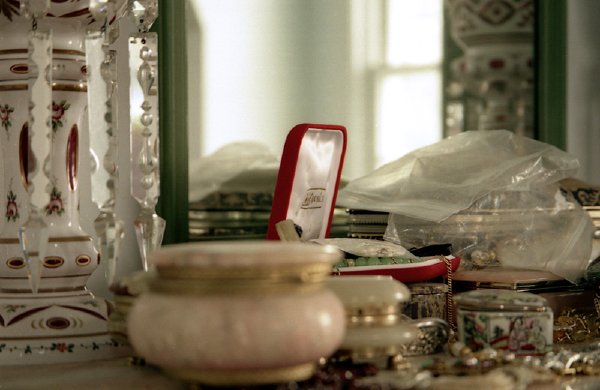
We’re planning a trip to Boston and southeastern New England this month. One of the things I’m most looking forward to is seeing Cape Cod for the first time since moving from Rhode Island twenty years ago, especially since this will be Barry’s first visit. It may seem strange, but while looking at these photographs of old things in interior spaces, I’m thinking of the extraordinary fresh light I’ve always associated with that long, sandy peninsula surrounded by the sea. The old house which shelters this furniture, ceramic and glass stands at the very entrance to the Cape and even its darker corners somehow share in that light.
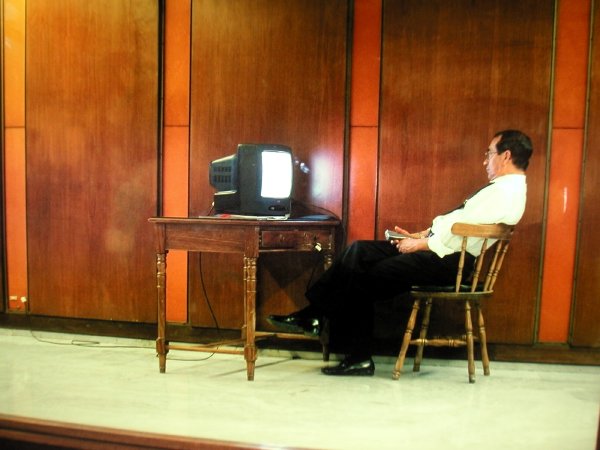
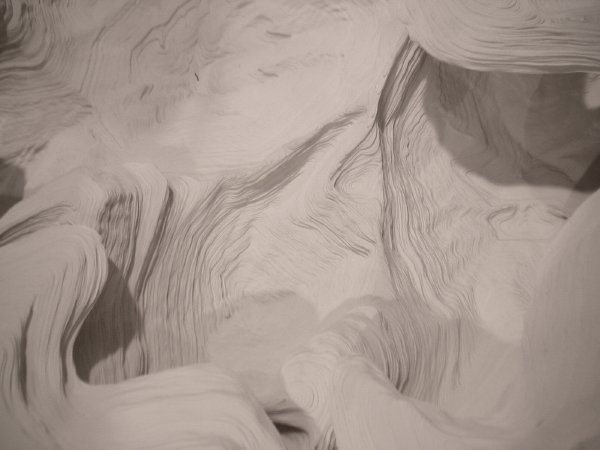
I first saw these gorgeous prints attached to the wall of Nicole Cherubini‘s pottery studio last week. I couldn’t get them out of my mind, so I asked her if I could have some jpegs to go with a short post. Once I had them on the screen in front of me I decided I couldn’t leave out any of them, so I’ve included thumbnails of each.
She sent this short note to accompany them:

These images are from an on-going project documenting my grandmother’s house, both the interiors and insides. By cataloguing her surroundings, I am able to enter into this developed aesthetic and come to a more complete understanding of excess, abundance and at times, their subsidiary, decay. These intimate portraits function as both finished works as well as source material for other works.
The final pieces are 30″x40″ highly saturated C-Prints mounted on
aluminum.

Wellll, . . . maybe I’ll admit that at this moment the last image is my favorite.

[images from Nicole Cherubini]
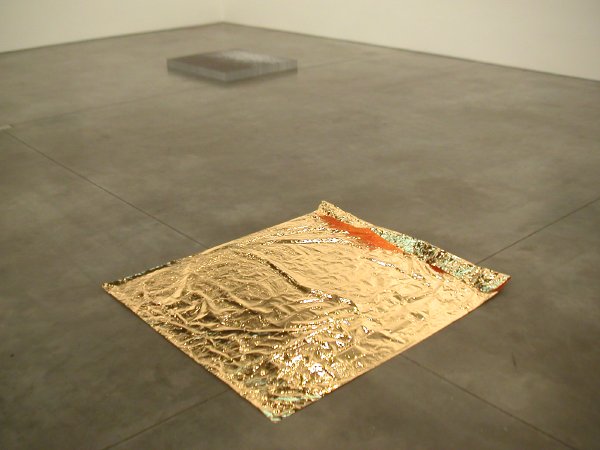
Felix Gonzalez-Torres and Roni Horn at Andrea Rosen

FelixRoniPICT0029.jpg
installation view of Roni Horn’s Gold Field (1992) in the foreground and Felix Gonzalez-Torres’s Untitled (1991) in the rear

The press release for the second in the Andrea Rosen Gallery‘s series of two-person exhibitions [closed last Saturday] exploring the affinities between Felix Gonzalez-Torres� and other artists� works included this excerpt of a 1990 text by Gonzalez-Torres read by Roni Horn at his memorial service:

L.A. 1990. Ross and I spent every Saturday afternoon visiting galleries, museums, thrift shops, and going on long, very long drives all around L.A., enjoying the �magic hour� when the light makes everything gold and magical in that city. It was the best and worst of times. Ross was dying right in front of my eyes. Leaving me. It was the first time in my life when I knew for sure where the money for rent was coming from. It was a time of desperation, yet of growth too.
1990, L.A. The Gold Field. How can I deal with the Gold Field? I don�t quite know. But the Gold Field was there. Ross and I entered the Museum of Contemporary Art, and without knowing the work of Roni Horn we were blown away by the heroic, gentle and horizontal presence of this gift. There it was, in a white room, all by itself, it didn�t need company, it didn�t need anything. Sitting on the floor, ever so lightly. A new landscape, a possible horizon, a place of rest and absolute beauty. Waiting for the right viewer willing and needing to be moved to a place of the imagination. This piece is nothing more than a thin layer of gold. It is everything a good poem by Wallace Steven is: precise, with no baggage, nothing extra. A poem that feels secure and dares to unravel itself, to become naked, to be enjoyed in a tactile manner, but beyond that, in an intellectual way too. Ross and I were lifted. That gesture was all we needed to rest, to think about the possibility of change. This showed the innate ability of an artist proposing to make this place a better place. How truly revolutionary.
This work was needed. This was an undiscovered ocean for us. It was impossible, yet it was real, we saw this landscape. Like no other landscape. We felt it. We traveled together to countless sunsets. But where did this object come from? Who produced this piece that risked itself by being so fragile, just laying on the floor, no base, no plexiglass box on top of it�. A place to dream, to regain energy, to dare. Ross and I always talked about this work, how much it affected us. After that any sunset became �The Gold Field.� Roni had named something that had always been there. Now we saw it through her eyes, her imagination.

The images on the stack of Gonzalez-Torres’s take-one-with-you’s are of a blue-grey horizonless ocean.
It was a breathtaking installation of seriously-wonderful work.

but it’s haaaaard worrrrrrrk

Taylor Steeddoll.jpg
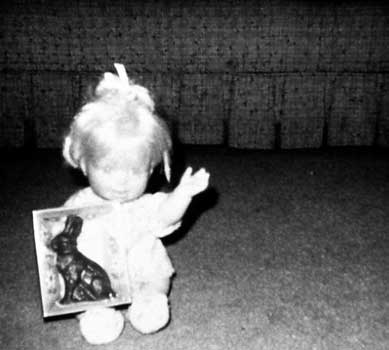
Steed Taylor Doll With Chocolate Bunny 1964 photograph 15″ x 15″

Even my mother might have shown she was impressed this time, and it was never easy to get her to show enthusiasm with our little accomplishments (she let us think she just expected them): I’m the curator for this month’s Visual AIDS web gallery.
There’s lots more in the statement, where I probabaly overdid it.

[image from thebody.com]

“Pink Houses”


heroes at large

We met these two extraordinary men for the first time this afternoon. Until then our knowledge and experience of the nobility and the courage of John Schenk and Robert Loyd had been limited to the incredible reports which regularly came to us from Barry’s wonderful mother Earline, their good friend and neighbor.
John and Robert are visiting New York this week from Conway, Arkansas, because their story and that of their now thoroughly-notorious pink Victorian house is being told in a documentary which is part of the New York Independent Film and Video Festival.
Barry has already written more about the couple and the film, “Pink Houses.” We will be seeing it tomorrow night, Tuesday, at 6 o’clock. He’s included an article from the Arkansas Democrat-Gazette, a statewide paper.

While the film is presented from the viewpoint of these two men, it also includes comment from a representative of the Family Council — a Little Rock-based organization that promotes traditional family values — and television footage of Greenbrier farmer Wesley Bono talking about his decision to spread a dump-truck load of manure along streets around the Pink House on the day of last summer’s gay-pride parade.
“It didn’t stop us,” Schenck says in the film, while standing outdoors with Loyd. “It smelled horrible for a couple of days, but we’re used to dealing with manure.”
. . .
In their 19 years in the Pink House, the two say, people have driven by and shouted derogatory names, shot at their house, broken their car windows and destroyed holiday decorations.
“One year we had a 9-foot Energizer bunny,” Loyd says. “It was decapitated Easter morning. I thought that was a little extreme.”

And some of us once assumed that the big city queer owned the breed’s style and courage.
Details: The 51-minute film will be screened at 6 o’clock on Tuesday, May 3rd, on screen 6 of the Village East Cinema, 181 2nd Avenue at 12th Street.

[image original source not available at this time]

more LMCC artists

delAmoYolanda.jpg
Yolanda del Amo (large detail of lightbox image)

SternOona.jpg
Oona Stern (detail of wall installation)

DumitEstevez.jpg
Nicolás Dumit Estévez (view of installation with still from video)

AmbeNoriko.jpg
Noriko Ambe (detail of cut paper sculpture)

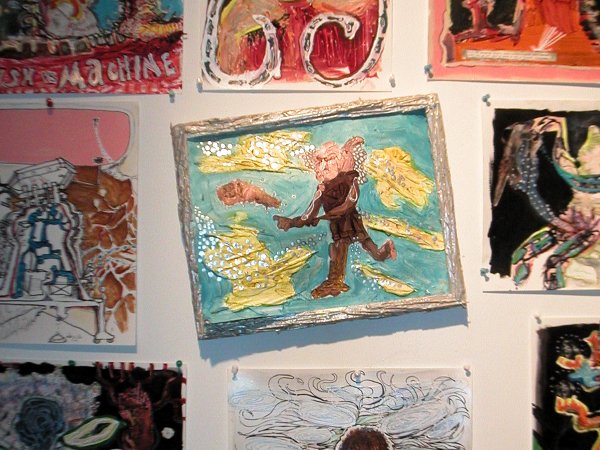
On Thursday I wrote about Jesse Bercowetz and Matt Bua and what I saw in their temporary Lower Manhattan Cultural Council studio. Yolanda del Amo, Oona Stern, Nicolás Dumit Estévez and Noriko Ambe are just four other artists included in the recently-completed session of the “artists-in-residence” program at the LMCC, and since I managed to leave with some interesting images of their work I’m including them here.
I really regret not trying to pull one of Olalekan B. Jeyifous’s exciting large-scale drawings/investigations of a future Manhattan, but I would be seriously wrong not to include him here. Unfortunately his site doesn’t include current work and it only begins to describe the scale and brilliance of what he is doing today.
For notes on each of these artist’s current work see the LMCC site.

David Humphrey at Morsel

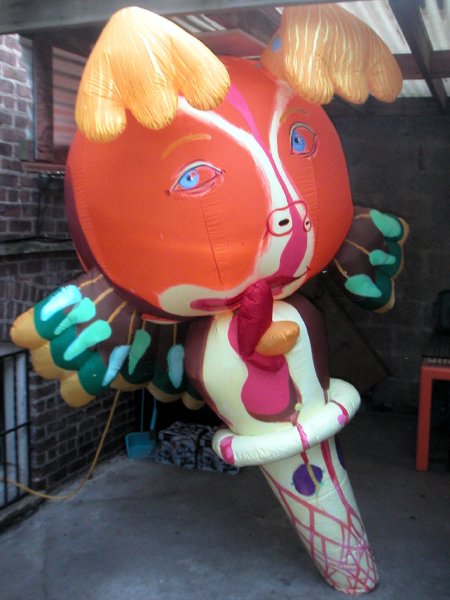
Humphreyturkeycone2.jpg
turkey cone

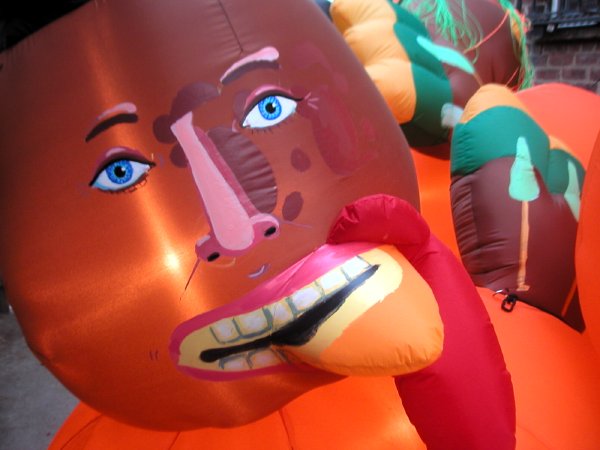
Hunphreyturkeyface.jpg
turkey face

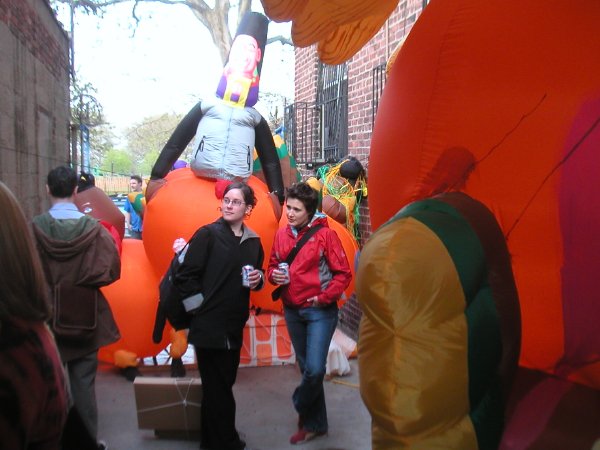
Humphreyturkeyscene.jpg
turkey scene

David Humphrey unveiled the delightful products of his latest trip into the fantastic on Friday evening. His “Oven Stuffer Roaster” installation is now, well, stuffed into the courtyard of the Morsel gallery in (rather) far eastern Williamsburg. The sculptures are essentially reconfigured giant (but still much smaller than Macy’s) Thanksgiving turkey balloons here lit from within.
Barry has more.

The Civilians in a benefit covering all

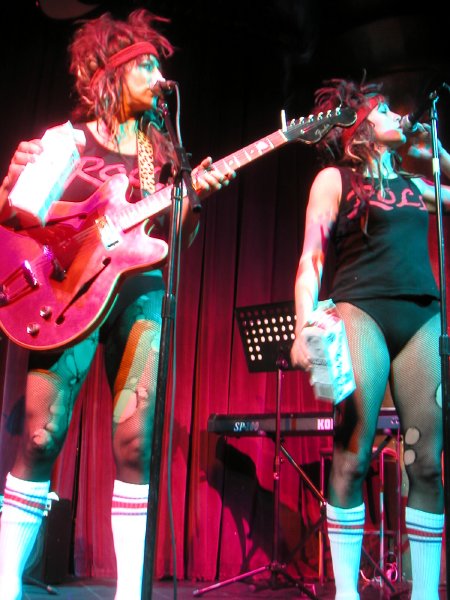
WauWausisters.jpg
the really, really fabulous Wau Wau Sisters [pronounced “vow vow”] fully staged an incredible cover of the Civilians favorite, “Gone Missing”

AllWearBowlers.jpg
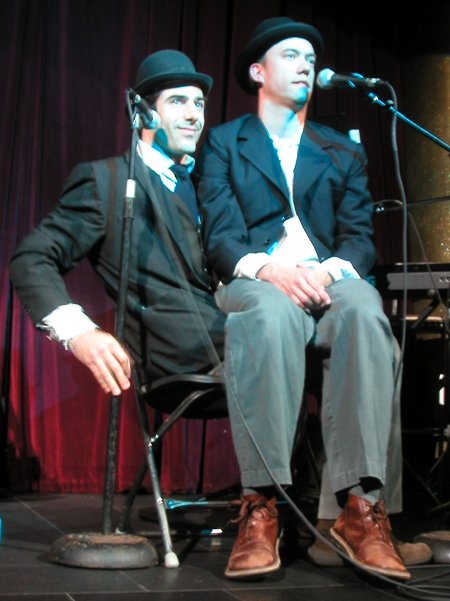
Geoff Sobelle and Trey Lyford of the Downtown hit “All Wear Bowlers” [Trey is a Civilian in another life and if it were up to me Geoff would be too] did their own thing

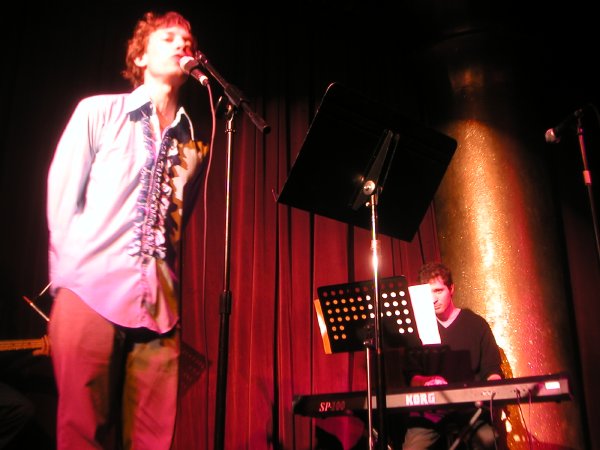
We had a great time – shared. The visiting artists’ performances at the benefit for The Civilians Thursday night were even more wonderful than we had anticipated, but since there will be no second chance for these numbers as covered last night, the best I can do now is show you what it looked like.
Actually, thanks to the company and everyone who helped make the benefit a success, there really will be a second chance (and a third, and a fourth, and so on) every time and everywhere these people put on another show.

FriedmanMichael2.jpg
Michael Friedman, the group’s brilliant composer and lyricist, “covered” his own brand-new song, “How to Can Peaches,” written for a show still in the works; Andy Boroson was at the piano

Jesse Bercowetz and Matt Bua at LMCC/Workspace

mattjessriver.jpg

mattjessdiver.jpg

MattJessoil.jpg

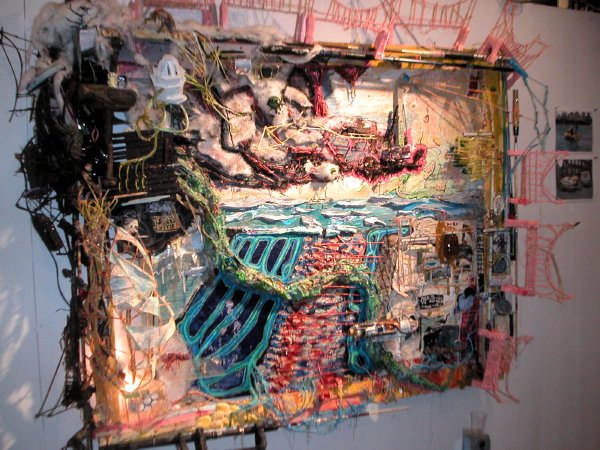
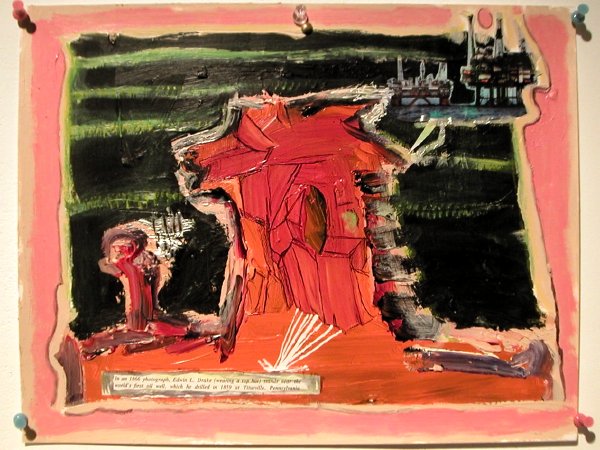
I apologize, but I have no precise details on these images, although I know that the large piece at the top reflects Jesse Bercowetz and Matt Bua‘s continued fascination with Roosevelt Island. I believe the figure in the center of the second photograph represents an underwater diver, and the “drawing” at the bottom is a reference to the first successful American oil well.
I hardly know what to write about this magic duo. Beginning several years ago, I stumbled across the work first of one, then the other and eventually the projects they had done together. Very soon I was pursuing more than stumbling, but everything they do is still almost as baffling as when I first found it – only more masterful, and more seductive.
This past weekend we visited their temporary studio in 120 Broadway, part of a program of the Lower Manhattan Cultural Council (LMCC). They had obviously cleaned up a lot for the official reception, but even what they had toyed around with and left pinned to the walls or lying on the windowsills (pre-studies?) could have kept me there most of the evening.
The press release for last weekend’s event can barely begin to describe what you see above:

Bercowetz/Bua’s work crosses disciplines and actively engages the community. Recently, it has been an investigation into the acts of youth deviance, social escapism, dissidence, utopian architecture and mobility. Often blurring the lines between work, play, manhood and boyhood. The process is elastic–crossing genres, mixing materials, and collaborating with others. The projects are often interactive with an exterior and interior. The subject matter is vast, experiential and vaguely didactic. Reality and fantasy collide–realistic situations are pushed to a fantasy level and that fantasy is treated as serious as real life.

Momenta Art Benefit 2005

kikir.jpg
Kiki Smith edition in the 2004 raffle (we were very lucky last year)

I don’t get around to plugging very much of anything, even when I have the best will to do so, but the Momenta Art benefit this Saturday is just too good a thing for everyone – impecunious patrons, emerging artists and the excellent and worthy non-profit gallery alike – to let pass this time.
We’ve just heard that the tickets haven’t yet sold out. Don’t let us buy more than our share; please help this excellent art get into more homes.
It’s also a really good party.
Barry has already posted just about everything you need to know about it.

roses arrive in Chechnya

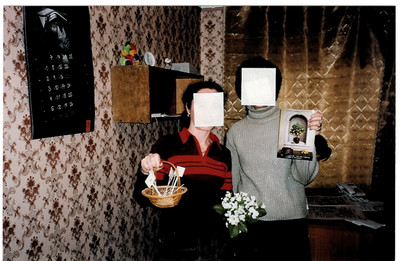
Grozny1gallery-1111957841-msg-21393-2.jpg
after unpacking a suitcase in Grozny

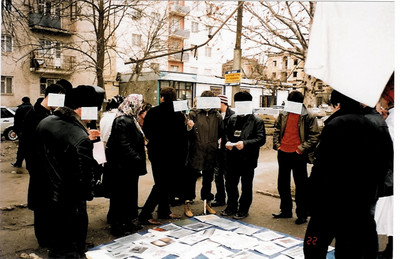
Grozny2gallery-1111956484-msg-19092-3.jpg
an installation on Friendship of Peoples Square

“Give them bread, but give them roses too” [traditional socialist cry]

I hate loose ends, so I’m following up on a post I did two months ago with another link to the site of the Emergency Biennale in Chechnya and a story which appeared in the Guardian. The project was formally launched the day after I first wrote about it, but in the nature of this extraordinary outreach it has taken weeks to even begin to record its success. From Dan Hancox writing for the Guardian on April 13:

The 62 contributing artists were asked to submit two copies of their work, and duplicates are displayed in the Palais du Tokyo contemporary art gallery in Paris, along with a series of films and talks about Chechen life. These suitcases of art travelled from Paris across Europe to Grozny. The Chechen Biennale has now been established, with the art on display in Grozny’s National Library. It will move on to four other cities, in the care of its Chechen supporters, who cannot be named for safety reasons.
This “arts sans frontières” approach makes the Emergency Biennale more than just another art festival – responding with speed and dedication, they are, like Médecins sans Frontières, working “on an emergency footing”. Jouanno and Castro are clearly subscribing to the old socialist idea, “Give them bread, but give them roses too.” A cultural life is a human right denied to most Chechens: the Russian authorities consented only a fortnight ago to rebuild the museums.

See the Biennale’s site, clicking onto “news” and “artists” for more images.

[images, which I believe must remain anonymous although they are posted by “evelyne,” are from emergencybiennale]