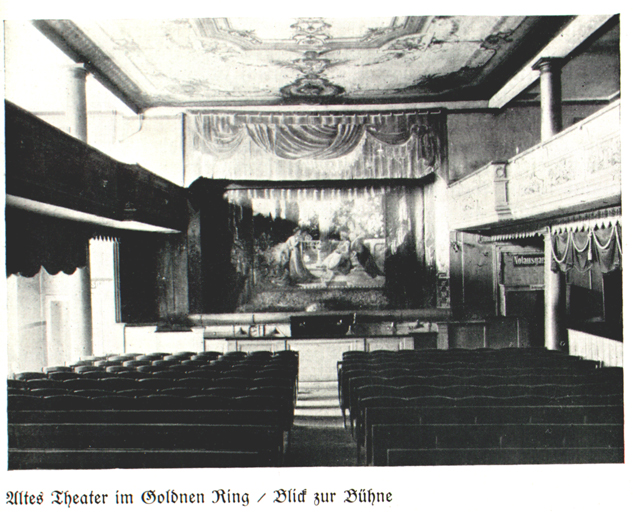
I came across the link where I found this picture while looking for images of the “Dada Baroness,” Elsa von Freytag-Loringhoven [she seems to have had an early and remote connection to the theatre shown above].
Wouldn’t it be wonderful if everyone had access to such a performance space in their own community? I mean wonderful for both audiences and artists!
When I saw this century-old picture of a basic, but absolutely complete theatre inside a small hotel in the provincial German town of Cottbus I thought about opera, and what fun it would be to see small productions in a space like this. Well, okay, I was also thinking of a scene in Fellini’s “Amarcord.” In our own experience, New York at least never seems to run out of spaces for non-musical theatre, so I thought it was fair to talk specifically about an opera house, maybe one in the west 20’s for instance. The hall shown above seems to have everything audiences and artists need, just a lot less of it. There’s a stage, curtains, an orchestra pit, parquet seats, boxes to see and be seen, wings, possibly a backstage area, carved or painted decoration, and even something most larger theatres don’t have, daylight when the large windows don’t have to be darkened.
It seems so simple. If a modest inn located in a provincial central European town could have this little jewelbox of a theatre, why can’t every town in America?
We know the answer, of course, because there was a time when every small town in America, and virtually every neighborhood, did have these stages, even if their productions might be high, low or anything in between. Then cinema appeared, and live entertainment began to disappear. Later, when television entered every home in America, if not every room and now most every SUV, the audiences stopped showing up altogether.
But today, for reasons discussed regularly in the cultural media, opera, especially new creations, and including work which would not be acknowedged as opera by the old guard, is once again hot and getting hotter. This is especially true in Europe, where there are still stages in every modest-sized town, most in appropriately-sized halls, and where there is serious public funding. But people everwhere seem to like what they are seeing and hearing – if they can find it. The boundaries between high and low are becoming blurred, with neither suffering diminishment. Once again, after almost a hundred years, whether grand or chamber/loft-sized, opera isn’t just for the elite, even if usually we can no longer whistle its new melodies in the streets.
I say let the Metropolitan Opera go on doing its museum thing in its big colliseum for increasingly older and wealthier audiences, but let’s create our own opera houses, and produce our own brand-new, unjustly-neglected or re-created operas, and let’s do it everywhere.
Although even the small halls I am imagining would need money, in the U.S. we would need only a fraction of the private or public [hah!] patronage which is thrown at television. Decades ago our government handed over the airwaves, which belong to the people, to a very few huge corporations which profit from an infinite number of other corporations which in their turn profit from selling stuff to the people who have been robbed of the patrimony of the airwaves. It’s an outrageous scam.
We need to get back what is ours, meaning the tools, both theatres and airwaves, with which we might build a culture beyond mere consumerism.
More opera, less soap.
[image from Klaus Martens (scroll down)]
Category: Culture
Eric Doeringer at apexart
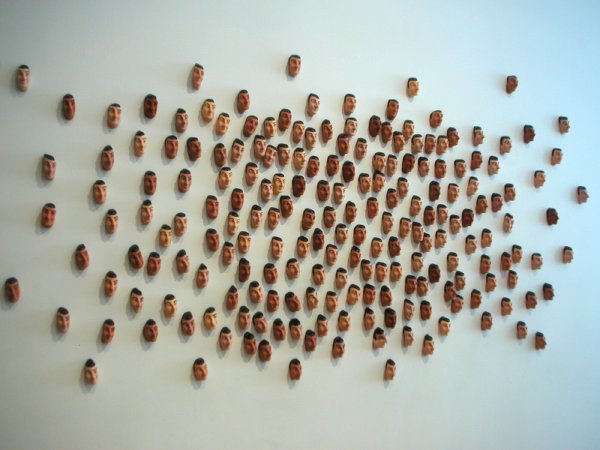
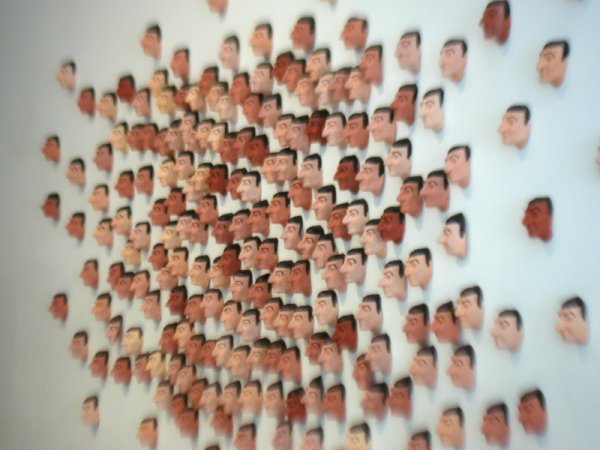
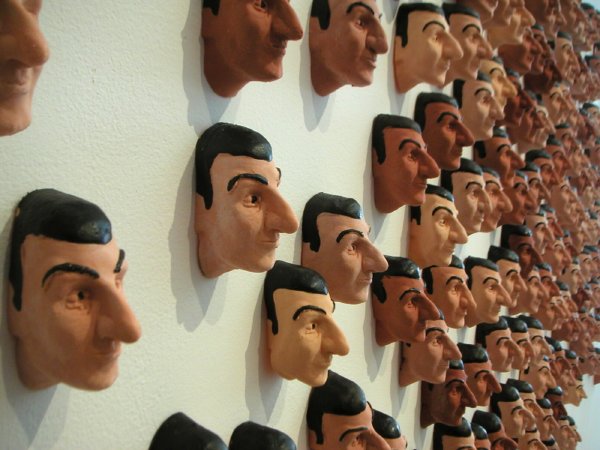
As far as I’m concerned there’s never enough of Maurizio Cattelan to go around, but now Eric Doeringer is helping out – with a wonderful additional conceit.
As I understand it Cattelan had been invited by apexart to do something in their space. What they ended up with was “Maurizio Couldn’t Be Here.” This was a series of five Saturdays of performance-related events organized by five different people invited by Cattelan to curate shows in the Church Street space. For the final Saturday the curator Fernanda Arruda picked Doeringer, and Doeringer created a new unlimited edition for the occasion, a hand-painted latex mask (miniature, of course) of Cattelan’s face. Behind a black curtain dividing the gallery on Saturday, in addition to pushing his earlier product range of “Bootlegs” of hot artists, he was offering a ziplock bag of five miniature masks for $100 (a price at or near the high end for his pieces).
No surprise, but I understand Cattelan himself is a Doeringer collector.
Sorry about all the images; I couldn’t help myself. I just had to put up all three of my pictures of the front-room installation. And yes, we did buy a bag of Doeringer Cattelans while there.
Korpys/Löffler at Armory
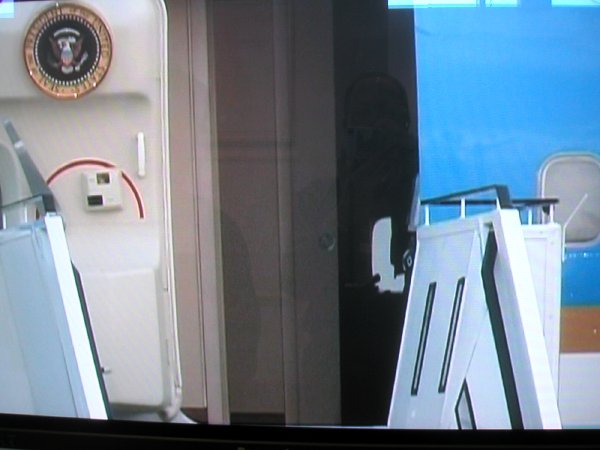
Korpys/Löffler The Nuclear Football 2004 DVD still from video
I almost couldn’t tear myself away from a video by André Korpys and Markus Löffler shown by Karlsruhe’s Meyer Riegger Galerie at the Armory show. And when I did, it was only to come back each time I passed near its images or heard the refrains of “Hail to the Chief” on its soundtrack.
A sexy male voiceover whisper accompanies a thirty-minute newscam-like documentary of Bush’s lightening-fast 2002 visit to Berlin, framed by the arrival and departure of Air Force One. The visible security systems are the stars of the video. Barry and I think we heard something like “secret service men make me hot,” but we could be wrong. The title refers to the leather bag which always closely accompanies an American president, the one which holds his special nuclear cellphone.
Dr. Sabine Maria Schmidt’s press release for Korpys/Löffler’s exhibition at the Wilhelm Lehmbruck Museum in Duisberg is slightly more helpful.
Generally speaking, political events such as the state visit by George W. Bush in 2002, provide the starting point for their investigative art, which places the strategy of artistic formal analysis in a new context. The artists weave fictional and biographical threads into their documentary analyses, which serve to further underline contradictions and revelations, and to construct new associations and opinions. Yet which associations have any meaning whatsoever for historical events, and which are to be given priority?
Whatever the magic, the piece is almost as funny as it is frightening, a little bit like our current “nukaler” chief himself.
Nicole Eisenman at Armory
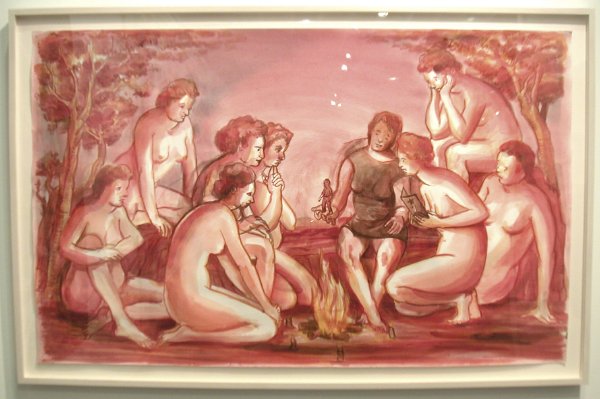
Nicole Eisenman untitled 2004 watercolor and pencil on paper 25.5″ x 39.5″
I see this wonderful Nicole Eisenman drawing as the other school of Athens. The work was in Leo Koenig‘s exciting booth.
Alice Neel at Armory
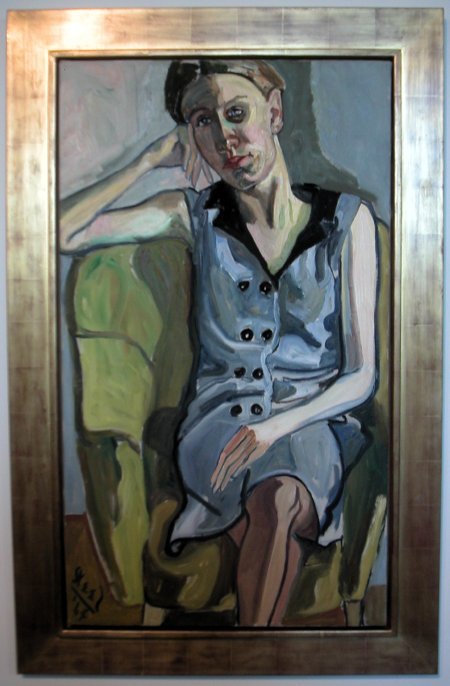
Alice Neel Eka 1964 oil on canvas
I turned the corner and there was this old master, except it was not old at all, even in the company of so much work by the truly young at Armory 05. This glorious portrait by Alice Neel was being shown by London’s Victoria Miro Gallery.
Jeff Sonhouse at Armory
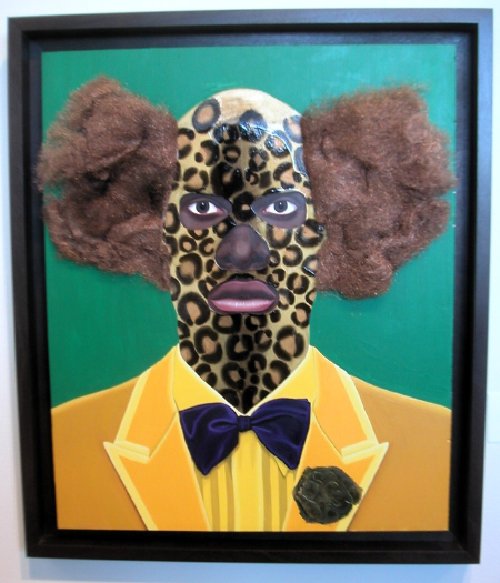
Jeff Sonhouse Green is For the Money, Gold is For the Honey, and Bronze is For the Bourgetto 2005 mixed media on wood 14″ x 18″
This dazzling piece by Jeff Sonhouse was in Jack Tilton‘s booth.
Spencer Finch at Armory
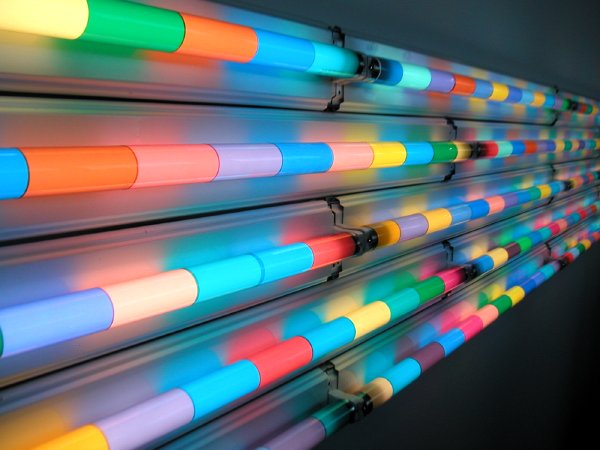
Spencer Finch Sunset (south Texas 6/20/03) 2003 fluorescent lights, filters 25″ X 40′
When I got home from a second trip to the Armory fair last night I saw that Tyler had already written about Spencer Finch‘s piece in the Postmasters booth, but I found this great image on my trusty micro and I didn’t want it to languish. Sorry I didn’t get a real closeup, because the piece is dynamite whether the eye is on top of it or as far away as the next pier.
the Armory Show, Pier 90 (the north side)
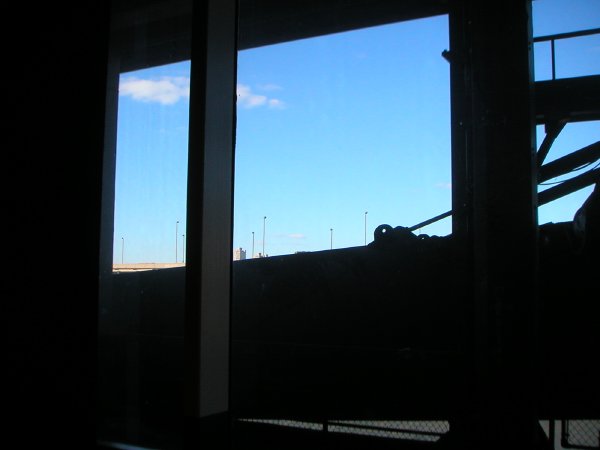
today, the view north from the same pier
Matthew Lutz-Kinoy at DIVA
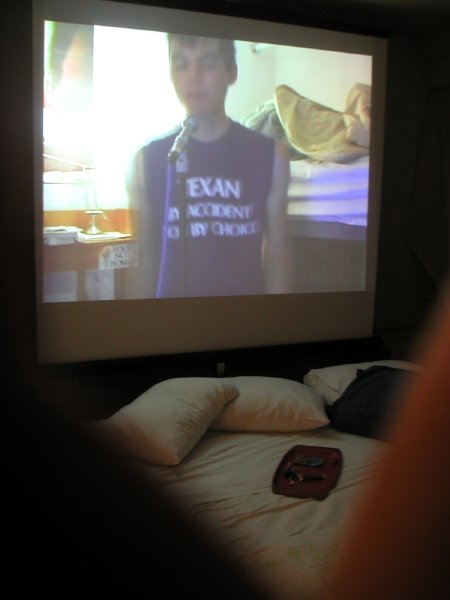
Matthew Lutz Kinoy Mixtape 2004 2005 video still installation view
We spent much of the afternoon and early evening today at DIVA, the Digital & Video Art Fair ensconced in the the Embassy Suites Hotel this weekend, located just above the World Trade Center. Barry is also writing as I’m typing this mini-report, but I’m pretty certain he’s saying something like what I am about its easy and seductive attractions.
Maybe it was the requirements of the medium but the experience was relatively serene. Unlike the traditional world of painting, sculpture and even photography, digital or video art demands darkness or at least a close substitute. At DIVA, even the process of repeatedly entering and leaving dozens of small spaces, almost every one liberally sprinkled with a number of animated screens in almost every possible size, and each with its own special claim to our visual and aural attention, seemed somehow far less stressful than my experience with the static displays of the Armory or Scope fairs.
That reminds me; today I really enjoyed the somewhat rare element of sound in the context of an art show, even if those sounds were so often so numerous and so insistent that they added unintended elements to some of the works.
At DIVA there was also the cool excitement of the exotic (finally, in a week which so far has seemed dominated by a New York aesthetic): According to the press pack, only thirteen of the exhibiting galleries were from the U.S. Most of the work shown by the remaining twenty-one seemed to be delightfully, singularly independent, even quirky.
At or near the top of a very rich selection, and regardless of considerations of nationality, I would put the work of Matthew Lutz-Kinoy. A still from one of his three videos being shown by the Paris-based curator Yukiko Kawase is shown above. The video consists of five post-teen U.S. college students in karaoke performance of music of their own choosing. The candy on a tray and the dishevelled bedding are part of the installation and are intended to perform as a welcome to visitors.
His drawings and modest sculptural interventions are scattered throughout the suite, in gestures designed to domesticate its transient hotel spaces.
Lutz-Kinoy lives and works in Brooklyn. He is a student at Cooper Union. He was born in 1984. He seems to be brilliant.
ADDENDUM: One more word about the location: While the “Executive Suites” venue remains just a shelf of hotel rooms, these quite ordinary, furnished environments do more than the walls of any white-space gallery to show how this spunky, even revolutionary art form can be displayed in an ordinary home. We really should get another monitor for our own ordinary, rather crowded rooms. How much are those little hand-helds now? Aha! They don’t even need any wallspace!
SCOPE New York
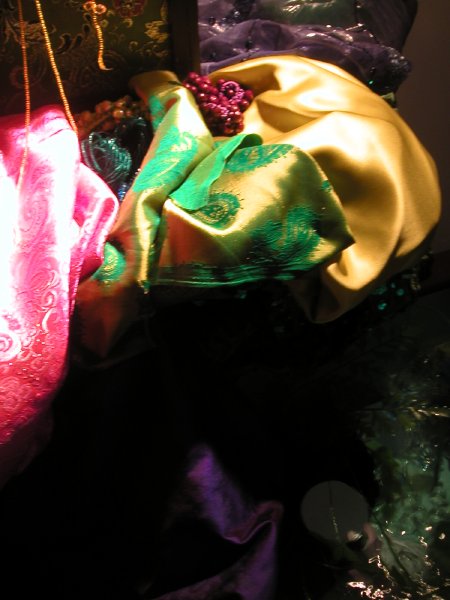
Gae Savannah Tai Rhi 2005 hair accessories, beads, fabric, wood, light 34″ x 18″ x 18″ detail
The image is just a teaser. More later on Gae Savannah, shown by curcioprojects at SCOPE this week.
Scope was a lot of fun today, and the art was better than ever. But a word of warning: The FLATOTEL venue is very seriously vertically challenged. Forty-seven floors, three elevators, one assigned to the thousands of people coming to the fair this week – well, only sorta assigned. Anyway, it just doesn’t work.
Tips: Go to the top (16th) floor and gradually make your way down to the lowest floor of the arts fair, the 10th (there’s no 13th). Because of the huge wait, at that point even if you’ve been on your feet all day you may want to consider walking all the way down to the street. Also, do not expect to find a WC anywhere above the two hole-er on the ground floor, possibly a one-hour round trip from the Scope rooms, unless you can persuade a gallery to move the art in their hotel-bathroom and let you lock the door behind you.
But enough with the logistics you won’t read about in the brochure. When I get some rest and find some spare minutes, I’ll continue to post about what we’ve seen at Scope and at the other arts events which crowd this week.