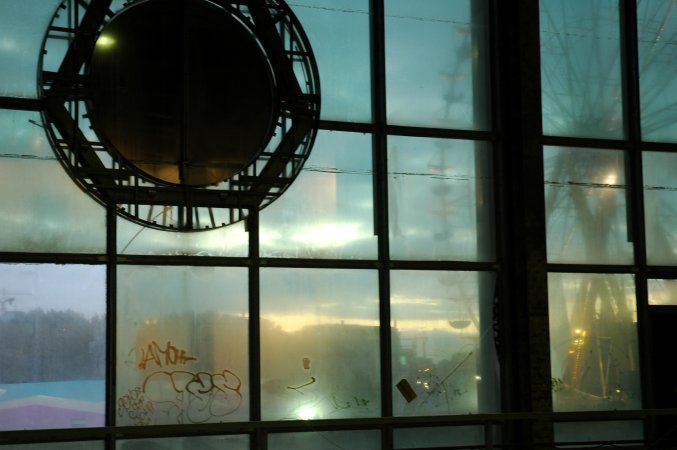
inside Der ehemaliges Palast der Republik, a small carnival on the Platz outside
Category: General
Berlin-Mitte gables
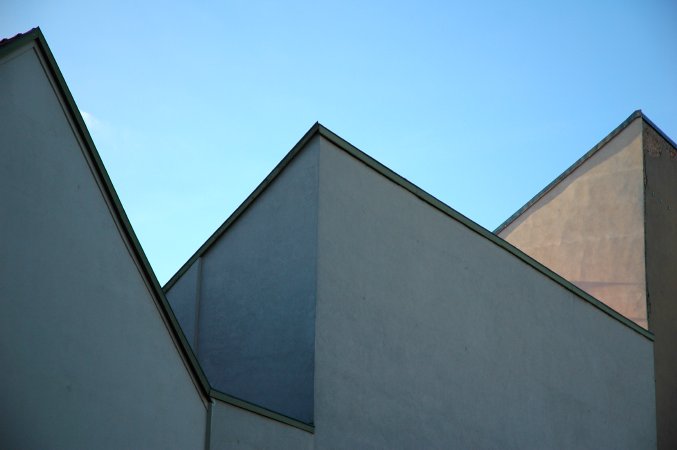
the streets below are even more cool
Berlin then and now
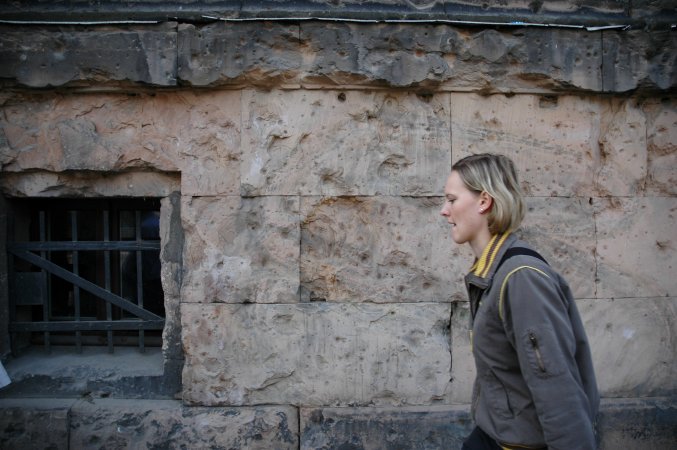
This noble old building lies directly west across the Spree from Museum Island, in the midst of the most heavily touristed part of Berlin. It still shows the scars of the battle for the city after sixty years.
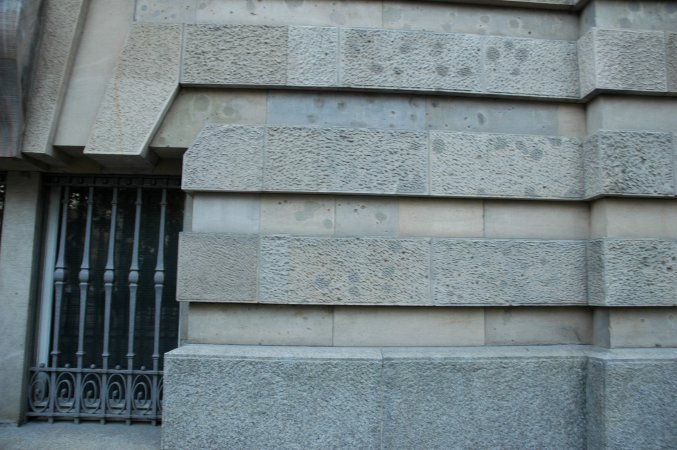
Just steps away from it to the south, another veteran of the war has been totally repaired and restored. The many holes left by large and small-arms fire exchanged in April and May of 1945 have been filled by stone cosmeticians, who have painstakingly simulated the subtle textures of the original rusticated stone on the surfaces of their plugs. See the image below, taken hours later than that above, as we left the Pergamon Museum in l’heur bleu.
Berlin-Prenslauerberg street art
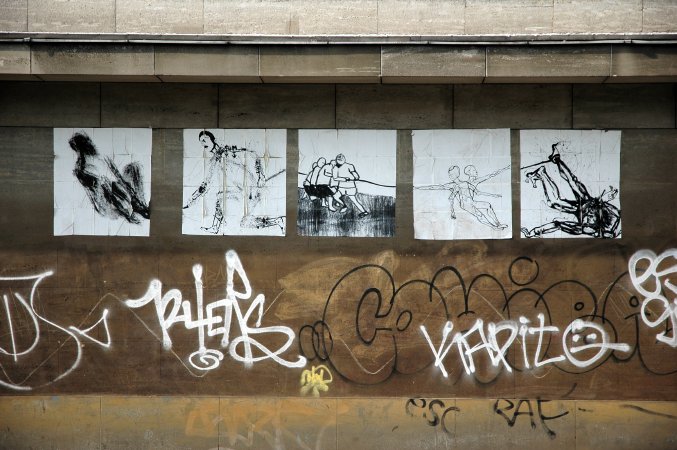
seen from the Strassenbahn haltestelle across from our apartment
Berlin fireworks
celebrating [whatever] near the Fernsehturm tonight
Berlin Alexanderplatz-cum-Williamsburg
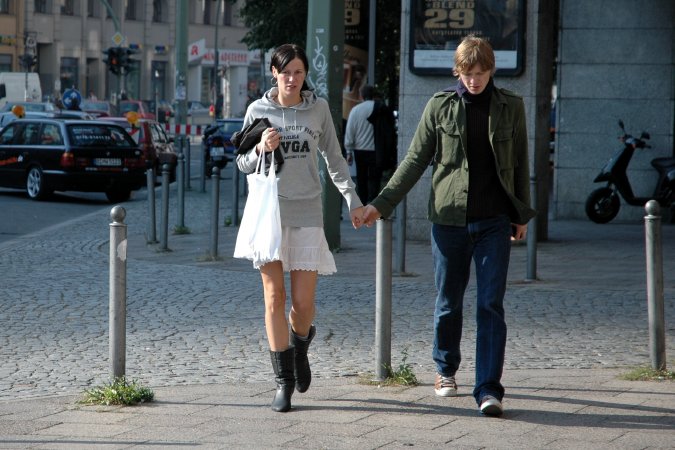
the new East Berlin
Berlin snack
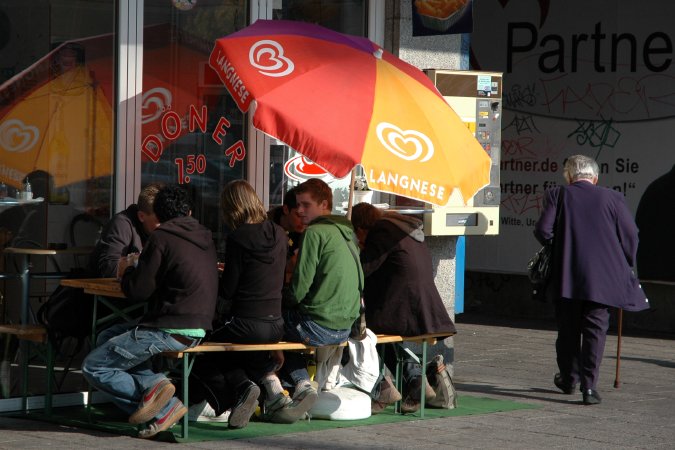
youth dallying at the schnell Imbiss, age rushing on
coming here soon: better hardware, and software

just testing
My old camera, a tiny digital, the DimageX, recently had to be sent in for repairs again. I really was planning to get a grown-up camera anyway, but the combination of immediate need and an impending trip to Berlin finally triggered my springing for the NIKON D70s which took the picture above.
It doesn’t fit into my pocket [on some days it will just have to stay home], but there will be compensations. See this earlier image taken with the miniature.
It’s a shame, but I haven’t had the time to even look at the manual or the DVD guide I bought. I’ve also not yet even tried to figure out how to use another new purchase, our Photoshop software.
Basically I want pictures, not gadgets. I don’t want to be too distracted by the machinery, but I know I’m going to have to do some homework to get what I want out of this magic box.
For a while longer it’s going to be just point and shoot, but I am going to pack that camera manual.
Rumors of deaths greatly exaggerated”
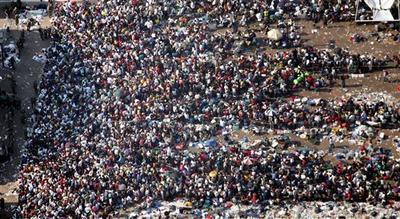
what do you think?
The Times-Picayune headline and story appears only after almost a full month of reports that the New Orleans victims of hurricane Katrina had acted like murderers and animals.
As the fog of warlike conditions in Hurricane Katrina’s aftermath has cleared, the vast majority of reported atrocities committed by evacuees have turned out to be false, or at least unsupported by any evidence, according to key military, law enforcement, medical and civilian officials in positions to know.
“I think 99 percent of it is bulls—,” said Sgt. 1st Class Jason Lachney, who played a key role in security and humanitarian work inside the Dome. “Don’t get me wrong, bad things happened, but I didn’t see any killing and raping and cutting of throats or anything. … Ninety-nine percent of the people in the Dome were very well-behaved.”
. . . .
Four weeks after the storm, few of the widely reported atrocities have been backed with evidence. The piles of bodies never materialized, and soldiers, police officers and rescue personnel on the front lines say that although anarchy reigned at times and people suffered unimaginable indignities, most of the worst crimes reported at the time never happened.
We should have known all along that racism would be a key part of the disaster response. What has surprised us most, the original reports or the news that they were spurious?
[image dated September 2, of crowd awaiting evacuation from the Superdome, by David J. Phillip from AP via Times-Picayune]
John Weir goes to Houston and finds ‘home’
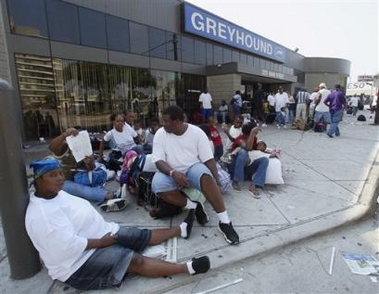
Chiquita Garner, left, of New Orleans, waits with her family outside the closed Greyhound terminal in Houston on Thursday, Sept. 22, 2005. Garner and her family had been evacuated from New Orleans after Hurricane Katrina hit and have been living in the Houston Astrodome since. They were hoping another bus would come by despite the fact that the station had closed.
The store of hurricane Katrina literature is already pretty vast, but it hasn’t always been very, well, literate. John Weir didn’t get to Houston until some time after the disaster in New Orleans which saw thousands of people flee to Texas and into the Astrodome, but he came away with a story about . . . home.
It’s no longer breaking news, and in fact evacuees in the Astrodome itself have now been [re-evacuated?] in the face of a new hurricane threat, but his is the kind of intelligent, primary-source account we will need in order to understand what went so terribly wrong in Louisiana this month.
ASTRODOME
This is how Americans lose everything: in public, within range of TV anchors taping standup segments for the nightly news. A week after 23,000 people left the New Orleans Superdome and fled to Texas, Im in Houstons Astrodome with a media handler and five other journalists taking notes and aiming video cameras. There are still 3,000 people sleeping on army cots across the playing field of the Astrodome a caravan of misplaced persons moving from dome to dome across the Gulf Coast. Reporters mill around them, watchfully ignored by the arenas inhabitants until one of them decides or is persuaded to tell her story.
Two-thirds of the people in the Superdome were women, many of them young mothers, and the Astrodome is a makeshift city of stunned moms whose little kids, playing jacks and doing cartwheels, seem unable or unwilling to relate to the disaster except as a day off from school. Beds made up with gray wool blankets are covered with boxes of Huggies, along with copies of the Bible, paperback novels by John Steinbeck, and inspirational books: Walk on Dry Land, a 12-step self-help manual that has been fortuitously named. Whenever someone is reunited with a lost family member, a cowbell clangs.
Postings on the giant message board speak of hope, and, indeed, in the past few days, there have been celebrity visitors here. Oprah came with her camera crew. George and Barbara Bush, Sr. showed up last Monday, with Bill and Hillary Clinton and Illinois Senator Barack Obama. Each of the dignitaries responded according to his or her inclination. Mrs. Bush, a booster for Texas, welcomed the new arrivals to her home state. So many of the people in the arena, here, you know, she told the radio audience of American Public Medias Markeptlace, were underprivileged anyway, so this. . . She paused for emphasis, laughing slightly. This is working very well for them.
Just whom she meant by them not to mention underprivileged and how much of the life and future of New Orleans has been permanently lost by their displacement, was a question that everyone was addressing directly, yet also, somehow, in code. There was the problem of what to call the arrivals in Texas, hundreds of thousands of black people who had fled New Orleans, a city whose largest Parish, Orleans, had been 66% black, and a majority of whose black citizens lived below the poverty line, many of them holding jobs that did not require marketable skills in the information economy busboys, warehouse workers, hotel maids.
They were being called refugees. They were being called evacuees. They were being called victims and survivors. In Houston, the relief workers and city functionaries had begun calling them neighbors and guests and, finally, residents. NBC news anchor Brian Williams, talking to Jon Stewart on The Daily Show, called them, defensively or apologetically, Americans, as if to distinguish them from the third world poor whose plights they suddenly if temporarily appeared to share.
They did not fit easily into the national narrative of opportunity and prosperity and the all-inclusive American melting pot. Moreover, the hurricane itself presented problems for the media and national government, restricting triumphant photo opportunities. There was the lack of a signature visual, as when the Twin Towers collapsed on 9/11. There was the lack of a unified band of Police officers and firefighters whose heroic rescue efforts could be praised and shared. Instead, the media leaked reports of members of the New Orleans Police Department abandoning the Superdome and the Convention Center, of officers looting homes and businesses, of the Police Departments spokesperson himself committing suicide after spending a few days in the flooded city.
There was finally the complication of the people in the Superdome being, not assassinated by terrorists and mourned as American martyrs, but in fact still alive, still trapped in the ruined building days later, still needing government aid. This time the victims were twenty-three thousand working class black people, many without cars or ready cash or means of escape. They had spent their lives within drowning distance of a lake whose levees everybody seemed to know would collapse, and they were corralled into a giant sports dome while the rains came and the toilets overflowed, and media choppers flew overhead without the apparent intention of getting anybody out.
In the aftermath of this tragedy, while President Bush was keeping a rather aristocratic distance, members of Americas shadow government celebrities, NBA jocks, movie stars were everywhere, flying over the Superdome to assess the damage and then touching down in Mississippi and Louisiana and Texas to talk to survivors and offer leadership and support. For a period of two or three days it appeared in fact that Oprah was President. She said what many must have felt but none of the countrys national leaders had yet articulated. Visiting the Astrodome, speaking to those who had endured the ordeal at the Superdome, she said, We owe these people an apology.
The apology came on Thursday in the form of debit cards. The survivors of Hurricane Katrina were now being called clients, and they were being invited to apply for ATM cards that were issued by the Red Cross on a sliding scale depending on family size, good for anything from a few hundred dollars up to a couple thousand. Then FEMA announced it was issuing cards worth $2000 to anyone who qualified for aid.
In America, when all is lost, someone gives you paperwork, and then you stand in line. On Thursday morning in Houston, two weeks after the flood, there are two massive lines snaking around the front of the Reliant Center, the convention center facing the Astrodome. One line is for people wanting to apply for Red Cross debit cards; the other is for successful applicants, cleared for access, validated forms in hand. Twenty-five hundred people are out in the heat, some of them under umbrellas, some of them holding newspapers and cardboard boxes over their heads to shield themselves from the sun. They are wearing flipflops and sandals, shorts and t-shirts, and clutching whatever they own. People are in wheel chairs; the disabled lean on canes. One small red stand dispenses Coke.
I speak to a young woman named Trina who has fifteen dollars pinned to her shirt. She is carrying her clothes in two plastic Whole Foods bags, while her son drives his toy car across the Reliant Center windows, shouting, Whee! Whee! Trina was in the Superdome for four days. The government sending all that money to Iraq, she says, angrily. Whatever money they give us aint going to replace everything we lost.
Lainez Fisher, a beautiful sleek woman in her mid-twenties, is wearing a Marilyn Monroe knapsack on her back and a black scarf around her head. She was in the Superdome from Monday until Friday. The military got the help, not us, she says. They treated us like animals. Her sister Gretchen agrees. No need for that, she says. Really no need. Gretchen has a pit bull with eleven puppies that she shipped in a crate to Gonzales, Louisiana. Otherwise, she left New Orleans with the clothes on her back and her Betty Boop handbag. Back in the day, she says, we used to run on those levees. We saw the holes. We knew they would collapse.
I am introduced to a woman named Miss Claiborne. She spells it for me. M-i-s-s, she begins, then her last name. I ask her if its true that the Red Cross is giving out money. Theyre supposed to, she says, loading the word supposed with the kind of skepticism and scorn that only certain middle-aged black women are able to achieve. She tells me, as do so many others, about living in the Superdome, about being treated like animals, fed like dogs, watching corpses rot, guarded by members of the National Guard who seemed interested only in protecting themselves. And then, thinking back before the Superdome and the floods damage, she remembers what else she lost. I owned a home, she says. I owned a home.
I cant convey how slowly and proudly she says it, how hopeful and tragic it sounds, how terribly sad, the beautiful American word, home. Whose home? The ruined homes on the coast of Biloxi, the historical homes? The drenched housing of the New Orleans poor? The temporary shelters, the sports domes, the welcoming cities, the question, repeatedly asked, Will you go home? Can you go home? In Houston, a week after the hurricane, people can name what they lost, their homeland, their families, their security Everything, so many tell me, I lost everything but the question of exactly what it was worth, and to whom, is only beginning to be addressed.
[image of Rick Bowmer from the AP via Yahoo!]