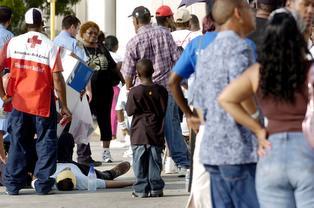
A man in the crowd in front of Reliant Arena, lies passed out from the morning heat. He was taken away in an ambulance. Residents of the shelter were told they were being evacuated to Arkansas, due to Hurricane Rita [Times-Picayune caption dated September 21]
Anyone who has been looking at this site for the last month knows how much I’ve been concerned about local control of the reconstruction of lives and neighborhoods in New Orleans.
This afternoon, as Louisiana awaits the impact of another hurricane, the burden for these communities and those who would help them has become more overwhelming than ever.
I was happy to find out only a few minutes ago that Community Labor United, the people whose experience and projects seem to best describe such an initiative now have their own neat and very useful website.
[image by Eliot Kamenitz from the Times-Picayune]
Category: General
after the flood, waiting for the new owners?
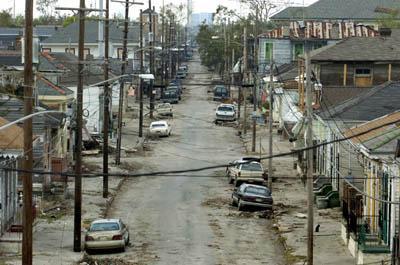
where Dumaine crosses North Roman, central Treme after the flood, sometime late last week
The title of Jordan Flaherty‘s latest letter is “Shelter and Safety”, but the context is racism, a racism exacerbated by the horrors of Hurricane Katrina, a racism which continues even today in “rescue” and “shelter” operations and which is built into the plans for tomorrow’s New Orleans.
The sections I’ve excerpted below describe just a little of the desperate struggle of a poor, almost-powerless, displaced community to remain a community. [The entire text includes much more detail on the specific horrors of “Shelter and Safety” today in Louisiana, and I expect it will soon appear on leftturn].
Just north of the French Quarter . . . is the historic Treme neighborhood. Settled in the early 1800s, its known as the oldest free African-American community in the US. Residents fear for the post-reconstruction stability of communities like Treme. Theres nothing some developers would like more than a ring of white neighborhoods around the French Quarter, said one Treme resident recently. The widespread fear among organizers is that the exclusionary, tourists only atmosphere of the French Quarter will be multiplied and expanded across the city, and that many residents simply wont be able to return home.
. . . .
Diane “Momma D” Frenchcoat never evacuated out of her Treme home on North Dorgenois Street, and has been helping feed and support 50 families, coordinating a relief and rebuilding effort consisting of, at its peak, 30 volunteers known as the Soul Patrol.
. . . .
Asked about her plan, Momma D had these words, “Rescue. Return. Restore. Can you hear what I’m saying, baby? Listen to those words again. Rescue, return, restore. We want the young, able-bodied men who are still here to stay to help those in need. And the ones that have been evacuated, we want them to come home and help clean up and rebuild this city. How can the city demand that we evacuate our homes but then have thousands of people from across this country volunteering to do the things that we can do ourselves?”
Community organizers like Momma D in Treme and Malik Rahim, who has a similar network in the Algiers neighborhood, are the forces for relief and rebuilding that need our help. The biggest disaster was not a hurricane, but the dispersal of communities, and that’s the disaster that needs to be addressed first.
Yesterday a friend told me through tears, I just want to go back as if this never happened. I want to go back to my friends and my neighbors and my community. Its our community that has brought us security. People I know in New Orleans dont feel safer when they see Blackwater mercenaries on their block, but they do feel security from knowing their neighbors are watching out for them. And that’s why the police and national guard and security companies on our streets havent brought us the security weve been looking for, and why discussions of razing neighborhoods makes us feel cold.
When we say we want our city back, we dont mean the structures and the institutions, and we dont mean law and order, we mean our community, the people we love. And that’s the city we want to fight for.
[image by Ted Jackson from the Times Picayune]
getting into New Orleans, with some paper and some attitude
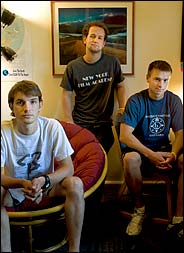
back at Duke, Sonny Byrd, David Hankla and Hans Buder
“It made no sense whatsoever that reporters were getting in and out of New Orleans, but the National Guard couldn’t remove those people from the convention center,” said Mr. Hankla, 20, a sophomore. “All we knew was that we were sick of being armchair humanitarians and that we intended to help get people out.”
So he and two dorm mates, Sonny Byrd and Hans Buder, set out in Mr. Byrd’s Hyundai sedan for a road trip and rescue mission. [read the whole story in the NYTimes]
That’s the can-do spirit which seems missing in most of the country these days. It’s also the spirit (and the devices) we used in ACT UP, especially in the early 90’s: Sometimes you just have to figure out how to make your own credentials if you want to help people.
Hey, these dudes weren’t arrested, and they even got media coverage – key in any action!
[image by John Loomis for the Times]
orgiastic greed, opportunism, and militarism in New Orleans
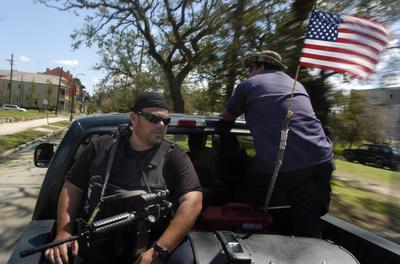
NOPD officers Danny Scanlan and Juan Lopez keep a watchful eye during patrol Thursday, Sept. 8, 2005 in New Orleans.
Jordan Flaherty continues to write from Louisiana, and on Friday he argued that the most serious damage done to New Orleans was not the consequence of the hurricane or even of the floods which followed the breaks in the levees. An excerpt follows.
But the worst damage is what is being done now, this confluence of forces barraging New Orleans and its Diaspora, what some local organizers have referred to as the Disaster Industrial Complex. This is the perfect storm created by an orgy of greed and opportunism engaged in by the jackals of disaster profiteering. The list of those who are gaining from our loss is large, and it includes everyone from the heavily armed thugs of Wackenhut Security and Blackwater USA to the often well-meaning but ineffective bureaucrats of Red Cross and FEMA, to the Scientology missionaries crowding the shelters, to journalists and disaster-gazers taking up a chunk of available housing, to the major multinationals such as Halliburton, working in concert with rich elites from uptown New Orleans seeking partners with which to exploit this tragedy.
These are the institutions and individuals poised to profit from this disaster, while the people of New Orleans face nothing but further dislocation and disempowerment.
. . . .
Whether its in the shelters or in the streets of New Orleans, this may go down as the most militarized relief effort in history. The Chicago police are camped out on a bar on Bourbon Street. Wackenhut security convoys are riding in and out of town. Israeli security patrol Audubon Place Uptown. White vigilante gangs patrol the West Bank, with tacit permission of local authorities. National Guard and Blackwater are on patrol throughout the city, along with DEA, INS, State police, New Orleans police, NYPD, and countless other agencies.
. . . .
This militarization of New Orleans stands in stark contradiction to the peoples efforts at reconstruction. The Common Ground Collective, in the Algiers area of New Orleans, has built a community health center and food distribution network serving, according to organizer Malik Rahims estimate, about 16,000 people in New Orleans Parish and surrounding areas such as Plaquemines and Jefferson Parishes. Have the police helped us? asked one local organizer, no, theyve stood in our way at every turn.
. . . .
Today I received a call from Royce Osborne, a local filmmaker who made the New Orleans classic film All On A Mardi Gras Day. Royce is also a community activist and one of the Mardi Gras Skeletons, another Black Mardi Gras tradition. Royce told me hes aching to come back, and looking forward to Mardi Gras 2006. If we see the Indians out on the streets in the next Mardi Gras, then Ill know theres hope for New Orleans, he said.
[image by Michael Democker for the Times Picayune]
anyone care what the owners of those houses think?

not everything’s in the French Quarter
I obviously haven’t seen everything being written about the reconstruction (or, gasp, “urban renewal”) of New Orleans, but I know I haven’t read a single word about who actually owns all those unique, traditional/vernacular style houses we’ve seen throughout the flooded older, poorer neighborhoods. I suspect they are mostly owner-occupied or rented from people who live in the neighborhood.
I certainly don’t think Halliburton or the developers own them – yet. Why are we talking about these neighborhoods as if their ownership had evaporated, as if the governments which failed them can now decide their disposition in a vacuum?
[image of two shotgun houses from Ingolf Vogeler]
for two weeks, “anyone could see his body from the street”
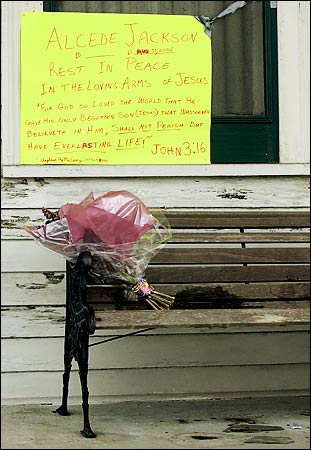
free at last
In a post I did one week ago I included a Times Picayune photograph of the blanket-wrapped body of Alcede Jackson lying on a bench on his front porch in New Orleans, and I included some strong lines from James W. Bailey. The NYTimes now reports that on Monday, almost two weeks after he died, the body was collected.
NEW ORLEANS, Sept. 12 – They collected Alcede Jackson on Monday, relieving him at long last of a duty in death he never requested in life: to be a poor man’s Pietà for his broken city.
They collected Alcede Jackson, finally.
They took nearly two weeks to do it, making their way through streets in Uptown that were never underwater, to the worn white house at 4734 Laurel St. Mr. Jackson’s body had been laid out on the front-porch bench – as though for an interminable outdoor wake – waiting to be transported to some semblance of dignity.
Anyone could see his body from the street, and many did. It cried out for retrieval, lying there under a baby-blue blanket mottled with cigarette burns, a bouquet of dead flowers resting nearby, as 90-degree days came and went.
The loudest cries, though, came from the epitaph, scrawled in large letters on the kind of yellow-green cardboard that seemed to glow in the dark and taped to the house above the body’s head. This was what it said:ALCEDE JACKSON
B – D Aug. 31, 2005
Rest in Peace
In the Loving Arms of Jesus
“For God so loved the world that he gave his only begotten son (Jesus) that whosoever believeth in Him, shall not perish but have everlasting life!” – John 3:16.For nearly two weeks, this was what it said. And not just from the porch.
Law-enforcement officials and search-and-rescue teams had regularly visited this neighborhood since the first of the month. Newspaper and magazine reporters and photographers passed by the modest house on Laurel Street every day. In fact the entire world read about this front porch and the entire world watched the body of Alcede Jackson lying there uncollected, day after day.
The entire world now wants to know how that could have happened, and it won’t be satisfied with Bush’s touchy, reflexive denial that there was any racial component to the government’s response to this disaster.
[image by Monica Almeida for the NYTimes]
a broken trumpet in a red velvet-lined box
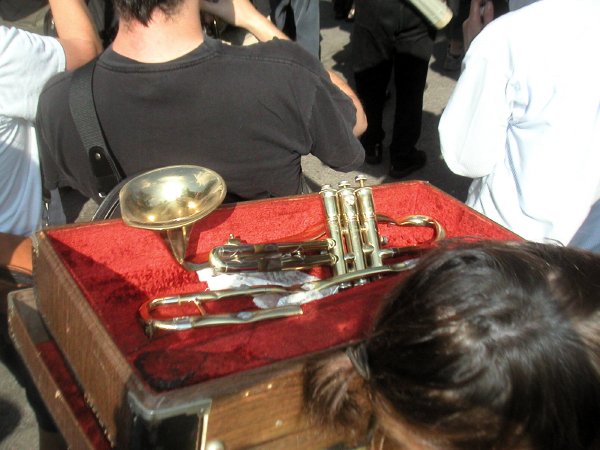
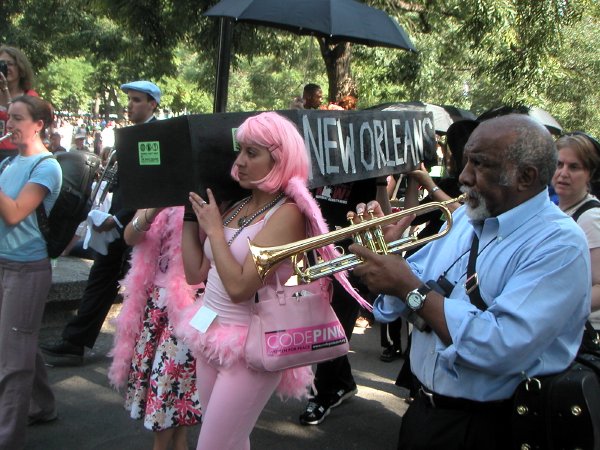
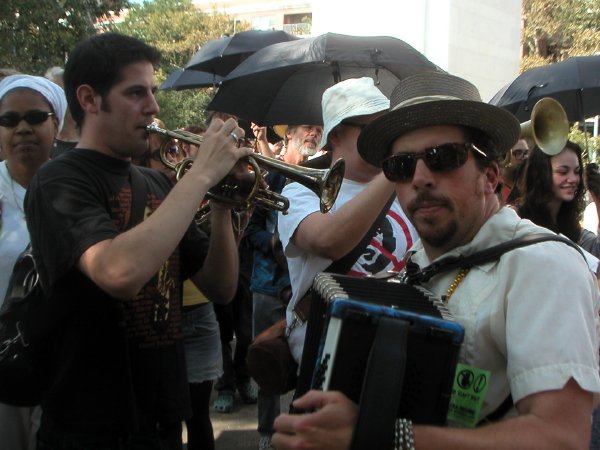
Barry and I were a part of this afternoon’s New Orleans Jazz Funeral March in Washington Square Park, where I managed to weave through an extraordinarily-diverse crowd to get a few decent images, even while encumbered by half of a sandwich board around my neck. My sign bore my simple conclusion:
NEED A REVOLUTION
The woman carrying on her shoulder a red velvet-lined case in which lay a shiny bent-up trumpet told me that some man she didn’t know had handed it to her, asking if she would carry it in the procession. For me that was the defining moment of the march and protest.
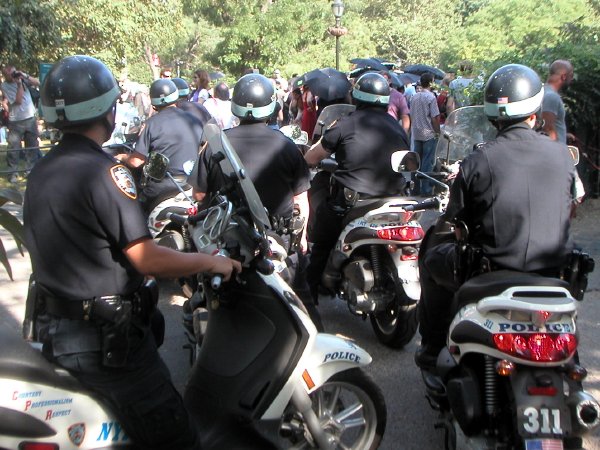
When we left and headed toward the West Village we had to squeeze through the phalanx of police motor scooters which had trailed this very peaceful group around the park for an hour.
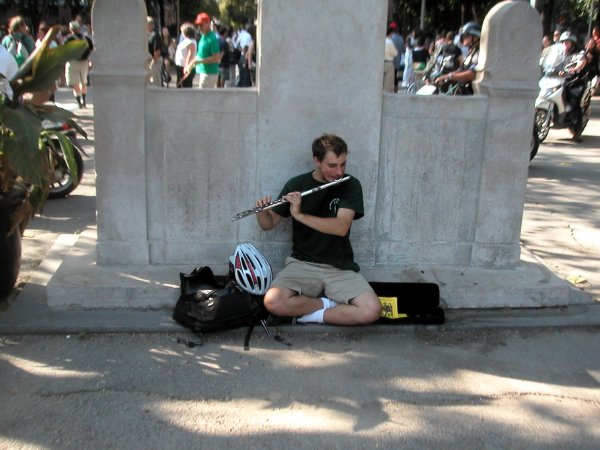
Seconds after I took a picture of this solitary flautist they swarmed into the open ground in front of him and faced the “mourners”.
Then the real surprise: Barely ten feet beyond this disturbing display of obsessively-focused armed law enforcement we found ourselves parties to the familiar, repeated pitch, “smoke”? “smoke”?
Ahhh. Still maybe the people’s park after all.
where to send help directly to the people who need it most
“Let the People Rebuild New Orleans”*
UPDATE: Community Labor United now has a website.
I’ve been looking at a lot of materials over for almost two weeks, and although many people have offered suggestions for directing money or other help to the people of New Orleans, I would like to suggest the importance of supporting the grassroots reconstruction of New Orleans by contributing whatever we can to:
The Peoples’ Hurricane Fund organized by Community Labor United [see my post from one week ago, or this piece in The Nation for information]
For additional community resources and organizations over the long haul, see these New Orleans people:
The Juvenile Justice Project of Louisiana,
The Justice Center and
Critical Resistence
*
the headline of Naomi Klein’s September 8 piece in The Nation
the nightmare began when the police and military showed up
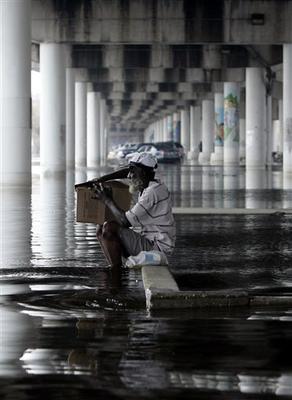
An unidentified man sits in the flood water underneath the Interstate-10 in New Orleans, La., Monday, Sept. 5, 2005.
I had forgotten to include a link to Rogers Cadenhead’s blog, which had inspired it, when I set up my own post on “trying to escape while black” yesterday, so I’m using my oversight as an excuse for uploading the entire story (now also on Counterpunch) below.
Nothing you will read about the disaster in New Orleans is likely to be more useful in understanding what went on inside than this surprisingly restrained account from two visitors caught in a nightmare which really began only when the police and military showed up.
First By the Floods, Then By Martial Law
TRAPPED IN NEW ORLEANS
By Larry Bradshaw
and Lorrie Beth Slonsky
Two days after Hurricane Katrina struck New Orleans, the Walgreens store at the corner of Royal and Iberville Streets in the city’s historic French Quarter remained locked. The dairy display case was clearly visible through the widows. It was now 48 hours without electricity, running water, plumbing, and the milk, yogurt, and cheeses were beginning to spoil in the 90-degree heat.
The owners and managers had locked up the food, water, pampers and prescriptions, and fled the city. Outside Walgreens’ windows, residents and tourists grew increasingly thirsty and hungry. The much-promised federal, state and local aid never materialized, and the windows at Walgreens gave way to the looters.
There was an alternative. The cops could have broken one small window and distributed the nuts, fruit juices and bottled water in an organized and systematic manner. But they did not. Instead, they spent hours playing cat and mouse, temporarily chasing away the looters.
We were finally airlifted out of New Orleans two days ago and arrived home on Saturday. We have yet to see any of the TV coverage or look at a newspaper. We are willing to guess that there were no video images or front-page pictures of European or affluent white tourists looting the Walgreens in the French Quarter.
We also suspect the media will have been inundated with “hero” images of the National Guard, the troops and police struggling to help the “victims” of the hurricane. What you will not see, but what we witnessed, were the real heroes and sheroes of the hurricane relief effort: the working class of New Orleans.
The maintenance workers who used a forklift to carry the sick and disabled. The engineers who rigged, nurtured and kept the generators running. The electricians who improvised thick extension cords stretching over blocks to share the little electricity we had in order to free cars stuck on rooftop parking lots. Nurses who took over for mechanical ventilators and spent many hours on end manually forcing air into the lungs of unconscious patients to keep them alive. Doormen who rescued folks stuck in elevators. Refinery workers who broke into boat yards, “stealing” boats to rescue their neighbors clinging to their roofs in flood waters. Mechanics who helped hotwire any car that could be found to ferry people out of the city. And the food service workers who scoured the commercial kitchens, improvising communal meals for hundreds of those stranded.
Most of these workers had lost their homes and had not heard from members of their families. Yet they stayed and provided the only infrastructure for the 20 percent of New Orleans that was not under water.
On Day Two, there were approximately 500 of us left in the hotels in the French Quarter. We were a mix of foreign tourists, conference attendees like ourselves and locals who had checked into hotels for safety and shelter from Katrina.
Some of us had cell phone contact with family and friends outside of New Orleans. We were repeatedly told that all sorts of resources, including the National Guard and scores of buses, were pouring into the city. The buses and the other resources must have been invisible, because none of us had seen them.
We decided we had to save ourselves. So we pooled our money and came up with $25,000 to have ten buses come and take us out of the city. Those who didn’t have the requisite $45 each were subsidized by those who did have extra money.
We waited for 48 hours for the buses, spending the last 12 hours standing outside, sharing the limited water, food and clothes we had. We created a priority boarding area for the sick, elderly and newborn babies. We waited late into the night for the “imminent” arrival of the buses. The buses never arrived. We later learned that the minute they arrived at the city limits, they were commandeered by the military.
By Day Four, our hotels had run out of fuel and water. Sanitation was dangerously bad. As the desperation and despair increased, street crime as well as water levels began to rise. The hotels turned us out and locked their doors, telling us that “officials” had told us to report to the convention center to wait for more buses. As we entered the center of the city, we finally encountered the National Guard.
The guard members told us we wouldn’t be allowed into the Superdome, as the city’s primary shelter had descended into a humanitarian and health hellhole. They further told us that the city’s only other shelter–the convention center–was also descending into chaos and squalor, and that the police weren’t allowing anyone else in.
Quite naturally, we asked, “If we can’t go to the only two shelters in the city, what was our alternative?” The guards told us that this was our problem–and no, they didn’t have extra water to give to us. This would be the start of our numerous encounters with callous and hostile “law enforcement.”
We walked to the police command center at Harrah’s on Canal Street and were told the same thing–that we were on our own, and no, they didn’t have water to give us. We now numbered several hundred.
We held a mass meeting to decide a course of action. We agreed to camp outside the police command post. We would be plainly visible to the media and constitute a highly visible embarrassment to city officials. The police told us that we couldn’t stay. Regardless, we began to settle in and set up camp.
In short order, the police commander came across the street to address our group. He told us he had a solution: we should walk to the Pontchartrain Expressway and cross the greater New Orleans Bridge to the south side of the Mississippi, where the police had buses lined up to take us out of the city.
The crowd cheered and began to move. We called everyone back and explained to the commander that there had been lots of misinformation, so was he sure that there were buses waiting for us. The commander turned to the crowd and stated emphatically, “I swear to you that the buses are there.”
We organized ourselves, and the 200 of us set off for the bridge with great excitement and hope. As we marched past the convention center, many locals saw our determined and optimistic group, and asked where we were headed. We told them about the great news.
Families immediately grabbed their few belongings, and quickly, our numbers doubled and then doubled again. Babies in strollers now joined us, as did people using crutches, elderly clasping walkers and other people in wheelchairs. We marched the two to three miles to the freeway and up the steep incline to the bridge. It now began to pour down rain, but it didn’t dampen our enthusiasm.
As we approached the bridge, armed sheriffs formed a line across the foot of the bridge. Before we were close enough to speak, they began firing their weapons over our heads. This sent the crowd fleeing in various directions.
As the crowd scattered and dissipated, a few of us inched forward and managed to engage some of the sheriffs in conversation. We told them of our conversation with the police commander and the commander’s assurances. The sheriffs informed us that there were no buses waiting. The commander had lied to us to get us to move.
We questioned why we couldn’t cross the bridge anyway, especially as there was little traffic on the six-lane highway. They responded that the West Bank was not going to become New Orleans, and there would be no Superdomes in their city. These were code words for: if you are poor and Black, you are not crossing the Mississippi River, and you are not getting out of New Orleans.
Our small group retreated back down Highway 90 to seek shelter from the rain under an overpass. We debated our options and, in the end, decided to build an encampment in the middle of the Ponchartrain Expressway–on the center divide, between the O’Keefe and Tchoupitoulas exits. We reasoned that we would be visible to everyone, we would have some security being on an elevated freeway, and we could wait and watch for the arrival of the yet-to-be-seen buses.
All day long, we saw other families, individuals and groups make the same trip up the incline in an attempt to cross the bridge, only to be turned away–some chased away with gunfire, others simply told no, others verbally berated and humiliated. Thousands of New Orleaners were prevented and prohibited from self-evacuating the city on foot.
Meanwhile, the only two city shelters sank further into squalor and disrepair. The only way across the bridge was by vehicle. We saw workers stealing trucks, buses, moving vans, semi-trucks and any car that could be hotwired. All were packed with people trying to escape the misery that New Orleans had become.
Our little encampment began to blossom. Someone stole a water delivery truck and brought it up to us. Let’s hear it for looting! A mile or so down the freeway, an Army truck lost a couple of pallets of C-rations on a tight turn. We ferried the food back to our camp in shopping carts.
Now – secure with these two necessities, food and water – cooperation, community and creativity flowered. We organized a clean-up and hung garbage bags from the rebar poles. We made beds from wood pallets and cardboard. We designated a storm drain as the bathroom, and the kids built an elaborate enclosure for privacy out of plastic, broken umbrellas and other scraps. We even organized a food-recycling system where individuals could swap out parts of C-rations (applesauce for babies and candies for kids!).
This was something we saw repeatedly in the aftermath of Katrina. When individuals had to fight to find food or water, it meant looking out for yourself. You had to do whatever it took to find water for your kids or food for your parents. But when these basic needs were met, people began to look out for each other, working together and constructing a community.
If the relief organizations had saturated the city with food and water in the first two or three days, the desperation, frustration and ugliness would not have set in.
Flush with the necessities, we offered food and water to passing families and individuals. Many decided to stay and join us. Our encampment grew to 80 or 90 people.
From a woman with a battery-powered radio, we learned that the media was talking about us. Up in full view on the freeway, every relief and news organizations saw us on their way into the city. Officials were being asked what they were going to do about all those families living up on the freeway. The officials responded that they were going to take care of us. Some of us got a sinking feeling. “Taking care of us” had an ominous tone to it.
Unfortunately, our sinking feeling (along with the sinking city) was accurate. Just as dusk set in, a sheriff showed up, jumped out of his patrol vehicle, aimed his gun at our faces and screamed, “Get off the fucking freeway.” A helicopter arrived and used the wind from its blades to blow away our flimsy structures. As we retreated, the sheriff loaded up his truck with our food and water.
Once again, at gunpoint, we were forced off the freeway. All the law enforcement agencies appeared threatened when we congregated into groups of 20 or more. In every congregation of “victims,” they saw “mob” or “riot.” We felt safety in numbers. Our “we must stay together” attitude was impossible because the agencies would force us into small atomized groups.
In the pandemonium of having our camp raided and destroyed, we scattered once again. Reduced to a small group of eight people, in the dark, we sought refuge in an abandoned school bus, under the freeway on Cilo Street. We were hiding from possible criminal elements, but equally and definitely, we were hiding from the police and sheriffs with their martial law, curfew and shoot-to-kill policies.
The next day, our group of eight walked most of the day, made contact with the New Orleans Fire Department and were eventually airlifted out by an urban search-and-rescue team.
We were dropped off near the airport and managed to catch a ride with the National Guard. The two young guardsmen apologized for the limited response of the Louisiana guards. They explained that a large section of their unit was in Iraq and that meant they were shorthanded and were unable to complete all the tasks they were assigned.
We arrived at the airport on the day a massive airlift had begun. The airport had become another Superdome. We eight were caught in a press of humanity as flights were delayed for several hours while George Bush landed briefly at the airport for a photo op. After being evacuated on a Coast Guard cargo plane, we arrived in San Antonio, Texas.
There, the humiliation and dehumanization of the official relief effort continued. We were placed on buses and driven to a large field where we were forced to sit for hours and hours. Some of the buses didn’t have air conditioners. In the dark, hundreds of us were forced to share two filthy overflowing porta-potties. Those who managed to make it out with any possessions (often a few belongings in tattered plastic bags) were subjected to two different dog-sniffing searches.
Most of us had not eaten all day because our C-rations had been confiscated at the airport–because the rations set off the metal detectors. Yet no food had been provided to the men, women, children, elderly and disabled, as we sat for hours waiting to be “medically screened” to make sure we weren’t carrying any communicable diseases.
This official treatment was in sharp contrast to the warm, heartfelt reception given to us by ordinary Texans. We saw one airline worker give her shoes to someone who was barefoot. Strangers on the street offered us money and toiletries with words of welcome.
Throughout, the official relief effort was callous, inept and racist. There was more suffering than need be. Lives were lost that did not need to be lost.
Larry Bradshaw and Lorrie Beth Slonsky are emergency medical services (EMS) workers from San Francisco and contributors to Socialist Worker. They were attending an EMS conference in New Orleans when Hurricane Katrina struck. They spent most of the next week trapped by the flooding–and the martial law cordon around the city.
[image by Eric Gay for AP from Times Picayune]
“another country”
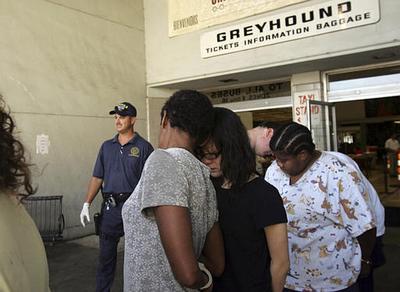
A line of women in custody line up at a makeshift jail facility at the Union Passenger Terminal in New Orleans, Friday, Sept. 9. The temporary holding facility holds those accused of a crime before they are sent to an operating jail. [Times Picayune caption dated September 10]
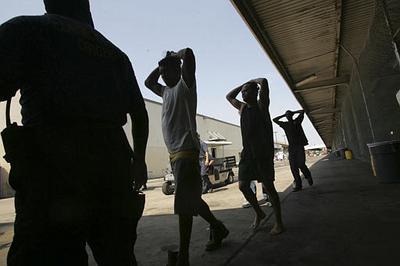
A line of men in custody line up after arriving from Jefferson Parish at a makeshift jail facility at the Union Passenger Terminal in New Orleans, Friday. The temporary facility holds those accused of a crime before being sent to an operating jail. [Times Picayune caption dated September 10]
A third letter from Jordan Flaherty:
Mourning For New Orleans
by Jordan Flaherty
Its been six days since I left New Orleans, and I miss
my home so much. Im still in a daze, its hard to
hold a conversation or to think straight. People ask
if everyone I know is ok, and I dont know what to
say. There are so many stories, so many rumors, so
many people dispersed around the US. So many of us
may never see each other again. I dont think any of
us are ok right now.
One friend, a teacher, was searching the Astrodome
while holding up a sign, looking for his former
students. Another friend says she fears shell never
see New Orleans or her friends from there again.
Another friend found temporary comfort with family in
Houston and then got kicked out. A lot of friends are
working in shelters, providing assistance, medical
care, whatever they can. We are already spread across
so many states, trying to pick up the pieces of our
lives.
I can think of at least thirty people that I have no
idea where they are. In some cities it seems like
when people meet they give out their email address or
weblog or friendster or whatever. In New Orleans, a
lot of us only know each other only by first names.
There are so many people I would see at least once a
week that I dont know how to get in touch with at
all. Even cel phones from the New Orleans area code
have been nonfunctioning for most of the last two
weeks.
New Orleans is a word of mouth town. The way you
would find out about parties, secondlines, jazz
funerals and other events is from hearing about it
from friends. I always liked that about New Orleans.
In an increasingly disconnected world, New Orleans
felt different, more real and concrete. Now that
we arent seeing each other regularly, our elaborate
communication network has broken down.
But when people ask I just say, yes, as far as I know
everyone is ok. I cant really bring myself to think
about it further than that.
Those with the least to begin with are the ones we
worry about most now. Families and Friends of
Louisianas Incarcerated Children is a grassroots
organization with a long history of fighting for New
Orleans most vulnerable. Since hurricane Katrina,
they have been on the front lines of relief,
spending time in the shelters, helping advocate for
the refugees of New Orleans, and trying to find out
what happened to both adults and children who were
locked up while New Orleans flooded.
There has been a lot of media hysteria regarding those
who were locked in New Orleans prisons during the
hurricane, stories that make it sound like a Hollywood
action film where murderers use a disaster to escape
and wreck havoc.
This is exactly wrong. The truth is that tales from
the imprisoned population of New Orleans are among the
most heartbreaking stories of the past week.
Families are still looking for loved ones lost in the
system. According to organizers with FFLIC, of
approximately 240 kids in state custody, as of a
couple of days ago only 6 or 7 parents had been able
to track down their children.
According to statistics compiled by the Juvenile
Justice Project of Louisiana, at least 78% of New
Orleans incarcerated youth were locked up for
nonviolent offenses. The detention center in Jefferson
Parish reports that 96% of the youth held there in
2000 were for nonviolent offenses. At least a third
of youth in prison have been sentenced to three or
more years for nonviolent offenses. In New
Orleans, 95% of the detained youth in 1999 were
African-American. Louisiana taxpayers spend
$96,713 to incarcerate a single child, and $4,724 to
educate a child in the public schools.
According to a report by Human Rights Watch, the
state of Louisiana has one of the highest rates in
the country of children living in poverty and children
not in school or working. Large numbers of children,
especially black children, are suspended from school
each year, sometimes for the whole year. Approximately
1,500 Louisiana children are confined in secure
correctional facilities each year…In response to the
question,”what would you most like to change here?”,
virtually every child at all of the facilities
responded that they would like the guards to stop
hitting them and that they would like more food.
Children consistently told us that they were hungry.
Some people have been hurt to hear people of New
Orleans called refugees. This hurts me too, but it
hurts me more to feel that we have been treated as
refugees. In a way, the people of New Orleans were
refugees before hurricane Katrina ever came. We were
abandoned by a country that never needed us, unless they needed a cheap vacation of strip clubs and binge drinking and
cheap live music.
One of the things I love about New Orleans is that it
always feels like another country. Now we see that in
the eyes of the federal government we truly are
residents of another country. A poor, black country.
Instead of insisting that the displaced of New Orleans
are not refugees, we should use this as an opportunity
to look at why the idea of US refugees is so
discomforting.
The transformation of the people of New Orleans into
refugees is a large part of what has captured the
imagination of people from around the world,
especially those who are refugees themselves. Ive
received emails from Ghana and Cuba and Peru and
Lebanon and Palestine. In New York City tonight, a
group of artists, initiated by Def Poetry Jam star and
Palestinian poet Suheir Hammad, organized a benefit
called Refugees For Refugees. That title beautifully
and poignantly captures the feelings this man-made
tragedy has generated around the world.
In her most recent poem, “On Refuge and Language”,
Suheir writes:I do not wish
To place words in living mouths
Or bury the dead dishonorably
I am not deaf to cries escaping shelters
That citizens are not refugees
Refugees are not Americans
I will not use language
One way or another
To accommodate my comfort
I will not look away
All I know is this
No peoples ever choose to claim status of dispossessed
No peoples want pity above compassion
No enslaved peoples ever called themselves slaves
What do we pledge allegiance to?
A government that leaves its old
To die of thirst surrounded by water
Is a foreign government
People who are streaming
Illiterate into paperwork
Have long ago been abandoned
I think of coded language
And all that words carry on their backs
I think of how it is always the poor
Who are tagged and boxed with labels
Not of their own choosing
I think of my grandparents
And how some called them refugees
Others called them non-existent
They called themselves landless
Which means homeless
Before the hurricane
No tents were prepared for the fleeing
Because Americans do not live in tents
Tents are for Haiti for Bosnia for Rwanda
Refugees are the rest of the world
Those left to defend their human decency
Against conditions the rich keep their animals from
Those who have too many children
Those who always have open hands and empty bellies
Those whose numbers are massive
Those who seek refuge
From natures currents and man’s resources
Those who are forgotten in the mean times
Those who remember
Ahmad from Guinea makes my falafel sandwich and says
So this is your country
Yes Amadou this my country
And these my people
Evacuated as if criminal
Rescued by neighbors
Shot by soldiers
Adamant they belong
The rest of the world can now see
What I have seen
Do not look away
The rest of the world lives here too
In America
[images by Lisa Krantz from AP via Times Picayune]