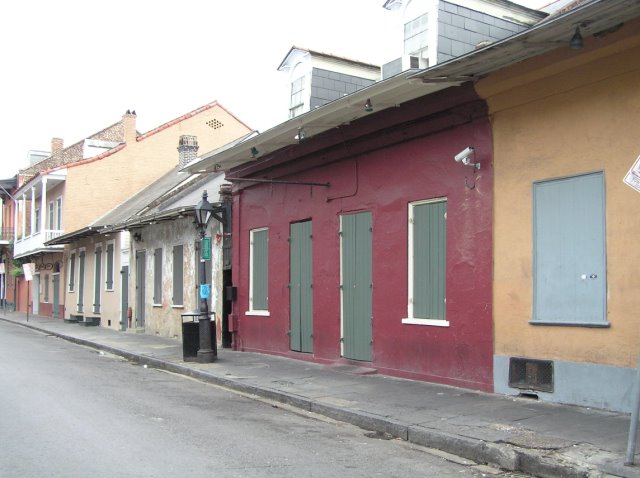
the day before
UPDATE: “Five Days with Katrina” had moved and, thanks to Silvia Morales who told me where it went, the link below now works once again
I haven’t seen anything like this site before now. This album, “Five Days with Katrina,” is in the form of a five-day diary posted by someone who survived the New Orleans hurricane inside the French Quarter. There are almost two hundred extraordiary images accompanied by some fascinating captions.
I haven’t gone through more than a few dozen myself yet, but wanted to broadcast the site right away. I have to say that the photographs of ancient deserted streets taken just before the storm hit are incredibly beautiful.
I don’t know much about this wonderful witness, but his name is Alvaro R. Morales Villa.
[thanks to Vincent Fisher for the link]
Category: General
suburban police blocked those trying to escape while black
None of this surprises me any more, although there was a time, less than two weeks ago, when I could still go about the day without these images of the horrors of our racism haunting me all day long and through much of the night.
Police Trapped Thousands in New Orleans
As the situation grew steadily worse in New Orleans last week, you might have wondered why people didn’t just leave on foot. The Louisiana Superdome is less than two miles from a bridge that leads over the Mississippi River out of the city.
The answer: Any crowd that tried to do so was met by suburban police, some of whom fired guns to disperse the group and seized their water.
This is a short excerpt from a post by Rogers Cadenhead linked from Atrios, who headlined his own abreviated citing, “America’s Worst Person,” referring to Gretna, Louisiana police chief Arthur Lawson.
FOOTNOTE: See the identiy of the armed man in an LAT photograph I included in this post of mine. Even a week ago I was struck by the imagery I found in several photographs I found which included Gretna police interacting with New Orleans refugees.
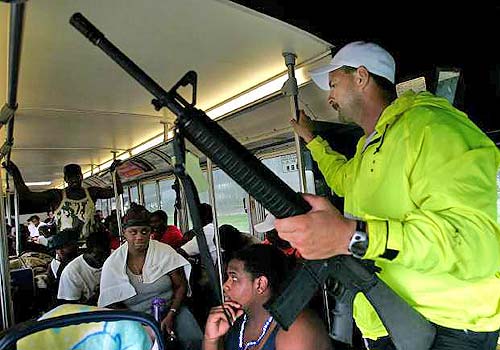
Gretna police officer Ray Lassiegne stands guard over a busload of evacuees after they were picked up near the Greater New Orleans Bridge just south of New Orleans. [Los Angeles Times caption, image dated September 1]
My point is not to paint an entire town with the color of racism or just plain selfishness (in this case, criminal), nor is it to exclude individuals or communities elsewhere. We can all share in the blame, and we know it, even as we express our outrage.
[image by Robert Gauthier from the Los Angeles Times, via Newsday]
a discussion of addiction helps us all to understand the chaos
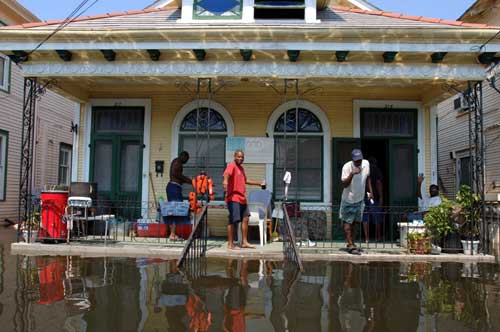
no dystopia here*
In an OPINION piece in Newsday this morning Patrick Moore writes about a subject which is extremely important to our understanding of both the reports of violence in a devastated New Orleans and the actual facts (not necessarily the same thing): drug and alcohol addiction. Even the most liberal elements of the media have largely avoided the subject of addiction and treatment in the poorest communities of the city.
Moore reminds us that, in addition to the parties already (morally) indicted, the guilt for this enormous tragedy must be shared by those who have addressed addiction and alcoholism as a criminal rather than a medical problem – for a hundred supposedly modern years in a supposedly modern nation.
For a week and a half I’ve watched many of my countrymen find ways to blame the people of New Orleans for their own “victimhood.” Why did some people get it right away while others will go to their graves convinced that the folks remaining in the city got what they deserved? First it was about maintaining a smug distance from the dead and the sick and those who were trapped in their homes. Then it was condemning those who had to scavenge in order to survive in a world which had been abandoned by the more fortunate, and their were demands that “looters” be shot. Finally, it was about being absolutely assured that the thefts of durable goods and bodily violence only proved that the victims were fundamentally beasts feeding on each other in a Hobbesian jungle.
Moore shines some light on that putative dystopia in this excerpt from the article:
Storm waters dry up drugs
Without programs to treat addiction, it’s no wonder the social fabric is torn to shreds
Many television viewers watching the aftermath of Hurricane Katrina last week found that their compassion soured as they watched the violence and looting in New Orleans. But what did those images really mean?
Disasters have a way of making hidden problems visible and, in this case, the effects of disproportionate addiction and alcoholism rates in poor, minority communities have been dramatically revealed. Already living in despair before the disaster, the looters were deprived of the “medicine” that made life bearable; violence was inevitable.
. . . .
When the president talks about “zero tolerance” for looters, he seems unable to recognize the conditions that produced their behavior. It’s hard to imagine his drawing a connection between the violence of looting by desperate poor people living in addiction and his own economic policies. Yet, the brutality of his “compassionate conservatism” is evidenced by poverty levels rising under this administration while federal funding for drug treatment has gone down.
. . . .
The most successful rehabilitation programs are in-patient and last at least 30 days. During that time, patients are provided with counseling, medical care, psychiatric evaluation and job training. Transitional housing after treatment further enhances the chances of an addict staying sober and returning to a productive life.
This type of treatment is now mostly available only to the wealthy or those with private insurance. We need to widen the range of recipients. While rigorous treatment programs are expensive, experts agree that they are still far more cost-effective than law enforcement.
In America, the poor are disproportionately likely to be addicts and less likely to have effective treatment available to them. When these people are forced to come down hard, it’s not surprising that some of them turn to violence. Law enforcement is not the answer. We need to reduce poverty in America and provide effective addiction treatment. We can no longer hide this problem or wait for the next crisis to deal with it.
*
the Newsday caption (undated) reads: Kevin Edwards, 42, his friend Daniel Mirenbe, 33, James Brown Jr., 50, who is brushing his teeth, and Dwayne Henderson, 36, sitting right, all refuse to leave their home.
[image by J. Conrad Williams Jr. for Newsday]
but what about their right of return . . . .
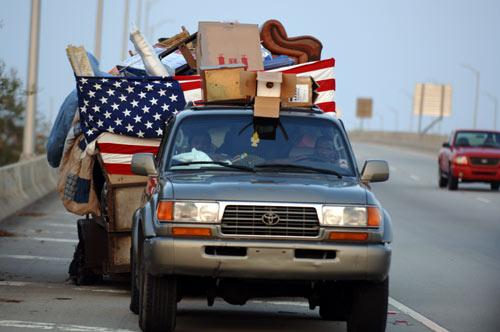
Joseph Williams attempts to leave New Orleans on Interstate 10. He has two flat tires on his trailer that is carrying half of everything he owns.
If tons of money end up going to restore New Orleans and protect it from floods in the future, I think we can be pretty certain they’re not going to let those people come back. It’s very interesting that the very best start for such a policy would be to force the poor out now, and that’s exactly what they’re doing. This is true regardless of the merits of arguments about the uninhabitability of the entire city.
In an email he sent to me today James W. Bailey used the familiar phrase, “right of return,” in a context I had not found it before. I immediately Googled it and found it prominently placed within a piece by Lloyd Hart, the last part of which I’m excerpting here from the North Carolina Independent Media Center site.
There are several reasons why New Orleans should not be totally controlled by the federal government and completely evacuated. The first and foremost is that local population should be the ones hired into the cleanup and reconstruction process as it is their jobs in the City of New Orleans that have been destroyed. Local contractors and local construction personnel should be given the contracts that are dispersed and specifically in the City of New Orleans the Mayor’s Office should be the office handling the dispersal of those contracts. As someone who worked on the Big dig in Boston I can tell you straight up you don’t want Bechtel Corp. building your dikes and levees after the leaky tunnels they built for us in Boston.
If there are dry homes that have not been flooded and there are people living in them, they should not be evacuated and people who wish to return to those dry homes should be allowed to. A civil society can not repair and redevelop if there are no citizens with a long history of the community to do so. And because of the varying degrees of flooding many homes are less damaged than others and therefore repairable.
Everyone must be for warned that there are greedy developers already rubbing their hands together hoping to use the recent corrupt Supreme Court ruling of imminent domain which allows for transferring private property into the hands of private developers to turn the city into some bizarre Disneyland version of New Orleans that existed before the hurricane but without the middle, working class, and poor folks that created the wonderful expression of culture that turned the pain and suffering caused by slavery into the healing power of the music New Orleans has become as famous for. The music born in Africa, raised on the plantation fields of America by black slaves and through the 20 century, the music that has become the road to our collective salvation.
If any of those folks that have been evacuated and not just the homeowners but the tenants as well lose their right to return to where they lived before Hurricane Katrina because of some nefarious claim that the market must be allowed to shake out the unproductive population in the reconstruction process then you can be sure the music will truly die. Assassinated by white gentrification.
The gentrification that was already taking place in New Orleans must not be allowed to accelerate or restart at all simply because the white guys in White House have decided to take complete charge of the disaster because of the Reagan and Bush regimes deliberate undermining of all Federal departments that deal directly with the civil society in America creating the “Fuck You Government.”
Just so you think about this a little. Another reason the white guys in the white house may want complete control of New Orleans may be to control and prevent the body count in the city from becoming the next stage of Bush Regime’s worst P.R. nightmare. You know, just like in Iraq “We don’t count the Civilian casualties.”
And then a short while ago this showed up as the lead story on Reuters.
FEMA accused of censorship
WASHINGTON (Reuters) – When U.S. officials asked the media not to take pictures of those killed by Hurricane Katrina and its aftermath, they were censoring a key part of the disaster story, free speech watchdogs said on Wednesday.
The move by the Federal Emergency Management Agency [FEMA] is in line with the Bush administration’s ban on images of flag-draped U.S. military coffins returning from the Iraq war, media monitors said in separate telephone interviews.
“It’s impossible for me to imagine how you report a story whose subject is death without allowing the public to see images of the subject of the story,” said Larry Siems of the PEN American Center, an authors’ group that defends free expression. [excerpt]
[image by J. Conrad Williams Jr. from Newsday]
“DEAD WHITE RICH GUY . . . LAID TO REST IN DC!”
The entire headline, taken from another blogger’s post, reads:
STOP THE FUCKING PRESSES! A DEAD WHITE RICH GUY WHO WORE A BLACK ROBE FOR A LIVING IS LAID TO REST IN DC!
Some people are very mad. Very, very mad. I see sense in all of it.
James W. Bailey* is from New Orleans. He sees a connection between two of today’s big stories, and it’s a connection we should all be able to recognize, on the day a powerful man is laid in the [dry] ground.
On his website Bailey shows a Washington Post photo of Bush standing on polished marble floors beside a flag-draped coffin resting on a plinth. At the foot of this monumental assemblage stands a huge bouquet of flowers professionally arranged (although part of their traditional function, disguising the odor of rotting flesh, had been rendered unnecessary by the attentions of an embalmer). Inside the fancy box is the body of William Rehnquist.
Below the Post image is a very different picture.
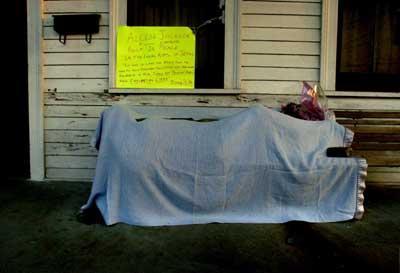
The corpse of Alcede Jackson is reverently laid out on his front porch and abandoned with a blanket held down by slate and a epitath on a poster board.
Bailey’s site continues:
The corpse of Alcede Jackson is reverantly laid out on his front porch in New Orleans. President Bush and first lady Laura Bush were unable to attend Mr. Jackson’s funeral. Some in New Orleans are suggesting, since he couldn’t attend the funeral ceremonies for Mr. Jackson because of a pressing schedule engaged in the War on Terror, that the President should consider sending the surviving members of Mr. Jackson’s family an American flag that has been flown over the Supreme Court Building. Although Mr. Jackson was not a rich white guy, and did not wear a black robe for a living, he did in fact wear black skin…and for all of his life.
No flag.
*
UPDATE: if you go to this link the first image you will see, according to the artist, was shot in the Lower 9th Ward in 1994, the area of the city that sustained some of the worst of the current flooding. Mr. Jackson, whose remains and memorial are pictured in the Times Picayune photo lived in the Lower 9th Ward
[if anyone has access to a larger image than the one I used here, please let me know, and I would like to see the entire text of the yellow sign]
[image by Ted Jackson from the plucky and courageous people of the Times Picayune]
the “can’t-do” folks, and lessons lost – or never learned
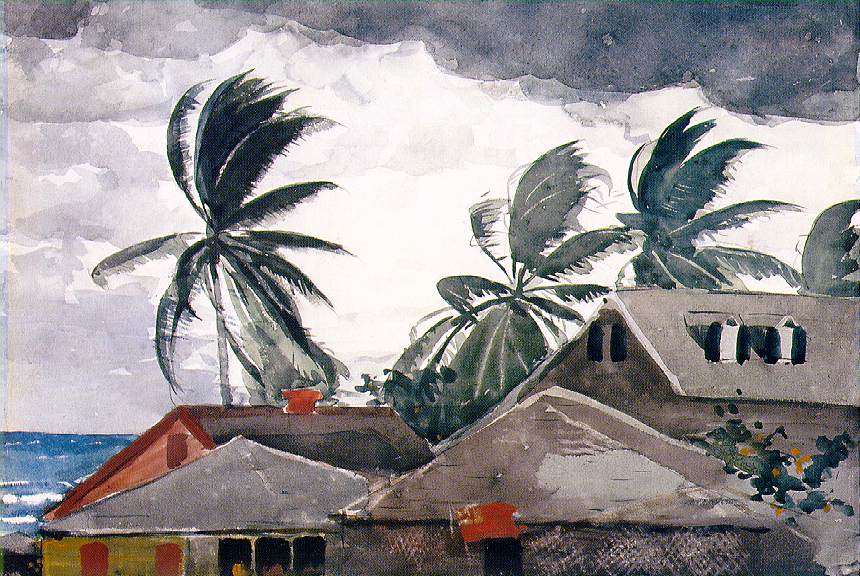
Winslow Homer Hurricane, Bahamas 1898-99 watercolor 14.5″ x 21″
I have two more stories which should be read more widely than they are likely to be. Like the tip on the previous post, both were sent to me by Steve Quester (who, as these things work, of course was himself tipped by his friends). The first is a description of an American state which was the target of a Category 4 hurricane last week; the second is a picture of a very different state which endured a Category 5 hurricane one year ago. Louisiana is an incalculable physical and human catastrophe; Cuba lost 20,000 homes, but no one died.
The Ugly Truth: Why we couldn’t save the people of New Orleans by Errol Louis
Bubbling up from the flood that destroyed New Orleans are images, beamed around the world, of America’s original and continuing sin: the shabby, contemptuous treatment this country metes out, decade after decade, to poor people in general and the descendants of African slaves in particular. The world sees New Orleans burning and dying today, but the televised anarchy – the shooting and looting, needless deaths, helpless rage and maddening governmental incompetence – was centuries in the making. [continued]
The Two Americas by Marjorie Cohn
Last September, a Category 5 hurricane battered the small island of Cuba with 160-mile-per-hour winds. More than 1.5 million Cubans were evacuated to higher ground ahead of the storm. Although the hurricane destroyed 20,000 houses, no one died.
What is Cuban President Fidel Castro’s secret? According to Dr. Nelson Valdes, a sociology professor at the University of New Mexico, and specialist in Latin America, “the whole civil defense is embedded in the community to begin with. People know ahead of time where they are to go.” [continued]
[image from theweathernotebook]
the criminal politics of disaster, seen from inside New Orleans
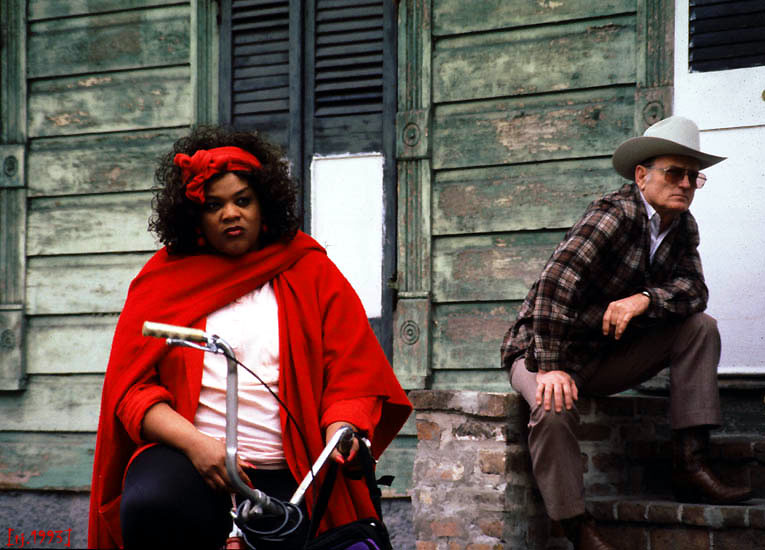
Algiers, Louisiana, 1993
This is a letter from a dry Algiers. No, not the sandy one. It’s the New Orleans neighborhood just across the river from the watery parts.
This piece is copied in its entirety from ZNet.
[Note: Malik Rahim, a veteran of the Black Panther Party in New Orleans, for decades an organizer of public housing tenants both there and in San Francisco and a recent Green Party candidate for New Orleans City Council, lives in the Algiers neighborhood, the only part of New Orleans that is not flooded. They have no power, but the water is still good and the phones work. Their neighborhood could be sheltering and feeding at least 40,000 refugees, he says, but they are allowed to help no one. What he describes is nothing less than deliberate genocide against Black and poor people.]
New Orleans, Sept. 1, 2005 — It’s criminal. From what you’re hearing, the people trapped in New Orleans are nothing but looters. We’re told we should be more “neighborly.” But nobody talked about being neighborly until after the people who could afford to leave — left.
If you ain’t got no money in America, you’re on your own. People were told to go to the Superdome, but they have no food, no water there. And before they could get in, people had to stand in line for 4-5 hours in the rain because everybody was being searched one by one at the entrance.
I can understand the chaos that happened after the tsunami, because they had no warning, but here there was plenty of warning. In the three days before the hurricane hit, we knew it was coming and everyone could have been evacuated.
We have Amtrak here that could have carried everybody out of town. There were enough school buses that could have evacuated 20,000 people easily, but they just let them be flooded. My son watched 40 buses go underwater – they just wouldn’t move them, afraid they’d be stolen.
People who could afford to leave were so afraid someone would steal what they own that they just let it all be flooded. They could have let a family without a vehicle borrow their extra car, but instead they left it behind to be destroyed.
There are gangs of white vigilantes near here riding around in pickup trucks, all of them armed, and any young Black they see who they figure doesn’t belong in their community, they shoot him. I tell them, “Stop! You’re going to start a riot.”
When you see all the poor people with no place to go, feeling alone and helpless and angry, I say this is a consequence of HOPE VI. New Orleans took all the HUD money it could get to tear down public housing, and families and neighbors who’d relied on each other for generations were uprooted and torn apart.
Most of the people who are going through this now had already lost touch with the only community they’d ever known. Their community was torn down and they were scattered. They’d already lost their real homes, the only place where they knew everybody, and now the places they’ve been staying are destroyed.
But nobody cares. They’re just lawless looters … dangerous.
The hurricane hit at the end of the month, the time when poor people are most vulnerable. Food stamps don’t buy enough but for about three weeks of the month, and by the end of the month everyone runs out. Now they have no way to get their food stamps or any money, so they just have to take what they can to survive.
Many people are getting sick and very weak. From the toxic water that people are walking through, little scratches and sores are turning into major wounds.
People whose homes and families were not destroyed went into the city right away with boats to bring the survivors out, but law enforcement told them they weren’t needed. They are willing and able to rescue thousands, but they’re not allowed to.
Every day countless volunteers are trying to help, but they’re turned back. Almost all the rescue that’s been done has been done by volunteers anyway.
My son and his family – his wife and kids, ages 1, 5 and 8 – were flooded out of their home when the levee broke. They had to swim out until they found an abandoned building with two rooms above water level.
There were 21 people in those two rooms for a day and a half. A guy in a boat who just said “I’m going to help regardless” rescued them and took them to Highway I-10 and dropped them there.
They sat on the freeway for about three hours, because someone said they’d be rescued and taken to the Superdome. Finally they just started walking, had to walk six and a half miles.
When they got to the Superdome, my son wasn’t allowed in – I don’t know why – so his wife and kids wouldn’t go in. They kept walking, and they happened to run across a guy with a tow truck that they knew, and he gave them his own personal truck.
When they got here, they had no gas, so I had to punch a hole in my gas tank to give them some gas, and now I’m trapped. I’m getting around by bicycle.
People from Placquemine Parish were rescued on a ferry and dropped off on a dock near here. All day they were sitting on the dock in the hot sun with no food, no water. Many were in a daze; they’ve lost everything.
They were all sitting there surrounded by armed guards. We asked the guards could we bring them water and food. My mother and all the other church ladies were cooking for them, and we have plenty of good water.
But the guards said, “No. If you don’t have enough water and food for everybody, you can’t give anything.” Finally the people were hauled off on school buses from other parishes.
You know Robert King Wilkerson (the only one of the Angola 3 political prisoners who’s been released). He’s been back in New Orleans working hard, organizing, helping people. Now nobody knows where he is. His house was destroyed. Knowing him, I think he’s out trying to save lives, but I’m worried.
The people who could help are being shipped out. People who want to stay, who have the skills to save lives and rebuild are being forced to go to Houston.
It’s not like New Orleans was caught off guard. This could have been prevented.
There’s military right here in New Orleans, but for three days they weren’t even mobilized. You’d think this was a Third World country.
I’m in the Algiers neighborhood of New Orleans, the only part that isn’t flooded. The water is good. Our parks and schools could easily hold 40,000 people, and they’re not using any of it.
This is criminal. These people are dying for no other reason than the lack of organization.
Everything is needed, but we’re still too disorganized. I’m asking people to go ahead and gather donations and relief supplies but to hold on to them for a few days until we have a way to put them to good use.
I’m challenging my party, the Green Party, to come down here and help us just as soon as things are a little more organized. The Republicans and Democrats didn’t do anything to prevent this or plan for it and don’t seem to care if everyone dies.
water, water everywhere . . . .
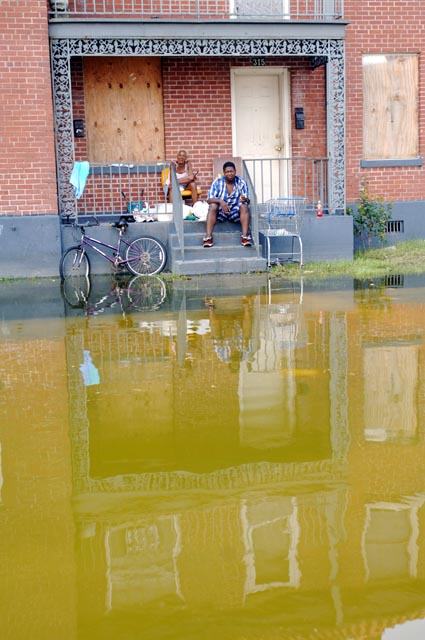
Two woman sitting in front of their home in New Orleans. They are not looking for another place to live even, though they have nothing to eat or drink.
As if the news from the past week wasn’t sufficiently horrific already, we have to prepare ourselves for what still lies ahead.
I just saw a headline expressing alarm about what lies beneath the water. But the accompanying story is about much more than the bodies of people who have already succumbed to this natural and man-made disaster. The water itself holds still more peril for the entire Gulf region. This site has been doing an excellent job preparing us for the news we will be seeing for many years to come.
The real disaster may have only just begun.
[thanks to Peter, who left a comment on my previous post giving a link to this section of Politics in the Zeros]
[image by Conrad Williams Jr. from Newsday]
keeping New Orleans alive, and honoring the dead their way
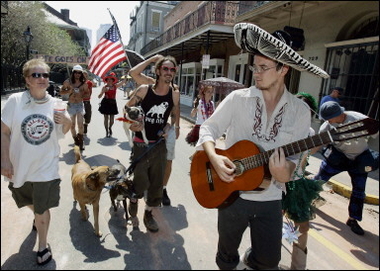
A ‘Gay Parade’ gets under way in the French Quarter of New Orleans. as a determined handful of hurricane survivors vowed to keep the spirit of New Orleans alive. The official parade was postponed because of the arrival of Hurricane Katrina six days ago.
New Orleans has a better chance of surviving if New Orleaneans are there to keep it going. Nobody should even think of leaving it all up to FEMA. Agence France Presse shows us today a little bit of how it’s going to happen.
NEW ORLEANS, United States (AFP) – Music, Mardi Gras beads, costumes and confetti returned to the French Quarter as a determined handful of hurricane survivors vowed to keep the spirit of New Orleans alive.
Decked out in a red polka-dot tutu and purple parasol, Candice Jamieson, marched through the city’s eerie abandoned streets, rattling a tambourine.
“We’re having a decadence parade,” said the 21-year-old student, referring to the annual gay pride march, usually a massive and raucous affair that rivals the city’s famed Mardi Gras festivities.
“We’re trying to bring up everyone’s morale,” Jamieson said moments before reaching out to catch beads tossed by the only populated balcony in Royal street.
“It’s usually a lot bigger,” Georgia Walker, 53, called down as she tossed more beads.
. . . .
Asked whether he thought some people might consider the parade in poor taste given that hundreds of survivors remained stranded and that rescue workers were harvesting the bodies of storm victims from streets and flooded homes, [Michael Skidmore] said the city was in desperate need of a little joy amid the carnage.
“We’re going to make life better, even if they laugh at us, we want them to laugh,” he said as his grass skirt flapped in the breeze.
Dancing in the streets is a traditional way of honoring the dead in the region, explained Diana Stray Dog as she held a pole flying a huge American flag against her shoulder.
“In New Orleans we celebrate death. When people die we go in the streets and sing,” she said, adding that she was marching to return some life to the battered city.
“Amid all the tears and all the sorrow we have a big heart and it’s not going to die.”
One of a number of places sheltering the life which continues in the city, in defiance of the authorities’ orders to leave, is Molly’s at the Market, described in better times by one fan as “Our favorite watering hole in the quarter, full of dropouts, queers, freaks, and phds. Oh yeah, and a fabulous juke box.”
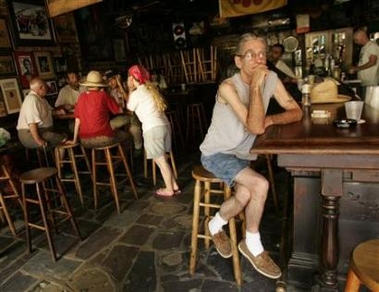
A patron spends the afternoon at Molly’s at the Market, one of at least two bars in New Orleans’ French Quarter that has remained open after Hurricane Katrina despite a lack of electricity and running water on September 4, 2005. Many residents of New Orleans who live in the few areas on high ground that escaped flood waters say they will defy official requests for them to abandon their homes.
UPDATE: For more on the “tribes” of the French Quarter, see this AP story, the stuff of tomorrow’s legends.
[top image by Robert Sullivan from AFP, second image by Shannon Stapleton from Reuters, both via Yahoo!]
preserving the people of New Orleans as a community
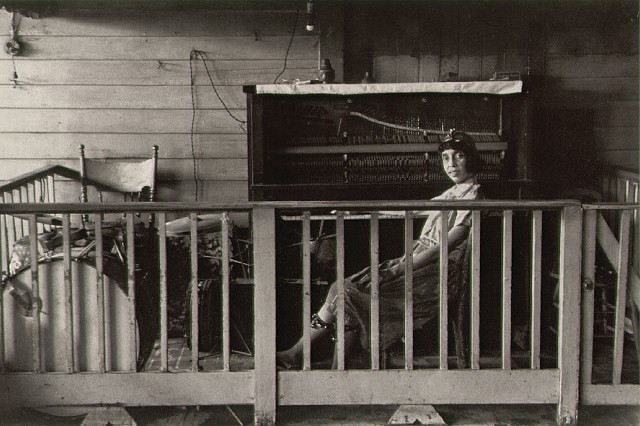
Lee Friedlander Sweet Emma Barrett, New Orleans 1958
A BROKEN NEW ORLEANS ROUSES ITSELF
I have no way of knowing how central this particular appeal may become, but it came to me through a friend and I share its anger and its emphasis on preserving a devasatated community intact. The call comes from some really good people, and I believe it should be broadcast widely. I decided not to wait for the promised formal press release.
Displaced New Orleans Community Demands Action,
Accountability and Initiates A Peoples
Hurricane Fund
Not until the fifth day of the federal governments
inept and inadequate emergency response to the
New Orleans disaster did George Bush even acknowledge
it was unacceptable. Unacceptable doesnt begin to
describe the depth of the neglect, racism and classism
shown to the people of New Orleans. The governments
actions and inactions were criminal. New Orleans, a
city whose population is almost 70% percent black, 40%
illiterate, and many are poor, was left day after day
to drown, to starve and to die of disease and thirst.
The people of New Orleans will not go quietly into the
night, scattering across this country to become
homeless in countless other cities while federal
relief funds are funneled into rebuilding casinos,
hotels, chemical plants and the wealthy white
districts of New Orleans like the French Quarter and
the Garden District. We will not stand idly by while
this disaster is used as an opportunity to replace our
homes with newly built mansions and condos in a
gentrified New Orleans.
Community Labor United (CLU), a coalition of the
progressive organizations throughout New Orleans, has
brought community members together for eight years to
discuss socio-economic issues. We have been
communicating with people from The Quality Education
as a Civil Right Campaign, the Algebra Project, the
Young Peoples Project and the Louisiana Research
Institute for Community Empowerment. We are
preparing a press release and framing document that
will be out as a draft later today for comments.
Here is what we are calling for:We are calling for all New Orleanians remaining in the
city to be evacuated immediately.
We are calling for information about where every
evacuee was taken.
We are calling for black and
progressive leadership to come together to meet in
Baton Rouge to initiate the formation of a
Community Oversight Committee of evacuees from all the
sites. This committee will demand to
oversee FEMA, the Red Cross and other organizations
collecting resources on behalf of our people.
We are calling for volunteers to enter the shelters
where our people are and to assist parents with
housing, food, water, health care and access to aid.
We are calling for teachers and educators to carve out
some time to come to evacuation sites and teach our
children.
We are calling for city schools and universities near
evacuation sites to open their doors for our
children to go to school.
We are calling for health care workers and mental
health workers to come to evacuation sites to
volunteer.
We are calling for lawyers to investigate the wrongful
death of those who died, to protect the land of
the displaced, to investigate whether the levies broke
due to natural and other related matters.
We are calling for evacuees from our community to
actively participate in the rebuilding of New
Orleans.
We are calling for the addresses of all the relevant
list serves and press contacts to send our
information.We are in the process of setting up a central command
post in Jackson, MS, where we will have
phone lines, fax, email and a web page to centralize
information. We will need volunteers to staff this
office.
We have set up a Peoples Hurricane Fund that will be
directed and administered by New Orleanian evacuees.
The Young Peoples Project, a 501(c)3 organization
formed by graduates of the Algebra Project, has agreed
to accept donations on behalf of this fund. Donations
can be mailed to:The Peoples Hurricane Fund
c/o The Young Peoples Project
99 Bishop Allen Drive
Cambridge, MA 02139If you have comments of how to proceed or need more
information, please email them to Curtis
Muhammad (muhammadcurtis@bellsouth.net) and Becky
Belcore (bbelcore@hotmail.com).
Thank you
.
[image from Masters of Photography]