more from inside New Orleans, from Jordan Flaherty

NewOrleansBlues.jpg
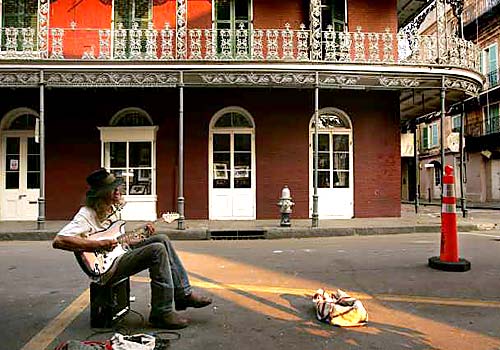
Troy Tallent brings some blues back to the French Quarter, by playing for the few residents and police still in the neighborhood. Originally from Georgia, Troy came to New Orleans in 1987 and he hasn’t left yet. [Los Angeles Times caption dated September 3]
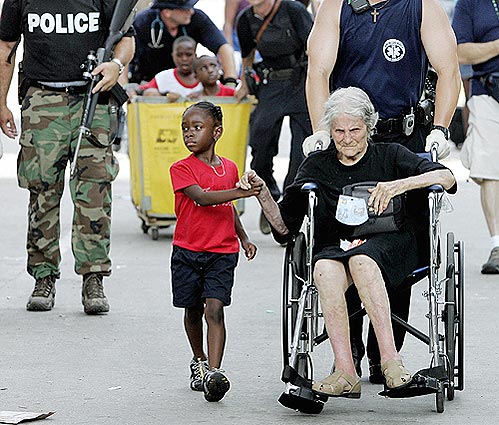
NewOrleans105.jpg
HELP AT HAND: Nita LaGarde, 105, leaves New Orleans’ convention center with her nurse’s granddaughter Tanisha Blevin, 5. Before coming to the shelter, they huddled in an attic and on an interstate island. Helicopters evacuated the elderly, infirm and infants. About 1,000 people remain. [Los Angeles Times dated September 4]

I’m publishing a second letter from Jordan Flaherty this morning, once again copied in its entirety. The first section includes his thoughts on the the city, the second is in the form of a diary and the third is the beginnings of a prospectus for aiding the people of New Orleans.

DON’T LET NEW ORLEANS DIE
by Jordan Flaherty
August 27 – September 3, 2005
Its been a day since I evacuated from New Orleans, my
home, the city I love. Today I saw Governor
Blanco proudly speak of troops coming in with orders
to shoot to kill. Is she trying to help New
Orleans, or has she declared war?
I feel like the world isn’t seeing the truth about the
city I love. People outside know about Jazz Fest
and Bourbon Street and beads, and now they know about
looters and armed gangs and helicopter
rescue.
What’s missing is the story of a city and people who
have created a culture of liberation and
resistance. A city where people have stood up against
centuries of racism and white supremacy.
This is the city where in 1892 Homer Plessy and the
Citizens Committee planned the direct action
that brought the first (unsuccessful) legal challenge
to the doctrine of “Separate but Equal.” This is
the city where in 1970 the New Orleans Black Panthers
held off the police from the desire housing
projects, and also formed one of the nations’ first
Black Panther chapters in prison. Where in 2005
teens at Frederick Douglas High School, one of the
most impoverished schools in the US, formed a
student activist group called Teens With Attitude to
fight for educational justice, and canvassed their
community to develop true community ownership of their
school.
I didn’t really understand community until I moved to
New Orleans. Secondlines, the new orleans
tradition of roving street parties with a brass band,
began as a form of community insurance, and are
still used to benefit those needing aid. New Orleans
is a place where someone always wants to feed
you.
Instead of demonizing this community, instead of
mistreating them and shooting them and stranding
them in refugee camps and displacing them across the
southern US, we need to give our love and
support to this community in their hour of crisis, and
then we need to let them lead the redevelopment
of New Orleans. As Naomi Klein has already pointed
out, the rebuilding money that will come in
doesn’t belong to the Red Cross or FEMA or Homeland
Security, the money belongs to the people of
New Orleans.

HURRICANE DIARY
Many people have asked for more information about my
experience in the past week. I was one of
the fortunate ones. I had food and water and a solid
home. Below are notes from my week in the
disaster that was constructed out of greed, corruption
and neglect.
Saturday, August 27
I’m in New Orleans, and there’s word of a hurricane
approaching. I don’t consider leaving. Why?
Because I don’t have a car, and all the airlines and
car rental companies are sold out. Because the
last two hurricanes were false alarms, despite the
shrill and vacuous media alarms. Because I have
a sturdy, second floor apartment, food, water,
flashlights, and supplies. Because there is not much
of an evacuation plan. Friends of mine who evacuated
last time sat in their cars, moving 50 miles in 12
hours.
Sunday, August 28
As the storm approaches and grows larger, everyone I
know is calling. “Are you staying or going?
where are you staying? Are you bringing your pets?
What should I do?” Governor Blanco urges us
to “pray the hurricane down” to a level 2.
I relent to pressure somewhat and relocate to a more
sturdy location, an apartment complex built out
of an old can factory in the midcity neighborhood.
The building is five stories high, built of concrete
and brick. There are seven of us in the apartment,
with four cats.
Monday, August 29
Its morning, the storm is over, and we survey the
streets outside. There has been some flooding. A
few of us explore the neighborhood in boats, and we
see extensive damage, but overall we feel as if
New Orleans has once again escaped fate.
Later in the day, we hear some reports of much greater
flooding in destruction in the ninth ward and
lower ninth ward neighborhoods, New Orleans’ most
overexploited communities.
Tomorrow, we decide, the water will lower and we’ll
walk home. We expect power will start coming
on in a week or so.
There are many relaxed and friendly conversations,
especially on the roof. With all of the lights in the
city out, the night sky is beautiful. We lie on our
backs and watch shooting stars.
Tuesday, August 30
We wake up to discover that the water level has risen
several feet. Panic begins to set in among
some. We inventory our food and find that, if we
ration it tightly, we have enough for five days. As
we discuss it, we repeatedly say, “not that we’ll be
here that long, but if we had to…”
We continue to explore the area by boat, helping
people when possible. The atmosphere outside is
a sort of post-apocalyptic, threatening world of
obscure danger, where the streets are empty and the
future seems cloudy. The water is a repellent mix of
sewage, gas, oil, trash and worse.
We meet some of our neighbors. Most of the building
is empty. Of at least 250 apartments, there are
maybe 200 people in the building, about half white and
half Black. Many people, like us, are crowded 7 or 10
to an apartment. Like us, many people came here for
safety from the storm. Some have no food and water.
A few folks break open the building candy machine and
distribute the contents. We talk about breaking into
the cafe attached to the building and distributing the
food.
We turn on a battery-powered tv and radio, and then
turn it off in disgust. No solid information, just
rumor and conjecture and fear. Throughout this time,
there is no reliable source of information,
compounding and multiplying the crisis.
The reporters and politicians talk 80% about looting
and 20% about flooding. I can’t understand how
anyone could blame someone for “looting” when they
just had their home destroyed by the neglect
and corruption of a country that doesn’t care about
them and never did.
Tomorrow, the news announces, the water level will
continue to rise, perhaps 12-15 feet. Governor
Blanco calls for a day of prayer.
Wednesday, August 31
White people in the building start whispering about
their fears of “them.” One woman complains of
people in the building “from the projects and hoarding
food.” There is talk of gangs in the streets,
shooting, robbing, and lawless anarchy. I feel like
there is a struggle in people’s minds between
compassion and panic, between empathy and fear.
However, we witness many folks traveling around in
boats, bringing food or giving lifts or sharing
information.
But the overwhelming atmosphere is one of fear. People
fear they wont be able to leave, they fear
disease, hunger, and crime. There is talk of a
soldier shot in the head by looters, of bodies
floating in the ninth ward, flooding in Charity
Hospital, and huge masses (including police) emptying
WalMart and the electronic stores on Canal street.
There are fires visible in the distance. A
particularly large fire seems to be nearby – we think
its at the projects at Orleans and Claiborne.
Helicopters drop army MREs (Meal Ready to Eat) and
water, and people rush forward to grab as many as
they can.
After the third air drop, people in the building start
organizing a distribution system.
Across the street is a spot of land, and helicopters
begin landing there and loading people aboard.
Hundreds of people from the nearby hospital make their
way there, many wearing only flimsy gowns, waiting in
the sun. As more helicopters come, people start
arriving from every direction, straggling in, swimming
or coming by boat.
A helicopter hovers over our roof, and a soldier comes
down and announces that tomorrow everyone in the
building will be evacuated.
Across the street, at least two hundred people spend
the night huddled on a tiny patch of land, waiting for
evacuation.
Thursday, September 1
People in the building want out. They are lining up
on the roof to be picked up by helicopters – three
copters come early in the morning and take a total of
nine people. Seventy-five people spend the
next several hours waiting on the roof, but no more
come.
Down in the parking garage, flooded with sewage, a
steady stream of boats takes people to various
locations, mostly to a nearby helicopter pickup point.
We hear stories of hundreds of people waiting for
evacuation nearby at Xavier University, a
historically Black college, and at other locations.
Our group fractures, people leaving at various times.
Two of us take a boat to a helicopter to a refugee
camp. If you ever wondered if the US government
would treat US refugees the same way they treat
Haitian refugees or Somali refugees, the answer is,
yes, if those refugees are poor, black, and from the
South.
The individual soldiers and police are friendly and
polite – at least to me – but nobody seems to know
what’s going on. As wave after wave of refugees
arrives, they are ushered behind the barricades
onto mud and dirt and sewage, while heavily armed
soldiers look on.
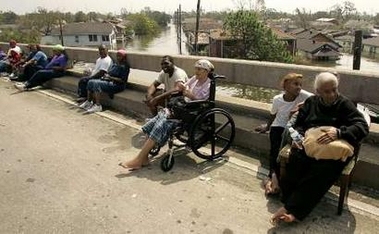
Many people sit on the side, not even trying to get on
a bus. Children, people in wheelchairs, and everyone
else sit in the sun by the side of the highway.
Everyone has a story to tell, of a home destroyed, of
swimming across town, of bodies and fights and
gunshots and looting and fear. The worst stories come
from the Superdome. I speak to one young man who
describes having to escape and swim up to midcity.
I‘m reminded of a moment I read about in the book
“Rising Tide,” about the Mississippi river flood of
1927. After the 1927 evacuation, a boatload of poor
black refugees is refused permission to get on
land “until they sing negro spirituals.” As a bus
arrives and a mass swarms forward and state police
and national guard do nothing to help, I feel like I’m
witnessing the modern equivalent of this dehumanizing
spectacle.
More refugees are arriving than are leaving. Three of
us walk out of the camp, considering trying to
hitchhike a ride from relief workers or press. We get
a ride from an Australian tv team who drive us to
Baton Rouge where we sit on the street and wait until
a relative arrives and gives us a ride to Houston.
While we sit on the street, everyone we meet is a
refugee from somewhere – Bay St Louis, Gulfport,
Slidell, Covington. Its after midnight, but the roads
are crowded. Everyone is going somewhere.
Friday, September 2
In Houston, I can’t sleep, although we drove through
the night. Governor Blanco announces that
she’s sending in more national guard troops, “These
troops are fresh back from Iraq, well trained,
experienced, battle tested and under my orders to
restore order in the streets. They have M-16s and
they are locked and loaded. These troops know how
to shoot and kill and they are more than willing
to do so if necessary and I expect they will.”

[WHAT TO DO]
Many people have called and written to ask what they
can do. I don’t really have answers. I’m still
tired and angry and I don’t know if my home survived.
But, here’s some thoughts:
1) Hold the politicians accountable. Hold the media
accountable. Defend Kanye West.
2) Support grassroots aid. A friend has compiled a
list at http://www.sparkplugfoundation.org/
katrinarelief.html

3) Volunteer. The following is a call for volunteers
from Families and friends of Louisiana’s
Incarcerated Children, an excellent grassroots group:

Come and help us walk through the shelters,
find people, help folks apply for FEMA assistance,
figure out what needs they have, match folks up
with other members willing to take people in. We
especially need Black folks to help us as the racial
divide between relief workers and evacuees is stark.
Email us ASAP if you would like to help with this
work.
kdhiggs@hotmail.com,
familiescantwait@yahoo.com
deenv_2000@yahoo.com
xochitl@mediajumpstart.org

4) Organize in your own community.
5) Add your apartment to the housing board at
www.hurricanehousing.org.
6) Support grassroots, community control of
redevelopment.
Don’t let New Orleans die.

More on Katrina, from independent sources, can be found on Znet.

[images from the Los Angeles Times, the first by LAT photographer Carolyn Cole, the second by the AP’s Eric Gay]
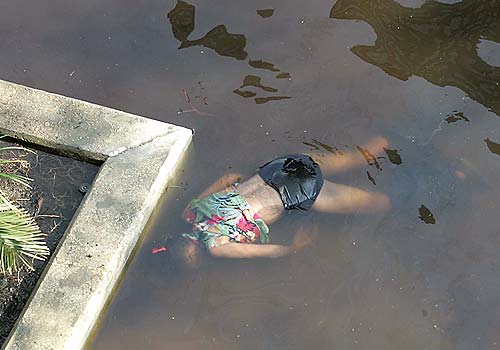
these people are being treated like vermin

superdomebody.jpg
A body floats outside the Superdome in New Orleans in the aftermath of Hurricane Katrina. [Los Angeles Times caption dated Friday]


How rich and white do you have to be to get the attention of your government?


These people are being treated like animals, and I’m not thinking of dog and cat animals. I mean rat animals! Where is the outrage? Where is the accountability? When do we start indicting?
This is an excerpt from a Reuters story posted earlier today, on the sixth day of the disaster in New Orleans:

As dusk fell on Friday evening, a woman’s bloated and brutally distorted figure lay prostrate on the corner of Jackson Avenue and Magazine Street in a poor neighborhood.
The black woman lay, arms flaccid, feet splayed, one shoe gone, her face distended from swelling and her chest swollen as gas filled her decaying corpse. Someone had covered her body in a plaid blanket in an anonymous gift offering some dignity.
A woman across the street shouted at photographers taking pictures of her, “She’s been there for five days, since Monday.” Then she approached to beg for bottled water, or anything at all that might help.
A convoy of five sport utility vehicles passed by, each packed with police training rifles with laser sights on the scant few residents out walking. They sped past the corpse without taking any notice.

If the police have been able to get there to protect property and search the victims who still survive, and if the media can get there to write about what’s going on and to take pictures, why are these people still suffering and dying, and why are there bodies rotting in the midst of all this, on both dry land and flooded streets?

[image by James Nielsen from AFP/Getty Images via the Los Angeles Times]

a letter from one who escaped a New Orleans refugee camp

NewOrleansawaitbus.jpg
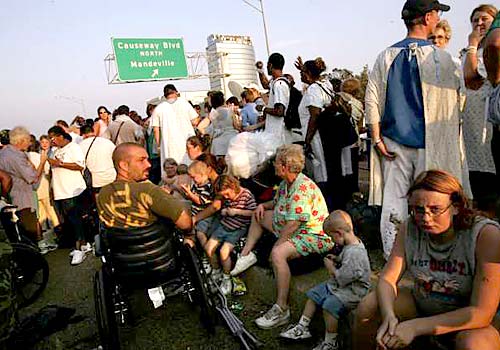
Hundreds of people wait for evacuation buses on the side of Interstate 10 in New Orleans. Many of them were suffering from dehydration after hours of waiting in the heat. [Los Angeles Times caption, image dated August 31]
NewOrleansbusguard.jpg
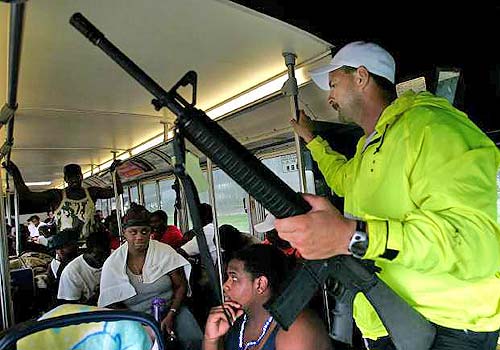
Gretna police officer Ray Lassiegne stands guard over a busload of evacuees after they were picked up near the Greater New Orleans Bridge just south of New Orleans. [Los Angeles Times caption, image dated September 1]

The following letter was forwarded to me by Steve Quester, who had just received it from a friend. Jordan Flaherty left a refugee camp today on the northern edge of New Orleans.
The first part of the letter is a frightening glimpse of the experience of thousands of hurricane survivors. The remainder is a picture of what they and all of us have lost, together with an indictment of those responsible. He closes with a call for a reconstruction which would honor a great city.
Flaherty is a white activist, originally from Brooklyn, who has lived in New Orleans for the last few years. He is an editor of Left Turn magazine.

Notes From Inside New Orleans
by Jordan Flaherty
Friday, September 2, 2005
I just left New Orleans a couple hours ago. I traveled from the apartment I was staying in by boat to a helicopter to a refugee camp. If anyone wants to examine the attitude of federal and state officials towards the victims of hurricane Katrina, I advise you to visit one of the refugee camps.
In the refugee camp I just left, on the I-10 freeway near Causeway, thousands of people (at least 90% black and poor) stood and squatted in mud and trash behind metal barricades, under an unforgiving sun, with heavily armed soldiers standing guard over them. When a bus would come through, it would stop at a random spot, state police would open a gap in one of the barricades, and people would rush for the bus, with no information given about where the bus was going. Once inside (we were told) evacuees would be told where the bus was taking them – Baton Rouge, Houston, Arkansas, Dallas, or other locations. I was told that if you boarded a bus bound for Arkansas (for example), even people with family and a place to stay in Baton Rouge would not be allowed to get out of the bus as it passed through Baton Rouge. You had no choice but to go to the shelter in Arkansas. If you had people willing to come to New Orleans to pick you up, they could not come within 17 miles of the camp.
I traveled throughout the camp and spoke to Red Cross workers, Salvation Army workers, National Guard, and state police, and although they were friendly, no one could give me any details on when buses would arrive, how many, where they would go to, or any other information. I spoke to the several teams of journalists nearby, and asked if any of them had been able to get any information from any federal or state officials on any of these questions, and all of them, from Australian tv to local Fox affiliates complained of an unorganized, non-communicative, mess. One cameraman told me “as someone who’s been here in this camp for two days, the only information I can give you is this: get out by nightfall. You don’t want to be here at night.”
There was also no visible attempt by any of those running the camp to set up any sort of transparent and consistent system, for instance a line to get on buses, a way to register contact information or find family members, special needs services for children and infirm, phone services, treatment for possible disease exposure, nor even a single trash can.
To understand this tragedy, its important to look at New Orleans itself.
For those who have not lived in New Orleans, you have missed a incredible, glorious, vital, city. A place with a culture and energy unlike anywhere else in the world. A 70% African-American city where resistance to white supremecy has supported a generous, subversive and unique culture of vivid beauty. From jazz, blues and hiphop, to secondlines, Mardi Gras Indians, Parades, Beads, Jazz Funerals, and red beans and rice on Monday nights, New Orleans is a place of art and music and dance and sexuality and liberation unlike anywhere else in the world.
It is a city of kindness and hospitality, where walking down the block can take two hours because you stop and talk to someone on every porch, and where a community pulls together when someone is in need. It is a city of extended families and social networks filling the gaps left by city, state and federal goverments that have abdicated their responsibilty for the public welfare. It is a city where someone you walk past on the street not only asks how you are, they wait for an answer.
It is also a city of exploitation and segregation and fear. The city of New Orleans has a population of just over 500,000 and was expecting 300 murders this year, most of them centered on just a few, overwhelmingly black, neighborhoods. Police have been quoted as saying that they don’t need to search out the perpetrators, because usually a few days after a shooting, the attacker is shot in revenge.
There is an atmosphere of intense hostility and distrust between much of Black New Orleans and the N.O. Police Department. In recent months, officers have been accused of everything from drug running to corruption to theft. In seperate incidents, two New Orleans police officers were recently charged with rape (while in uniform), and there have been several high profile police killings of unarmed youth, including the murder of Jenard Thomas, which has inspired ongoing weekly protests for several months.
The city has a 40% illiteracy rate, and over 50% of black ninth graders will not graduate in four years. Louisiana spends on average $4,724 per child’s education and ranks 48th in the country for lowest teacher salaries. The equivalent of more than two classrooms of young people drop out of Louisiana schools every day and about 50,000 students are absent from school on any given day. Far too many young black men from New Orleans end up enslaved in Angola Prison, a former slave plantation where inmates still do manual farm labor, and over 90% of inmates eventually die in the prison. It is a city where industry has left, and most remaining jobs are are low-paying, transient, insecure jobs in the service economy.
Race has always been the undercurrent of Louisiana politics. This disaster is one that was constructed out of racism, neglect and incompetence.
Hurricane Katrina was the inevitable spark igniting the gasoline of cruelty and corruption. From the neighborhoods left most at risk, to the treatment of the refugees to the the media portayal of the victims, this disaster is shaped by race.
Louisiana politics is famously corrupt, but with the tragedies of this week our political leaders have defined a new level of incompetence. As hurricane Katrina approached, our Governor urged us to “Pray the hurricane down” to a level two. Trapped in a building two days after the hurricane, we tuned our battery-operated radio into local radio and tv stations, hoping for vital news, and were told that our governor had called for a day of prayer. As rumors and panic began to rule, they was no source of solid dependable information. Tuesday night, politicians and reporters said the water level would rise another 12 feet – instead it stabilized. Rumors spread like wildfire, and the politicians and media only made it worse.
While the rich escaped New Orleans, those with nowhere to go and no way to get there were left behind. Adding salt to the wound, the local and national media have spent the last week demonizing those left behind. As someone that loves New Orleans and the people in it, this is the part of this tragedy that hurts me the most, and it hurts me deeply.
No sane person should classify someone who takes food from indefinitely closed stores in a desperate, starving city as a “looter,” but thats just what the media did over and over again. Sherrifs and politicians talked of having troops protect stores instead of perform rescue operations.
Images of New Orleans’ hurricane-ravaged population were transformed into black, out-of-control, criminals. As if taking a stereo from a store that will clearly be insured against loss is a greater crime than the governmental neglect and incompetence that did billions of dollars of damage and destroyed a city. This media focus is a tactic, just as the eighties focus on “welfare queens” and “super-predators” obscured the simultaneous and much larger crimes of the Savings and Loan scams and mass layoffs, the hyper-exploited people of New Orleans are being used as a scapegoat to cover up much larger crimes.
City, state and national politicians are the real criminals here. Since at least the mid-1800s, its been widely known the danger faced by flooding to New Orleans. The flood of 1927, which, like this week’s events, was more about politics and racism than any kind of natural disaster, illustrated exactly the danger faced. Yet government officials have consistently refused to spend the money to protect this poor, overwhelmingly black, city. While FEMA and others warned of the urgent impending danger to New Orleans and put forward proposals for funding to reinforce and protect the city, the Bush administration, in every year since 2001, has cut or refused to fund New Orleans flood control, and ignored scientists warnings of increased hurricanes as a result of global warming. And, as the dangers rose with the floodlines, the lack of coordinated response dramatized vividly the callous disregard of our elected leaders.
The aftermath from the 1927 flood helped shape the elections of both a US President and a Governor, and ushered in the southern populist politics of Huey Long.
In the coming months, billions of dollars will likely flood into New Orleans. This money can either be spent to usher in a “New Deal” for the city, with public investment, creation of stable union jobs, new schools, cultural programs and housing restoration, or the city can be “rebuilt and revitalized” to a shell of its former self, with newer hotels, more casinos, and with chain stores and theme parks replacing the former neighborhoods, cultural centers and corner jazz clubs.
Long before Katrina, New Orleans was hit by a hurricane of poverty, racism, disinvestment, de-industrialization and corruption. Simply the damage from this pre-Katrina hurricane will take billions to repair.
Now that the money is flowing in, and the world’s eyes are focused on Katrina, its vital that progressive-minded people take this opportunity to fight for a rebuilding with justice. New Orleans is a special place, and we need to fight for its rebirth.

[images from the Los Angeles Times, via Newsday, the first by Carolyn Cole, the second by Robert Gauthier]

the picture of the U.S. hidden in the attic until now

NewOrleansConvention.jpg
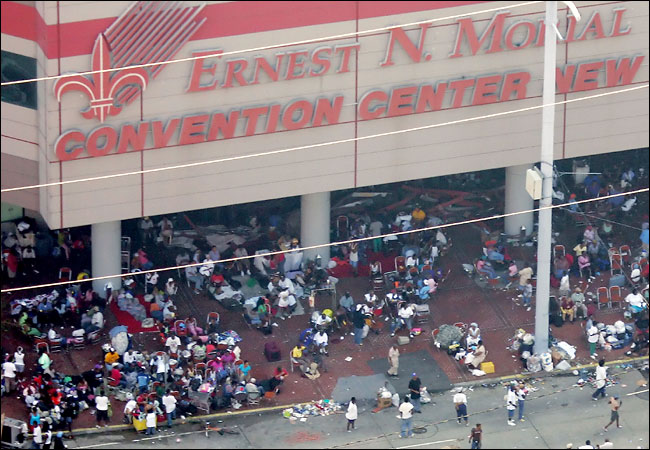
outside the New Orleans convention center today

While still lying abed this morning I listened to the BBC World Service coverage of the New Orleans disaster. Unfortunately I did not get the name of the (American?) woman being interviewed in London who used Oscar Wilde’s “The Picture of Dorian Gray” as a very dramatic metaphor for our contemporary U.S.
The BBC guy asked her to explain what she meant when she said something like, “we’re now looking at the picture of Dorian Gray which had been hidden in the attic.” She meant that the world can now see the America we have hidden behind the image of prosperity, liberty, equality and well . . . yes, fraternity.
Poor Americans on television? Poor African-Americans on television? And we can all agree they’re certainly not looking their Sunday best. How is that?
I believe the world knows much better than we do what has been going on here for decades, but now they have good pictures.
There was a related reference to this catastrophe’s elements of race and class in a segment from another show this morning. Although I can’t stand the Brian Lehrer Show, this morning I stayed around during the opening segment in order to hear The Nation‘s Katrina vanden Heuvel (whom Rush Limbaugh, taking childish delight in her given name, has blamed for the hurricane and everything else he sees wrong with America). Before her good sense could be “balanced” by someone from what is euphemistically referred to as a “Right-wing thinktank,” vanden Heuvel pointed out that Americans haven’t seen poor people on television for years, and now they are forced to do so, day after day. I would add (I don’t recall if she said something similar herself) that they see these images now only because of events not unrelated to our long-time abandonment of these folks, the least powerful elements of a very cruel, capitalist society quite full of itself.

[image, a pool photo by David J. Phillip, from the NYTimes]

saving a living archive of American social and cultural history

NewOrleansBywater.jpg
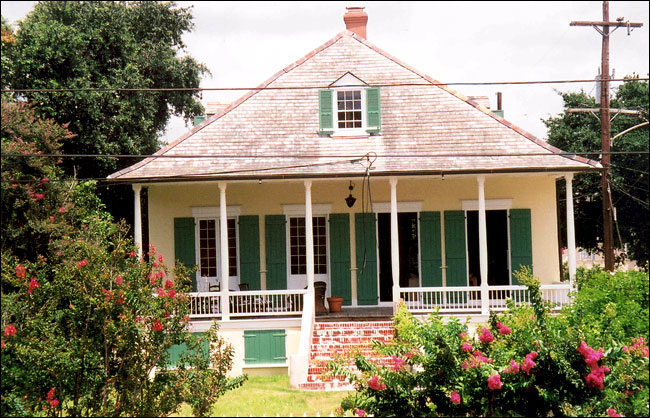
the author’s home, before the flood


I have a stack of neglected newspapers on my right as I sit here at my laptop looking at the staggering reports of human tragedy flowing in from Louisiana, Mississippi and Alabama. I saved yesterday’s NYTimes “House & Home” section for later, mostly because of this article [with another, very different picture] which appeared at the top of the front page. A few minutes ago, while looking for something else, I saw it for the third time on Tyler Green’s site.* I decided I had to read it now, and I’m glad I did. In the midst of so much reason for despair, the writer, Frederick Starr, recalls a community which has been all but destroyed this week, but he also offers some hope for its survival.

My home is there, a West Indian-style plantation house built in 1826, standing as an ancient relic amid a maze of wooden houses a century younger. Some are classic bungalows, but most are distinctly New Orleans building types, with fanciful names like shotguns and camelbacks. I watch as a neighbor is rescued from his rooftop. Dazed, he has emerged from his attic, wriggling through a hole he hacked in the roof, swooped up by a Guardsman on a swinging rope. He is safe. Scores of others aren’t. Bodies float through the streets of the Ninth Ward. Presumably they are from the diverse group that inhabits this deepest-dyed old New Orleans neighborhood: poorer blacks and whites, Creoles of color and a sprinkling of artists.
My neighbor Miss Marie is also one of the lucky ones. Born on the ground floor of what is now my house, she is 81, residing in a shotgun house that her husband, now deceased, built 60 years ago. She has spent most of her life within a perimeter of barely 30 yards. Both her speech and her cooking were formed right there. A painted plaster statue of the Virgin has protected her through all previous storms. But this time she pleaded with my friend John White to take her as he left town. Satellite photos show the shadow of her roof beneath the filthy water. Her house is gone, but John saved her life, driving to Atlanta, sleeping on benches at rest stops.
. . . .
We are just beginning to appreciate the human disaster occurring in New Orleans and the Gulf Coast. Hundreds, maybe thousands, have already perished. Hundreds of thousands will lose their homes and all their worldly possessions. Untold numbers of businesses will close their doors, throwing huge numbers of people out of work. New Orleans, its population already in decline, now faces economic and social collapse.
It also faces the loss of some of America’s most notable historic architecture. Maybe not in the French Quarter, which may emerge relatively intact, or the Garden District, which was spared most of the flooding. The dangers lie in neighborhoods like Tremé and Mid-City, which extend along Bayou Road toward Lake Pontchartrain and are rich in 18th- and 19th-century homes, shops, churches and social halls. They have been badly hit by the violent winds or torrents of water. And so have hundreds of other important buildings and vernacular structures throughout the city and across the breadth of South Louisiana and the Gulf Coast.
. . . .
Louisiana, especially South Louisiana, is a living archive of American social and cultural history, and not just in its buildings. In no other state is the proportion of people born and raised within its borders so high. As a consequence, they are something that is ever more rare in a homogenized and suburbanized America: the living bearers and transmitters of their own history and culture. Katrina, and those fateful levee breaks in New Orleans, put this all at risk.
. . . .
Now [my own house] is under water. If it survives at all, it will need massive rehabilitation. Just as likely, it will go the way of Miss Marie’s house and of hundreds of other pieces of the region’s heritage.
But I do not intend to give up easily. Why? Because I am absolutely convinced that New Orleanians will not allow their city to become a ghost town. And I intend to be part of the renewal that springs from this determination.

*
Go to Green’s site, “Modern Art Notes,” for regular updates on cultural loss in the Gulf area, and suggestions on how to help, along with very helpful links.

[image from the NYTimes]

we’re totally fucked

NewOrleansbodies.jpg
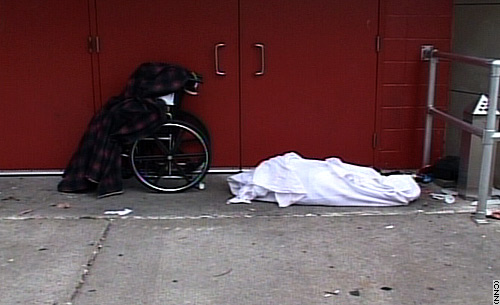
A blanket covers the body of a woman who died in a wheelchair, and another body is wrapped in a sheet Thursday at the convention center in New Orleans. [CNN caption]

If we actually were to be the victim of a major deliberate attack any time in the near future it’s now certified that we have no plan, no defense, no means of recovery. This was just a big storm, a very big storm, but just a storm, and there’s no radiation or poison weaponry involved, yet it’s been five days and virtually no help of any kind has arrived for our good neighbors, the people of New Orleans. They’re dying in the attics, on the roofs and in the hell of the “shelters.”
This time even the major commercial media can’t keep quiet about the incompetence of what passes for government today in our benighted land:
New Orleans hospitals desperate as food runs low

The Associated Press
Doctors at two desperately crippled hospitals in New Orleans called The Associated Press Thursday morning pleading for rescue, saying they were nearly out of food and power and had been forced to move patients to higher floors to escape looters.
“We have been trying to call the mayor’s office, we have been trying to call the governor’s office … we have tried to use any inside pressure we can. We are turning to you. Please help us,” said Dr. Norman McSwain, chief of trauma surgery at Charity Hospital, the larger of two public hospitals.
. . . .
Earlier, McSwain described horrific conditions in his hospital.
“There is no food in Charity Hospital. They’re eating fruit bowl punch and that’s all they’ve got to eat. There’s minimal water,” McSwain said.
“Most of their power is out. Much of the hospital is dark. The ICU (intensive care unit) is on the 12th floor, so the physicians and nurses are having to walk up floors to see the patients.”
Dr. Lee Hamm, chairman of medicine at Tulane University, said he took a canoe from there to the two public hospitals, where he also works, to check conditions.
“The physicians and nurses are doing an incredible job, but there are patients laying on stretchers on the floor, the halls were dark, the stairwells are dark. Of course, there’s no elevators. There’s no communication with the outside world,” he said.
“We’re afraid that somehow these two hospitals have been left off … that somehow somebody has either forgotten it or ignored it or something, because there is no evidence anything is being done.”
Hamm said there was relief Wednesday as word traveled throughout University Hospital that the National Guard was coming to evacuate them, but the rescue never materialized.
“You can imagine how demoralizing that was,” he said.

And here is the Reuters lead headline at this moment (try to get past the racist analogy and digest the substance of the story):
Bodies, gunfire and chaos in New Orleans’ streets

NEW ORLEANS (Reuters) – Rotting bodies littered the flooded streets of New Orleans on Thursday and mounting violence threatened to turn into all-out anarchy as thousands of survivors of Hurricane Katrina pleaded to be evacuated, or even just fed.
The historic jazz city has fallen prey to armed looters since Katrina tore through and it now more closely resembles Haiti or another Third World trouble spot in a refugee crisis than one of America’s most popular vacation centers.
Louisiana Gov. Kathleen Blanco warned rioters and looters late on Thursday that National Guard troops were under her orders to “shoot and kill” if needed to restore order.
“These troops are battle-tested. They have M-16s and are locked and loaded,” she said. “These troops know how to shoot and kill and I expect they will.”
Police units, rescue teams and even hospital workers came under gunfire on Thursday and New Orleans Mayor Ray Nagin pleaded for urgent help in getting thousands of evacuees to safety. “This is a desperate SOS,” he said.
People became increasingly frustrated at the slow pace of rescue and evacuation efforts a full three days after Katrina tore up the U.S. Gulf Coast.
Elderly people in wheelchairs braved flooded streets in search of help, and entire families were trapped on elevated highways without food or water in sweltering heat.
“We want help,” people chanted at the city convention center, where thousands of evacuees were told to seek shelter only to find woefully inadequate supplies of food or water.
Several corpses lay in nearby streets. The body of one elderly woman was simply abandoned in her wheelchair, covered with just a blanket. Officials feared thousands of people were killed but they could still only guess at the death toll.

And all the suits and uniforms seem to be thinking about is how to put down “looting” by desperate people reduced to nothing. Fifty thousand troops have been promised, no, threatened, and they have orders to shoot, but still there is no sign of food, nor water, nor rescue, nor means of evacuation from the city, nor decent shelter once they get out.
We are truly fucked, and next time it won’t be mostly just the poor, the old, the sick and the powerless.

[image, photographer uncredited, from CNN]

bring the National Guard and the money home now

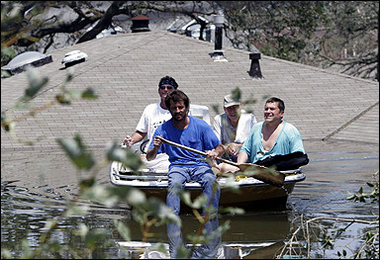
residents.jpg
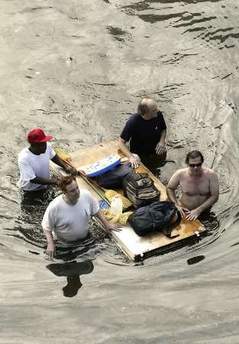
door.jpg
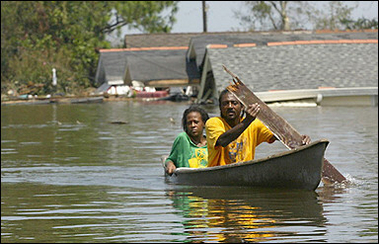
canoe.jpg
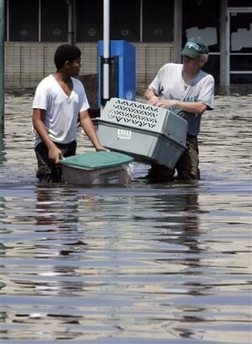
boxes.jpg
overpass.jpg

I cry for New Orleans.
And I don’t want to see another photo with a caption screaming about folks “looting,” when they are in the midst of an unprecedented disaster where there is no food, no water and no help. Only people with real resources could have afforded to leave before the hurricane hit: For the many who stayed, everything they ever had was in their homes. They could expect no protection, and almost certainly no insurance compensation.
[UPDATE: I’ve just learned that in fact many people who were mobile and who wanted to leave just couldn’t, as there was no public transportation. Our blindered media doesn’t point out that since this is America if you didn’t have a car you didn’t get out. The Greyhound station was closed before the hurricane hit, and of course there are no trains. Similarly, there’s also no media discussion of how the sick and the aged were expected to leave.]
Also, I hesitate to dignify their status by even mentioning the network, but this morning FOX “NEWS” includes a discussion asking seriously whether this city and these stricken people should get any disaster funds from the federal government. I guess they should all have known better and chosen to live in a less vulnerable area, say . . . Florida(?), where there’s always government disaster relief available. Not heard explicitly, but perhaps implied here, and certainly to be found along the long, rough road ahead, is the voice of racism – and even that of the hellish “Christian” Right: Colored folk don’t deserve the help, and for its sins this entire great, irreplaceable city itself should go the way of Sodom and Gomorrah.
We must save these people and this city, and of course we must do what we can to reduce the impact of the next storm. Just for starters, we should have the National Guard and skilled Army and Navy engineers here now, when and where they could make a difference.
The enemy is here, not in Iraq.

[images, in descending order (all via YAHOO! Photo) by Chris Graythen for Getty Images, Rick Wilking for Reuters, James Nielsen for AFP, Bill Haber for AP Photos, and Rick Wilking for Reuters]

where did good industrial design leave the road?

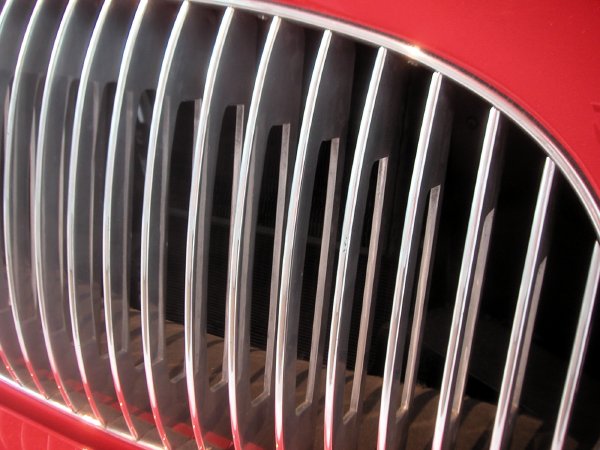
Cisitaliagrill.jpg
Pinin Farina Cisitalia 202 GT Car 1946 aluminum body 49″ x 57 5/8″ x 13′ 2″ [detail of installation]

I didn’t expect to look for the Cisitalia again when I casually wandered into MoMA’s Architecture and Design galleries earlier this week. I’d seen it many times before and in spite of my obsession with interesting automobiles I didn’t think it could mean much to me any more.
Uh-uh.
I was particularly sensitive to industrial design that day because we recently decided we needed a new land phone and I had just been looking at the lamentable, no, painful choices available. This beautiful car was imagined and put together almost 60 years ago. Have we learned nothing since?
I’m not even going to dwell on the ugliness and gigantism of the SUVs, Town Cars and Ford taxis which confronted me as I left an art museum which has tried since 1932 to honor good, simple design in everyday objects created over the last 150 years or so.
I’m sticking my neck out a bit by bringing up the subject of this Museum collection in the first place. Many people still think a design gallery in an art museum is inappropriate in the first place, but I’m happy with the idea that we shouldn’t be content with a world where art is only found hanging on walls or standing in public spaces.
There’s also the subject of the [ethics?] of any kind of enthusiasm for the private automobile, especially in the twenty-first century, even if Americans don’t have any real alternatives at the moment. In any event, when this car was built General Motors and the oil companies had barely begun their campaign to destroy public transportation, so the idea of a private pleasure vehicle did not carry the baggage it does today.
Incidently, this little Cisitalia has an engine smaller than that in my 1962 VW Beetle, but with more power, and it weighs about the same (1600 pounds). Hey, those power and weight figures are pretty much the same as those of a basic Smart. Now there’s an original and almost perfect design for modern industry, and it too is now a part of the Collection. But, and no surprise here, we’re not allowed to have it on our streets. Too pretty and too sensible, and it doesn’t have a brutal line in its body.
But back to the old car and the new phone. The color of the sleek Italian antique on MoMA’s third floor is a luscious red which could never be forgotten, much less ignored if you’re anywhere near it. When I’m through with this post I’m going to plug in my new phone system. it’s in a busy combination of a dull black and a grey pseudo-aluminum, and it looks like it will be almost too painfull to live with. Maybe I can cover it with a doily. But, really, it’s not about color. The colors are only symptoms.

papal Carnival in Cologne

anti-religious.jpg
demonstrators dressed as a priest and a nun kiss in front of a large model dinosaur during an anti-religion demonstration in Cologne August 19, 2005 [as der Ratzinger arrived in Cologne]

Sometimes it’s best to let the thing speak for itself.
I’m very proud of my family’s ancient Rhenish Catholic [and before that, Roman without the Catholic] Heimat, and amazed at the effrontery of [Yahoo!]. See Bloggy for a related post.

[image by Pawel Kopczynski from Reuters which, together with my excerpt from its accompanying caption, is furnished by Yahoo!]

Heathrow mess: what’s the real story, the clients or the serfs?

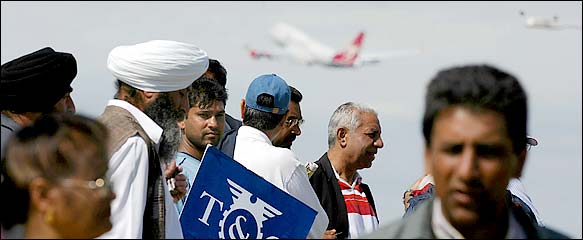
HeathrowstrikersNYT.jpg
are they invisible?

Is the story about lost or missed flights and the attendant inconvenience for thousands of travellers, or is it about humiliating and discarding hundreds of low-paid Asian workers struggling in a racist society?
There have been headlines about the British Air interruptions everywhere in the mainstream media since last Wednesday, but you’d have to be a very determined newsy indeed if you wanted to know what started the disruption.
Most American accounts, when they included any information about the origin of the toubles, referred to “wildcat ground staff strikes” or some equally vague and pejorative description of the original offense.
I did some digging and I’ve come up with some facts which have been reported almost nowhere within the reach of most U.S. news consumers. They must have been considered too complex for us to understand, or, more likely, too destructive of the conventional wisdom of contemporary American society about the evils of labor unions. Besides, images of people (especially attractive blond people, and most especially young women) stranded at Heathrow are a better sell to corporate media advertisers than the background facts and images which might assault their Olympian indifference to the people in real markets.
In a front-page article in the NYTimes this morning, at least four days after the [“unofficial strike,” in the brief, enigmatic description found in the piece’s first lines] you would have to read through thirteen paragraphs and move onto page 4 before you would find anything about the origins of the disruption in London.

And in fact, the dispute at the heart of the walkout – over employment practices at Gate Gourmet, an independent catering firm based in the United States [my italics] that provides food for British Airways and other airlines – is only indirectly related to the airline.
The strike began when the catering firm abruptly fired about 670 of its Heathrow-based workers on Wednesday, causing the rest of the catering staff to walk out in a show of support. On Thursday, about 1,000 other airport workers – including baggage handlers, bus drivers, ramp workers and check-in staff, walked out, too, for an unofficial strike.

To give the paper credit, the larger image accompanying the article on the inside page is of a group of Gate Gourmet [ex-?] employees assembled at the airport.
But the context of the firings is missing, as is any attempt to describe why they might have been kicked out in the first place.
I went looking and turned up this story on thisismoney, a financial website belonging to Britain’s [populist right-wing] Daily Mail/Evening Standard:

But what happened last Wednesday in a car park in Hounslow, near Heathrow, was everything that [Sir Rod Eddington, British Airways’ departing chief executive] says he condemns. It was crude, unintelligent and ultimately totally counter-productive.
When Gate Gourmet sacked 650 workers – some of them pregnant – by bellowing through a megaphone in the car park [italics mine again], it was, he believes. the inevitable trigger for retaliation.
In the closeknit Asian community around Heathrow, sacking lowly paid workers in such humiliating terms was an outrage.
Many Gate Gourmet workers had relatives employed by BA – not surprising since the airline sold its catering division to Gate Gourmet in 1997 for £60m.
The illegal sympathy strike action by 1,000 BA staff had the understanding and sympathy of all BA workers, even at the highest level.
Eddington, whose wife is Asian, has diplomatically refused to comment on Gate Gourmet’s management style. Publicly, he says: ‘I would like to apologise unreservedly to our customers who have suffered because we have been dragged into a dispute not of our doing.’
But he has not hidden his anger to close friends at the ‘stupidity’ of Gate Gourmet. ‘When you tackle change, you need to be clever and box clever,’ he said. ‘What happened out there was unintelligent and stupid,’ he is alleged to have said, adding ‘You can’t treat people in this way. They were not fat cats for God’s sake, they were hard-working lowly paid people.’
As for Gate Gourmet, it is satisfied it has not made any mistakes in its handling of the dispute, which started after an attempt to change working conditions and cut the workforce. A spokesman said it was haemorrhaging cash and unless there were agreed changes, the company would go into administration. As for sacking people by megaphone, he said: ‘ Sometimes the only way to communicate with the staff is by megaphone.’

Or whips?

[image by Andrew Stuart for the Associated Press via the NYTimes]