IDEC: can the Greeks’ moira steer a ship if it’s French?

IDECfate.jpg
IDEC in New York, two weeks ago

I absolutely do not follow yachting news. Well, at least not since I lived in the old, “undeveloped” Newport and enjoyed the regular visits to that sleepy town of hunky crewmen from around the world seeking to wrest the Americas Cup from the New York Yacht Club.
But the yachts can be extraordinarily beautiful themselves, even if today their design may sometimes approach the grotesque in the hands of skilled engineers and mathematicians.
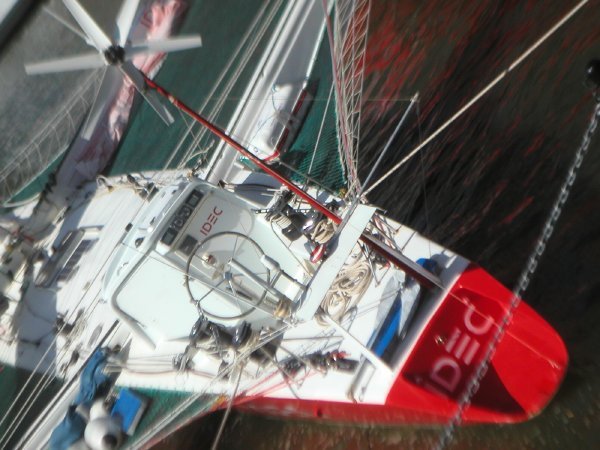
A little over two weeks ago I saw the great tricolor trimaran IDEC moored in the basin below the Winter Garden in the World and casually snapped the picture above. I decided it wasn’t a bit grotesque, but rather resembled a giant water strider. The vessel looked shockingly purposeful, even if I was ignorant of its mission.
While going through my photo library this evening looking for something else I decided the IDEC shot was worth uploading for the image alone. Since I wanted to identify the craft I Googled the name and discovered that after leaving New York the vessel and her skipper, Francis Joyon, had broken the 24-hour world speed record when they clocked up 543 miles and, on arriving in France six days out of New York, the transatlantic record for a single sailor as well. The French landfall occurred just three days ago.
But there’s more to the story, an ending the ancient Greeks would surely have understood.

Just a few hours after breaking the outright singlehanded transatlantic record yesterday (see news story here) Francis Joyon was involved in a collision which has totally destroyed his 90ft trimaran IDEC.
Having crossed the finish line off the Lizard, Joyon – still unaccompanied – did a quick u-turn to head back to his home port in La Trinite, France but fell asleep and hit the rocks at Pte de Marc’h at 0100 this morning.

The skipper survived unscathed.

NOTE: the Greek moira is similar to the Latin fortuna.

disgusted, but not quite shutting up

stadium.jpg
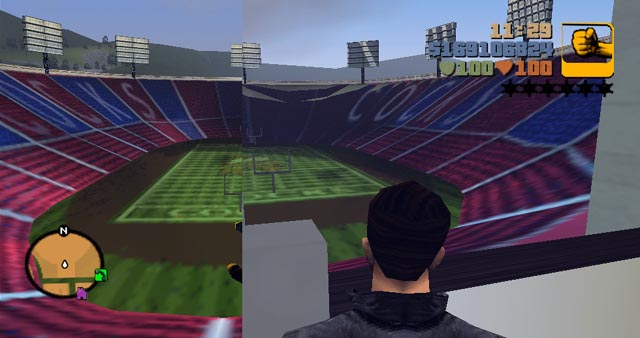
” . . . the inside of the stadium in Liberty City”
Yes!
Just when I think I’ve been doing pretty well with my own campaign of “inner emigration”* [because, basically, we are clearly not a democracy; I don’t think anything else we can do will make a difference; there are no institutions left in place to turn this country around; etc.], something gets me going again. This time it’s Barry, with whose frustrations [“I rarely post about politics anymore. I’m too disgusted.”] – and limits of patience – I am totally in agreement.

* For discussions of the subject, see a discussion centered on Thomas Mann and his contemporaries, and one devoted to the experience of Karl Amadeus Hartman.

[image from colinfahey.com]

just resting a bit

Have I missed anything?
I’ve been neglecting the blog this week because I’ve been down with a wicked flu accompanied by an impressive body temperature. For a couple of days I could barely think, I ached everywhere, so that even moving my fingers around the keyboard seemed out of the question, and it even hurt to touch my skin.
We have to be ready to leave Saturday for a week in New England with family, regardless of how I’m feeling, so it’s time to start getting myself together.
Maybe I can do a post later today.

the World Trade Center site as a grand public plaza

plazaMexico.jpg
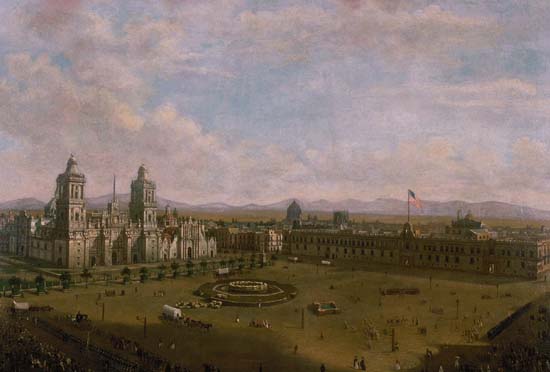
Pietro Gualdi Grand Plaza of Mexico City, Following the American Occupation of September 14, 1847 1847 oil on canvas [one of my all-time favorite public squares, for the richness of its life – once we left]

Over seventy years ago the Empire State Building was completed within thirteen months and yet we’re still staring at a hole downtown.
As we approach the fourth anniversary of the attacks on the World Trade Center we have no idea what’s going to be built on the still-empty site. Every intended purpose and every proposed design has ended up being compromised or rejected for one reason or another.
Except for the shopping mall.
The cultural spaces are out; people are apparently terrified of the idea of sitting at a desk high above “ground Zero,” so no one is talking about building the tall office buildings first included in the proposals; and no one knows where the little Greek church is going to be. The only projects now left on the table are something called the “Freedom Tower,” which has just been put on hold once again (because of the name, it’s a not-so-surprising augury for Bush’s America) and the even more tenebrous “Freedom Museum.” The current state of plans for a memorial to the events of September 11 is a mess, and it was ill-conceived from the start.
And as far as real freedom is concerned, forget about it; gotta stay off the grass and stay off the streets. Maybe watch it on TV.
So I have a modest proposal to resolve the problem. Actually it’s not modest in its implications or in the scale of its ambitions, only in the simplicity of its utility and its physical design.
New Yorkers have been told that they have no right to assemble in large numbers in Central Park to party or address political grievances, and they have seen how impossible it is to find any alternative in a city without great open public spaces. I suggest that the site of the old World Trade Center be made a true monument to freedom by reserving every acre of its surface as a public square devoted solely to the enjoyment of the people and to their right of expression, whether in joy or in anger.
It absolutely must not be a lawn however, even if there were any way to ensure that great assemblies of people would not damage it. We need a great plaza worthy of a great city. Plazas welcome free assembly. Downtown, in the new World Trade Center there will be trading in ideas and grass is not part of the kit.
We would be perfectly happy with cut stone or the happy-sounding, gravel-like surface used almost universally in the grand parks of European towns and cities. Trees, yes. Include trees perhaps, but only around the perimeter. London Plane trees would do just fine. Above all, let us have light and air. Freedom thrives on it.

ADDENDUM: A year and a half ago, Barry did a post describing a provocative, minimalist WTC proposal from Ellsworth Kelly, although his concept involved the grass thing.

[image from Louisiana State Museum]

best in show – but it was no contest

Zephyr1936lincoln.jpg
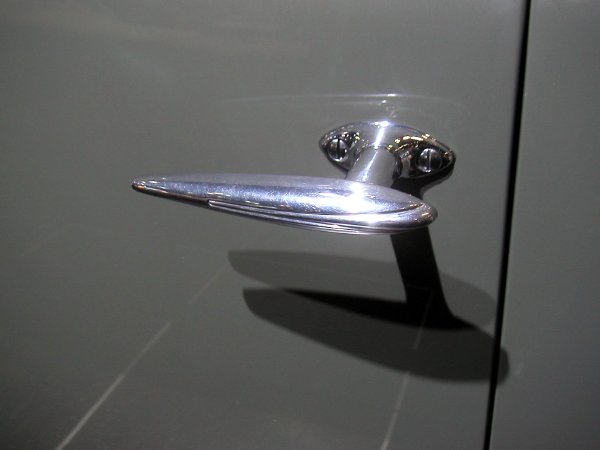
untitled (1936 Lincoln Zephyr door handle) 2005

I saw no vehicle which pleased me more at the New York auto show than this seventy-year-old prop for the introduction of one manufacturer’s 2006 model.
I spent the entire afternoon at the show on Monday, but I don’t know why I bother anymore. The cars being sold to Americans are, almost without exception, pure junk and an appalling assault on the planet. We get to choose between trucks and “sport utility vehicles” (with no real truck, sport or utility capability) and the occasional but equally-ugly sedan or lets-pretend “sports” car.
Virtually every one of these adult toys is intended to do little more than satisfy the fantasies of a 16-year-old with nothing other than his member or the implied violence of speed on his mind. I suppose if your waking life revolves around driving, as it seems to for most Americans, what else is there to guide your transportation decisions? The few exceptions to that infantile appeal of the guy-demographic which manage to squeeze through are condemned as chick cars and either discontinued or pumped with steroids and the carworld equivalent of graceless football padding.
Only if you’ve ever been outside the country would you be likely to realize that nothing is really small in the American automobile market. We have no sense of proportion, and I mean that here in every sense. Even if it starts out with a modest footprint when introduced, any relatively compact vehicle is inevitably designed and equipped as a cheap substitute for the heroic virtues of the real thing. If it isn’t ignored and doesn’t quickly disappear it begins its inexorable course on the path toward gigantism with the very next model change. Has anyone seen a Geo Metro or Ford Fiesta lately, or looked at what passes for a Honda Civic these days? Remember when a Civic was smaller than the original Mini? [thanks, David, for the reminder]
Some of us have noticed that this commercial exhibition is being staged in the middle of the most urban civilization in a country engaged in wars over access to the world’s finite supply of oil. The NYTimes “Automobiles” section pointed out on Monday, there was not one city car in sight at the Javits Center.

In Europe, the “city car” is a well-understood concept, a vehicle whose dimensions and design are as ideally suited to its duties as the minivan’s multiple seats and cup holders are to its role in American suburbs. A city car is one intended primarily for urban use. Its size makes it economical and easy to park and lets it slip between huge trucks clogging the narrow streets. And, yes, a city car is a bit sophisticated in style.
In New York, a city car is not a tiny car. “Every time I come here I’m struck by the scale of vehicles,” Ed Welburn, vice president for global design at General Motors, said at the auto show last week. “It is unlike any other city in the world.”

Anyone who has travelled to Europe knows that vehicles there, whether “city cars” or not, are for grown-ups who want and get intelligence, beauty and function regardless of their transportation choices. If nothing else will bring us to our senses over here, perhaps the thought of billions of newly-prosperous car fans in Asia shopping for their own SUVs – and the oil to propel them – will be able to do it through self-interest.
I don’t believe I’m reading too much into the phenomenon if I say I really believe the design and scale of the cars we drive in the U.S. represents our increasing indifference to, hatred or fear of all the people on the outside (“the other”), however we define that.
Oh yeah, for what it’s worth, I don’t have a car of my own, and haven’t since moving to New York. But while I firmly believe in public transportation I’m fascinated with small, efficient vehicles and the idea of sharing their use whenever they might be needed. All of this seems to make me very un-American.

must be the rural part of the South Bronx

CriticalMass1231.jpg
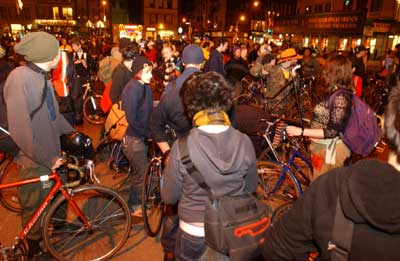
including at least one farmer and feed dealer

There’s a fairly happy story in Newsday this morning, reporting the relatively unaggressive approach of NYC police to last night’s local Critical Mass.
The monthly event promoting pollution-free transportation went off almost without incident, marking the first time since the Republican Convention in August that police did not harass the participants.*
The numbers were down from those recorded on recent Fridays, perhaps because of winter and the holiday, but more likely because many enthusiasts would have feared a repeat of unprovoked police violence, indiscriminate incarceration and illegal confiscation of bicycles. News of last night’s peace should produce larger turnouts in the [warmer] future.
After the news of the success of the ride, my favorite part of Wil Cruz’s article is the attribution of a quote near the end which criticizes ambiguous police direction. The speaker is described as “Jack Horowitz, 57, a farmer and feed dealer from the South Bronx.”
I read this to Barry and he immediately added to my own glee: “That’s why I love New York!”

*for recent history, see this September link and this one from late October.

[image by Joel Cairo from Newsday]

the tsunami, how can we help?

Chennai.jpg
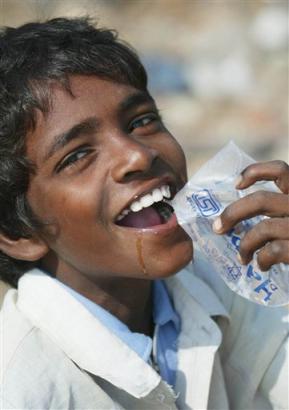
a boy drinks a bag of clean water in Chennai, capital of the tsunami-stricken state of Tamil Nadu, south India Tuesday, Dec. 28, 2004 [excerpt of caption from AP]

Of course we want to do something, but how?
Along with surely at least scores of his other friends, relatives or colleagues, this morning I received this email from our good friend Sumit, who fortunately lives safely in Bangalore with his wife Seema, miles from the violence on the southeast coast of India.

Hi,
Let us wish your family and you a very happy and healthy New Year.
By now you would have all heard about the terrible natural disaster that struck Southern coastal India, Southeast Asia and Sri Lanka. The devastation is immense. The loss of life and damage to property is shocking. The thousands who have been affected by this tragedy need any help they can get. There are many ways in which one can help.
Seema and I are collecting the following items in Bangalore to send it to Chennai tomorrow to the Banyan (an NGO) in Chennai, which is arranging distribution at the affected areas. The items are:
1. Blankets and Sheet
2. Face Masks
3. Provisions: Daal (Lentils), Rice, Sugar
4. Electral, Glucose
5. Biscuits
6. Clothes: Children and Adult. Old and New.
We are collecting at the basement in our house:
[here he gives their address and telphone number in Bangalore]
Those interested in helping may also contact the following people in Chennai (Madras).
Ashok from The Banyan: 91-44-26530504 ashok@thebanyan.org
Sulek and Pravin from DBA: 91-44-26630063 spravin@dba-corp.com
Exnora is another organization that has helped with relief measures in the past. Details about their organization can be found at:
http://www.chennaibest.com/discoverchennai/ngowatch/feature05.asp
For those outside of Tamilnadu and India, the Prime Minister’s relief fund is a reliable (relatively free of bureaucratic hassles) organization that has appealed for funds. Here are 2 websites, one about the Fund and the other with a form through which you can make donations.
Please donate whatever you can. Every bit counts.
http://pmindia.nic.in/relief.htm
http://pmindia.nic.in/formpmnrf.htm
Please forward this request to anyone you know. We need to do whatever we can.
God Bless
Seema & Sumit

The list of emergency items is painful to read, but I think his words tell us even more about how we should all think of our responsibilities when disasters strike, or at least all of us who are not able to offer skilled help on the scene.
Realistically however most people outside of the countries immediately affected by this one will have to be satisfied with the less dramatic gesture of contributions in money rather than kind.
Since Sumit’s suggestions only include agencies able to offer help on the sub-continent, here is a list of relief agencies assembled by the NYTimes.
My own preference will probably be Doctors Without Borders, because of my faith in and admiration for their extraordinary importance, commitment and effectiveness. Alright, I’m also totally dazzled by their heroism.
I’ve just checked their normal website, where I was given the very happy message, “Doctors Without Borders web site is experiencing very heavy traffic.” The page then gives a secure link where donations can be made and a separate link where people can secure information about volunteering services.
Their traffic volume seems to suggest that enormous numbers of people are being very generous and perhaps also that the other NGO’s offering tsunami relief are being deluged with contributions as well.
I will end this long post with an large excerpt from one of several emails I’ve received from a New York friend who had been on holiday in Phuket with a mutual friend of ours until that fateful morning. They were having breakfast on the beach at 8:30 when Donald felt something he only later realized was the earthquake itself. They both left for the airport at 9:30 when the sea was quite calm. Minutes later the wave hit. Only when they ran into the first survivors at the airport a little later did they learn what had happened.
Donald wrote this note from Thailand, and I received it late last night:

James, the post-wave problems will be severe, as you can imagine. Fortunately, Thailand has extremely good infrastructure for addressing things like this, government corruption notwithstanding. Communications here are good, lots of airports, roads, etc. So getting things down to the South where they are needed will be fairly easy, although once down there, there are a zillion little islands.
The impact of this is most easily described to Americans this way. “These people were poor TO BEGIN WITH”. If they lost family members, then they lost everything, because for most people in this region, family is all they have. (Americans tend to exoticize things like the intensity of Asian kin relations, but the reality is that intense kinship is a good way to sustain a network that mitigates the dire poverty.)
The impact is also horrible in terms of employment and living. Whether you are a tourist or a local, if you were in Phuket, you were there because of tourism. If you weren’t a tourist, then working for tourists was your job. So with the tourism trashed by a tidal wave, probably more than a million Thai survivors have just lost their employment, and are now job less, and possibly homeless, grieving for dead relatives and a dashed future.
Now, add to that the imminent public health disaster created by the loss of sanitation, piles of corpses etc. It is like you already were in hell, and now it’s going to get worse right before your eyes.
In terms of public consciousness, Thai people everywhere are mortified. And since one of the kings grandchildren died, it gives a personal context that everyone can connect with. (The royal family is very revered here). The press here is talking about nothing but the tidal wave, and that probably won’t change for a while. It has totally eclipsed coverage of the national election! Even the very arrogant and dictatorial prime minister knows better than to shame himself by appearing to capitalize on this.
I am actually more concerned about Sri Lanka. Though I’ve never been there, I know it is a much poorer country than Thailand. Like I said, Thailand has some very decent infrastructure.
I am rambling, but I appreciate the opportunity to talk about this.

Now we all have to try to save the survivors.
Above all, perhaps for a change, I’m thinking of Americans, as an American, not a New Yorker. If the Red Cross estimate of at least 100,000 deaths proves correct, more than 33 times as many people died this past Sunday as did on September 11. Unlike the aftermath of September 11, in Asia today millions of children and adults remain in serious danger because of disease, or from loss of food, shelter or livelihood. We have to rise to this challenge or lose our self-respect as a people.

[image from AP Photo/Xinhua, by An Zhiping]
art bloggers in hard print

Wow.
I haven’t seen the January Art in America, but I’ve heard, through subscribers who have already received their copies, about the “FRONT PAGE” article, “Art in the Blogosphere.” The issue still hasn’t reached the stores, and there’s nothing on their site, but I did receive a scanned image from one generous blogger.
Barry writes that I’ve achieved fame in the print media.
[for more on the story see Joy garnett]
This modest site, jameswagner.com, is one of twelve included in a list assembled for the magazine by Raphael Rubinstein, who writes in his introduction, “. . . there are now quite a few interesting art-related blogs. Here is a list, briefly annotated, of those that I’ve found to be worth regular visits.”
My first reaction was shock, especially when I heard how short the list was. When I finally saw it I realized that a number of important people weren’t there. If the list actually means anything, I think it’s quite unfair. I can only explain my inclusion as something of a fluke, especially since I’m “not in the industry” (in the words of a friend who is, Michael Gillespie). Not only do I have no academic credentials in the fine arts, but I’m also neither a working artist nor a critic, I’m not selling anything, and I can buy very little.
I’m a fan.
Then I thought (again, if the list actually means anything), wow!, the blogosphere makes it pretty easy to become slightly famous. Without the financial resources, the connections, real talent or probably even the will to get “published,” a lot of people now see the stuff I upload.
If I can do that, almost anyone should be able to. I wonder if this world is ready for us.
Scary.
But I’m not going to let the pressure get to me. (the audience is hushed here) This is going to remain the very independent, subjective and idiosyncratic arts-politics-and-whatever blog it’s been for two and a half years. With the arts I write only about (some of) the things that please me; with everything else it could be praise, condemnation, plain observation, or just a silly whim. I also try to amuse with decent images whenever possible, while trying to avoid overwhelming bandwidth with their size or number.

today’s “Europeans,” civilization’s imposters?

“To the whites, the lives of their black office boys or chauffeurs seem unimaginably separate and isolated from their own. . . . But to the urban Africans, the ‘Europeans’ are the ones who seem isolated, in their remote and hidden mansions in the superior suburbs. The Africans no longer feel themselves reliant on white patrons or promoters for their education and cultural development; they see themselves as the heirs of Western civilization, and the ‘Europeans’ as the impostors.”

Anthony Sampson, a British jouranalist and biographer of Nelson Mandela, was writing about the divide which separated whites from blacks in the cities of Apartheid-era South Africa, but today his last sentence seems prophetic on a scale he might not have imagined when it was published in the NYTimes Magazine in 1960: Try substituting the word “non-Europeans” for the word “Africans” and the world won’t look as simple as it might have a moment before.

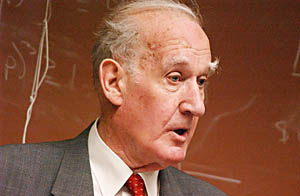
sampson_300.jpg

Sampson loved Africa and Africans, as much as he loved civilization and liberty, human rights and social justice. He died on Saturday at the age of 78.