
on the Oregon coast yesterday afternoon, just north of Otter Rock
We made it to the Pacific, but when we got there everbody was gone.
Actually, Barry and I are staying in Portland this week, where he’s attending a tech conference, and after that we’ll be in Los Angeles for a week. Yesterday was free, so we drove to the coast, much of the time through an almost abandoned wilderness, to stick our toes in the Pacific.
It’s a long drive for one day, so while we didn’t have much time to explore, the town of Newport looked like it would worth more than a detour.
We had a great lunch at the Chowder Bowl above Nye Beach: tiny shrimp in a thick clam chowder, followed by oysters and chips (clams and chips for Barry), the crustaceans all from local waters. Yes, they had good beer and wine, but most of the families sitting around us took a pass on the grownup stuff and finished quickly; they must have found the calories which fed their very ample American forms elsewise.
Another thought from a New York innocent abroad: This part of the world is very middle class and white, very clean and very civic. Why is it that away from the East Coast this country seems to be able to provide clean restrooms almost everywhere and such essentials as well-cared for parks or other public amenities, while in the Eastern cities you have to be a sneak or a sleuth to find a bathroom, and even a successful search will rarely uncover a clean, decent-sized facility? And in so far as parks are concerned (at least in New York City), unless you can get corporations to sponsor them, including their maintenance, your neighborhood is just out of luck.
As a nation are we able to provide for the public only if that public is perceived to be composed of a homogenous class and ethnicity?
Of course there are some parts of America which do have homogeneity, but still don’t think anything should be provided to the public. If you’re from such places, or visited them, you know where they are. Those are the areas from which most decent people flee as soon as they can – sometimes ending up in Oregon or New York.
Category: General
way cool photo-in captures New York MTA
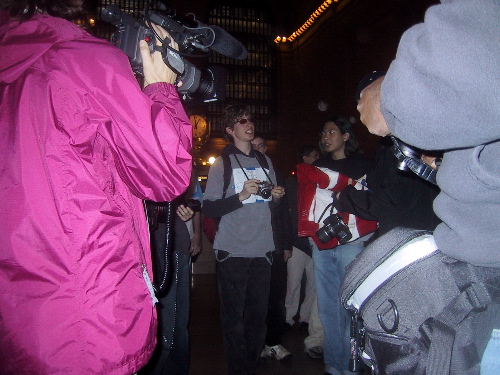
Grand Central Station
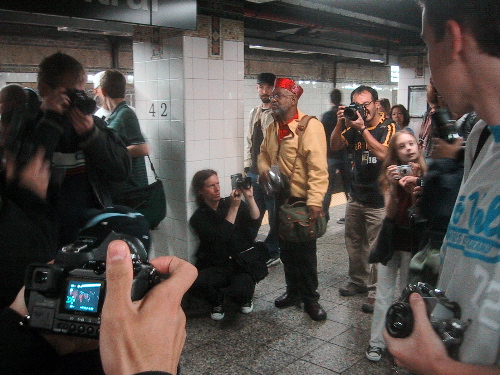
waiting for the Lex express
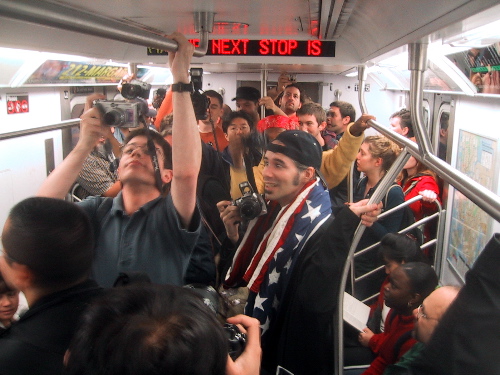
on board, somewhere above Union Square, er . . . actually, below
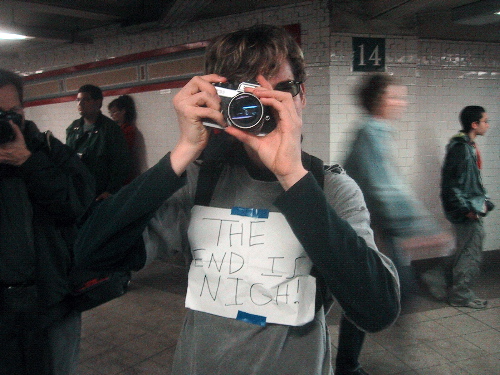
transferring to the L
I saw the message captioned, “Photographer’s Rights Protest,” and I told myself, “I’m in!”
The issue is the New York MTA’s recently-announced proposal that photography be banned throughout the system. Of course it would be for our protection, from camera-hefting researcher/terrorists. I was attracted to the issue (how could its lack of merit even be arguable?), but the fact that a demonstration was announced through the internet, the modest panache of its text appeal, and finally my own recent experience with MTA security incompetence, and its photographic documentation, made it a must.
An excerpt from the organizers’ webpage:
This will be a peaceful demonstration against the MTA’s proposed Photography Ban, conducted in the spirit of Rosa Parks. We will simply ride through Manhattan with our cameras, taking as many photographs as we please, of whatever we please. This is a completely legal protest, as photography within the subway system has not yet been banned (even though the police seem to have been told otherwise).
Participants were asked to bring cameras and, if they wished, “a witty sign.” I have to admit that while I had good intentions, I didn’t manage to fabricate the cool sandwich-board I had created in my head; I went shamefully textless. So did all but one of the hundred or so people who gathered in the central hall of Grand Central Station early this afternoon. That singular body sign, “the end is nigh,” was suitably wry but undoubtedly arcane for all passers- and sitters-by.
But maybe in this action it really was appropriate to just take pictures, especially if the press was already interested, as it seemed this afternoon it was.
The weirdest thing for someone who’s been in perhaps hundreds of other zaps and demonstrations was to be in the midst of all these people taking pictures of each other. Right now there must be thousands of shots out there somewhere showing people snapping people snapping people snapping people, and perhaps beyond.
Not incidently, our progress through the system today must represented the safest time and place in the history of the MTA – at least as far as any threat originating with camera-wielding terrorists is concerned. Don’t leave those cameras home, good folks; it’s for your own security.
For some early-posted, great images go to the dart board]
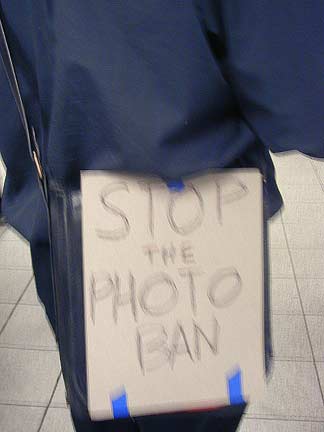
In the end, I broke down and made this crummy impromptu sign on the site, hoping it might raise us above the “flashmob”-type thing.
[bottom image from Forgotten NY]
New York Times erases AIDS
The NYTimes begins its obituary of Ronald Reagan today with a three-column headline on the front page and it continues inside for a total of four more full-page sheets uninterrrupted by advertising. The size of this death notice may be unprecedented, but the most newsworthy item is what’s missing.
The words AIDS or HIV do not appear once.
This is beyond politics; it’s criminal neglect, if not part of a deliberate agenda, from the newspaper which was itself so guilty in ignoring or mishandling accounts of the plague during the Reagan years. Now that same newspaper would have us regard as serious journalism its account of the life of our second-most-disastrous president, the man whose administration, in surviving its general malfeasance and treasons, marked the final disintegration of American democracy.
We won’t buy it.
Reagan, more dead[ly] as president than now
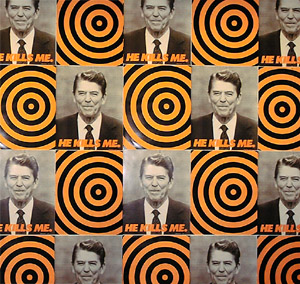
Donald Moffett He Kills Me (installation detail), 1987
He’s dead, but as the encomiums pile up he’s not going to look dead enough.
Reagan virtually spat on people with AIDS throughout his presidency. The epidemic began under his watch, and he ensured that it would ultimately kill millions. For that responsibility alone, he didn’t deserve the relief alzheimers must have brought to his memory.
Ah, wait, Barry just turned on Sylvester’s “You Make Me Feel Mighty Real.” The magical musical legend Sylvester died of AIDS in 1988, so that ecstatic, triumphant shout of delight seems very real around here today. We’re dancing on his grave tonight. Maybe me especially. I’m still talking, and now that monster/fool is not. I’m one of the lucky ones. I’ve been HIV+ for decades, and I’m not leaving yet.
Oh yes, and my memory’s just fine.
[image from Richard F. Brush Gallery, St. Lawrence University]
2 more
Coming in from 23rd Street, I went back into our lobby and past another set of doors to the garden, where I found these [another score for the number 2] dogwood trees.
Incredibly, this too is Manhattan.


2nd anniversary

Remembering that as of today I’ve been at this blog for two full years, I went outside to look for something visual in twos. I found these three on the awning marquee of the Chelsea Hotel accross the street.
New full RSS feed
Barry here, as master of all things webbish.
For those who read James’s weblog via an RSS reader, I’ve added a new full feed with comments.
Go here for more info.
more on what we would lose
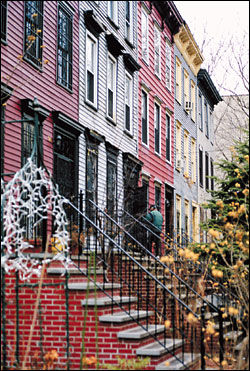
Dean Street
[see yesterday’s “replacing people with a basketball court“]
New facts are emerging about the political and money deals behind the project, and about the vibrant community which woud be destroyed if an “eminent” real estate mogul gets his “domain”.
Anywhere else in New York, time would pass too fast or slow for us to notice this unfolding history [that is, of the Village Voice writer’s neighborhood]. Most of the city has such a high turnover rate, no one would ever bother to learn anything about the prior residents, while those places that pride themselves on their constancy, like Carroll Gardens or Fort Greene, are desirable because they haven’t changed. Now that Ratner and company have awakened us to the possibility of upheaval in our backyard, we’re feeling very protective of what we have: a comfortable community that doesn’t feel bourgie or exclusionary, that makes room for its past while slowly evolving into most people’s present. It’s the best kind of New York, and it’s why we chose to live here. We want our son to feel at home on the block, but we want him to think everyone he meets belongs here too.
The NYTimes, which is enthusiastic about the sexed-up sports arena, mall and housing complex planned to displace hundreds of Brooklyn families, finally admitted to at least one of its ongoing intimacies with developer Bruce Ratner.
The team’s move from the Meadowlands in New Jersey if indeed it ever happens won’t occur overnight or without a fight. The $300 million deal to sell the Nets to Mr. Ratner (whose development company is a partner of The New York Times in building the newspaper’s new headquarters) is just a first step. [from an editorial today]
Ratner has just purchased the New Jersey Nets professional basketball company. He intends to install it in a $.5B complex in Prospect Heights, next to six blocks of $2.5B in other new structures. [The dollar figures are already being described as seriously underestimated.] The buildings would be occupied by commercial and residential tenants paying him generous market rate rents. The problem is that they are not his blocks. The people living there now don’t pay Ratner a penny in rent. He will need the city of New York to seize the buildings and the land on a perverse interpretation of the principle of eminent domain. Ratner also has the nerve to expect the city to help pay for his personal obsessions: letting others watch him play with money and watching others play with balls.
Leave it to Newsday to tell us once again what the Times won’t. Ratner said in December that 100 people would be relocated. The real figure may be closer to 1000.
Finally, even the Times can’t avoid covering some of the objections to the project in its story today, although this part of the text comes at the very end.
Councilwoman Letitia James, whose district includes the neighborhood, is a rare voice of opposition among Brooklyn politicians. She considers the project an oversized monster that will destroy a vibrant working-class neighborhood that has rebuilt itself over the past 20 years.
“This is a great day for rich developers and a sad day for working families,” Ms. James said. “It will open the floodgates to public financing of sports arenas.”
Harvey Robins, a former official in the Koch and Dinkins administrations, said the Ratner project is “antithetical” to building communities. “You’re putting up monstrous buildings in a low-density area.”
Boys throwing their weight around. This is a rehearsal for Manhattan’s own stadium boondoggle.
[image from the Voice]
“replacing people for a basketball court”

Big money interests, not least the NYTimes, want to displace families, artisans and artists, and in fact physically destroy an entire Brooklyn community, in order to build a commercial sports arena.
Our friend Charles Goldman once lived in a building on Dean Street that will be levelled for the proposed Nets Stadium. New York and the world are much better for what he and other artists created there.
Jimmy Breslin has the scoop on the human cost, and gives it out today in his column piece, “So Whose Domain Is It?”.
The claim is that the land can be condemned under eminent domain. This is a way for the government to take land for needed undertakings. The Verrazano Bridge, for one.
But this time they want to take 71 buildings on 10 acres and more than three blocks. This would throw out 864 residents, including 200 people who work in their homes at things like violins, canvas stretching, architecture, photography, painting. They make gentle so much around them, and their government wants to replace them with a basketball team that has a player named Jason Kidd and would be a nice addition to Brooklyn, if you had them in an arena someplace that disturbed no human beings who contribute a lot more to the world than a foul shot.
The idea of replacing people for a basketball court is so insane that of course it brought me right back to the Corona houses – the Corona 69 – who were going to be displaced by an athletic field for Forest Hills High School. The 69 residents had a meeting at the Corona Volunteer Ambulance Hall and it was at a point when they had no chance, the courts and the thieves had it wrapped up. Then a fairly young, unknown Court Street lawyer named Mario Cuomo walked into the hall and said he would represent them. Soon, he had legal paper flying and motions causing dizziness in courts. The city lawyers were sick to their stomachs. And the people rose up and produced this one most memorable scene of civic rebellion:
The great Mrs. Nellie Picarelli stood up at a meeting in a school auditorium and reached into her purse and brought out a big hammer and waved it in the air.
“Why don’t you try coming to take my house?” she yelled at a politician.
“saints”

Tom Hurndall
He’s gone. I had actually thought that he had died last April, but Thomas Hurndall had survived in a vegetative state until this week, when he succumbed to pneumonia in a London hospital. He had turned 22 while lying in a coma. Hurndall had so little time, but while he was alive he seemed to care about helping others more than anything else.
He had joined protests against the war in Iraq, but his mother Jocelyn has said he was not that political – although he did like to help the underdog.
His family remember the 22-year-old as someone who squared up to a mugger trying to steal a boy’s mobile phone near his home in Tufnell Park, north London.
His sister Sophie told the BBC: “Tom was somebody who made everybody laugh, he was intelligent, witty, caring – the kind of person who was always sticking up for anybody who was in trouble.”
. . . .
His family say his diaries show he was clear headed and went with an open mind to Rafah, determined to draw his own conclusions about what was happening to Palestinian civilians.
But he was deeply affected by the sight of a young boy he had photographed being shot in the shoulder.
Eyewitnesses are said to have seen him pulling two Palestinian children to safety in Rafah when he was shot in April 2003.
Aimée Stauffer-Stitelmann is still alive, very much alive, at 79. This week she became the first citiizen to seek to clear her name under a new Swiss law which is intended to finally pardon those who were penalized for helping victims of Nazism. Many Swiss citizens had been tried and disciplined or imprisoned for violating the country’s neutrality before and during World War II while trying to aid victims of the Nazi regime. Stauffer-Stitelmann is credited with saving the lives of 15 to 20 Jewish children and assisting a number of Resistance fighters, beginning while she was still a teenager. She has in fact been an activist all of her life.
After the war, Ms. Stauffer-Stitelmann said, she supported partisans fighting Franco in Spain and organized protests against apartheid in South Africa and the American war in Vietnam, and was at the front of antiglobalization marches last summer in Evian, France, during a meeting of the major industrial nations.
After retiring as an elementary school teacher in 1987, she helped set up an underground school in a church to teach French to the children of illegal immigrants. (The children were banned from attending public schools.)
Her political activities were secretly monitored by the Swiss government until the 1980’s, until public revelations about the extensive monitoring of Swiss citizens ended the practice in the late 1980’s.
According to her file, which is now public, she was accused, among other things, of subscribing to Communist publications and helping Spain’s anti-fascist movement, and of organizing a news conference in Bern against the Vietnam war, where she even “paid for the room and the aperitifs.”
Dorothy Day died in 1980, but the work which she began continues today, usually benefiting most those neglected or insulted by other institutions, “the homeless, exiled, hungry, and foresaken”, in words which appear on the website of the organization she founded, The Catholic Worker Movement.
Late Tuesday night we found ourselves walking past their New York headquarters, Mary House, on East 3rd Street. It was freezing cold outside. Inside, up a few steps and plainly visible and secure in the lobby of the modest nineteenth-century building, was one or more of those big canvas-sling mail bins on wheels often used by street people to store and move their possessions around the city. The cart was more than full. Through the windows below grade we could see a cozy lounge and some people bustling about. Those Workers and their guests represent more than food and shelter.
The nuclear age has sharpened awareness of the need for disarmament and alternatives to war. The widening gap between rich and poor in our country and between nations has spurred greater urgency in the quest for a more just social order. But the distinguishing marks of the movement remain smallness, decentralization, personal responsibility, the personal response to persons in need in direct encounter and a search for answers to the questions that arise from that meeting: Why are there so many poor and abandoned? What is honest work? What is due workers and the unemployed? What is the relationship between political, social and economic democracy, and between these and the common good? [excerpt from a description of the movement found on their own site]
These three individuals, and those who work with their heritage and their spirit all over the world really are “saints”, but we don’t have to”canonize” them to recognize or emulate their selfless concern and their work for others.
Meanwhile, in St. Patrick’s Cathedral on 5th Avenue, the very grand showplace of the American Catholic Church, the homeless are thrown into the streets every night by ushers and police. This is not the work of saints. It’s not even the work of decent human beings. Jimmy Breslin writes today:
They were in a palace away from the cold, the most famous church of the Catholics in America. It is supposed to represent the Lord’s religion.
On this cold night, one of the ushers said that the church closes at 8:35 p.m. Exactly.
And at a little before 8:30, a man on the right side stood up, yawned, stretched and then gathered his plastic bags and walked down the aisle.
From far up in front, a woman pulled her suitcase on loud wheels.
At 8:35, a cop and an usher walked around the church telling homeless people that the church was closing and they had to go out into the cold.
“Nobody can stay?” an usher was asked.
“Church closes,” he said.
In the last row on the left side, a man stirred, then sat bolt upright. He put on a blue wool hat and lifted a backpack that he carefully put on. He had two heavy shirts to fight the cold. He started out. People were coming from the darkness on the side aisles. Soon, the church was empty.
As I finish posting this tonight, the temperature reads 1 degree above zero fahrenheit, with 21 mph winds.
[image by Kay Fernandes on The Thomas Hurndall Fund site]