fallen angels

fireman.gif

New York City firefighter Robert Walsh has been on a respirator in a medically-induced coma in a Staten Island hospital since Thursday. Today he still lies heavily sedated, suffering the consequences of severe facial fractures and a partly severed nose.
Walsh was assaulted with a metal chair on New Years Eve by fellow firefighter Michael R. Silvestri, in the borough firehouse where they shared duties.
It seems that Silvestri had called Walsh a [faggot/fairy/queer/homo – we have to use our imaginations here, since as usual the NYTimes isn’t specific], and Walsh had answered back by charging that Silvestri had gamed the system, taking advantage of his fellows to earn extra pay.
Their comrades initially tried to cover up the facts, obstructing investigation by representing Walsh’s injuries as the result of an accidental fall. He was cleaned up, his clothes changed, and driven to the hospital. No ambulance, no police.
The story may have legs, and it certainly should, for the elements of homophobia and obstruction of justice. My outrage is for what I think are even more fundamental, societal reasons.
Michelle O’Donnell’s Times article yesterday quoted a retired deputy chief, Vincent Dunn, on the subject of “busting chops”, as the paper’s editorial calls it today.

“Everybody verbally abuses young firefighters,” [Walsh is 40, Silvestri 41] said Vincent Dunn, a retired deputy chief, who added that even longtime firefighters do not outgrow the sport of razzing. “Nobody wants physical violence — that’s a no-no. But there’s a lot of verbal abuse. It’s like society.” [my italics]

Umm . . . I don’t think so. [Still, if it were true, it would help explain something about how Americans treat each other and the rest of the world, and why we have only buffoons and bullies running the country.]
But can our hometown “heroes” really only relate to each other through violence, real or implied?
By the way, the Times editorial finally brings up the subject of departmental racism and male chauvinism, even if it only alludes indirectly to its effective and very illegal homophobia.

The firehouse culture of taunting may violate anti-discrimination law, and may be one reason white men make up about 91 percent of the department, which has only one woman in its current probationary class of 304.

Now that Tom Ryan has retired, there now may actually be no out gay New York City firemen, and perhaps only one woman, at least as far as I have been able to determine, Michele Fitzsimmons. It seems that with the exception of Tom and Michele, you might be gay when you retire, if you’re very courageous, but not before. But in this area it’s really the civil cowardice of their straight comrades that stands out.
New York should not have to put up with such nonsense, but above all neither the country nor the world should have to accept the “society” of American straight male violence, verbal or physical.

the site’s been upgraded

As you have probably noticed by now, something new is going on with this site. Barry has upgraded me, moving it from b2 to Movable Type. Yea!
For you readers or picture gazers it means quicker response with internal links and a site search tool which really works.
If you have any problems with the weblog, let me know (or tell him, which is what I will have to do, since he’s the one who is going to fix it, bless him).
There may still be some subtle aesthetic changes made, but I’ve been too otherwise-engaged to deal with those issues today.

“but then I remember John”

Jogged by current arguments over New York’s Harvey Milk High School, and a recent postcard from his own school, bj has written an honest, beautiful piece about an ugly memory, one whose counterpart I share shamefully, as I’m sure do many others. An excerpt:

John I love You
I actually started thinking a lot about my high school days during the first bits of current “controversey” over the Harvey Milk School’s expansion this fall when that postcard arrived. No, I don’t have horrible stories about constant harrassment from fellow students (but you can imagine in an all-male high school); yes, harrassment took place, and yes, I managed to survive it. And no, the Harvey Milk School wouldn’t have been a good alternative for me. But then I remember John.
See, back then, I would get only the occasional taunts – the name-calling, the teasing. I remember one horrible day just after Christmas. My parents had bought me a leather/vinyl shoulder bag for my books – very 70’s, very nice. But the day I brought it to school, the taunting began immediately. Guys grabbed it, put in over their shoulder and “minced” around, lisping words pretending to immitate me. They passed the bag around, wouldn’t let me have it back. I tried to ignore them, and eventually got it back. But the day continued like that, name-calling, joking, tugging at the bag, laughing at my expense. When I got home, I walked straight down to the basement, put it on a shelf with all the abandoned toys and games of childhood, and left it there, never touching it again. Oddly, my parents never asked about it (it wasn’t cheap, and we didn’t have much money), and of course I never mentioned that horrible day to them, I was ashamed. Maybe they knew, and didn’t know what to say or do.
But John. He was the “obvious” one. He had the pronounced lisp, limp-wrists, effeminate manner. He got it every day, all day. I don’t know the real extent to what happened to him, I kept my distance. And it makes me feel very sad, and ashamed. Not once did I ever consider befriending him, and not ’til my senior year did I ever raise my voice to defend him, or tell the other guys to knock it off (By then I was into drugs, so that “coolness” aspect trumped my suspected homosexuality.) I remember once, sitting in the assistant principle’s office, trying to get a class changed, and John was in the waiting room; our eyes met, a moment of sadness from him, then a determined resolve toughened him up, and he looked away. The assistant principle looked in John’s direction, breathed a heavy sigh, and mumbled something like “not him again, won’t he ever learn?” I said nothing, but was deeply disappointed in this ‘educator’. John never got into trouble, he was no doubt there to complain about whatever latest incident happened to him.
Then I went to my next class, attendance was called, and when John’s name came up, some tittering from the students, and I said “Oh, he’s in with the assistant principle.” The art teacher, who we all assumed was gay, then said “Jeez! What’s wrong with him, he brings it on himself, he just needs to stop acting that way.” You have no idea how clearly that is set in my memory, 25 years later, as vivid as if it happened yesterday. No, I didn’t say anything, but I felt even sadder, more disappointment with the adults, and much, much more isolated. And I must say, I must’ve secretly been feeling “thank god John’s here, otherwise it would be me.”

Don’t miss the music clip in his headline.

“but as for its people . . . .”

Silipups explains.
He’s describing the intent of his own weblog, but on the subject of Palestine he could be speaking for many of us.

Hi, my name is Anees. As per many questions I was recently asked:
I THINK SUICIDE BOMBINGS AGAINST ISRAELIS ARE AN ABOMINATION AND A CRIME. LIKE ALL CRIMES, I WISH THEY WOULD STOP FOREVER.
I AM NOT A JEW-HATER AND HAVE MANY DEAR JEWISH FRIENDS. DO I HATE ISRAEL? ANSWER: I RESENT ISRAEL FOR HAVING INFLICTED MUCH PAIN ON A POWERLESS PEOPLE FOR SO LONG. DO I BELIEVE ISRAEL HAS THE RIGHT TO EXIST? ANSWER: AS THE FORCE WHICH ENACTS A RACIST AGENDA IN BRUTAL WAYS, ‘ISRAEL THE IDEA’, DOES NOT HAVE THE RIGHT TO EXIST AS IS. IT MUST CHANGE. BUT AS FOR ITS PEOPLE, I BELIEVE ISRAELIS LIKE ALL HUMANS HAVE THE RIGHT TO EXIST IN THE LAND WHICH HAS BECOME THEIR HOME.
THE MAIN PURPOSE OF STARTING THIS BLOG WAS TO SPREAD INFORMATION ABOUT ISRAEL’S MISTREATMENT OF PALESTINIANS. WHY NOT SPREAD INFORMATION ABOUT PALESTINIAN’S CRIMES AGAINST ISRAELIS AS WELL? THE ANSWER IS: BECAUSE AMERICAN MEDIA ALREADY COVERS THAT, AND I BELIEVE THAT IT IS BIASED TOWARDS OBSCURING THE SUFFERING OF PALESTINIANS UNDER ISRAEL’S BRUTAL RULE.
WHY JUST TALK ABOUT PALESTINIANS? AREN’T THERE OTHER PEOPLE WORTHY OF MORE ATTENTION BECAUSE OF THEIR SUFFERING? ANSWER: YES THERE CERTAINLY ARE AND PALESTINIANS DO NOT HAVE A MONOPOLY ON BEING VICTIMS, AND IF YOU CONSIDER THE AFRICAN CONTINENT AND WHAT’S BEEN GOING ON THERE, IT IS EASILY MORE HORRIFIC AND WORTHY OF MORE URGENT ATTENTION. BUT ONE FIGHTS AND PROTECTS THE PEOPLE AND THE AREA AROUND HIM, BECAUSE THESE ARE WHAT HE SEES AND FEELS. THIS IS HOW HUMAN EXISTENCE WORKS.
MY HOPE (SOME WOULD SAY AN UNREALISTIC DREAM) IS FOR PALESTINIAN ARABS AND ISRAELI JEWS TO LIVE IN PEACE IN ONE STATE.

the blackout blast blog

When the power went off we were upstairs at the Metropolitan Museum. We had just finished walking through the extraordinary “Art of the First Cities” exhibit on one of its very last days, and I had picked up, but not yet paid for, a book in the adjacent little tie-in shop. That whole area of the Museum was immediately thrown into total darkness, but no one was the least upset, and once we were in rooms with natural light, most people, including the guards, seemed not even to have become distracted. There wasn’t a crack of light visible in the “Cities” galleries, so we decided to wander around the grand permanent-collection areas where there was natural light from skylights, until we eventually decided it might be more interesting, if not wiser, to be out on the street. First I slipped around the ropes blocking the men’s room on the first floor (absolutely no light inside, but I knew it well, and I was to be very glad I did that!). I reluctantly gave up my book at another museum shop just outside.
Our only delay getting home was the line of hundreds of people wanting to pick up bags and other interesting stuff from the checkrooms all at just about the same moment. Even now, about a half hour into it, no one seemed to have a clue about the scale of the blackout, but I was beginning to suspect the worse (short of a terrorist attack, which somehow I did not think likely) and I asked a security supervisor about it, since he appeared to have a radio headphone. He told me, “the whole Northeast, including Canada, all the way to Ohio and Michigan.” Heavy.
We walked home at a very relaxed pace, stopping for small meals along the way (gosh, I love hotdogs and brownies!), beginning in Central Park and continuing down 5th Avenue to 42d Street, then to Times Sq. and left down 8th Ave., taking pictures as we went. Arrived home early in the evening. The weather? Like September 11, a beautiful, beautiful day.
When we arrived home on 23rd Street, coming in through the lush interior garden from the north, we found ourselves in the midst of a residents and refugees garden party. There was lots of conviviality, the sharing of food, wine, flashlights and candles, much greeting and talking among people who had never taken time to approach each other before (and a certain number who had, of course), soft songs and one mandolin. We were almost half and half “boys” and “girls,” but we agreed that it was still just about certain that there would be no new babies in this building 9 months from now.
Back in the apartment at first we even had warmish water for showers! We returned to the garden for a spell, until we became overheated by the zillions of tea candles and their truly monstrous relatives. We headed to the roof for a look at the darkened skyline and streets, and of course the Big Dipper, scads of other stars and red Mars itself.
We came down for a walk around the neighborhood where the real life was concentrated in and outside the gay bars on 8th Avenue, with hundreds of barely- (and bearly-) dressed Tom-of-Finland types hanging out in the dark. Pretty impressive group, even by Chelsea standards, but the most significant difference about the street on Thursday night was probably less the extraordinary subtle lighting than the relaxed friendliness and sociability of the guys. “Attitude” had taken a holiday. It felt like a steroid re-creation of the gyms and playing fields of my all-boy prep school or college experience, but here you could fearlessly look at the musculature.
In the end (if not at the very beginning as well), like those schools, it was a pretty dull scene without any women around. Eventually the cold beer ran out and the crowd started to thin.
On our way out the doors of our building we had run into our friend Glenn, and he was trailing a wheeled suitcase, having just arrived from D.C. in circuitous Greyhound routing. Since he lives pretty far out in Williamsburg and intended to go on to Texas the next day, he stayed here that night. The next morning he set off for the airport. We wished him luck. Hope he made it out that same day.
Now we all really understand why, pre-Edison, people went to bed early, and got up early. What do you do after dark, if it stays dark after dark? We tried sleeping, with only some success.
Friday we walked to our Hudson River Park (in the Village, since the Chelsea Piers corporation owns all of our shore in Chelsea), and had a beautiful day. The new park is wonderful. I hope it manages to be maintained properly. On the way back the power went on in the West Village, but we found it was still dark above 14th Street.
Later that afternoon, between 5 and 6, having just about had it with the information shutdown, I got on my bike and zoomed up and down Manhattan from 80th Street to the Battery, visiting both sides of the island. I found that the only neighborhoods which did not yet have power were either the poorest neighborhoods, or those which were the least important as far as corporations are concerned. Coincidence, political calculation, political reality or a reflection of where we build our substations?
Friday night I decided we’d have a relaxed supper on our own terrace, so I moved a small table and a couple of Windsor chairs out with the potted garden, along with some old candle lanterns, linens, and the food which might not last much longer (Italian salamis, cheese, bread, cooked broccoli salad, fresh plums, wine). Sweetpea joined us out there. It was a delightful meal, in circumstances which probably could not and should not be repeated.
I had reluctantly decided, very much against my nature, and for the first time since the lights and the hot water had disappeared, not to wash the dishes immediately. I was going to just rinse them in the dark and finish them the next day in light, with water heated on the old gas stove. But just after I had brought the dishes into the kitchen, I heard a loud roar, cheering actually, coming from the larger garden below, where there was the now familiar assembly of friendly neighbors being very friendly. The power had returned. Bingo! Hot water for dishes. And showers! We rushed to join the group, but by the time we got downstairs they had dispersed into the walls, and the now exotic hum of air conditioners already surrounded us.
Sleep came easily that night.
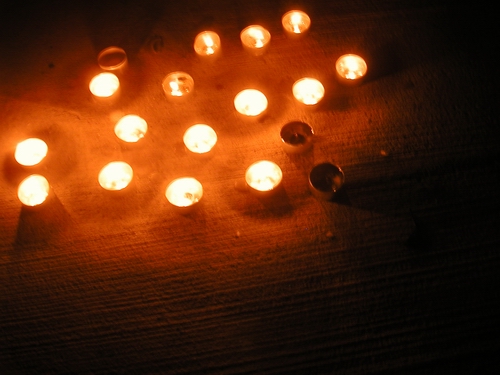
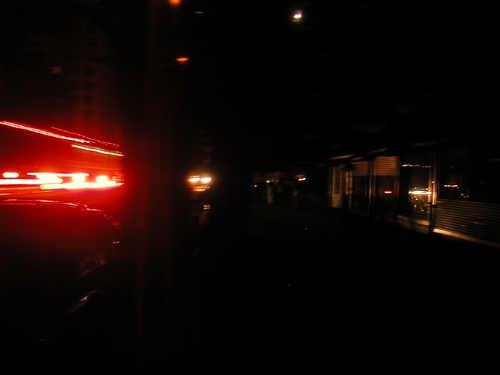
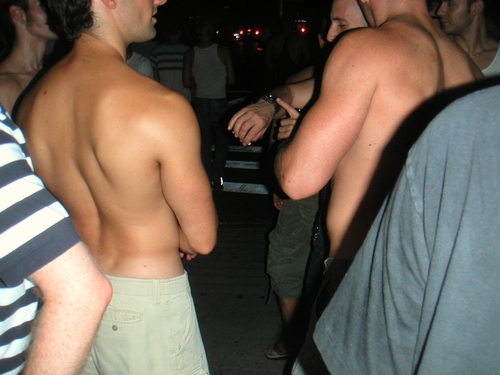
The images, from the top: tea lights in the garden, 23rd Street in front of our building, guys outside of Rawhide
the blackout beef blog

Updated August 20, with pictures
We’re back. Time Warner somehow managed finally to push the right remote control button exactly two days after electrical power (but, for our building, not their cable) was restored to Chelsea. We now have our connection once again, for email and the internet, and of course for television as well (although I haven’t looked, and now have no need for its sad contribution to news reporting).
As you see, Barry and I have been pretty much out of touch with the world since Thursday morning (We left the apartment early in the afternoon to visit the Metropolitan Museum, where we were when the power went off). This means that I have little idea of what has already been said on line about the events of last week, so I’m going to limit my comments to personal experience – and I guess I’ll use the opportunity to let off a little steam.
First of all, I am so f ___ing furious about the spin we were getting, and still get! Yes, New Yorkers were wonderful, but the people everywhere at the very top (of the political, energy and communications heaps) who are supposed to be responsible for our security and basic services should be boiled in oil. Instead, we’re forever hearing this counter-productive, counter-revolutionary crap about how well we made it through.
For most New Yorkers, at least for those with batteries and portable units, there was nothing but radio for word about what was going on, and that is another problem about which we should be hearing much more from both the cord and remote phone industries. We can at least ask whether it was necessary for our only source of information to give us only what they or the authorities thought would calm us poor children, rather than any real information. I only remember hearing over and over again about how relaxed the City was, about how there was one cooling-off shelter in each borough (one in each?), about calling 311 rather than 911 unless it was a real emergency (how were we going to call any number?) and about the mayor expecting power to be restored very soon, in hours, pretty soon, well, . . . soon, or maybe by some time on Monday. The only practical information I remember hearing (and this from public radio, where I should have expected real reporting and real questions to be asked) was the situation at the airports, certainly not a priority even for New Yorkers not stuck in subways or trying to survive without food or water.
New York did so well, I’m almost surprised we don’t hear some people saying, “Bring it on, again!” – the idea being that we should regularly have this kind of opportunity to prove our mettle and our civic sweetness. Besides selling papers and airtime, it helps the economy – or so the reasoning might go. Even though we know there was no power overload this time, that it was the transmission and other systems that failed, I expect nothing to be done to prevent a recurrence, except what will further enhance the profits of the decision-makers at the top and their paid operatives in Washington, state capitols and cities. Alaskan oil drilling, tax breaks for the oil and gas industry, nuclear energy and countless other destructive rapes of the public and its weal, come to mind immediately. Hey, does anyone remember ENRON? Does anyone recall the vaunted and still very secret Cheney energy meetings that were supposed to result in miracles? The only miracles were the obscene profits of those whose conversations are still kept from us.
Second, do we really have to submit to “Blade Runner”-like assaults by police helicopters? We hardly slept Thursday evening, and the problem was not just the dark, warm, airless room. It was less the heat and humidity that arrested sleep and more the horrendous and mindless whop-clack of the police helicopters (infra-red cameras directed below them in a neighborhood “security” watch) passing every few minutes and hovering directly overhead for a few more, while occasionally and disturbingly shining searchlights onto the ground and the walls outside our rooms. Not knowing at the time how many days and nights this might continue made it even more horrible and obscene.
Can’t the police walk, or pedal, or even drive cars anymore? Did they have to terrorize us (disturbing what peace we might have hoped for) in the name of combating terror (keeping the peace) by remote, and in fact secret, control? These may be rhetorical questions, since there is little doubt that helicopters are considered more fun, more manly, than the alternatives, even as they are less risky for the individual officer. If the police were only interested in preventing lootings or controlling what they consider to be the threat to order represented by the large public housing units in our neighborhood, they would have announced they were going to be haunting us all beforehand, but even after the fact you don’t see any report of their overhead presence, at least in the print media. I figure it’s something like the approach our cops use to catch speeders. In the U.S. they usually try to catch them by hiding; in Europe they are interested in keeping them from speeding in he first place, so they are very visible, especially on dangerous sections of roads.
And finally, why on this tight little island of Manhattan has no one apparently even thought of setting aside at least one or two north-south avenues for emergency vehicles and some routes for pedestrians alone? Why, in the great emergencies unfortunately not unexpected these days, do 10 million people on foot have to compete with the idiots who choose to drive private cars in Manhattan?
Walking down from the Metropolitan, we saw a couple of women try to force their Oldsmobile across Fifth Avenue on 52nd Street through the huge crowd of pedestrians. They nudged a woman pushing a baby carriage. At that moment there were thousands, maybe tens of thousands of pedestrians visible on Fifth Avenue at 52nd Street, and only a handfull of cars and SUVs, each of them carrying but one or two people. And yet the machines still seemed to think they had the right of way – they wouldn’t even pull over when an emergency vehicle was blasting its horn immediately behind them, until people on foot engaged the drivers. All this a habit of 50 years, encouraged by the authorities in the name of “keeping [vehicle] traffic moving.”
In fact we ourselves were really very little inconvenienced, especially compared to the problems experienced by so many others, and compared to what could have happened to all of us.
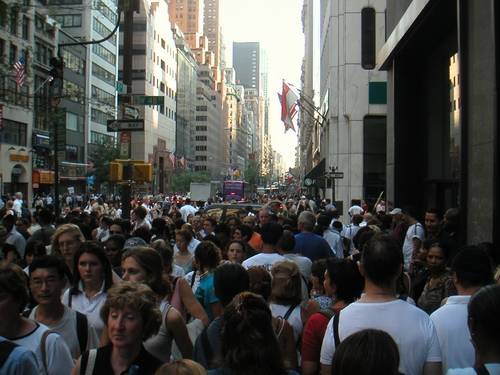
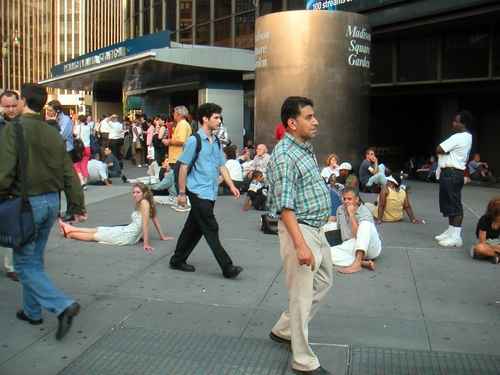
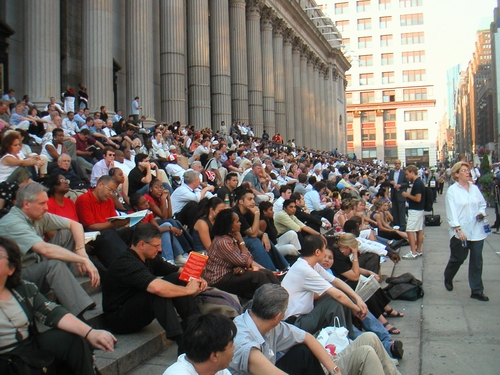
There are a few pictures below. For the fun part of the blackout, and more pictures, go to the next post, just above this one.


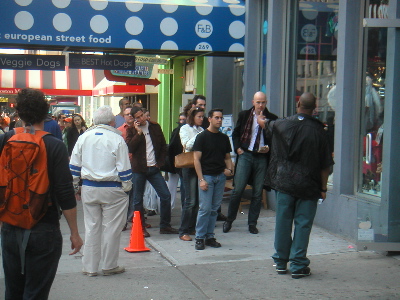
The images, from the top: 5th Avenue, Pennsylvania Station, Public Library steps across from the station