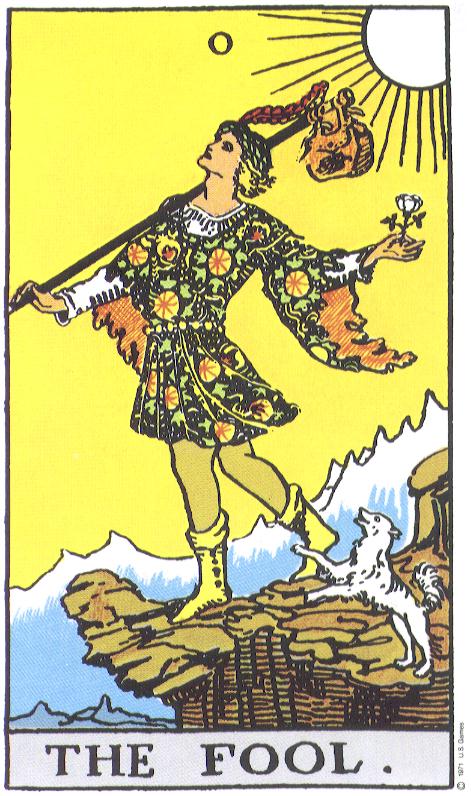
I think I can speak for a lot of people on the Left if I say that for a long time we’ve been in a state of despair because of our belief that the radical Right was pretty much in absolute control of things at the top.
But today, as I stare at the national and international news stories now unfolding regularly, each headline topping the outrageousness of its predecessor, I’m thinking it should be pretty clear to all of us that absolutely nobody is in charge in Washington [and I suspect this isn’t what Republicans meant by small government].
Somehow I’m not feeling better yet.
May the luck of the simple fool save us from total annihilation, since it’s clear we won’t make it with our cleverness.
[image from History of Magic]
Category: General
we are all Danes today

This whole Mohammed image thing is almost perfectly ridiculous, but there is one perfect solution to the problem.
Denmark simply must not be left hanging in the wind. There is a popular, although apparently apocryphal story concerning the Danish resistance to the Nazi occupation. Supposedly the aged King Christian X left the palace on his daily ride wearing the yellow Star of David, the symbol which jews had been ordered to display prominently on their clothing.
Maybe it’s just a nice story, but whatever its basis in fact, the combined efforts of the Danish population saved from extermination all but a few dozen of the nation’s 6500 jews.
Let’s put together a wonderful, real story with the material we’ve been handed sixty years later.
It’s time for all newspapers, and all nations, everyone who has a media outlet, to make themselves a common target of those who would threaten the freedoms which support liberal societies.
I believe the images scorned by ignorant or cynical people who do not, or pretend not, to understand our liberties should be shown everywhere, and as prominently as is possible. Now.
We are all Danes today, regardless of our beliefs.
[image via Dutch MP Geert Wilders, who has published all 12 original cartoons on his blog]
NOTE:
It would be inappropriate under the circumstances were I not to mention the significance of the source of the very elusive image I’ve used and the link I provide. Geert Wilders is more than a little controversial himself.
finally it’s right here: a secret police with matching state*
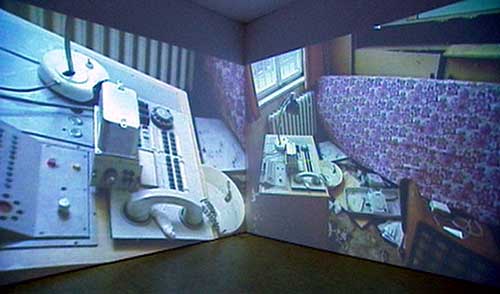
Jane and Louise Wilson Stasi City 1997 video [still from installation]
All this blithering about to execute or not to execute, for the death penalty or against – all rot, comrades. Execute! And, when necessary, without a court judgment.” – Erich Mielke, GDR Minister for State Security, in a 1982 address to high-ranking Stasi officers [from “Stasiland”]
While still trying to fathom my fellow Americans’ seeming indifference to extraordinary reports about our National Security Agency‘s domestic spying operations I’ve found myself reading Anna Funder’s “Stasiland“.
It’s a terrifying story and it’s incredibly depressing, even if it ultimately ends somewhat happily in 1989 – happily for those who survived. Oddly, and unfortunately, it’s also a story which many Germans seem to want very much to forget.
I have to confess that even I wasn’t very interested in the particulars of Stasi history until recently, in spite of having regularly and almost literally bumped into the physical relics of its power in the eastern neighborhoods of Berlin last fall. It was actually Barry’s idea to order “Stasiland” from the library when we returned from Germany, having heard about its existence while we were there.
Since he was too busy with projects to begin reading it when it arrived, I took up the book myself, at first almost casually, although a somewhat dutifully, and certainly thinking it would be a bit of a drudge. Only then, when I became totally absorbed in this world I wish had only existed in the imagination of George Orwell, did I realize how relevant this brilliant account from both its victims and its perpetrators was to what was going on around me today.
Today’s Germans may entertain the luxury of this selective amnesia about the very recent past, but the course of our own recent political history has made it more and more clear that we, as citizens of the nation which was so important as both model and midwife in the birth of their post-war democracy, must not.
“Stasi” was the common name for the East German Ministerium für Staatssicherheit (Ministry of State Security). I think it’s interesting that the increasingly-threatening contemporary U.S. equivalent should go by a name virtually identical to that given to the hated DDR secret police. Ministry of State Security or National Security Agency. There is only the slightest semantic difference between the two, little more than a question of style.
The German victims of an experiment gone very wrong are quite free today, but here in the land of the free and the home of the brave we seem anxious to build our own police state, or we’re at least remarkably indifferent to the construction going on all around us.
If we want to get the attention of a sleeping citizenry, maybe we’ll have to come up with an appropriate nickname for our own National Security Agency, a tab which could hold its own when set next to the one which described the East Germans’ nightmare. My own first thought? “NASY” (with the second letter pronounced “ah” of course)
*
“Well, when the president decides that he can do whatever he wants in violation of the law, including detaining citizens without charges and spying on citizens without warrants, that pretty much is the definition of a police state. It’s the claimed authority that matters, not the extent to which it’s used.” Atrios
[image from Bayerisches Rundfunk]
of superstition and death
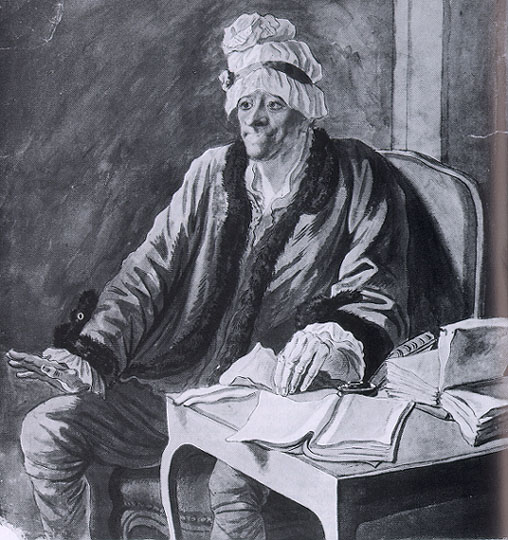
Voltaire: not quite an atheist, but an enemy of superstition everywhere
Even, or perhaps especially, in the midst of so much grief being felt in Mecca and all over the world today, I don’t think it’s unfair to ask:
When was the last time we’ve read about hundreds of atheists deliberately drinking poisoned Cool Aid together, or accidently trampling each other to death [again], while passionately pursuing preposterous belief?
[Jean Huber image from University of Chicago, Humanities Division]
the American idea of learning; or, what to do with extra cash?

Once again America steps up to the plate, or goalpost, to show the world that we understand what edjukation is all about.
Oklahoma State University has announced that Texas oil magnate T. Boone Pickens will donate $165 million to its athletic program.
My favorite part of the story may be the reference to the previous record for an athletic bequest to a university. It seems that the custodians of American institutions of learning don’t put much store in the subject of education themselves:
The amount [of Pickens’ gift] surpasses the $100 million that the Las Vegas casino owner Ralph Engelstad gave to the University of North Dakota in 1998. Half of that was initially intended to build a hockey arena, but the project eventually consumed the entire gift.
And not a penny left over for any of that boring learnin’ stuff.
Before I leave this subject, even a quick check with our memories and the internet will remind us that Pickens and his money are very close to both Bush (not incidently a major funder of the Swift Boat Veterans ads) and to the tax-exempt Progress for America, currently spending tons of cash in a campaign to push Alito’s case in the Senate.
For an additional lesson in the values held by this Texas billionaire takeover artist, it’s interesting to see that according to Wikipedia, Pickens and employees of his BP Capital LLC [my italics] donated a realtively paltry $5 million to the Hurricane Katrina relief effort. But, hey, what possible connection would the poor people of Louisiana have with the oil business? Well, I’d humbly suggest that their claim to some of his wealth is far superior to that of the beneficiaries of a redundant sports facility attached to an institution supposedly devoted to higher learning.
[Oklahoma State University logo from aggiesports]
Jesus, just visiting
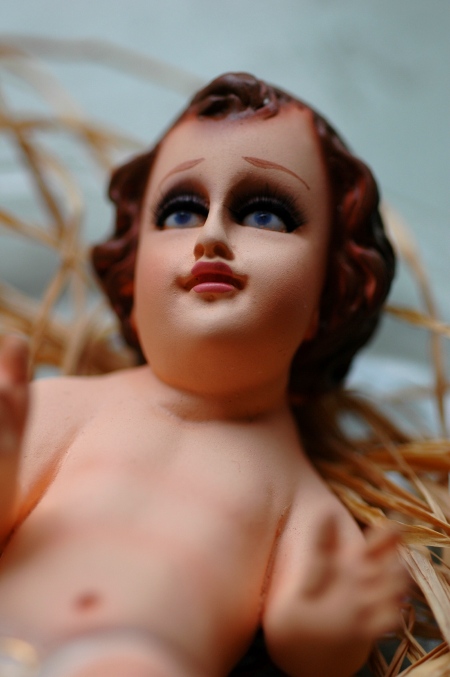
the eyes have it
As I write this it’s already the early hours of January 6, the Feast of the Epiphany and traditionally the absolute finish to the long holiday which celebrates the birth of the founder of the Christian religion.
But of course there’s another story behind the seasonal image I’ve uploaded above.
I don’t have a religious bone left in my body, but I can’t ignore a pretty face. A number of years ago Barry and I were in New Mexico where we stopped at one of the more important Mexican colonial country churches. Attached to the beautiful ancient adobe stucture and just beside the sacristy was a fairly serious gift shop. We were alone in its two short aisles for a few moments, so we were able to discuss between ourselves (but still carefully sotto voce) the purchase of this delicate ceramic figure of a baby Jesus sporting some pretty amazing eye make-up.
We were both very much afraid that the middle-aged Franciscan who managed the shop might realize that our interest in the object was not wholly devotional, but the weight of experience assembled during my extended Roman Catholic childhood and our two very straight faces managed to carry the day.
Every year since that day we’ve placed the pretty little tyke in a thin bed of straw on a prized side table in the parlor every year around the period of the ancient pagan feasts of Yule and Saturnalia. Oh yeah, we give him a small pair of wooden dreidels to play with while he’s there.
We figure Jesus needs a vacation from all the Christmas fuss. And besides, we really like kids.
Sweet Pea cam

This morning Barry remembered we had once made a very short video of Sweetpea, and he’s arranged a link to it here. Be warned, the file is pretty big.
Early in his stay with us, several years ago now, I was playing with my new little camera and I managed to pick up this short video of our new roommate. I don’t think I ever used its video function again, and as it turns out it’s now one of the few images, and the only moving picture, we have of Sweet Pea.
I guess we thought we’d eventually be able to record him better outside the cage, but the little guy stubbornly resisted all of our efforts to introduce him to our fingers in order that he might share in the delights (and dangers) of life outside a cage. Maybe the big experience which preceded his arrival at our window had been enough to put him off open spaces forever. He certainly was never able to bring himself to trust a finger, and that was a very sad thing for the two of us.
Eventually we all must have grown so comfortable with the relationship defined by his own personal space that Barry and I never again thought of documenting the hops, the chirps and the peeps, the deep bows, the impromptu overtures of greeting which found him clinging to the bars on the side, the curiosity which kept him peering around his mirror at whatever I was up to in the kitchen, the happy dances, the huge delight in fresh fennel or frissee, the ecstatic play or the gurgling little songs which accompanied his sweet dreams.
He was always there, and he’d be there tomorrow.
I suppose he still is.
Sweet Pea

warming up on the cold afternoon he flew through our opened window three years ago
Barry and I said goodbye to Sweet Pea* this afternoon.
I know it’s silly, but I have to say it: He was part of a very happy little family.
I can’t begin to express how good this tiny, beautiful bird could make us feel. He weighed only one and a half ounces, but he knew how to sing and dance, he knew how to play and just maybe he knew how to make us laugh.
We were pretty inseparable, except for vacation trips and ordinary excursions outside our building (Still, we both occasionally fantasized being able to walk around anywhere with Sweet Pea on either of our shoulders). For over three years he sat and acted up in his cage at the side of our table, and if we were going to be anywhere else in the aprtment for a while, we’d move him there.
He didn’t seem to miss anything that was going on around him.
He ate when he was hungry all day long, but around dinner time he waited and then seemed to make a big point of scooting down the side of the cage and eating the moment we turned the lights low and sat down. On some level he seemed to understand that meal’s importance to the whole flock.
He sang back to all the birds in the garden, and to the sound of running water (a huge flock of parakeets?).
He loved Mozart and he loved Miss Kittin.
The inevitable consequence of our great affection for this blithe spirit is the grief which follows his absence.
We thought we were going to be bringing him back home when we set out for the veterinarian today.
Sweet Pea had been fighting a liver disorder, probably cancer, for several months. After we talked to the doctor this afternoon, Barry and I were forced to realize not only that there was nothing more that could be done for him, but that we couldn’t let him suffer the increasing pain that had already almost totally replaced such great joy.
Right now I’m sitting at the table in a breakfast room which had been kept so very alive by a lttle bundle of green feathers. Yeah, carrying away the empty cage was a killer.
*
This is the spelling Barry uses. I’ve just noticed for the first time that Barry and I have been typing the name differently for three years. Oh well, spelling rules came late in our language anyway, so we shouldn’t stress over this stuff. Although I may adopt his mode from now on, since I’ve done a number of posts about our little friend in the past you’ll have to use “Sweetpea” if you’re searching my site.
Pinter reminds us that political truth still requires a poet

Sir Harold
Nobel laureate Harold Pinter addressed the Swedish Academy yesterday. He began with a beautiful description of his own creative process, but very soon stepped up to the broader political pulpit which the prize so generously provides its honorees.
From the brief account in the NYTimes:
Dressed in black, bristling with controlled fury, Mr. Pinter began by explaining the almost unconscious process he uses to write his plays. They start with an image, a word, a phrase, he said; the characters soon become “people with will and an individual sensibility of their own, made out of component parts you are unable to change, manipulate or distort.”
“So language in art remains a highly ambiguous transaction,” he continued, “a quicksand, a trampoline, a frozen pool which might give way under you, the author, at any time.”
But while drama represents “the search for truth,” Mr. Pinter said, politics works against truth, surrounding citizens with “a vast tapestry of lies” spun by politicians eager to cling to power.
Mr. Pinter attacked American foreign policy since World War II, saying that while the crimes of the Soviet Union had been well documented, those of the United States had not. “I put to you that the United States is without doubt the greatest show on the road,” he said. “Brutal, indifferent, scornful and ruthless it may be, but it is also very clever. As a salesman it is out on its own and its most saleable commodity is self-love.”
Earlier in his address [see the Guardian for the entire text, and it’s definitely worth a read] Pinter reminded the world that American narcissism has been exercised at enormous cost, and that the world continues to pay for it today.
The United States supported and in many cases engendered every right wing military dictatorship in the world after the end of the Second World War.
And yet we persist in the myth that we are just a peace-loving, democratic folk continually abused by a world to which we generously offer our highest ideals and material support.
SIDEBAR: Barry and I will be seeing Pinter’s first and most recent plays in a double bill at the Atlantic Theater next Tuesday. I could hardly wait for the day even before the artist’s appearance on the screens in Stockholm; now I can’t help thinking of the opportunity as a small event of world significance.
[image from CamdenNewJournal]
posting to resume tomorrow
Between pre-Miami, during-Miami and after-Miami distractions and commitments, I’ve been unable to post anything for a week or so. My vacation ends tomorrow however. I’ll try to make up for my neglect.
[image from mikkibeymer]