It was already early Saturday evening. We were walking down through Hudson River Park with a destination in mind, but we had started to assume that we would arrive too late to see the posthumous [performance?] of Robert Smithson’s 1970 sculptural concept, “Floating Island”, an homage to Manhattan and Olmsted’s Central Park.
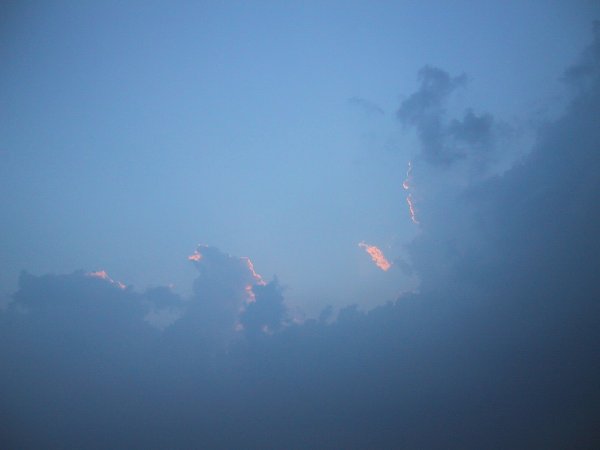
I stopped at the shore railing for a moment with my camera in order to capture a golden lining on the last clouds to witness a sun which had probably already set.
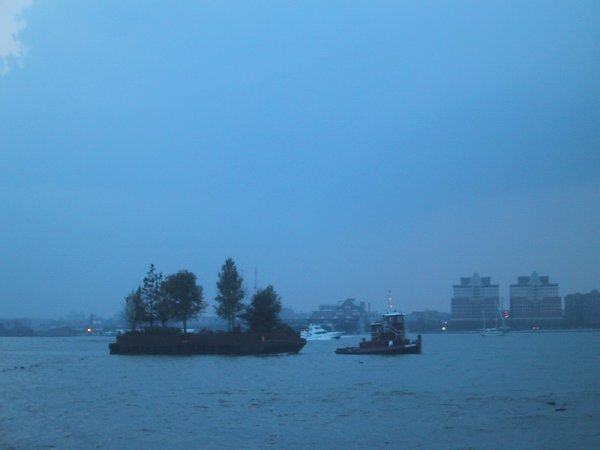
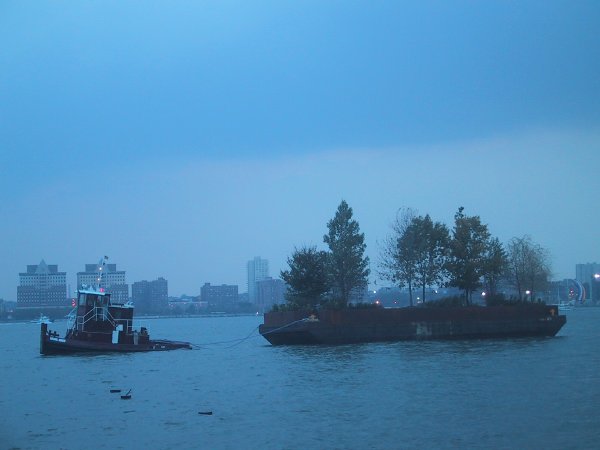
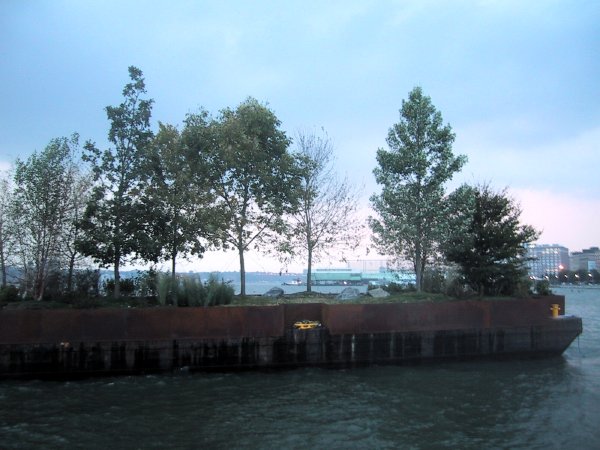
Then I caught up with Karen and Barry and we soon spotted downriver what the world had only seen as a child-like sketch until that afternoon: a little tugboat pulling a small barge along the shoreline, the barge filled with what looked like a chunk of landscape from the park itself, complete with shrubs, grass and boulders [the rocks borrowed from the park for the occasion].
The excellent skipper of the “Little Toot”-like tug had amazing control of his charges, and none of the spectators were disappointed, whether they stood on the shore or on the piers, as he passed by with his chunk of Manhattan in tow, then turned and passed again and again and again along the edges of both.
The three of us weren’t even disappointed that we had forgotten about invitations to receptions which had promised food and drink. We had lingered too long among the temptations offered by Chelsea galleries that afternoon. By the time we arrived at the scene by the piers further downtown black-garbed, white-aproned caterers were emptying lots of unused bags of ice into the Hudson.
But the chase and the catch (here, the art, a delightful late-summer gift to the people of New York) was the thing, we reminded ourselves, especially if we couldn’t picnic on the barge. It was now almost totally dark, so we crossed the highway and headed into the West Village to track down what turned out to be a fine dinner with excellent company.
One last thought: At what age did we first learn that most islands don’t float?
Category: Happy

sturdy Bavarian beasts
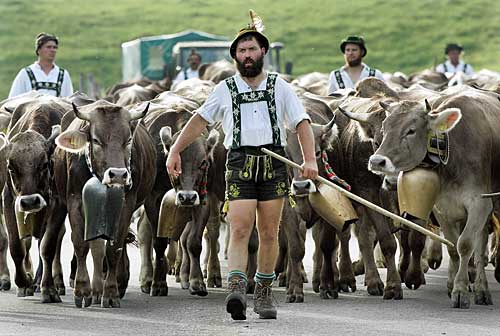
I couldn’t begin to say who’s the prettiest
The caption supplied with the photo reads:
Bavarian herdsmen in traditional dresses drive their beasts on a road during the return of the cattle from the summer pastures in the mountains near the small town of Oberstaufen, southern Germany, Friday, Sept. 9, 2005. Cattle are returned to their owners after the summer grazing period.
When heard in the mountains, the cattle often out of sight, the sound of even one of those bells is absolutely sublime.
[image by Diether Endlicher for the Associated Press]
ArtCal now has pictures!
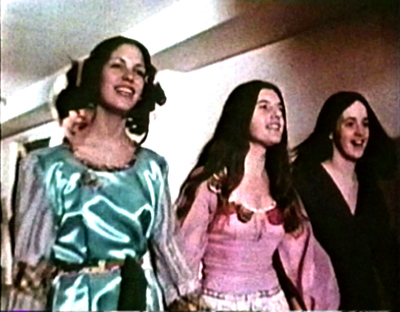
Robert Boyd Heaven’s Little Helper (from the series Xanadu) 2005 video still (Manson Girls)
News flash! ArtCal now has pictures as well as information. Well, it is all about the visual arts, so offering some images along with direction only seemed [more than] appropriate.
Marking the unofficial end of summer, there are gazillions of art openings this week, and most of them are on Thursday (see “Opening Soon” on the home page). The site’s convenient geographical and, in the case of Chelsea, even sub-geographical arrangement of listings will help all you fanatics find your way through the rich offerings. Press the print button and you’re halfway there.
Maye we’ll all bump into each other. Say hi.
[image of a “Featured Opening” from ArtCal]
keeping New Orleans alive, and honoring the dead their way
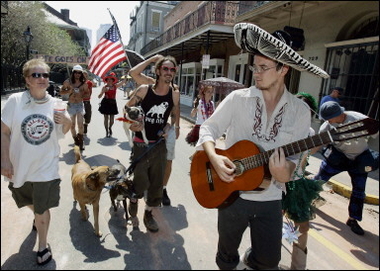
A ‘Gay Parade’ gets under way in the French Quarter of New Orleans. as a determined handful of hurricane survivors vowed to keep the spirit of New Orleans alive. The official parade was postponed because of the arrival of Hurricane Katrina six days ago.
New Orleans has a better chance of surviving if New Orleaneans are there to keep it going. Nobody should even think of leaving it all up to FEMA. Agence France Presse shows us today a little bit of how it’s going to happen.
NEW ORLEANS, United States (AFP) – Music, Mardi Gras beads, costumes and confetti returned to the French Quarter as a determined handful of hurricane survivors vowed to keep the spirit of New Orleans alive.
Decked out in a red polka-dot tutu and purple parasol, Candice Jamieson, marched through the city’s eerie abandoned streets, rattling a tambourine.
“We’re having a decadence parade,” said the 21-year-old student, referring to the annual gay pride march, usually a massive and raucous affair that rivals the city’s famed Mardi Gras festivities.
“We’re trying to bring up everyone’s morale,” Jamieson said moments before reaching out to catch beads tossed by the only populated balcony in Royal street.
“It’s usually a lot bigger,” Georgia Walker, 53, called down as she tossed more beads.
. . . .
Asked whether he thought some people might consider the parade in poor taste given that hundreds of survivors remained stranded and that rescue workers were harvesting the bodies of storm victims from streets and flooded homes, [Michael Skidmore] said the city was in desperate need of a little joy amid the carnage.
“We’re going to make life better, even if they laugh at us, we want them to laugh,” he said as his grass skirt flapped in the breeze.
Dancing in the streets is a traditional way of honoring the dead in the region, explained Diana Stray Dog as she held a pole flying a huge American flag against her shoulder.
“In New Orleans we celebrate death. When people die we go in the streets and sing,” she said, adding that she was marching to return some life to the battered city.
“Amid all the tears and all the sorrow we have a big heart and it’s not going to die.”
One of a number of places sheltering the life which continues in the city, in defiance of the authorities’ orders to leave, is Molly’s at the Market, described in better times by one fan as “Our favorite watering hole in the quarter, full of dropouts, queers, freaks, and phds. Oh yeah, and a fabulous juke box.”
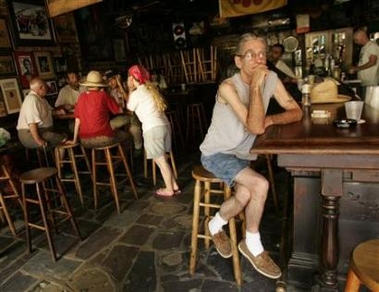
A patron spends the afternoon at Molly’s at the Market, one of at least two bars in New Orleans’ French Quarter that has remained open after Hurricane Katrina despite a lack of electricity and running water on September 4, 2005. Many residents of New Orleans who live in the few areas on high ground that escaped flood waters say they will defy official requests for them to abandon their homes.
UPDATE: For more on the “tribes” of the French Quarter, see this AP story, the stuff of tomorrow’s legends.
[top image by Robert Sullivan from AFP, second image by Shannon Stapleton from Reuters, both via Yahoo!]
saving a living archive of American social and cultural history
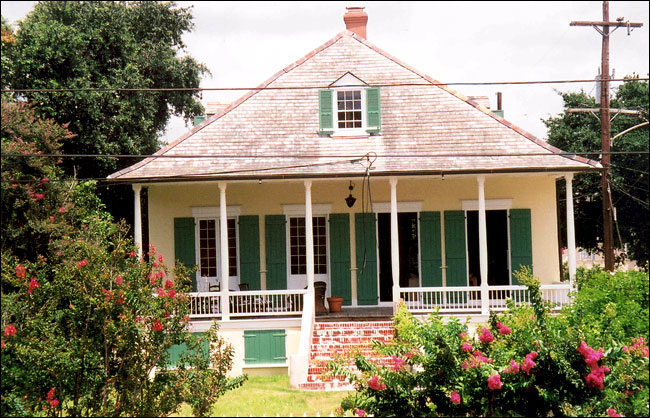
the author’s home, before the flood
I have a stack of neglected newspapers on my right as I sit here at my laptop looking at the staggering reports of human tragedy flowing in from Louisiana, Mississippi and Alabama. I saved yesterday’s NYTimes “House & Home” section for later, mostly because of this article [with another, very different picture] which appeared at the top of the front page. A few minutes ago, while looking for something else, I saw it for the third time on Tyler Green’s site.* I decided I had to read it now, and I’m glad I did. In the midst of so much reason for despair, the writer, Frederick Starr, recalls a community which has been all but destroyed this week, but he also offers some hope for its survival.
My home is there, a West Indian-style plantation house built in 1826, standing as an ancient relic amid a maze of wooden houses a century younger. Some are classic bungalows, but most are distinctly New Orleans building types, with fanciful names like shotguns and camelbacks. I watch as a neighbor is rescued from his rooftop. Dazed, he has emerged from his attic, wriggling through a hole he hacked in the roof, swooped up by a Guardsman on a swinging rope. He is safe. Scores of others aren’t. Bodies float through the streets of the Ninth Ward. Presumably they are from the diverse group that inhabits this deepest-dyed old New Orleans neighborhood: poorer blacks and whites, Creoles of color and a sprinkling of artists.
My neighbor Miss Marie is also one of the lucky ones. Born on the ground floor of what is now my house, she is 81, residing in a shotgun house that her husband, now deceased, built 60 years ago. She has spent most of her life within a perimeter of barely 30 yards. Both her speech and her cooking were formed right there. A painted plaster statue of the Virgin has protected her through all previous storms. But this time she pleaded with my friend John White to take her as he left town. Satellite photos show the shadow of her roof beneath the filthy water. Her house is gone, but John saved her life, driving to Atlanta, sleeping on benches at rest stops.
. . . .
We are just beginning to appreciate the human disaster occurring in New Orleans and the Gulf Coast. Hundreds, maybe thousands, have already perished. Hundreds of thousands will lose their homes and all their worldly possessions. Untold numbers of businesses will close their doors, throwing huge numbers of people out of work. New Orleans, its population already in decline, now faces economic and social collapse.
It also faces the loss of some of America’s most notable historic architecture. Maybe not in the French Quarter, which may emerge relatively intact, or the Garden District, which was spared most of the flooding. The dangers lie in neighborhoods like Tremé and Mid-City, which extend along Bayou Road toward Lake Pontchartrain and are rich in 18th- and 19th-century homes, shops, churches and social halls. They have been badly hit by the violent winds or torrents of water. And so have hundreds of other important buildings and vernacular structures throughout the city and across the breadth of South Louisiana and the Gulf Coast.
. . . .
Louisiana, especially South Louisiana, is a living archive of American social and cultural history, and not just in its buildings. In no other state is the proportion of people born and raised within its borders so high. As a consequence, they are something that is ever more rare in a homogenized and suburbanized America: the living bearers and transmitters of their own history and culture. Katrina, and those fateful levee breaks in New Orleans, put this all at risk.
. . . .
Now [my own house] is under water. If it survives at all, it will need massive rehabilitation. Just as likely, it will go the way of Miss Marie’s house and of hundreds of other pieces of the region’s heritage.
But I do not intend to give up easily. Why? Because I am absolutely convinced that New Orleanians will not allow their city to become a ghost town. And I intend to be part of the renewal that springs from this determination.
*
Go to Green’s site, “Modern Art Notes,” for regular updates on cultural loss in the Gulf area, and suggestions on how to help, along with very helpful links.
[image from the NYTimes]
Marcos is gay
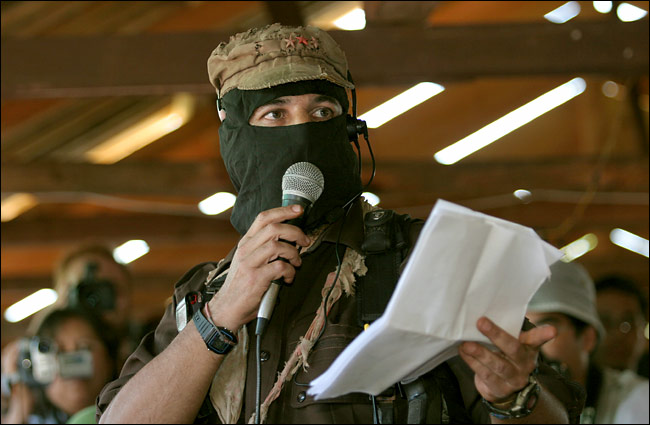
Subcommander Marcos
Well, maybe not, but he sounds really good, and he still looks wonderful.
His words, especially since they’re from the mid-90’s, won’t be news to many out there, but I tripped over this powerful quote from Subcommander Marcos while trying to get more information about the Mexican rebel this morning. I had just read this piece in the NYTimes about his current campaign to move his great nation to the Left. It was accompanied by this attractive photograph. After more than ten years of news accounts and imagery, I was immediately smitten all over again. The reporter himself was not immune to his attractions, for he wrote that Marcos “may be the only man in history to make a ski mask and pipe look sexy.”
Marcos is gay in San Francisco, black in South Africa, an Asian in Europe, a Chicano in San Ysidro, an anarchist in Spain, a Palestinian in Israel, a Mayan Indian in the streets of San Cristobal, a gang member in Neza, a rocker in the National University, a Jew in Germany, an ombudsman in the Defense Ministry, a communist in the post-Cold War era, an artist without gallery or portfolio…. A pacifist in Bosnia, a housewife alone on Saturday night in any neighborhood in any city in Mexico, a striker in the CTM, a reporter writing filler stories for the back pages, a single woman on the subway at 10 pm, a peasant without land, an unemployed worker… an unhappy student, a dissident amid free market economics, a writer without books or readers, and, of course, a Zapatista in the mountains of southeast Mexico. So Marcos is a human being, any human being, in this world. Marcos is all the exploited, marginalized and oppressed minorities, resisting and saying, ‘Enough’!
[image by Adriana Zehbrauskas from the NYTimes]
fiores stravagantes

in the Channel Gardens, Rockefeller Center, on Thursday
miniature Manhattan wildlife II

up the wall
He’s back! I’d seen nothing since last July, but there were two sightings of our roof garden lizard this morning, both on the wall above the planters. Barry thinks we actually saw two separate little creatures, one a bit larger than the other. Hmm. When do we get to see the kids? And are they going to want to come inside when it gets colder?
Sorry for the quality of the image, but she or he’s really tiny, and I didn’t want to frighten the little guy away by getting too close.
Barenboim continues Said’s dream
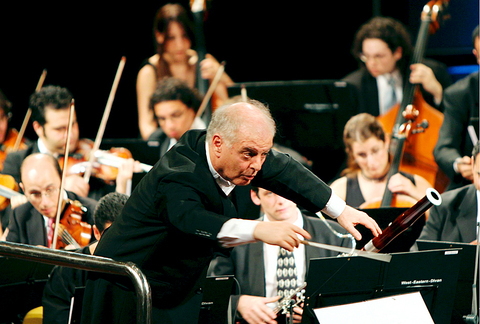
playing for peace
In a project begun with the dream of his late friend Edward Said, Daniel Barenboim finally made it to Ramallah with his West-Eastern Divan Orchestra last night. Members of the orchestra, founded in 1998, come from Israel, Palestine, Syria, Lebanon, Egypt and Jordan.
The sound of Beethoven’s Fifth Symphony drowned out the staccato of bullets on Sunday in the conflict-ridden Middle East as world-famous conductor Daniel Barenboim dazzled his Ramallah audience with both music and words.
Playing under the theme “Freedom for Palestine,” Barenboim and his new West-Eastern Diwan [sic] orchestra were able to break all barriers and help an audience fatigued by strife to enjoy two hours of pure music from Beethoven and Mozart.
. . . .
The 1,200-seat auditorium of the Ramallah Cultural Center was packed with a Palestinian, international and even Israeli audience an hour before the baton was scheduled to drop. As the seats filled, hundreds others milled in the hallways and the aisles hoping to get a seat or just to be allowed to stay in standing room and listen to Barenboim and the orchestra.
The same audience stood for 15 minutes, enthusiastically clapping and yelling “bravo” after Barenboim concluded the performance, giving Palestinians in Ramallah a chance to forget the checkpoints, the occupation, the wall and everything that has made their lives void of spirit, as one member of the audience remarked after the concert.
Outside the auditorium, the reality for West Bank residents had not yet changed after the concert, as Barenboim hoping to achieve with his music and orchestra.
A few audience members had to leave early to get home before some checkpoints at entrances to Ramallah closed. Others who waited until the end and headed home after the concert had to stop in long lines of cars waiting at checkpoints to be able to reach their homes. Barenboim realized this reality, and this is why he brought his new orchestra to Ramallah.
“What I want to say to you,” Barenboim told the audience after the orchestra finished playing, “I have already said in the music.
But it wasn’t easy getting there.
[image from European Pressphoto via Taipei Times]
papal Carnival in Cologne
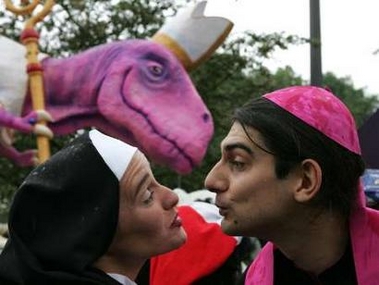
demonstrators dressed as a priest and a nun kiss in front of a large model dinosaur during an anti-religion demonstration in Cologne August 19, 2005 [as der Ratzinger arrived in Cologne]
Sometimes it’s best to let the thing speak for itself.
I’m very proud of my family’s ancient Rhenish Catholic [and before that, Roman without the Catholic] Heimat, and amazed at the effrontery of [Yahoo!]. See Bloggy for a related post.
[image by Pawel Kopczynski from Reuters which, together with my excerpt from its accompanying caption, is furnished by Yahoo!]
