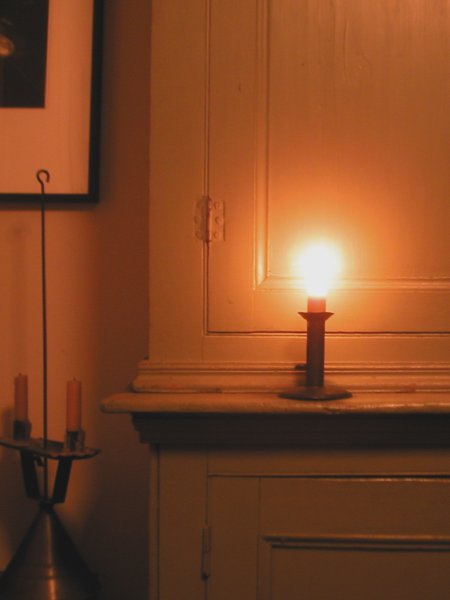
that’s actually a candle flame; the cupboard is a faded apple green
It looks onto the garden roof terrace, away from the street bustle. We eat all of our informal meals here, but otherwise it functions more like a combination Victorian-era morning room and late-twentieth-century family room. Then again, I suppose it’s really Sweetpea’s room [he’s doing fine, thank you; just refuses to give up his millet for regular birdseed or pellets, although he loves his greens as well].
Old American furniture. Nothing here even begins to suggest our current collecting interests. Funny that, but the picture would change if the camera pulled back just a bit.
Category: Happy
chapel computer

Europe’s fastest supercomputer, an IBM capable of making 40 trillion calculations per second, was booted up for the first time yesterday in a chapel [italics mine] of the Polytechnical University in Barcelona, Spain
A beleaguered American atheist, I was startled by this picture and caption when I came across it in Newsday this morning (I couldn’t find it on their on-line edition). I showed it to Barry who said, “This is not your father’s Spain,” and then he went on with something about using churches more productively, for performances, galleries or . . . computers.
back HERE: Trey Lyford and Geoff Sobelle

Six weeks ago I wrote about a terrific theatre piece at HERE, “All Wear Bowlers.” After a brief hiatis Trey Lyford and Geoff Sobelle are back with the same show. Performances begin once again on April 22.
If you missed it the first time around, you can still get to heaven, and it will cost you only $20, $17, maybe $15, or even $10, depending upon your status when you ask for tickets.
[image, by Greg Costanzo, from 1812 Productions]
“people fall in love with these creatures”
I was feeling just slightly abashed as I sat in the waiting room of a small-animal veterinarian a few days ago. I was gently cradling Sweetpea, our little green parakeet, slumped in his small clear-plexiglas travelling case, waiting our turn to be interviewed and examined.
To Barry and I our bright, chirpy roommate looked and acted perfectly healthy, but he had not been eating any of his normal seeds for almost a week and we had become very concerned. Other than the receptionist, our bench companions were a woman waiting for her dog to come out of the examination room and a young girl holding a box which sheltered a beautiful small rabbit with an injured leg.
Sweetpea had flown into our apartment two and a half years ago on a cold November day, and this was the first time he’d had any occasion to leave its safety since. He had become precious to Barry and me, but every visit to a pet store was a reminder that his relatives were being traded everywhere in New York for only $9.95.
And then everything in that room changed.
The door from the street opened suddenly and a tall, sturdy young man came in with a container similar to Sweetpea’s, but smaller still. Even before sitting down he addressed the room sheepishly, almost apologetically, “you probably haven’t seen a ‘small animal’ this small before.” In the box was a tiny turtle, a red ear, its carapace perhaps an inch in diameter. The man’s little charge was one of three he had brought home from Chinatown a few months earlier. The other two had flourished and grown considerably, but this little Fred only languished, and his companion thought he even appeared to be shrinking.
Sweetpea checked out fine, and he’s back home now, although he’s still ignoring the food mix which once seemed to make him so happy. He’s also acting more than a bit subdued now, probably because of the trauma of his capture and tranport to and from the East Village by taxi, not to mention some intimate torso-poking and the drawing of blood for tests. But I’m hoping he’ll eventually tire of his current diet of millet and greens, and go on to fill his biblical half score of years – at least – with two people who smile every time they look at him.
I’ve read that those cute little turtles could theoretically outlive their owners, even if they do cost half the going price of a parakeet when they’re very young. I asked the veterinarian today whether Fred was going to make it, and she admitted he didn’t have a good prognosis.
“It’s such a shame; there are so many natural hazards for some species, and only some of them can survive. People fall in love with these little creatures, and sometimes there’s nothing that can be done.”
garbage flowers
I spotted this garden planted just outside the long frontage of the Museum of Modern Art on West 53rd Street today. I was on my way to the American Folk Art Museum located next door.
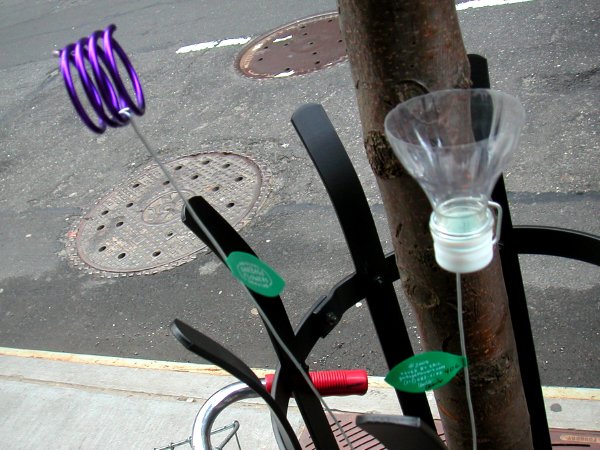
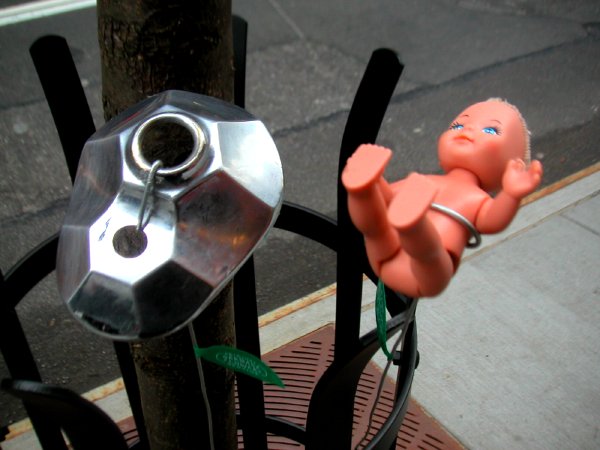
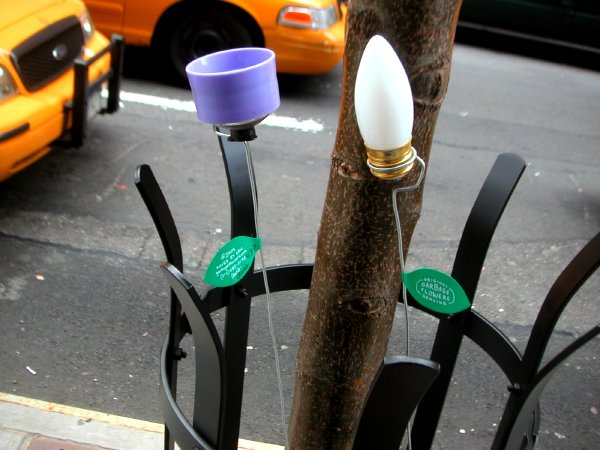
Each “flower” bore one green leaf attached to its shiny metal stem. The individual pieces had been signed and numbered.
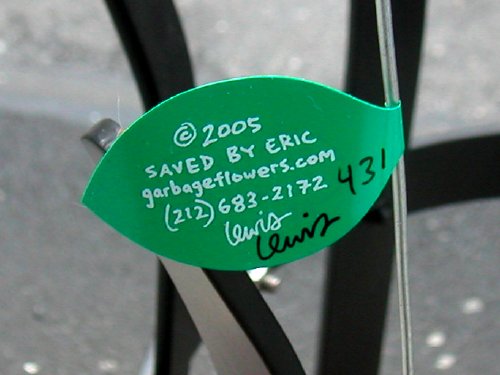
On the reverse of each leaf were the words, “Original – Garbage Flowers – Genuine,” arranged in an oval gently suggesting a logo.
Oh yes, when I passed the site again two hours later I was astounded to find that no one had removed a single blossom, and none had wilted, not one wit.
like a huge, colored Eostre egg

untitled (piebald Met Life Building and van doppel) 2005
There can only be one explanation for the exuberance of this neighborhood display tonight: The fecundity feast of Eostre [sic]. Excerpts from the Wikipedia entry for Easter:

The English and German names, “Easter” and “Ostern”, seem clearly unrelated to Pesach [that is, Passover, to which the name for this Christian feast is related in all other European languages] etymologically and likely derive either from Eostremonat, an old Germanic month name, or Eostre, a Germanic goddess associated with the springtime, who as the 8th century English historian Bede records was honored with a festival during Eostremonat. It has been suggested that many of modern Easter’s symbols, such as colored eggs and the Easter Bunny, are cultural remnants of Eostre’s springtime festival and that Eostre merged with the Christian Pesach celebrations after the Germanic heathens were Christianized (see Easter as a Germanic Heathen festival below.), even though giving of eggs at spring festivals was not restricted to Germanic peoples and could be found among the Persians, the Romans, and the Jews.
. . . .
According to the Bede, the word “Easter” is derived from the Old Norse Ostara or Eostre, a festival of spring at the vernal equinox, March 21, when nature is in resurrection after winter, hence, the symbolism of rabbits, notable for their fecundity, and the eggs, colored like rays of the returning sun and the aurora borealis. The Easter Bunny is a Western European tradition and has never been adopted by Orthodox Christians, showing as false the claim that the entire holiday is some sort of “Germanic Heathen” festival. Some historians assert that Bede falsely concluded the existence of goddess Eostre from the unquestionably real month name Eostremonat, as any references to such a goddess from other Germanic sources are missing. Children roll easter eggs in England and America but not in all traditionally Christian countries. They hunt the many-colored Easter eggs, brought by the Easter Bunny. Hidden in the play area, it has been argued, the vestiges of a fertility rite, the eggs and the rabbit both symbolizing fertility. (A rabbit, furthermore, was sometimes said to be the escort of the goddess, but there are no pre-19th century sources for this.) However, such claims ignore at least as ancient use of eggs as symbolic gifts among the Persians and Jews.
Anyway, in the spirit of this happy season, Barry and I have decided to share a great feast with friends tomorrow, built around an extremely pagan Agnello al forno.
parrot as family
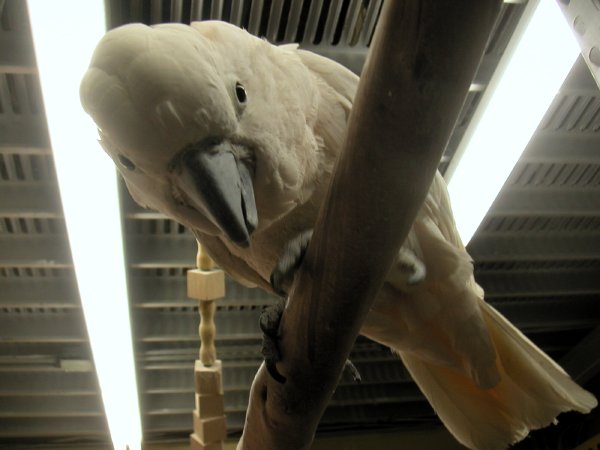
Bernie, wanting still more
Yesterday I made one of my regular visits to the wonderful avian shop called 33rd & Bird to pick up supplies for the third member of the family. As usual, I hung out with their hundreds of birds for a good part of an hour.
Our own friend, Sweetpea, is a beautiful, tiny green parakeet who flew into our apartment out of the cold two and a half years ago. He sits near one or both of us much or most of the day, and he provides enormous good cheer and good company. We do our best to return it.
I’ve always loved birds, but this little creature has given me an enormous respect for all of their kind, and above all for the parrot species.
Each time I visit this shop (which raises many of the parrots itself) after checking out the young birds still in their homely pinfeathers, I look around for Bernie. In the picture above he had just gotten a good scratching on the back of his head, the only spot on his body he can’t access with his remarkably-flexible neck. He was looking for still more, and I’m sure he soon got it. He bends his head down for anyone who comes near. He’s gorgeous, and extraordinarily affectionate, as all Moluccan Cockattoos are said to be. He’s not for sale: good for me and all the people who come to the shop, and probably very good for Bernie. He has a huge family exactly where he is.
Oh yes, for anyone thinking about living with a bird, while Barry and I got ours free, you’ll need at least $9.95 to go home with a parakeet from most shops. I’d recommend 33rd and Bird, whatever they ask. They respect all of their tenants and the wishes of all of their customers equally, regardless of how much money is involved, but if you really want to spend more, possibly thousands more, and you’re ready to commit to fully sharing your life and perhaps that of your heirs, you can adopt a larger bird. Just remember that you may never be alone again. There’s a reason some people walk around everywhere with birds on their shoulders; they really, really need interaction. I mean that it’s the birds who need the attention, although I admit I once thought it was the other way around.
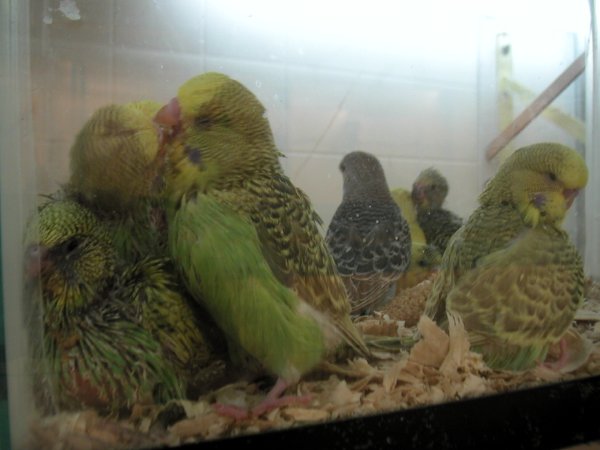
parakeet chicks, can’t say they’re pretty yet, but they sure are lovable
2nd Annual Drinkin’ and Drawin’ Championship
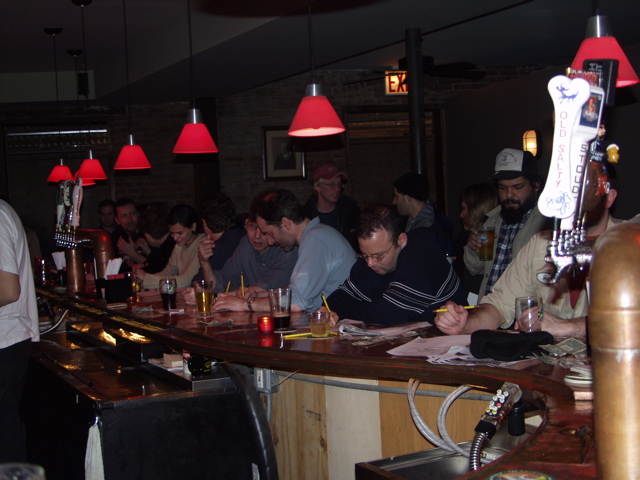
intense bar scene from last year’s competition
Dunno exactly why, but this sounds like a wonderful thing.
The promoters (yeah, that sounds so big-deal), M.River and T.Whid, have their explanation:
It might be interesting if an art idea conceived in a bar could use a bar as a site and context for said art idea and it’s been a long hard winter.
But I like the sense of place and proportion provided by the description of the first prize:
Win a $100 bar tab [at the event’s venue, Greenpoint’s Bar Matchless]
This year Inka Essenhigh and Steve Mumford will be the judges.
For images from last year’s event, go to MTAA.
[image from MTAA]
getting one’s priorities straight
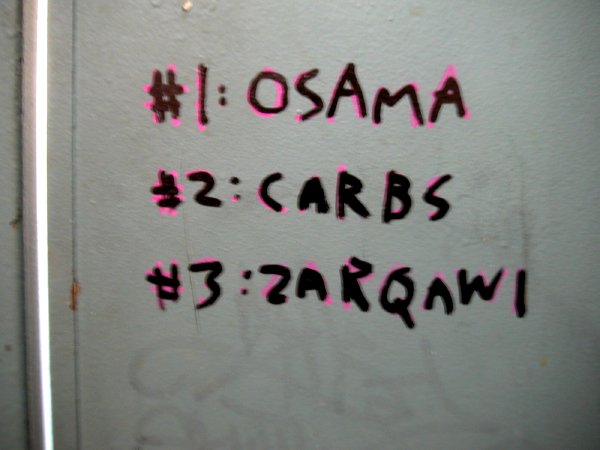
This graffito was found inside the boy’s room in one of the large Chelsea gallery/studio buildings today.
happy meals
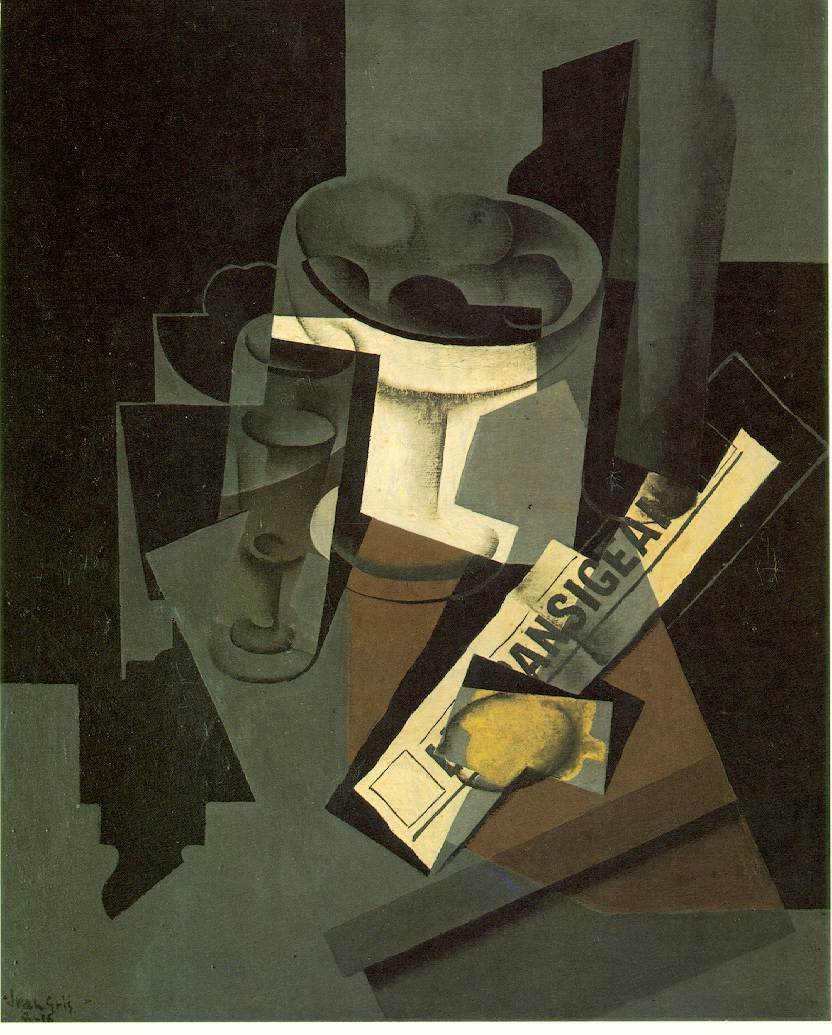
Juan Gris Fruit Dish, Glass, and Lemon (Still Life with Newspaper) 1916 oil on canvas 28.75″ x 23.5″
I don’t know anything about cooking, but I know what I like. No, that’s not quite right. I do know something about cooking, and I know when it’s right, but I’m not really a creative chef. When it comes to the things I love (including the arts) maybe I usually get by with only an intense curiosity about the new, a certain amount of taste and a good deal of almost-academic deliberateness.
I started cooking years ago while a graduate student at Brown. Perhaps imagining myself more impecunious than I really was, I convinced myself that learning to cook would be the most reliable way to be certain that I would eat very well – at least some of the time.
I can report right now that two nights ago Barry and I ate really well. No, it wasn’t the first time, but I did get pretty excited about it, partly because it was so unexpected – and so easy. It’s now Wednesday, and the immediate near-ecstasy of the moment has passed, but I told myself while clearing the table on Monday that I had to write about a meal which, although rather casually assembled, ended up an almost perfect little Italian table. I wish I could pull that off every night, and even more to the point, I wish we could share it with others more often than we do.
I had spent several final hours at the Armory show that afternoon while Barry stayed home to work, and when I returned home I wanted to go through mail and post a bit before dinner, so my early-evening Whole Foods trek for provisions was more perfunctory than usual. At the market I decided on squid (I know, it was don’t-buy seafood-on-Monday, but they looked and smelled great) and some very fresh-looking broccoli rabe. While there I remembered I had a small net of golden fingerling potatoes hanging on a hook at home.
Altogether it was a pretty modest Italian meal, especially since only if I were to count our eager “seconds” could I begin to relate it to the three or four courses and dessert tradition:
Dressed Squid briefly roasted in the oven together with crumbled red chilies, dried oregano, a bit of olive oil and the juice of half a Meyer lemon;
potatoes on the same plate, also roasted in a baking dish in the oven, but for a full half hour, after being cut lengthwise into four pieces, mixed together in a bowl with chopped garlic, oregano leaves (the recipe had specified marjoram, but the larder showed only the fresh form of the dried herb called for with the squid), a little olive oil and this time two lemons, each cut into twelve wedges and squeezed with the rest of the ingredients;
the very green contorni, served in separate bowls, was the rabe, quickly boiled, drained and then sauteed in a pan which had first heated a few garlic slices in olive oil;
the wine was a simple bottle of Fiano Di Avellino from Campania.
The pleasures were of both the palate and the eye, as they must be with a good meal.
I was amazed at how fantastic the seafood and the potatoes both looked and tasted together, and the vegetable was as perfect a visual contrast as it was a gustatory one.
The cooking utensils, my old white-lined blue enamel NACCO baking pan for the squid, a red-brown terra cotta rectangular pan for the potatoes and a heavy, black Wagner iron frying pan for the greens, all eventually found a home on top of our high-legged dark green and cream deco 73-year-old range, but there never seems to be time for pictures at these moments. Sitting at the old maple turned-leg drop-leaf in the breakfast room we ate off sturdy cream and mushroom-colored Shenango restaurant ware, with small lightly-tinted ribbed-glass Duraflex kitchen bowls on the side for the greens. Once again we found this really good homey restaurant in the middle of Manhattan; we’ll be going back.
The recipes I used for the squid and the potatoes are from the really excellent “Italian Easy: Recipes from the London River Cafe
by Rose Gray and Ruth Rogers, which is accurately summarized in Amazon’s editorial review: “These are visually spectacular, remarkably simple recipes for those who love good food but have little time to prepare it.”
[image from the Artchive]
