Santiago Cucullu’s Hammer

CuculluBarricades.300.jpg
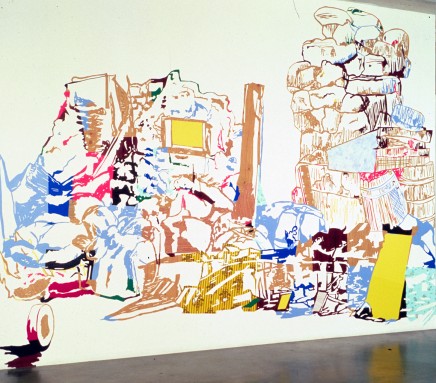
Santiago Cucullu Barricades from All D&D, Haiti, Prague that Fall, Fermin Salvochea (2003) Contact paper on wall.

Even a week after returning from the West Coast I’m still finding pieces of paper reminding me of things I wanted to write about. One of them is the wonderful wall installation we spotted on our way out of Los Angeles’s Hammer Museum after visiting the exhibition, “Made In Mexico.”
Although not on the scaffold at the time, Santiago Cucullu was still in the midst of installing a large temporary mural (not the work shown above) at the top of the main staircase, assembled from large sheets of all kinds of contact paper. I first noticed it when coming from behind the installation. I spotted a single section of cerulean blue hologram paper on the corner of a wall. I’m sucker for those papers, which give the uncanny impression you’re looking into three dimensions and this one was gorgeous. But even incomplete as it was, Cucullu’s piece was of course far more breathtaking. In its early form I assumed it was totally abstract. In fact, like much of his work it reads as both abstract and representational.
An excerpt from notes on the Museum’s site:

Cucullu’s mural-scale drawing for the Hammer Museum is perhaps his most ambitious and freewheeling contact paper work to date. Its source imagery is almost comically disparate: some comes from the archives of the Federación Libertaria de Argentina (FLA), an anarchist library in Buenos Aires; other parts reference a drawing the artist made while in school (and subsequently lost) that depicted a pair of Doc Martens with the imagined name Dusty Springfield Rhoades written across the top; and still other fragments allude to Dusty Rhodes, a real-life reporter from Springfield, Illinois, whose name the artist came across coincidentally while listening to a radio report about a police officer dismissed from her force. Cucullu presents everything as a tangle of images on a nearly flat picture plane, which can lead almost to the point of visual abstraction—making it hard to see the trees for the forest, so to speak—but also calls to mind pre-Renaissance religious paintings, which often set down multiple narratives in a single space on a single canvas.

[image from the Hammer Museum and courtesy of Julia Friedman Gallery]
Los Angeles precision landscaping

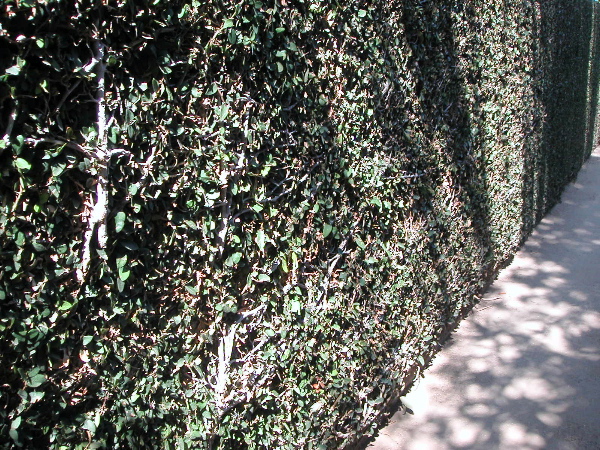
Schindlerhedge.JPG
Schindler House, high, tight-foliage “hedge” bordering the entrance drive
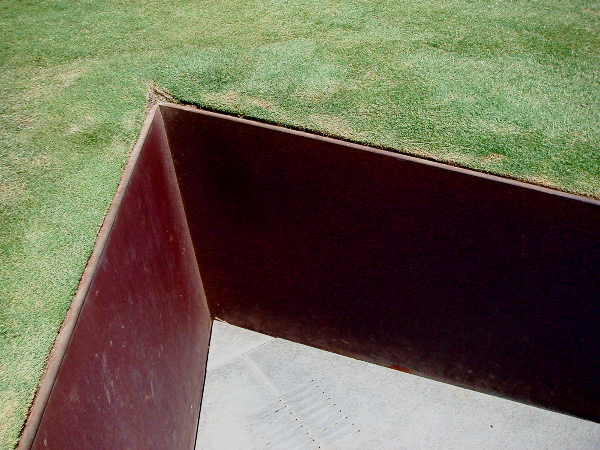
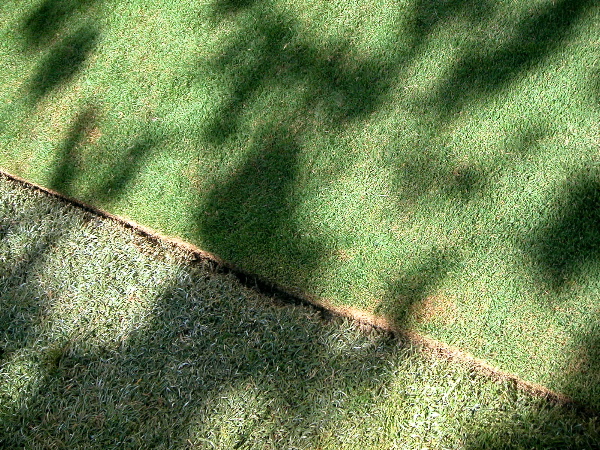
Irwin3.JPGGetty Center, corner of zigzag pedestrian path through Central Garden

Los Angeles doesn’t disappoint a visitor from the North, and for this pilgrim its charms always begin with the flora, even if much of what has become identified with the region is imported or artificially maintained. In fact, the boldness of both its humblest and most fabled gardeners must regularly surprise even Angelenos themselves. The “hedge” shown above is little over an inch deep, and is actually a vine attached to a cement wall. The 30-inch metal retaining wall in the image below it allows delighted visitors to literally walk through a large hillside lawn.
The most striking aspect of these two disciplined geometric creations may be that they are found in a hybrid environment. In both cases the larger gardens are a delicious combination of minimalism and wild abandon. For some of the gardens attached to Rudolf M. Schindler’s Studio-House, see the next post; for flowers in Robert Irwin‘s inventions at the Getty, see the images which will go up over the next week or so.

Green Hummer Project

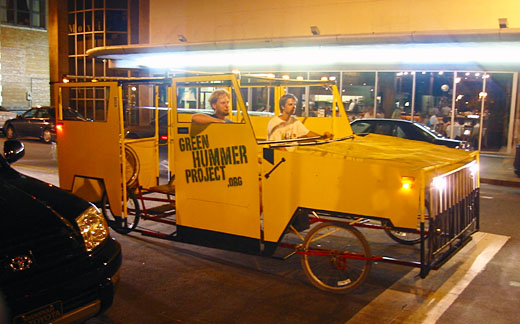
greenhummer.jpg
political art, cruising Savannah streets

Crazy about bikes, but just can’t get those Hummers out of your mind? Check out these guys and their wonderful full-size Green Hummer.

This bicycle is an attempt to make large numbers of people reconsider the ways that they move around their cites. Our SUV is the opposite of modern consumer culture, an anti-commercial. We want people to think independently of the corporations who program their televisions. We want people to see our pedal-powered, life-size Green Hummer cruise around a real city, and think about the contrast between advertising and the real world.
In advertising, cities are lifeless, cars are safe, drivers are happy, gas is clean, and you are not responsible whatsoever for traffic, pollution, your weight, the marring of our landscapes, or war.
Our SUV is for the real world.

Don’t miss the wonderful short video clips!

[thanks to Derick Melander and his brother for the link]

“Sam Shepard ghost town”

We’re home!
Since we only had a dial-up connection in the hotel room, I didn’t try to post everything I wanted to while we were in Los Angeles. This item, and perhaps a few others to follow, will make up for some of this blog’s relative “silence” of the past week.

We wanted to get out of the man-made environment for a day and get into the desert, so we left Wilshire Boulevard and drove northeast, eventually passing through the current greater-L.A. frontier around its fabled Victorville, soon after making a pit stop in the newly-created settlement of Summit Heights (where the mall was complete even if the tract homes were not). Beyond this new asphalt camp the (unpeopled) wilderness began. Going through open country baking in 105-degree heat (convertible top up, AC cranked), we turned back after Barstow, but well before approaching Needles, and drove back across the top of Edwards Air Force Base.
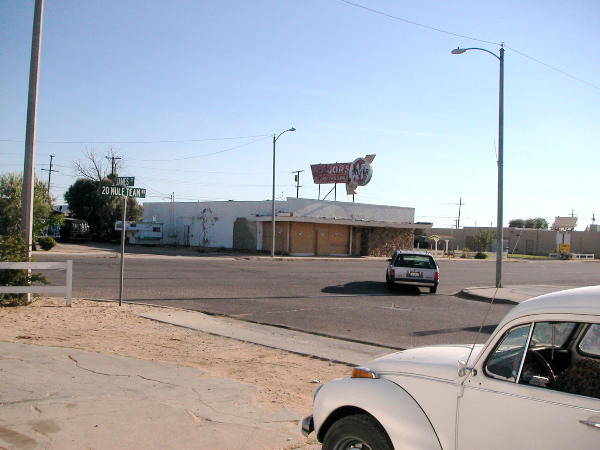
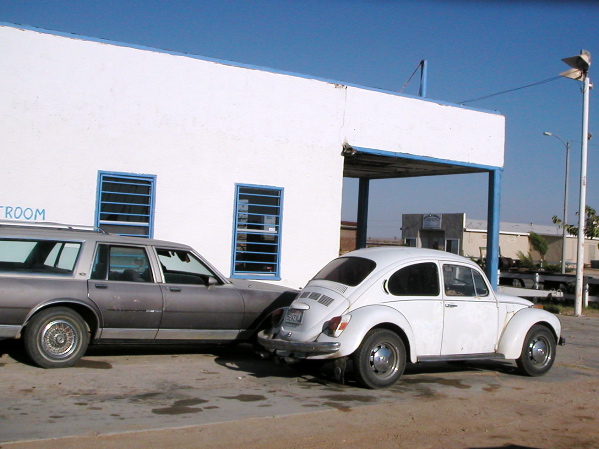
We had seen real and re-created ghost towns, but the two images below are descriptions of a special case, the community of Boron, which Barry called a “Sam Shepard town.” We both thought it was pretty cool, if a bit of a commute from Manhattan. A special touch was provided by the excellent 80’s rock coming from the white-painted repair garage with the “…troom” sign (the chamber indicated was of course the reason we had ended up there for this serendipity).

Historical note: The 20 Mule Team Rd. marker refers to the fact that this street was once the route, established in the 1880’s, of the 20 mule teams which hauled borax from the borax Works in Death Valley and Amargosa to the railhead at Mojave (30 miles west of Boron).

BoronCalifornia.JPG
BoronCalifornia2.JPG

I’m a tree hugger

palmtrees.JPG
untitled (palms in the blue)

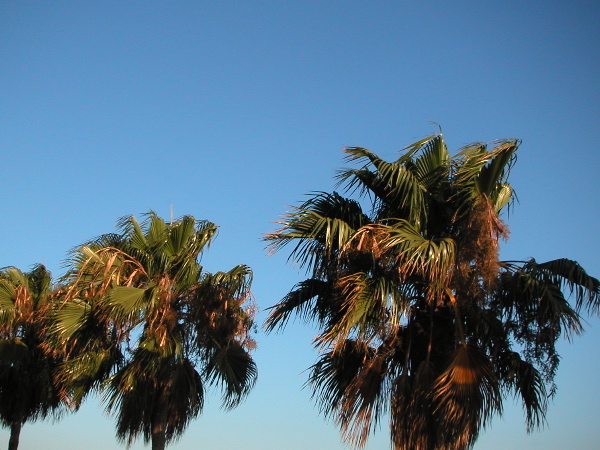
These wonderful creatures could easily turn me into an animist. These palms were waving above the high terrace of the Los Angeles County Museum of Art this afternoon.
But, at least on the surface, the current featured exhibition, “Beyond Geometry: Experiments in Form 1940s−70s,” could hardly be more removed from these beautiful sentinals outside. It’s a stunning show, even if I somehow missed the argument of its curatorial premise.