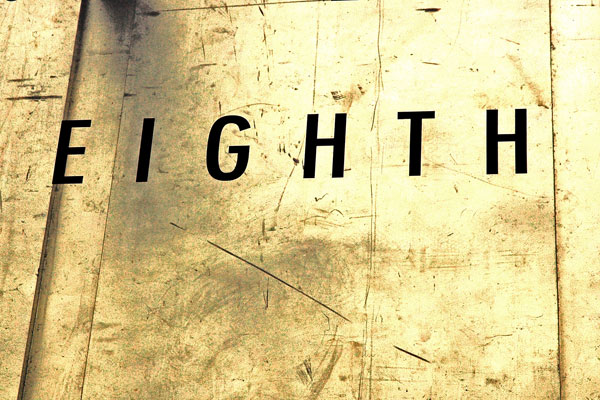
Today is the eighth anniversary of this blog.
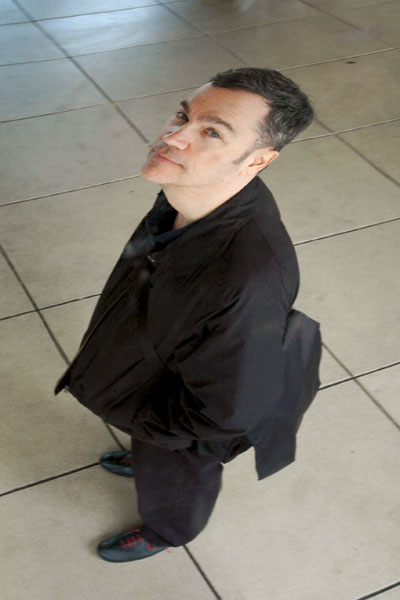
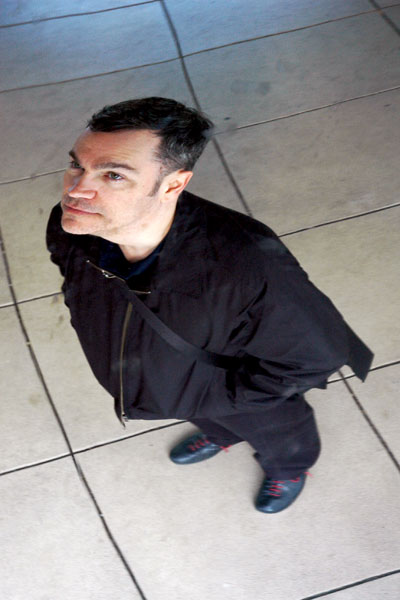
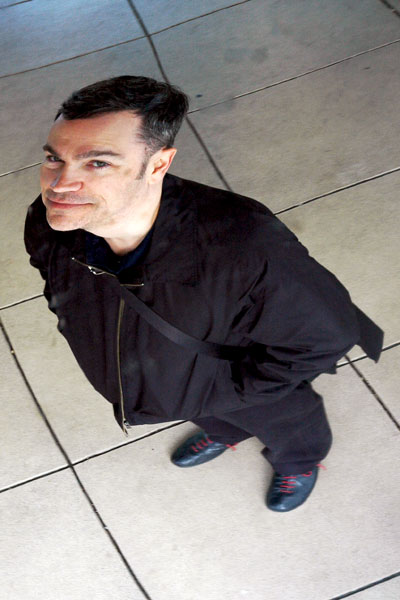
I said it last year, and I’m delighted and incredibly privileged to say it again: This is also the anniversary of what turned out to be the most important event in my life, the night Barry and I met (now nineteen years ago).
Last year I also wrote, looking at the world outside our circle of close friends, that I was “more upbeat about the world” than I had been the year before, the eighth year of our second Bush, adding, “but only a bit”. That hasn’t changed, a bit.
And happy birthday, Paddy Johnson!
[the image is of a portion of the street number on the glass above one of the Art Deco entrances of the former Port Authority Commerce Building (1932), 111 Eighth Avenue the wall seen several feet behind the glass is covered with gold leaf]
Category: Happy
the Starns install “Big Bambú” on the Met Roof Garden
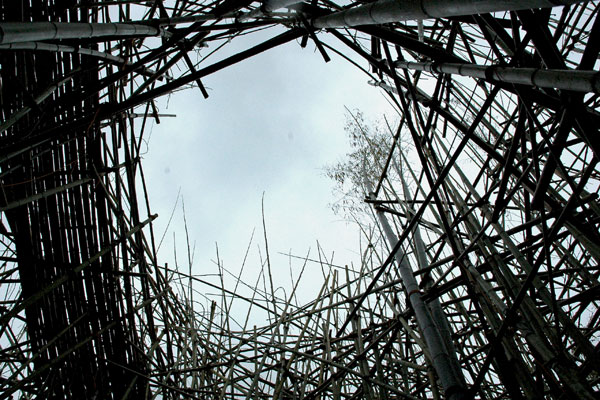
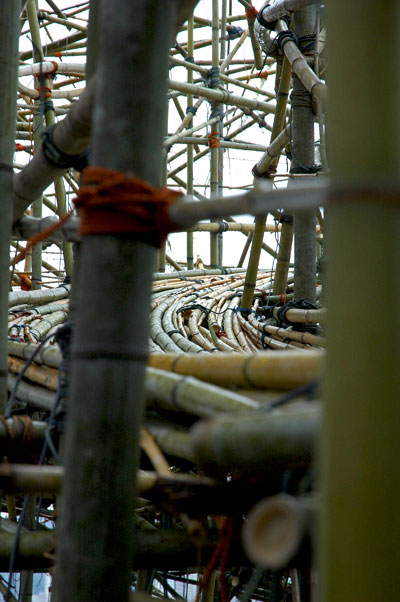
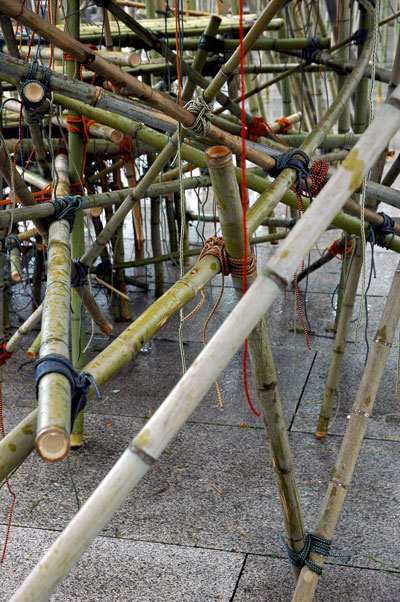
Brothers Mike and Doug Starn‘s Metropolitan Museum roof installation, “Bambú: You Can’t, You Don’t, and You Won’t Stop“, opens today, April 27. Barry and I were at the press preview yesterday morning. I’m sharing here a few of the images with which I returned.
I’m not really drawn to openings (of any kind, galleries, performances or film) just for the sake of being there first. There has to be some other lure; it might be the prospect of being around creative friends. And only the promise of something very special, also something which almost has to be experienced in the relative isolation of a preview could normally bring me to the Upper East Side before noon, but there we were yesterday at 11 am, standing in the rain on the roof of the Met, and there wasn’t a friend of any kind in sight.
Oh yes, I admit that I was also there because I was looking forward to some terrific, uncrowded photo opportunities, even if we weren’t going to be able to scale the heights of the bamboo cloud surrounding us.
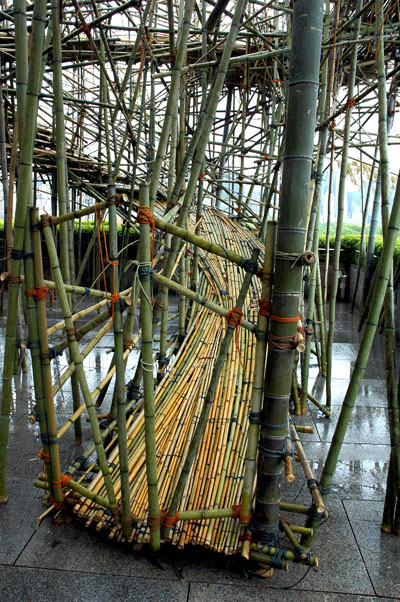
It turned out that the “Bambú” itself was friendly enough, even if the wet-blankets working at the underwriting desks of the museum’s insurance company refused to let anyone enter the internal footpaths. It’s a prohibition which can be expected to be applied, throughout the spring, summer and early fall, whenever the surfaces become wet.
The Starn’s piece will not move across the roof, as did their earlier bamboo sculpture at the former Tallix factory in Beacon, New York. There the structure, assembled inside an enormous, 320-foot space, was continuously reconstructed by dismantling individual poles and carrying them down the floor to be reassembled into (another?) monumental piece, several times over and over, and then back again.
The forest at the Met will continue to grow in height throughout the spring and summer, and the existing paths constructed within it (in the sky, so to speak) will be extended further during at least much of that time. Visitors who are not so unfortunate as to show up on a drizzly day can expect to encounter a number of sturdy rock climbers, mustered from northern New England and the European Alps, working on the piece above their heads.
The other friendly faces we encountered were those of the Starns themselves. I’ve been encountering their work for more than 25 years, and I’ve never been disappointed by what I’ve seen as they’ve reconfigured the world around them. On Monday they were completely generous with their time and open to any queries from the press.
“Bambú” likely represents the most complete transformation of the Iris and B. Gerald Cantor Roof Garden in the twenty-three years of the space’s history. It may also turn out to be the most successful, not least because for its visitors it’s probably going to be the most exciting ever.
I thought it was a pretty awesome piece, not least for the fact that its rather serious scale depends on only a rather smallish carbon footprint, and for being a frankly ephemeral construction (ephemeral except in the memory of those who will experience it). The very fact that it was done at all is a remarkable accomplishment for the artists, the Museum, and, yes, that insurance company too.
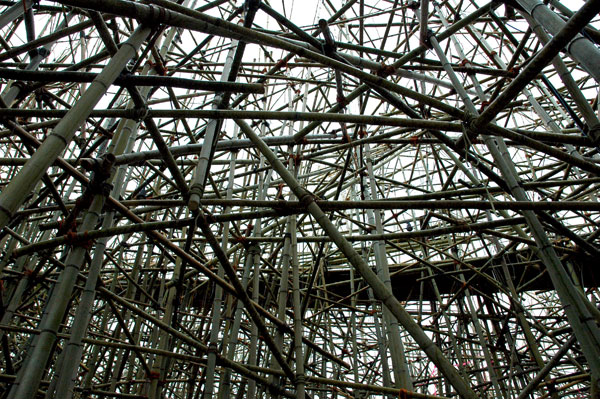
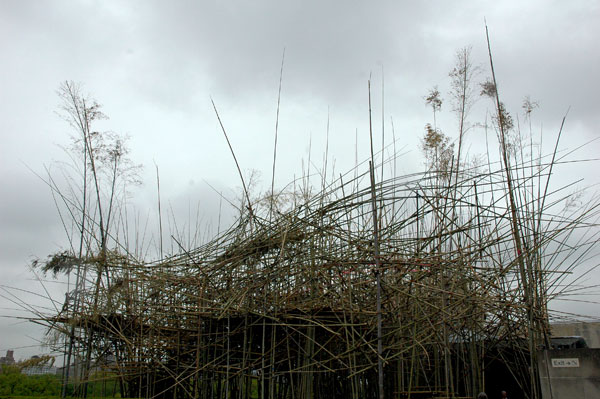
Now I’m thinking about the piece as art. It’s a maze, with elements both random and designed. It’s a forest of natural, wooden materials, yet bound together with synthetic, nylon cords. But this “forest” has been planted in the middle of, and yet above, a great artificial metropolis by the hand of man alone. It has been accomplished through the borrowing of the products of nature as well as human genius. It displays attributes of chaos as well as order, and the contributions made by nature and by man both exhibit each of those. Every piece in it was assembled, arranged, and bound into place by artists, although working closely with their collaborators. Every element of the structure has an intelligence and a rhythm. Not one part of it is quite accidental or entirely superfluous.
The forest maze closes forever on October 31. I wish instead that we could flood the roof and watch it grow forever.
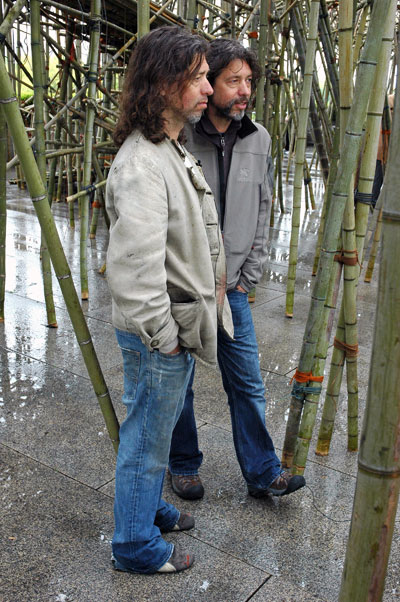
the artists: Doug (l.) and Mike
Fifth Avenue tulips
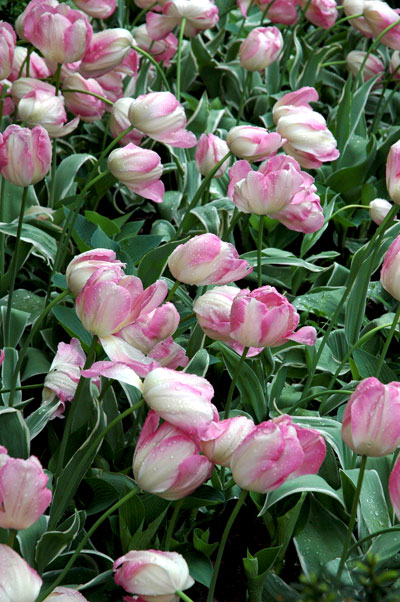
Even the tulips manage to look more genteel on the Upper East Side. This pink bower was spotted on Sunday gathered together in the tidy front garden of an elegant apartment building in the 70’s.
potted spring excitement, with no bulb in sight
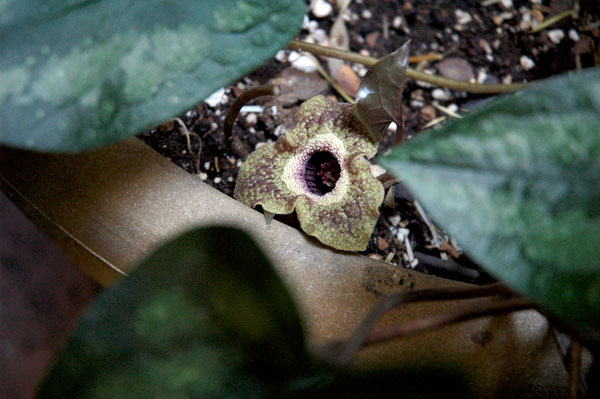
Chinese Wild Ginger Asarum Splendens
Spring comes to the sunless recesses of our roof garden.
I must leave to others, meaning anyone who can plant or is able to overlook gardens touched directly by the rays of our life-sustaining star, the delights of brightly-colored bulb flowers. Our own garden pleasures are more subtle, and sometimes more exotic.
The odd growth shown above is apparently a flower, but there is always only one (it’s in a pot after all). It appears each year at this time within the very healthy clump of evergreen wild Chinese ginger which has naturalized itself in one of our terrace pots. It’s surprisingly hard, or woody, to the touch. It is, as might be easily imagined, even more bizarre before it actually opens to (barely) announce itself: The first time I spotted it, at least five years ago, I thought it was a piece of debris fallen from an upstairs window. I was about to pull it out when I noticed that it was somehow connected to the tangle of shiny green leaves all around it which had miraculously survived the winter unaltered.
With all respect to the excellent mushroom and the magical truffle, this node? appears to be somewhere on the evolutionary ladder between fungi and what we think of when we say “flower”, regardless of its actual botanical status. While it certainly suggests a sexual appurtenance, it also looks like it would have no interest in, and no chance of, attracting the reproductive ministrations of a bee.
the last hour of Man Bartlett’s “24h #class action”
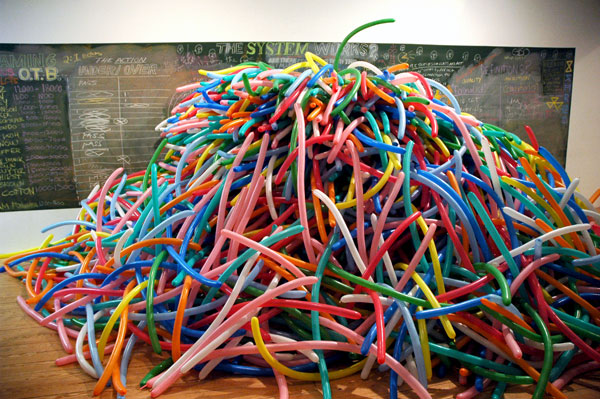
the last balloon
I had contributed something like a hundred or so inflated balloons to Man Bartlett’s “24h #class action” the day before, but when I arrived at Winkleman Gallery Thursday afternoon around 4:15, almost 24 hours later, it was too late to add to my score. The artist however had been going strong all that day and throughout the night before. I managed to capture one of the last long, narrow balloons he tossed onto the sculpture from the cubby he had created behind it.
Thousands of inflatables were about to disappear at the stroke of a pin, without ever having achieved a single polished mirror finish.
It was picture time.
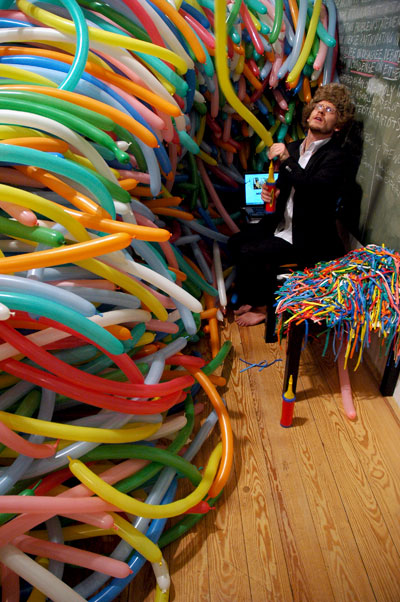
the sculptor and his tools
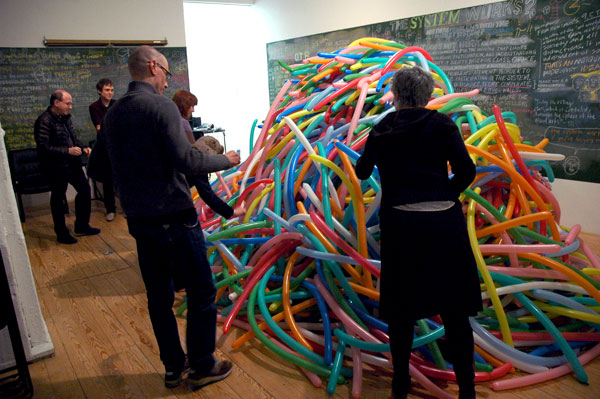
final group intervention commences
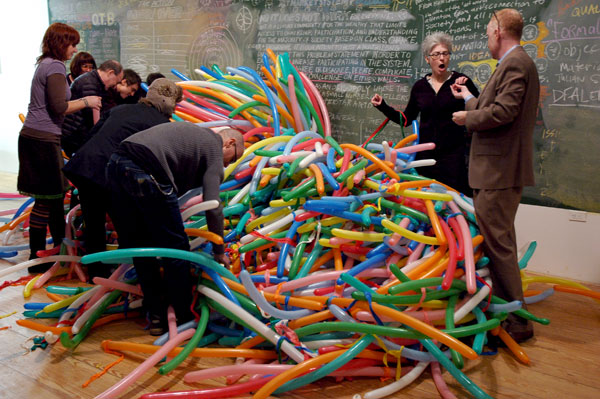
the attack underway
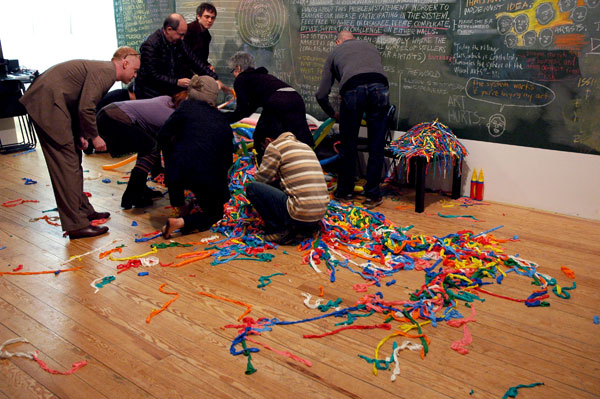
last pops/wheezes
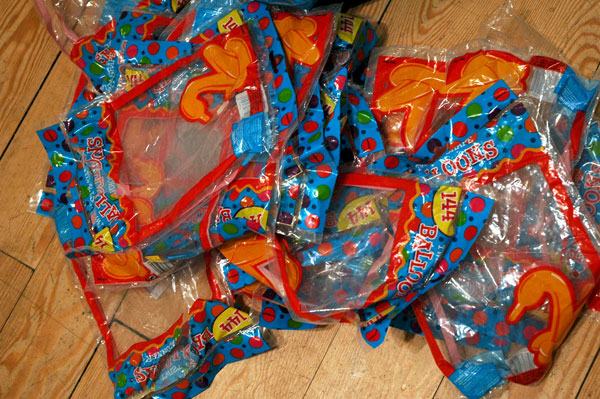
empty packaging, sadly showing suggested Koonsian applications
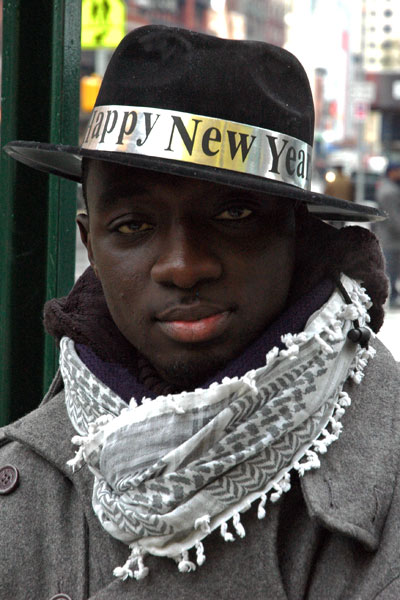
Chelsea hats, crazy wigs, and Serigne, New Year’s 2009
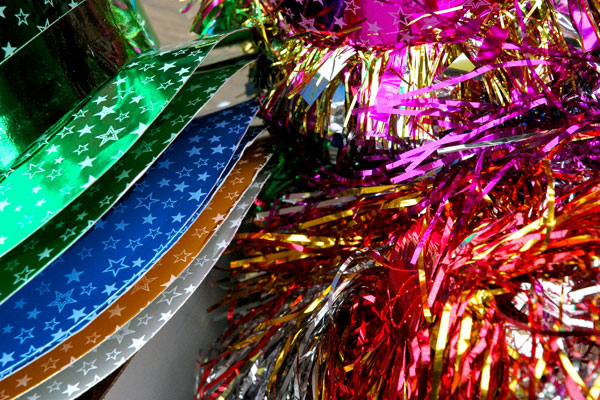
I passed the stand set up on the corner of 7th Avenue and 23rd Street. It was late last evening, windy and bitterly cold. The two vendors were selling New Year’s Eve party hats, light wands, and noise makers. I had already passed them by when I stopped to think about checking out the merchandise. My arms however were already juggling several heavy bags of food, so I decided I’d go back today to pick up something for a occasion to whose observance I’ve never been indifferent.
I’ve saved stuff from past years when I thought something was a little more special than most of the ephemera manufactured for this ancient holiday; I could recycle the old tin horns and such, but I probably needed some fresh party streamers. Then I asked myself, should I also get two pairs of 2010 spectacles? I’d never worn the silly things before, but this just might be the very last year for that classic template.
Aside from satisfying my needs, or encouraging last-minute buying impulses, I was looking forward to seeing what I expected would be a colorful array of merchandise (bring the camera!). It hadn’t occurred to me that the market experience, the bargaining between customer and seller would itself have been a powerful draw.
I didn’t see any streamers, and I didn’t spring for the glasses, but Serigne gave me a good price on two outrageous tinsel “wigs” (I might have some work in persuading Barry to wear his). I had already asked Serigne if I might take a few pictures of his table display, and he was kind enough to ascent – even without the condition that I make a purchase, although he encouraged me to do so. I heard him talking to the woman he was with, who later told me he was her son, and I was mesmerized by the cadences of their speech. I asked what language they were speaking, and they told me it was Wolof, that they were Wolof, from Senegal.
Serigne suggested I take a picture of his hat. It was one of the many models arrayed accross the table, but I doubt it could ever look as good as it does on his own handsome head.
Chelsea winter garden
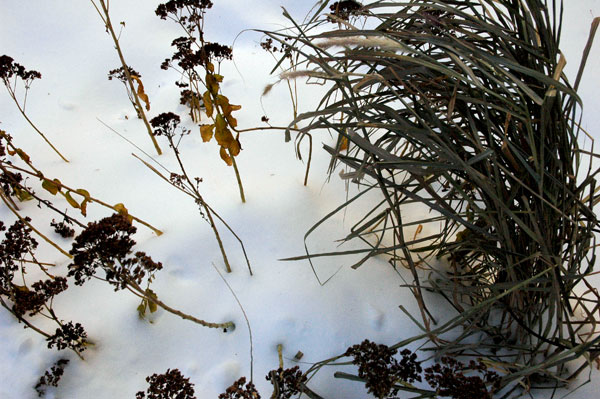
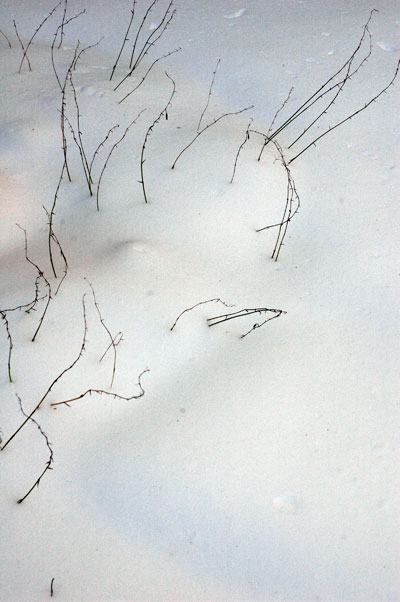
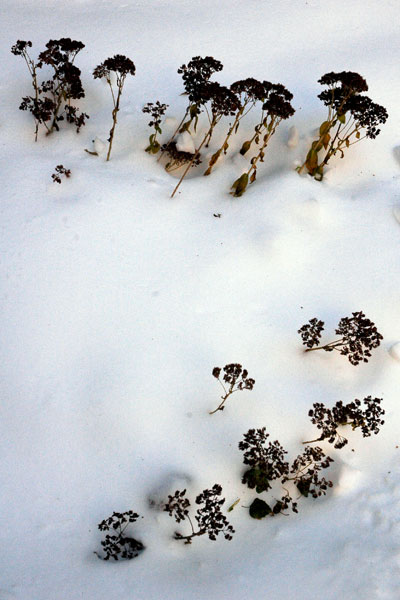
The beauty created by a heavy snowfall is even more exceptional for its certain evanescence – although a camera can still try to keep it from vanishing.
This afternoon, 24 hours or so after the snow had ended here, I took all three of these images in the central garden of our building, but the pair which appear below really want to be together.
 |
 |
the High Line, but this time on a slow day
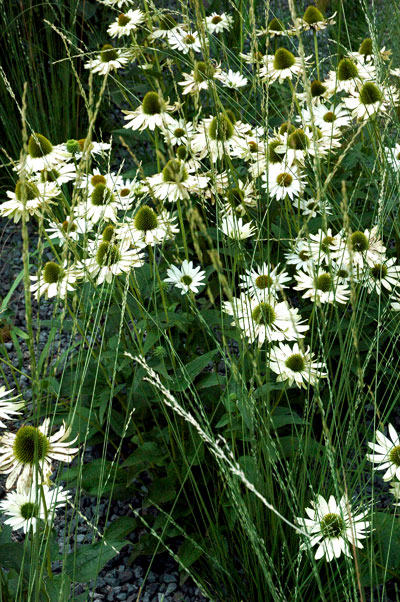
I couldn’t stand looking at it any more, even if it shows a tweaked image of the Whole Foods logo, one which now serves as the symbol of a national boycott. I’m referring to my last, melancholy post, “Whole Foods’ John Mackey wants us unwholesome“. So, thinking I might not be the only one so depressed, I decided to upload a picture of some flowers I snapped up on the High Line at around 4 o’clock on this warm, sleepy afternoon. I was walking back from Buon Italia in Chelsea Market, a really, really, wonderful sort-of-smallish, genuine food emporium for anyone interested in Italian food, now destined to become an even more important part of my food shopping rounds.
Then, remembering how few people I saw up there today, I thought about how the beautiful slim park, which has quickly become the site of a documented neighborhood passeggiata, manages to look very different at various hours and on various days of the week. Here are a couple images showing just how popular it is on weekends. Both of them were taken on the first of August, a Saturday.
These pictures remind me of why I decided years ago that I had to move to New York permanently: Weekends here seemed to have been arranged mostly for visitors, and they still are, although back in the early 80’s I was thinking of Downtown music, theater, dance bars and performance, which were always much more interesting on school nights.
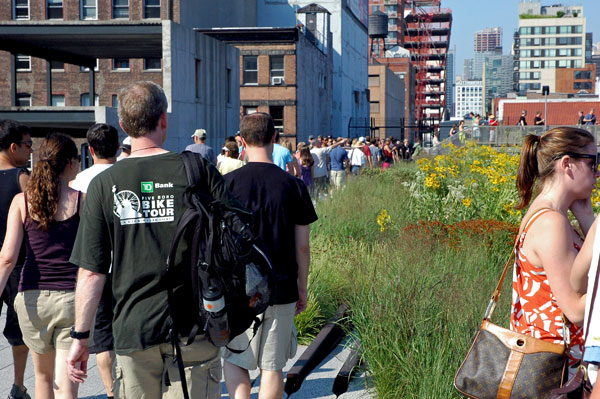
take a number
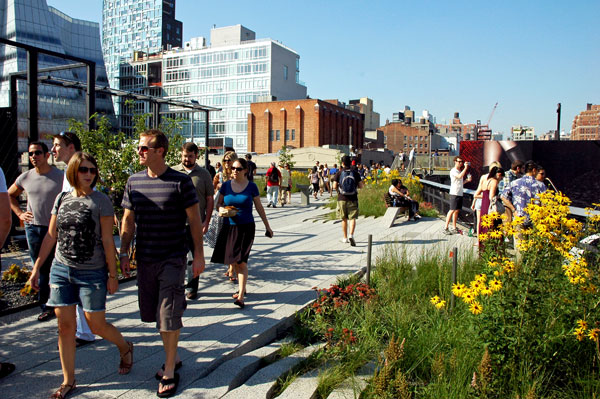
but it can look like a commercial travel brochure
Duke Riley’s “Those About to Die Salute You”
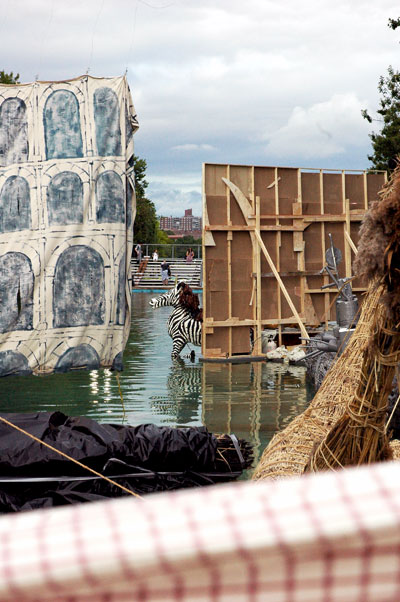
backstage at 6 pm: the battleships await their crews
Duke Riley’s rich, seriously-ambitious, aggressively-unprecious but still whimsically-theatrical large-scale piece of interactive art, “Those About to Die Salute You“, unfolded across the plains and the seas of Flushing Meadows on Thursday night, managing to exceed all expectations, probably including those of the artist himself.
The Queens Museum of Art commissioned the work from Riley earlier this year and this resourceful, heterodox (and genuinely-communal institution) got just about exactly what we saw described in the event’s press release:
Those About to Die Salute You, a battle on water wielded with baguette swords and watermelon cannon balls by New York’s art dignitaries, will take place on Thursday, August 13, 2009 at 6 pm in a flooded World’s Fair-era reflecting pool in Flushing Meadows Corona Park, just outside of the Queens Museum of Art. Various types of vessels have been designed and constructed by artist provocateur Duke Riley and his collaborators: the galleons, some made of reeds harvested in the park, will be used to stage a citywide battle of the art museums in which representatives from the Queens Museum of Art, the Brooklyn Museum, Bronx Museum of the Arts, and El Museo del Barrio will battle before a toga-clad crowd of frenzied onlookers.
And the people came.
No words can do more than begin to describe what they saw – and what they contributed themselves. There are already enough images posted around the blogosphere to make anyone who wasn’t there feel a bit like what now seems to have been the handful of people who didn’t get to Woodstock forty years ago. I missed Bethel myself, but, especially since I had been following Riley’s projects for several years, I wasn’t about to miss Corona Park, only one transfer away on the subway. Besides, as a student of the classics, I just couldn’t, and if I had given it a pass, when could I expect another invitation to a Naumachia?
Barry and I got there a bit before 6, as all the announcements had suggested, but after we had checked out the boat yards at one end of the flooded “lake”, we learned that the sea battle itself wouldn’t begin until after 8 o’clock.
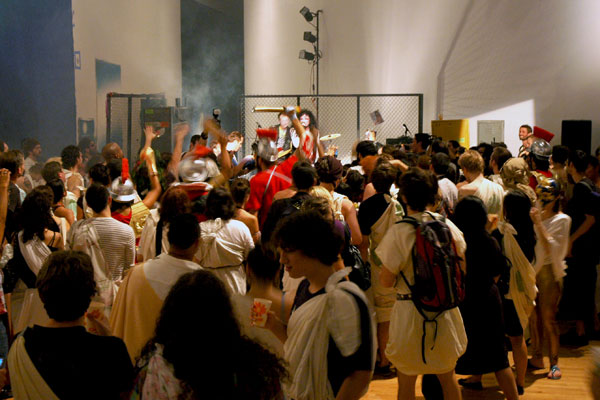
Populi entertained by Hell-Bent Hooker, including band-engineered special effects
We headed for the Museum, where an artist friend, one of Duke’s “herohelpers”, invited us to visit the now-nearly-empty and very dusty 40,000 sq. ft. “studio” where the battleships had been constructed. We stood next to an incongruously-shiny large black motorcycle with a box of cookies balanced on its seat: “Take some cookies; a nice Italian lady with her kids left these for us,” offered a long-haired gentleman with a deep, froggy voice just before he headed off to the other end of the space. I later recognized him as the lead in the metal band which was the evening’s early entertainment. We took two cookies, and they were the best: delicate, chewy macaroons.
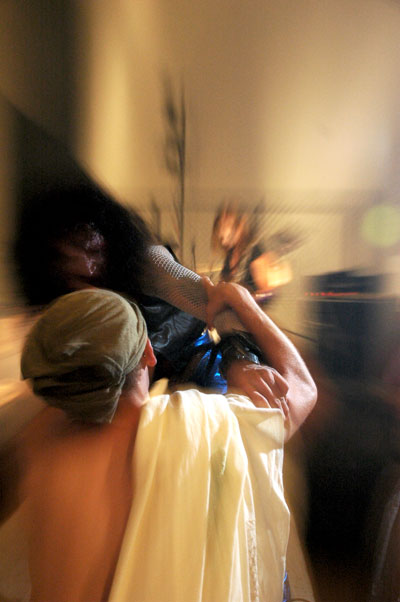
La-Vein Hooker (Hell-Bent Hooker vocals) and affectionate Roman fan
I guess we spent too much time mingling with all the Romans eating and imbibing in and around the Queens Museum and enjoying a bit of the evening serenades offered by Hell-Bent Hooker, so it was already twilight when we finally headed back to the site of the featured event (so featured that there was a box to one side, designated ESPN, where the faux anchorman for the proceedings was ensconced). There we found another huge crowd, and unfortunately all the spaces close to the water and the powerful spotlights had already been taken. In the end, while our late arrival meant I couldn’t capture any decent documentary images, it also meant that I saved my camera from encounters with water balloons, ripe tomatoes and rotten melons.
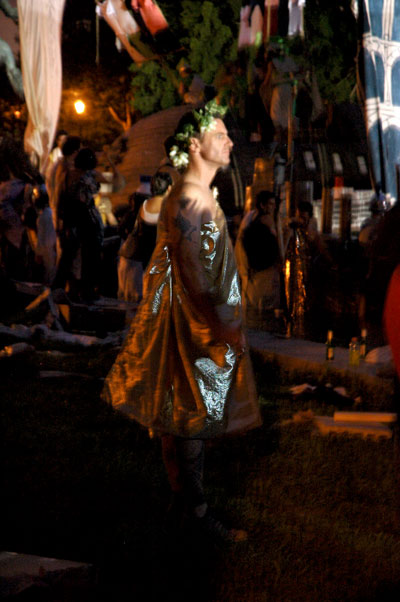
Duke-emperor, artist and prime mover, observing from the darkened wings
I’ve included a few of the pictures I took with available light while holding the camera high above my head. They’re pretty “impressionistic”, but the blurriness may convey a small bit of the excitement of the spectacle.
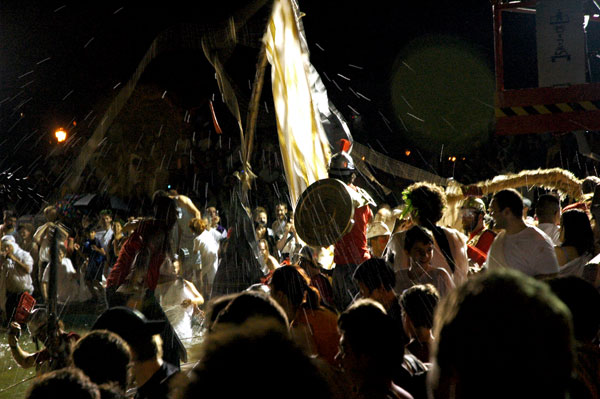
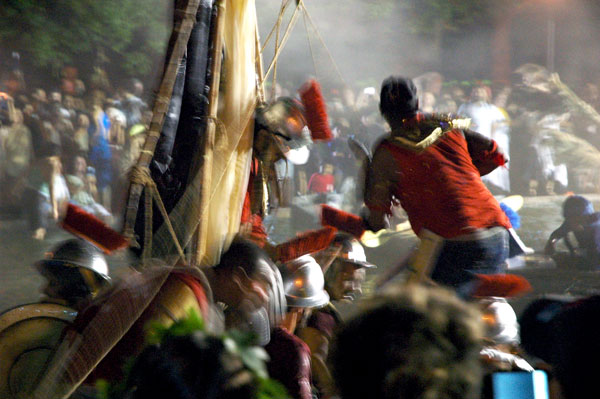
Queens Museum battleship and crew, later to be declared the victors
I’m not sure what’s going on in the next image (the camera saw much more than I did, and it can’t talk to me), but it looks a bit like a victory celebration.
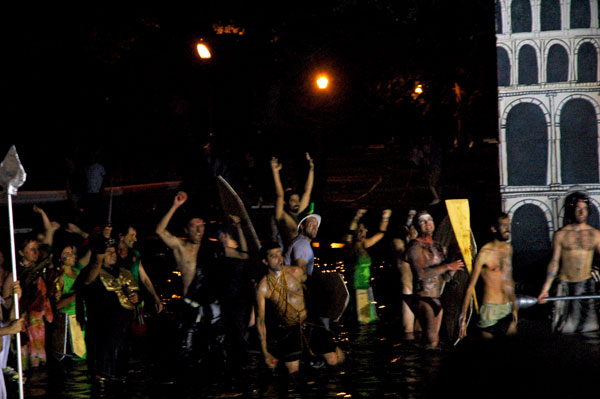
Neptune’s rowdy crew?
That whoopee came just after the sinking or withdrawal of the last manned and womanned battleships, and just before a reed-and-paper-constructed Queen Mary 2 slowly glided toward the head of the lake. Riley and the Queen have a history: When the artist tried to maneuver his one-man submarine near that vessel while it was docked in Red Hook he was arrested and his own ship was temporarily seized. Two nights ago Riley oversaw the replica go up in flames amid spectacular fireworks – turn over, and sink.
The crowd, which for several minutes seemed to be somewhat in shock and awe as they saw and heard the Roman candles going off, then went wild.
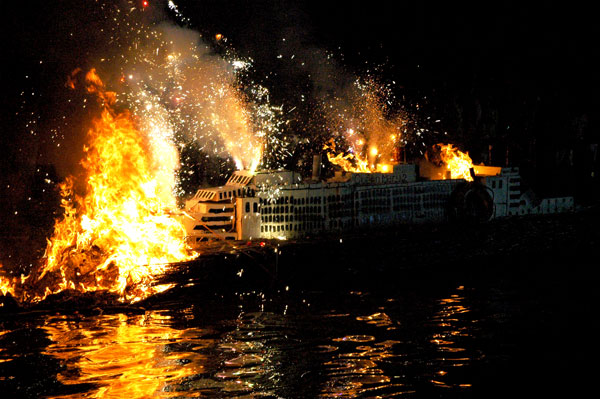
but no one’s suggesting actual sorcery is involved
Chicago’s shiny bean, Anish Kapoor’s “Cloud Gate”
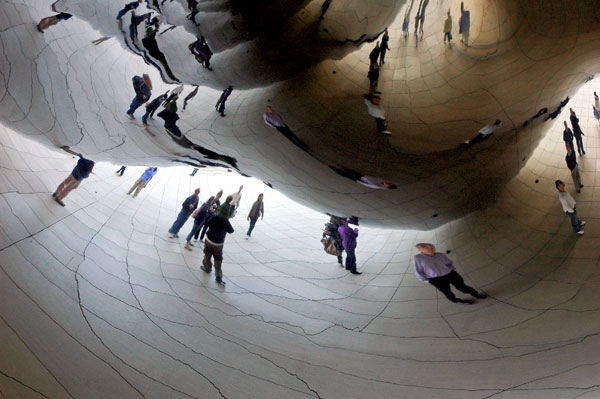
Anish Kapoor Cloud Gate 2004-2006 polished stainless steel 33′ x 66′ x 42′ [detail of installation]
I think I expected to be charmed by Anish Kapoor’s sculpture in Millenium Park, but when Barry and I encountered “Cloud Gate” on the first full day of our visit to the city two weeks ago I thought it was even better than the reviews had reported – and even more fun than its billings.
But it’s also an incredible photo opportunity, and this was one of those rare times I totally went with it. The underside of what Chicagoans had early on dubbed “the Bean” is described as an omphalos, or navel, a complex, curving indentation whose mirrored surface multiplies anything found beneath it, but in the other images I snapped the same afternoon I concentrated entirely on the first of the foreshortened Barrys I spotted above me.