headline of the day

J. Lo and Affleck Finally Get Some Privacy,” is the headline the NYTimes uses in an illustrated business (media) section article today.

The story of Jennifer Lopez and Ben Affleck, glamorous movie stars whose love affair blossomed on a Hollywood set, has turned into the summer’s most watched romance. The movie they made, however, has had no such luck.

The film is a disaster. The Times piece speculates on the overexposure factor. The couple have been splashed across magazine covers and television screens until even their fans may have had enough, but such a take would be too generous to all involved, and it would leave the film itself off the hook.

The problems with “Gigli” (pronounced JEE-lee, although not by many) did not start with the reviews, but the reviews were scathing. The Washington Post called the movie “enervated, torpid, slack, dreary and, oh yes, nasty, brutish and long.”
The Los Angeles Times told readers, “Forget the hype — this movie would stink even without its big-ticket stars.”
The New York Times said the movie, though it draws on various other movies, “has a special badness all its own.”
The Wall Street Journal called it “the worst movie — all right, the worst allegedly major movie — of our admittedly young century.”

Now if we could only believe Ms. Lopez’s and Mr. Affleck’s new privacy signaled a trend.
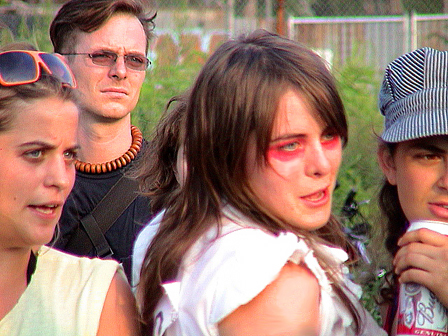
C.H.U.N.K. women


photo by Basil Bernstat
The pix keep coming in. This wonderful image of several competitors [Amy in the center] is from the C.H.U.N.K. 666 site itself.
The picture gives some idea of just how hot the Chunkathalon afternoon really was.
__________________
Go here for the Free Williamsburg story on the Chunkathalon.

Brooklyn still offers a few places where you can have good, clean fun away from the prying eyes of those who would seek to prevent it (hence, stickball). One of those places is a fenced-in patch of condemned state property abutting the East River in Williamsburg. If you walk down the last desolate trash-strewn block of North 7th St. to where it ends at the disused MTA power station, you’ll find-so long as no cops are camped out and you’re not put off by the No Trespassing signs or the occasional burned-out car- a ratty park that offers one of the most blessedly intimate river views of Manhattan. On any given day there, Williamsburg’s skateboarders and bikers can be found doing tricks on a concrete expanse about the size of football field that rises about five feet above the weeds and crabgrass (a refrigerator offers a leg up). It was here, on the last Saturday of July, that Chunkathon 2003 went down.

Mensch-y diversity

Mitchell’s Home Delivery Service drops the NYTimes and Newsday (the latter is essential because it’s more human and more Lefty than its big sister) in front of our door every morning (well, almost every morning). I’m pretty fussy, so there have been times when I had to call their office for one reason or another, but I’ve always been very impressed with the people at the other end, especially Maury.
I sometimes talk to Maury. Maury Gordon is actually the co-president of this scrappy little company, but not only does he know my account number by heart, he seems to know each of the carriers like sons and daughters, and he has actually delivered papers himself when some emergency or human failure meant there was no alternative. In our conversations Maury sounds like a Mensch.
I learned more about Mitchell’s this week when the Daily News did a story on another aspect of the company’s resourcefullness, and in doing so it filled in some of the blanks about its history. Now I had to look for more, and I found Mitchell’s website. I suppose I shouldn’t have been surprised at the amazing diversity I found in the kind of people working at the top. Take a look for yourself at what I love about New York – Mitchell’s included.

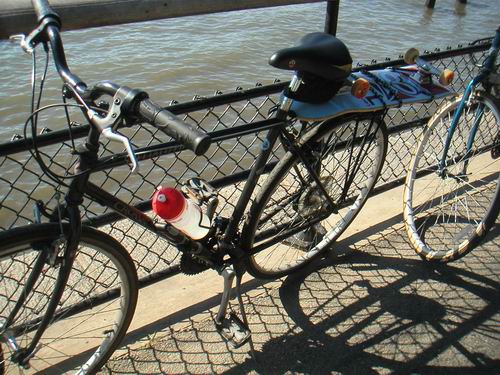
boys and girls and their bikes


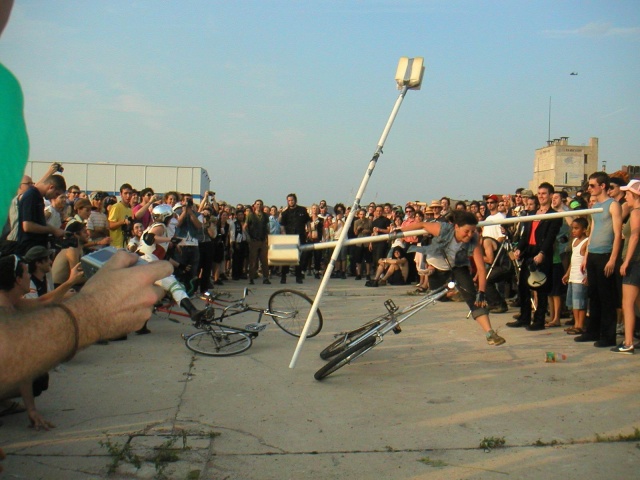
both go down here, but in the end Amy, the white knight on the left, was topped
We walked down to the Willamsburg shore yesterday afternoon and had a delirious good time as part of the 2003 Chunkathalon. By the organizers’ [C.H.U.N.K. 666] own description, the event was “a series of death-defying bicycle contests that purge the group of weaker members while amusing the survivors.” No attitude, no swagger, and as some cute sage said yesterday, “bikes are for fun.”
There are dozens of annotated images in this gallery.
Bloggy has much more. Don’t miss the [teabagging] item at the bottom of his post.
We ran into Tom Moody on the field of honor yesterday. Tom has his own report, with still more pictures.
See this site for a report, with pix, on last year’s event.
Who needs Chelsea, when you have ambisexuality, who needs cars when you have bikes, and who needs a summer getaway when you have North 7th Street?
And so to Relish, for dinner.
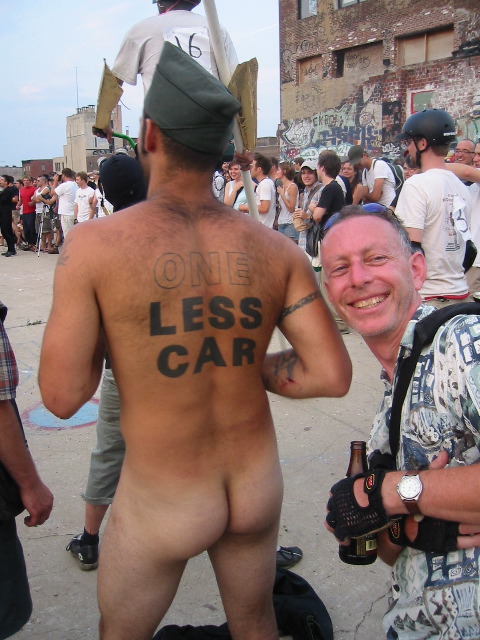
Oh, now there are more images available, on the yeabikes site, including this, of Zach:

The tattoo reads, “ONE LESS CAR” – but more Zach is good.

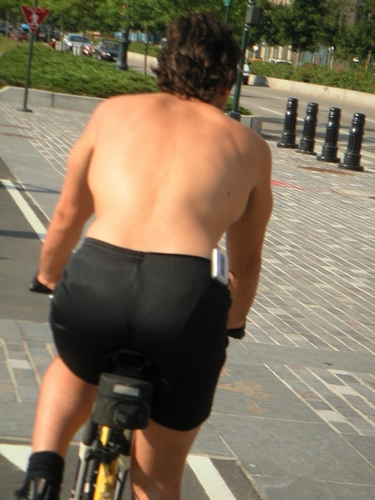
great shapes

Sunday, back on the river.


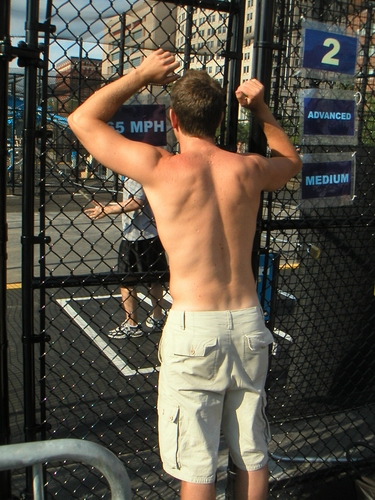
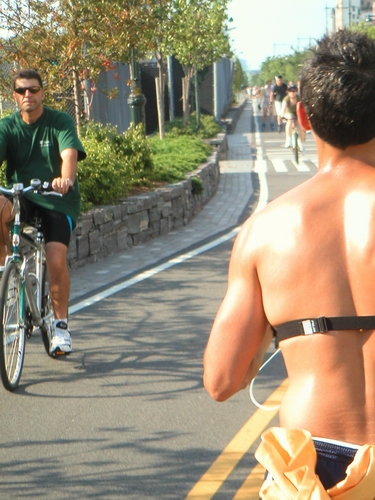
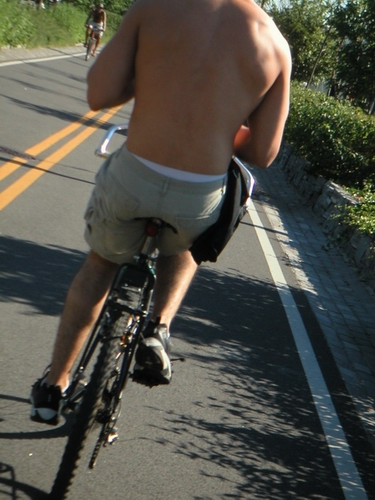
The chain link separates him from the batting machine, the strap is not a brassiere, but it sure is sexy, and bike shorts* seldom looked better.
_____________________
*
Sorry he’s a bit blurry, but we were both turning, I had only one arm on the handlebars, and both eyes behind the camera. It still seemed worthwhile.

getting there

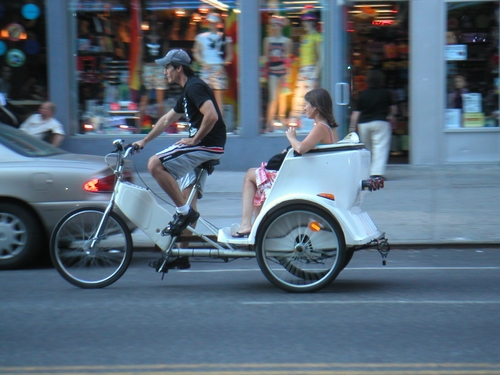
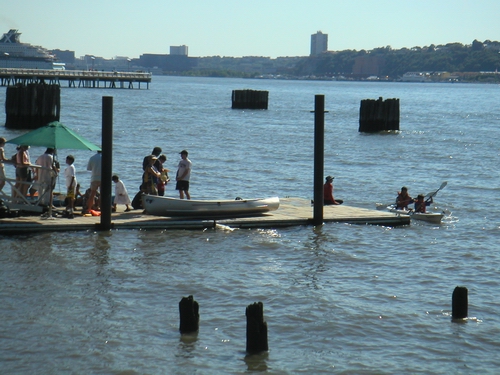
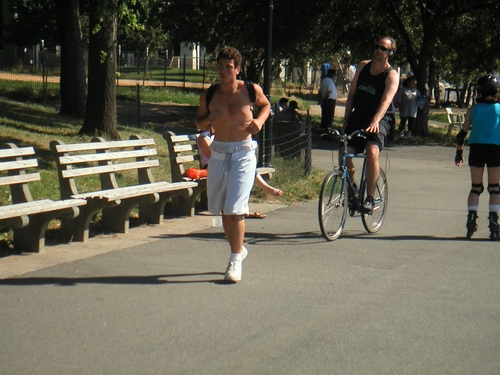
I ran up along the west side of Manhattan on my bright-green shamefully under-utilized two-wheeler this afternoon. Along the way I spotted a delightful variety of approaches to the concept of urban transportation.

rickshawing

skating

kayaking

running

resting (sort of an exception to the transportation theme)

skateboarding (or with intentions – maybe he’s kayaking))

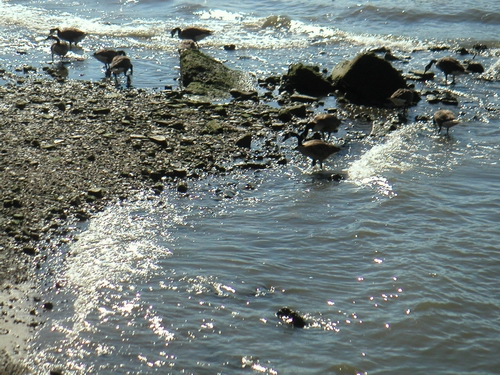
wading, and then finally

bicycling, like meself, but looking very, very pretty, and waving to everyone along the way

joy in French North America


And we can avoid the long plane trip!
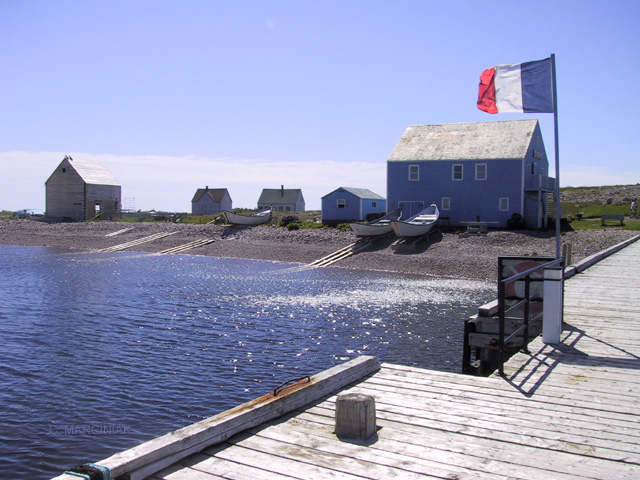
Suggestion for celebrating the anniversary of the birth of the first state fully heir to the Enlightenment: Visit St.-Pierre and Miquelon next July 14, a collectivité territoriale, a part of metropolitan France, just off the southern coast of Newfoundland Island.
Years ago I had heard that bread was flown in each morning from Paris, to be sold at the same price as in the capital, just to maintain the strength of the islands’ ties to the rest of the nation, since they are now the last relic of what was once a French empire which included most of North America.

After France lost Quebec [all of Canada] to the British during the Seven Years War, Paris managed some deft negotiating in 1763 to keep this sliver of its colonial empire to give its fishermen a safe haven.
During Prohibition, the archipelago became a way station for Canadian liquor smuggled into the United States. Virtually every basement was converted into a warehouse for bootleggers, and Al Capone set up shop at the Hotel Robert, where his straw hat still graces a small museum.
Capone came here to solve a problem. The wooden whiskey crates that were to be unloaded near Fire Island made too much noise when they knocked against each other, tipping off the feds. Capone decided to discard the crates for jute sacks and straw, leaving behind 350,000 cases a year here that stimulated an odd housing boom — one cabin outside town made completely of crates is still known as “Cutty Sark villa.”
When the Volstead Act was repealed in 1933, truckers held a mock funeral.
Not much has happened here since, although the archipelago was the site of a World War II military landing that arguably spelled the beginning of the end for the Vichy government. On Christmas Eve 1941, Free French fighters aboard three corvettes and a submarine landed in St. Pierre without bloodshed. They held an election, and the people voted to boot out the local Vichy authorities.

[photo from C. Marciniak]

New York

wegee summer
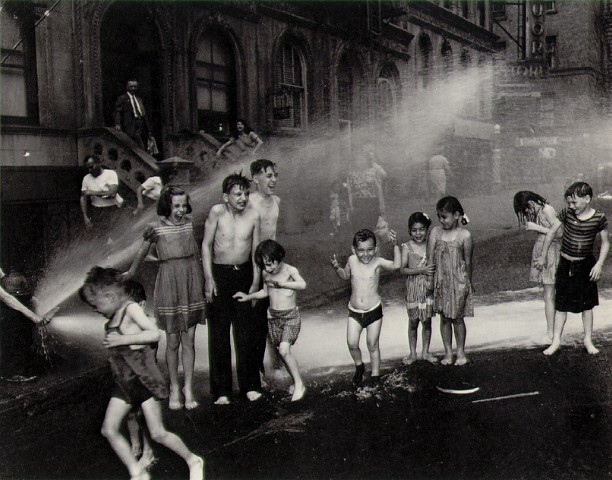
Weegee (Arthur Fellig), “Summer, Lower East Side” (1937)
Maybe the longer you’re here the more likely New York will feel like a small town, but normally that means small in physical scale. What about the dimension of time? When we find really long-term survivors in our midst, our assumptions about the city’s evanescent joys and sorrows fly out the window, and the years themselves are abreviated.
Linda Wolfe recently tripped over her own and her city’s histories on a recent afternoon when she returned for the first time in 50 years to two old houses on East Broadway, nos. 185 and 187,* where she had lived one summer between college semesters.
She admits that she knew nothing of the nineteenth-century history of the neighborhood when she was there in 1953, although that of the 20th century was very much present.

After all, The Jewish Daily Forward building, with its columns, crowning clock and bas reliefs of the heroes of European socialism, was three doors over. The Educational Alliance, where assimilated uptown Jews once tutored their rough-edged newcomer cousins in English and social graces, was just across the near corner. The Garden Cafeteria, where aging Trotskyists and Stalinists sat chain-smoking and arguing the future, was on the far corner. These famed institutions were all still functioning. I had moved into the bleachers of history.

What she found when she returned put the last two centuries in a perspective denied most New Yorkers.
____________________
*
In Caleb Carr’s “The Alienist” the title character operates an institute for children at 185-187 East Broadway. I wonder if Ms. Wolfe knows about this shared reference.