low down on the High Line
Barry and I visited the newly-opened first stretch of the High Line last Thursday, in spite of a light mist which probably reduced the crowds of the curious that afternoon. The experience was more lovely than I had dared to expect. My favorite things are its physical position (three stories above the street snaking around and through some other interesting structures, often within view of the Hudson), the handsome naturalistic plantings, and the fact that it’s only a few blocks from our apartment.
It’s a really, really wonderful thing. Its delights start even before you climb (or “elevate”) to the height of the old freight railway, with the breathtaking sight of smiling, happy people out in the open air beyond an old railing thirty feet above you, and it never stops. Actually, I think we’re both still high a week later, just thinking about it.
But I do have quibbles about some of the fancy details. I think that certain features introduced by the design team, led by landscape architecture and urban design firm James Corner Field Operations with architecture firm Diller Scofidio + Renfro, seem a bit too fussy, and their design may not age well. I’m thinking of the concrete-and-stone composite seat supports and “fingers” stretching from the path into the crushed-stone planted areas. I assume there’s a practical reason for their being there, if not in their precise configuration, and in any case nature may soon disguise or soften a lot of what now seems too much like an affectation.
The monstrous commercial Chelsea Piers operation robbed Chelsea of the kind of access to the Hudson River enjoyed by most of the communities north and south of us when the designs for Hudson River Park were approved. Chelsea is only now getting its first real park.
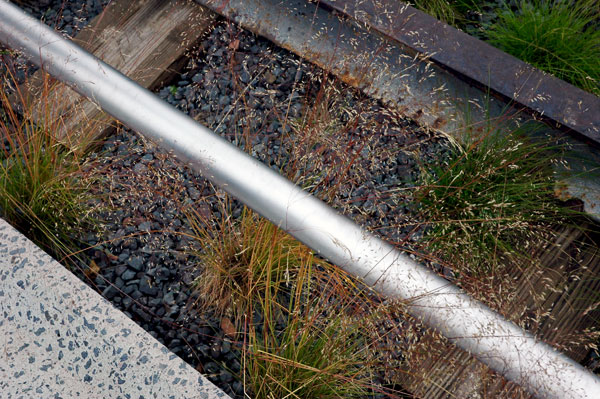
I’ve included only one photo here, an aesthetic and historically-referenced impression of the new High Line. It’s a detail describing some of the materials used in its construction, including the edge of the pavement, a very low steel railing, a segment of the original freight rails, and a look at the beautiful ornamental grass. I decided to hold back on any images documenting the park more thoroughly (they’re available all over the internet anyway), in order to make it easier for the reader to experience the environment visually unprejudiced.
Category: Happy
COV’s “Greek”: brilliantly mounted – and great fun too
the flat
the caf
Barry and I both love Mark-Anthony Turnage‘s work, and we love our fifteen-year-old CD of his 1988 opera, “Greek”, in which he reinvents the Oedipus myth in London’s East End during the plague years of 1980’s Thatcherian England, using a 1984 play by Steven Berkoff as a base. I don’t think we ever expected to see a production of this exciting piece in the U.S., especially here in New York, where opera programmers and patrons haven’t even begun to acknowledge the music of the last one hundred years.
We had already made arrangements for a trip to Chicago (from which we returned late last night) when we first learned that Chicago Opera Vanguard, a spunky young opera company, was staging “Greek” somewhere on the edge of downtown while we were going to be there. We would probably have traveled west just to see this work live but it appears that the ancient gods aren’t dead yet and had secretly made the arrangements for us.
As it turns out, not only was the pleasure we got for our short trip out to Wicker Park Saturday night all out of proportion to the small effort we had expended, we would even have considered it worth the 1500 round-trip miles if we had made a special trip just for this particular “Greek”.
No, there were no supertitles, so in the planned-chaos and fantastic mix of this thrilling staging some of the dialogue may have been lost, but the extraordinary beauty, intelligence, creativity and sheer exuberance of everything and everyone involved in the production made it one of the most exciting operatic performances I’ve seen. It doesn’t hurt that the setting also summons the devils of our own contemporary plague years. And, yes, it really is opera.
The production was carved out of a somewhat eccentric late nineteenth-century “defrocked” (very appropriate, that) church, now the St. Paul Arts Center, with a wonderful and oddly-anachronistic avant-garde theater seating plan.
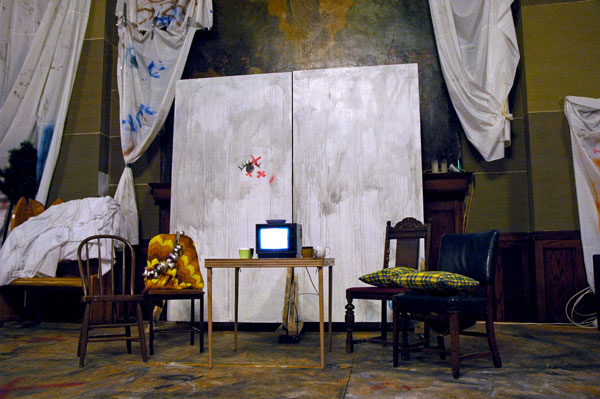
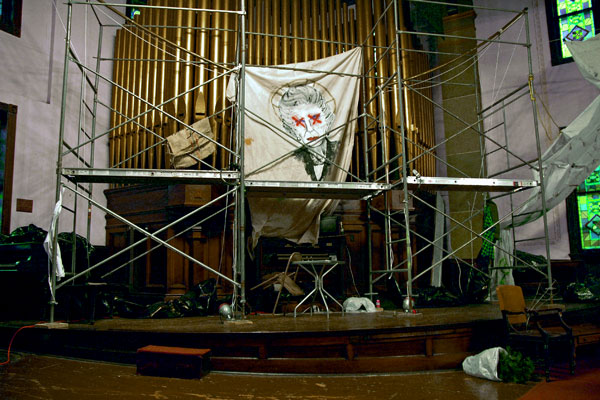
We arrived early to pick up our tickets and when I peeked through the doors to the theater space from the foyer where the “box office” was located I saw what appeared to be a set still in the making (scaffolding, buckets and sheets and such). Minutes later I saw instead that what I was looking at was actually a detail of the most thoroughly-broadcast set decoration operation I’d ever seen. The entire church was the stage for the opera, as we learned the moment it began, and that included the balcony above us, where music director/conductor Christopher Ramaekers and the nineteen members of the excellent orchestra were installed.
I took the images at the top, of two sections of John Sundling’s wonderful set in this theater-kind-a-in-the-round, a few minutes before the performance began.
There were four excellent singers (and real actors!), and their moves (choreographed by Erica Reid) were augmented by a fleet and nimble crew of supernumeraries/stage assistants which managed to be everywhere doing just about everything an actor, dancer, properties person or technician could be asked to do. Philip Dawkins’s costumes were spot on. I was enchanted by the kind of special effects (generally pretty low-tech) which might have intrigued a small eighteenth-century theater director, and the improvised magic lantern stuff was a terrific “stocking stuffer”.
The cast:
Justin Neal Adair (Eddy), Ashlee Hardgrave (Mum/Woman/Waitress/Sphinx), Brad Jungwirth (Dad/Police Chief/Manager), Caitlin McKechney (Doreen/Woman/Waitress/Wife/Sphinx)
Sean Eweert, Dwight Sora, Cassie Vlahos, Kelly Yacono (in various roles)
Chicago Opera Vanguard appears to be basically the creation of its amazing composer/director, Eric Reda. The COV site describes the company’s laudable mission:
Chicago Opera Vanguard is dedicated to exploring the delicate balance needed between performance, music, words, design and technology in order to make a truly immersive and transformative experience.
COV is commited to creating accessible and exciting theatrical experiences, both concretely and virtually, by producing new works, giving a second voice to important or overlooked modern pieces, and completely reimagining the standard repertoire.
There shouldn’t be an empty seat in the house for something this good. Now that the work has received some awesome reviews, tickets may be hard to find for the last three performances, this Wednesday, Friday and Saturday.
For those who can’t make it, I just found a listing for a DVD of a television production.
We definitely want to go back to Chicago, since we had such a great time and thought the people were great, but another COV production will definitely do it for us.
7th anniversary of jameswagner.com
It seems to me like it’s been around forever, but today is actually the seventh anniversary of this blog.
For those of us who follow these things, this is also the anniversary of what turned out to be the most important event in my life, the night Barry and I met, eighteen years ago.
And, making the day even more perfect, . . . it’s also Paddy Johnson‘s birthday!
I just checked on what I had written one year ago. Today I may be more upbeat about the world outside the circle of our friends, but only a bit.
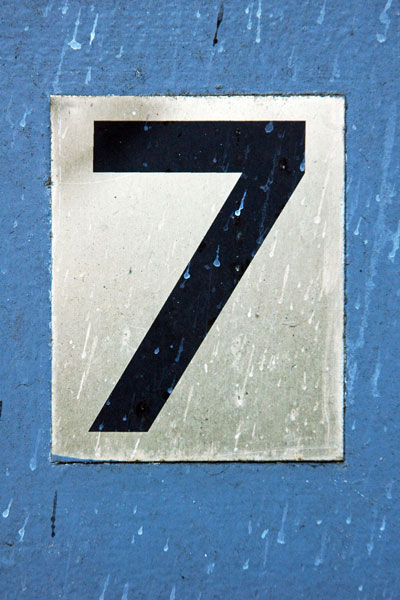
[the image is of one the three metal street numbers mounted on a metal service door belonging to a building down the street from our own]
Ostara’s eggs
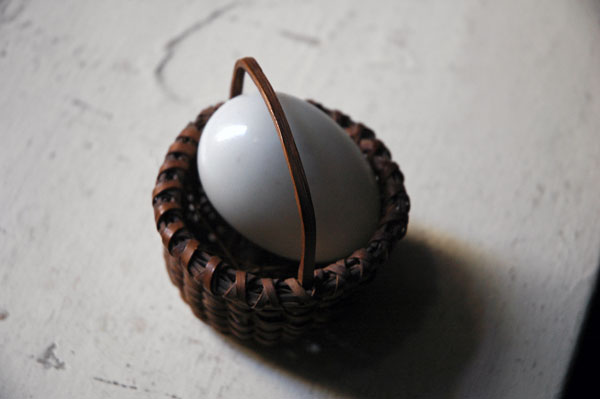
I hope this image doesn’t make the blog look too sentimental, especially coming after my last post (a picture of some yellow spring flowers in front of a blue wall), but today, or some other day close to it, is a big holiday for a lot of people – for many different reasons, some of them even related.
Easter was one of my favorite holidays growing up. We were observing Catholics, but my obsession with the holiday was more about the return, finally, after another interminable Lent, of lots of smells and bells: colorful church vestments (including pink!), fresh flowers everywhere, lots of music, and candy of course (even before church).
The ancient Germans, who seem to be behind all of our biggest holidays, revered a fertility goddess called Ostara (there are many spellings), who was associated with the rising sun and spring, but who was also a friend to all children. She had a pet bird that for some reason she had to change into a rabbit to produce brightly colored eggs, which the goddess gave to the children as gifts.
None of this makes sense to me now, and I’m referring to the yarns spun by both Catholic and pagan cults, so the fact that once every year at this time I pull out of the cupboard an opaque nineteenth-century glass egg (made for darning socks?) which has sat forever on some dry grasses inside a two-inch-round antique splint basket from the same era would seem to represent as much nonsense as its inspirations. Maybe it’s my way of freely rendering an astronomical calendar, but I do know it makes me feel good.
We have another very old basket which I also set out early this morning, this one in the living room. It’s a bit larger. Inside its ancient woven splints rest three hollowed-out and brightly-decorated real eggs. The eggs have grown old themselves since the day they were purchased at a Ukrainian holiday fair decades ago, although they don’t look like they’ve changed a bit. Although These curios are real, and they definitely have color, I think I’ve always preferred their glass replica, and it’s the one I’m looking at now as I type these lines.
Happy spring!
springy
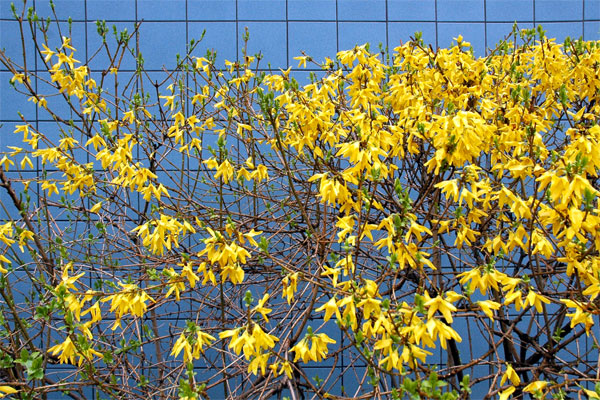
Forsythia on 24th Street, down the street from our apartment and behind the Visual Arts Theatre, which opened as the RKO 23rd Street in 1963.
pigeon squadron over the Lower East Side
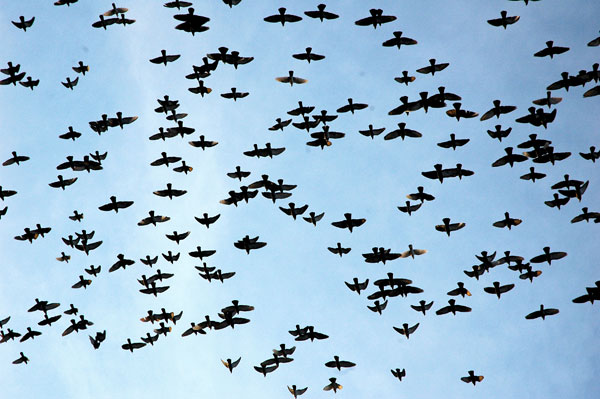
untitled (“feather-light”) 2009
It’s an even more awesome and happy sight when they’re seen moving.
real New York Times front page evokes fake Times
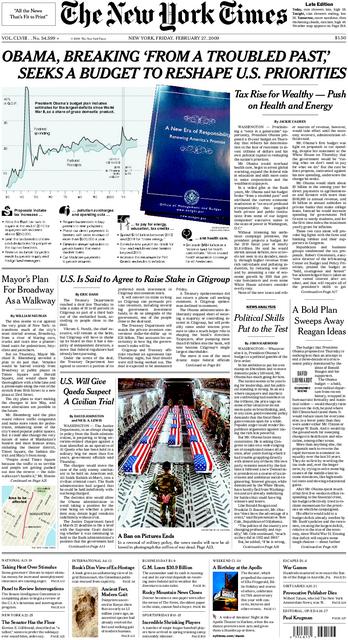
real
The front page of this morning’s real New York Times looks an awful lot like the fake New York Times published by the Yes Men with the help of many others last November 12. My own hard copy of today’s Late [City] Edition differs only slightly from the one shown above. It adds a story which suggests the feds are getting closer to nationalizing the banks.
Probably the most significant element missing from the February 27, 2009, paper is the banner headline on the July 4, 2009, edition shown below: “IRAQ WAR ENDS” – but then we still have more than four months to get that one right.
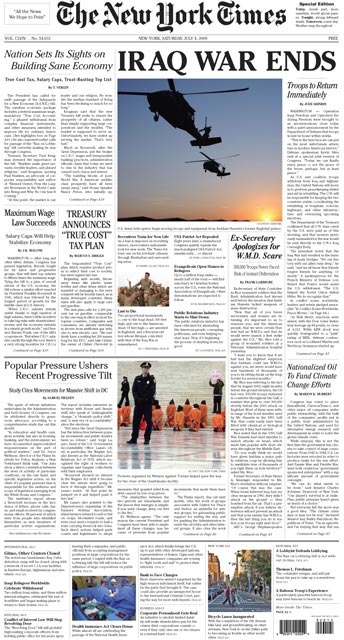
fake New York Times
[first image from the real NYT site; second from the faux NYT site]
Obama’s change will require something like revolution
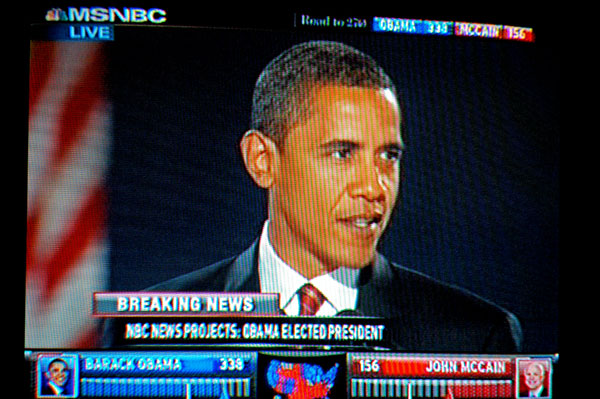
On election day at around 6:30 in the evening I drafted some thoughts that seemed to reflect my state of mind at the time. Barry and I were going to meet Paddy Johnson a little later at the election watch party at Huffington Post headquarters, where I had hoped to come up with an image to go with the draft post. But by the time Obama’s election was actually called, around 11 o’clock Eastern, I had tears in my eyes. I was home, and when I looked at my lines a little later I knew they just wouldn’t fly right then (unless you were asleep that night or brain dead, you know what I mean).
Like most of the world, I am overwhelmed and overjoyed by what has happened, even more so since I will admit that ever since 2000 I thought I’d never see another real Presidential election (even blogging about my scepticism, repeatedly, beginning almost seven years ago). I had seriously underestimated the Republicans incompetence in both their ability to govern and to maintain power.
But it’s now less than three days later and the questions have already begun.
Will Obama be be able to oversee our national restoration? My brother reminded me on the phone yesterday afternoon, from suburban D.C., of the price we had to pay to bring about this victory. We endured eight disastrous years of a Bush presidency, years which saw both the haughty ascendancy and the ignoble collapse of the unmourned Late Capitalist, Neoconservative and Republican regime. Nothing of importance or worth in our own Republic or in much of the rest of the world has escaped the depredations of its arrogance, its sententiousness, its dominion and its greed. I had believed for years that no fundamental political change would occur until we had sunk into a genuine economic depression, and I had gloomily predicted the change would be toward some form of Fascism.
I hadn’t anticipated the confluence of the dramatic events of the last year and the exceptional capabilities of Barack Hussein Obama. I’d say we were far luckier than we deserved to be. There was certainly no inevitability in the timing of either’s appearance.
But in order to rebuild institutions, restore well-being and a belief in the future, the new President will have to pull off something like a major revolution. And he’s going to have to move fast. Roosevelt’s entire “First New Deal” was proposed and passed by Congress within the first 100 days of his administration. I can’t imagine how he and his administration managed it, but in 1933 the people were demanding immediate relief.
Today there may not yet be universal recognition of the full impact of the current economic collapse. Only a few are beginning to describe it as equivalent to the Great Depression, whose ravages were well underway as FDR assumed office (although to be sure, our 32nd President didn’t also have to deal with two messy wars and Global Warming when he moved into the White House). Without that full recognition of the seriousness of our crisis, and with the continuing strength of contemporary skeptics, dinosaurs and reactionaries, including the fact that almost as many people didn’t vote for him as did, Obama will almost certainly have to push through what must be, and almost certain will be, an extremely progressive agenda while not making it look too radical, and he will have to do it in a way that will disarm and even enlist on its behalf as many of its potential adversaries as possible.
It was very interesting to me when I finally looked into it, that during his campaign Roosevelt had apparently spoken to the voters of nothing remotely related to what became his extraordinarily-ambitious New Deal programs; in fact, much of what he did say suggested an agenda quite the opposite of what was later framed and passed. Not knowing this then, but because I knew something about my countrymen, it did not surprise me when I heard nothing specific about any kind of new New Deal from Obama at any time during his own extended campaign.
Obama knows he will have to be diplomatically politic. The nation is fortunate that such an approach corresponds with his own temperament, and that he brings to the task an extremely sharp mind, including the ability to think and speak on his feet, and what appears to be enormous strength of character. I have no doubt that if anyone could pull this thing off in this shaken country at this time, Barack Obama could, but he won’t be able to do it alone.
I know there will be mistakes, as FDR made mistakes, but, and call me Pollyanna again, I believe he will pull it off, partly because of what I have just written, but also because he will have so much help (both enthusiastic and skilled), and because we have come to such a pass that we all really want to see him to succeed: Regardless of our diversity, and despite the vast range in our individual conditions and current fortunes, none of us can afford the cost of failure. We’ll have to be in there with him.
Did I mention the awesome and “monumental” importance that our success would signify, an importance even beyond that of our decision to make a man who happens to be [described as] Black the President of the United States? More than a material recovery, success would mean the restoration of the all-but-buried idea of a free and welcoming America first invented by a wise, older world sometime in the seventeenth century.
These are the tone-deaf, and surprisingly angry lines I wrote early Tuesday evening, exactly as I had left them*:
The corporate devisers and the engine of our national disaster and disgrace have finally been repudiated. Bush and his enablers will squirm in their Pennsylvania Avenue lair for almost three more months, where they can still do a lot of damage, but the lease is up.
While it is clearly a victory for reason and common sense and what used to be called “the American way”, today’s vote marks only the beginning of the real recovery.
We must all immediately get to work picking up the shattered pieces of a proud republic, and it won’t be easy. While we are doing so it will be equally as important to resolve and ensure that as the privileged and proud citizens of this fortunate land we will never again sell our heritage to slick con men who thrive by preying on our selfish appetites and ignorant fears.
We are a free people only if we remain actively and continuously responsible for our own governance.
Freedom ain’t a tower.
*
I’m struck by the fact that I totally ignored mentioning the significance of race when I wrote about what I already expected would be an Obama victory. I’d like to think that what looks like my indifference to its role may turn out to be a bellwether for this country finally arriving at maturity, but I can’t help mentioning that later that evening I noticed and remarked to my friends that sadly even the Huffington party presented little more than a handful of dark faces in a sea of white. I was regretting that we hadn’t decided to watch the unfolding wonders from somewhere in the streets.
[image is a still of the MSNBC broadcast as seen on our home screen]
breezy couple with wispy Papillon in Pierrot suit
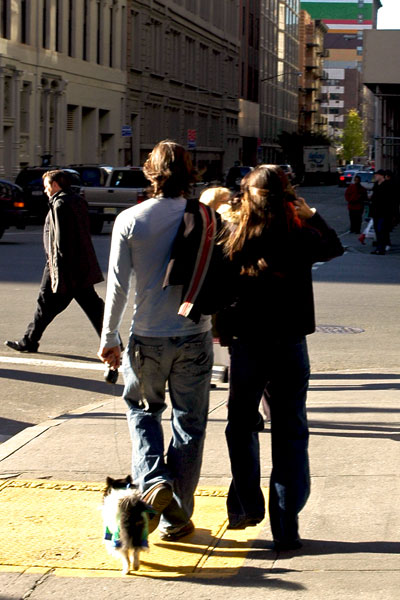
I was hauling 30 pounds of gleanings from the Union Square Greenmarket this afternoon, but I still managed to hold up my camera and capture this smart trio on West 19th Street. The Papillon is wearing a colorful silk Pierrot suit with a high collar.
surf’s up in Bushwick?
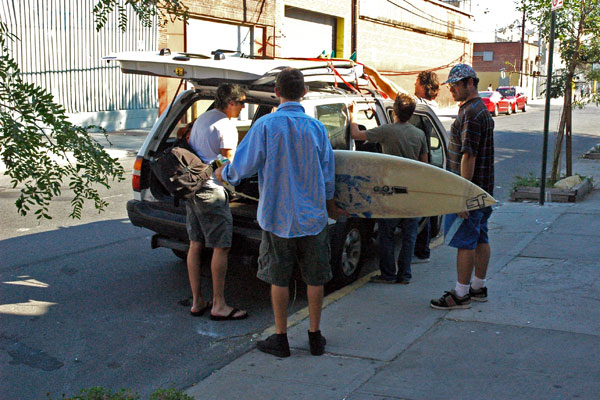
A surfer colony in Bushwick? Who knew? Yesterday afternoon these surfer dudes were busy loading a number of boards into and onto this beach buggy on Bogart across from Grattan.