my favorite Iraq war photo

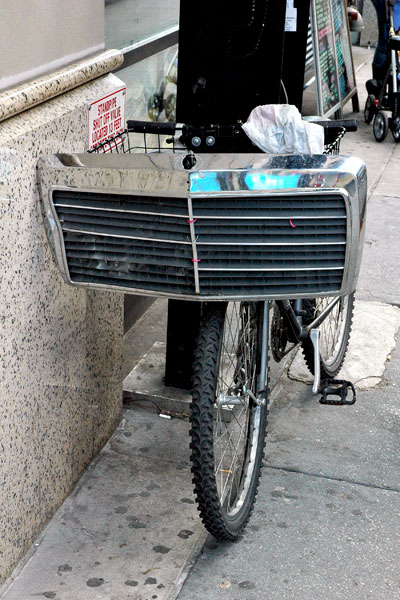
Modified Bicycle
a long way from Williamsburg

I found this image searching Google while preparing my post about Ashley Gilbertson’s book. It’s from a photo-sharing site in an album maintained by a Marine photo journalist, Staff Sergeant Chad McMeen. This is the photographer’s own caption:

This Marine customized his bicycle beyone the point most are capable of. By extending the front forks and welding the rear swingarm in a lower angle he was able to position himself feet above the ground. Somehow with a backpack, bulky jacket and rifle slung across his body he managed to mount the bike and ride effortless.

[image from webshots]

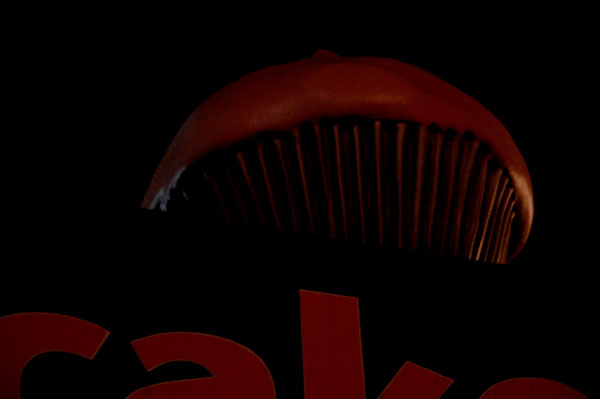
pink cupcake exceeds sell-by date: CLOSED

pink_cupcake_dark.jpg
lights out

The pink cupcake is dark tonight. Dead. And long may it rest, in oblivion.
I was immediately sorry for what the closing of Burgers & Cupcakes might mean to its employees, but minutes after I heard the news from Barry that the restaurant had closed (he had seen the sign on the window this evening) I told him that I actually felt sorry for the owners.
Then he reminded me that one of them had referred to that paragon of neighborhood aesthetics and sensitivity, the Sixth Avenue branch of the huge Caliente Cab Company chain, as a model for what they described as (if not in the same word) their own landmark sign, a giant spotlighted, revolving cupcake poised on top of an illegal canopy above the curb. Now I can feel totally comfortable saying that anyone who could argue that the archtypical Village monstrosity was an appropriate model for a new, improved 23rd Street totally deserves to go out of business.
We had a celebratory toast before a late supper tonight.
With no thanks to our City Council representative.

UPDATES: Today the giant cupcake itself is nowhere to be seen, although the illegal canopy on which it once rotated remains in place. [reporting from the scene on Tuesday, October 2] Now [later this afternoon] we’ve heard that someone had paid $400 to take it away.

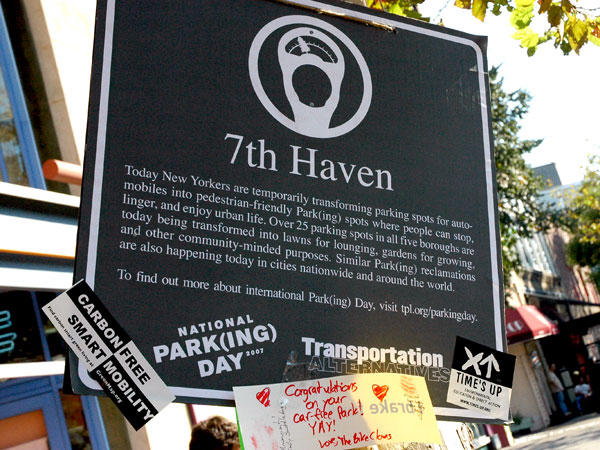
a “7th haven” on international Park(ing) Day

Times_Up_7th_Haven.jpg
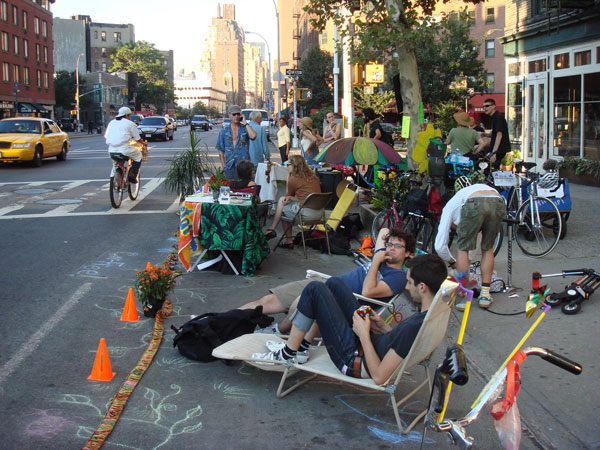
hanging out in a park and free bike repair station on 7th Avenue at Charles yesterday

7th_Haven_sign.jpg
Park(ing) Day, it’s about serious greenstreets

See Jim Dwyer’s column for a word picture of the larger footprint of New York’s part in the event, organized by the Trust for Public Land.
Another piece in the NYTimes reported:

The city’s Transportation Department does not know the total number of parking spaces in the city, but according to Transportation Alternatives, an advocacy group, 45 percent of public land in Manhattan is dedicated to moving and storing cars.

That’s a pretty impressive figure, especially since the total area of “public land” would include Central Park and every other square foot of park and sidewalk.

NOTES: I found the wonderful Barbara Ross photograph [earlier credited on the flickr site to Mike Pidell, who is actually in the photo instead] at the top of this entry while looking for pictures of yesterday’s events. The unremarkable image of the sign is mine. Finally, before I was told that the photo had mistakenly been credited to Pidell, while I was searching for a way I could link to him I located this delightful five-minute bike clown video from last year, “Bike Lane Liberation“.

[with thanks to Tim Doody, image by Barbara Ross from flickr]

the Chelsea Symphony is super!

Chelsea_Symphony.JPG
supernal music between the altar and the first pew

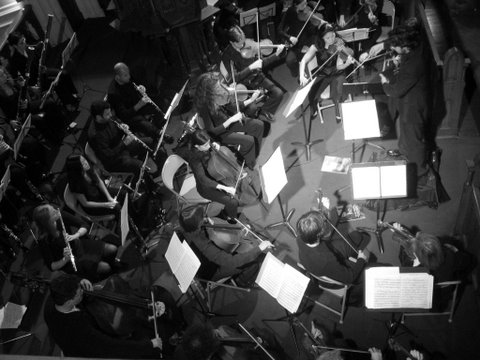
Barry and I are big fans of the two-year-old Chelsea Symphony. It has little to do with allegiance to a home team, even if that’s what got us into the little German Church around the corner the first time. There were also at least two other connections: One of our neighbors, Blair Lawhead, is a superb violinist who plays with the group and Louise Fishman, who also lives across the hall and had beaten us to a performance, has since lent an image of one of her magnificent paintings to animate the orchestra’s posters. It seemed like everyone in the building, including the doormen and porters, knew about our local band of players before Barry and I heard them for the first time.
This summer, through the generosity of another neighbor, David Shear, a string quartet composed of musicians from the Orchestra was engaged to play as part of our annual garden party. Wow. Now that’s a home team.
Since first attending a concert last summer, we’ve found it almost impossible to miss any of their appearances. Yes, they’re that good; they’re very good – but there’s even more to like.
I started out in the Midwest a long time ago with a passion for serious music almost from the very beginning. I’ve now lived and traveled over much of the world, during which time I’ve enjoyed some magnificent orchestras I’ve attended (with pleasure, but often with too much wincing) more than most people’s share of performances by smaller, less professional ensembles. When I’m home I’m surrounded by thousands of LPs and CDs, for the most part “classical” recordings of music stretching from ancient Greece to the day before yesterday. They are mostly professional ensembles and the majority are on commercial labels.
But to be in a modest-sized hall with this Mozart-sized company of well-rehearsed, enthusiastic and gifted young artists lifts the spirit in ways an orchestra like the New York Philharmonic never can. Yes, tears will happen. And perhaps to top it off, there’s at least one piece of new music in each program – take that, Lincoln Center and Carnegie Hall programmers!
If New York has more living composers than there are music programs open to them, there are also far more great musicians and conductors than there are seats or podiums available in the orchestras. Some of these composers and performers still believe in symphonic music and some of them are stubborn enough and creative enough to take things into their own hands and do something about it. Some of them have founded, or found a home in, the Chelsea Symphony.
I highly recommend this concert experience, regardless of what your previous commitment to classical music may be, even if doing so might make it harder for me to ever find a seat again only a dozen feet from the conductor.
This is an excerpt from the Wikipedia entry for the Chelsea Symphony:

The Chelsea Symphony is an orchestra noted for its uniquely fluid hierarchy. Based in New York City, The Chelsea Symphony’s members rotate as the ensemble’s own conductors, composers, and soloists. Each season, every conductor conducts a complete symphonic program with the group; each composer has a new work performed by the full orchestra; and every soloist performs a featured piece with the entire ensemble. The Chelsea Symphony gives most of its concerts at the German Church of St. Paul’s.

There will be performances this Saturday at 8 and Sunday at 3, in St. Paul’s Church at 315 W 22 Street (just west of 8 Avenue).
Saturday at 8:
Debussy Prelude to the Afternoon of the Faun (Don Lawhead conducting)
Haydn Cello Concerto in D Major (Mark Seto conducting, Michael Haas, cello)
Wagner Siegfried Idyll (Geoff Robson conducting)
Mozart Symphony 29 (Geoff Robson conducting)
Sunday at 3:
Strauss Concerto No. 1 for Horn (Mark Seto conducting, Katherine Smith, horn)
Wieniawski Fantasia on themes from Gounod’s Faust (Mark Seto conducting, Hanna Lachert, violin)
Wagner Siegfried Idyll (Geoff Robson conducting)
Mozart Symphony 29 (Geoff Robson conducting)

[image from Wikipedia]

Alex the parrot

Alex_NYT.jpg
“Thinking about animals”

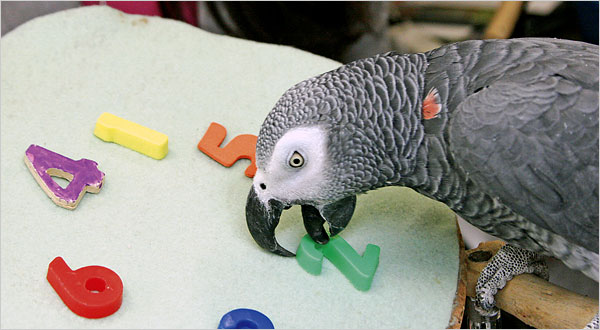
He was probably already my favorite member of the paper’s staff, but a short piece by Verlyn Klinkenborg in today’s NYTimes was worth far more than the price of admission. He is writing about Alex, the extraordinary African Grey parrot who died last week [“Brainy Parrot Dies, Emotive to the End“], and this is much of what he concludes, about Alex – and ourselves:

A truly dispassionate observer might argue that most Grey parrots could probably learn what Alex had learned, but only a microscopic minority of humans could have learned what Alex had to teach. Most humans are not truly dispassionate observers. We’re too invested in the idea of our superiority to understand what an inferior quality it really is. I always wonder how the experiments would go if they were reversed — if, instead of us trying to teach Alex how to use the English language, Alex were to try teaching us to understand the world as it appears to parrots.
These are bottomless questions, of course. For us, language is everything because we know ourselves in it. Alex’s final words were: “I love you.”
There is no doubt that Alex had a keen awareness of the situations in which that sentence is appropriate — that is, at the end of a message at the end of the day. But to say whether Alex loved the human who taught him, we’d have to know if he had a separate conceptual grasp of what love is, which is different from understanding the context in which the word occurs. By any performative standard — knowing how to use the word properly — Alex loved Dr. Pepperberg [Dr. Irene Pepperberg, Alex’s companion and student].
Beyond that, only our intuitions, our sense of who that bird might really be, are useful. And in some ways this is also a judgment we make about loving each other.
To wonder what Alex recognized when he recognized words is also to wonder what humans recognize when we recognize words. It was indeed surprising to realize how quickly Alex could take in words and concepts.
Scientifically speaking, the value of this research lies in its specific details about patterns of learning and cognition. Ethically speaking, the value lies in our surprise, our renewed awareness of how little we allow ourselves to expect from the animals around us

.

[image by Mike Lovett from NYTimes]

I love science!

bee_pollen_fossil.jpg

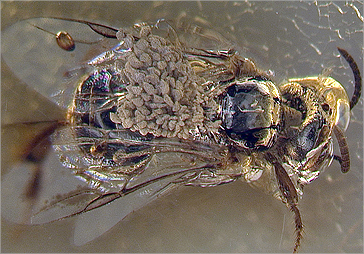
A piece of amber 15 to 20 million years old, found in the Dominican Republic, contains a perfectly-preserved bee within it. The news seems to be all about the fossilized orchid pollen on the insect’s back, and how it demonstrates that orchids were around during the age of the dinosour, but for me the wonder begins with the integrity and beauty of the carcass of this incredibly ancient worker bee; it would look as good had it been alive until a few minutes ago. It’s also interesting to think about how much better this gal is doing than any of those Pharohs who were buried, what, a couple seconds ago?
For the science geeks, the biologists tell us that although the pollen and its carrier are only 15 to 20 million years old, they were able to use their examination of the pollen and a molecular-clock analysis to estimate the age of the orchid family, which they date to about 80 million years ago, some 15 million years before the extinction of the dinosaurs. Okay, that’s pretty cool too.
No wiggle room for the creationists there.
CORRECTION: I’ve been reminded [see comment] that worker bees are in fact female; I have accordingly corrected a noun used in the text above. My apologies and my respects to a very long line of exquisite creatures.

[image of Santiago Ramirez from Reuters via the Globe and Mail]

they’re totally okay with this weather

impatiens_white-crimson.jpg
hibiscus_red.jpg
morning_glories_purple.jpg

Some of our friends seem quite happy with the kind of weather that makes me pretty miserable. I snapped these happy guys on 10th Avenue in front of the Red Cat late Wednesday afternoon. It had rained lightly all day, and although it wasn’t as warm as it is today, the humidity must have hovered around 100% when I passed them at six o’clock.
For the floriculturally challenged, the common names for these blossoms are, from the top, Impatiens, Hibiscus and Morning Glory.