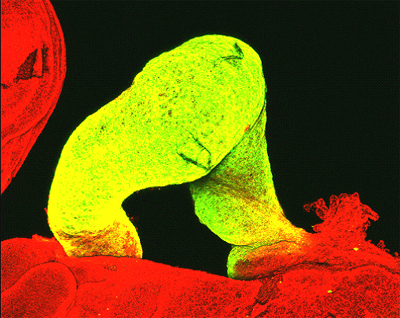
I brought us home a big bunch of beautiful off-red tulips tonight. I really admire more creative responses to the ancient Valentinus challenge, but one story totally intimidates me. John Waters has lately been talking about his own special valentine tradition: “I used to always send boys a little chicken heart . . . that I’d get at the butcher. I thought that was a nice way of telling them that I had a crush . . . .”
I wasn’t surprised that I couldn’t find a pretty picture of a chicken heart, so I went for this dramatic abstraction I found on an Amsterdam medical site where the image is described without any elaboration as an “embryonal stage of a chicken heart”.
[image from academisch medisch centrum]
Category: Happy
Leah Tinari at Mixed Greens
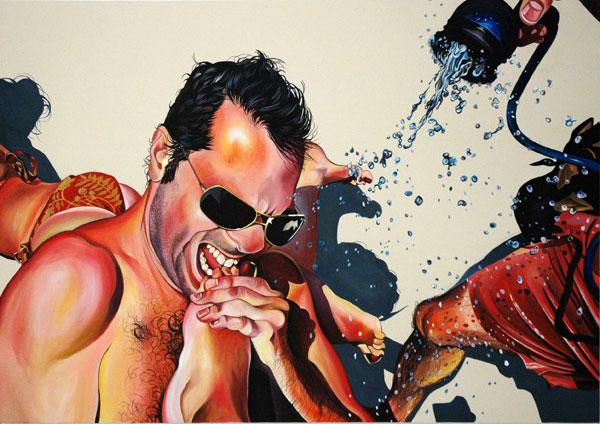
Leah Tinari Enjoying the Hose Down 2006 acrylic on canvas 48″ x 68″
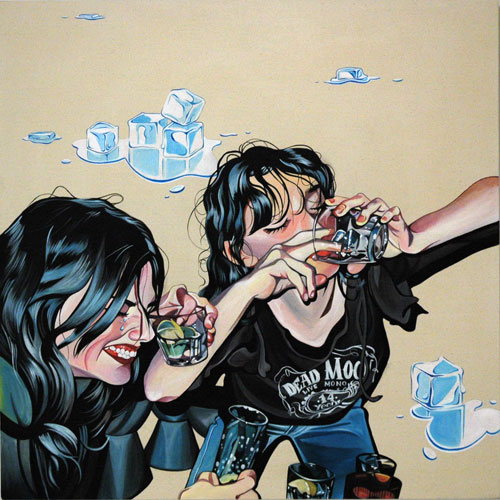
Leah Tinari Chug-a-Lug 2006 acrylic on canvas 40″ x 40″
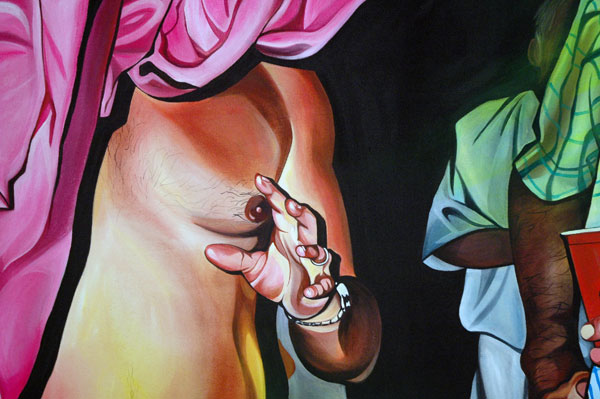
Leah Tinari Disappearing Act 2006 acrylic on canvas 48″ x 68″ [detail]
That’s just hot.
Leah Tinari’s show at Mixed Greens, “We Could Definitely Run for the Presidency“, closes on Saturday, and that’s a shame, because West 26th Street just won’t be the same when it’s gone. “Enjoying the Hose Down” is currently the hottest piece of art on the block, and it’s visible outside the gallery or even from across the street. In fact the fresh crisp lines and shapes of Tinari’s cartoon-like paintings, their backgrounds variously washed in white or black light, read as well from fifty feet as from fifty inches.
The most common subject of what I have to describe as her increasingly-mature work is the artist’s own family and friends, gathered together mostly in lusty parties. Captured originally in snapshots, their merriment is transformed by an unlikely combination of paint strokes both lush and neat into hugely-seductive acrylic cartoons more colorful and alive than the work of either a camera or any ordinary brush.
This old dude is thinking he wants to be in there with the rest of the party, even if he’s actually looking into the hysterical eye of a bridal shower or the beery scrum of a group of maturing frat-boys. Or maybe because.
Homeless Museum at home to guests this Sunday
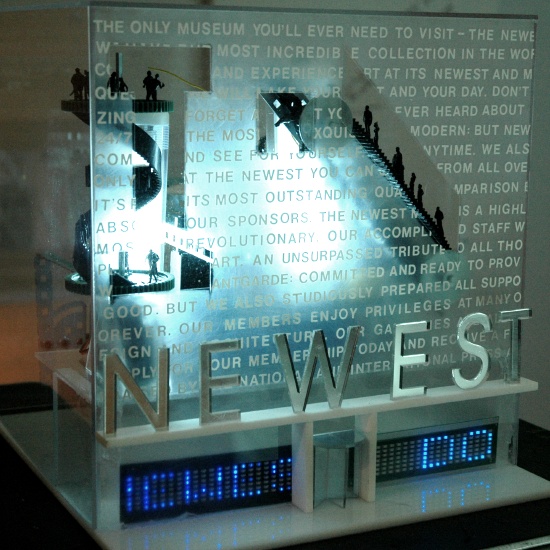
Filip Noterdaeme THE NEWEST� 2006 model (plexiglass, LED screens, figurines, remote-controlled robotic system) [installation view]*
The Homeless Museum (affectionately referred to as HoMu by both adoring fans and its own creators) will be welcoming visitors once again this Sunday. I don’t think anyone could describe this incredible institution as well as the creators themselves do on the museum’s website, and I’m certainly not going to try:
A product of New York City’s cultural decline, the Homeless Museum (HoMu) is a budget-and-staff-free, unaccredited arts organization that enables and engages cultural dialogue practiced at the intersection of the arts and homelessness.
Originally established mostly as a concept, two years ago the museum found a home in the fifth-floor walkup the founder shares with his partner Daniel Isengart. Once a month they open their doors to guests by invitation. Visitors are encouraged to email (info@homelessmuseum.org) or call (718-522-5683).
The NYTimes has found out about it and last month Dan Shaw wrote an excellent account of its mission and its work. The Believer has an extended article by Samantha Topol in the December/January issue.
I highly recommend a visit to the museum. Barry and I were there several weeks ago and we were charmed by the wit and sincerity of our hosts and delighted with the museum experience. We had first encountered what I’ll call the creative humanism of Filip Noterdaeme’s projects two years ago when we read about his campaign to shame the Museum of Modern Art (called MoMa by both supporters and critics, with little warmth from either) for its introduction of a compulsory $20 admission charge. Noterdaeme encouraged and inspired visitors to pay the entire amount in pennies, making it necessary for the museum to place buckets beside the station of each ticket clerk.
The admission at HoMu itself is determined on the basis weight (1�/lb.), cash only. The Times article describes its membership policy:
The museum raises money for the homeless with a twist on the usual cultural memberships. ”We encourage visitors to become members,” Mr. Isengart said. ”We tell them they can choose from any levels, from $5 to $125, and that they must give the money to a homeless person of their choice directly. We do it this way so that 100 percent of their donation goes to the homeless.”
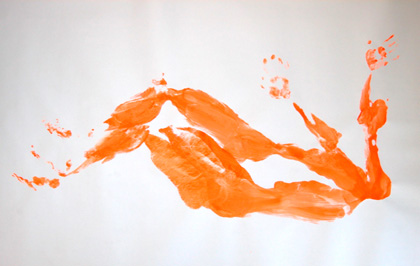
Filip Noterdaeme Spoon, 1/8 Iroquios drawing
“Spoon, 1/8 Iroquios” is in the museum’s collection. It is part of a series which represents a kind of empathetic curating concern absent from any museum of my experience. From the HoMu website:
The One-on-One Collection is a deeply felt and authentic engagement with the grim and stultifying lives of countless homeless adults who yearn for love, but instead must settle for broken dreams, abuse, and danger.
What began as a fascination with the sex lives of homeless men and how they fulfill their sexual desires has inspired this collection of body prints that are reminiscent in style of Yves Klein’s Anthropometries. Paintings on paper made by the imprint of naked bodies previously drenched in “Homeless Orange” provide a range of erotic connotations, addressing taboos such as homelessness, public sex, and homosexuality. For example, in “Spoon, 1/8 Iroquois”, two silhouettes suggest a hurried sexual encounter between two men.
What’s the tie-in between HoMu’s championing of the homeless and its critique of the museum? I think it lies in a profound awareness of the contrast between the outlandish sums of money and attention devoted to the increasingly-elaborate (and increasingly-inaccessible) temples in which we house the high-end items branded as our official cultural idols, and an incredibly wealthy society’s neglect or spurning of its own most-forsaken things and people, including its own material detritus but above all the homeless, the outsider, and the uncompromised artist. Noterdaeme and Isengart bring it all home with their phenomenal mix of minimalist panache and compassion.
The open house is Sunday from 1 to 6, on Clinton Street in Brooklyn Heights.
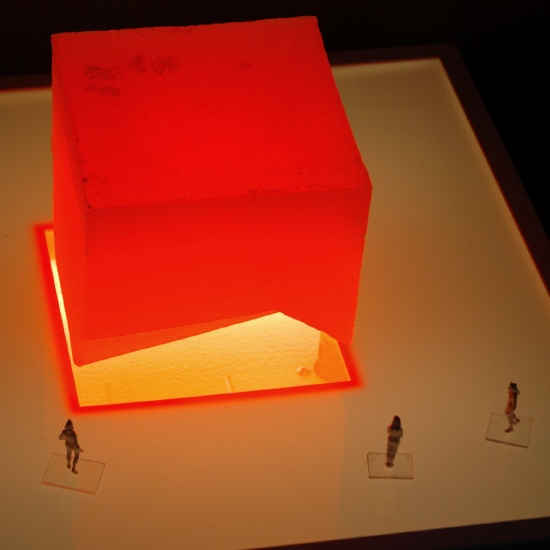
Filip Noterdaeme ISM (The Incredible Shrinking Museum) 2004-2006 model (glycerin soap) [installation view]*
*
descriptions of the two works shown in model form above, adapted from material furnished by the artist:
“The Newest�” presents itself as a new contemporary art museum. Viewed from the front, it appears to be a building that is inundated by visitors whose silhouettes can be seen moving about behind its see-through fa�ade, outfitted with several slogan-flashing LED screens. But a look behind the scene reveals the effect to be a choreographed deception: The Newest� is not a building but an oversized stage-set simulating a building front. The visitors turn out to be dummies circulating on conveyor belts and rotating platforms. The machinery is controlled from a computer operated by a single person, the museum director.
“ISM (The Incredible Shrinking Museum)” is a project for an interactive museum consisting of a sixteen-foot cube of glycerin soap. The cube is subject to constant change through exposure to the elements. In addition, visitors will be invited to exploit the structure like a mine until is it is used up, the goal being to reach out to a new audience and challenge visitors to think about their role as active participants in the shaping and destruction of culture through direct participation in the realization and, ultimately, the deconstruction of a museum.
[image of “Spoon” from HoMu]
Boston authorities crazy about LED street art

1/31 changed everything
I’m so embarassed for my friends in Boston. No, wait: Maybe our good neighbors are all actually onto something really, really big (I’m not talking about the suits and uniforms – or an impressively stupid Boston Globe editorial*): the growing role of the artist as the new and very visible hero of whatever pockets of progressive political life may still survive in locked-down America today. Fortunately the best of our twenty-first-century court jesters are not really part of the court, and they’re not really just jesting.
This Aqua Team Hunger Force LED bomb scare thing sounds like the outrageous scenario for a summer movie, so why aren’t Boston’s mayor and police department laughing?
Go here for the press conference archtype for a new age. It’s Dada!
*
the editorial, from this morning’s edition, isn’t available on line without a registration, so here are some excerpts of “PARALLYZED BY A GIMMICK”:
. . . Turner’s ad gimmick, undertaken in 10 cities from coast to coast, affected tens of thousands of people in the Greater Boston area. Businesses lost customers. Commuters lost time. Even more serious, first responders from local, state, and federal public safety agencies were called away from their legitimate duties.
One wouldn’t expect the promoters of the TV program “Aqua Teen Hunger Force” to score high on a maturity index. But anyone older than 8 or 9 should be able to understand the dangers of staging such a stunt in the post-Sept. 11 world. Homeland Security experts will need to review the response of local law enforcement. Public safety personnel may have overreacted ; local bloggers apparently identified the guerrilla advertising campaign early on. But it’s hardly surprising if others who weren’t in on the gag were suspicious. As a rule, first responders are left little choice but to assume they are facing a legitimate threat.
Perpetrators of terror hoaxes face prison sentences of up to five years if convicted. Police arrested an Arlington man last night in connection with the ad stunt, but potential criminal prosecution is only one consideration. The tricksters at Turner, a unit of Time Warner Inc., should pay the bill for the consequences of a lame marketing gimmick.
[image of Boston supporters of the artists Peter Berdovsky and Sean Stevens by Bizuayehu Tesfaye/AP via Gothamist]
Abbé Pierre, the excessive priest

“holy anger”
Abbé Pierre died yesterday. If there is such a thing as a “saint”, this man clearly deserved the title, but he will never be canonized by the Church. Too excessive.
He wrote that as a young priest, he had sex with a woman, and further infuriated Roman Catholic authorities by advocating gay marriage.
Even Jeanne d’Arc, who finally made saint after waiting 600 years, had never talked that kind of nonsense.
This and (almost) everything else in this remarkable NYTimes obituary of a 20th-century St. Francis almost reads like pure invention; it describes the perfect French or even universal hero of the poor, the homeless, the disenfranchised. And there’s recycling in there too!
ADDENDUM: In doing a little searching I’ve just discovered that l’Abbé was a good friend of this dangerous man.
[image of Jacques Nadeau from Le Devoir]
gone yesterday

untitled (vinca) 2006
This image was taken on January 6, just ten days ago, when temperatures hovered near 70 degrees and a gentle rain was falling on our roof garden outside the breakfast room window. Last night the temperature slipped below freezing with an earnestness not seen this winter until now. It finally feels like the planet may have snapped back into its proper orbit, just as we are about to obtain the second moon of a season begun last December 21.
anti-terror jack-o’-lantern

This is my second Hallowe’en post. This one’s the opposite of grumpy. So I’m thinking, the times are already scary enough; this year a goofy jack-o’-lantern may be just what the doctor ought to have ordered.
[I really should be bringing home bigger pumpkins; you can’t be very imaginative when you have only five and a half inches to work with]
clowns commuting to Brooklyn
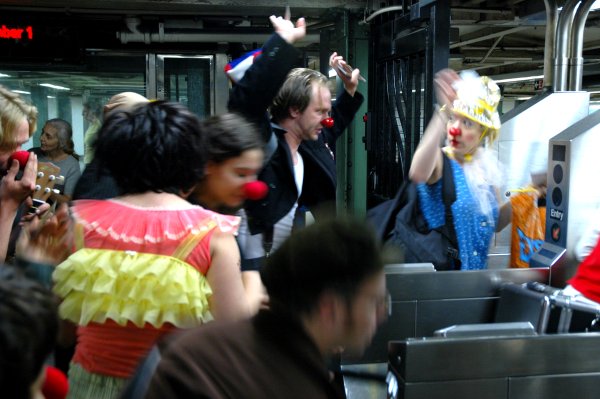
rushing the turnstiles
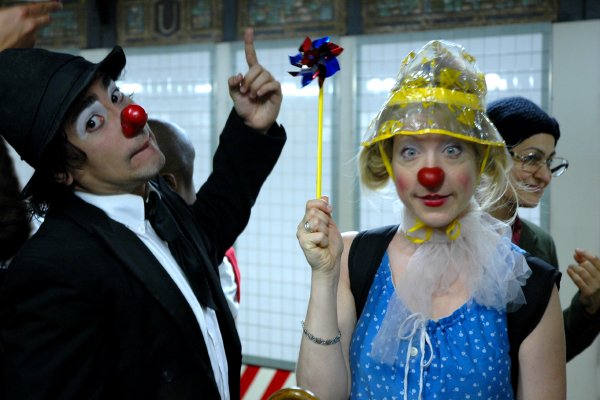
happy together
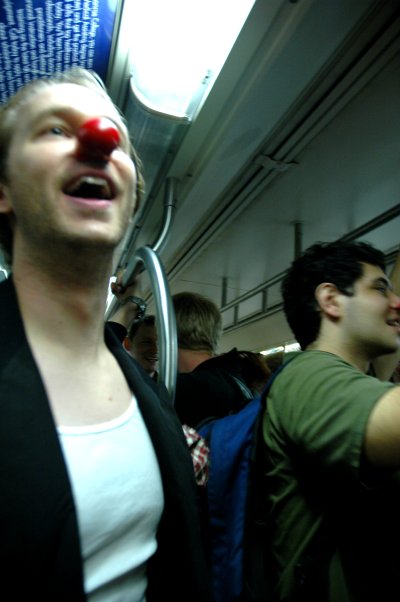
favorite hunky clown
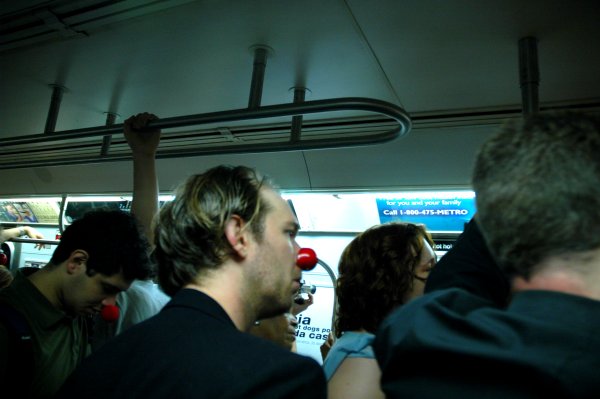
just ordinary commuters
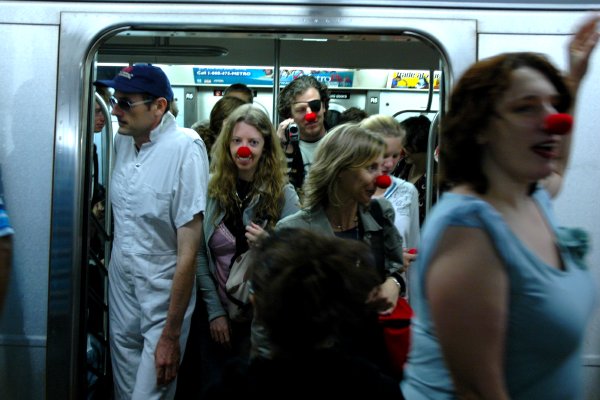
DIY nose jobs
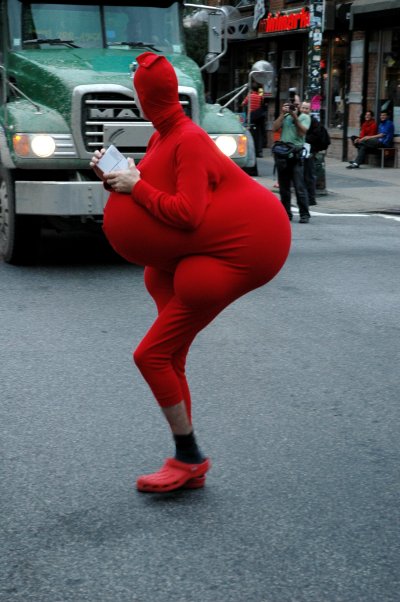
but hard to miss
I knew pretty much what to expect. I was told a horde of clowns would be descending onto a subway platform in Union Square at 5 o’clock this afternoon where they would squeeze into the L train heading into Williamsburg. I thought, “clowns”! How wonderful! And then I saw the pictures of pie fights on the website, and I thought of traditional scenes of eratic behavior, sadism including lots of let’s-pretend violence and the the cutting-up-little-babies illusions. Real clowns don’t come conveniently packaged for innocent amusement, and they never did. But that’s precisely the secret of their universal and historic appeal. I went with this particular, merely mildly-scary bunch only to the Bedford Street stop and then a few blocks further down the street.
They were on their way to the Brick Theater, where the NY Clown Theatre Festival will be headquartered for the next three weeks. If New York is lucky these clowns won’t confine themselves to the building at 575 Metropolitan Avenue.
We’re told this is New York’s first clown festival in twenty years. That probably goes a long way toward explaining why some things have been so messed up around here in the last couple of decades: Some folks need a little constructive provocation to stay in line, and New Yorkers could certainly use a regular extra-strength antidote for the common humbug.
But I’ll own up to my own cowardice this evening: I never believed the baby stuff, but I’m still afraid of pie fights.
a table for the ‘farm’
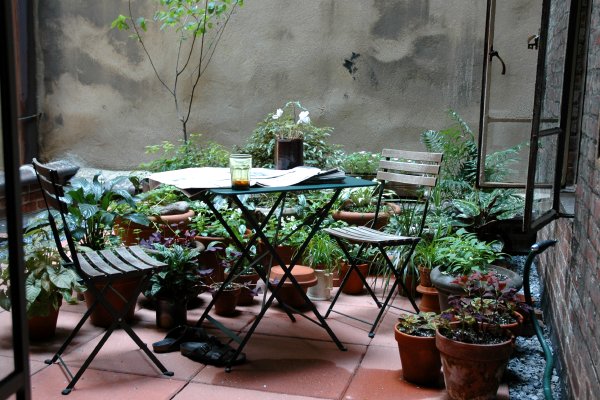
I found the table I’d been looking for!
Now I may never be tempted to leave town, at least not before morning papers and iced coffee. Even the plants seem happier.
our little scrub farm
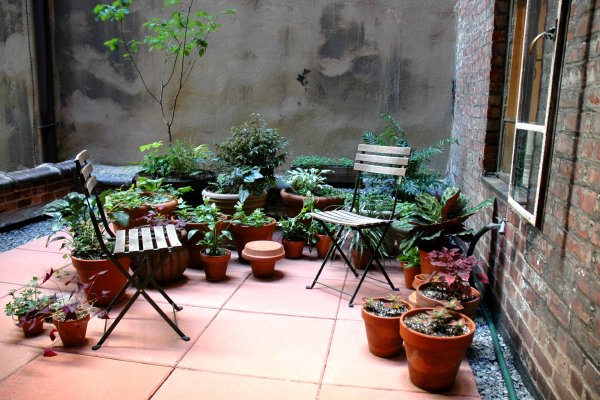
it only appears restful between regular campaigns replacing casualties with new recruits
Our apartment envelops this bit of the outside on its north side, but nature refuses to forgive a building for totally blocking all direct sun with its height, so the possibilities for happy plants are very limited.
I don’t ask for much however, and the only thing I think we’re really missing is a proper surface for a newpaper and a coffee. Does anyone know where I could find the folding steel table designed to go with these dark green chairs?