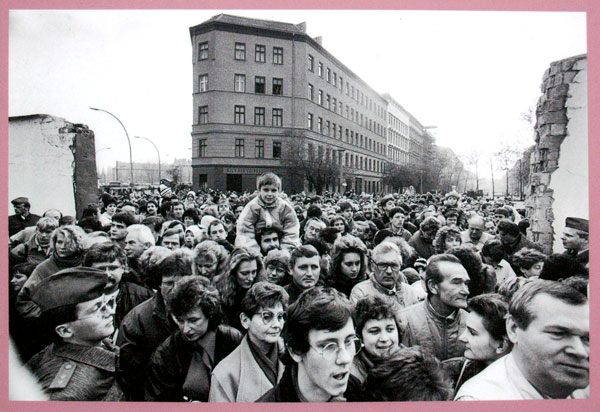
tenth anniversary of jameswagner.com

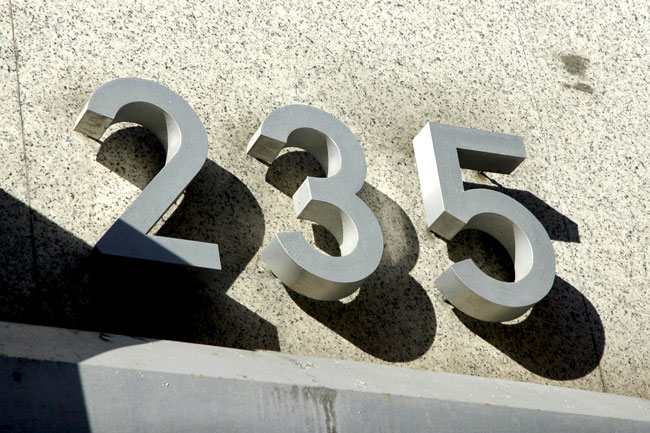
235_tenth_anniversary.jpg
adding them up

Today marks the end of a full decade for this blog.
As I have been more than a little slow in posting over the past year (probably from having discovered more of the outside world – and of course Twitter), I felt I didn’t deserve a real number on this anniversary; instead of a 10 I’ve gone for three numbers which add up to 10.
I can’t predict what, or how much, will show up in the blog over the next year, but It’s not going away. In the meantime this is a brief description of its history, in pretty much the same words I used a year ago:

The blog began when, finding myself totally frustrated with the idiocy and brutishness of my country’s response to the events of September 11 and feeling almost totally isolated in my disgust, I started sending a series of emails to people I knew well, sharing my thoughts and my anger. A few months later I started jameswagner.com, intending it to be a more structured – and more widely broadcast – form for the kinds of unelicited rants with which I had been testing the patience of my friends. It was also intended to include ruminations on subjects in which I thought others might share my interest.
Almost from the start there were entries on politics, the arts, queerdom, history, New York and the world, and within a year they began to be accompanied by images and photographs. Many of the latter have been my own.

April 27 is another anniversary for me, much more precious and infinitely more important than the launch of this modest little blog: I met Barry, my perfect partner in everything (and Wunderkind webmaster) exactly twenty one-years ago today.

[the image is that of the modernist numbers above one of the entrances of the building two doors down from us, a very sturdy structure which incidentally houses the National Office of the American Communist Party USA]

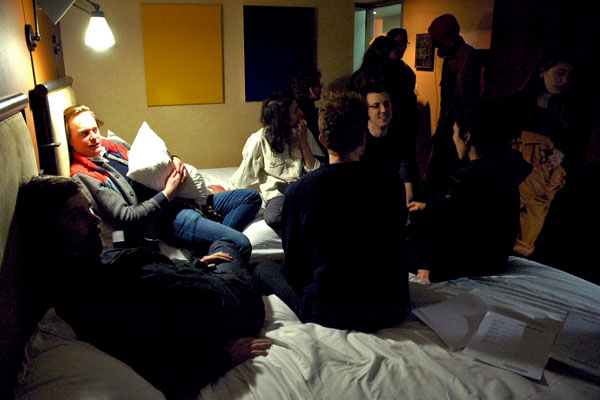
‘Animal Farm: A Musical’ at the Brucennial 2012

BHQF_Animal_Farm.jpg
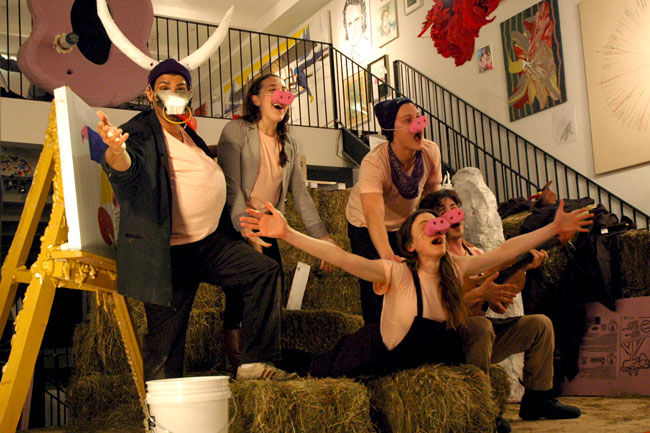
graduating Piggy Artists celebrate the breakthrough which made the Brucennial possible [from left to right: Ian Lassiter, Liz Olanoff, Joe Kay, Maria Dizzia, Matt Nasser]

Last night the earnest, tuneful sounds of the Bruce High Quality Foundation‘s production of Animal Farm: A Musical further enlivened the halls of an already almost-impossibly-vigorous second edition of the arts collective’s Brucennial, first visited upon the unsuspecting city in 2010.
The fable, based only very loosely on Orwell’s allegorical novella, describes the redemptive journey of “the graduating Piggy Artists of the class of 2012” (from the BHQF site) after their confrontation with their school’s alleged penury; its chicken trustees’ incompetence, cowardice, and stinginess, and their move toward charging tuition for the first time after 150 years; its greedy dog financial-advisors, and the dispersal, for a time, of the collective creative energy of the porcine members of the class itself.
While somewhere in BHQF materials there’s a reference to the group’s own institution of higher arts learning, the Bruce High Quality Foundation University, the real story of the high-spirited lets-put-on-a-show production is that of The Cooper Union for the Advancement of Science and Art and the handful(s) of former Cooper students which founded the collective in 2004.
Following the conclusion of the show one of the Bruce’s made a very straight appeal to members of the audience, asking them to help ensure that the college on Cooper Square not betray its legacy as a pure meritocracy: It was founded by the self-made industrialist Peter Cooper to give young people the opportunity of the good education he never had, a tuition-free school whose facilities were open to anyone who applied.
We were asked to go to freecooperunion.com for more information, and to spread its words. Those of the Bruce High Quality Foundation University anthem, printed inside Sunday’s handsome “Playbill”, offer an inspiration:

Every Pig is an artist.
No pig flies alone.
Teaching others is our greatest work.
We can’t do it on our own.

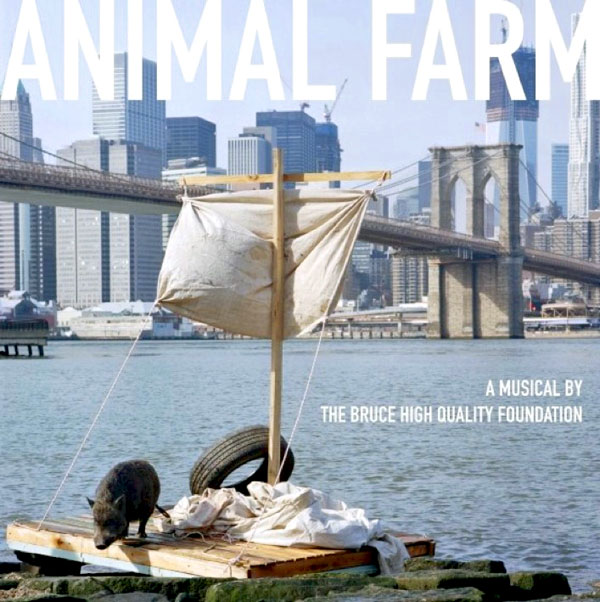
ANIMALFARM_AD_from_BHQF.jpg

[second image, the program cover, from GalleristNY]

the Chelsea Hotel: now living with ghosts?

Patti_Smith_at_Chelsea_12_11_2011.jpg
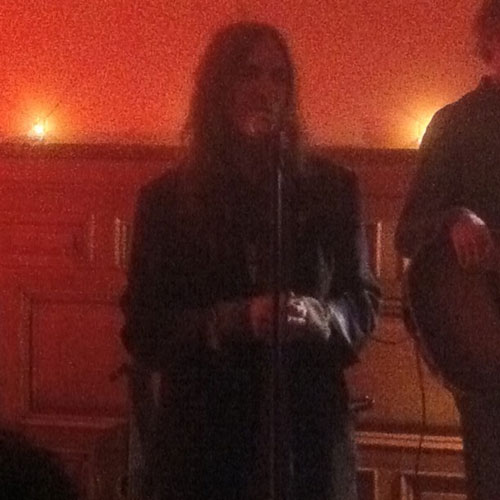
Patti Smith performing for the one percent at the Chelsea Wednesday night

UPDATE: Citing the wishes of the Chelsea’s tenants, Patti Smith cancelled Thursday night’s concert, to which they had been invited. Her statement appears on her web site. Score another one for the 99%.

The Chelsea Hotel seems to be attracting more tourists than ever these days; do they know that what they have come to photograph is now a shell, that it has already been destroyed, in a process begun three and a half years ago?
We live almost directly across the street from it, and I have passed by its front doors almost every day for 25 years. I also have wonderful memories of both strangers and friends, and of the provocations of both visual and performance art projects which could only have come out of this amazing community.
I can’t bring myself to look inside the lobby these days. I stopped going in when the bouncers appeared, and later the new owners removed all traces of the life with which the building had been so richly endowed as they tossed out the odd furniture and the amazing collection of art, both accumulated over many decades. Adding insult to injury, the walls were then essentially – and revealingly – whitewashed.
Those of us who remember the Chelsea Hotel when it was still a vibrant cultural hive have been made both saddened and angered by the unfolding story of its demise, driven by an unfettered greed absent during the 70 years it was under the management of the Bard family.
I admit I don’t understand much of what is happening inside 222 West 23rd Street, and I don’t think many people do. More to the point, I can’t believe that so little is known about the owners’ plans for such an important landmark and once-living monument, if only because of its importance as real estate in a real estate-obsessed city. Permits have to be applied for – and granted (or not) – and I would think the media would be on top of any developments in the story, even if they turned out to be rumors.
All of this brings me to the latest development in the saga of the beautiful 127-year-old relic of brick, iron, and passion: A Patti Smith concert is to be held tonight inside the old hotel ballroom, a concert which may or may not be sponsored by the Chetrit Group, the new corporate owners. The New York Times finds the response to the announcement newsworthy, but doesn’t add much light to the larger story. The newspaper neglected to mention that last night Smith was at the hotel to play what the Village Voice wrote “appears to have been a new-hotel-management-planned event to which tenants were not invited, but the architect and others were”.
This is a story which wouldn’t exist at all if it weren’t for the fact that a number of people still live in the 12-story landmark, and obviously have a more personal stake in its future than those who merely love it; these people have paid for their attachment to the Chelsea, and they continue to do so. It is their home, but they also stewards of its heritage, on behalf of all of us. We should do them the honor of respecting their concerns and join them in asking for answers to questions apparently not being asked anywhere else.
I was moved, in coming up with a title to this post, by the indispensable in-house Chelsea Hotel blog, “Living with Legends“, published by our friend Ed Hamilton. We want to see Ed, his blog, and the Chelsea thrive; our hope is for continuing living legends, not just ghosts.
Jeremiah’s Vanishing New York” and “Living with Legends” are asking friends of the real Chelsea to meet outside the hotel tonight at 8pm during the second, tenants’ concert, to raise lit lighters, and recite the lyrics of Smith’s song “People Have the Power”:

I was dreaming in my dreaming of an aspect bright and fair
And my sleeping it was broken
but my dream it lingered near
In the form of shining valleys
where the pure air recognized
And my senses newly opened
I awakened to cry –
That the people have the power to redeem the works of fools
Upon the meek the graces shower
it’s decreed
the people rule.
The people have the power
the people have the power
The people have the power
the people have the power.
Vengeful aspects became suspect and bending low as if to hear
And the armies ceased advancing because the people had their ear.
And the shepherds and the soldiers lay beneath the stars
Exchanging visions and laying arms to waste in the dust
In the form of shining valleys where the pure air recognized
And my senses newly opened
I awakened to the cry –
The people have the power
the people have the power
The people have the power
the people have the power.
The power to dream
to rule
to wrestle the world from fools
It’s decreed
the people rule
it’s decreed
the people rule.
Listen: I believe everything we dream can come to pass through our
union
We can tun the world around
we can turn the earths revolution.
We have the power
the people have the power
The people have the power
the people have the power.
The power to dream
to rule
to wrestle us from fools
It’s decreed
the people rule.
We have the power
we have the power
The people have the power
we have the power.

[image by Maydersen via the Village Voice; lyrics from STLyrics.com]

a wall is a wall is a wall

US-mexican_border_wall.jpg
from the Arizona side of the 21-feet-high wall on the Mexico-U.S. border

Something there is that doesn’t love a wall,
That wants it down.
[the first lines of Robert Frost’s “Mending Wall” from 1915]

That something is apparently not us: The message of this wall is abominable, and yet we concur with it in our affirmation or merely our daily silence.
The image is from an illustrated article in today’s New York TImes, “At the Border, on the Night Watch”, describing our iniquitous operations “securing” our southern perimeter from the people we conquered to obtain it.

[image by Joshua Lott for The New York Times]

the Wall: remnant of full fabric of 20th-c German history

Mauer_waving_across_wall.jpg
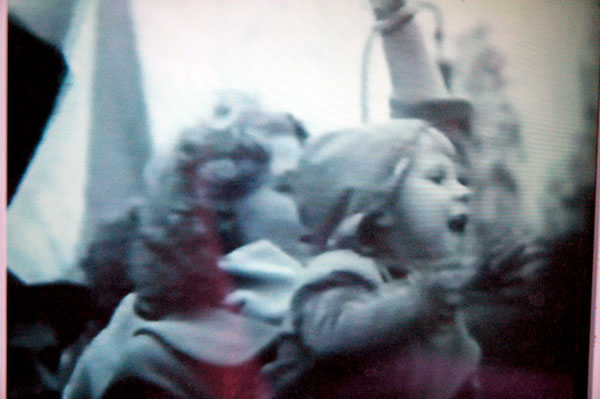
woman and child at the Wall, waving from West to East, 1961 (from a video on a stele at the Wall Memorial)

ADDENDUM: two images have been added within the original set below [on August 21, 2011]

I find myself nearly choking up as I write this. Yes, it’s been a very long time since I’ve blogged anything on this site, but my emotion has nothing to do with having been absent so long from a “post”. The reason I’m feeling a bit fragile right now is that I’ve been looking lately at a lot of images attached to the history of the Berlin Wall, memorialized yesterday exactly 50 years after it was installed. There are also my own memories of the Wall, and of Berlin, which begin in late spring of 1961, a few months before it even existed.
I returned to Berlin several times during the years the wall stood (but not often enough, as I still regret), and I’ve been back three times since it was torn down in 1989.
I suppose it’s natural that at this time there should be more and more attention being paid to this piece of German and Western history, more perhaps than that currently being focused on the Nazi regime and its so much greater horror. At least two generations have been born since 1945, and Germans today are well-educated about the country’s darker legacy, and fully-conscious of both the origins and the deeds of the twelve-year regime which ended in a Berlin bunker. Over 65 years later Germany is a very different country, the Germans a very different people, and almost no one survives today who could be said to have played an important role in the horrors which accompanied the first half of the last century.
The story of a divided Germany, a divided Berlin, however remains very much alive – and insufficiently known or documented. It’s also the story of a divided people, and much of that division remains today. Both victims and tormentors survive, certainly in numbers sufficient to attract the curious social observer or documentarian.
Peter Schneider wrote in the Times two days ago that when he first began investigating the Wall 30 years ago his progressive friends thought his interest was weird, that the subject should be of interest to the Right: “The left held that the split was the price Germans had to pay for the crimes of the Third Reich.” I can back him up: I was aware of something like that attitude among the Germans I knew decades ago.
Even today it seems there’s not even the beginnings of a consensus about what happened between 1961 and 1989, or how it happened.
The Wall was one of the last remnants of a social and political struggle which began before 1933 and continued after 1945; it was a part of a much broader panorama of German history, and not just a product of an East/West Cold War (which had been germinating for several generations, not merely years). Much of the suspicion and passion of the struggle which created the wall is still with us, even if disguised and diffused.
I have been obsessed with German history all my life, and especially with the 25 years fateful years of the Weimar and National Socialist eras, but in the last decade or so I have become increasingly interested in the story of divided Germany, and especially divided Berlin (subjects my teachers would have called “current events”). Part of the reason for my fascination and hunger for information could be the fact that Barry and I have stayed, on our last two visits, in what had been East Berlin. There is nothing like affection for an adopted neighborhood – even a temporary one – and proximity to the subject to inspire interest in its history. But I’m sure I would find the subject fascinating even at a greater distance, and it offers virtually unlimited opportunities for discovery.
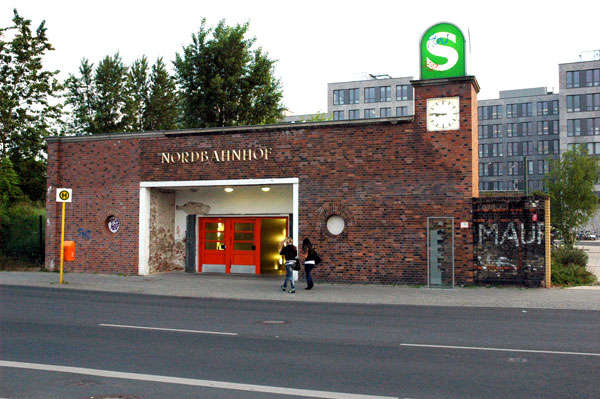
I took these pictures while we were in Berlin in May of this year. I’m using, welcoming, the anniversary of the Wall as the occasion and an inducement to publishing them here now. We stayed just one street away from the Berlin Wall Memorial, which begins roughly at the Nordbahnhof, on Gartenstrasse, and runs along Bernauerstrasse. The memorial service held yesterday was held one street in the other direction from our apartment. These photographs were captured in half-light, as we returned to our base on our first full day in the city.

Mauer_Nordbahnhof.jpg
The S-Bahn stop, Nordbahnhof, closed between August 13,1961, the day the Berlin Wall went up, and September 1, 1990, is at the southwestern edge of the Bernauerstrasse section of the Wall Memorial; it includes an extensive, and evocative, “ghost stations” exhibit; this same building, by Richard Brademann, was constructed in 1936 and survived war (bombs, flooding), the postwar division of the city, and finally the Wall which destroyed its function

Mauer_Bergstrasse_curb.jpg
looking not unlike a street in Pompei, the archeological remains of Bergstrasse, showing the curb, paving stones and stumps of metal fence poles which were a part of the wall system

Mauer_wall_section_Denkmal_Schild.jpg
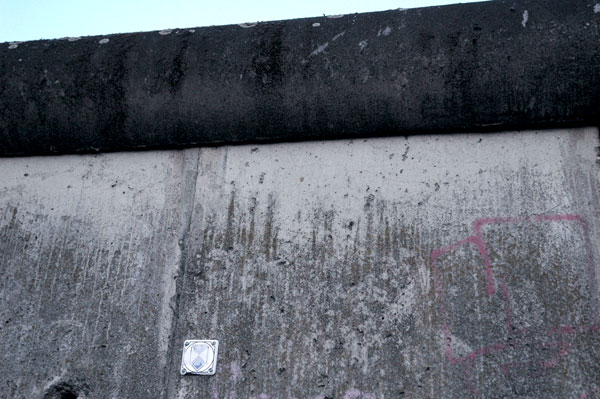
a section of one of the last surviving pieces of the Wall, on Bernauerstrasse, showing the small international Denkmalplakette, or monument emblem, established by the 1954 Hague Convention to identify “movable or immovable property of great importance to the cultural heritage of every people,” to be protected in the event of armed conflict.

mauer_wall_remnant_and_steel_memorial.jpg
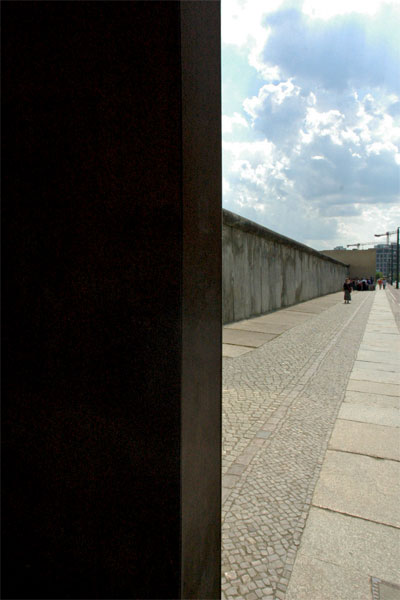
a view of one of a section of the concrete “Grenzmauer 75” (restored to its original condition), and in the left foreground the edge of the steel side wall designed by the memorial architects, the Stuttgart firm Kohlhoff & Kohlhoff, so that the polished surface of one of its sides would give an impression, artistically and optically, of the sheer length of the original barrier, most of which does not survive; the Gedenkst�tte has not yet been completed in its entirety

Mauer_youths_visiting_monument.jpg
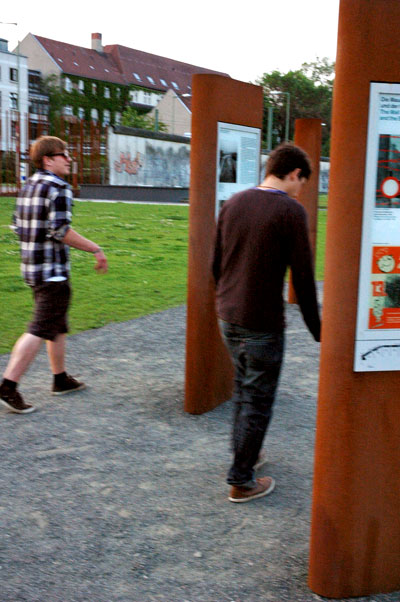
two Berlin youths visiting the still-under-construction Memorial Grounds on Bernauerstrasse, at dusk; we were near them while they watched one of the video screens imbedded in a stele, and when then-B�rgermeister Willy Brandt was seen speaking to the crowd at the wall, only three days after the closure (criticizing what he described as President Kennedy’s empty rhetoric, asserting “Berlin expects more than words. It expects political action”), one of the two uttered respectfully – and affectionately, “Der Willy,” in the way Germans often modify a friend’s given name.

mauer_11_Nov_1989_first_crossing.jpg
an image included in the wall of memorial materials located along Ackerstrasse, about one kilometer east of where this crowd of happy, stunned(?) East Berliners crossed to the West from Eberswalderstrasse into Bernauerstrasse the morning of November 11, 1989, through the first new street opening

More on the Wall, pictures and texts, from German sites, in English:
Germany marks 50 years (Deutsche Welle)
Before and After Photos of Germany’s East-West Border (Der Spiegel)
‘West Berliners Felt Abandoned and Powerless’ (Der Spiegel)

of shirtwaists and straitjackets: labor and Republicans

shirtwaist_names.jpg
Don’t let the Republican barons bring back their “good old days.”

I was downtown on Friday afternoon at the corner of Greene Street and Washington Place, at 4:45, the exact moment one hundred years earlier when a fire began inside one of the three floors occupied by the Triangle Waist Company. In 1911, less than an hour after the fire began, 146 garment workers were dead, most of them young women and girls (the youngest were 14), either from the fire itself or because they had jumped a hundred feet and more to their deaths. The factory owners had locked the exits on each of three floors, to ensure that their hundreds of pawns (600 female workers, and about 100 male) could not leave their work stations, in violation of even the rudimentary safety statutes in effect before the horrific disaster which changed everything. Well, not everything, and not quite overnight.
Also, appallingly, today we see increasingly bold attacks on unions and governmental regulatory authority of any kind, which, if successful, would straitjacket all working people, even Republicans not yet become rich: The party is maneuvering to roll back everything which was won by organized labor in the years after 1911, including both safety and living wage rules.
The Republicans want to be able to lock the exit doors, just like they used to.
The Triangle Waist Company factory fire should be remembered as a tragedy dividing an age of capitalist barbarism from an age of enlightened, direct government interest in the welfare of the governed. Instead today there are ominous signs that it may be remembered as only one more horror inspiring only a temporary improvement in the condition of the powerless.

shirtwaist_funerary_bunting_skirts.jpg
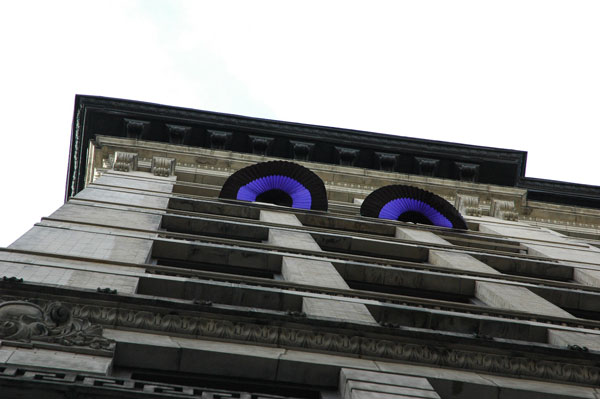
On the 100th anniversary of the tragic – and criminal – fire which engulfed the top three floors of the building which once housed the Triangle Waist Company factory, an installation on the eighth floor, visible from the street below, suggested both funerary bunting and the parachuting skirts of young women jumping to their deaths.

shirtwaist_red_socialist_party_flag.jpg
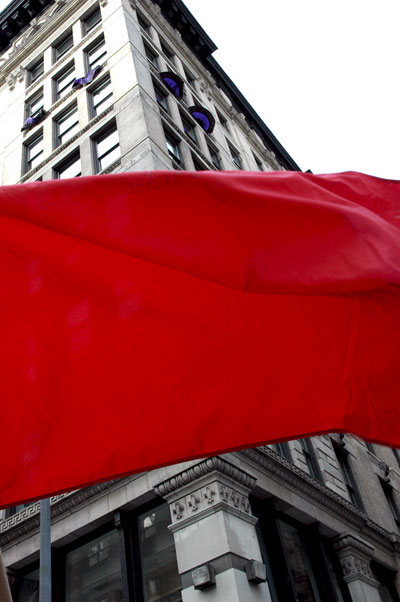
One man, a member of the Socialist Party USA, waved a brave red flag, telling everyone in hearing, “We were there!” He’s right.

shirtwaist_Benjamin_Kurtz.jpg
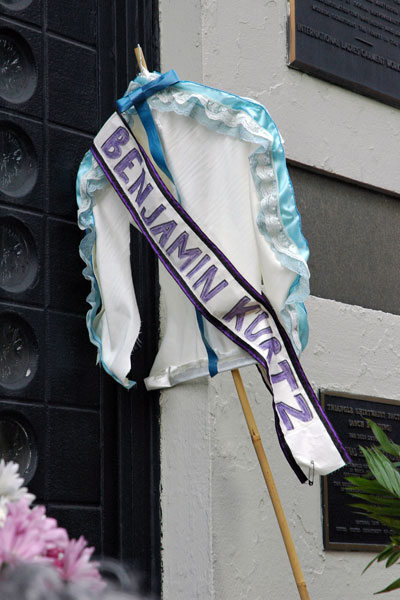
Benjamin Kurtz, 19, was one of the few male victims of the fire, represented here by one of the shirtwaist replicas which was carried to the site in a procession earlier.

Shirtwaist_rosewater.jpg
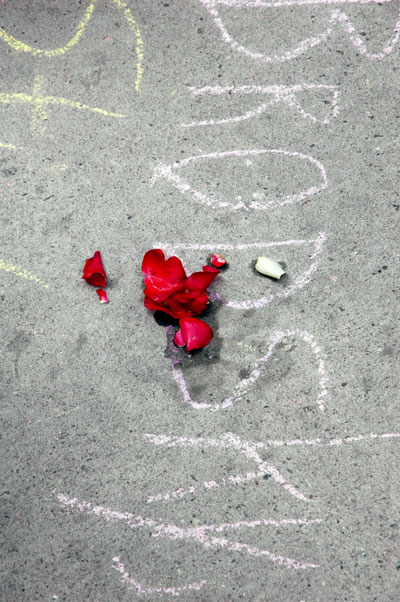
On Friday, one woman in the crowd explained that the most common name among the dead was “Rosie.” She carried a large bowl of rose water and rose petals into which people were invited to dip their hands and caress the side of the building or the pavement.

Wisconsion.jpg
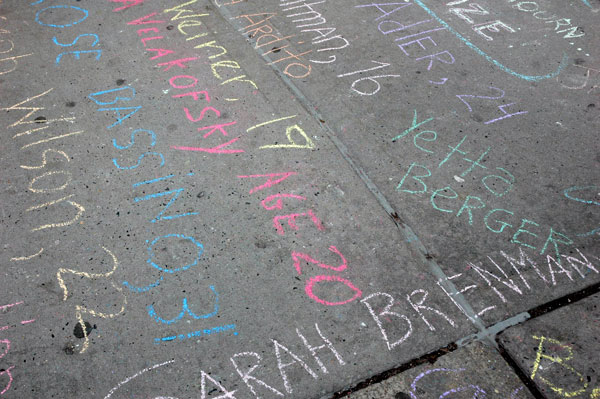
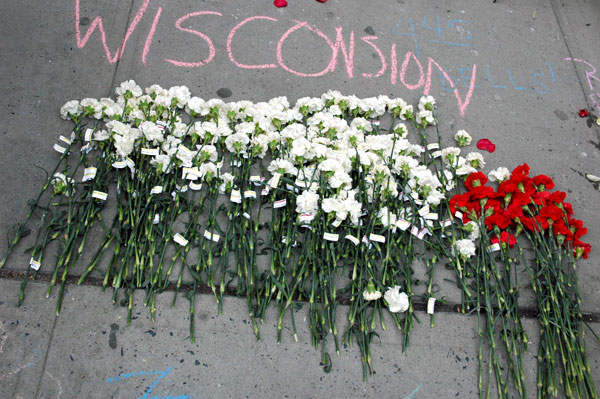
The names of those who had perished had been written in oddly-festive, parti-colored chalk onto the sidewalk, and here the name “Wisconcion” alluded to the unravelling of both hard-fought workers’ rights and industry regulations currently underway in Wisconsin and elsewhere in the U.S. Even in New York today, the sweatshop itself survives.

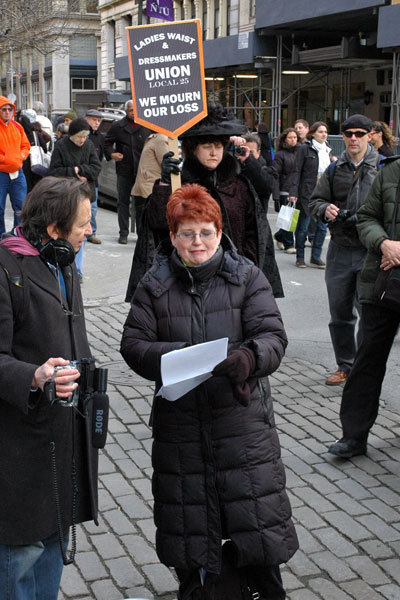
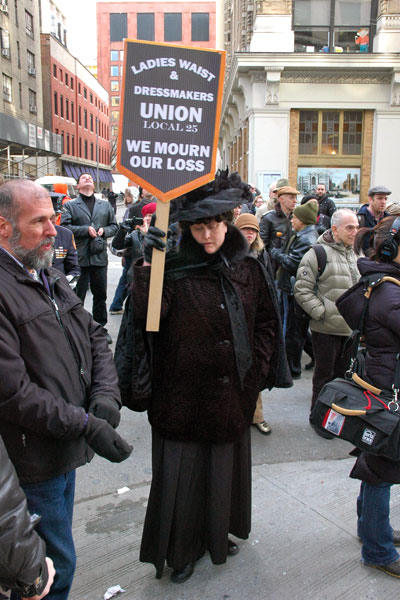
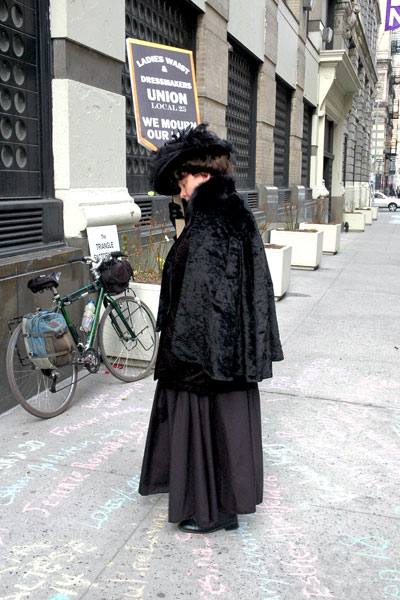
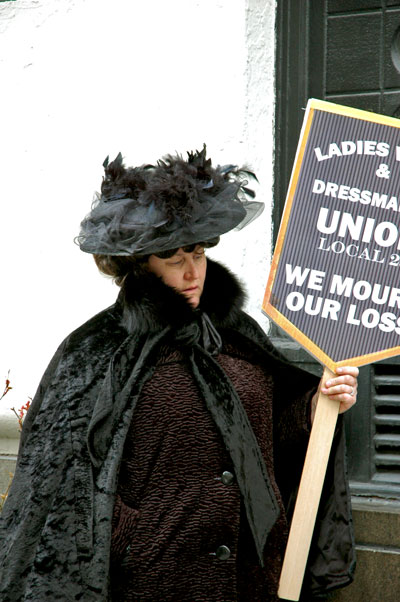
While I was standing about and photographing the group and the visual props gathered on this historic corner, I noticed in the near distance a woman dressed all in black, of brave proportion and stately manner, perfectly-costumed in the manner of a hundred years back. She carried an old-fashioned sign, and moved slowly on the edge of and eventually right through the crowd. At first it seemed that no one else had noticed her, but eventually it was clear she just couldn’t be ignored.
I felt a cold shiver and my knees weakened when I first spied her, and I thought about her heroic models and at least a century of noble antecedents. Did she represent one of the founders of the International Ladies Garment Workers Union (ILGWU) or local 25* specifically, to which the Triangle workers belonged? Since she seemed very well dressed, perhaps she was a patron, like Mary Dreier, Alva Vanderbilt Belmont, Anne Morgan (J. P. Morgan’s daughter), or any of a number of wealthy and influential women who worked to share their privilege with their sisters.
As I was leaving, I heard the sad phantom speak to the crowd for the first time: She began by asking, “Are any of you members of a union?”
shirtwaist_spectre_appears.jpg
Union_patron_appears.jpg
union_patron_looks_at_names.jpg
union_patron_near_wall.jpg

The figure I’ll call our conscience seemed to appear out of nowhere, perhaps with a warning: The robber barons are back.

*
The New York State Archives has this to say about Local 25:

Local 25 [of the ILGWU] was known for its militant members. These members led the famous 1909 Uprising of 20,000 in which workers walked out of the Triangle Shirtwaist Factory. The uprising eventually sparked a widespread walkout among shirtwaist workers throughout the city. Many shops met the union’s demands while others including the Triangle Shirtwaist Factory did not. Strengthened by a post-strike spike in membership, the workers remained active. The tragic Triangle Shirtwaist Factory fire of 1911 further spurred the union’s growth, finally establishing the local’s position in the New York garment industry.

In its account the archive addresses the particularly-energetic radicalism of Local 25. There were communist sympathizers in all ILGWU locals, but the more conservative union leaders, regarding 25 as the hotbed, decided to divide its workers into two new locals. It didn’t quite work, but eventually, reflecting the history of the American labor movement generally, the union was able to keep genuine leftists out of it leadership entirely.

Manning’s torture: preventive war on open government

apache_video.jpg
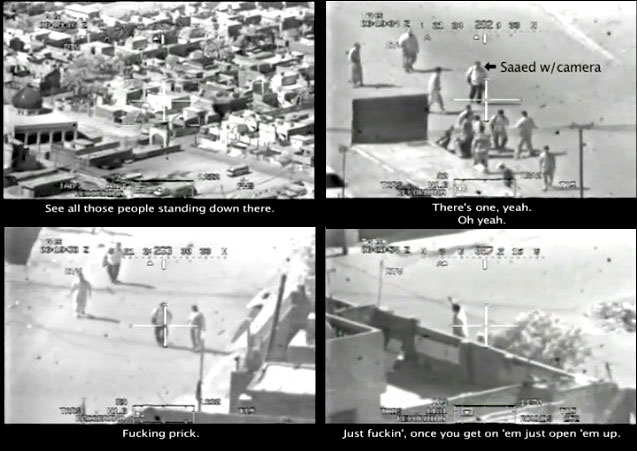
stills from 2007 video posted by Wikileaks showing a US Apache helicopter firing on civilians in Baghdad

Are we doing the government’s own, dirty work?
I just now got it. I’d searched my mind for weeks, probably months, trying to figure out why the U.S. government (and the British terrier) has come down so hard on Bradley Manning and Julian Assange. Sure, no institution wants its endemic practices of deception to be broadcast to the world, and there is no institution more powerful than the U.S. government, but the aggressive offensive it has launched on these two men appears to be all out of proportion to what it might gain from any likely outcome.
While lying in bed this morning listening to the BBC I was pondering if or when we will learn the story behind the UN resolution which approved foreign intervention in Libya: How did the most gung-ho elements in the most gung-ho countries arrange it? That is, how did they ensure that no members of the Security Council would vote nay (including two with absolute veto power)? And why? I mean, what do they think is in it for them? Then, as my mind went back to Bradley Manning’s parlous plight in a Marine Brig,* I realized that we may never know more than we do now; the leaks may have been fixed, the taps plumbed tight.
I don’t think the U.S. has any intention of trying and sentencing either Bradley or Assange. Aside from the fact that it would be too messy, for many reasons (including more revelations?), our entrenched oligarchy, that brutal mob, already has what it wants. It’s frightened the whistle blowers.
This is all part of an full-out war on open government.
The extraordinary damage Manning has done to exposing the lies of the war regime in Washington, beginning shortly before the world saw the Apache helicopter video, can’t be reversed now, but he’s certainly not going to be handing over more evidence. As for Assange, our government doesn’t even really have to have him physically in its hands: The role of the WikiLeaks editor is to hand off to other media, and publish on his own site, information furnished him by others, and even if Assange now has some worthy imitators, anyone who might be thinking of leaking to the public more information about illegal and criminal government acts of any kind will now be reconsidering the cost of acting with moral integrity and fighting for open government. The lesson seems to be: Don’t fuck with the military; don’t cross the bosses. You’re not going to survive the war.
So it would seem to follow that when we write about and demonstrate against what has been done to Bradley Manning we are doing what the anti-whistleblowers want: Warning of the dangers in working for truth and open government.
But that would be true only if they are expected to win, and we can’t let that happen.

*
Manning has been imprisoned without trial, shackled, tortured and drugged, for almost ten months. He was not charged with any crime until 7 months after he was locked up. He has undergone prolonged isolated confinement and total idleness, and he is now forced to go naked inside his tiny cell much of the time and during daily inspections by his guards while standing outside of it. He is subject to sleep deprivation because of repeated nighttime physical inspections, and not permitted to sleep during the day. He is constantly drugged with antidepressants. He is unable to exercise in any ordinary way and never in his cell, but only after being moved to an empty room where he is allowed to do nothing other than walk in circles or figure eights for one hour (or less, if he decides to stop). Manning’s cell has no window or any natural light. He is permitted no pillow or sheets and his “blanket” sounds like it’s a stiff carpet (can’t be fashioned into a noose). He has been stripped of the glasses he needs to read, and is shackled whenever he leaves the cell. No trial has been scheduled. I can’t imagine how he could survive intact as a human being.

[image from BoingBoing]

we’re “good Germans,” Bradley Manning’s the real thing

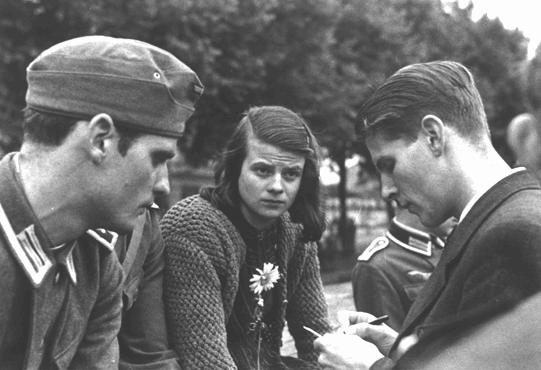
WhiteRose.jpg
surely we can hold ourselves to a higher justice than that which condemned them

The Six core members of Die Weisse Rose (The White Rose), a non-violent resistance group in Nazi Germany, were arrested by the Gestapo, tried and executed in 1943. Some of the male members had been activated for military service and been witness to atrocities, both on the battlefield itself and against civilian populations. The group had become known over the eight months prior to the arrests for an anonymous leaflet campaign describing what the government was doing and calling for resistance. The text of their sixth and final leaflet was smuggled out of the country and copies of it were dropped over Germany by Allied planes.
Today the members of the White Rose and others who opposed the Nazi regime, including those inside the government and the military who revealed the plans of the Nazis to other governments both before and after the war began, are honored as some of Germany’s greatest heroes. They acted from conscience and spoke truth to power; almost all of them paid for it with their lives.
Pfc Bradley Manning is their heir. Having learned about government and military lies, official war crimes, and having even been asked to contribute to them, he could not claim ignorance, or deny his moral responsibility to expose and to put an end to the hypocrisy and the atrocities.
Manning is the real thing.
Manning is a hero, not merely for what he did, which is only what morality and codes both command, but because doing it is still today an exceptional act for anyone within government or the military. He is also a hero because he is being punished horribly for doing it – by the real criminals themselves. Finally, and perhaps most discouragingly, he is a hero because, although he has not been tried or convicted of any crime, most Americans seem to believe he is a traitor, or much worse.
The shy young army private did precisely what all members of the armed forces are supposed to do, and have been instructed to do, at least since the 1946-1947 Nuremberg Trials. Those processes established that the traditional military defense of just following orders, the “Superior Orders” plea, isn’t enough to escape punishment.
These trials established the “Nuremberg principles,” which provided the basis for all subsequent prosecutions, anywhere in the world, for crimes against the peace, war crimes, crimes against humanity, and genocide. They continue to stand even if most Americans do not believe this sort of thing could apply to them. They are encouraged in maintaining this perverted self-deception by their most exalted leaders: When he was asked about the possible prosecutions for American torture practices, our current President says he’s “a strong believer that it’s important to look forward and not backwards.”
In fact, most of us share directly in the guilt for American crimes at home and abroad. We’ve been waging wars on the other side of the planet – shamefully – for almost ten years. My partner Barry ended a 2007 post on American electoral politics: “Americans didn’t exactly reject the Bush administration in 2004, when we had all seen the images of Abu Ghraib, and knew that they had no legitimate evidence of Iraqi WMDs. When Americans . . . say the people of countries like Germany under the Nazis were guilty, what does that say about us?”
Any individual or group choosing to describe and oppose criminal U.S. policy on ethical or moral grounds is without honor in this country today, this in the nation which was so instrumental in destroying Nazism and creating the document which set guidelines for determining what constitutes a war crime. Manning’s experience confirms this.
The most salient muckraker in the country today is now the least visible to his fellow citizens.
Manning remains locked in solitary confinement, ten months after being arrested for allegedly passing a mountain of digital “U.S. secrets” to WikiLeaks. He awaits his kangaroo court. Meanwhile, inside the Marine brig he is subject to no-touch-torture regimens which include being stripped naked each night and forced in the morning to stand outside his cell naked for “inspection.” After the revelations about American prisoner treatment over the last ten years, I think we know what that’s all about.
Meanwhile the real criminals, inside government, corporations, or the military, are free to continue the practices which were the subject of Manning’s whistle-blowing (no 5 am naked inspections for them). Those at the top have flourished and become rich, but those who would point out their crimes are ignored, punished, or imprisoned (and in at least one extraordinary case, fired for speaking out).
Ours may be the least responsible government in the West. Its elected (a generous adjective) officials do not pursue even in the most general terms the policies which the voters enjoin on them, and the mainstream media doesn’t cry foul. It’s the height of idiocy for citizens of a modern republic to believe in the first place that they could trust the paid officers of an unrepresentative and irresponsive oligarchy to know what is best for them, but to permit them to properly administer the affairs of the citizenry in secrecy is more dangerous still. The secrets, in any event, belong to the people. Bradley Manning is the agent of their retrieval. He is our tribune.
We know that as a nation we’ve been bad, very bad; an impenetrable cocoon of silence at the top means that no one with any political power will admit it; but worst of all, too many “good Americans” also refuse to admit that we might be guilty of anything.
Surely we’ve never engaged in optional wars, tortured the state’s “enemies,” or killed incalculable numbers of innocents in the nations we’ve invaded. Nor have we enslaved many of our own people, or placed others in concentration camps solely on the basis of race, and we’ve never corrupted our own constitution or judicial systems in the name of “national security.”
Or if we have done those things (we have, and we’re still doing some of them today), maybe we stay silent because we didn’t do them on a Nazi scale. Or maybe it’s because we think our shit don’t stink.

David House
David House is Manning’s support team. He is a friend, and a computer scientist now a researcher at MIT, who visits him in jail twice a month, one of the very few people permitted to do so. On December 23, 2010, House appeared on MSNBC’s Dylan Ratigan Show, guest-hosted by Jonathan Capehart, to describe his latest visit. I transcribed a section of his statement in a video shown on Firedoglake (FDL), specifically, Firedoglake TV:

After commenting that there are laws protecting whistel blowers in the United states, Capehart asked House, “Do you think Bradley Manning did anything wrong?” He replied: “If the allegations against Bradley Manning are true, I think he is an ethical giant of our generation. I think perhaps in this case America has judged him in the press much too quickly, and we should really reconsider why we keep alleged whistle blowers locked up in solitary confinement.”
When he was asked if he holds Assange resposnsible for the situation in which Manning finds himself, House responded that he would have to have information about whether they had a relationship, adding that all information to that effect is coming out from one very unreliable source [Adrian Lamo]. “So I don’t think that’s something I could speculate on now.” Capehart then suggested they talk about House’s thoughts on what Assange has done with the information that he has released via WikiLeaks. House: “So I think that the underlying principles of the WikiLeaks organization are actually principles which are very much in line with most American ideals, the principles of open government, the principles of government transparency; so at least from an abstract, 30,000 foot perspective, I think the actions of WikiLeaks are very much in line with the principles of the American people.

I can’t imagine a better spokesperson. House is awesome.

EXPOSING WAR CRIMES IS NOT A CRIME!, reads the banner on the home page of the Bradley Manning support site. There are demonstrations of support planned for Manning all over the world tomorrow, March 20. The site has information for all of them. The gathering in New York will be at 2 pm in Union Square. Clothing optional.
Jay+Marx+Supporters+Army+Pfc+Bradley+Manning+7Jd5U-Tuvs6l.jpg
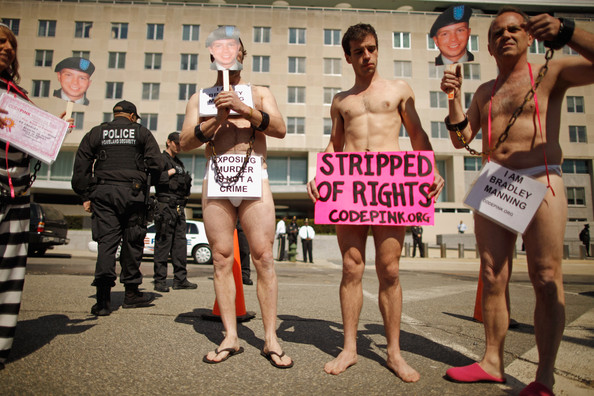
supporters of Army Pfc Bradley Manning at a rally at the State Department March 14th
(SF activist Logan Price, in the pink sign, writes on FDL about why he got naked)

APPENDIX I: Manning was, and still is, a very young man (only 21 when he first started transferring classified data into his personal computer). He was not a sophisticated undercover agent. It seems to me that he was in the place where he found himself, where he had incredible access to government documents, because he was smart and because he was a techie, in fact a computer geek. I also can’t help noticing that, since Manning is gay (openly for I don’t know how long), the army may have chosen neither to ask nor to tell; there just may not be enough straight men who answer that description and are also willing to serve their country, as Manning was when he enlisted (and is now more than ever, as we see). But all of that, including the impact upon Manning’s story of DADT is the subject for another discussion altogether.

APPENDIX II: [This account of how Manning met House is taken from the Wikipedia entry for Manning] While he was at Fort Drum in New York, Manning regularly traveled to the Boston area to visit his then boyfriend, Tyler Watkins, who was studying neuroscience and psychology at Brandeis University. At Brandeis he “was introduced to Watkins’s network of friends, and the university’s hacker community, as well as its ideas about the importance of information being free. He visited the university’s “hackerspace” workshop, and met David House, the computer scientist and MIT researcher who has been allowed to visit him in jail twice a month, the only person apart from his lawyer with permission to do so.”

[first image from Wikipedia, the second from Jay Marx’s Zimbio photostream]
Armory Arts Week 2011, a few personal impressions

Dependent_New_York_Fine_Arts.jpg
The Dependent, where boundaries blurred (here the New York Fine Arts room)

I’ve found my art fair. “Armory Arts Week” worked this year: Institutions often don’t age any better than people, and maybe the secret of life for old art shows is in the spawning of the new.
The Armory Show itself was, well, armorial, although there were pockets of real humanity.
Independent, which was such a hit last year on its first outing, was definitely more cerebral than both the Armory itself and even its own first manifestation. But there was little eye candy or energy, and it felt surprisingly stiff and corporate. I’m certain many individual conceptual projects would open up if only I could hang around some more, but on a frustratingly-short weekend of compelling attractions there’s almost never enough time.
Speaking of candy, Daniel Reich hosted a modest, slightly roguish party inside his gallery on Friday afternoon. A salute to the 60s and the current gallery installation, Jack Early’s Ear Candy Machine, it included continuous live music performances. it will probably remain one of my personal highlights of the week, and only partly for its odd folksy character (and Daniel’s inimitable conversation).
The Dependent was the event I had most anticipated since I first heard about it, and I wasn’t disappointed. Last night the Gramercy Fair (The Gramercy International Contemporary Art Fair), the 1994 progenitor of the modern Armory Show, was resurrected for a few hours. This was no sterile reproduction however, but a brilliant, exciting original. On the basis of the magic created last night, may have already created its own legend. It was “let’s put on a show,” and the results were pretty compelling, beginning with the contagious enthusiasm of the crowds on both sides of the “proscenium,” and continuing through the marvelous blur of boundaries between art, environment, artists, viewers and listeners. The dozen or so exhibitors were given one hour to arrange their installations inside an equivalent number of smallish rooms (inside the Sheraton Hotel on West 25th Street) before the doors were opened at 4 pm. The show was supposed to end five hours later, but the crowds were still lined up outside when we left at nine o’clock.

the 2011 Egyptian Revolution: end of colonialism?

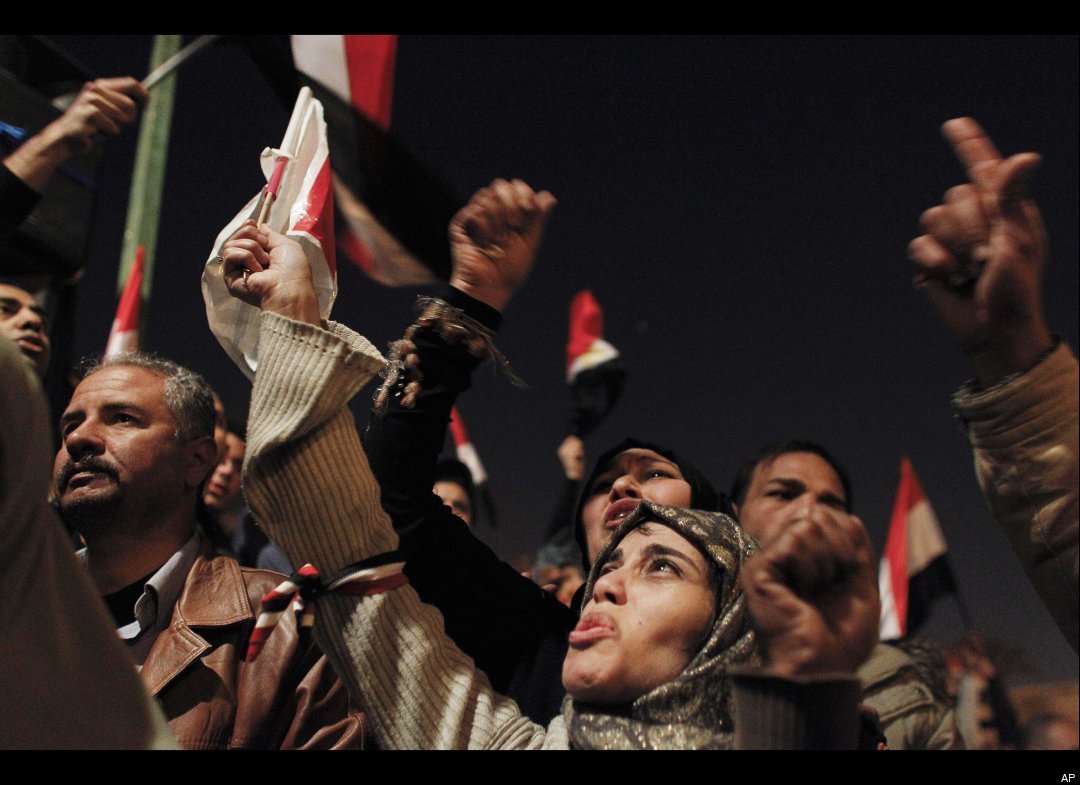
Cairo_crowd_Mubarak_gone.jpg
today in Tahrir Square, “Egyptian people greet selves as liberators”*

While the victory of the Egyptian people is a major problem for authoritarian governments throughout the Middle East, it’s a bonanza for virtually everyone else, one which could be world-changing: Last night I heard Ayman Mohyeldin, speaking on Rachel Maddow’s show (before the announcement of the resignation of Mubarak), say that their success was Osama Bin Laden’s worst nightmare:

It might take a day or two or a week or two. They have already won. But this scene of winning peacefully the way they have, this is Bin Laden’s nightmare. What we’re seeing here is Bin Laden’s nightmare.

If the Egyptian protests are copied elsewhere, and successfully, it would not only put Bin Laden out of work, it would put an end to his and others’ hopes for the world governed by Sharia law which they envision.
And President Obama couldn’t see that? Actually, he may still not see it.
I propose that even now the Egyptian Revolution may be viewed by our own government as a disaster, regardless of the tardy words of support and congratulation coming from Washington. Mohamed ElBaradei, in an Op-Ed piece published in today’s New York Times, also before Mubarak’s resignation, makes this comparison:

The United States and its allies have spent the better part of the last decade, at a cost of hundreds of billions of dollars and countless lives, fighting wars to establish democracy in Iraq and Afghanistan. Now that the youth of Cairo, armed with nothing but Facebook and the power of their convictions, have drawn millions into the street to demand a true Egyptian democracy, it would be absurd to continue to tacitly endorse the rule of a regime that has lost its own people’s trust.

The Americans in possession of enormous power and access to the ordinary taxpayer’s money (or mortgaged futures) did not engage in these foreign wars in order to bring about the kind of world which the peaceful and triumphant Egyptians are about to carve for themselves after over half a century of military dictatorship and heroic exertions over the past weeks. It’s hard to imagine even the least astute of our dull politicos having any illusions about the efficacy of Imperial American war policies in planting freedom and democracy by force and intimidation.
I’m often tempted to think of almost all of our post-war foreign policy as just a game played by boys who never grew up, but it’s probably more useful to understand it as the work of a military industrial and media complex, in it for the money and the power; its lip service to freedom and democracy was always cant, and talk of a communist, and later a fundamentalist threat, only a cover.
May the Egyptians now safely secure the awesome accomplishment of popular revolution – and incidentally save Americans from themselves.

*
The phrase in quotes was tweeted by David Waldman today, in negative tribute to Dick Cheney’s 2003 prediction that the Iraqis would welcome us with open arms and greet us with flowers (or some such words) when we invaded their country.

[image (uncredited on the site) from Huffington Post]