
I never thought we’d still be doing this 20 years on. The image above is of a thin stenciled sign I held up on the steps of the Metropolitan Museum of Art August 1, 1989.
I thought of it as a work of art; I was thinking of both the sign and the afternoon.
I didn’t make the sign. Along with a lot of others just like it, and any number of other images and texts, it was a small, elegant part of a powerful New York demonstration protesting the Corcoran Gallery of Art’s cancellation of the D.C. exhibition of the show, “Robert Mapplethorpe: The Perfect Moment” and the Helms Amendment. The amendment was designed to prohibit the National Endowment for the Arts (NEA) funds from ever being used for so-called “obscene” or “indecent” materials, descriptions that at the time had repeatedly been applied to much of Mapplethorpe’s art, and to that of Andres Serrano, who had also become a target in what was being called the American “culture wars.”
While the artists attacked became more famous than ever, neither the NEA nor our other cultural institutions ever recovered from the assault on their artistic integrity and independence. I’m reluctant to employ the war metaphor (we’re going off in every direction with real wars already), but I think most people would say that, whatever it is called, a fundamental culture struggle continues today: There are too many frightened people in this country, and too many anxious to profit from that fear.
Bill Donohue is a vile and disgusting little opportunist with a computer and a fan base which he regularly whips up to get them to send checks his way. A retrogressive darling of the crazy Right, he invents issues and targets which can attract enough visibility to provoke the fears and hatreds of ignorant older Catholics, allowing him to draw a very generous salary of some $400,000 a year. His primary targets are gays, jews, women, progressives of any kind, and all news media (excepting the just-pretend one, Fox).
While Donohue does not represent the Catholic Church, officially or otherwise, he operates within its comfort zone. He may be the crazy ranting uncle everyone would like to ignore, but the Church hierarchy has never disavowed anything he has said; and they all go to the same banquets.
I thought that the kind of primitive depravity he represents had been pretty much squished twenty years ago, but on the 1st of December, which was, whether incidentally or not, World AIDS Day, the head of the Smithsonian, institutional parent of the National Portrait Gallery, pulled the David Wojnarowicz video, “A Fire in My Belly.” from the excellent NPG exhibition, “Hide/Seek,” and apologized for its contents. The show had already been open for an entire month when complaints from Donohue’s Catholic League, several Right-wing House Republicans, and Fox News [sic] resulted in its peremptory censorship, or debasement.
So we have a professional gay-bashing Catholic fanatic leaning on two fellow political and social fundamentalists, House Republicans John Boehner and Eric Cantor, to blackmail a great museum by threatening to cut its funding if it did not remove a work of art to which the Catholic nut objected. Viz. ants on a crucifix. We know it’s not about ants: Donohue and his own coterie are unhappy about everything that has happened in the West since the suppression of the Spanish Inquisition. His Republican fellow-travelers may be in it for power, but their sympathies may actually be sincere, however warped.
I hate to do anything to give more visibility to Bill Donohue, or his Congressional altar boys, but this madness has now been covered by the media everywhere, and roundly condemned in as many places, and the Smithsonian has so far failed to reinstall the art it was so anxious to agree with the nasty little man was offensive.
PUT IT BACK – NOW!
A lot of people are going to be on Fifth Avenue this Sunday demanding that the Wojnarowicz video be returned to the National Portrait Gallery. We will be demonstrating as colorfully and dramatically as we can that we care about censorship and homophobia.
We have to be there, at one o’clock on the steps of the Met, Fifth Avenue and 82nd Street. And why the Met? Because it’s the front porch of the art world, because there’s plenty of space and a grandstand of sorts. From there the group will march up to the Cooper-Hewitt Museum, which actually is a part of the Smithsonian.
The 1989 demo included the ACT UP group “Art Positive” (broadcasting a double meaning for the second word); the primary target then was homophobia and censorship. The 2010 demo will include members of the 1989 collaborative, and the entire demonstration has been designated “ART+” (only a slightly altered written form of the 1989 name); the primary target is essentially, and shockingly, the same, homophobia and censorship.
But since we’re talking about the public treatment of work by an artist closely identified with a disease which as a nation we still haven’t fully confronted, the subject of AIDS must not be left out of the discussion. Silence does equal death.
Finally, because we are dealing with people identifying themselves as representing the interests of the Catholic Church, we also have to understand that the targets of their assault necessarily include all women everywhere.
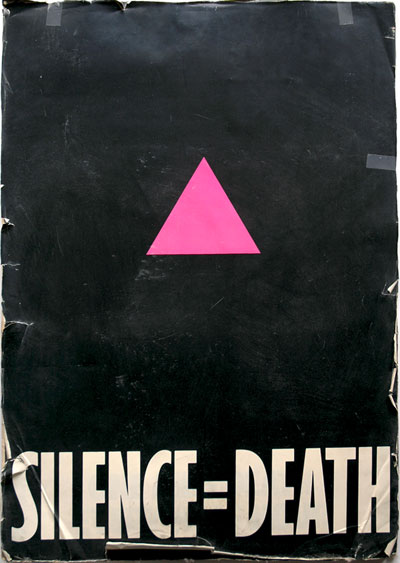
And there’s more: America’s continuing failure as a society to deal with what it thinks of as the very scary subjects of sex and art (and not only when they are combined, or ignited by the inclusion of AIDS) is inseparable from the ignorance and fear which prevents it from addressing our newest, and rapidly-mushrooming real problems.
In this country the public conversation always gets back to religion (if it ever leaves it in the first place). Organized and intensifying public religion gums up the works of virtualy every institution and increasingly ties our hands when we have to deal with impending national and planetary disasters. We may never grow up enough to understand the damage it has done and continues to do, but there’s a slim hope that a larger percentage of the next generation will be able to think for itself.

For more information on the censorship outrage:
ART+ [the demonstration site]
Modern Art Notes [Tyler Green – one of many posts]
NEWSgrist [Joy Garnett – see many posts]
Diamanda Gal�s [Washington City Paper, Arts Desk]
[the second image is of a slightly-battered veteran ACT UP foamcore-mounted sign which spends its retirement leaning on a wall in our apartment, a constant reminder; the third photograph includes, in addition to the Sontag volume and an old ACT UP “Stop the Church” button, the cover of “Seven Miles a Second“, a posthumously-completed graphic novel written by Wojnarowicz in collaboration with James Romberger and Marguerite Van Cook, and a small globe turned toward Africa]
Category: History
downtown “Dream Hotel” shows off its portholes
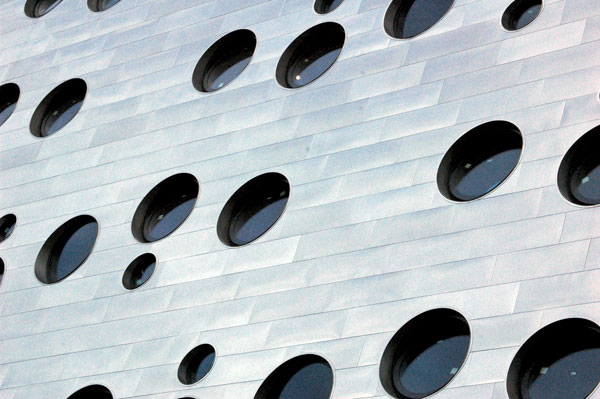
Because I believe so strongly in preserving an interesting building’s integrity, and an artist’s vision, I find it hard to say this, but what’s happening to the building that once housed Fr. Bruce Ritter‘s Covenant House shelter for homeless and runaway youth may just possibly be an improvement over the original concept – and execution.
I’ve now seen what looks to be the almost-finished “Dream Hotel Downtown” of hotelier Vikram Chatwal, located at 346 West 17th Street. It is a refitting of a building designed and constructed for the Maritime Union half a century ago to accommodate medical and recreational facilities for its members. The 11-story building is located behind the re-conceived Maritime Hotel, and both eccentric structures were designed by a young architect named Albert Ledner.
I remember the buildings when they were new, and the excitement they created, and I’m delighted that at least two of this architect’s trio of Village commissions has survived at all.
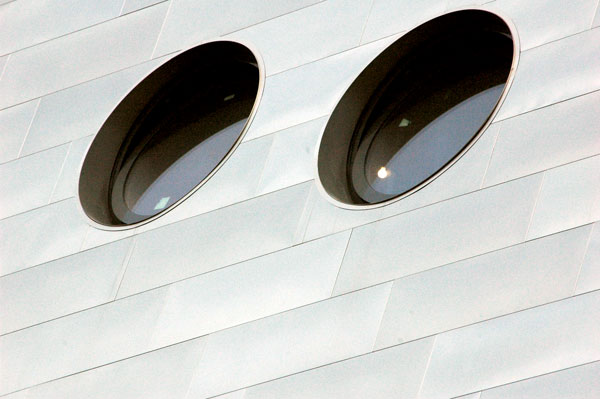
I say that the new building may be an improvement because, while I’ve always loved its perfect round windows, along with their beautifully-crafted frames and hopper-like opening mechanisms, the new dancing pattern punched out by the current design team, Handel Architects LLP, in two different sizes of openings, really makes me smile. Also, the building’s original tiny ceramic tiles were replaced by stucco years ago, probably because of problems inherent in the materials, and the way the horizontal lines of the (tile-like) rectangles composing the new shiny (hull-like) metal skin wrap around the tilted corners of the main facade, and dip down along the sides, showcases a very different effect, one at least equal to the 1960’s original.
The overall building shape remains unchanged.
Now if only somebody would change that name: “Dream Hotel” scares me silly.
NOTE: Except for its romance-novel appellation, I think I could love this building, but now I’m wondering if it’s already a doomed affair: While looking for additional information on the building’s design and construction, and searching, sometimes fruitlessly, for links to incorporate in this blog, I got the impression that the project may be on hold. There are some indications that the “dream” may be trouble, because of problems related to money, the health of the principal, or (perhaps the least daunting challenge) engineering problems, and I notice that the hotel web site itself is still “under construction”.
Saint-Gaudens’ “Hiawatha”, and Manifest Destiny
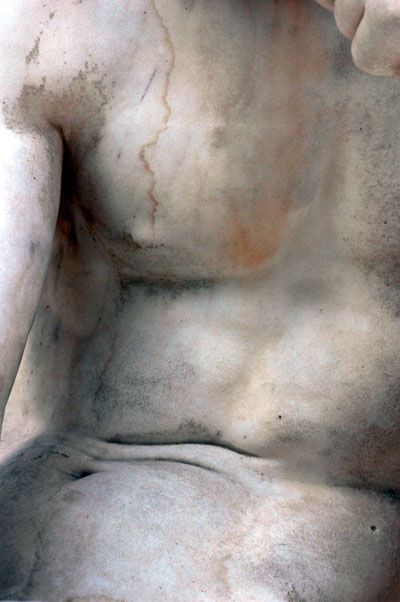
Augustus Saint-Gaudens Hiawatha in clay, 1871-1872; this marble carving, 1874, 7 feet 9 inches high, including pedestal [detail]
Barry and I were leaving the Metropolitan Museum cafe in the American Wing yesterday when we passed the Saint-Gaudens marble “Hiawatha”. I must have passed it any number of times before, but now I found myself zeroing in on the beautifully-modeled torso of this noble young man, created by an artist who was only about 23 himself when he began the work in clay. Then, thinking about the date, 1870, I thought about the time and geography of the work’s origins.
In the very midst of the beginnings of the last segment of our protracted Indian wars, a very young Augustus Saint-Gaudens, fled Paris, where he had studied for three years, on the outbreak of the Franco-Prussian War. He settled in Rome in late 1870 where he began work on “Hiawatha”, his first full-length statue. His inspiration was the legendary Chippewa chief and founder of the Iroquois confederacy who was the main protagonist in Henry Wadsworth Longfellow’s enormously popular 1955 poem, “The Song of Hiawatha“*.
In 1870 Saint-Gaudens’ native country was still nursing the wounds of the Civil War; France and Germany were engaged in a duel which quickly realized the end of one empire and the birth of another, both with enormous consequences which continue today; the Italian army had crossed the papal frontier (finally completing the wars for unification), in the same month the artist arrived in Rome. Saint-Gaudens however was otherwise engaged.
The War Between the States may have ended (he had been too young to participate), but there was hardly going to be any peace on the other side of the Atlantic, where twenty more years of wars directly impacted – in fact completely devastated – the people represented in his early masterpiece.
Americans were eager to settle the lands which had been opened up in the west, and Civil War veterans, adventurers and misfits were volunteering to secure their right to be there, defending it from the legitimate claims of the peoples we were already making into legends and heroes. The United States was determined to fulfill its own peoples’ “manifest destiny” and would not allow what remained of native American civilizations to stand in the way of its claim to the “Land of Many Uses“. In spite of occasional sensational – and hugely popularized – news events like “Custer’s Last Stand”**, the full horror of these last Indian Wars was largely removed from the consciousness of Americans back east, much as in the case of our own wars today.
It was all over by 1890: Providence had made the entire country safe for the American Empire, but the devil had taken the hindmost; the Indian was now almost gone, and almost forgotten, except where and how it served the victors to remember him.
But it is a beautiful statue.
*
The fame and legend attached to both the poem and its subject continued well into the 20th century: I remember my class being told in grade school to memorize the trochaic tetrameter of this Longfellow poem, and we barely questioned the assignment (I never got beyond a few stanzas).
**
When my own family drove west in the big Buick on a long vacation 55 years ago, the Little Big Horn ranked extremely high on our own list of “must sees”, and in fact, I’ve never forgotten my impressions of that sad, and then still very desolate, little-visited place.
“The Voyage of Garbhglas” at the Irish Hunger Memorial
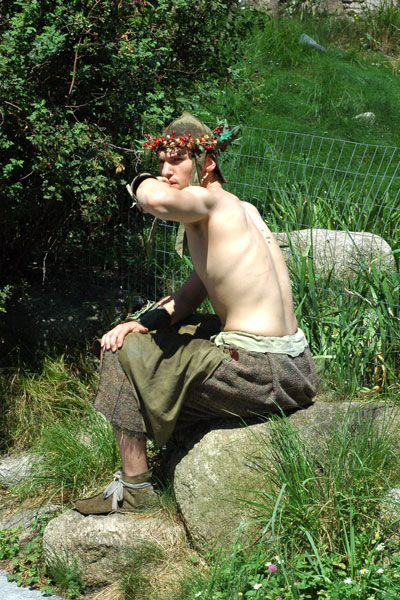
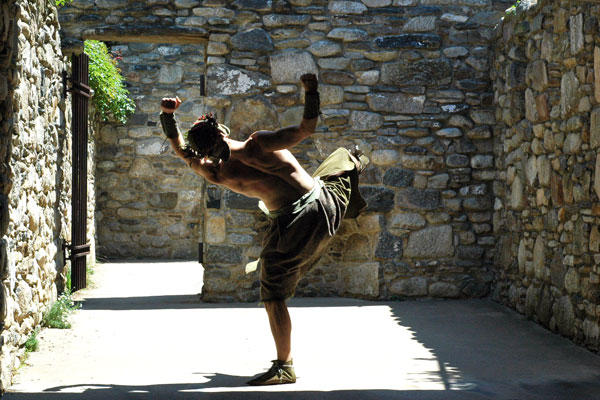
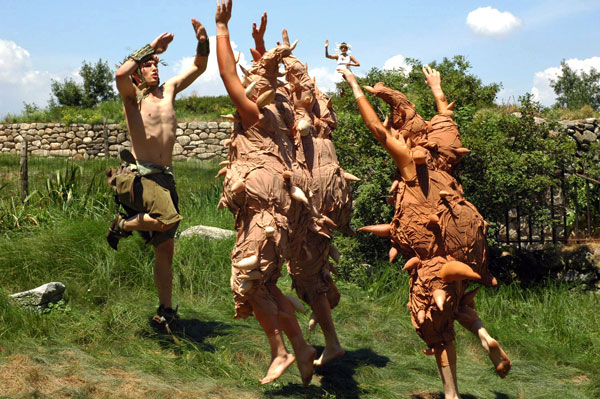
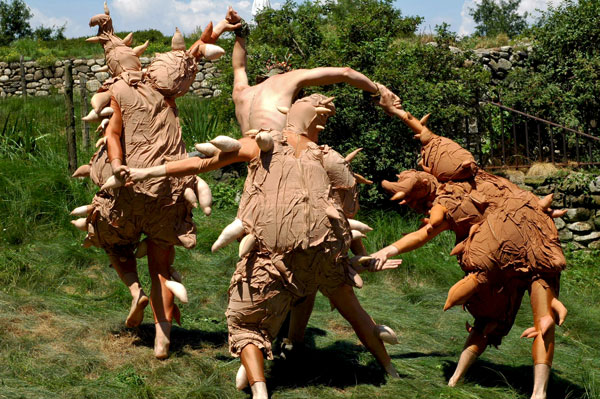
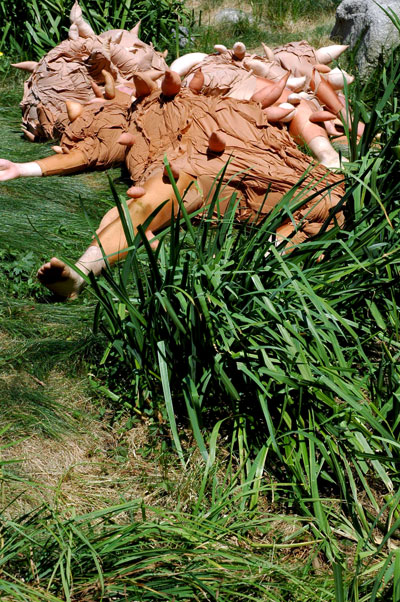
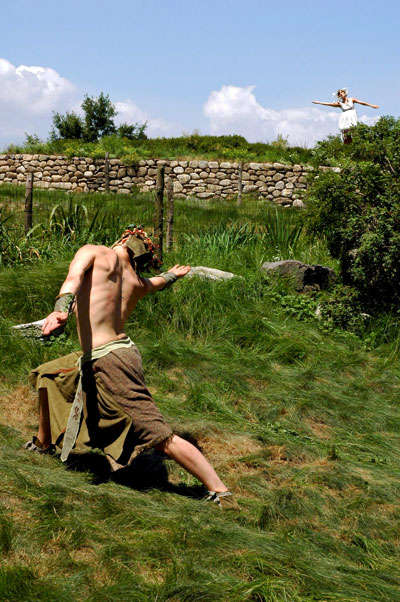
Barry and I headed for the Irish Hunger Memorial shortly after noon on Monday (after my visit to City Hall Park) to see an excerpt of “The Voyage of Garbhglas“, choreographed by Christopher Williams and presented, courtesy of the Lower Manhattan Cultural Council, as a part of the River To River Festival.
It was a total delight, a magical allusion to ancient Irish faerie lore performed in a magical Irish place on a beautiful afternoon, and I recommend it to anyone who can make downtown for the two performances remaining, Wednesday and Thursday, at 12:30 each day. The Memorial is located inside Battery Park City, 290 Vesey Street at North End Avenue, an easy, almost straight walk west from the World Trade Center stop of the E train.
The performers were Ursula Eagly, Kira Blazek, Caitlin Scranton, Michael Ingle, Sydney Skybetter, Moses Kaplan, and Andrew Smith. I believe Michael Ingle was the celtic youth, and the three other male dancers were what I’ll call “the tubers”. Christopher Williams himself and Matthew Tutsky played troubadour harps of different sizes, and the music was by Gregory Spears, who can be seen in some of the images directing the singers.
Barry has posted a video, on Bloggy, of a short segment of the 30-minute performance and has a link to his Flickr set.
As someone who tries to take advantage of what New York has to offer culturally, I think a lot about how everyone who would like to see art in performance (in any medium) can find a way to do so without having to deal with discouraging lines, fifth-balcony-in-the-rear seats, or even sold-out notices. In my own case it helps that I’m usually interested in work that most people are unlikely to even be aware of, and I’m lucky to have the leisure to seek it out. But what happens when something really good becomes well known, and suddenly everyone wants to see or hear it?
I was considering this subject with Barry when we left the performance of “Garbhglas”. His answer was that the ideal would be that there would be so much art out there, and really good art, that there would never have to be a line or a crowd. We’d all have so many options that we wouldn’t have to keep bumping into each other, or fight for tickets. Of course that ideal assumes we all think and feel for ourselves and aren’t seduced by the inevitable hype – including, I suppose, in this case, my own modest efforts at making a ballyhoo.
This time the subject had come up because in Monday’s surprisingly intimate, georgic performance by Williams’ dancers and musicians, while everything took place outdoors, it seemed that there was really room on the Memorial’s platform for only about a hundred people to fully experience it, not including whatever the numbers were for those standing on the street below.
While I imagine there must be other things to do at lunch time Wendsday and Thursday, if you go, maybe it wouldn’t be a bad idea to plan on getting to “Garbhglas” early for its final two performances.

Costa Rica followup: Monroe Doctrine means it’s all ours
America’s backyard
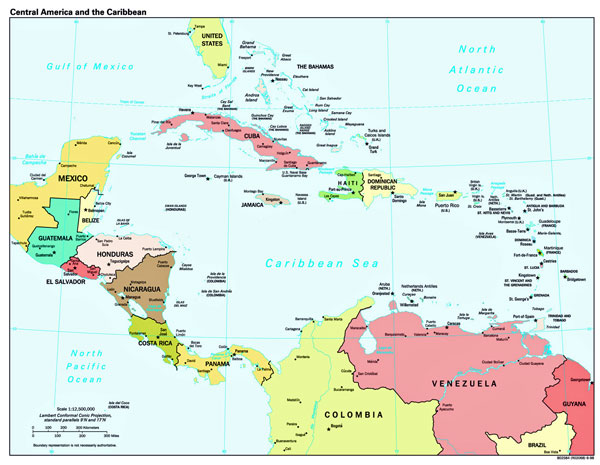
We still haven’t heard one peep from the commercial media/entertainment news corporations (even the simple fact that something’s happening), but Mark Vorpahl has written an articulate and persuasive description of what’s really behind the U.S. flotilla en route to the southern Caribbean (Mare Nostrum, or our “Fourth Shore”), “The U. S. Military Moves Into Costa Rica“.
I am entirely in agreement with his conclusions. Anyone who would prefer not to be completely surprised by another shooting war, or the next U.S.-backed coup attempt, should read what he has to say.
An excerpt:
Most of these measures [recent U.S. military operations in Central and northern South America] have been justified on the grounds of combating drug trafficking, including the military buildup in Costa Rica. However, they have not curtailed this problem at all. Such U.S. military buildups have generally been accompanied by an increase in drug trafficking, as has happened in both Columbia and Afghanistan. Based on this record it can only be concluded that the “War on Drugs” rationale is a red herring for public relations consumption, not the actual motivation.
This military build up in Costa Rica is the latest in a series of moves the U.S. has made in Latin America that seeks to use threats and arms to reverse the strength of popular anti-imperialist forces across the region. The U.S. is playing with the possibility of erupting a continental conflagration for the sake of corporate profits.
While it is doubtful that the U.S. wants to directly engage in a military conflict with, most likely, Venezuela right now, preparations for this possibility are being made. What is more likely in the short term is that the U.S. military will use its forces to engage in sabotage and intimidation in hopes of reversing support for the nations aligned with ALBA. It is also very possible that the U.S. military will help to support proxy armies, such as Colombia’s, in military conflicts that align with U.S. interests. However, this is a dangerous game. Even in the short term, the U.S. ruling class may drag the nation into another direct conflict, in spite of their intentions, that could spread to involve numerous other nations.
[image from Map of the United States (the irony was not likely intended)]
Costa Rica asks for U.S. invasion; U.S. media silent

Coca (Erythroxylum coca)
ADDENDA:
This extended discussion on Upside Down World, published July 15, includes a statement that the idea of the U.S. military presence did not originate in a request from Costa Rica; rather it was initiated by the U.S. in a diplomatic request from the US Embassy made on July 1.
Also, in its own post on the Costa Rican story [in Spanish, but easily translated], the Comisi�n Intereclesial de Justicia y Paz describes the operation as “continuing the process of the militarization of Central America” and refers to it as a part of the continuing U.S. agenda for Latin America, which has recently seen the establishment of seven bases in Colombia, intensified militarization in Honduras and Haiti, the announcement of new bases in Panama.
On July 2nd the Congress of Costa Rica authorized the entry of 46 U.S. warships capable of carrying 200 helicopters and warplanes, plus 7,000 U.S. Marines “who may circulate the country in uniform without any restrictions”, plus submarine killer ships, to the Costa Rican coast for “anti-narcotics operations and humanitarian missions”.
Where’s the outrage? Actually, where in fact is the news?
I have not found a single line on this story anywhere in the MSM.
I think the media silence is probably the first thing which should be questioned (have we all, including the world at large, become inured to yet another attestation to the expanding American imperial lust?).
But I am just as shocked by the news itself. Why is this happening?
Is it because we’ve done so well with both our former and continuing foreign wars and interventions? Is it because we’ve done so well with our internal war on drugs, or because our impact on the drug traffic in other countries has been so benevolent?
Or does it actually have nothing to do with interventions, or drugs? I’d like to hear from people who are familiar with Costa Rica and have followed the events about which we currently hear nothing.
So far Costa Rica is only asking for “help”, but remember how “helpful” our innate imperialist impulse has been elsewhere for two centuries. I can’t imagine why any Latin American country would actually welcome the arrival of the U.S. military, unless of course there were banana kings running things at the top, or at least a right-wing regime, and they/it were worried about losing control. Oh, wait, bananas are still a major Costa Rican export, and the government, while enlightened, is still composed of members of an entrenched oligarchy, and by most accounts its biggest concern lately has been “security”.
The current president, Laura Chinchilla Miranda, who follows the modest centrist welfare policies of the National Liberation Party and promises to continue the free-trade policies of her predecessor, �scar Arias, is a social conservative who opposes abortion and gay marriage. But, more significant to the story of her nation’s call for U.S. Military help, she ran on a platform which promised to be tough on crime, and it included a larger and more professional law enforcement establishment. Sworn in two and a half months ago, one of her first acts was to create the nation’s first anti-drug “czar”, whose office is a part of the cabinet.
For half a century Costa Rica had enjoyed peace and political stability, and, overall an impressive growth in economic prosperity and social welfare systems, but beginning in the 90’s the country began to witness the rise of its own version of American neo-liberalism, which threatens the moderate socialism built up in the previous decades. It all sounds very American to me. The only thing missing was a security panic of their own and an indigenous drug war, and they’ve just ordered both.
But not everyone in Costa Rica is happy.
For a good discussion of the issues (with some reservation about a mostly-irrelevant postscriptive remark about the brave and unselfish volunteers in uniform), go to Costa Rica Blogger.
[all thanks to artist Pedro Velez for the Comisi�n Intereclesial de Justicia y Paz post alert]
[image from Wikipedia]
gay or black in the garden state: is it still 1953 in NJ?
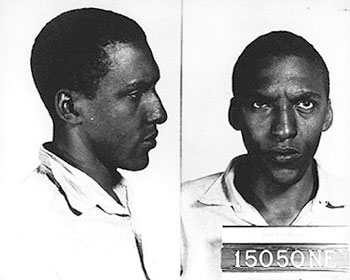
Bayard Rustin’s 1953 mug shot*
The CEO of an Atlanta credit union, on a visit to New Jersey for his 30th high school reunion, has been shot and killed in a Newark park by an undercover policeman. The alleged sex-related incident ended in the senseless death of an unarmed man, DeFarra Gaymon, a successful businessman and a married father of four.
The official explanation, delivered by the acting Essex County prosecutor (that the officer, trying to arrest Gaymon for lewd behavior, had fired in self-defense), makes no sense, and even if the pieces could be fitted together they suggest a world I thought had disappeared decades ago: I remember what many urban parks looked like after dark half a century back, I know that the police played them for sport, and I know the combination could destroy lives, but it’s now 2010. This Essex County park is located in a state which by most accounts ranks at the very top in the nation in laws extending equality and civil rights to both the gay and black communities (yes, the victim was black), and I thought we now had better uses for our constabulary – and that we could still afford real uniforms.
Actually, 57 years ago Bayard Rustin got off much easier than DeFarra Gaymon, whatever the unfortunate Atlanta businessman was doing in the park last Friday night.
According to the New York Times story, “The officer, whose name was not released because of his undercover work, had been on what is not usually a particularly dangerous assignment, scouring the park, in northern Newark, for men seeking sex.” The Times also tells us: “The officer and his partner were patrolling the park in plain clothes, part of an operation that has been going on for years, said Mr. [Robert D.] Laurino, the prosecutor.”
And that would be, . . . an assignment to arrest men who have no interest in frightening the horses. In the email he sent out before dawn this morning my friend, the activist Bill Dobbs, reminds us that “Those who seek hookups in such locales traditionally shield their activities from uninterested parties.”
The Essex County sheriffs have been very interested for years. May we ask why?
The whole incident stinks, and the only hope for justice, and reform of current police tactics, is the power of the presumed outrage of both Gaymon’s family and the community or communities targeted by a law enforcement agency.
In his letter, Dobbs asks:
What exactly was this undercover officer doing in a park known for cruising? Uniformed cops are safer and more effective for such situations � less danger when an arrest is made since cops identities are clear. Who approved this undercover operation? Was it a �sting� operation, enticing men and then arresting them? Was the cop given this assignment considered attractive to other men? Were there backup officers involved? What does the NJ gay lobby think about this? The only person who seems to be quoted on NJ matters gay, Steven Goldstein, is so rabidly and single-mindedly pro-gay marriage – will he and the state-wide gay political group Garden State Equality speak about an alleged sex-related incident that ended in the death of an unarmed African American man? According to the Star Ledger newspaper several hundred arrests have been made in that park over a year and a half, where has Garden State Equality been? How much money has been wasted on this operation?
Additional links:
*
The image at the top is of Bayard Rustin’s mug shot. His Wikipedia entry reads, in part:
In 1953, Rustin was arrested in Pasadena, California for homosexual activity. Originally charged with vagrancy and lewd conduct, he pleaded guilty to a single, lesser charge of “sex perversion” (as consensual sodomy was officially referred to in California then) and served 60 days in jail.
[image from GBMNews]
cherries, cherries, cherries, also van Buren and nativism

This image includes only one segment of a vast checkered display set up in the Union Square Greenmarket last Friday by Samascott Orchards, of Martin van Buren‘s Kinderhook, New York. The cherries were going fast.
Speaking of van Buren, I just learned that the bewhiskered knickerbocker, incidentally the first president from New York (and the first born in the U.S.), was the first one for whom English was not a first language. We’re still waiting for the second, and, if we all survive, there should be many more.
The boy went far. If he were alive today, what do we think he’d say about our modern Know Nothings? But maybe there’s no real parallel, since his family, and many other Dutch settlers, had been busy, and dominant, in the upper Hudson valley since the early 1600’s, before English, or the English had subsumed all. Also, the Dutch were pretty white, and definitely not Catholic. Today’s Know Nothings have to find a way to get around the fact that if there are any “illegals”, it’s the people who stole the West, indeed the entire Western Hemisphere, from those who were there first.
eighteenth-century New England trivet
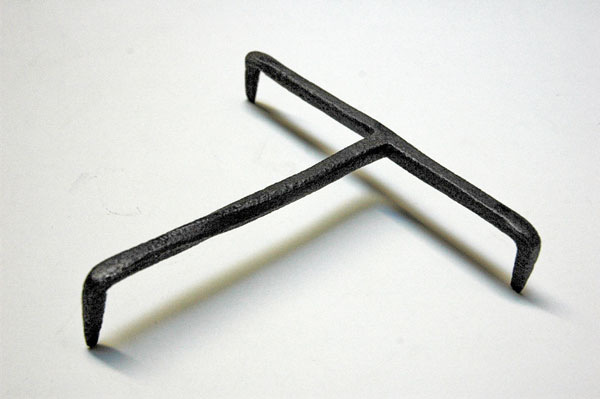
wrought iron trivet, likely late eighteenth century, probably Rhode Island 7″ x 5.75″ x 1.75″
I’m normally almost dysfunctional if asked to speak in front of a group, but I hardly hesitated when Austin Thomas asked if I would be a part of �One Image, One Minute: Significant People Present Significant Images�. The event, hosted at Hyperallergic on June 22, was a benefit for Camp Pocket Utopia, a creative summer project, social school and free arts camp for kids, being put together by Thomas and the nonprofit space Norte Maar. Their ambitious program, to be located at Rouses Point in upstate New York, will be based on a learning model created at Black Mountain College, as interpreted by Thomas, who describes it further:
The Camp hopes to inspire a conversation amongst artists, creative thinkers, and the community, empowering participants and observers to think for themselves while offering a free arts camp for the kids of Rouses Point, NY, and the surrounding North Country.
I was honored, and eventually psyched (almost) to be a part of the terrific “show and tell” organized as a fundraiser for the project. Thomas had asked twenty-five people to each submit an image of something very important to them, and to talk about it for one minute. Almost immediately I thought of the trivet shown at the top of this post, and told her I would contribute, since I knew I wouldn’t have any trouble talking about something I know well and which has meant a lot to me.
I only had to stand up there for 60 seconds. How hard could that be? It turned out that the hardest part was the time restriction. I didn’t want to read from notes, and I didn’t want to stress out by doing too much preparation, but, less than an hour before leaving for Williamsburg, when I first did a run-through, I realized I had enough material for five or ten times my time slot.
We were told we would be called up in alphabetical order, so I had plenty of time while I waited. Grade school flashback: Once again Wagner was going to be the last to give his report (I’d like to think Austin had thought of that conceit, for its connection to her larger, school-ish project). I managed to pare it down a lot from my piece while I sat waiting my turn, but much of the story survived.
It was a successful experiment. It made for a thought-provoking evening, and it drew a great group of people – on both sides of the tiny apron stage.
One of the reasons the trivet had come to my mind must have been that it was a simple and beautiful thing. It was a rough material, yet it had left the forge with an awesome grace. It was totally functional, but perfectly sculpted: Each of its branches was chamfered along its entire length and the 90-degree twist of the longest arm was an artist’s aesthetic gesture and, perhaps, a strengthening fillip.
It was also a thing whose description, and even its personal importance, I originally thought could be described in one minute.
In spite of, or perhaps because of, my enthusiasm for contemporary visual art, It had not occurred to me to look there for a subject. The reservoir was too vast, and I probably sensed that I’d never be able to focus on the one work which, using the adjective in Austin’s invitation, was particularly “important to me”. I had looked elsewhere for my subject.
For many years I had created, and still cherish, an environment pretty much removed from modernism of any kind. I chose to share something from that world; I chose this trivet, a humble piece of worked (“wrought”) iron.
It was created in southeastern New England, probably somewhere in Rhode Island, and probably in the late eighteenth century. Its working purpose: to elevate a plate, pan or heavy pot above hot coals spread onto a hearth, or, alternatively, above a table surface which would be damaged by a hot vessel.
The material is bog iron, which was once found locally near the surface of the ground (no longer of any practical interest except to antiquarians). It’s a very low-carbon metal (unlike steel), and easily malleable. It was the work of a skilled blacksmith. It has a characteristic “grain” (again, unlike steel). Because of its purity, it’s extremely resistant to rusting.
I brought it with me from Rhode Island 25 years ago, when I decided to give up the simple mid-eighteenth-century clapboard house in Providence which I and my partner at the time had bought (in 1970). We restored it [I have to say, “lovingly” restored it] over a number of years, until it looked like it had never needed restoring. It was both a home and a house museum: I thought we would live there until we died, and it was furnished entirely with things appropriate to its date, its geography and the particular economic circumstances of its original occupants. There was essentially no upholstered furniture.
This trivet was a working part of that house, and so was I.
The curatorial assignment my partner and I had undertaken (after we learned the real antiquity of what we had initially thought was just an old rundown house, a very rundown house) precluded living with contemporary art, in spite of the interest we both had for the art of our own time. Instead, for 15 years I lived with art that was contemporary to the earliest period of the house, and there was very little of that.
In the years of assembling things for the house I consciously avoided interesting examples of regional New England folk art, even though it wouldn’t have been difficult to secure such things, because it seemed so unlikely that the interior of our very modest, and genuinely urban, house would have seen much of the folksy kind of decoration so prized today. Also, Shaker design did not yet exist at the time the house was built, and when it did, the communities which produced it were nowhere near Rhode Island. Much of what I did have may have looked “Shaker”, but I can’t say any of it was.
But I kept my passion for both historic and contemporary art, even if I was sheltered under a very old roof and beside a large, fully-equipped cooking hearth. Beyond my newly-founded antiquarian interests, I still wanted to be surrounded by art. The house itself was an incredibly understated design, and I found myself going for the simplest, most elegant forms of practical furniture and artifacts, in wood, glass, metal and pottery: There was that fabulous Mochaware mug with a geometric shape and pattern which would not have looked out of place in the Bauhaus, and that beautiful provincial Sheraton side chair with squared, vertical splats, that could have posed as a Josef Hoffman prototype.
I did some serious cooking in that house, in both the almost-modern kitchen and on the open hearth (I cook more than ever today, but without those wood fires), so I’m not surprised that I almost immediately fell in love with the small tool which I had picked up, probably in an old barn, soon after we were first able to use the fireplaces.
My partner and I broke up, and when I finally decided to decamp to New York, in 1985, I sold much of its contents and put the house up for sale.
I brought the trivet with me. Today it rests only on the counter or the table. Its cooking days may be over, but I prize it as much as I ever did, for its function, its beauty and its associations. Although there are hundreds of drawings and paintings hanging on our walls, when guests are here, especially for dinner, I’m just as likely to pull this little black tripod off the kitchen counter and play “show and tell” with it as anything else in the apartment.
So is it sculpture? I seems to defy categories. Although it may end up on the table at many meals, while the pot it supports will return to the kitchen, the trivet remains. I never tire of looking at it.
The other presenters at the benefit were Laura Braslow, Deborah Brown, Paul D’Agostino, Anna D’Agrosa, Jen Dalton, Kianga Ellis, Louise Fishman, Veken Gueyikian, Rachel Gugelberger, Chris Harding, Valerie Hegarty, Roger Hodge, Lars Kremer, Ellen Letcher, Matthew Miller, Brooke Moyse, Ellie Murphy, James Panero, Gravelle Pierre, Cathy Nan Quinlan, Paul Rome, Adam Simon, Jonathan Stevenson, and Douglas Utter.
[someday soon I hope to set up a gallery devoted specifically to images of the house]
June 28 again, and all not so quiet on the eastern front
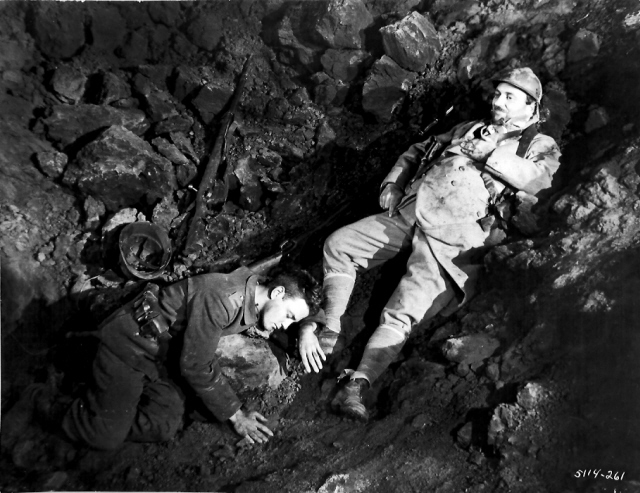
the enemies finally come face to face
We watched the restored version of “All Quiet on the Western Front” at home late last night. Before yesterday I had neither read the book nor seen the film. This early talkie, an eighty-year-old masterpiece, has survived, both as art and as a surprisingly strong piece of theater. It’s terrifying, when it’s not heart-braking, and there’s nothing maudlin or melodramatic about it.
It’s an extraordinary film; don’t wait for the remake.
As if it just watching “Front” were not already enough of a profound and moving experience, today we learned that the event that precipitated The Great War. The conflict that inspired Remarque’s seminal anti-war novel, and Russian-born Louis Milestone’s 1930 film of the same name which was based on the world-wide best-seller, occurred exactly ninety-six years ago (still within living memory – of at least a very few). While today is the anniversary of the assassination in Sarajevo of the heir to the Austro-Hungarian throne, It’s also the anniversary of the Versailles Treaty which officially ended the hostilities between the remaining major combatants. That accord was signed ninety-one years ago today.
The war was supposed to be “the war to end all wars”, the phrase a perverse, but catchy rationalization which was actually invented early on by its most enthusiastic champions.
It’s clear however that, as the direct heirs of its horrors, which include the Second World War, among others, we haven’t learned a thing in the intervening years. This is in spite of the hopes of the remarkable German author of “Front” and most of the people connected with the film, including its fictional chief protagonist, Paul B�umer, and the very real pacifist actor who played him, Lew Ayres.
In the image above Paul is lamenting the death, by his own hand, of a French Soldier who had lept into his trench in the chaos and heat of a particularly violent infantry battle.
In the Turner Classics commentary supplied with the DVD, film historian Robert Osborne sincerely and persuasively proposes that subtitles be created in every language, that the film be shown to people all over the world, and that they should see it again and again, once every year.
But today a country whose people mistakably believe themselves to be the most peace-loving on earth, have created two optional, trillion-dollar, asymmetric wars, killing fields inside dirt-poor nations which have no working governments, on the other side of the planet, and it seems we can give no justification for our continuing these wars other than the fact that we are at war(s). In retrospect, a century later, even the fools and jingoes who marched off in 1914 don’t look so singularly absurd as we once thought they did.
Besides, while the number of casualties in 1914-1918 certainly dwarf the total of all losses in the Middle East, that war was at least brought to a halt in four and a quarter years. Our own, current madness has already gone on twice that long.
[image from leftofcybercenter]