Zoe Crosher’s “Unraveling” at DCKT

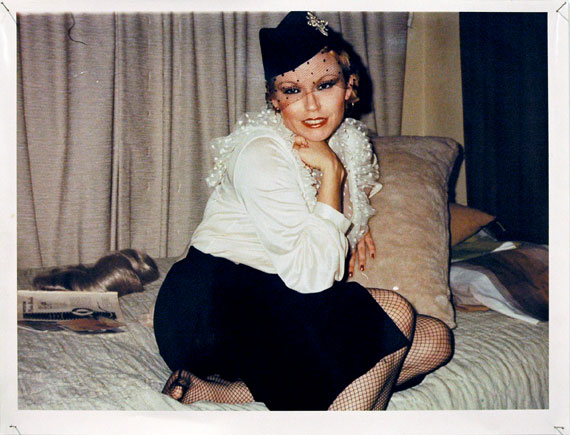
Zoe_Crosher_on_bed.jpg
Zoe Crosher Untitled ca. 2002 C-print 10″ x 13″ image (11×14� paper) [installation view]
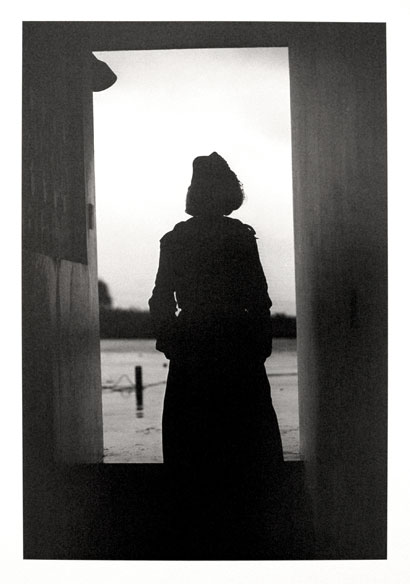
Zoe_Crosher_Silhouette_7.jpg
Zoe Crosher Silhouette #7 2009 inkjet print 24″ x 20″ paper [installation view, including a portion of the white border, a part of the piece]
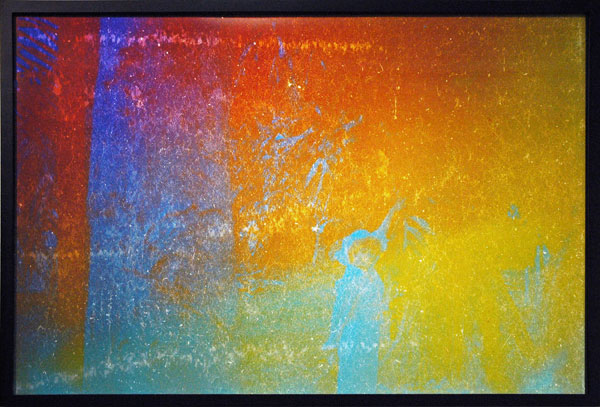
Zoe_Crosher_Obfuscated_3.jpg
Zoe Crosher Obfuscated 3 2009 inkjet print 23.5″ x 34.75″
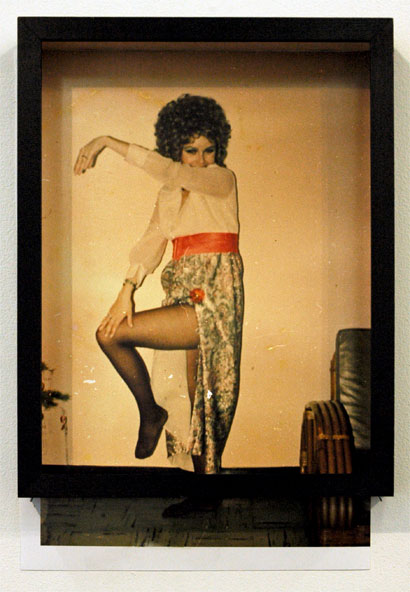
Zoe_Crosher_Acting_Like_A_Tiger.jpg
Zoe Crosher Acting Like a Tiger 2009 inkjet print 12″ x 9″ image alone [installation view]
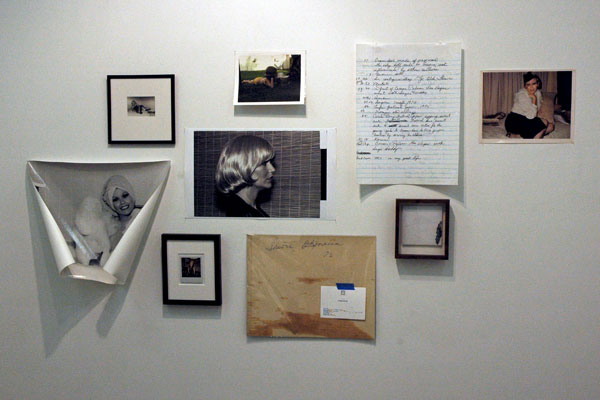
Zoe_Crosher_wall_installation.jpg
Zoe Crosher [installation view of individual pieces arranged as a group]

We made it a top pick on ArtCat just this afternoon, while standing inside the gallery. The bad news is that Zoe Crosher’s show at DCKT, “The Unraveling of Michelle duBois“, closes tomorrow.
You probably don’t want to miss this one, but if you can’t make it you’ll have a chance to visit some of the work at the Armory Show next month, in the next issue of Aperture Magazine, or, I’ve been told, in a book. I’m crossing my fingers for the chances of that last one.
The DCKT show itself is described by the gallery as:

. . . a reconsidered archive culled from crates, boxes and albums consisting of endless flirtatious smiles, tourist shots, cheesecake mementos and suggestive poses in every film type and size.
It is simply an archive. But nothing is ever simple. Michelle duBois, one of a number of aliases, kept a lot of pictures of herself. Turning tricks in the Pacific Rim during the �70s, she took on many guises for her particular profession and kept fanatical documentation of her many dramatic transformations.

duBois handed over the materials to Crosher, who met the older woman through her aunt, who was a friend of hers. Yes, the show is made up of pictures of pictures, but what pictures, and what a triumph the artist has made of them, in both their direct and conceptual impact. The images, almost all of them portraits of the same woman in different costumes, wigs and environments, appear at first to be pure inventions of the artist (who in fact resembles the younger “Michelle duBois”) but the truth is that they are possibly more creative, and incredible, than ordinary studio constructions. They are collaborations, sensitive original concoctions composed of minimally-reworked materials which were entrusted to Crosher by another human being, and by, in more than one sense, the callous degradations of time.
They are photographs whose images, the visitor soon learns, the artist has loosed from their surfaces and advanced toward the sublime.

Two tips for additional access to the Crosher’s work:
On Tuesday, February 16, at 6:30 pm., the Aperture Foundation is hosting an evening with Crosher and Jan Tumlir, who wrote the article which will appear in issue 198. The event is described as “a conversation exploring self-invention and role-playing as told through personal photographs, and what comes of the great �archival theme� in the digital era”.
A remarkable double-sided print by Crosher was included in the 2009 edition of the Artist of the Month Club, an annual curated subscription portfolio produced by Invisible-Exports.
an IDIOM: a conversation with Salinger’s ghosts

Salinger_Idiom_Telegraph_3.gif
just how much could it have hurt?

I know I’m one of the publishers, and so it may not be quite proper for me to sing the praises of the online arts magazine Barry and I introduced late last summer, but I’m going to risk it anyway.
Although so much else of IDIOM is just as good or even better, because of its particular timeliness and its unexpected format I wanted the conversation between some of the publication’s writers, “On the passing of J.D. Salinger“, which we published yesterday, to get more attention than it might otherwise attract.
So consider this a flag.
The spirited short piece is nothing like the fulsome academic discourse available almost everywhere this week, and you’ll feel like you’re sitting in the room with the three young participants – even contributing to the conversation. The voices you’ll hear are those of Alice Gregory, Editor Stephen Squibb and Jessica Loudis.
While you’re at the site, take a look at the latest posting, which is equally timely, “Art and Culture in Haiti after the Quake“, by Hong-An Truong, and browse through the still-modest-size archives.
My own two cents about Salinger’s “The Catcher in the Rye” is the thought which came to me almost immediately after hearing about Salinger’s death: I don’t mean to minimize the importance of what he accomplished back in 1951, but, as a gay boy the year it was written, and a gay young man when I finally read it, “Catcher” never quite resonated with me in the same way it did with others. It seems to have attached itself to the psyche of many of my approximate contemporaries, or at least the straight, male, white, middle to upper class types.
Today I’m no longer gay; I think of myself as totally queer instead, but I can remember what it was like when being gay meant dissemblance, invisibility, powerlessness, desperation and, for “practicing” Catholics, eternal damnation. I’m now more than cool with my orientation, in fact I consider it a strength in almost every way, and I’m definitely no longer totally alone with it. So maybe I should try once again to make Holden Caulfield’s acquaintance: His own much-analyzed disconnect looked pretty trifling to me at a time when the the whole world despised my, literally, unspeakable differentness and when I would have been crushed in an instant had I revealed myself.

This last thought can only serve as a footnote, and I don’t want to make too much of a purely personal irony, but I can’t help noting that, at roughly the same time I began emerging from a closet to which I had been condemned by others, J.D. Salinger shut himself up in one of his own construction. It’s his odyssey that still baffles everyone.

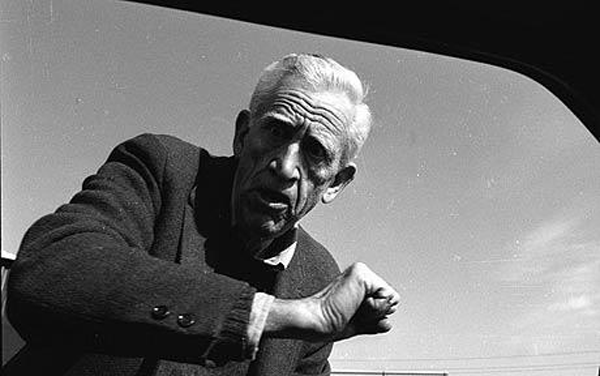
[image from the Telegraph via IDIOM]

so how about a frakking presidential news conference?

FDR_press_conference.jpg
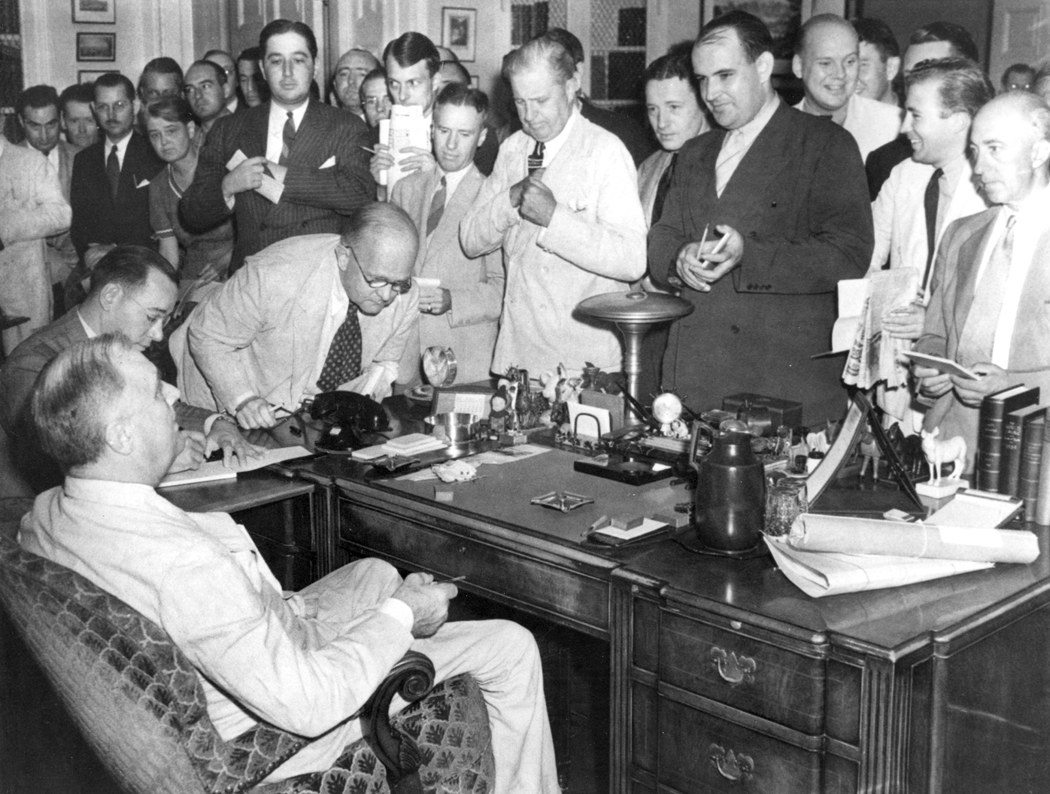
FDR talks to the press; the press talks to FDR

I was only slightly confounded to realize I had no interest in watching the speech last night; didn’t even think about recording it in case it turned out POTUS actually said something. When it comes to a corporate one-party state, I guess I make a bad subject.
And I’m old-fashioned: As unsatisfying as they may almost always have been, I still have some good memories of actual Presidential news conferences. Not recalling the last time I had heard of one, this morning I went on line looking and found that Obama hasn’t had a press conference in six months.
Transparently nontransparent.

[image from swamppolitics]

Joanna Malinowska at CANADA

Makinowska_Beuys_Ustvolskaya.jpg
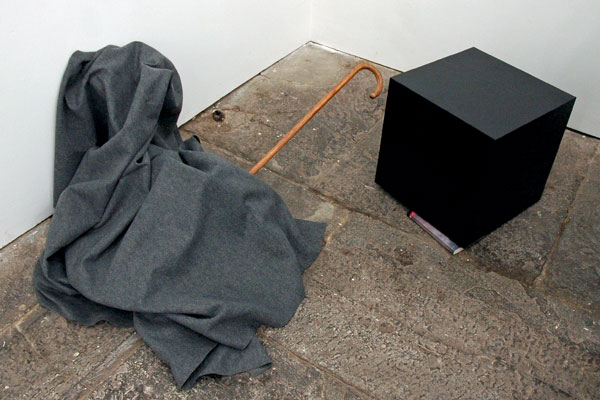
Beuys’s cane continuously raps on the surface of Ustvolskaya’s percussion box, one corner of which rests on a copy of Castaneda’s “Don Juan”

Malinowska_Boll_Malevich.jpg
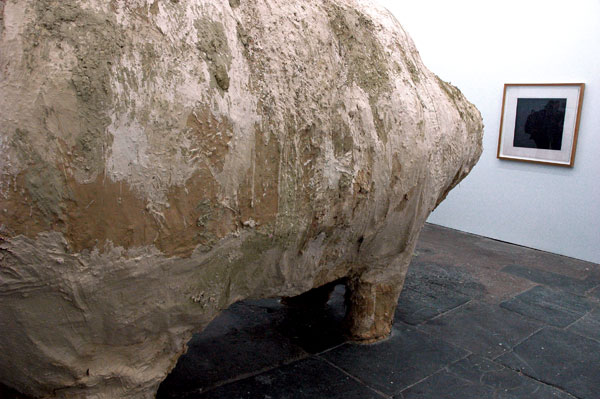
the hugely-outsize Boli, constructed of sacrificial materials, including one of Evo Morales‘s acrylic sweaters, contemplates Malinowska’s replica of Malevich’s “Black Square

Malinowska_McCarren_solar_system.jpg
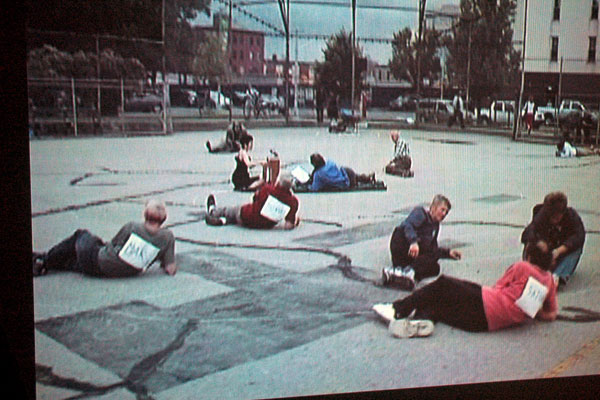
a group of slightly-scruffy habitu�s of McCarren Park “performing the Solar System model falling apart”, accompanied by toy piano, in a video using Messiaen’s “Visions de l’amen” as sound

Joanna Malinowska has installed her own aggressively-idiosyncratic diagram of the universe, “Time of Guerilla Metaphysics“, inside the two gallery spaces of CANADA, on the Lower East Side.
It’s not a simple walk-through show. A certain amount of attention has to be paid when the universe is being re-imagined. Its appeal may only develop slowly, at least partly because it’s surfaces are largely brown and gray, and because its pieces echo the diversity of Malinowska’s model, the universe itself, but ultimately the installations, both separately and together, register as powerful, tantalizing, and, ultimately, deliciously enigmatic. Their mysteries mirror the artist’s sources themselves, which include traditional West African totems, Joseph Beuys, Copernicus, Mammoths, Galina Ustvolskaya, Oglala Sioux dance, Spinoza, Kazimir Malevich, Evo Morales, and Brooklyn�s McCarren Park.
I left the gallery thinking that visitors to this, her second New York show could only be scratching the surface of this artist’s creative imagination.

Lesbian Herstory Archives party, and Lizzie Bonaventura

Lesbian_Herstory_Archives_Benefit_2009.jpg
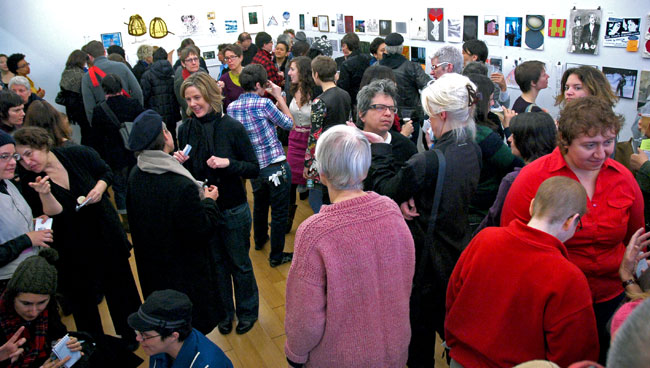
a shot of the crowd before the room filled up yesterday, from a camera held high overhead, feeling the power, and documenting all the super Lesbians, and some very enthusiastic friends and supporters

The entire event was run incredibly well, as efficiently and perhaps more efficiently than many benefits organized by non-profits that have been doing it for years. And we’ve seen a lot. Barry and I had a blast at yesterday’s first ever art benefit for the Lesbian Herstory Archives [LHA], held at the gallery of Alexander Gray Associates.
As the snow began shortly after midday, we were gathered with a lot of other people, many of them friends, many of them heroes known only from a distance, some soon to become friends. We were ten floors above the Hudson River in west Chelsea, and all we had to do was enjoy ourselves; the real champagne; the delicate cookies and savories; emcees Moe Angelos, milDRED, the artist formerly known as DRED, and Kay Turner; the work mounted on the walls; and above all the tonic of a wonderful crowd.
Oh well, we did have to wait a while for our name to be drawn, when we would be able to announce our choice of the art, but the selection was so good there was little reason for anxiety and virtually no chance that anyone would be disappointed.
But a lot of people were saddened to learn that the 80-some tickets for 80-some pieces of art had been sold out early. Many of those couldn’t come, and others did come by for the excitement, and to contribute directly to the endowment fund; maybe the LHA should rent an entire armory for their second art benefit.

Elizabeth_Bonaventura_Untitled_or_2010_Olympic_Hopefuls_2.jpg
Elizabeth Bonaventura Untitled, or 2010 Olympic Hopefuls casein paint on inkjet print 2009 8.5″ x 11″

We went home with the beautiful paint-on-photograph piece by Lizzie Bonaventura [no link or website] shown above, and we were able to talk to the artist and exchange contact information even before we had a chance to pick her work.

Lesbian Herstory Archives Benefit, saturday at noon

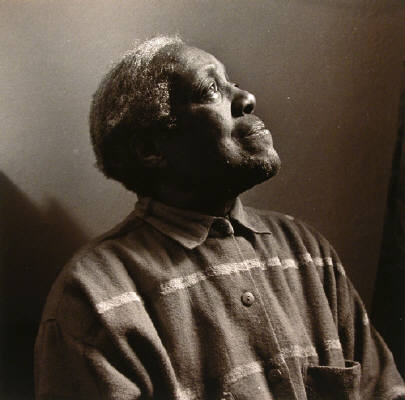
Estate_of_Robert_Giard_Mabel_Hampton_Sees_the_Pigeons_at_the_Old_Lesbian__2142_41.jpg
Robert Giard Mabel Hampton Sees the Pigeons at the Old Lesbian Herstory Archive 1989

The archive was somewhere out in Brooklyn, and also, as strange as it may seem today, I was pretty shy.
It was somewhere around 1990, and I had just read about a place called the Lesbian Herstory Archives. Accompanying the story was a picture of this wonderful older black woman sitting in the middle of stacks of books and papers. It was Mabel Hampton. She seemed to belong to the ages already. I was fascinated, and wanted to know more.
I also really wanted to visit the place, but although I was quickly becoming more and more involved with ACT UP, I still didn’t think I knew any honest-to-goodness lesbians, at least as friends. I was also scared: The strong women activists I saw all around me were pretty fierce; besides, having grown up as a secret homo in the Midwest in the 40s and 50s, I had to confess I still wasn’t even very comfortable with straight women.
I suppose it was pretty stupid, but I was also afraid I would be very much out of place, and perhaps even be challenged by the people who I believed had good reason to be there, unlike me.
I was learning fast (about all kinds of difference), but I wasn’t there yet.
That was twenty years ago, and I feel much more comfortable in my own skin, and to my great delight, in every kind of skin. I still haven’t been to the permanent home of the Archives, today “a grassroots collection supported by a non-hierarchical women�s collective, available for all Lesbians and housed within a communal, not an academic, setting in a 4-story limestone brownhouse [sic]” (according to Mickey Weems in the Boston Edge). But at noon on Saturday Barry and I are going to begin celebrating my birthday by attending the first ever Art Benefit for the Lesbian Herstory Archives here in Chelsea, before we go off to an equally festive holiday lunch.
Unfortunately, unless you’ve already purchased one of the 80 tickets (they’re already sold out!), you won’t be able to go home with a piece of art by one of the artists who is part of their incredible list of donors. Anyone who wishes to attend the event however (I would look forward to the hot crowd as much as a chance to see the art), and support the Archives, can just show up and donate $25 cash, “more or less if”, according to the Archives site, at the door. The drawing itself begins at one o’clock.
The event is being held at Alexander Gray Associates, 526 W. 26th Street, and not at the Archives.

[image from the Bulger Gallery]

solving “the German Problem”

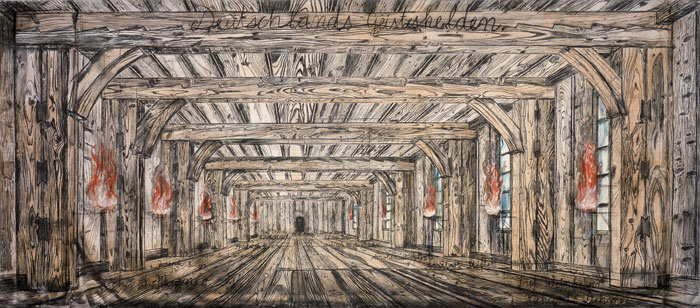
Anselm_Kiefer_Deutschlands_Geisteshelden.jpg
Anselm Kiefer Deutschlands Geisteshelden (Germany�s Spiritual Heroes) 1973 oil and charcoal on burlap, mounted on canvas 121″ x 268.5″

Still a home for Dichter und Denker

Schicksalstag.
Five major events in German history* are directly connected to November 9, the most recent being the fall of the Berlin Wall, twenty years ago today. Whatever else we make of it, the anniversary of this latest in a series of fateful moments should be a timely reminder, in our contemporary obsession with the present, that everything has a story, if not a reason. Of course I’m talking about history.
“The German Problem”.
Historians don’t record statesmen and diplomats ever speaking of an enduring “French Problem” or a persistent “English Problem” (although I believe Americans should be more aware than we are that the rest of the world is increasingly thinking of an intensifying and abiding “American Problem”), but over hundreds of years, even two thousand years, for the Romans, the Byzantines, the Carolingians, all the Slavs, the French, Poles, the Danes, the Belgians and the Dutch, the Russians, the Balts, even the Spanish, and, irregularly, the British, there was always something on the order of what would eventually be known as “the German Problem”.
The problem was recognized or imagined by non-Germans as the perceived threat of a large and vigorous people without natural borders. The danger was to be minimized by means of policies which would contain the Germans geographically, limit their economic authority, and, by the later nineteenth century, assemble and maintain counterweights to their real or potential power in a united nation-state. It worked pretty well while “Germany” consisted of hundreds of mostly-independent realms (Reiche), and especially during periods when Germans were enduring or recovering from plagues and dynastic battles. The horrible ravages of the Thirty Years War were mostly visited on central Europe (viz., the Germans), but in the midst of the impressive economic and cultural resurgence which followed those religious “crusades” a new player, Prussia, equipped with a modern bureaucracy and a highly-trained standing army, appeared on the field, almost out of nowhere, eventually to succesfully engage with, or seduce, the cultural forces of nationalism in founding the Second German Reich.
Whatever the merits of the proposition, for much of the planet the most important lesson to be learned from two twentieth-century world wars was the imperative of eliminating “the German Problem” once again, and this time for good.
Then suddenly the unexpected, the inexplicable happened, confounding everyone’s expectations. The Berlin wall fell, the Soviet bloc and its system collapsed, Germany was peacefully reunited.
New York Times Berlin Bureau Chief, Nicholas Kulish, in a piece in the paper two days ago quoted Robert E. Hunter, senior adviser at the RAND Corporation and an ambassador to NATO under President Bill Clinton. Hunter was able to describe the profound significance of what happened in 1989. After recalling the fears of those observing from the outside that the sudden appearance of “this thing in the center of Europe, if it were allowed to become unified, was going to be a cancer once again and lead to Act III of the great European tragedy.” Instead, he continued, “the German problem, which emerged with the unifying of Germany beginning in the 1860s, is one of the few problems in modern history that has been solved.�
Okay, now my eyes were too wet to immediately read further.
Four months after the proclamation of the united German Empire inside the Hall of Mirrors of the occupied Palace of Versailles, the German Austrian composer Johannes Brahms completed a large-scale piece for chorus and orchestra.
Tonight I’m going to be listening to a recording of Brahms’ Schicksalsied to accompany thoughts of the deep sadness and unbridled joy linked with this date. Brahms wrote it after reading a poem by H�lderlin which was included in the author’s 1797 novel of letters, “Hyperion”. The poet had been inspired by the freedom struggle of the Greeks and in these lines he contrasted the glorious world of their ancient gods with a mankind continually threatened by Schicksal (destiny).
The text appears here, in both German and an English translation.
I’ve just now listened to a sample of the Brahms on line and I was reminded of how much of it relates to the music of his near contemporary, the German German composer Richard Wagner, represented at the time of its composition as Brahms’ musical antithesis, that is, defined so by the passionate factions of each. Together they created the Brahms-Wagner “War of the Romantics”, which disfigured musical life in the second half of the nineteenth century, but which, so far as I can tell, resulted in no fatalities.

*
the symbolic collapse of the Revolution of 1848, the collapse of the monarchy in 1918, the 1923 Beer Hall Putsch, Kristallnacht in 1938, and the fall of the Berlin Wall in 1989

[image from lacma]