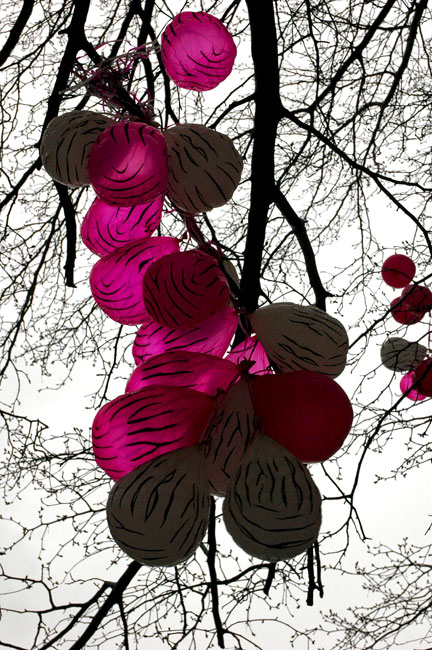
untitled (expiring balloons) 2012
These aging balloon clusters (their black lines the hand of an artist?) were snagged in the branches of a sidewalk tree on 23rd Street yesterday, the oxygen (NOTE: my readers are going for helium) which had given them life slowly expelling.
Category: Image
retired truck tire shelters Williamsburg flora

untitled (truck tire) 2011
I spotted this miniature landscape in the front of a house on Graham Avenue in WIlliamsburg, and captured it in an unwitting homage to Harry Callahan.
Duchamp haunts old White Box

snow forms
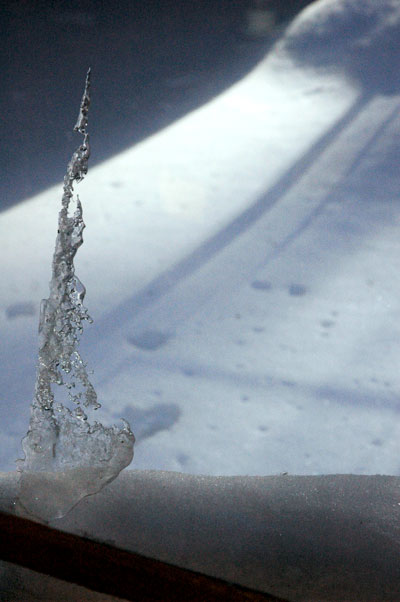
untitled (casement ice) 2010
showy vine on Jefferson Market Garden fence

Ipomoea alba
I was walking about the West Village this afternoon when I spotted this gorgeous plant garlanding the high metal fence surrounding the lush Jefferson Market Garden. I immediately thought of one of my childhood favorites (and always a guaranteed gardening success), the Morning Glory, although this was clearly not my Michigan friend.
Just now I Googled “vine with large white flowers” and discovered I had seen and photographed a “Moon Vine”, or “Moonflower” (Ipomoea alba). It’s “a species of night-blooming morning-glory”, according to Wikipedia, where I also learned that it may grow to 100 feet, given the appropriate host.
But the plant isn’t just a pretty face and a tall drink of water: Ipomoea alba played an historic role in the history of rubber:
The ancient Mesoamerican civilizations used the Ipomoea alba morning glory to convert the latex from the Castilla elastica tree and the guayule plant to produce bouncing rubber balls. The sulfur in this morning glory served to vulcanize the rubber, a process pre-dating Charles Goodyear’s discovery by at least 3,000 years.
*
But why is a tall person a “tall drink of water”? I’ve noticed a lot of silly ideas about this very-old-fashioned expression on line, but the phrase (one of my favorites) was always pretty clear to me, even as a child: Obviously if a very tall person took a drink of water, it would have a lot longer to go to reach the stomach.
Saint-Gaudens’ “Hiawatha”, and Manifest Destiny
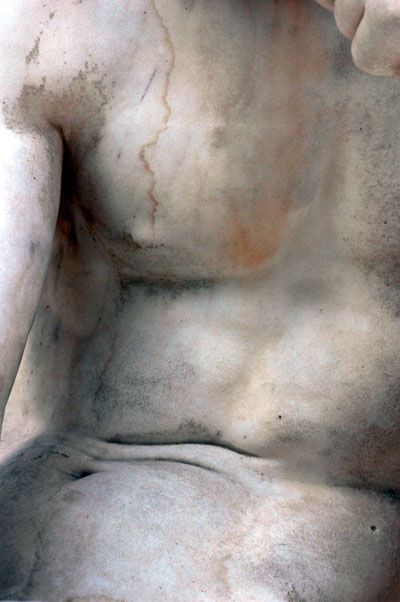
Augustus Saint-Gaudens Hiawatha in clay, 1871-1872; this marble carving, 1874, 7 feet 9 inches high, including pedestal [detail]
Barry and I were leaving the Metropolitan Museum cafe in the American Wing yesterday when we passed the Saint-Gaudens marble “Hiawatha”. I must have passed it any number of times before, but now I found myself zeroing in on the beautifully-modeled torso of this noble young man, created by an artist who was only about 23 himself when he began the work in clay. Then, thinking about the date, 1870, I thought about the time and geography of the work’s origins.
In the very midst of the beginnings of the last segment of our protracted Indian wars, a very young Augustus Saint-Gaudens, fled Paris, where he had studied for three years, on the outbreak of the Franco-Prussian War. He settled in Rome in late 1870 where he began work on “Hiawatha”, his first full-length statue. His inspiration was the legendary Chippewa chief and founder of the Iroquois confederacy who was the main protagonist in Henry Wadsworth Longfellow’s enormously popular 1955 poem, “The Song of Hiawatha“*.
In 1870 Saint-Gaudens’ native country was still nursing the wounds of the Civil War; France and Germany were engaged in a duel which quickly realized the end of one empire and the birth of another, both with enormous consequences which continue today; the Italian army had crossed the papal frontier (finally completing the wars for unification), in the same month the artist arrived in Rome. Saint-Gaudens however was otherwise engaged.
The War Between the States may have ended (he had been too young to participate), but there was hardly going to be any peace on the other side of the Atlantic, where twenty more years of wars directly impacted – in fact completely devastated – the people represented in his early masterpiece.
Americans were eager to settle the lands which had been opened up in the west, and Civil War veterans, adventurers and misfits were volunteering to secure their right to be there, defending it from the legitimate claims of the peoples we were already making into legends and heroes. The United States was determined to fulfill its own peoples’ “manifest destiny” and would not allow what remained of native American civilizations to stand in the way of its claim to the “Land of Many Uses“. In spite of occasional sensational – and hugely popularized – news events like “Custer’s Last Stand”**, the full horror of these last Indian Wars was largely removed from the consciousness of Americans back east, much as in the case of our own wars today.
It was all over by 1890: Providence had made the entire country safe for the American Empire, but the devil had taken the hindmost; the Indian was now almost gone, and almost forgotten, except where and how it served the victors to remember him.
But it is a beautiful statue.
*
The fame and legend attached to both the poem and its subject continued well into the 20th century: I remember my class being told in grade school to memorize the trochaic tetrameter of this Longfellow poem, and we barely questioned the assignment (I never got beyond a few stanzas).
**
When my own family drove west in the big Buick on a long vacation 55 years ago, the Little Big Horn ranked extremely high on our own list of “must sees”, and in fact, I’ve never forgotten my impressions of that sad, and then still very desolate, little-visited place.
cherries, cherries, cherries, also van Buren and nativism

This image includes only one segment of a vast checkered display set up in the Union Square Greenmarket last Friday by Samascott Orchards, of Martin van Buren‘s Kinderhook, New York. The cherries were going fast.
Speaking of van Buren, I just learned that the bewhiskered knickerbocker, incidentally the first president from New York (and the first born in the U.S.), was the first one for whom English was not a first language. We’re still waiting for the second, and, if we all survive, there should be many more.
The boy went far. If he were alive today, what do we think he’d say about our modern Know Nothings? But maybe there’s no real parallel, since his family, and many other Dutch settlers, had been busy, and dominant, in the upper Hudson valley since the early 1600’s, before English, or the English had subsumed all. Also, the Dutch were pretty white, and definitely not Catholic. Today’s Know Nothings have to find a way to get around the fact that if there are any “illegals”, it’s the people who stole the West, indeed the entire Western Hemisphere, from those who were there first.
Paterson ghosts greet “Escape from New York” visitors
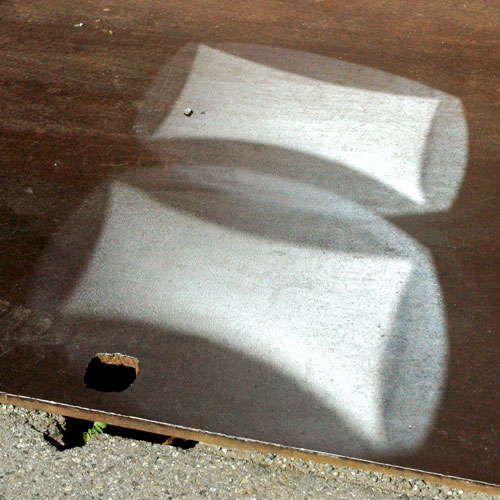
It took us only about 45 minues to get to Paterson by train from Manhattan on Saturday afternoon (it can take longer for us to get to some parts of Brooklyn). At the end of our pleasant urban walk from the station at the New Jersey end we were rewarded at the entrance to “Escape from New York” by the sight of this pair of shapes kissing the surface of one of those familiar steel plates we see all over Manhattan covering temporary holes dug by utility construction workers.
The odd, shiny silvery glow and doubled light image attached to each shape, visible in full daylight, was so remarkable that I immediately assumed it was one of the pieces curator/impresario straordinario Olympia Lambert had attracted to her show, but I was soon disabused of the notion when I looked behind me at another old industrial structure towering above us next door. Like so many other handsome 19th-century mill buildings in this historic city, this one was being reinvented for tomorrow: The two shapes were actually reflections cast by the slightly-bowed surfaces of plexiglass panels used to secure window openings in the ancient brick wall.
Nature was cooperating with man’s built history to shape the present.
So it goes.
My images from the Paterson show itself will follow in another post.
8th anniversary of jameswagner.com
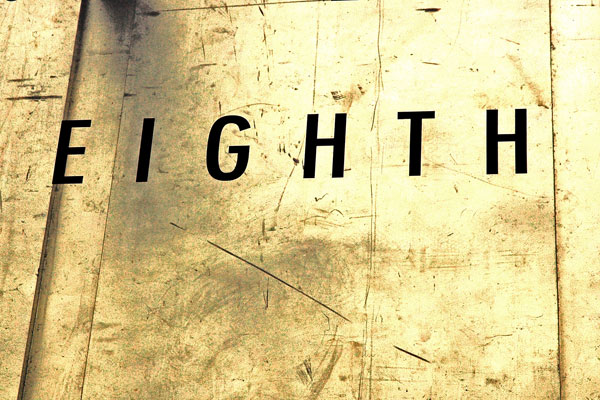
Today is the eighth anniversary of this blog.
I said it last year, and I’m delighted and incredibly privileged to say it again: This is also the anniversary of what turned out to be the most important event in my life, the night Barry and I met (now nineteen years ago).
Last year I also wrote, looking at the world outside our circle of close friends, that I was “more upbeat about the world” than I had been the year before, the eighth year of our second Bush, adding, “but only a bit”. That hasn’t changed, a bit.
And happy birthday, Paddy Johnson!
[the image is of a portion of the street number on the glass above one of the Art Deco entrances of the former Port Authority Commerce Building (1932), 111 Eighth Avenue the wall seen several feet behind the glass is covered with gold leaf]
Fifth Avenue tulips

Even the tulips manage to look more genteel on the Upper East Side. This pink bower was spotted on Sunday gathered together in the tidy front garden of an elegant apartment building in the 70’s.