Lesbian Herstory Archives party, and Lizzie Bonaventura

Lesbian_Herstory_Archives_Benefit_2009.jpg
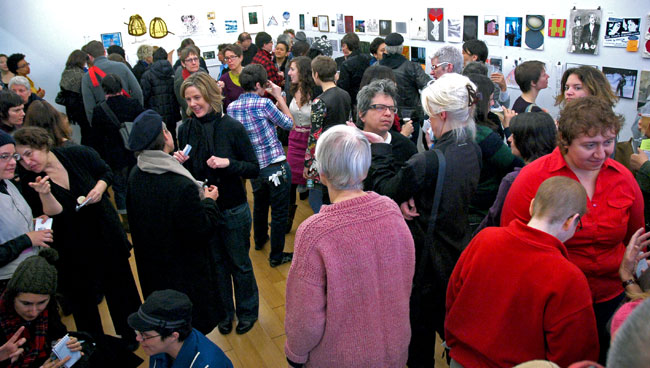
a shot of the crowd before the room filled up yesterday, from a camera held high overhead, feeling the power, and documenting all the super Lesbians, and some very enthusiastic friends and supporters

The entire event was run incredibly well, as efficiently and perhaps more efficiently than many benefits organized by non-profits that have been doing it for years. And we’ve seen a lot. Barry and I had a blast at yesterday’s first ever art benefit for the Lesbian Herstory Archives [LHA], held at the gallery of Alexander Gray Associates.
As the snow began shortly after midday, we were gathered with a lot of other people, many of them friends, many of them heroes known only from a distance, some soon to become friends. We were ten floors above the Hudson River in west Chelsea, and all we had to do was enjoy ourselves; the real champagne; the delicate cookies and savories; emcees Moe Angelos, milDRED, the artist formerly known as DRED, and Kay Turner; the work mounted on the walls; and above all the tonic of a wonderful crowd.
Oh well, we did have to wait a while for our name to be drawn, when we would be able to announce our choice of the art, but the selection was so good there was little reason for anxiety and virtually no chance that anyone would be disappointed.
But a lot of people were saddened to learn that the 80-some tickets for 80-some pieces of art had been sold out early. Many of those couldn’t come, and others did come by for the excitement, and to contribute directly to the endowment fund; maybe the LHA should rent an entire armory for their second art benefit.

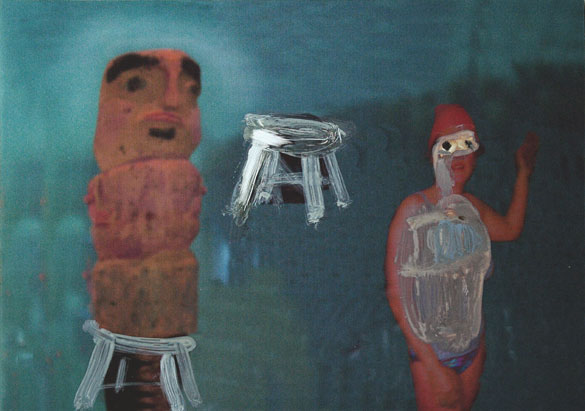
Elizabeth_Bonaventura_Untitled_or_2010_Olympic_Hopefuls_2.jpg
Elizabeth Bonaventura Untitled, or 2010 Olympic Hopefuls casein paint on inkjet print 2009 8.5″ x 11″

We went home with the beautiful paint-on-photograph piece by Lizzie Bonaventura [no link or website] shown above, and we were able to talk to the artist and exchange contact information even before we had a chance to pick her work.

Lesbian Herstory Archives Benefit, saturday at noon

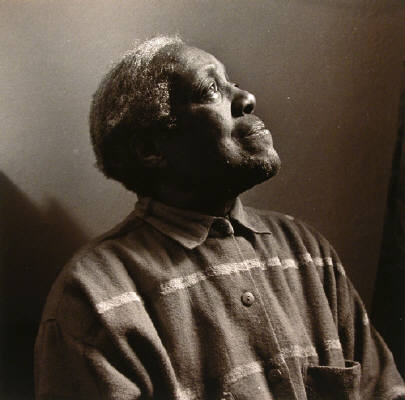
Estate_of_Robert_Giard_Mabel_Hampton_Sees_the_Pigeons_at_the_Old_Lesbian__2142_41.jpg
Robert Giard Mabel Hampton Sees the Pigeons at the Old Lesbian Herstory Archive 1989

The archive was somewhere out in Brooklyn, and also, as strange as it may seem today, I was pretty shy.
It was somewhere around 1990, and I had just read about a place called the Lesbian Herstory Archives. Accompanying the story was a picture of this wonderful older black woman sitting in the middle of stacks of books and papers. It was Mabel Hampton. She seemed to belong to the ages already. I was fascinated, and wanted to know more.
I also really wanted to visit the place, but although I was quickly becoming more and more involved with ACT UP, I still didn’t think I knew any honest-to-goodness lesbians, at least as friends. I was also scared: The strong women activists I saw all around me were pretty fierce; besides, having grown up as a secret homo in the Midwest in the 40s and 50s, I had to confess I still wasn’t even very comfortable with straight women.
I suppose it was pretty stupid, but I was also afraid I would be very much out of place, and perhaps even be challenged by the people who I believed had good reason to be there, unlike me.
I was learning fast (about all kinds of difference), but I wasn’t there yet.
That was twenty years ago, and I feel much more comfortable in my own skin, and to my great delight, in every kind of skin. I still haven’t been to the permanent home of the Archives, today “a grassroots collection supported by a non-hierarchical women�s collective, available for all Lesbians and housed within a communal, not an academic, setting in a 4-story limestone brownhouse [sic]” (according to Mickey Weems in the Boston Edge). But at noon on Saturday Barry and I are going to begin celebrating my birthday by attending the first ever Art Benefit for the Lesbian Herstory Archives here in Chelsea, before we go off to an equally festive holiday lunch.
Unfortunately, unless you’ve already purchased one of the 80 tickets (they’re already sold out!), you won’t be able to go home with a piece of art by one of the artists who is part of their incredible list of donors. Anyone who wishes to attend the event however (I would look forward to the hot crowd as much as a chance to see the art), and support the Archives, can just show up and donate $25 cash, “more or less if”, according to the Archives site, at the door. The drawing itself begins at one o’clock.
The event is being held at Alexander Gray Associates, 526 W. 26th Street, and not at the Archives.

[image from the Bulger Gallery]

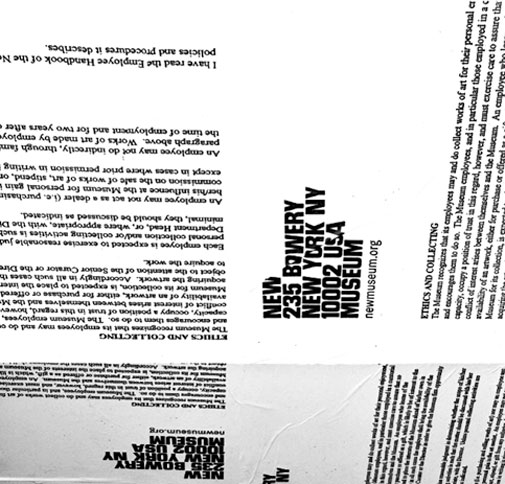
New Museum code, “ethics and collecting”

Turner_Fauvell_numu_Code_2.jpg
Kate Fauvell/Daniel Turner, Visitor Services/Security Guard Untitled [detail of ceiling installation]

Is an institution doing its job if its concern about ethics goes no further than the printed code it submits to its employees? A year ago a little-noticed exhibition mounted only ten blocks from the New Museum, a New York institution which is now the subject of a lively, and international, controversy about its curatorial decisions and ethical practice, seems to have anticipated some of the issues which were raised in reaction to a program announcement it released last September.

THE BACKGROUND: On September 25th this site became the first of many blogs to cry foul over NuMu’s decision to host the art collection of its billionaire trustee, curated by a celebrity artist of whose work he is the foremost collector, the Museum adding that the exhibition was to be only the first of a number of similar ventures in a series it would call “the imaginary museum”.
Since that time the story has snowballed dramatically.


In November of 2008 a group of artists mounted an exhibition at The Stanton Chapter Gallery on the Lower East Side, not far from the recently-opened new home of the New Museum. They did it entirely on their own, but their special relationship to NuMu was described in the title of the show, “New Work: Art from the Workers of The New Museum“. The installation included only art created by people working at the museum, and their capacities there were described on the art labels immediately after their names.
Daniel Turner, one of the artists in the show, has written me that during the month the exhibition was open “there was high tension in the museum, a few staff members were afraid of getting fired etc. In the end several of the ‘junior staff’* removed their works from the exhibition out of fear”.
Turner was not the only one who thought it was a very good show, although it appears to have been much overlooked at the time – except by the New Museum itself. He now believes that, because of NuMu’s September 24th announcement [the Times basically copied the press release the next day] of certain future installation practices, and the resulting and mushrooming discussion of general museum ethics and art market practice (see a short selection of recent discussions below), the 2008 show is definitely worth a first, or second, look, and argues that its merits should now command even more attention than it should have a year ago.
He wrote further that the exhibition catalog is “very rich with this topic” (ethics and practice) in general. It includes several very interesting essays, one by Ruby McNeil, the daughter of the founder of the Museum, Marcia Tucker. Although I missed the show itself, some of the work looks really great, and I totally agree with Turner about relevance, especially after looking at the piece he and Kate Fauvell created for the show (the New Museum code of ethics enlarged and wheat pasted on the gallery ceiling), and going on to read the actual text of that code, reproduced inside the catalog. The image at the top of this post is a detail of his and Fauvell’s installation.
I’ve looked at the catalog in pdf form, and a printed copy is available through Lulu here.
The New Museum code of “ethics and collecting” a copy of which Fauvell and Turner mounted on the ceiling of the Stanton Chapter Gallery, is reproduced just below. I think it’s particularly interesting In the context of current discussions both within and outside of the art world about institutional principles, as this code is addressed only to employees:


ETHICS AND COLLECTING
The Museum recognizes that its employees may and do collect works of art for their personal enjoyment, and encourages them to do so. The Museum employees, and in particular those employed in a curatorial capacity, occupy a position of trust in this regard, however, and must exercise care to assure that no conflict of interest arises between themselves and the Museum. An employee who learns of the availability of an artwork, either for purchase or offered as a gift, which is likely to be of interest to the Museum for its collection, is expected to place the interests of the Museum ahead of his/her own in acquiring the artwork. Accordingly in all such cases the employee shall bring the availability of the object to the attention of the Senior Curator or the Director in order to give the Museum first opportunity to acquire the work.
Each employee is expected to exercise reasonable judgment in determining whether the scope of his/her personal collection and/or collecting activities is such that the matter should be discussed with his/her Department Head, or, where appropriate, with the Director. Unless personal collection activities are minimal, they should be discussed as indicated.
An employee may not act as a dealer (i.e. purchasing and selling works of art) nor may an employee use her/his influence at the Museum for personal gain in the art market. An employee may not accept any commission on the sale of works of art, stipend, or gift from any collector, dealer, artist, or institution, except in cases where prior permission in writing is given by the Director.
An employee may not do indirectly, through family or friends, anything she/he may not do in the paragraph above. Works of art made by employees or family of employees will not be exploited during the time of employment and for two years after employment has terminated.

I have read the Employee Handbook of the New Museum of Contemporary Art and understand the policies and procedures it describes.
[below that line are spaces for name, signature and date]

Unfortunately one doesn’t have to be a staff member of NuMu (either senior or “junior”) to suspect or actually assert that this code of ethics, and similar protocols maintained by other arts institutions, may be honored in the breach more than the observance.
But, returning to my initial statement at the top, I think the big story isn’t about how much the New Museum, or any arts institution, should worry about what its artist employees are up to, but whether the guardians at the top are properly performing the stewardship with which they have been entrusted.

*
Artist and writer Maureen Connor expands upon the “junior staff” identification in this excerpt from her extended essay in the catalog:

As I understand it the New Work show was initiated by the New Museum staff (later defined as “junior” staff by management), not exactly as a guerilla action, but certainly one that arose from a need for agency and for some acknowledgment of their identity as artists. A proposal for New Work expresses a desire to �further the mission of the museum�new art, new ideas��, directly quoting from the New Museum’s website banner � �Manhattan’s only dedicated contemporary art museum�a leading destination for new art and new ideas.� Given the museum’s stated mission, one would hardly expect the artist members of its staff to need permission from upper management to organize and participate in an offsite show of their work. With the broad range of alternative art practices the New Museum supports and represents, one would think that the curators would recognize how this show could embody a radical approach to exhibition thematics that, to further quote from New Work’s proposal,� allows the audience to experience a museum in a completely new way�we posit the museum as the people who make a building and its program happen.�

This may only be a footnote to the argument of this post, but I think it has a significance well beyond the recitation of a fact:
I’ve noticed that there are no staff credits on the New Museum site, only the names of the trustees and benefactors, who of course don’t need the reinforcement artist-employee handlers, curators, guards, ticket takers, maintenance workers and coat checkers do. This is apparently standard, but not universal, museum practice. And just why would this seem to anyone like a good idea?

Finally, an idea of the nature of the ongoing discussion about museum practice, once it was picked up by mediums other than individual blogs, can be found in this very abbreviated list, which begins with the first critical treatment of the story by the New York Times:

  • “Some Object as Museum Shows Its Trustee�s Art” in the Times November 10
  • Georgina Adams. “Art for whose sake?”, in the Financial Times
  • David Goodman interviews William Powhida on the BOMBlog: “I don�t think the New Museum drawing would have elicited the kind of reactions it did, [if] there wasn�t such a problematic situation.”
  • Powhida inside “the belly of the beast”: a New York Times report from the Basel Miami show
  • Bettina Korek on the Ovation TV blog, describing the “Elephant in the Room”
  • Ben Davis on artnet, under “politics”, with: “the coronation of New York artist William Powhida as the anti-Koons”

[image, courtesy of the artists, from the “New Work” catalog]

the ArtCat calendar is five years old today

artcat5.jpg

Five years ago today Barry and I launched the first version of the ArtCat Calendar (then called ArtCal). It was an outgrowth of the messy lists I used to make on a lined pad (yeah, paper) and carry around the city. The process had become pretty unwieldy as the number of galleries grew. It was also impossible to share with others.
The original on line version did no more than keep track of shows and dates by neighborhood, but it was sophisticated enough to list Chelsea galleries by street and building number.
Some history:
* Images added: September 6, 2005
* RSS and iCal feeds added: December 12, 2005
* E-mail newsletter launched: March 30, 2006
* Newsletter reaches 1000 subscribers: March 13, 2007
* Redesigned: August 28, 2007
* Merged ArtCal and ArtCat: March 2009

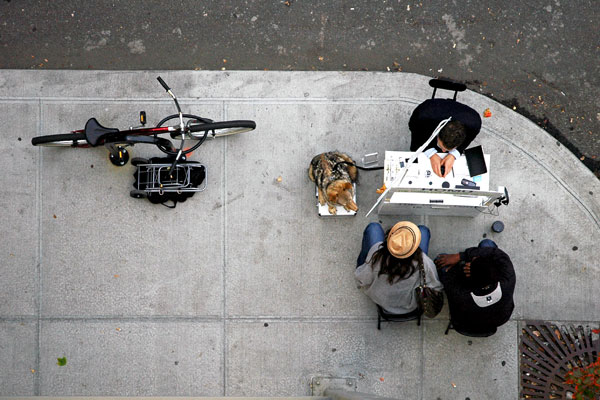
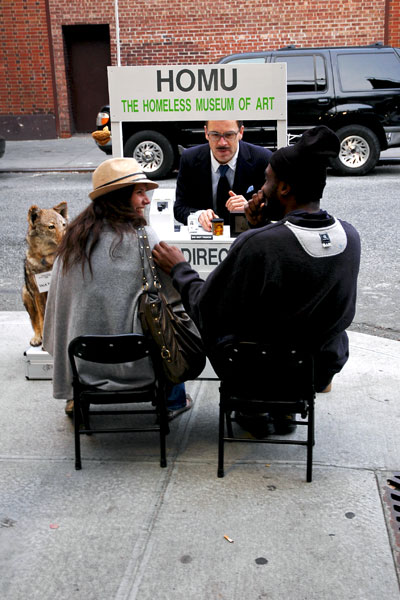
HOMU under the Highline today

HOMU_Highline_overhead.jpg

HOMU is out, and the director is in.
We’ve just received word that the continually enthralling, yet characteristically elusive HOMU booth will be out and about today, Tuesday, on West 20th Street (between 10th and 11th Avenues, next to the entrance to the Highline Park), as the Director writes, “circa 1-4 PM”.
These images were taken last Tuesday, when just before Barry and I had squeezed ourselves onto the little chairs in front of the “Director is [hanging square wood tile] in” sign mounted on the front of the portable booth. We were having so much fun, both constructive and unserious, that we hadn’t realized a small crowd had gathered above and behind us. We’ve been enthusiastic members of the Museum for years, so we had no problem getting up and making room for new visitors.

HOMU_Highline_street.jpg

Nikhil Chopra, as Yog Raj Chitrakar, at the New Museum

Nikhil_Chopra_on-floor.jpg

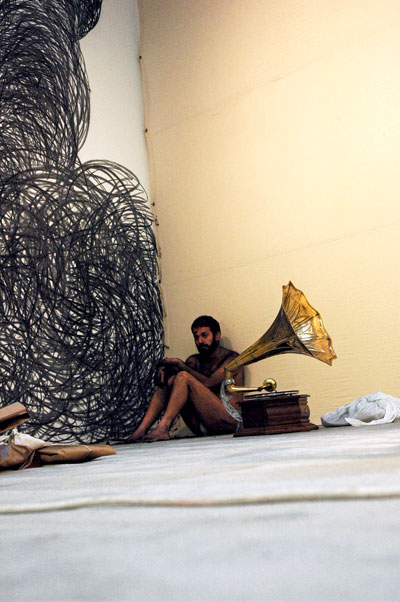
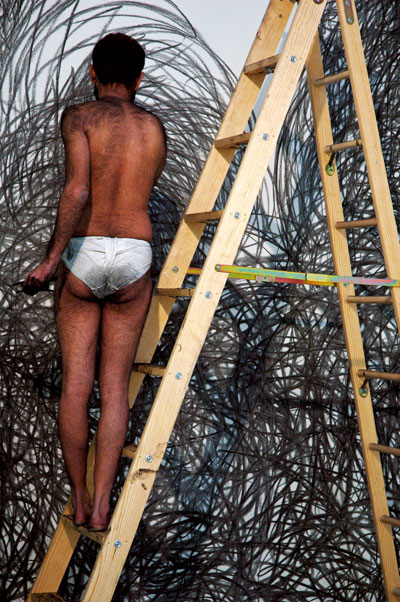
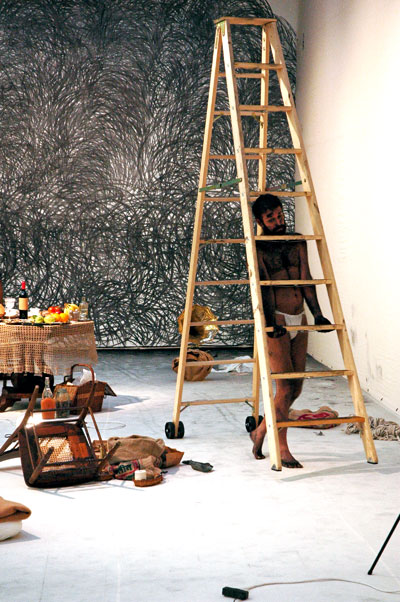
Nikhil Chopra settled into his temporary home in the lobby-level Glass Gallery at the New Museum on Wednesday.
Ever since the opening of the new building almost two years ago I’ve heard and read many criticisms of this space, a broad, twenty-foot-deep box on the far end of Marcia Tucker Hall which the architects have described by a floor-to-ceiling wall of glass. I don’t have a problem with it myself, and in fact I think it’s an inspired device. Especially with the right installation, meaning a powerful concept (however subtle it might be), it effects a bridge between the formal, clean white spaces of the Museum above and the vibrant life on the Bowery outside. At the same time it shares its (ideally) seductive offerings with the various functions of the foyer, shop and cafe areas, all very urban, and on a human scale. It has the special appeal of being absolutely free, and it probably works best when it is not just a large shop window but actually open to a visitor walking into the box.

Nikhil_Chopra_on_ladder.jpg

Nikhil_Chopra_carrying_ladder.jpg

Nikhil_Chopra_washing.jpg

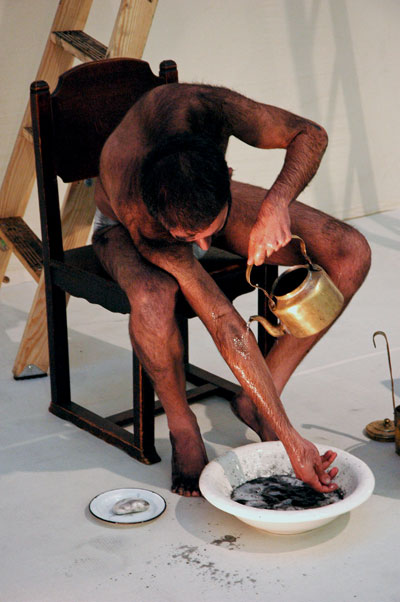
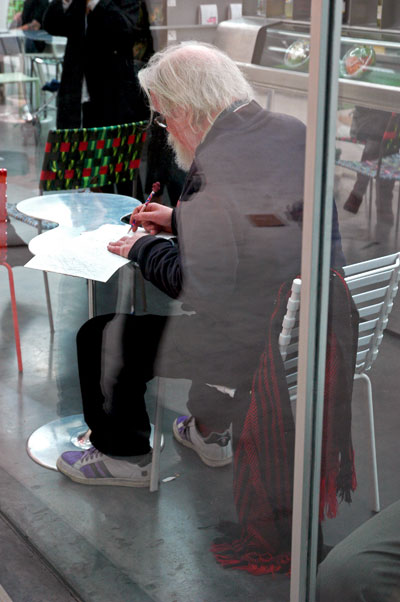
Chopra’s is the right installation, and �Yog Raj Chitrakar: Memory Drawing IX� is a powerful concept. It has the seductive attraction of a live performance and the public is not only invited into the middle of it, but encouraged to bring their cameras. I wrote a short paragraph about the work after visiting the installation during the the press preview last week. This past Wednesday I spent at least two hours with Chopra’s performance, in several visits throughout the day, positioning myself on both sides of the glass wall. Since his character in this work is that of a nineteenth-century artist/draughtsman (modeled somewhat on his own grandfather) I was delighted to see that at least one visitor was actually sketching, working on a pencil drawing of the entire installation/performance. Yes, he was sitting in a chair in the cafe which is witness to everything that goes on to the other side of the glass. Myself, I only had a fancy digital camera. Sigh.

Nikhil_Chopra_sketching.jpg

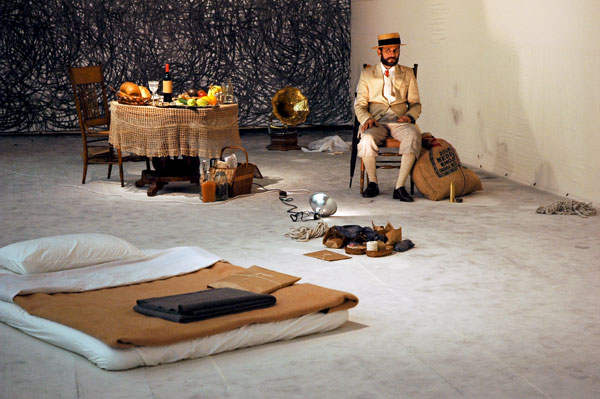
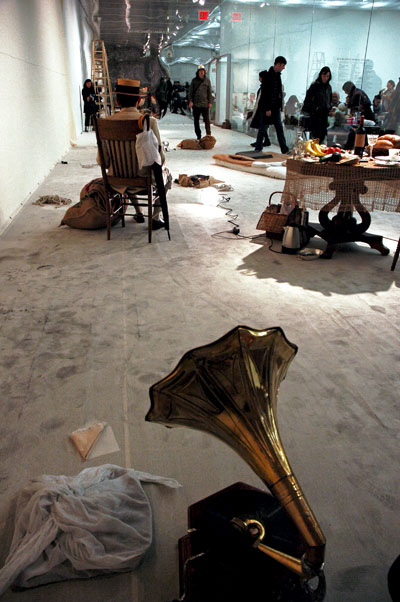
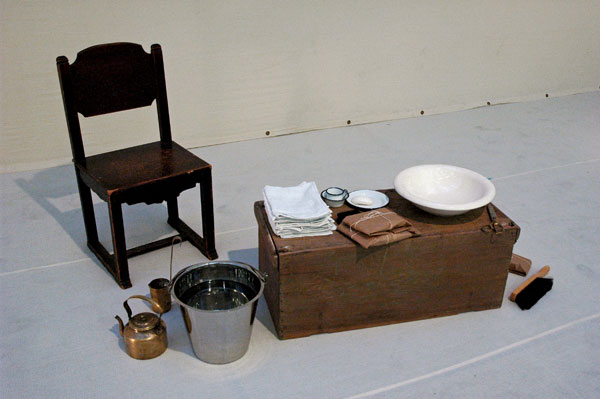
The artist, in the character of Yog Raj Chitrakar, will be installed for five days within, in the Museum’s description, a “gallery transformed into a turn-of the-century tableau vivant”. Except for several excursions outside the museum, he will be eating, drinking, sleeping, washing, shaving, dressing, and sometimes simply observing, all while remaining inside that gallery until the end of the day Sunday.

Nikhil_Chopra_waiting.jpg

Nikhil_Chopra_waiting_Observed.jpg

On Thursday morning he was expected to rise, dress in his antique costume, and, carrying his ever-present brown-paper-wrapped, string-tied bundles, he was to take the subway to the bottom of Manhattan. There he was to catch the ferry to Ellis Island where he would spend much of the day sketching the New York skyline in charcoal on one of the three huge sections of canvas he will have taken down from the east wall of his temporary home. He was expected to do the same thing on Friday and Saturday, each time taking along a different section of canvas, and returning to the Glass Gallery by mid-afternoon.
Both Yog Raj Chitrakar and the by-then-completed mural can be seen inside the space all day on Sunday. I am told we can expect a surprise.
Chopra’s performance and installation was curated by Eungie Joo, Keith Haring Director and Curator of Education and Public Programs. The New Museum has scheduled additional programs related to this work next weekend, and aspects of the performance and exhibition can continue to be seen at the museum until next February. From the press release:

At its conclusion, remnants of Chopra�s occupation of the space remain on display as an installation. Documentation from three previous performances also on view in this exhibition�Memory Drawing II (Mumbai, 2007), Yog Raj Chitrakar visits Lal Chowk (Srinagar, 2007), and Memory Drawing VI (London, 2008)�suggests the many ways in which the history and reality of a location impact the artist�s execution of characters though costuming, gesture, and action.

Nikhil_Chopra_installation_detail.jpg

Brooklyn Rail cover: Powhida’s New Museum cartoon

Powhida_Rail_FRONT_COVER.jpg
go to large, high resolution image here

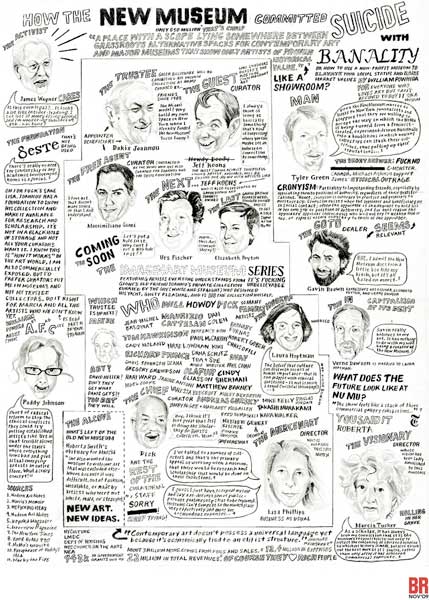
Sometimes a picture really is worth a thousand words, especially if it’s been drawn by William Powhida. The artist’s editorial cartoon, addressing the current weird curatorial course of the New Museum, completely fills the cover of the Brooklyn Rail out tomorrow.
I wrote this post back on September 25th, immediately after reading the NuMu’s press release announcing a metamorphosis which will find it installing a series of museum-wide shows displaying the collections of one or more of its own wealthy trustees and curated by those collectors’ favorite wealthy artists.
I followed it with this related entry.
From the beginning I was sure this story had legs, but then I noticed almost no one wanted to talk or write about it, even if they were as outraged as I was. Now I think its time has finally come. Thanks, William.
Pick up a copy of the Rail if you live anywhere near one of the outlets. If not, and if you have some coin, you can subscribe (to what I think is the most vital and definitely the most beautiful magazine published anywhere) here.

[image courtesy of the artist and the Brooklyn Rail]

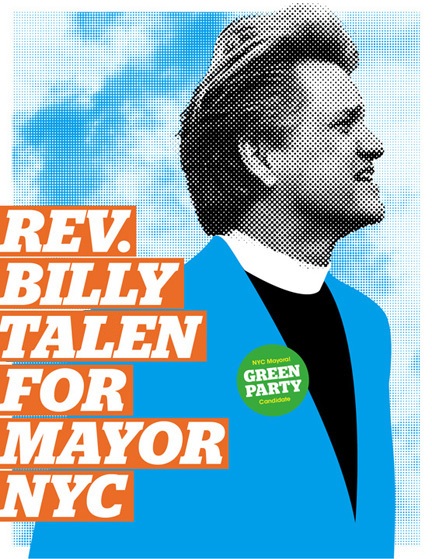
vote for Billy Talen

billy_talen_for_mayor.jpg

I would argue that Gawker* doesn’t quite go far enough in its condemnation of Bloomberg’s candidacy, since it stops a little too short of suggesting the obvious alternative. I have no hesitation myself in endorsing the Billy Talen for mayor over Thompson. Thompson (unless he’s actually working for a Bloomberg victory) ran an extraordinarily incompetent campaign, and he finally appears to be something of a fool (okay, just for starters, look at where he stands on bike lanes).
Talen is the candidate of a significant political party, the Green Party, but you may never have seen him or heard him; you may not have heard of him: The commercial media ignores Talen and he’s not allowed to participate in their vaunted mayoral debates or in their interviews with the approved candidates. But I’ve heard him talk, of course to crowds, in character as the colorful and truly-righteous Reverend Billy, but also as “layman” Billy in small groups, and to individuals, and he has a better (in both senses) understanding of the city and the world than any of the politicians foisted upon us by the corporations in whose pay they perform, and certainly superior to the small-minded billionaire who blithely, and regularly, buys his high office outright.
Vote for someone tomorrow whose ideas you share. You deserve it; we all deserve it. Talen’s mayoral platform is a dream – unfortunately – but that’s not a bad place to start.
Hell, if I could I’d even endorse him for president – right now – this time confident we’d get change when we voted for it.

*
in a post written by Alex Pareene.

[image from Bradley R. Hughes]